Published on : 27 Jun 2026
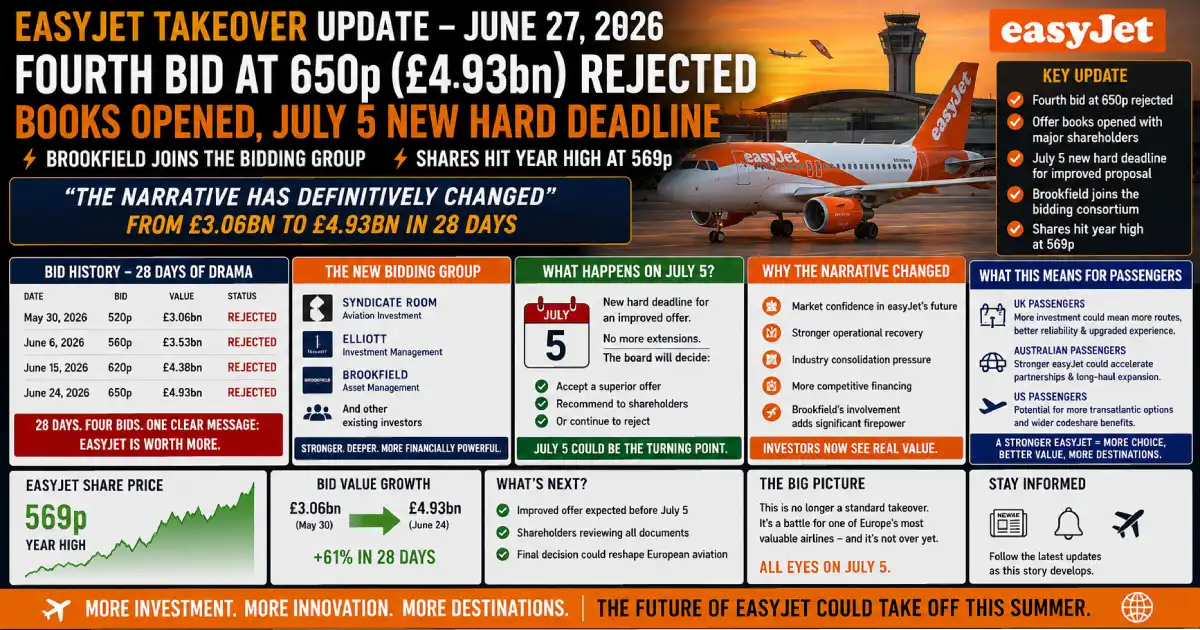
Published: June 27, 2026 — Saturday (9 Days to July 5, 5pm Deadline) Status: Active possible offer period — books open — Castlelake reviewing commercial data Latest development: Fourth bid of 650p (£4.93bn) rejected June 25 — but books opened, deadline extended Previous bids: 560p (rejected) · 600p (rejected) · 625p (rejected, made public June 22) · 650p (rejected June 25) New hard deadline: 5:00 PM BST — Sunday July 5, 2026 Share price reaction to July 5 extension: +5.5% to 569p — year high Share price reaction overall (since bid emerged late May): +36%+ strong>EasyJet’s undisturbed price (pre-bid, May 29): 392.4p Latest bid premium to undisturbed price: ~+66% Investor target price (FT report): £7 per share (~£5.3 billion total) Castlelake latest bid: 650p per share / £4.93 billion / $6.5 billion What changed at June 25: Books opened · Brookfield formally named · EU structure clarified · Deadline extended Brookfield role: 49% co-investor alongside Castlelake in the bidding vehicle EU partner (51% majority): Peter Bellew + Mark Breen (EU nationals — required for EU airline ownership rules) Peter Bellew background: Former CEO of Malaysia Airlines · Former COO of easyJet · Former SVP of Ryanair Mark Breen background: CEO of Oneiros Aerospace, Dublin · Former Oman Air executive Goodbody analyst Dudley Shanley: “The narrative has definitively changed — easyJet are now effectively in negotiations with Castlelake, which means the business is for sale at the right price” IG analyst Chris Beauchamp: “The deadline extension has been taken as a sign that some kind of deal is doable” Oldfield Partners (EZJ shareholder): Any new bid price must be “significantly higher” than 650p EasyJet’s own medium-term target: £1 billion+ annual profit before tax EasyJet Holidays target: £450 million profit by 2030 (up from £250m already achieved) Fleet: 355 aircraft · 1,207 routes · 38 countries · 164 airports New aircraft deliveries: 17 A320neo-family in FY2026 · 73 more A320neo/A321neo in FY2027–28 EasyJet position: “In a position of strength” — net cash, investment-grade, expanding fleet What passengers need to do NOW: Nothing — easyJet operating normally
Something fundamental shifted in the easyJet takeover saga on Thursday June 25. When easyJet’s board unanimously rejected Castlelake’s fourth bid — 650 pence per share, £4.93 billion — analysts would normally have expected the bidder to walk away or the story to stall. Instead, easyJet did something it had pointedly refused to do through three previous rejections: it opened its books. The board told Castlelake it could have limited access to commercial information. It requested a nine-day extension of the takeover deadline, which the UK Takeover Panel granted. And Castlelake, in response, said it “welcomed the constructive engagement.” Goodbody Stockbrokers analyst Dudley Shanley — who has covered easyJet through all four bids — stated bluntly: “The narrative has definitively changed. EasyJet are now effectively in negotiations with Castlelake, which means the business is for sale at the right price.” EasyJet shares jumped 5.5% to 569 pence — a year high. The story that began as a “highly opportunistic” approach at 403 pence on May 29 is now, 28 days later, a live negotiation at 650 pence and counting. Here is the complete picture — every bid, every rejection, the new ownership structure, the July 5 deadline, and exactly what this means for the 90 million passengers who fly easyJet every year.
Late May 2026: Castlelake privately approaches easyJet about a possible acquisition. EasyJet’s share price has fallen approximately 20% since the start of 2026, driven by jet fuel prices at $142/barrel following the Iran war escalation, weaker forward bookings, and relegation from the FTSE 100 to FTSE 250 in March. Castlelake holds 2.14% of easyJet’s shares — approximately 16.2 million shares — acquired during this share price weakness.
May 29, 2026: Castlelake publicly discloses it is considering a possible offer. The disclosure triggers a formal possible offer period under UK Takeover Code rules. The minimum price disclosed: 403.23 pence per share, valuing easyJet at approximately £3.06 billion. EasyJet’s board response: “highly opportunistic.” Shares surge 13%.
June 1, 2026: Castlelake confirms it already holds 2.14% of easyJet’s share capital.
June 16, 2026 — First formal bid at 560p: The first formal proposal offered 560 pence per share, which was rejected by easyJet on June 16, 2026. EasyJet’s board rejects it unanimously. The board says Castlelake is “trying to buy the airline on the cheap.”
June 20, 2026 — Second formal bid at 600p: Castlelake returned with a second proposal at 600 pence per share, which was also rejected. Board rejection unanimous. EasyJet says Castlelake’s analysis is “based primarily on Middle East conflict-affected share prices, short-term earnings, and analyst reports.”
June 22, 2026 — Third bid at 625p goes PUBLIC: Castlelake went public with its £4.7 billion takeover bid for the UK-based low-cost carrier, having had three proposals rejected by the easyJet board. The third offer valued easyJet at 625 pence per share. By going public, Castlelake bypassed the board and addressed shareholders directly — an unusual and aggressive escalation in UK takeover practice. The aim: pressure the board by making shareholders aware of the offer’s merits before the June 26 deadline. EasyJet rejects again — “highly opportunistic, fundamentally undervalues the company.”
June 23, 2026 — Fourth bid at 650p submitted (privately): The board received the fourth proposal on June 23, valuing easyJet at 650 pence per share in cash. This bid also introduced a new element: a partial alternative allowing shareholders to elect unlisted, non-transferable, non-voting shares in the acquisition vehicle instead of cash.
June 25, 2026 — THE TURNING POINT: EasyJet said it would grant Castlelake limited access to commercial data in hopes of drawing a higher bid after rejecting the fourth £4.93 billion proposal. The budget airline’s board unanimously rejected the new proposal but said giving Castlelake limited access to its books might produce a “more attractive proposal.” Castlelake formally names Brookfield Asset Management as a co-investor. Deadline extended to July 5. Shares jump 5.5% to 569p — year high.
June 26, 2026 — Original deadline passes without resolution. Under the extension, Castlelake now has until 5pm BST on Sunday July 5 to make a firm offer or walk away.
Today — June 27, 2026: Castlelake is reviewing easyJet’s commercial information. A fifth bid — almost certainly above 650p — is expected before July 5.
| Date | Bid price | Valuation | EasyJet board response |
|---|---|---|---|
| May 29 | 403p (minimum stated) | £3.06 billion | “Highly opportunistic” |
| June 16 | 560p | £4.25 billion | Rejected unanimously |
| June 20 | 600p | £4.55 billion | Rejected unanimously |
| June 22 | 625p (made public) | £4.74 billion | Rejected unanimously |
| June 23 | 650p | £4.93 billion | Rejected — but books opened |
| July 5 (expected) | 680p–720p? | £5.15–5.46 billion? | TBC |
| Investors’ target | ~700p | ~£5.3 billion | — |
Through three rejected bids, easyJet’s board consistently refused to provide Castlelake with access to anything beyond publicly available information. That changed on June 25. EasyJet said it would grant Castlelake limited access to commercial information in hopes of drawing a higher offer. “The Board believes that giving Castlelake access to limited commercial information, as Castlelake sought in the letter which contained the Fourth Proposal, might produce a more attractive proposal,” easyJet said in a statement.
In takeover practice, opening books — even limited access — is a decisive signal. It means the board is prepared to facilitate due diligence for a transaction it might recommend. Companies that are genuinely committed to staying independent do not open their books to potential acquirers. The June 25 decision does not mean a deal is certain. But it means a deal is now possible in a way it was not on June 22.
What “limited commercial information” means in practice: financial data beyond published accounts (forward booking curves, route-level profitability, easyJet Holidays margin detail, fleet cost schedules). This information will allow Castlelake — and Brookfield — to build a more precise valuation model and determine whether a bid that satisfies easyJet shareholders is financially viable within their investment return requirements.
Through the first three bids, Castlelake was described as working with EU nationals Peter Bellew and Mark Breen. On June 25, Castlelake named New York-based Brookfield Asset Management as a co-investor, along with two previously disclosed partners.
Brookfield’s formal inclusion changes the scale of the bid. Brookfield Asset Management is not a secondary investor — it manages approximately $865 billion in assets globally and has an existing track record in aviation finance (it acquired Air Lease Corporation in a $7.4 billion deal last year). Brookfield was also part of a consortium that acquired one of the world’s largest aircraft lessors Air Lease in a $7.4 billion cash deal last year. With Brookfield in the consortium, the financing capacity behind this bid is no longer limited to Castlelake’s $38 billion platform. It extends to Brookfield’s full credit and equity infrastructure.
A key concern throughout the bidding process has been whether Castlelake could legally acquire easyJet given EU airline ownership rules requiring airlines to be majority-owned and controlled by EU nationals. On June 25, the structure was clarified with greater precision. Under the proposed terms, the bidding vehicle would be owned 49% by Castlelake and co-investors including Brookfield Asset Management. The remaining 51% would be owned by EU nationals Bellew and Breen.
This 49/51 structure — with EU nationals holding the majority — is designed to satisfy the EU ownership and control requirement. EasyJet has described the structure as “opaque” and questioned its deliverability. But Castlelake has pointed to precedents in other European airline structures that use similar frameworks.
Minneapolis-based Castlelake manages approximately $38 billion in assets, specialising in aviation finance, private credit and asset-backed investments. It holds 2.14% of easyJet already. Its aviation credentials include: prior SAS stake (sold to Air France-KLM), Spirit Airlines talks (did not proceed — Spirit collapsed May 2026), and Castlelake Aviation portfolio of 118 aircraft sold to Avolon in 2024. The lead architect of this bid.
Brookfield was part of a consortium that acquired one of the world’s largest aircraft lessors Air Lease in a $7.4 billion cash deal last year. Manages approximately $865 billion globally. Its involvement brings three things: financing capacity at the scale needed, credibility with easyJet’s institutional shareholders, and operational expertise in large-scale aviation asset management. Holds 49% of the bidding vehicle alongside Castlelake.
Peter Bellew is a former chief operating officer at Ryanair, former CEO of Malaysia Airlines, and most recently the first COO of Riyadh Air. He runs Dooks Capital, a seed investment and advisory firm focused on AI in aviation, based in Saudi Arabia. Bellew is one of two EU nationals whose majority ownership of the bidding vehicle is designed to satisfy EU airline ownership rules. His operational background at Ryanair and Malaysia Airlines gives the consortium genuine airline management credibility — not just financial engineering.
Mark Breen is CEO of Dublin-based Oneiros Aerospace and has worked for Oman Air. As the second EU national in the 51% majority, Breen completes the ownership structure required for EU compliance.
The most important price signal in the entire easyJet takeover saga comes not from Castlelake or easyJet’s board, but from the financial institution that covers the company most closely. According to a Financial Times report, easyJet investors were hoping to get a price tag of £7 per share — tracking towards the offer at 650p.
£7 per share values easyJet at approximately £5.3 billion — £370 million more than Castlelake’s latest 650p bid. This is the number the institutional shareholder base has collectively settled on as the minimum acceptable price. Not the price they hope for as a stretch. The minimum they will accept.
| Bid level | Price per share | Total valuation | Gap to £7 investor target |
|---|---|---|---|
| Current Castlelake bid | 650p | £4.93 billion | -350p / -£2.66 billion |
| FT-reported investor minimum | 700p | £5.31 billion | — (the target) |
| Barclays sum-of-parts | £11+ | £8.35 billion+ | Theoretical maximum |
The gap between 650p and 700p is 7.7%. In the context of a transaction of this size, 7.7% is not an insurmountable financing challenge for a consortium that includes Brookfield. EasyJet shares sank to a four-year low in March and April when the company revealed that the Iran war had ramped up jet fuel costs and made booking patterns more uncertain. Since Castlelake’s first approach, shares have risen from 392p to a year high of 569p — still below the 650p latest bid.
The fact that easyJet’s shares remain below the 650p bid price — rather than trading at or above it — signals that the market assigns less than 100% probability to a deal closing at 650p. The shares are pricing in the probability that Castlelake either walks away or needs to raise the bid. The extension and book access have been taken as a sign that a fifth bid is coming.
The commercial information easyJet has agreed to share will likely include:
If Castlelake’s analysis of this data supports a valuation above 700p per share, a fifth bid at or near 700p becomes viable. If the data reveals the fuel and booking headwinds are more severe than the market assumes, Castlelake may conclude the deal cannot be done at a price easyJet shareholders will accept and walk away on July 5.
The Panel on Takeovers and Mergers consented to a nine-day extension of the Put Up or Shut Up deadline. Castlelake must now, by 5:00 PM BST on Sunday July 5, either announce a firm offer under Rule 2.7 of the UK Takeover Code or confirm it does not intend to bid.
Rule 2.7 of the UK Takeover Code is the definitive bid announcement — the point at which Castlelake is legally committed to the offer price, subject to shareholder acceptance. An announcement under Rule 2.7 triggers a formal offer period of typically 28 days, during which easyJet’s shareholders vote on whether to accept.
If Castlelake announces a firm offer at or above 700p on July 5: The board may choose to recommend it. A formal offer period begins. Shareholders vote, typically within 28–60 days. If accepted, the takeover completes.
If Castlelake announces a firm offer below 700p: The board will likely reject it again. But institutional shareholders may override the board recommendation if they believe the price is adequate — a hostile takeover remains possible.
If Castlelake walks away by 5pm July 5: Under UK Takeover Code, it cannot make another approach for 6 months. EasyJet shares would fall sharply — back toward the undisturbed 392p level or somewhere between that and current levels depending on how much of the share price gain is attributed to the takeover premium vs improved underlying sentiment.
Scenario A — Firm bid at 700p+ (Probability: 45%): Castlelake’s book review reveals data that supports a higher valuation. A fifth bid at approximately £7 per share is announced before or on July 5. EasyJet’s board faces pressure from major institutional shareholders to recommend the deal. A formal 28-60 day offer period begins. Passengers see no immediate change.
Scenario B — Firm bid at 650p–700p, board still refuses (Probability: 25%): Castlelake raises slightly but not enough for the board to recommend. Castlelake may attempt a hostile takeover by going directly to shareholders. The deal becomes contested. Uncertainty extends over weeks.
Scenario C — Castlelake walks away (Probability: 30%): Book review reveals headwinds too severe to support a higher price. Castlelake announces it will not bid. 6-month restriction applies. EasyJet shares fall. Airline refocuses on standalone strategy. No impact on passengers.
The easyJet shareholder register determines whether any takeover succeeds. Three groups matter most:
The airline’s founder holds approximately 15% of shares through his family concert party and receives a 0.25% brand royalty on revenues. Stelios has not commented publicly since the fourth bid was announced. At 650p — already a 66% premium to the undisturbed price — his financial incentive to sell is significant. At £7 per share, his stake would be worth approximately £800 million. The royalty negotiation remains the most complex element of any final deal.
EasyJet’s institutional shareholder base — major UK pension funds, European asset managers, global index funds — has reportedly settled on approximately £7 per share as the minimum acceptable level. Samuel Ziff, a portfolio manager at Oldfield Partners, an easyJet investor, said that any new bid price would need to be “significantly higher” than the rejected 650p proposal. “Significantly higher” in context means approaching £7 or above.
EasyJet’s retail shareholder base is substantial — the airline has been a FTSE 100 constituent for years and has a wide UK retail following. Retail shareholders typically follow institutional sentiment in contested takeover situations. If the institutions indicate they would accept a £7 bid, retail shareholders are likely to follow.
Absolutely nothing changes for passengers. EasyJet continues as a listed company. All bookings are valid. Flights operate normally. The 13 new winter routes already announced continue as planned. The 17 new A320neo aircraft delivering in FY2026 join the fleet on schedule.
Short term (during offer period — 28–60 days after July 5): No change to flights, bookings, or operations. UK consumer law requires all booked flights to be honoured by any new owner. EU261 and UK261 passenger rights continue unchanged.
Medium term (first year under private ownership): The airline’s operational strategy is unlikely to change materially. A Castlelake/Brookfield-owned easyJet would be focused on maximising return on the assets it has just paid £5+ billion for. Those assets — 355 aircraft, 1,207 routes, Gatwick/Orly/Geneva slot portfolios, easyJet Holidays — are most valuable when the airline is operating fully and profitably. Wholesale route cuts or fare increases post-takeover would reduce asset value. They are therefore economically self-defeating for any rational private owner.
The easyJet Holidays question: The holidays division is growing towards £450 million profit by 2030. A private equity owner focused on returns would almost certainly invest in, not cut, this division. It is the highest-margin business within the easyJet group.
Fares: Private equity ownership does not reliably produce fare increases — market competition from Ryanair and Wizz Air prevents easyJet from pricing above competitive levels regardless of who owns it. On routes where easyJet competes with Ryanair, a private owner has the same pricing ceiling as a listed company.
Any change of ownership of easyJet — whether to Castlelake/Brookfield or anyone else — does not affect passengers’ rights under EU261 (departing EU airports) or UK261 (departing UK airports). These rights are statutory obligations attached to the operating licence of the airline, not to its ownership structure. Even in a complete change of ownership, the operating licence continues and EU261/UK261 protections continue with it.
| Date | What to watch |
|---|---|
| June 27–30 | Castlelake reviewing easyJet’s commercial data |
| June 30 – July 3 | Analyst reaction to any data signals · Institutional shareholder statements |
| July 3–4 | Final structuring decisions by Castlelake/Brookfield/Bellew/Breen |
| July 5, 5pm BST | HARD DEADLINE — firm offer or walk away |
| July 6 | Market reaction — deal or no deal reflected immediately in share price |
| If deal: 28–60 days later | Formal shareholder vote |
The signal to watch before July 5: Any public statement from Stelios Haji-Ioannou. His 15% stake makes him the single most important variable between a deal that succeeds and one that fails. If Stelios signals he would accept at £7, the board comes under overwhelming pressure. If he signals opposition at any price, the hostile-bid route becomes the only viable path — and that is a much higher legal and financial bar.
| Metric | Data |
|---|---|
| Current Castlelake bid | 650p / £4.93 billion |
| New deadline | 5pm BST, Sunday July 5, 2026 |
| EasyJet share price (latest) | ~569p (year high) |
| Undisturbed share price (May 29) | 392.4p |
| Premium at 650p to undisturbed | +66% |
| Investor target | ~700p / £5.3 billion |
| Barclays sum-of-parts | £11+ per share |
| EasyJet net cash position | Positive — “position of strength” |
| Fleet | 355 aircraft · 1,207 routes · 38 countries |
| EasyJet Holidays profit target | £450 million by 2030 |
| Medium-term profit target | £1 billion+ annual pre-tax |
| New aircraft pipeline | 17 A320neo in FY2026 · 73 A320neo/A321neo in FY2027–28 |
Posted By : Vinay
This article is provided for general informational purposes only and is based on information available at the time of publication. Travel advisories, airline schedules, airport operations, visa requirements, government regulations, and other travel-related information are subject to change without prior notice. While Travel Tourister makes reasonable efforts to verify information using official announcements, government publications, airline and airport communications, and other reliable sources, we cannot guarantee that all information remains complete, accurate, or up to date at all times. Readers should independently verify any information that may affect their travel plans with the relevant airline, airport authority, government agency, embassy, or other official source before making travel, financial, or other decisions. Travel Tourister shall not be liable for any direct or indirect loss, inconvenience, or damages arising from the use of or reliance on the information contained in this article. Nothing in this publication constitutes legal, immigration, financial, or professional travel advice. If you believe any information in this article is inaccurate or outdated, please contact our editorial team. We review all credible correction requests promptly and update our content whenever appropriate.
Lastest News
2nd Floor, 39, Above Kirti Club, DLF Industrial Area, Kirti Nagar, New Delhi, Delhi 110015



Travel Tourister is a leading Travel portal where we introduce travellers to trusted travel agents to make their journey hasselfree, memorable And happy. Travel Tourister is a platform where travellers get Tour packages ,Hotel packages deals through trusted travel companies And hoteliers who are working with us across the world. We always try to find new and more travel agents and hoteliers from every nook and corners across the world so that you could compare the deals with different travel agents and hoteliers and book your tour or hotel with the one you have chosen according to your taste and budget.
Copyright © Travel Tourister, India. All Rights Reserved

 Call
Call Enquiry