Published on : 05 Oct 2026
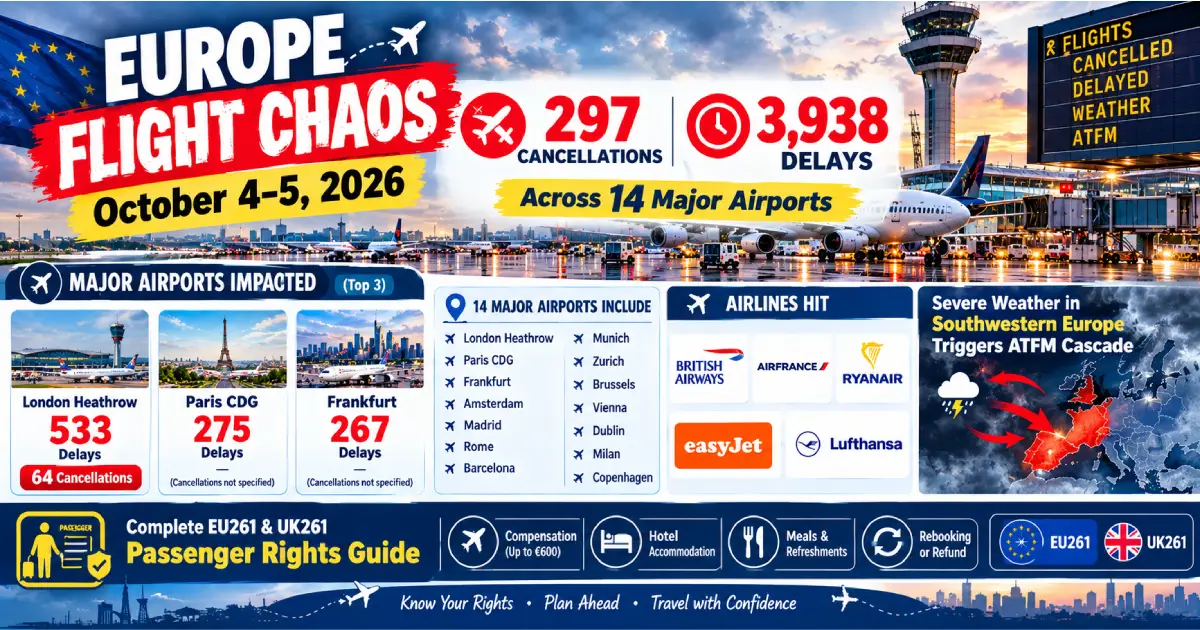
Europe’s aviation network suffered one of its most disruptive days of Q4 on Sunday October 4, 2026, as Air Traffic Flow Management restrictions triggered primarily by severe weather in Southwestern Europe cascaded through 14 major airport hubs, producing 297 flight cancellations and 3,938 delays across the continent. London Heathrow recorded 533 delays and 64 cancellations — the worst single-airport total in Europe on the day — with a 39% departure delay rate that directly disrupted transatlantic connections into the United States, Canada and beyond. Paris Charles de Gaulle recorded 275 delays and 33 cancellations. Frankfurt recorded 267 delays and 9 cancellations. Additional significant disruptions hit Milan Malpensa, Düsseldorf, Paris Orly, Berlin-Brandenburg, Dublin, Manchester, and Hamburg. If you flew through any European hub on October 4 or are flying today, here is everything you need to know.
Data reflects currently reported delays and cancellations across heavily impacted European airports, with Air Traffic Flow Management restrictions, triggered primarily by severe weather in Southwestern Europe, compounding with tight hub capacity and network-wide rotational delays to disrupt thousands of flights.
National total — October 4, 2026:
| Metric | October 4, 2026 |
|---|---|
| Total Europe delays | 3,938 |
| Total Europe cancellations | 297 |
| Worst airport — delays | London Heathrow (LHR) — 533 delays |
| Worst airport — cancellations | London Heathrow (LHR) — 64 cancellations |
| Highest US-connected delays | Heathrow 73, Frankfurt 28, CDG 17 |
| Heathrow departure delay rate | 39% |
| Heathrow arrival delay rate | 33% |
| CDG departure delay rate | 23% |
| Frankfurt departure delay rate | 20% |
| Primary cause | ATFM restrictions — severe weather Southwestern Europe |
| Additional hubs disrupted | Milan Malpensa, Düsseldorf, Paris Orly, Berlin-Brandenburg, Dublin, Manchester, Hamburg |
London Heathrow recorded the highest US-connected delays at 73, with live tracking reports showing average departure delays ranging between 39 and 48 minutes. Hub operators like British Airways initiate tactical cancellations to prevent aircraft and crew duty-time expirations from cascading into transatlantic schedules.
Heathrow’s 533 delays and 64 cancellations make it the single worst European airport today by both metrics. A 39% departure delay rate means more than one in three Heathrow departures ran late on Sunday — a significant operational failure at the world’s third-busiest international hub.
The 73 US-connected delays at Heathrow are the most consequential figure for TravelTourister’s readership. Every delayed transatlantic departure from Heathrow creates a corresponding disruption at a US arrival airport — Boston, New York JFK, Newark, Washington Dulles, Los Angeles, Chicago O’Hare. UK–US passengers who landed in America late on Sunday will have missed onward domestic connections, required hotel rebooking, and faced cascading schedule disruption through Monday.
Airlines most affected at Heathrow: British Airways (primary hub carrier — largest share of delays and cancellations), Virgin Atlantic (US route delays), Lufthansa (Frankfurt connections), Air France (CDG feeder delays).
Why Heathrow is most exposed: Heathrow operates at 98%+ slot utilisation — the closest to capacity of any major hub in Europe. When ATFM restrictions reduce the number of aircraft the network can process per hour, Heathrow has no slack in its schedule to absorb the difference. Every delayed aircraft blocks a gate needed for the next departure.
Paris Charles de Gaulle recorded 275 delays and 33 cancellations, with a 23% departure delay rate and 17% arrival delay rate.
CDG’s 33 cancellations are the second-highest in Europe today. Air France, which operates CDG as its primary hub, accounts for the largest share of delays — alongside Lufthansa, which operates significant feeder connections between CDG and Frankfurt.
The 17 US-connected delays at CDG reflect Air France’s transatlantic network — New York JFK, Boston, Los Angeles, Chicago and Washington all carry Air France services. Sunday afternoon delays at CDG translate directly into Sunday night and Monday morning disruptions at US East Coast airports.
Frankfurt recorded 267 delays and 9 cancellations, with a 20% departure delay rate and 20% arrival delay rate.
Frankfurt is Lufthansa’s primary hub and one of the busiest connecting airports in the world. The 28 US-connected delays at Frankfurt reflect Lufthansa’s transatlantic network — New York JFK, Newark, Boston, Chicago, Los Angeles, Miami, Houston and Washington all carry daily Frankfurt services.
Frankfurt’s 20% delay rate is lower than Heathrow’s 39% — reflecting Frankfurt’s larger physical footprint and slightly more operational flexibility, even at peak congestion.
Additional significant disruptions are active at Milan Malpensa, Düsseldorf, Paris Orly, Berlin-Brandenburg, Dublin, Manchester, and Hamburg.
| Airport | Code | Key Disruptions |
|---|---|---|
| Milan Malpensa | MXP | Significant delays — easyJet, Ryanair, ITA Airways |
| Düsseldorf | DUS | Delays — Eurowings, Lufthansa regional |
| Paris Orly | ORY | Delays — Transavia France, easyJet, Air France Hop |
| Berlin-Brandenburg | BER | Delays — Ryanair, easyJet, Eurowings |
| Dublin | DUB | Delays — Ryanair (primary hub carrier), Aer Lingus |
| Manchester | MAN | Delays and cancellations — easyJet, Ryanair, Jet2 |
| Hamburg | HAM | Delays — Eurowings, Ryanair |
British Airways operates Heathrow as its exclusive hub. Every Heathrow delay is a British Airways problem, and Heathrow’s 39% departure delay rate reflects directly in BA’s October 4 performance. BA’s tactical cancellations — deliberately grounding some flights to free up aircraft and crew for higher-priority departures — are standard procedure during hub congestion events but leave passengers stranded without immediate alternatives.
Routes most affected: All BA shorthaul services from Heathrow — and critically, BA’s transatlantic network. BA operates more US–UK routes than any other carrier: New York JFK, New York Newark, Boston, Los Angeles, Miami, Chicago, Dallas, Seattle, San Francisco, Washington, Philadelphia and more.
Air France accounts for the largest share of CDG’s 275 delays. CDG’s 23% departure delay rate reflects the pressure on Air France’s hub from the ATFM restrictions hitting southwestern Europe. Air France’s transatlantic routes — JFK, BOS, LAX, ORD, DCA, MIA — all carry the knock-on effects of Sunday’s CDG congestion into Monday at US airports.
Ryanair operates from Dublin, Manchester, Milan Malpensa, Berlin-Brandenburg, Paris Beauvais and multiple other affected hubs. Its point-to-point network model means a delay in Dublin cascades into a late departure from London Stansted, which becomes a delayed arrival in Milan, which mispositions the crew for the next Ryanair departure from Italy.
easyJet’s October 4 disruption adds to an already difficult week — the airline’s Portuguese cabin crew are simultaneously on strike through October 6. EasyJet operates significant frequencies from Heathrow (Terminal 2), Gatwick, Manchester, Milan Malpensa, Paris CDG and Paris Orly — all under pressure today.
Lufthansa’s Frankfurt hub recorded 267 delays and 9 cancellations with a 20% delay rate. Lufthansa’s network interconnects with virtually every other major European carrier — delayed Lufthansa feeder flights strand passengers at Frankfurt who were connecting to British Airways, Air France, Emirates and Qantas longhaul services.
Air Traffic Flow Management is the European network-level system that controls how many aircraft can enter any given sector of airspace per hour. When severe weather — thunderstorms, convective cells, icing conditions — closes or restricts a segment of European airspace, ATFM issues “slot credits” that delay departure times to prevent airspace overcrowding.
Air Traffic Flow Management restrictions, triggered primarily by severe weather in Southwestern Europe, compounded with tight hub capacity and network-wide rotational delays to disrupt thousands of flights.
Southwestern Europe — Spain, southern France, the western Mediterranean — sits at the confluence of Atlantic weather systems and Mediterranean airflows. October is a transitional month when summer heat meets autumn frontal systems, producing convective storms that develop rapidly and disrupt ATFM flow management across the entire European network.
When ATFM restricts airspace over Spain or southern France, aircraft routing from the US, Canada, Latin America and Africa must take longer paths — adding fuel burn, crew duty hours and delay minutes to every arrival into Northern European hubs. That is why London, Paris and Frankfurt all show high US-connected delay counts despite being geographically distant from the southwestern weather system.
The ripple effect timeline on October 4:
If you flew from Heathrow, Gatwick, Manchester or any UK airport on Sunday October 4, you are likely to have experienced delays of 30–90 minutes on most services. Your UK261 rights apply to all flights departing UK airports, regardless of the airline’s nationality.
What you can claim: If your flight was delayed 2+ hours, you are entitled to meals and refreshments. If delayed 3+ hours at destination, you may be entitled to cash compensation of £220/£350/£520 (short/medium/longhaul) — UNLESS the airline successfully argues extraordinary circumstances. ATFM restrictions caused by weather are typically treated as extraordinary circumstances, reducing your compensation entitlement. However, your refund right (if the flight was cancelled) and your care rights (meals, hotel if overnight) are unconditional.
Your Sunday evening transatlantic arrivals from Europe were delayed. If you missed a domestic connection as a result, your rights depend on whether your European flight and US domestic connection were on the same ticket. On the same ticket — the operating carrier is responsible for rebooking you at no extra cost. On separate tickets — you bear the cost of rebooking, though travel insurance may cover the loss.
US DOT rights apply to your US domestic connection if operated by a US carrier. For the transatlantic leg departing a European airport, EU261 or UK261 apply.
Air Canada and WestJet both operate European routes connecting through Heathrow, Frankfurt and CDG. If your October 4 transatlantic flight was delayed at a European departure airport, EU261/UK261 apply for compensation on the European leg. Canada’s APPR applies for any Canadian-departing delayed flights home.
Qantas operates the Kangaroo Route through Heathrow. Heathrow’s 39% delay rate on Sunday means Qantas services both arriving and departing London on October 4 were disrupted. Emirates (DXB hub), Singapore Airlines and Cathay Pacific all connect through European hubs affected today. If you were transiting Heathrow on a Qantas or oneworld partner itinerary on October 4, your Qantas Conditions of Carriage entitle you to rebooking at no additional cost.
| Situation | EU261/UK261 Rights |
|---|---|
| Flight cancelled | Full refund OR rebooking on next available flight — your choice |
| Delay 2+ hours | Meals + refreshments — request proactively; airlines don’t always volunteer |
| Delay 3+ hours at destination | Right to compensation (£220–£520 / €250–€600) — check extraordinary circumstances |
| Overnight delay | Hotel accommodation + transport — airline must arrange or reimburse |
| ATFM/weather delay | Likely extraordinary circumstances — compensation may not apply but care rights always do |
| Missed connection (same ticket) | Free rebooking on next available flight — same or partner airline |
Key principle: The weather/ATFM cause of today’s disruption means airlines will invoke “extraordinary circumstances” to resist cash compensation claims. That defence is legitimate for weather. It does NOT apply to care rights — meals, accommodation and transport are owed regardless of cause. And if your flight was cancelled (not just delayed), your right to a full cash refund is unconditional.
How to claim EU261/UK261:
Today’s ATFM disruption is the first major European aviation event of Q4 2026. But the month ahead is packed with confirmed disruption risks your readers need to know about:
| Date | Event | Risk Level |
|---|---|---|
| Oct 2–6 (ongoing) | EasyJet Portugal cabin crew strike | 🔴 HIGH — 500 flights |
| Oct 9 | Milan ATM Group 24-hr strike — metro, buses | 🔴 HIGH — M4 to Linate closed |
| Oct 14 | Tuscany regional general strike — rail 9am–5pm | 🟡 MEDIUM — Florence, Pisa |
| Oct 16 | easyJet Italy cabin crew 24hr + ENAV ATC + Venice VCE security | 🔴🔴 CRITICAL |
| Oct 17 | Five-union Italy pilot + cabin crew strike | 🔴🔴 CRITICAL |
| Oct 17–21 | France nationwide aviation strike — Air France, Transavia, 36,000 crew | 🔴🔴 CRITICAL |
| Oct 30 | Italy national general strike — all sectors 24hr | 🔴 HIGH |
| Nov 1–30 | Naples Airport CLOSED — Salerno replacement | 🔴🔴 CRITICAL — 30 days |
Posted By : Vinay
This article is provided for general informational purposes only and is based on information available at the time of publication. Travel advisories, airline schedules, airport operations, visa requirements, government regulations, and other travel-related information are subject to change without prior notice. While Travel Tourister makes reasonable efforts to verify information using official announcements, government publications, airline and airport communications, and other reliable sources, we cannot guarantee that all information remains complete, accurate, or up to date at all times. Readers should independently verify any information that may affect their travel plans with the relevant airline, airport authority, government agency, embassy, or other official source before making travel, financial, or other decisions. Travel Tourister shall not be liable for any direct or indirect loss, inconvenience, or damages arising from the use of or reliance on the information contained in this article. Nothing in this publication constitutes legal, immigration, financial, or professional travel advice. If you believe any information in this article is inaccurate or outdated, please contact our editorial team. We review all credible correction requests promptly and update our content whenever appropriate.
Lastest News
2nd Floor, 39, Above Kirti Club, DLF Industrial Area, Kirti Nagar, New Delhi, Delhi 110015



Travel Tourister is a leading Travel portal where we introduce travellers to trusted travel agents to make their journey hasselfree, memorable And happy. Travel Tourister is a platform where travellers get Tour packages ,Hotel packages deals through trusted travel companies And hoteliers who are working with us across the world. We always try to find new and more travel agents and hoteliers from every nook and corners across the world so that you could compare the deals with different travel agents and hoteliers and book your tour or hotel with the one you have chosen according to your taste and budget.
Copyright © Travel Tourister, India. All Rights Reserved

 Call
Call Enquiry