Published on : 03 Oct 2026
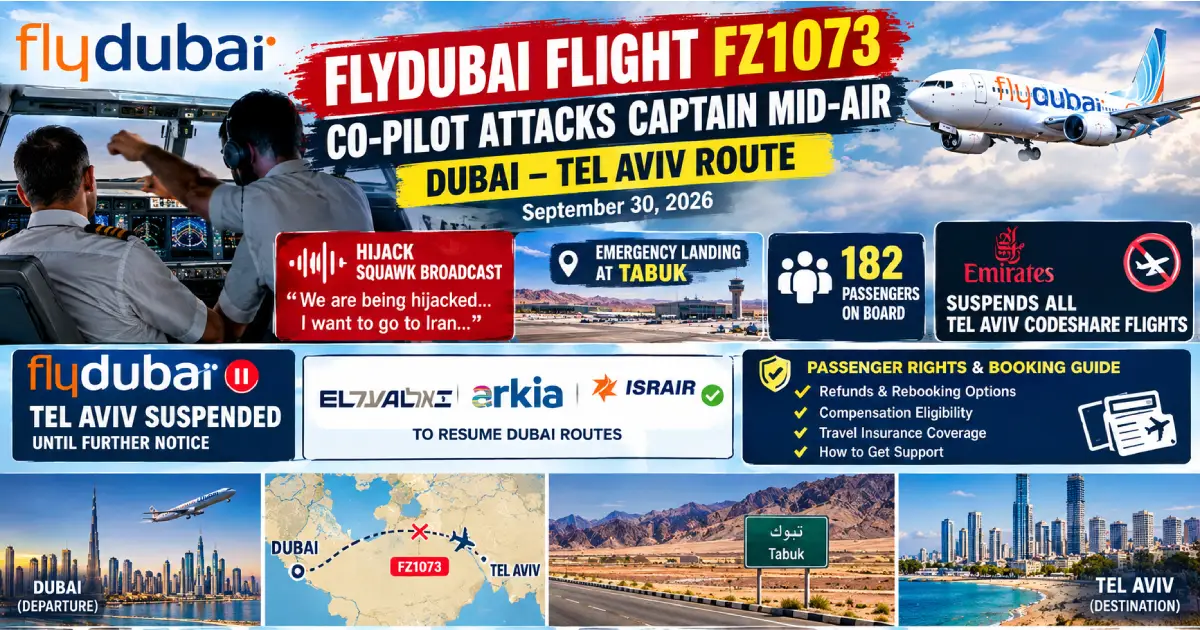
A flydubai Boeing 737 MAX 8 from Dubai to Tel Aviv broadcast a hijack squawk code on the morning of September 30, 2026, and made an emergency landing in Tabuk, Saudi Arabia, after a co-pilot attacked the captain inside the cockpit. 182 passengers were on board. The captain was stabbed. Other pilots and passengers physically intervened to overpower the attacker. All passengers were safely transported to their destination — but the incident has triggered a cascade of flight suspensions, security investigations, and diplomatic consequences that are still unfolding today.
FlydubAI Flight FZ1073 was a regularly scheduled international passenger flight operated by flydubai from Dubai International Airport to Ben Gurion International Airport in Tel Aviv on 30 September 2026. While en route, the Boeing 737 MAX 8 broadcast the squawk code for a hijacking, diverted from its flight path, and made an emergency landing at Prince Sultan bin Abdulaziz Airport in Tabuk, Saudi Arabia.
The co-pilot, of Omani nationality, attacked the captain inside the cockpit. Captain Smit Machchhar — an Indian national — was stabbed. Despite his injuries, he managed to open the cockpit door so that passengers could help restrain the attacker. Other flydubai pilots on board then landed the plane in Tabuk. The co-pilot had previously been flagged as a security risk, officials have since confirmed.
All 182 passengers were transported safely. Some crew members were injured and taken to hospital in Saudi Arabia. FlydubAI sent two replacement aircraft to Tabuk to fly passengers onward to Tel Aviv. Captain Machchhar was taken to a hospital in Abu Dhabi, where he subsequently spoke to Indian Prime Minister Narendra Modi. “I was fighting for my life,” he told the Prime Minister.
Published: October 3, 2026 Incident date: September 30, 2026 Flight: FZ1073 — Dubai International (DXB) → Ben Gurion International (TLV), Tel Aviv Aircraft: Boeing 737 MAX 8 (flydubai) Passengers on board: 182 Incident: Co-pilot attacked captain in the cockpit — stabbing — attempted to crash aircraft Squawk code broadcast: 7500 — hijacking Emergency landing: Prince Sultan bin Abdulaziz Airport, Tabuk, Saudi Arabia Captain: Smit Machchhar (Indian national) — stabbed, survived, hospitalised in Abu Dhabi Co-pilot: Omani national — under arrest, under investigation — previously flagged as security risk Passengers status: All safe — two replacement aircraft flew them to Tel Aviv Crew hospitalisations: Some crew members taken to hospital in Saudi Arabia GCAA statement: “Security incident that was brought under control” — investigation ongoing flydubai statement: “Reasons and motives remain unknown” — urged against speculation Current suspension — flydubai: All Tel Aviv flights suspended until further notice Current suspension — Emirates: All codeshare flights with flydubai to/from Tel Aviv suspended Confirmed specific cancelled flights (Oct 1): FZ1542/EK2333 · FZ1074/EK2121 and others Israeli response: Netanyahu announces new security measures · Transport Minister asked for full flydubai suspension · Israeli carriers had previously halted UAE services UAE diplomatic response: Agreed to relax restrictions preventing Israeli airlines from flying to Dubai El Al / Arkia / Israir: Announced they will resume Dubai flights in November 2026 Confirmed by: Khaleej Times · Gulf News · The National News · FlightGlobal · Wikipedia (incident article) · Washington Times · Ynet News · Curly Tales · GCAA
Morning, September 30, 2026 — en route Dubai to Tel Aviv:
Flight FZ1073 had departed Dubai International Airport on its regular scheduled service to Tel Aviv’s Ben Gurion International Airport. The Boeing 737 MAX 8 was carrying 182 passengers and crew on a flight that normally lasts approximately 3 hours 45 minutes.
Inside the cockpit, the co-pilot — an Omani national — launched a physical attack on the captain. The attack involved stabbing. The motive remains under investigation and the co-pilot had not communicated any grievance or threat before the attack.
The hijack squawk:
During the attack or immediately after it was discovered, the aircraft broadcast squawk code 7500 — the international emergency transponder code that indicates an aircraft is being hijacked. This code immediately alarms air traffic control across the region and triggers military and emergency response protocols in every country that can track the aircraft on radar. Saudi and Israeli air defence systems would have immediately locked on to FZ1073 the moment the squawk was broadcast.
The captain’s response:
Captain Smit Machchhar, despite having been stabbed in the cockpit, opened the cockpit door. This decision — made while injured — allowed other flydubai pilots who were travelling as passengers or crew in the cabin to enter the cockpit and take over the controls, while simultaneously allowing Israeli passengers in the cabin to help physically restrain the attacker. The combined intervention of cabin crew, pilot-passengers, and passengers brought the co-pilot under control.
Other flydubai pilots on board then landed the plane in Tabuk — Prince Sultan bin Abdulaziz Airport in northwestern Saudi Arabia.
The emergency landing at Tabuk:
The aircraft diverted from its flight path and descended toward Tabuk. Communication with the aircraft was briefly lost, then restored. The relief crew declared an emergency at 9:44am GST (9:45am local time). The aircraft landed safely.
Saudi emergency services and security forces met the aircraft on the ground. Some crew members were taken to hospital in Saudi Arabia. Captain Machchhar was ultimately transferred to a hospital in Abu Dhabi.
The passengers:
All 182 passengers were unhurt. FlydubAI sent two replacement aircraft to Tabuk — one to fly the passengers onward to Tel Aviv, one for operational support. The passengers eventually completed their journey to Ben Gurion International Airport.
The co-pilot:
The Omani co-pilot was arrested at Tabuk. He has subsequently been identified as having been previously flagged as a security risk by officials — a detail that has triggered intense scrutiny of flydubai’s crew screening and security vetting processes. The underlying reasons and motives behind the incident remain under investigation.
The most alarming confirmed detail to emerge from the FZ1073 investigation is that the co-pilot accused in the attack was previously flagged as a security risk, officials say.
This revelation — confirmed by multiple government sources cited by the Washington Times, Ynet News, and other outlets — raises profound questions about the failure of security screening and crew vetting processes at flydubai and potentially across the wider UAE aviation security framework.
The specific nature of the prior flagging has not been confirmed publicly. Whether it involved psychological screening, background checks, ideological concerns, or previous behavioural incidents is under investigation. What is confirmed is that the flag existed, that the co-pilot continued to fly, and that the flag was not sufficient to prevent his assignment to an active commercial flight carrying 182 passengers.
FlightGlobal confirmed that the investigation will include a review of operational and security aspects. Netanyahu announced new security measures in response to the incident — suggesting Israeli intelligence services had information about the co-pilot’s prior flagging that they will now bring to bear on the investigation.
FlydubAI has suspended all operations to and from Tel Aviv until further notice. The airline confirmed the suspension on October 1, following the completion of the immediate response to the FZ1073 incident.
The Wikipedia incident article confirms the suspension is for at least 6 days — but the “until further notice” designation means there is no confirmed restart date. Given that the GCAA investigation is ongoing, that the co-pilot’s motives remain unknown, and that security review processes are being revised, a rapid reinstatement of services is unlikely.
Specific confirmed cancelled flydubai/Emirates Tel Aviv services on October 1 (Gulf News):
Emirates has suspended its codeshare operations with flydubai to and from Tel Aviv with immediate effect, until further notice.
The suspension has two practical consequences for passengers:
1 — Passengers booked on Emirates-coded Tel Aviv flights operated by flydubai: Any passenger who holds an Emirates booking number (EK2XXX) for a flight that was physically operated by a flydubai aircraft is now without that service. Emirates said affected customers had been advised to contact their travel agent or the Emirates contact centre, or visit emirates.com for the latest updates. Passengers whose final destination is Tel Aviv will not be accepted for travel at their point of origin.
2 — Passengers already en route: Customers already en route to Tel Aviv at the time the suspension was announced were accommodated and given all possible support to complete their journeys.
This does NOT affect Emirates’ own direct Tel Aviv services: Emirates began its own daily passenger service between Dubai and Tel Aviv in June 2022 following the Abraham Accords. Emirates’ own mainline flights (EK-coded flights on Emirates aircraft, not codeshare) are separate from the flydubai codeshare operation. Check the specific status of your Emirates booking to determine whether it is on an Emirates-operated aircraft or a flydubai-codeshare flight.
Separately from the FZ1073 incident, Etihad Tel Aviv flights were previously cancelled and delayed amid a Ben Gurion Airport workers strike — a separate, unrelated Israeli labour dispute. Etihad’s Tel Aviv status is therefore doubly uncertain: the prior strike disruption AND the security environment following FZ1073. Check etihad.com for current Tel Aviv service status.
The FZ1073 incident has paradoxically triggered an unexpected diplomatic development: the UAE has agreed to relax restrictions that previously prevented Israeli airlines from flying to Dubai.
El Al, Arkia, and Israir have announced that they will resume flights from Tel Aviv to Dubai in November 2026, or as soon as operational and logistical conditions are met.
This announcement represents a significant normalisation in UAE-Israel aviation relations. Israeli carriers had previously halted UAE services — which means that until now, the flydubai/Emirates routes were among the only direct connections between the two countries. The FZ1073 suspension has removed the flydubai-Emirates axis from the route — but the commitment to return Israeli carriers fills the gap and potentially creates a more diversified, better-secured aviation corridor.
What this means for passengers planning Dubai–Tel Aviv travel:
| Carrier | Current status | Expected return |
|---|---|---|
| flydubai (FZ) | Suspended — until further notice | Unknown |
| Emirates codeshare (EK via FZ) | Suspended — until further notice | Unknown |
| El Al (LY) | Suspended — resuming | November 2026 |
| Arkia (IZ) | Suspended — resuming | November 2026 |
| Israir (6H) | Suspended — resuming | November 2026 |
FlydubAI kept flying to Israel through the Gaza conflict period — maintaining the route when many international carriers had suspended services. The airline’s continued operations through the war period reflected both the UAE’s Abraham Accords commitment to Israel normalisation and the commercial significance of the Tel Aviv route, which serves a large population of Israeli tourists, businesspeople, and expatriates in Dubai.
Since 2017, flydubai has maintained a broad strategic partnership with Emirates, including codeshare flights and coordination between their route networks. The Dubai-Tel Aviv route was part of this partnership — with Emirates marketing flydubai-operated seats under Emirates codeshare numbers, expanding the commercial reach of the route to Emirates’ global frequent flyer base.
The significance of flydubai’s continued Tel Aviv operations was therefore not merely commercial — it was symbolic of the UAE-Israel diplomatic relationship post-Abraham Accords. The FZ1073 incident has interrupted that symbolic continuity at a sensitive moment.
Every passenger whose flydubai Tel Aviv flight or Emirates EK-coded Tel Aviv codeshare flight was cancelled following the FZ1073 suspension is entitled to a full refund to the original payment method.
If you still need to travel between Dubai and Tel Aviv, request rebooking on an alternative carrier. With flydubai and Emirates codeshare both suspended, the available alternatives as of October 3 are limited — El Al direct services are not yet operational until November. Indirect routings via Istanbul (Turkish Airlines) or Amman (Royal Jordanian) are the most practical near-term alternatives.
If you booked this trip for a specific purpose (event, business meeting, family occasion) and the cancellation has caused consequential losses beyond the flight cost, claim against your travel insurance’s trip cancellation or trip interruption benefit.
If you experience difficulty obtaining a refund, contact the UAE General Civil Aviation Authority consumer complaints channel: gcaa.gov.ae.
For passengers on flights that were cancelled as a direct consequence of the FZ1073 security incident, the extraordinary circumstances classification is almost certain to apply. A co-pilot attack inside a cockpit is categorically beyond any airline’s ability to predict or prevent — it is precisely the type of extraordinary, external-security event that EU261 and UK261 extraordinary circumstances provisions were designed for.
However: EU261/UK261 cash compensation does not apply if extraordinary circumstances are confirmed. But duty of care (meals, hotel, rebooking) STILL applies. If you were stranded in Dubai or elsewhere following cancellations linked to FZ1073, claim your duty of care costs regardless.
| Contact | Details |
|---|---|
| flydubai | +971 4 232 2232 · flydubai.com → Manage Booking |
| Emirates | 600 555 555 (UAE) · emirates.com → Manage Booking |
| Etihad Airways | 600 555 0600 (UAE) · etihad.com → Manage Booking |
| El Al | +972 3 977 1111 · elal.com |
| Turkish Airlines (via Istanbul) | thy.com → alternative routing |
| Royal Jordanian (via Amman) | rj.com → alternative routing |
| UAE GCAA complaints | gcaa.gov.ae |
| FlightGlobal incident updates | flightglobal.com |
| Ben Gurion Airport status | iaa.gov.il |
| Metric | Detail |
|---|---|
| Flight | FZ1073 — Dubai (DXB) → Tel Aviv (TLV) — September 30, 2026 |
| Aircraft | Boeing 737 MAX 8 |
| Passengers | 182 — all safe |
| Incident | Co-pilot attacked and stabbed captain in cockpit |
| Squawk | 7500 — hijacking — broadcast during incident |
| Emergency landing | Tabuk, Saudi Arabia — Prince Sultan bin Abdulaziz Airport |
| Captain | Smit Machchhar (Indian) — stabbed, survived, hospitalised Abu Dhabi |
| Co-pilot | Omani national — arrested — previously flagged as security risk |
| Resolution | Passengers + other pilots restrained attacker — relief crew landed plane |
| flydubai response | All Tel Aviv flights suspended until further notice |
| Emirates response | All codeshare Tel Aviv flights (EK via FZ) suspended until further notice |
| Israeli response | New security measures · Transport Minister requested full suspension |
| UAE diplomatic move | Relaxed restrictions on Israeli carriers flying to Dubai |
| El Al / Arkia / Israir | To resume Dubai flights — November 2026 |
| Refund right | Full cash refund for all cancelled services |
| Compensation | Extraordinary circumstances likely — cash comp unlikely; duty of care applies |
| Investigation | GCAA investigating — motives unknown — prior security flagging under scrutiny |
Related Articles:
Posted By : Vinay
This article is provided for general informational purposes only and is based on information available at the time of publication. Travel advisories, airline schedules, airport operations, visa requirements, government regulations, and other travel-related information are subject to change without prior notice. While Travel Tourister makes reasonable efforts to verify information using official announcements, government publications, airline and airport communications, and other reliable sources, we cannot guarantee that all information remains complete, accurate, or up to date at all times. Readers should independently verify any information that may affect their travel plans with the relevant airline, airport authority, government agency, embassy, or other official source before making travel, financial, or other decisions. Travel Tourister shall not be liable for any direct or indirect loss, inconvenience, or damages arising from the use of or reliance on the information contained in this article. Nothing in this publication constitutes legal, immigration, financial, or professional travel advice. If you believe any information in this article is inaccurate or outdated, please contact our editorial team. We review all credible correction requests promptly and update our content whenever appropriate.
Lastest News
2nd Floor, 39, Above Kirti Club, DLF Industrial Area, Kirti Nagar, New Delhi, Delhi 110015



Travel Tourister is a leading Travel portal where we introduce travellers to trusted travel agents to make their journey hasselfree, memorable And happy. Travel Tourister is a platform where travellers get Tour packages ,Hotel packages deals through trusted travel companies And hoteliers who are working with us across the world. We always try to find new and more travel agents and hoteliers from every nook and corners across the world so that you could compare the deals with different travel agents and hoteliers and book your tour or hotel with the one you have chosen according to your taste and budget.
Copyright © Travel Tourister, India. All Rights Reserved

 Call
Call Enquiry