Published on : 08 May 2026
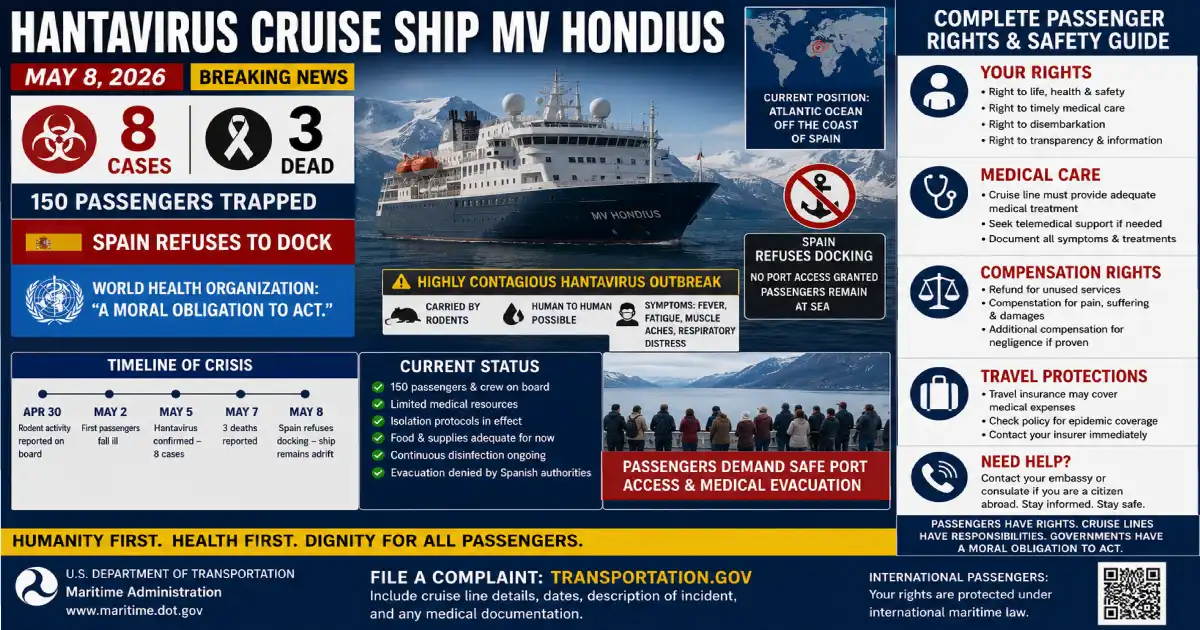
Breaking — May 8, 2026: The cruise ship MV Hondius has become the centre of a global health emergency after 8 confirmed and suspected hantavirus cases and 3 deaths were recorded aboard the Dutch-flagged expedition vessel, carrying 150 passengers of 23 nationalities — including 17 Americans, multiple UK nationals, and Spanish citizens. Spain’s Canary Islands president has flatly refused to allow the ship to dock in Tenerife, despite the World Health Organization declaring that Spain has a “moral and legal obligation” to receive the vessel. The Andes strain of hantavirus detected aboard MV Hondius is the only species of hantavirus known to be capable of human-to-human transmission. New cases are now being confirmed beyond the ship — in Switzerland, France, and Singapore — as governments race to trace passengers who disembarked weeks earlier. The ship is currently anchored off Cape Verde, passengers unable to disembark, while WHO coordinates an emergency international response. Here is every confirmed fact, every country involved, every passenger right you hold, and everything the cruise industry is not telling you.
Published: May 8, 2026 — Friday Ship: MV Hondius — Dutch-flagged expedition cruise vessel, operated by Oceanwide Expeditions Departed: Ushuaia, Argentina — April 1, 2026 Planned route: Antarctica and isolated South Atlantic islands Current location: Anchored off Praia, Cape Verde — passengers unable to disembark Cases: 8 total — 5 laboratory-confirmed hantavirus, 3 suspected Deaths: 3 confirmed dead (one Dutch, one German national — cause under investigation for third) Critically ill: 1 patient in ICU, South Africa Virus strain: Andes hantavirus — the only known hantavirus capable of human-to-human transmission Passengers onboard: ~150 people of 23 nationalities Nationalities most represented: Spanish, British, American (17 Americans confirmed) Crew: 72 crew members, mostly Filipino nationals Ship capacity: 196 passengers, 72 crew WHO risk assessment: Low risk to global public — but “more cases may emerge” CDC assessment: Extremely low risk to US public — monitoring all 17 Americans aboard Spain response: Canary Islands president refuses docking — WHO calls it a legal obligation WHO actions: Expert deployed aboard ship · 2,500 diagnostic kits shipped to 5 countries · International coordination active
What began as a routine Antarctic expedition has evolved into one of the most serious cruise health emergencies in recent history. The MV Hondius departed Ushuaia, Argentina on April 1, 2026, with 147–149 passengers and 72 crew aboard — a small, intimate expedition vessel heading to Antarctica and a series of remote South Atlantic islands. By April 11, the first passenger was dead.
The sequence of events that has brought 150 people to an anchorage off Cape Verde — unable to leave the ship, unable to travel home, unable to receive full medical care — is a story that reveals every vulnerability in the cruise industry’s management of remote-voyage health emergencies. It is also a story that every cruise traveller, travel agent, and travel insurer needs to understand before booking another ocean voyage.
The timeline of the outbreak:
On April 11, 2026, a passenger — a Dutch man — died aboard the ship. His body was removed from the vessel on April 24 when MV Hondius docked at Saint Helena, the remote British South Atlantic island. His wife, who had accompanied him as a close contact, disembarked at Saint Helena showing gastrointestinal symptoms. She subsequently deteriorated during a flight from Saint Helena to Johannesburg, South Africa, on April 25. She died upon arrival at the emergency department on April 26. Laboratory testing later confirmed hantavirus infection in both.
At approximately the same time, a third passenger — an adult male — presented to the ship’s doctor on April 24 with fever, shortness of breath, and signs of pneumonia. By April 26, his condition had deteriorated to the point where he required medical evacuation. He was airlifted from Ascension Island to South Africa on April 27, where he remains hospitalised in an Intensive Care Unit.
On May 2 — the same day Spirit Airlines shut down in the United States — a German woman died aboard the ship. The ship docked in Praia, the capital of Cape Verde, on May 3. On May 6, the Andes strain of hantavirus was confirmed as the causative agent. On the same day, Switzerland confirmed a case in a male patient being treated in Zurich — a passenger from the ship. The total confirmed case count reached 8, with 5 laboratory-confirmed and 3 suspected. WHO Director-General Dr Tedros Adhanom Ghebreyesus briefed the world on May 7, 2026.
The MV Hondius’s intended evacuation point was Tenerife, in Spain’s Canary Islands — the closest major airport hub with the infrastructure to handle a complex international medical disembarkation. The plan made logical, medical, and legal sense. Spain is an EU member state with legal obligations under international maritime law and the International Health Regulations.
Fernando Clavijo, president of the Canary Islands, said he “cannot allow MV Hondius to enter the Canaries.” His stated reason: fear of endangering the people of the Canary Islands, citing the region’s experience during the COVID-19 pandemic.
WHO’s response was direct and public. The World Health Organization stated that “Spain has a moral and legal obligation to assist these people, among whom are several Spanish citizens.” As of May 8, the standoff continues. The ship remains anchored off Cape Verde — a nation that WHO has assessed as not having the infrastructure to handle the scale of operation needed for a safe, coordinated disembarkation of 150 passengers of 23 nationalities.
The political and humanitarian dimensions of this standoff are significant. Among the trapped passengers are Spanish citizens whose own government’s territory has refused to receive them. There are 17 Americans whose State Department has confirmed it is “closely monitoring the situation.” There are UK nationals on a ship notified to WHO by the United Kingdom’s IHR Focal Point. There are passengers from 23 countries, many of whom simply want to go home.
The US Department of State has confirmed it is “leading a coordinated, whole-of-government response including direct contact with passengers, diplomatic coordination, and engagement with domestic and international health authorities.” The US government has confirmed its top priority is “the health and safety of all US passengers.”
Understanding why this outbreak is being treated as a global health event requires understanding what hantavirus is — and what makes the Andes strain specifically different from every other known hantavirus.
Hantavirus is a catch-all term for a family of viruses found worldwide. In the Americas, hantaviruses cause Hantavirus Pulmonary Syndrome (HPS). The case fatality rate for HPS is approximately 40% among those who develop severe disease. Initial symptoms typically begin 1 to 8 weeks after exposure and are indistinguishable from flu: fatigue, muscle aches, fever, dizziness, gastrointestinal symptoms including nausea and diarrhoea.
Four to ten days after symptom onset, HPS can rapidly escalate — coughing and shortness of breath progressing to acute respiratory distress syndrome and, in severe cases, respiratory failure and shock. The progression is fast, the treatment options are limited, and the disease is not easily diagnosed in its early stages.
All other known hantaviruses are transmitted exclusively through contact with infected rodents — their urine, faeces, or saliva. Human-to-human transmission does not occur. The Andes virus is the sole exception: it is the only hantavirus species known to be capable of limited human-to-human transmission, typically through close and prolonged contact involving exchanges of bodily fluids.
This is what makes the MV Hondius outbreak globally significant. A confined shipboard environment — small cabins, shared dining spaces, shared bathrooms — represents precisely the conditions in which Andes virus human-to-human transmission risk is elevated.
WHO’s current assessment: The risk to the global public is low. There is no evidence of widespread transmission risk. WHO does not anticipate a large epidemic comparable to COVID-19. The Andes virus human-to-human transmission, when it occurs, requires close and prolonged contact — not casual proximity.
The incubation period: Hantavirus typically incubates for one to eight weeks before patients present symptoms. This means that passengers who disembarked at Saint Helena in late April — more than 30 people — may only now be approaching the outer edge of the incubation window. WHO has stated it is “possible that more cases may be reported.”
The complexity of this outbreak reflects the international nature of modern cruise travel. Passengers who flew off MV Hondius at Saint Helena and Ascension Island have dispersed across the world. Contact tracing is now active across at least six countries:
The CDC and State Department have confirmed that 17 American citizens remain aboard MV Hondius. The US government has confirmed monitoring. Three people in the United States are believed to have been in contact with passengers; the CDC has been conducting assessments. The CDC’s current position: risk to the US public is “extremely low.”
What US passengers should do: If you or a family member was aboard MV Hondius or on a flight from Saint Helena to Johannesburg on April 25, contact your local health department immediately.
The United Kingdom was the first country to formally notify WHO under International Health Regulations on May 2, 2026 — the day laboratory confirmation came through in South Africa. UK nationals are among the passengers aboard. UK contact tracing has been initiated for any UK-based passengers who disembarked at Saint Helena.
What UK passengers should do: Contact NHS 111 online or call 111. Inform them of travel aboard MV Hondius and any symptoms — even mild ones. Follow UKHSA guidance for hantavirus exposure monitoring.
Eight French nationals who were not on the cruise have been identified as close contacts of a confirmed case. They were on the international flight from Saint Helena to Johannesburg on April 25, 2026 — the same flight on which a confirmed case deteriorated en route. One individual is displaying mild symptoms; diagnostic tests are being carried out with isolation measures in place.
Switzerland confirmed on May 6 that a male passenger from MV Hondius is being treated in Zurich for confirmed hantavirus infection. This brings the total cases connected to the outbreak, including off-ship, to 8.
Singapore’s Communicable Diseases Agency confirmed that two Singaporean residents — both men in their 60s — are self-isolating and being tested for hantavirus. One has a runny nose but is otherwise well; the other is asymptomatic. Both were connected to MV Hondius.
Three people in Canada are self-isolating, including two in Ontario and one in Quebec. One of the three was not aboard the ship but was on the same flight home as two Canadians who were.
Argentine authorities are reconstructing the birdwatching route taken by the Dutch couple — believed to be the index cases — who arrived in Argentina on November 27, 2025, and conducted a four-month road trip across Chile, Uruguay, and Argentina before boarding MV Hondius in Ushuaia on April 1. No cases related to the ship outbreak have been identified in Argentina. The virus is endemic in some areas of Argentina but had not been recorded in Ushuaia in recent decades.
MV Hondius is owned and operated by Oceanwide Expeditions, a Dutch company specialising in polar and remote expedition cruises. The vessel is a purpose-built expedition ship with accommodation for 196 passengers. It operates small-group voyages to Antarctica, the Arctic, and remote South Atlantic and Pacific islands.
Remote expedition cruising carries a categorically different risk profile from mainstream Caribbean or Mediterranean cruising. Passengers on expedition vessels like MV Hondius travel to destinations where:
What expedition cruise passengers must now ask before booking:
The MV Hondius situation is legally unprecedented in several respects. It raises passenger rights questions that standard cruise booking terms and conditions do not address clearly.
Under international maritime law — specifically SOLAS (Safety of Life at Sea) and the Maritime Labour Convention — the ship operator has an obligation to provide medical care to passengers showing illness and to seek port access for medical evacuation of seriously ill individuals. Oceanwide Expeditions has fulfilled these baseline obligations: they have cooperated with WHO, they have facilitated medical evacuations, and they have kept passengers informed.
What passengers may be owed:
✅ Full refund of unused cruise portion — passengers are not completing their contracted itinerary through no fault of their own.
✅ Repatriation costs — the operator has a duty of care to facilitate passengers reaching their home countries, including the cost of alternative flights once disembarkation is authorised.
✅ Medical costs — for passengers who required onboard medical treatment or evacuation, costs should be covered first by travel insurance, with potential operator liability for cases traceable to inadequate biosecurity protocols.
✅ Compensation for consequential losses — missed onward flights, hotel bookings, pre-paid tours — covered under comprehensive travel insurance, potentially under operator liability depending on jurisdiction.
Under the International Health Regulations (2005), to which Spain is a signatory, states have obligations to assist ships in distress — including health emergencies — at ports within their territory. WHO’s public statement that “Spain has a moral and legal obligation to assist these people” is not diplomatic language. It is a statement of legal principle under a binding international agreement.
Spain’s refusal creates a legally significant precedent: a state party to the IHR refusing port access to a vessel under active WHO coordination. Legal scholars and maritime law specialists are watching the standoff closely.
If you were aboard MV Hondius:
If you were on the April 25 Saint Helena–Johannesburg flight:
If you have booked a future Oceanwide Expeditions cruise:
The MV Hondius outbreak has prompted quiet but significant activity across the broader cruise industry. While no major cruise line has issued a public statement directly referencing MV Hondius, the incident has accelerated internal discussions around:
Biosecurity protocols for expedition and remote voyages: The mainstream cruise industry invested heavily in enhanced sanitation and health screening protocols following the COVID-19 pandemic. Expedition voyage operators like Oceanwide Expeditions operate on a smaller scale with less institutional infrastructure for rapid health response.
Medical evacuation insurance requirements: Several cruise industry insiders have indicated that the MV Hondius situation will likely prompt updated recommendations — and potentially requirements — around medical evacuation insurance for remote and polar expedition voyages specifically.
Port access contingency planning: The Spain refusal has exposed a critical gap: what happens when the planned evacuation port refuses entry? The cruise industry has no standard protocol for government port-denial scenarios outside of political crises and conflicts.
Royal Caribbean context: Separately, Royal Caribbean has already suspended all visits to its Labadee, Haiti private destination for all of 2026 due to security concerns — demonstrating that port access denials, whether government or operator-initiated, are increasingly a feature of the 2026 cruise environment.
The MV Hondius outbreak does not represent a systemic risk to mainstream Caribbean, Mediterranean, or Alaskan cruise itineraries. WHO has been explicit: the risk to the global public is low. Hantavirus is not transmitted through casual contact. The mainstream cruise lines sailing the Caribbean, the Mediterranean, and Alaska are operating on routes where hantavirus exposure risk from the environment is essentially zero.
What the MV Hondius outbreak does change:
For expedition cruise bookings: Any voyage to South America, Antarctica, Patagonia, or remote South Atlantic destinations should now trigger a specific set of insurance and medical questions before booking. The risk of hantavirus exposure in rural Argentina, Chile, and Uruguay is real — it is the same risk that is believed to have produced the index cases on MV Hondius.
For all cruise bookings: The port-denial scenario — a government refusing to allow a ship to dock — is now a demonstrated, documented reality in 2026. Standard cruise cancellation insurance does not typically cover port-denial-induced itinerary changes or extended disembarkation delays. Review your policy specifically for this clause.
For travel insurance: Comprehensive travel insurance — not the basic coverage offered by most cruise lines at checkout — is non-negotiable for any expedition voyage. The costs of medical evacuation from a remote South Atlantic island, accommodation during an extended disembarkation delay in Cape Verde, and alternative flights home from an unplanned location run into tens of thousands of dollars per passenger.
WHO current status:
CDC current status:
Symptoms to watch for (up to 8 weeks post-exposure):
If you develop any symptoms and were connected to MV Hondius:
The MV Hondius outbreak is the most acute cruise emergency of May 2026, but it is not the only significant cruise disruption affecting travellers right now:
🔴 Spirit Airlines collapse — cruise passengers stranded: Spirit Airlines permanently ceased operations on May 2, 2026. Thousands of cruise passengers who booked Spirit flights to Port Everglades, PortMiami, and Port Canaveral now face a scramble to find alternative flights ahead of summer sailing. Cruise lines — including Royal Caribbean and Carnival — have confirmed they will not offer refunds if passengers miss their ship due to airline collapse.
🟠 Royal Caribbean — Labadee (Haiti) suspended all 2026: Royal Caribbean has suspended all visits to its private Labadee destination for the remainder of 2026 due to ongoing security concerns. More than a dozen ships have had itineraries modified. A US State Department Level 4 “Do Not Travel” advisory remains in place for Haiti.
🟠 Middle East cruise cancellations: Multiple cruise lines — including Celestyal Cruises and Explora Journeys — have cancelled or redirected entire seasons of Middle East itineraries following airspace closures and maritime restrictions linked to the Iran conflict. Celestyal’s ships remain stranded in Dubai and Doha.
🟡 NCL passenger death — Great Stirrup Cay: A passenger aboard a Norwegian Cruise Line vessel died during a snorkelling excursion at Great Stirrup Cay, NCL’s private Bahamas island, on May 6, 2026. NCL has not yet issued a public statement.
The MV Hondius hantavirus outbreak will be studied for years as a case study in remote voyage risk management, international maritime law, and the limits of government cooperation in a health emergency. For travellers, travel agents, and travel insurers, the lessons are immediate and practical.
The most important lesson is not about hantavirus specifically — it is about the assumption of safety that underlies expedition cruise bookings. Passengers aboard remote expedition voyages are not simply booking a holiday. They are entering environments where medical evacuation is measured in days rather than hours, where port access is not guaranteed, and where the international legal framework for passenger protection is being tested in real time off the coast of Cape Verde.
The second most important lesson is about travel insurance. The passengers aboard MV Hondius who purchased comprehensive travel insurance — including medical evacuation cover — are in a fundamentally different position today than those who took the cruise line’s basic coverage at checkout. Medical evacuation from a remote island. Extended accommodation in Cape Verde. Alternative flights from an unplanned location. These costs are real, they are large, and they are exactly what comprehensive travel insurance exists to cover.
We will continue updating this article as the MV Hondius situation develops. Check back for the latest on the docking standoff resolution, passenger disembarkation updates, and WHO case count changes.
For More Resources:
Related Articles:
Posted By : Vinay
This article is provided for general informational purposes only and is based on information available at the time of publication. Travel advisories, airline schedules, airport operations, visa requirements, government regulations, and other travel-related information are subject to change without prior notice. While Travel Tourister makes reasonable efforts to verify information using official announcements, government publications, airline and airport communications, and other reliable sources, we cannot guarantee that all information remains complete, accurate, or up to date at all times. Readers should independently verify any information that may affect their travel plans with the relevant airline, airport authority, government agency, embassy, or other official source before making travel, financial, or other decisions. Travel Tourister shall not be liable for any direct or indirect loss, inconvenience, or damages arising from the use of or reliance on the information contained in this article. Nothing in this publication constitutes legal, immigration, financial, or professional travel advice. If you believe any information in this article is inaccurate or outdated, please contact our editorial team. We review all credible correction requests promptly and update our content whenever appropriate.
Lastest News
2nd Floor, 39, Above Kirti Club, DLF Industrial Area, Kirti Nagar, New Delhi, Delhi 110015



Travel Tourister is a leading Travel portal where we introduce travellers to trusted travel agents to make their journey hasselfree, memorable And happy. Travel Tourister is a platform where travellers get Tour packages ,Hotel packages deals through trusted travel companies And hoteliers who are working with us across the world. We always try to find new and more travel agents and hoteliers from every nook and corners across the world so that you could compare the deals with different travel agents and hoteliers and book your tour or hotel with the one you have chosen according to your taste and budget.
Copyright © Travel Tourister, India. All Rights Reserved

 Call
Call Enquiry