Published on : 15 Apr 2026
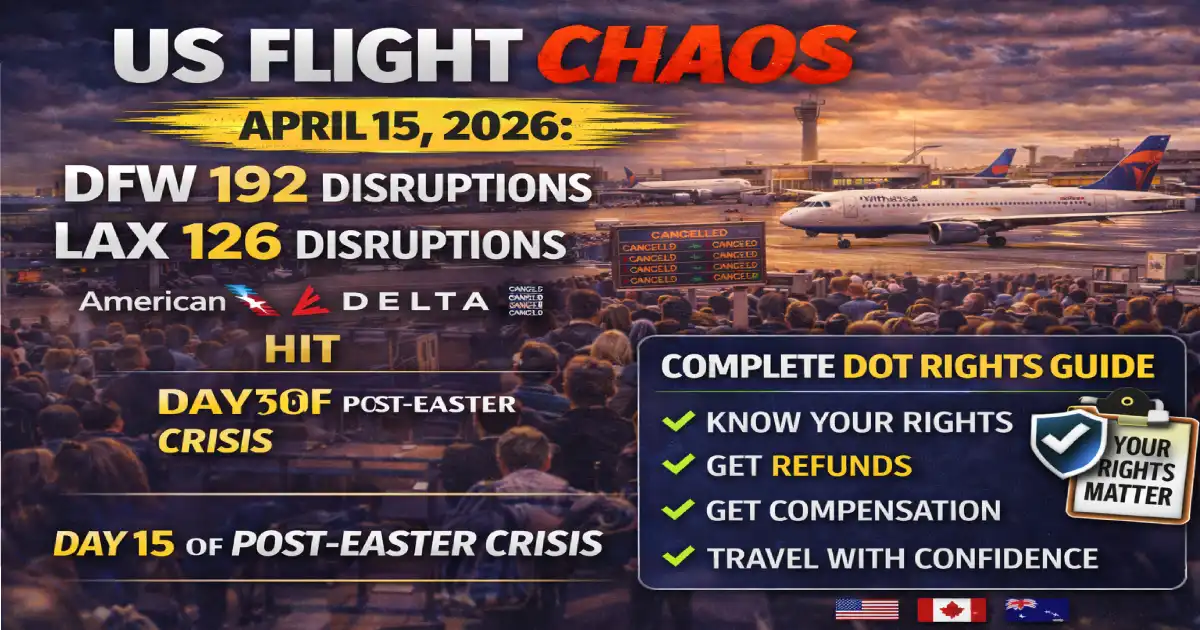
Breaking: Wednesday April 15, 2026 marks Day 15 of continuous elevated disruption in the US aviation system — and today’s pattern confirms the system has not yet achieved a clean recovery from the post-Easter crisis. Dallas–Fort Worth International Airport (DFW) is today’s primary disruption hub with 186 delays and 6 cancellations — 192 total disruptions — with American Airlines, Delta Air Lines, and Southwest Airlines all posting elevated counts at their largest shared hub. On the West Coast, Los Angeles International Airport (LAX) has recorded 120 delays and 6 cancellations — 126 total disruptions — affecting American Airlines, Delta Air Lines, United Airlines, and Alaska Airlines on domestic and transatlantic routes. Tuesday April 14 produced the worst disruption day of the post-Easter period — 2,729 total disruptions nationally, including Chicago O’Hare’s 400+ meltdown and Atlanta’s 227 disruptions. Today’s reduced but still-elevated numbers signal a partial recovery, not a full one. Here is every airport, every carrier, and exactly what you are owed.
Published: April 15, 2026 — Wednesday Day of Post-Easter Crisis: Day 15 (continuous elevated disruption since Good Friday April 3) DFW Total Today: 192 (186 delays + 6 cancellations) LAX Total Today: 126 (120 delays + 6 cancellations) Carriers Affected at DFW: American Airlines, Delta Air Lines, Southwest Airlines Carriers Affected at LAX: American Airlines, Delta Air Lines, United Airlines, Alaska Airlines Routes Disrupted: Los Angeles, Chicago, New York, Atlanta, Miami, New York, San Francisco, Seattle, London Context: Day after national high of 2,729 disruptions (April 14) — partial recovery underway TSA Status: Day 60 of DHS partial shutdown — 500+ officers still absent from rosters Hormuz Blockade: US naval blockade effective from April 13 — oil at $104/barrel — jet fuel pressure rising
The United States aviation disruption crisis that began on Good Friday April 3 has now run for fifteen consecutive days. In that span, the system has absorbed multiple compounding shocks that a normal spring would never see simultaneously:
The Easter surge drove over 16,000 disruptions across April 3–6, leaving aircraft and crews badly out of position across every major hub in the network.
A Central US thunderstorm system hit on April 13 — generating 1,800+ delays — and then tracked east, driving 2,729 total disruptions on April 14. Chicago O’Hare alone recorded 400+ disruptions on April 14. Atlanta posted 227. Dallas Fort Worth recorded 159 on April 14 alone, before today’s 192.
The Lufthansa pilot strike (April 13–14) added an international dimension — 80–90% of Frankfurt and Munich operations cancelled for 48 hours, rippling into Star Alliance partner United Airlines’ transatlantic network and leaving aircraft out of position at US hubs including O’Hare and LAX through this week.
The DHS partial shutdown continues on Day 60 — over 500 TSA officers have resigned since February 14, creating structural staffing gaps at major checkpoints that slow security throughput, contribute to missed flights, and push late passenger arrivals onto already-delayed aircraft.
The US naval blockade of the Strait of Hormuz, announced April 13, has pushed Brent crude back above $104/barrel. Aviation fuel now stands at more than double its pre-conflict level. United Airlines has publicly confirmed a 5% reduction in Q2–Q3 flight capacity. Spirit Airlines is operating in Chapter 11 with fewer than 125 active aircraft. Every carrier is running a thinner operation than a normal April would see.
Against this backdrop, today’s 192 DFW disruptions and 126 LAX disruptions represent a partial — but incomplete — recovery from April 14’s worst day. The system is improving, but it has not cleared.
Dallas–Fort Worth is the world’s third-busiest airport by aircraft operations and American Airlines’ absolute global super-hub. When national disruption ripples, DFW amplifies it — because the airport’s tightly banked departure schedule leaves almost no slack to absorb incoming delays.
Yesterday’s 159 DFW disruptions (April 14) — driven by the eastward-moving thunderstorm complex and the Lufthansa pilot strike’s ripple into United’s transatlantic network — left DFW’s overnight rotation incomplete. Aircraft that should have been in position for today’s morning bank arrived late. Crews that flew yesterday’s disrupted operations hit duty-time limits earlier than normal, requiring relief crews who may not have been pre-positioned. Today’s 192 disruptions are the compounded result of last night’s incomplete recovery.
American Airlines at DFW today: American Airlines operates approximately 900 daily departures from DFW — more than any other carrier at any single airport in the world. Every major American Airlines network corridor passes through Dallas Fort Worth:
✈️ DFW → New York (JFK/LGA/EWR): American’s primary Northeast corridor — delays cascading east ✈️ DFW → Los Angeles (LAX): American’s flagship transcontinental corridor ✈️ DFW → Chicago O’Hare (ORD): Midwest hub connector — ORD still recovering from yesterday’s 400+ disruptions ✈️ DFW → Miami (MIA): American’s Latin America gateway ✈️ DFW → Charlotte (CLT): Southeast US hub + transatlantic connection point for UK passengers ✈️ DFW → Atlanta (ATL): Secondary Southeast corridor — ATL still elevated from yesterday
Southwest Airlines at DFW: Southwest does not operate from Dallas Fort Worth — Southwest’s Dallas base is Dallas Love Field (DAL), approximately 11km from DFW. However, Southwest’s disruptions at Dallas Love Field are contributing to the broader Dallas-area system pressure today. Southwest’s point-to-point network means Love Field delays cascade independently into Chicago Midway, Las Vegas, Phoenix, and other high-frequency corridors.
Delta Air Lines at DFW: Delta operates fewer daily departures from DFW than American, but its presence on key routes to Atlanta, New York, and Los Angeles means any DFW disruption directly affects Delta’s connection banks at its own Atlanta and New York hubs.
A significant number of UK passengers fly LHR→DFW on American Airlines before connecting onward to Latin America, the Caribbean, or US domestic destinations. With DFW running 192 disruptions today:
If your AA DFW connection is under 90 minutes, treat it as at risk. American’s minimum connection time at DFW is officially 45 minutes, but with today’s disruption levels, the practical safe minimum is 90 minutes. If your connection was booked shorter than this, contact American Airlines proactively to request a rebooking to a more generously timed connection.
Your rights: Under UK261 (the post-Brexit equivalent of EU261), if your onward connection fails because of a delay on an AA-operated LHR→DFW leg, and you arrive at your final destination 3+ hours late, you may be entitled to up to £520 compensation per passenger — as long as the delay was operational (not weather-caused).
Los Angeles International Airport has a structural vulnerability that makes it disproportionately prone to delays: just four parallel runways packed into a compact coastal footprint. When the national network runs disrupted — as it has for fifteen consecutive days — LAX becomes a compressor, taking in late inbound aircraft and multiplying delays through its afternoon and evening departure banks.
Today’s 126 disruptions at LAX are broadly moderate by April 2026 standards — the airport has seen 180 delays on some days this month. But for the individual passengers caught in those 120 delays, the impact is real: missed transcontinental connections, delayed trans-Pacific arrivals in Australia and Asia, and broken onward journeys into the UK and Europe via London Heathrow.
American Airlines at LAX: American operates LAX as a major West Coast gateway, with high-frequency services to New York JFK, Dallas Fort Worth, Chicago, and international routes including London Heathrow. Today’s delays on American at LAX are the downstream consequence of DFW’s 192-disruption morning — aircraft that flew into LAX from Dallas late are now running behind for return and onward operations.
Delta Air Lines at LAX: Delta operates from Terminals 2 and 3 at LAX and runs key routes to New York JFK, Atlanta, and trans-Pacific services to Tokyo, Seoul, and Sydney. Any significant disruption at Delta LAX flows through into its next-day Sydney and Tokyo rotations — affecting Australian passengers connecting back to Melbourne, Brisbane, and Perth.
🇦🇺 Australian passengers via LAX: If you are connecting LAX→SYD or LAX→MEL on Qantas or Delta tonight, check your inbound flight status immediately. A 90-minute inbound delay on a US domestic feeder into LAX can make a trans-Pacific departure technically tight — and trans-Pacific aircraft do not hold once the gate-push process begins.
United Airlines at LAX: United operates from Terminal 7 and 8 at LAX. Today’s United disruptions reflect the residual positioning failure from the Lufthansa pilot strike’s impact on United’s Star Alliance transatlantic network — particularly the Frankfurt and Munich connections that United shares codeshare inventory on with Lufthansa. With Lufthansa’s 48-hour strike (April 13–14) over, United is now trying to rebuild aircraft and crew rotation through LAX as part of its recovery.
Alaska Airlines at LAX: Alaska Airlines operates a significant West Coast network from LAX, including key routes to Seattle (SEA), Portland (PDX), San Francisco (SFO), and a growing number of transcontinental services. Today’s Alaska delays at LAX reflect both the national positioning failure and Alaska’s particular exposure to West Coast weather patterns that, while calmer than the Central US storm that drove April 13–14’s chaos, continue to generate modest flow restrictions.
LAX’s horseshoe terminal layout is one of the most confusing in the US. If your flight is disrupted and you need to switch airlines:
⚠️ Critical: You cannot walk between terminals at LAX without exiting security and taking the inter-terminal shuttle bus. In disruption conditions, allow a minimum of 45 minutes terminal-to-terminal. If you are being rebooked from American to Delta (or vice versa), factor this travel time into your connection window.
Alternative airports to LAX for same-day rebooking:
If your transcontinental connection is cancelled and you need to reach New York same-day, BUR is worth checking — Southwest frequently has capacity when LAX is full.
| Airport | Disruptions | Key Carriers |
|---|---|---|
| DFW | 192 (186 del + 6 can) | American, Delta, Southwest |
| LAX | 126 (120 del + 6 can) | American, Delta, United, Alaska |
| ORD | Recovering from 400+ (Apr 14) | United, American, Lufthansa bleed |
| ATL | Recovering from 227 (Apr 14) | Delta dominant |
| CLT | Elevated — storm tail | American dominant |
| JFK | Continued moderate disruption | JetBlue, Delta, American |
The recovery trajectory:
The storm system has cleared the East Coast. Today’s disruptions are driven primarily by aircraft and crew positioning failures — not active weather. This is a critical distinction: positioning failures can be resolved overnight, whereas storm-driven disruptions cannot. The system is trending toward genuine recovery, but today is not that day yet.
You are entitled — immediately and unconditionally — to:
✅ A full cash refund to your original payment method, regardless of fare type. Basic economy, non-refundable, sale fares — none of these restrictions apply when the airline cancels your flight. The DOT Automatic Refund Rule (effective October 2024) requires airlines to process refunds within 7 business days for credit card payments and 20 calendar days for other payment methods.
✅ Free rebooking on the next available flight to your final destination — including on other carriers if your airline cannot accommodate you within a reasonable time
✅ Meals and refreshments during delays of 3+ hours that are within the airline’s control (today’s positioning failures = within airline control)
✅ Hotel accommodation and airport transfers if the cancellation causes an overnight stranding and the cause is operational (not weather)
The exact words to say: “My flight has been cancelled by the airline. I am requesting a full cash refund to my original payment method under the DOT automatic refund rule.”
If an agent offers you a voucher or travel credit instead of cash, you can decline and insist on cash. Say: “I understand a voucher is being offered, but I am entitled to a cash refund and I am requesting that.”
Under US law, delays alone do not automatically trigger cash compensation (unlike EU261 in Europe). However:
✅ 3+ hour domestic delay → You can request a full cash refund and choose not to fly. This is your right even on a non-refundable ticket if the delay is 3+ hours.
✅ Meals and refreshments → Airlines are expected (though not legally mandated under current DOT rules) to provide meal vouchers during significant operational delays. Ask at the gate agent desk. American Airlines, Delta, and United all have stated policies to provide meal vouchers for delays of 3+ hours caused by airline operations.
✅ Same-day flight changes → All three major carriers at DFW and LAX today (American, Delta, United) allow same-day confirmed flight changes for a fee or free for elite status members. If your delayed flight is likely to result in a missed connection, proactively request a change to a later departure before the board shows “cancelled.”
❌ Mandatory cash compensation for delays does not exist under US law. This is the key difference from EU261. If your flight is delayed 4 hours but not cancelled, you have no automatic right to €250–€600 per person as you would in Europe. File a complaint at airconsumer.dot.gov if you feel the airline has not met its service obligations.
LAX has significant transatlantic and transpacific operations. If your disrupted LAX flight is operated by:
Key amounts:
These amounts apply to cancellations and delays of 3+ hours at final destination caused by the airline’s operations — not by weather.
Today’s disruptions at DFW and LAX are primarily caused by positioning failures, not active weather. This makes them potentially eligible for EU261/UK261 compensation on applicable flights.
Step 1 — Check Your Inbound Aircraft RIGHT NOW Go to FlightAware.com. Enter your flight number. Find the aircraft’s current location (the “tail number” shown in the flight details). If your aircraft is sitting on the ground in Chicago, Atlanta, or New York — your departure will be late regardless of what the departures board currently shows. This is the single most powerful early-warning tool available to passengers.
Step 2 — At DFW: Do Not Rely on American’s App Alone American Airlines’ app frequently shows “On Time” for flights whose inbound aircraft are running late. Cross-reference with FlightAware. If the inbound shows a 45-minute delay, your outbound will run at least that late. Request a proactive rebooking to a later connection immediately — before the delay is officially declared.
Step 3 — At LAX: Identify Your Terminal Before You Need It If you are being rebooked from one carrier to another, identify the terminal immediately and budget 45 minutes for the inter-terminal shuttle. Do not assume you can run across the airport — you cannot at LAX without going through security again.
Step 4 — Connection Under 90 Minutes at Either Airport: Act Now With today’s disruption levels, 45-minute minimum connection times at DFW and LAX are inadequate. Any connection of under 90 minutes carries material risk today. Contact your airline proactively and request a move to the next available departure with a wider connection window. You will be better positioned doing this before the delay is declared than after, when the rebooking queue fills.
Step 5 — Document Everything for Compensation If your flight is cancelled or delayed 3+ hours by an operational cause (not weather), you have rights. Screenshot every notification. Keep all receipts for meals, ground transport, and accommodation. File your DOT complaint or EU261/UK261 claim within 6 months of travel. Airlines process proactive, documented claims more quickly than vague post-trip complaints.
The Bottom Line: Day 15 of post-Easter chaos is running at a lower temperature than yesterday’s 2,729-disruption national peak — but DFW’s 192 disruptions and LAX’s 126 disruptions confirm the US aviation system has not yet cleared. American Airlines passengers at Dallas–Fort Worth face the highest disruption concentration. Delta, United, and Alaska passengers at Los Angeles are running elevated delays on both domestic and international routes. The thunderstorm system that drove April 13–14’s catastrophic numbers has cleared — but the aircraft and crew positioning failures it created are still unwinding through the network. Thursday April 16 is the earliest realistic date for a clean national day. For today: check your inbound aircraft, extend your connection buffers, know your DOT rights, and document everything for compensation if your delay is operational.
For More Resources:
Related Articles:
Posted By : Vinay
This article is provided for general informational purposes only and is based on information available at the time of publication. Travel advisories, airline schedules, airport operations, visa requirements, government regulations, and other travel-related information are subject to change without prior notice. While Travel Tourister makes reasonable efforts to verify information using official announcements, government publications, airline and airport communications, and other reliable sources, we cannot guarantee that all information remains complete, accurate, or up to date at all times. Readers should independently verify any information that may affect their travel plans with the relevant airline, airport authority, government agency, embassy, or other official source before making travel, financial, or other decisions. Travel Tourister shall not be liable for any direct or indirect loss, inconvenience, or damages arising from the use of or reliance on the information contained in this article. Nothing in this publication constitutes legal, immigration, financial, or professional travel advice. If you believe any information in this article is inaccurate or outdated, please contact our editorial team. We review all credible correction requests promptly and update our content whenever appropriate.
Lastest News
2nd Floor, 39, Above Kirti Club, DLF Industrial Area, Kirti Nagar, New Delhi, Delhi 110015



Travel Tourister is a leading Travel portal where we introduce travellers to trusted travel agents to make their journey hasselfree, memorable And happy. Travel Tourister is a platform where travellers get Tour packages ,Hotel packages deals through trusted travel companies And hoteliers who are working with us across the world. We always try to find new and more travel agents and hoteliers from every nook and corners across the world so that you could compare the deals with different travel agents and hoteliers and book your tour or hotel with the one you have chosen according to your taste and budget.
Copyright © Travel Tourister, India. All Rights Reserved

 Call
Call Enquiry