Published on : 30 Jun 2026
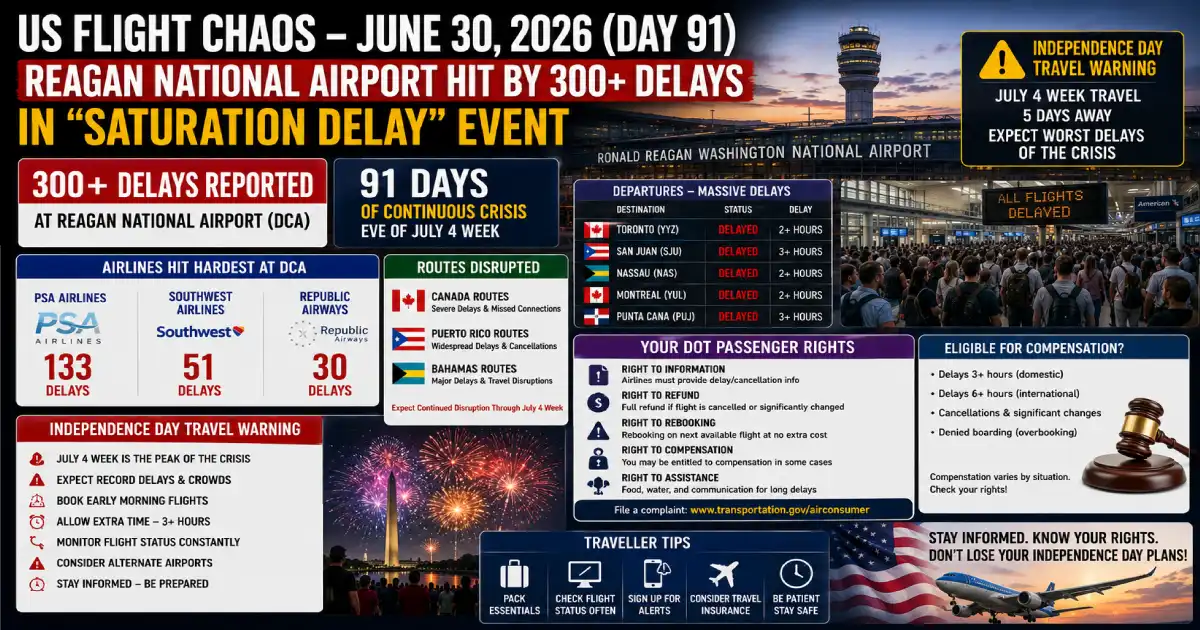
Published: June 30, 2026 — Tuesday (Day 91 · US Aviation Crisis · Final Day Before July 4 Week) Today’s headline event: Reagan National Airport (DCA) — 300+ flights delayed, just 1 cancellation (Delta) DCA carrier breakdown:
Day 91. Tomorrow is July 1 — the unofficial start of America’s busiest travel week of the year, when tens of millions of passengers will move through the national aviation network ahead of Independence Day. Today, the system gave a preview of what that pressure looks like when it meets an airport with no spare capacity left. Ronald Reagan Washington National Airport recorded more than 300 flight delays today — and just a single cancellation. That combination is not an accident or a fluke. It is what aviation analysts are increasingly calling a “saturation delay” event: an airport so structurally full that there is no slack left to absorb even modest disruption, producing hundreds of late departures while airlines fight to preserve as much of the schedule as possible rather than cancelling outright. PSA Airlines, American Eagle’s regional operator, absorbed the worst of it with 133 delays. Southwest added 51. Republic Airways contributed 30 more. Connections to Charlotte, Detroit, Oklahoma City, Pensacola, Toronto, Puerto Rico and the Bahamas were all disrupted. With July 4 week now just one day away, today’s DCA event is the clearest possible warning of what an already-stretched system looks like the moment real holiday-week volume arrives.
Ronald Reagan Washington National Airport has been plunged into a state of operational duress today, struggling to manage a backlog of more than 300 recorded flight delays. Delta Air Lines, Southwest, and PSA Airlines are among the hardest hit carriers in today’s disruption, with critical routes through Charlotte, Detroit, Oklahoma City, and Pensacola experiencing significant scheduling lag. Tens of thousands of passengers are navigating revised itineraries and missed onward connections as a result.
What makes today’s event analytically distinct from many of the cancellation-heavy disruption days recorded earlier this month is the cancellation-to-delay ratio. While only one total flight cancellation was reported today — a single Delta Air Lines service — the sheer volume of delays has triggered widespread travel chaos in its own right. This is a deliberate operational choice by airlines: rather than cancelling flights outright to clear the schedule board, carriers are choosing to delay flights to ensure passengers eventually reach their destinations, accepting the operational pain of rolling delays instead of the customer-facing pain of outright cancellation.
The reason a single cancellation can coexist with 300+ delays comes down to a specific operational phenomenon airport analysts describe as a “gate glut.” When hundreds of flights are delayed rather than cancelled, it creates a backlog at the airport that causes even incoming flights to wait on the tarmac for an open gate to become available. Unlike a mass cancellation event — which clears the schedule board by removing flights entirely — a high-delay day puts continuous, compounding pressure on gate availability and airport infrastructure throughout the entire operating day.
This matters specifically at Reagan National because of the airport’s structural characteristics. DCA operates a limited physical footprint and stringent slot-control mandates that make it particularly susceptible to exactly this kind of systemic failure. Unlike larger airports with more gates and runway capacity to absorb temporary backlogs, DCA’s slot-controlled design — intended to manage noise and congestion around the nation’s capital — leaves minimal room to recover once a delay cascade begins.
PSA Airlines, operating regional feeder routes under the American Eagle brand, absorbed by far the largest share of today’s disruption with 133 delayed flights. PSA’s position as one of American Airlines’ two primary regional feeder operators at DCA means it operates a disproportionately large share of the airport’s total daily departures relative to its aircraft size — and when a gate glut develops, PSA’s high-frequency regional schedule is among the first and hardest hit.
For PSA-operated American Eagle passengers today: Rebook via aa.com → Manage Trips. American Airlines bears responsibility for PSA-operated segments under its mainline ticketing.
Southwest recorded 51 delays at DCA today. Southwest’s point-to-point network model means its DCA delays today are distributed across its broader East Coast and Midwest map rather than concentrated through a single hub connection — but the airport-level gate congestion still produces the same rolling delay pattern regardless of network structure.
For Southwest passengers today: southwest.com → Manage Reservations. Southwest’s no-fee same-day change policy remains the easiest rebooking path during a delay-heavy (rather than cancellation-heavy) disruption day.
Republic Airways, which operates regional feeder flights for multiple major carriers including American, United and Delta, recorded 30 delays at DCA today. As with PSA, Republic’s exposure stems from operating a high volume of shorter regional routes that are most vulnerable to gate availability constraints during a saturation event.
For Republic-operated passengers today: Rebook via your ticketing carrier — aa.com, united.com or delta.com depending on which mainline carrier issued your ticket.
Delta recorded the single cancellation logged at DCA today. While Delta’s overall delay exposure at the airport was comparatively contained relative to PSA, Southwest and Republic, the one cancelled flight represents the full extent of outright schedule clearing that occurred during today’s event — underscoring just how strongly airlines are favouring delays over cancellations as their preferred disruption-management strategy this week.
For Delta passengers today: delta.com → My Trips for rebooking on the cancelled service.
Today’s DCA disruption reaches well beyond the Washington metropolitan area itself, touching both domestic leisure and business corridors and at least one international connection point.
Domestic routes affected:
Cross-border and international routes affected:
For passengers connecting through DCA to any of these destinations today, the practical experience is one of high-stakes uncertainty: most aircraft do eventually depart, but the cumulative delay across a multi-leg itinerary can easily compound into a missed final connection, particularly for passengers transiting through Charlotte or Detroit on already-tight schedules.
Today’s event arrives at a uniquely sensitive moment in the 91-day crisis calendar. Tomorrow, July 1, marks the effective start of the build-up to Independence Day — historically the highest-volume domestic travel week of the entire US summer calendar. Every major airline will be operating its maximum-density schedule for the week, with minimal scheduling slack built in to absorb disruption of any kind.
The Reagan National saturation delay event today is instructive precisely because it occurred without a major weather trigger or a confirmed large-scale operational failure — it appears to have emerged primarily from accumulated scheduling pressure at a structurally constrained airport. If a slot-controlled, perimeter-restricted airport like DCA can generate a 300-delay day under today’s relatively contained conditions, the risk profile for July 4 week itself — when passenger volumes surge dramatically above normal levels — is considerably higher.
Day 91 means the US aviation network has now operated under continuous elevated disruption conditions since April 1, 2026, without a single fully clean recovery day in nearly three months. Every day of accumulated positioning debt — aircraft and crews ending each operating day slightly out of position relative to where the next day’s schedule requires them to be — compounds into the next. A system entering July 4 week with 91 days of this kind of accumulated debt behind it has structurally less capacity to absorb the holiday surge than a system would have in a normal year.
Book the earliest available departure for any July 1–6 travel. Morning flights consistently outperform afternoon and evening departures during high-volume periods, because the aircraft assigned to early rotations has not yet accumulated the day’s delay debt.
Avoid Reagan National connections if you have flexibility. Today’s event demonstrates the airport’s specific structural vulnerability to saturation delays. If your itinerary can route through a less slot-constrained airport instead, consider doing so for July 4 week travel specifically.
Build in extra connection buffer time. A 45–60 minute connection that might be comfortable in a normal operating environment carries significantly elevated risk during the final days of June and the first week of July, given both the accumulated 91-day system debt and the seasonal volume surge arriving simultaneously.
Complete online check-in and travel with carry-on luggage where possible for any July 4 week domestic travel, to minimise the time-sensitive steps required at the airport itself.
Today’s DCA event — overwhelmingly delays rather than cancellations — raises a specific and common passenger question: what are you entitled to when your flight is delayed for hours but never actually cancelled?
For delays of 3+ hours where the cause is within airline control (crew scheduling, aircraft positioning, gate availability mismanagement): cash compensation of $200–$775 may apply depending on flight distance, under DOT rules governing controllable disruptions.
Regardless of compensation eligibility, you are entitled to:
If you were on today’s single cancelled Delta flight at DCA, you are unconditionally entitled to:
If your airline refuses these rights: airconsumer.dot.gov → Consumer Complaint → Aviation. Keep your boarding pass, any delay notifications, and receipts for meals or accommodation purchased while waiting. DOT investigations typically resolve within 30–60 days, with enforceable penalties for airlines found non-compliant.
| Airline | Rebooking Portal | Phone |
|---|---|---|
| PSA Airlines (American Eagle) | aa.com → Manage Trips | 1-800-433-7300 |
| Southwest Airlines | southwest.com → Manage Reservations | 1-800-435-9792 |
| Republic Airways | Rebook via aa.com, united.com or delta.com | — |
| Delta Air Lines | delta.com → My Trips | 1-800-221-1212 |
| DOT Complaint | airconsumer.dot.gov | 1-202-366-2220 |
Posted By : Vinay
This article is provided for general informational purposes only and is based on information available at the time of publication. Travel advisories, airline schedules, airport operations, visa requirements, government regulations, and other travel-related information are subject to change without prior notice. While Travel Tourister makes reasonable efforts to verify information using official announcements, government publications, airline and airport communications, and other reliable sources, we cannot guarantee that all information remains complete, accurate, or up to date at all times. Readers should independently verify any information that may affect their travel plans with the relevant airline, airport authority, government agency, embassy, or other official source before making travel, financial, or other decisions. Travel Tourister shall not be liable for any direct or indirect loss, inconvenience, or damages arising from the use of or reliance on the information contained in this article. Nothing in this publication constitutes legal, immigration, financial, or professional travel advice. If you believe any information in this article is inaccurate or outdated, please contact our editorial team. We review all credible correction requests promptly and update our content whenever appropriate.
Lastest News
2nd Floor, 39, Above Kirti Club, DLF Industrial Area, Kirti Nagar, New Delhi, Delhi 110015



Travel Tourister is a leading Travel portal where we introduce travellers to trusted travel agents to make their journey hasselfree, memorable And happy. Travel Tourister is a platform where travellers get Tour packages ,Hotel packages deals through trusted travel companies And hoteliers who are working with us across the world. We always try to find new and more travel agents and hoteliers from every nook and corners across the world so that you could compare the deals with different travel agents and hoteliers and book your tour or hotel with the one you have chosen according to your taste and budget.
Copyright © Travel Tourister, India. All Rights Reserved

 Call
Call Enquiry