Published on : 30 Jun 2026
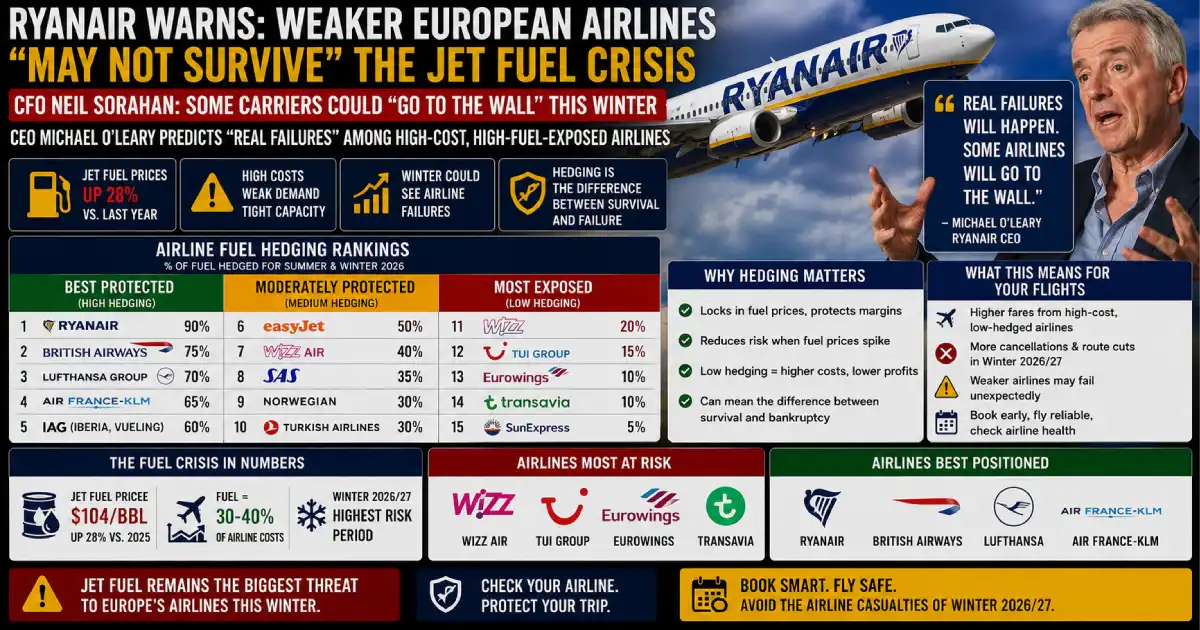
Published: June 30, 2026 — Tuesday Who said it: Ryanair CFO Neil Sorahan (CNBC, May 18, 2026) and Ryanair CEO Michael O’Leary (CNBC, April 28, 2026) The core warning: “I think we will see some of the weaker carriers who were already struggling before the war possibly go to the wall in the winter” — Sorahan The Spirit Airlines parallel: Sorahan said he “wouldn’t be surprised” to see European airlines fail in a similar way to Spirit Airlines, which collapsed in the US after the fuel crisis compounded existing debt and cost problems Trigger event: Iran war began February 28, 2026 — Strait of Hormuz blockaded Jet fuel price before war: ~$80 per barrel (Jet A-1, March 2026) Jet fuel price peak: $150–179 per barrel (April 2026, per IATA Jet Fuel Price Monitor) Strait of Hormuz significance: 25–35% of global jet fuel supply passes through this corridor; accounted for 75% of Europe’s net jet fuel imports pre-war Ryanair’s fuel hedge: 80% of summer fuel locked in at $668 per metric ton — among the strongest in Europe Ryanair share price: Up 6% on May 18 (full-year earnings day) — but down ~22% year-to-date overall Most exposed airline (Morningstar): Wizz Air — lowest full-year hedge protection, higher fuel cost share, weaker margin cushion Best protected (Morningstar): Ryanair (low-cost) and IAG/British Airways (network carrier) Fuel hedge rankings: Ryanair ~80% · Lufthansa ~77% · IAG ~62% · easyJet ~70% · Wizz Air ~55% · Delta 0% (owns refinery) · United 0% · American 0% United Airlines exposure: No financial hedges — expects $11 billion in additional annual fuel costs American Airlines exposure: No financial hedges — fuel bill expected to rise by $4 billion this year — already suspending 6 domestic routes Delta’s position: Owns the Trainer refinery — saves ~$300 million/year but still exposed to crude oil spikes Ryanair’s promise: No fuel surcharges, no fare-related price hikes tied directly to fuel costs this summer or winter IEA warning: Europe could face jet fuel shortages within six weeks of the conflict’s escalation (April 2026 estimate) Current status: Ceasefire extension announced, but Strait remains volatile; oil prices remain elevated
It is the warning every airline executive has been careful not to say out loud — until Ryanair said it twice. First, CEO Michael O’Leary told CNBC in April that if jet fuel prices stayed elevated through the summer, “you’ll see European airlines fail.” Then, in May, Ryanair’s CFO Neil Sorahan went further, telling CNBC he expected “some of the weaker carriers who were already struggling before the war” to “go to the wall in the winter” — drawing a direct parallel to the collapse of Spirit Airlines in the United States. Ryanair itself is not at risk. The Irish budget giant has locked in 80% of its summer fuel at $668 per metric ton, a price far below the roughly $1,300 per metric ton other European carriers are paying at the height of the crisis. But the warning is not really about Ryanair. It is about everyone else. Morningstar analysts have already named Wizz Air as the most exposed major European carrier. United and American Airlines in the US have zero fuel hedging at all. And the question now facing every airline passenger booking flights for the rest of 2026 is simple: which airlines will still be flying by Christmas?
Speaking to CNBC’s Ben Boulos at the Norges Bank Investment Management Conference in Oslo, Ryanair CEO Michael O’Leary delivered the first major public warning from a European airline leader about the potential for carrier failures during the jet fuel crisis.
“Pricing has mushroomed since March. Jet A-1 was about $80 a barrel in March. It’s now $150,” O’Leary told CNBC. He went on: “I think there will be failures. If it continues at $150 a barrel into July, August, September, then you’ll see European airlines fail and that, in the medium term, would probably be good for Ryanair’s business.”
O’Leary was careful to frame Ryanair’s own position as fundamentally different from the airlines he expected to struggle. “We are the best insulated, most hedged airline in Europe,” he said, adding that Ryanair could “guarantee people there’ll be no price increases, no fuel hedging, no fuel surge levy surcharges, regardless of what happens to summer supply.”
Three weeks later, on the day Ryanair reported its full-year earnings, CFO Neil Sorahan went further than O’Leary had in April — naming a specific timeframe and drawing a specific historical parallel.
“Do we have plans for some kind of Armageddon situation? Of course, we do, but I don’t see that coming to pass. As things stand, we’re operating a full schedule this summer, and plan to operate a full schedule into the winter period,” Sorahan told CNBC’s Ritika Gupta.
Then came the warning that has defined the story since: “I think we will see some of the weaker carriers who were already struggling before the war possibly go to the wall in the winter.”
Sorahan also told CNBC that he wouldn’t be surprised to see some European airlines “getting themselves into trouble” in a scenario similar to what occurred with Spirit Airlines in the US — which ceased all operations on May 2, 2026, after the jet fuel crisis compounded its existing heavy debt load and cost pressures. The comparison is significant: Spirit was not a hypothetical case study by the time Sorahan made this comment — it was an airline that had already gone under.
Throughout both statements, Ryanair’s leadership was consistent in framing the airline’s own outlook as secure. The carrier has hedged 80% of its summer fuel at $668 per metric ton — a price that compares favourably even to what Ryanair itself paid for fuel the previous year, according to Sorahan. Ryanair shares closed up 6% on May 18, the day of the CFO’s comments, though the stock remained down approximately 22% year-to-date, reflecting broader market anxiety about the sector despite Ryanair’s relative insulation.
On the question of fuel supply itself, rather than just price, Sorahan struck a more reassuring tone in May than O’Leary had in April: “We’re in obviously very volatile oil markets at the moment. If we go back a couple of months ago, we probably had some concern around oil supply, but we’re increasingly confident that there won’t be issues in relation to oil into this summer.” He attributed this improved confidence to Europe’s declining dependence on the Strait of Hormuz, with alternative suppliers including the US, Venezuela and Brazil increasingly filling the gap. “That said, I think prices will remain higher for longer, which puts Ryanair in a particularly strong position, given our strong fuel hedging,” he said.
The jet fuel crisis traces directly to the escalation of the Iran war, which began on February 28, 2026, when hostilities between the US, its allies and Iran intensified around the Strait of Hormuz — one of the most critical chokepoints in global energy logistics. Between 25% and 35% of global jet fuel supply is shipped through this single corridor, and it had previously accounted for 75% of Europe’s net jet fuel imports.
The price trajectory has been severe. Jet A-1, the standard aviation fuel grade, was trading at approximately $80 per barrel in March 2026. By the time O’Leary spoke to CNBC in late April, it had reached $150. The average price tracked by the International Air Transport Association’s Jet Fuel Price Monitor peaked even higher, hitting $179 per barrel in the week ending April 24, 2026 — more than double the pre-war level.
The International Energy Agency’s head warned in April that Europe could feel the effects of jet fuel shortages within as few as six weeks, depending on how quickly alternative supply could be imported to replace the lost Middle Eastern volumes. By the time of Sorahan’s May comments, that immediate shortage risk had eased somewhat — Ryanair specifically cited growing confidence in supply continuity through the summer, attributing it to diversified sourcing from the US, Venezuela, Brazil, Norway and West Africa.
But easing supply concerns did not mean easing price concerns. Even with supply stabilising, the price of jet fuel remained structurally elevated well above pre-war levels — and it is price, not supply, that determines which airlines can survive the crisis and which cannot.
Fuel hedging is a financial strategy where an airline locks in fuel prices in advance through contracts, insulating itself from short-term price spikes. An airline with high hedge coverage at a low locked-in price pays substantially less for fuel than the prevailing market rate during a crisis. An airline with low or no hedge coverage pays the full, volatile market price — which, during this crisis, has meant paying close to double what it budgeted for.
Morningstar equity analyst Loredana Muharremi summarised the sector split clearly: “In Europe, that points to Ryanair among low-cost carriers and IAG among network carriers. By contrast, Wizz Air is the most exposed, given lower full-year hedge protection, a higher fuel cost share, and weaker margin cushion.” She added a crucial caveat that applies to every carrier on this list, including the best-protected: even the best-hedged airlines are only “partially shielded” from the soaring fuel prices, because hedges are front-loaded and eventually expire into the prevailing market rate.
| Airline | Fuel Hedge % | Protection Type | Estimated Impact |
|---|---|---|---|
| Ryanair | ~80% | Financial contracts | Low — locked in at ~$67/barrel equivalent |
| Lufthansa | ~77% | Financial contracts | Moderate — high volume but exposed to “crack spread” |
| easyJet | ~70% | Financial contracts | Contained — heavy protection through H1 2026 |
| IAG (British Airways, Iberia, Aer Lingus, Vueling) | ~62% | Financial contracts | Moderate — best-positioned network carrier |
| Wizz Air | ~55% | Financial contracts | Severe — lowest protection among major EU budget carriers |
| Delta Air Lines | 0% | Refinery ownership | Moderate — owns the Trainer refinery, saves ~$300M/year, but remains exposed to crude spikes |
| United Airlines | 0% | None | Severe — no financial hedges, expects $11 billion in additional annual fuel costs |
| American Airlines | 0% | None | Severe — no financial hedges, fuel bill expected to rise by $4 billion this year |
Ryanair (80% hedged): The clear winner of the crisis so far. Locked-in pricing at $668/metric ton — roughly half the prevailing European average of around $1,300/metric ton at crisis peak — gives Ryanair both a cost advantage and a competitive pricing weapon. The airline has explicitly used this position to promise no fuel surcharges.
Lufthansa (77% hedged): Strong protection on paper, but Lufthansa’s hedge is complicated by what analysts call “crack spread” exposure — the cost differential between crude oil and refined jet fuel, which has its own volatility separate from headline crude prices.
easyJet (70% hedged): Reasonably well protected through the first half of 2026, which aligns with easyJet’s own public statements attributing its earnings pressure more to reduced bookings and passenger confidence than to direct fuel cost shock. This is also relevant context for easyJet’s ongoing Castlelake takeover situation — the fuel crisis is part of what depressed easyJet’s share price low enough to attract a takeover approach in the first place.
IAG / British Airways (62% hedged): The best-positioned full-service network carrier, according to Morningstar — giving British Airways, Iberia, Aer Lingus and Vueling a meaningfully stronger position than their lower-cost European rivals at Wizz Air.
Wizz Air (55% hedged) — THE NAME TO WATCH: Morningstar’s explicit identification of Wizz Air as the most exposed major European carrier is the single most actionable data point in this entire story for passengers. Lower hedge coverage, a higher proportion of operating costs tied to fuel, and a thinner margin cushion to begin with combine to make Wizz Air the airline analysts are watching most closely as the crisis extends into winter.
United and American Airlines (0% hedged): Neither US legacy carrier maintains a financial fuel hedging programme, leaving both fully exposed to market price volatility. United expects $11 billion in additional annual fuel costs; American expects $4 billion. American has already acted on this exposure by suspending six domestic routes from August 5 through October 5, 2026, citing the fuel cost surge directly.
Delta Air Lines (0% financial hedge, but refinery-owned): Delta’s unusual position — owning the Trainer oil refinery in Pennsylvania — gives it a structurally different kind of protection. The refinery saves Delta approximately $300 million per year compared to buying refined jet fuel on the open market, but it does not insulate Delta from the underlying volatility of crude oil prices the way a financial hedge would.
Sorahan’s comparison to Spirit Airlines is not abstract — it is the clearest available case study for what a fuel-crisis airline failure looks like in practice, and it happened just weeks before he made the comment.
Spirit Airlines ceased all US operations on May 2, 2026. The airline had entered the crisis already carrying a heavy debt load and a longstanding pattern of cost pressure from its ultra-low-cost business model, which left it with minimal financial buffer when jet fuel prices doubled. Unlike Ryanair, which had locked in favourable pricing months in advance, Spirit had no comparable hedge position robust enough to absorb the shock. The combination of pre-existing debt, thin margins, and full exposure to spot-market fuel prices proved fatal within roughly two months of the crisis beginning.
The pattern Sorahan is warning about for European carriers follows the same logic: airlines that were already financially fragile before the war — carrying high debt, operating on thin margins, or lacking strong hedge positions — face a materially higher risk of failure than airlines entering the crisis from a position of financial strength. Wizz Air’s combination of lower hedge coverage and weaker margin cushion places it closest to this profile among major European carriers, according to Morningstar’s analysis, though it is important to note that no analyst has predicted Wizz Air’s collapse specifically — only flagged it as the most exposed among major carriers.
These four are the best-protected major European carriers based on current hedge data. Ryanair has explicitly promised no fuel surcharges. Lufthansa, easyJet and the IAG carriers (British Airways, Iberia, Aer Lingus, Vueling) all carry hedge protection in the 60–77% range, giving meaningful but not complete insulation. Booking with any of these carriers for summer or winter 2026 travel carries materially lower risk of a sudden operational failure than booking with a less-hedged carrier — though “lower risk” does not mean “no risk,” and broader demand patterns (discussed below) still affect all of them.
Wizz Air’s position as the most exposed major European carrier, per Morningstar, does not mean the airline is at imminent risk of collapse — it means the airline carries materially higher financial exposure to continued elevated fuel prices than its competitors. For passengers with existing Wizz Air bookings or those considering booking, this is useful context rather than a reason for alarm: Wizz Air continues to operate its full published schedule as of this writing. But travellers with significant non-refundable bookings far in advance (autumn or winter 2026) may wish to consider travel insurance with airline-failure coverage as an additional precaution, given the explicit analyst warning.
Both carriers face the largest absolute dollar exposure to the fuel crisis among major US airlines, given their complete lack of financial hedging. American has already demonstrated how this exposure translates into operational change, suspending six domestic routes specifically citing fuel costs. Further capacity adjustments at either carrier in the second half of 2026 should not be considered surprising given their unhedged exposure.
Despite the scale of the cost pressure described throughout this story, ticket prices have not surged dramatically as of this writing. Ryanair’s CFO specifically addressed this: “We haven’t promised no price increases. Ryanair operates a load active yield passive strategy, which means we price to fill the planes, and the consumers pretty much decide what that pricing is going to be.” This means Ryanair — and likely other carriers operating similar dynamic pricing models — will raise prices where demand allows it, rather than imposing blanket fuel surcharges across all routes and dates. The practical effect for passengers: fares may rise on high-demand routes and dates even without an explicit “fuel surcharge” line item, while remaining stable or even falling on routes where demand is softer.
One of the clearest signals of how seriously the travel market is taking this crisis: travel demand patterns are visibly changing. Holidaymakers in Europe and the UK are increasingly planning to travel via rail this summer or opting for shorter-haul flights, with Southern Europe expected to be the favoured destination over longer-haul alternatives. This shift in consumer behaviour — moving toward shorter, cheaper, more flexible travel options — is itself a rational response to the uncertainty the fuel crisis has created, independent of whether any specific airline ultimately fails.
Check your airline’s hedge position context using the rankings table above as a general risk indicator — not a prediction of failure, but a useful gauge of relative financial resilience.
Consider travel insurance with scheduled airline failure (SAFI) coverage for any significant non-refundable bookings made several months in advance, particularly for autumn/winter 2026 travel on lower-hedged carriers.
Pay by credit card where possible. In the UK, Section 75 of the Consumer Credit Act provides additional protection for purchases over £100 if a company fails. In the US, credit card chargeback protections offer a similar safety net.
Monitor for schedule changes rather than outright collapse as the more likely near-term signal. Airline financial distress typically shows up first as route suspensions, reduced frequencies, or fleet downsizing — as already seen with American Airlines — well before a full operational shutdown, which gives passengers some practical warning time in most cases.
Do not panic-cancel existing bookings. No analyst or executive quoted in this story has predicted the specific failure of any named carrier. The warnings describe sector-wide risk and identify relative exposure — they are not forecasts of a confirmed event.
| Risk Level | Airlines |
|---|---|
| 🟢 Best protected | Ryanair (80% hedged) |
| 🟢 Well protected | Lufthansa (77%), easyJet (70%) |
| 🟡 Moderately protected | IAG / British Airways (62%) |
| 🔴 Most exposed (Europe) | Wizz Air (55%) |
| 🔴 Most exposed (US, no hedge) | United Airlines, American Airlines |
| 🟡 Alternative protection | Delta Air Lines (refinery-owned) |
Posted By : Vinay
This article is provided for general informational purposes only and is based on information available at the time of publication. Travel advisories, airline schedules, airport operations, visa requirements, government regulations, and other travel-related information are subject to change without prior notice. While Travel Tourister makes reasonable efforts to verify information using official announcements, government publications, airline and airport communications, and other reliable sources, we cannot guarantee that all information remains complete, accurate, or up to date at all times. Readers should independently verify any information that may affect their travel plans with the relevant airline, airport authority, government agency, embassy, or other official source before making travel, financial, or other decisions. Travel Tourister shall not be liable for any direct or indirect loss, inconvenience, or damages arising from the use of or reliance on the information contained in this article. Nothing in this publication constitutes legal, immigration, financial, or professional travel advice. If you believe any information in this article is inaccurate or outdated, please contact our editorial team. We review all credible correction requests promptly and update our content whenever appropriate.
Lastest News
2nd Floor, 39, Above Kirti Club, DLF Industrial Area, Kirti Nagar, New Delhi, Delhi 110015



Travel Tourister is a leading Travel portal where we introduce travellers to trusted travel agents to make their journey hasselfree, memorable And happy. Travel Tourister is a platform where travellers get Tour packages ,Hotel packages deals through trusted travel companies And hoteliers who are working with us across the world. We always try to find new and more travel agents and hoteliers from every nook and corners across the world so that you could compare the deals with different travel agents and hoteliers and book your tour or hotel with the one you have chosen according to your taste and budget.
Copyright © Travel Tourister, India. All Rights Reserved

 Call
Call Enquiry