Published on : 08 May 2026
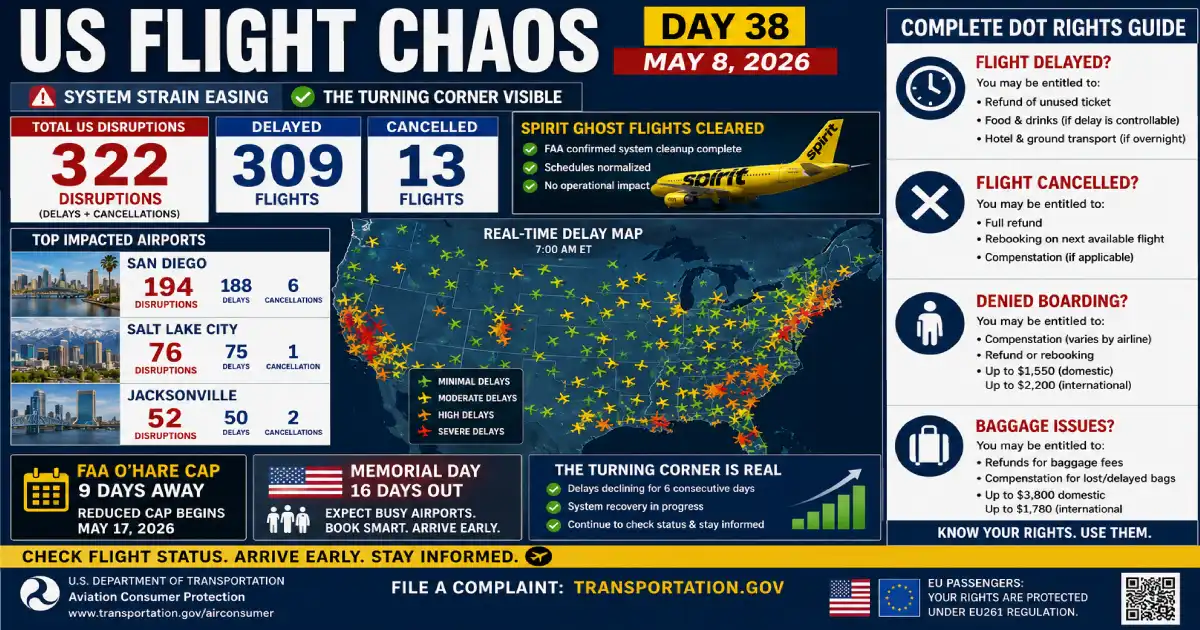
Breaking — May 8, 2026: Day 38 of the longest sustained US aviation disruption streak in modern history looks structurally different from every day that preceded it — and in the best possible way. Today’s most disrupted airports are San Diego (194 disruptions), Salt Lake City (76), and Jacksonville (52) — secondary and regional airports, not the dominant national hubs of Chicago, Dallas, and Atlanta that defined April’s catastrophe. Today there is no O’Hare ground stop. No Dallas cancellation avalanche. No Atlanta Delta meltdown. Spirit Airlines ghost flights are fully cleared from the system. The rescue fare programmes have all expired. The national aviation network, for the first time in 38 days, is showing the structural characteristics of a system in genuine recovery rather than a system in crisis. But “recovery visible” is not the same as “recovered.” Two major countdowns are now accelerating simultaneously that will determine whether the summer travel season is disrupted or manageable: the FAA O’Hare summer flight cap arrives in 9 days on May 17, and Memorial Day weekend — 45 million Americans travelling — is 16 days away on May 23. Here is the complete Day 38 picture, every airport, every carrier, and what the next 16 days mean for every US traveller.
Published: May 8, 2026 — Friday (Day 38 of post-Easter US aviation crisis) Today’s Most Disrupted Airport: San Diego International Airport (SAN) — 191 delays + 3 cancellations = 194 disruptions Second: Salt Lake City International (SLC) — 59 delays + 17 cancellations = 76 total Third: Jacksonville International (JAX) — 42 delays + 10 cancellations = 52 total Worst Carrier at SAN: Southwest Airlines · Alaska Airlines · Delta · United · American (all five major carriers hit) Worst Carrier at SLC: Delta Air Lines · Southwest Airlines · American Airlines Worst Carrier at JAX: American Airlines · Delta Air Lines · Southwest Airlines National Tone: Secondary and regional airports dominating — NOT O’Hare, Dallas, Atlanta Spirit ghost flights: ✅ FULLY CLEARED — no longer registering in national cancellation data All rescue fare programmes: ✅ EXPIRED — JetBlue May 5 · Southwest/American May 6 · United May 16 (still active for Spirit-displaced passengers) FAA O’Hare summer cap: ⏰ 9 DAYS AWAY — May 17, 2026 — 300 fewer peak operations per day Memorial Day weekend: ⏰ 16 DAYS AWAY — May 23, 2026 — 45 million Americans travelling Southwest O’Hare exit: ⏰ 27 days — June 4, 2026 — Southwest permanently leaves O’Hare Day 38 vs Day 32 (worst day): Spirit shutdown day = 4,652 national disruptions. Today = dramatically lower — regional airports only Crisis milestone: 38 consecutive days above normal US disruption baseline — surpassing any stretch outside COVID-19 and September 11 DOT rights: Full cash refund mandatory for all cancellations — 7 business days to credit card
To understand why Day 38 feels different, you need to see today’s disruption pattern against the 38-day arc.
The complete post-Easter national crisis — key milestones:
| Day | Date | National Total | Notable |
|---|---|---|---|
| Day 1 | April 3 (Good Friday) | Elevated | Crisis begins |
| Day 18 | April 18 | 4,651 | Single worst day — O’Hare 718 |
| Day 19 | April 19 | 3,161 | First partial recovery |
| Day 20 | April 20 | 4,310 | Surge back — weather |
| Day 22 | April 22 | 1,808 | First genuine signal — lowest to that point |
| Day 29 | April 29 | 4,662 | Atlanta 1,241 — Delta 1,093 delays |
| Day 30 | April 30 | O’Hare 1,021 | FAA cap ordered |
| Day 32 | May 2 | 4,652 | Spirit ceases operations — worst non-weather day |
| Day 33 | May 3 | 846 | FLL ghost flights + Spirit surge |
| Day 35 | May 5 | 3,248 | National meltdown — FLL/JFK/LAX/DEN |
| Day 36 | May 6 | 723 | Spirit ghost flights fading — rescue fares end |
| Day 37 | May 7 | Denver 335 | Snowstorm — regional, not national |
| Day 38 | May 8 | SAN 194, SLC 76, JAX 52 | ⬅️ SECONDARY AIRPORTS ONLY — turning corner |
Why today’s pattern is genuinely significant:
The disruption is now concentrated at secondary and regional airports — San Diego, Salt Lake City, Jacksonville — rather than the primary national hubs. When O’Hare, Dallas, Atlanta, and Newark are all operating at elevated but manageable levels simultaneously, the cascade mechanism that produced April’s catastrophic days cannot activate. The cascade only becomes national when two or more dominant hubs fail simultaneously. Today, they are not failing simultaneously.
The three structural changes that enabled this:
1. Spirit ghost flights fully cleared. Spirit Airlines ceased operations on May 2. For four days (May 2–6), Spirit’s cancelled flights continued registering in the system as “cancellations” — artificially inflating national cancellation counts and confusing passengers who still had Spirit tickets in their booking systems. As of May 6–7, those ghost flights have been fully expunged. The system is now running on its actual operational reality, not Spirit’s digital ghost.
2. Rescue fare displacement surge absorbed. The surge of Spirit-displaced passengers into alternative carriers peaked in the days immediately after the shutdown, as JetBlue, Southwest, United, and American absorbed hundreds of thousands of rebooked passengers through rescue fare programmes. That surge has now been substantially absorbed into normal booking inventory. Loads at primary hubs are elevated but no longer spike-elevated from rescue fare demand.
3. Post-Easter positioning debt partially resolved. The 38 consecutive days of above-normal disruption generated a massive aircraft and crew positioning debt — planes in the wrong cities, crews at the wrong bases, rest cycles disrupted. Airlines spent May 6–8 on minimal-disruption operating days to restore positioning. Today is benefiting from three days of partial recovery.
Worst disrupted airport in America today — and your site has never published a SAN standalone article
San Diego International Airport descended into operational chaos on May 8, with 191 flights delayed and 3 canceled — disrupting five major US carriers and stranding passengers bound for critical domestic and international hubs. The cascading disruptions underscore the fragility of America’s heavily interconnected aviation system, where a single airport’s infrastructure limitations can send shockwaves across the entire national network within hours.
Why San Diego is particularly vulnerable:
San Diego International Airport — officially known as Lindbergh Field — operates with a single runway. It is the busiest single-runway commercial airport in the United States. This configuration means there is zero redundancy: one runway for arrivals, one runway for departures, sequenced in alternation. When weather, ATC constraints, or maintenance create even a 3-minute-per-aircraft elongation in the landing sequence, the departure queue builds instantly. There is no second runway to absorb overflow.
Average departure delays of 27 minutes compounded across connecting flights to Dallas, Chicago, Denver, Seattle, Las Vegas, Phoenix, New York, and London. The 2026 aviation system across the United States remains under persistent operational stress, with air traffic control capacity facing chronic understaffing.
Carriers most affected at SAN today:
✈️ Southwest Airlines — San Diego is one of Southwest’s highest-frequency West Coast focus cities. Southwest operates 25–30 daily departures from SAN on routes to Las Vegas, Phoenix, Denver, Dallas Love Field, Los Angeles, and Seattle. With its point-to-point network, SAN delays propagate directly into every Southwest city in its Western network without a hub buffer.
✈️ Alaska Airlines — Alaska’s SAN operation covers Seattle (SEA), Portland (PDX), Los Angeles (LAX), and San Francisco (SFO). With SFO’s own ongoing structural capacity problems (FAA parallel runway ban + Runway 1R construction), an Alaska SAN→SFO delay today arrives into an already-constrained San Francisco.
✈️ Delta Air Lines — Delta operates from SAN to Atlanta (ATL) and New York (JFK) — its two primary East Coast hubs. Today’s SAN delays are cascading into Delta’s ATL and JFK arrival banks, adding downstream pressure to those hubs.
✈️ United Airlines — United operates SAN to San Francisco (SFO) and Denver (DEN). The SAN→DEN→EWR connection chain is particularly exposed today: a SAN delay becomes a Denver delay becomes a Newark delay.
✈️ American Airlines — American operates SAN to Dallas–Fort Worth (DFW) and Phoenix (PHX) — routes that are themselves under elevated disruption pressure post-Spirit.
Routes most affected from SAN today:
🇬🇧 UK passengers note: SAN→LHR connections typically route via SFO, LAX, or JFK. Today’s SAN delays affect all three of those transatlantic gateway connections. If you have a SAN→JFK→LHR or SAN→LAX→LHR itinerary today, allow a minimum 90-minute connection at the intermediate hub.
Contact airlines at SAN:
Salt Lake City International Airport is experiencing significant operational setbacks with 59 delays and 17 cancellations, impacting major domestic carriers including Delta, Southwest, and American. Unpredictable seasonal weather patterns, including late-spring snowfall and fluctuating conditions in the Utah region, have historically triggered ripple effects across the national aviation system. Even as conditions on the ground improve, aircraft arriving late lead to cascading delays that persist for hours — the domino effect is particularly damaging for hub airports like SLC where a single late arrival can derail dozens of subsequent domestic routes.
Why SLC matters nationally:
Salt Lake City serves as Delta’s Mountain West hub and a critical Southwest focus city. Delta operates a significant connecting operation through SLC — passengers routing from the Southwest (Phoenix, Las Vegas, Los Angeles) to the Midwest and East Coast (Chicago, New York, Boston) frequently connect through Salt Lake. When SLC is disrupted:
The cancellation proportion is elevated: 17 cancellations out of 76 total disruptions = 22% cancellation rate. This is higher than a typical SLC disruption day. Late-season snowfall in Utah — which the Nomad Lawyer article confirms as a contributing factor — tends to produce cancellations more readily than delays, because SLC’s approach paths through the Wasatch Mountains require visual conditions that snowfall eliminates.
For ski season travellers: May 8 falls during the very final days of Utah’s ski season — Snowbird and Alta both extend into May. Passengers flying home from Salt Lake after ski trips face today’s cancellation-heavy disruption at the end of their holidays. Check your specific flight now before driving to the airport.
Contact Delta SLC: 1-800-221-1212 | delta.com Contact Southwest SLC: 1-800-435-9792 | southwest.com
Jacksonville International Airport faces significant travel setbacks with 42 delays and 10 cancellations. Major carriers including American, Delta, and Southwest are impacted across key domestic routes. Several critical factors are converging: the unpredictable Florida climate, air traffic congestion as passenger volumes continue to climb, and ongoing staffing pressures in critical aviation services that earlier in 2026 contributed to delays at several US airports including JAX.
The post-Spirit Jacksonville story:
Jacksonville was a Spirit Airlines market. Spirit operated routes from JAX to Fort Lauderdale, Orlando, and other Florida cities — providing ultra-low-cost fares for leisure travellers in northeast Florida. With Spirit gone, those passengers have migrated to American, Delta, and Southwest — all three of which are recording delays today at JAX.
This is the post-Spirit fare consequence made visible: American, Delta, and Southwest are carrying elevated loads on routes they previously shared with Spirit’s price competition. Higher loads with the same aircraft capacity means longer boarding times, longer ground times, and more delays.
Key JAX routes disrupted today:
Contact American JAX: 1-800-433-7300 | aa.com Contact Delta JAX: 1-800-221-1212 | delta.com Contact Southwest JAX: 1-800-435-9792 | southwest.com
The Federal Aviation Administration’s ordered summer flight cap at Chicago O’Hare takes effect in 9 days. The cap will reduce peak operations at O’Hare by approximately 300 movements per day — roughly 10–12% of the airport’s normal peak schedule.
What the cap means in practice:
United Airlines and American Airlines — both with massive O’Hare presences — are already adjusting their May/June/July schedules. Routes that operate twice daily from O’Hare may drop to once daily. Routes that United operates from ORD will be partially shifted to other hubs (Newark, Washington Dulles, Denver). American will similarly redistribute some ORD capacity to Dallas and Philadelphia.
The transition risk: The 10-14 day period immediately following a major schedule change is historically the highest-disruption window at any hub. When airlines restructure hundreds of daily rotations simultaneously — new gate assignments, new crew pairings, new aircraft rotation sequences — the probability of cascade failures is elevated. Passengers with O’Hare connections in the week of May 17–24 should build 90-minute minimum buffers.
Southwest exits O’Hare on June 4 — 27 days away. Southwest’s entire ORD operation moves to Midway (MDW), where it has always been dominant. The combined effect of the FAA cap (May 17) and Southwest’s ORD exit (June 4) will restructure Chicago’s aviation landscape more fundamentally than any event since the COVID-19 groundings.
Memorial Day weekend 2026 is the first major US travel holiday since Spirit Airlines ceased operations. Approximately 45 million Americans will travel over the Memorial Day period — by air, road, and rail. For aviation specifically:
The Spirit-shaped hole: Spirit was a significant Memorial Day carrier, operating popular leisure routes to Florida, the Caribbean, and Mexico at ultra-low-cost fares. With Spirit gone, those same passengers are now booking on American, Delta, Southwest, JetBlue, and Frontier at prices that are 30–60% higher. The available seats on Memorial Day weekend are fewer, the fares are higher, and the loads on surviving carriers are at record levels.
The FAA cap timing: The Memorial Day weekend begins exactly 6 days after the FAA’s O’Hare cap takes effect. Airlines will have had less than one week to stabilise their operations under the new reduced-capacity regime before the heaviest travel weekend of the year hits.
What passengers should do right now:
✅ Book now if you don’t have Memorial Day flights yet — availability on Spirit’s former routes is genuinely tight, and prices are rising daily ✅ Build 3-hour airport arrival buffers for Memorial Day weekend departures — not 2 hours, not 90 minutes. Three hours minimum at every major US hub ✅ Avoid O’Hare connections during Memorial Day weekend if your itinerary allows — the FAA cap transition window + peak travel demand at the same hub is the highest-risk single point in US aviation during this period ✅ Book refundable or flexible fares for any Memorial Day 2026 booking — the combination of the cap transition, Spirit’s absence, and 38 days of positioning debt means that flexibility is worth more right now than it has been in years
The last remaining Spirit rescue fare programme — United’s $199 one-way rescue fare — is still available at united.com/specialfares through May 16. This is your final 8 days to access this fare if you are a Spirit-displaced passenger.
If you had Spirit tickets for any future date and have not yet rebooked: ✅ Go to united.com/specialfares NOW — $199 one-way to United destinations ✅ This fare does not require proof of Spirit tickets — it is open to any passenger ✅ After May 16, the rescue fare expires and normal pricing resumes
Under the DOT Automatic Refund Rule: ✅ Full cash refund to your original payment method within 7 business days (credit card) or 20 calendar days ✅ Free rebooking on the next available service — same airline ✅ No vouchers forced — if the airline offers a voucher, say: “I am requesting a full cash refund to my original payment method under the DOT automatic refund rule.”
Today’s cause matters:
At Salt Lake City: Late-season snowfall is a weather cause — airlines can invoke extraordinary circumstances. Duty-of-care (meals, refreshments) may be provided voluntarily but is not legally required for weather-only delays.
At San Diego and Jacksonville: Today’s delays are primarily operational — Spirit displacement loads, ATC constraints, single-runway congestion at SAN. These are operational causes, NOT extraordinary circumstances. Duty-of-care obligations apply more robustly.
| Delay | Right |
|---|---|
| 2+ hours (operational) | Meals, refreshments, communication access |
| 3+ hours | Right to full refund and not to fly |
| 5+ hours | Unconditional refund — leave the airport |
1. SAN passengers: check FlightAware for your inbound aircraft NOW San Diego’s single runway means your inbound aircraft is critical. If it has not yet departed from its previous city, that delay is coming to SAN and adding to the existing 191-delay pile. Go to flightaware.com → your flight number → click tail number.
2. SLC passengers: check for cancellation before driving to the airport With 17 cancellations and late-season Utah snowfall, the probability that your specific SLC flight is cancelled is materially higher than normal. Call your airline before leaving home. A 30-second phone call saves a 45-minute drive to find your flight cancelled.
3. Any O’Hare connection in the next 9 days: build 90-minute minimum With the FAA cap 9 days away and airlines already adjusting gate assignments, crew pairings, and aircraft rotations in preparation, O’Hare is in a transition period that historically elevates cascade risk. Any ORD connection under 90 minutes between now and June 1 is elevated risk.
4. If you are a Spirit-displaced passenger without a new booking: act today United’s $199 rescue fare expires May 16 — 8 days from today. If you still have unresolved Spirit tickets and have not rebooked: go to united.com/specialfares today. After May 16, normal pricing applies and no rescue programme will be available.
5. Memorial Day: book now, book flexible If you do not yet have Memorial Day weekend flights (May 23–26), the window to book at reasonable prices is narrowing. American, Delta, Southwest, and JetBlue Memorial Day inventory is selling out on Spirit’s former routes. Book today — flexible fare — and note that O’Hare is the single highest-risk connecting hub for Memorial Day weekend travel in 2026.
The Bottom Line: Day 38 looks different because it is different. The disruption pattern has shifted from dominant national hub collapse — O’Hare 1,021, Dallas 283 cancellations, Atlanta 1,199 delays — to secondary and regional airport pressure at San Diego, Salt Lake City, and Jacksonville. Spirit ghost flights are gone. Rescue fares have expired. The system is genuinely beginning to stabilise. But the next 16 days carry two of the biggest structural tests the US aviation network has faced since the post-Easter crisis began: the FAA O’Hare cap on May 17 and Memorial Day weekend on May 23. The window to prepare is narrow. Build the connections. Book the flexibility. And if you are still holding unresolved Spirit tickets: United’s $199 rescue fare disappears in 8 days.
For More Resources:
Related Articles:
Posted By : Vinay
This article is provided for general informational purposes only and is based on information available at the time of publication. Travel advisories, airline schedules, airport operations, visa requirements, government regulations, and other travel-related information are subject to change without prior notice. While Travel Tourister makes reasonable efforts to verify information using official announcements, government publications, airline and airport communications, and other reliable sources, we cannot guarantee that all information remains complete, accurate, or up to date at all times. Readers should independently verify any information that may affect their travel plans with the relevant airline, airport authority, government agency, embassy, or other official source before making travel, financial, or other decisions. Travel Tourister shall not be liable for any direct or indirect loss, inconvenience, or damages arising from the use of or reliance on the information contained in this article. Nothing in this publication constitutes legal, immigration, financial, or professional travel advice. If you believe any information in this article is inaccurate or outdated, please contact our editorial team. We review all credible correction requests promptly and update our content whenever appropriate.
Lastest News
2nd Floor, 39, Above Kirti Club, DLF Industrial Area, Kirti Nagar, New Delhi, Delhi 110015



Travel Tourister is a leading Travel portal where we introduce travellers to trusted travel agents to make their journey hasselfree, memorable And happy. Travel Tourister is a platform where travellers get Tour packages ,Hotel packages deals through trusted travel companies And hoteliers who are working with us across the world. We always try to find new and more travel agents and hoteliers from every nook and corners across the world so that you could compare the deals with different travel agents and hoteliers and book your tour or hotel with the one you have chosen according to your taste and budget.
Copyright © Travel Tourister, India. All Rights Reserved

 Call
Call Enquiry