Published on : 30 Jan 2026
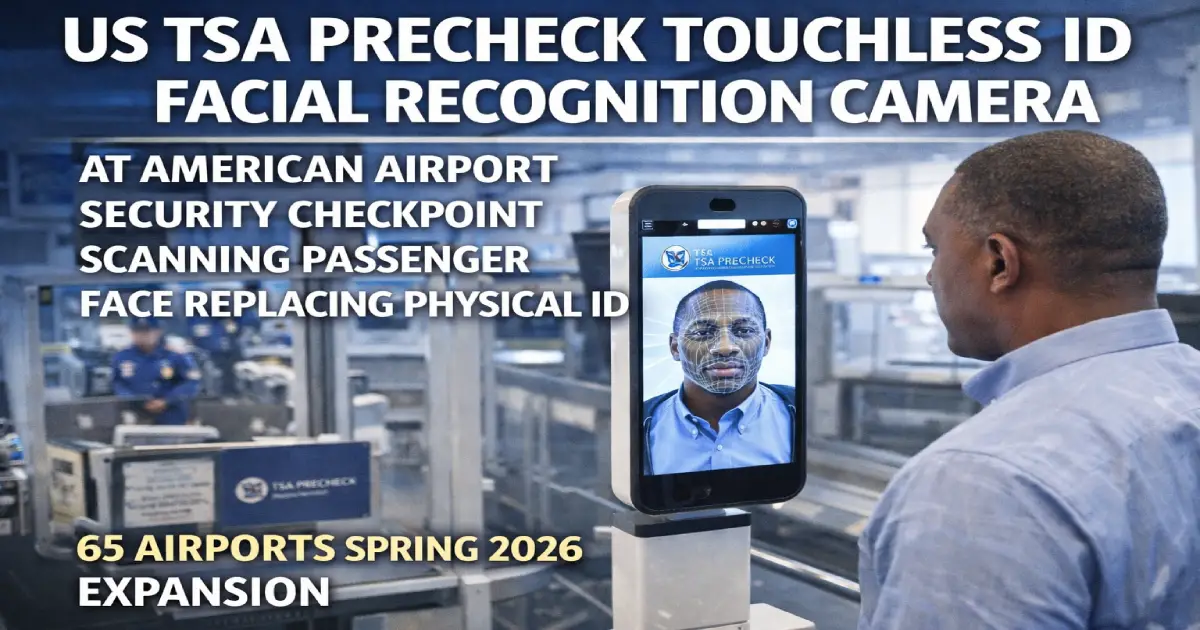
Breaking: The TSA is expanding its controversial facial recognition program to 65 airports by spring 2026—a 433% increase from the current 15 locations. If you fly through Houston, Boston, Miami, or Dallas, you’ll soon skip showing your ID entirely. Just look at a camera. Washington Post broke this story January 28, and airlines are already preparing for the rollout. Here’s what’s changing and why privacy advocates are alarmed.
Published: January 30, 2026 Expansion Timeline: Spring 2026 (March-May) Current Locations: 15 airports New Total: 65 airports (50 new additions) Passengers Affected: 40+ million TSA PreCheck members Privacy Concerns: Massive biometric data collection
The Transportation Security Administration is rolling out TSA PreCheck Touchless ID to 50 additional airports starting spring 2026. The program uses facial recognition technology to verify your identity in 10 seconds or less—no physical ID required.
Key Changes:
✈️ Facial recognition replaces ID checks – Camera scans your face, verifies against passport photo ✈️ Available at 65 airports – Up from current 15 locations ✈️ Opt-in only – Must enroll through airline, not mandatory ✈️ World Cup priority – 2026 FIFA host cities get it first ✈️ PreCheck members only – Regular security still requires physical ID ✈️ Data deleted within 24 hours – TSA claims images not stored long-term
TSA is prioritizing high-traffic hubs and 2026 World Cup host cities for the spring rollout:
Confirmed for Early 2026:
TSA hasn’t confirmed the remaining ~30 airports, but industry sources expect these high-volume hubs:
If you fly through these airports today, Touchless ID is already operational:
The technology replaces the traditional TSA agent examining your driver’s license or passport:
Important: You must still carry a physical REAL ID-compliant license or passport as backup. If the facial recognition fails, you revert to standard ID check.
You can’t just show up and use facial recognition. TSA has strict enrollment requirements:
✅ TSA PreCheck membership – Active $78/5-year or $100 Global Entry membership ✅ Valid passport – Must be uploaded to airline profile (driver’s license not accepted) ✅ Participating airline – Alaska, American, Delta, Southwest, or United ✅ Opt-in confirmation – Must enable through airline app/website ✅ Touchless ID indicator on boarding pass – Shows you’re cleared for the program ✅ Flying from equipped airport – One of the 65 locations with the technology
JetBlue, Spirit, Frontier, Allegiant: Not participating yet—passengers on these carriers cannot use Touchless ID even with PreCheck.
Step 1: Get TSA PreCheck If you don’t have PreCheck, apply at tsa.gov/precheck. Cost: $78 for 5 years. Better option: Global Entry ($100/5 years) includes PreCheck PLUS expedited customs.
Step 2: Upload Valid Passport to Airline Profile Log into your frequent flyer account with American, Delta, United, Southwest, or Alaska. Navigate to profile/passport section. Upload passport information—this is REQUIRED (driver’s license won’t work).
Step 3: Opt-In Through Airline Look for “TSA PreCheck Touchless ID” option in your airline account settings or mobile app. Toggle it ON. Some airlines auto-enroll you if passport is uploaded; others require manual opt-in.
Step 4: Verify Before Flying When you check in for your flight, look for the Touchless ID indicator on your mobile boarding pass. If it appears, you’re cleared to use the dedicated lane.
Step 5: Use Dedicated Lane at Airport At the checkpoint, look for digital screens or signs marking “TSA PreCheck Touchless ID.” Enter this lane (separate from regular PreCheck). Follow camera prompts.
Pro Tip: Enroll NOW before spring rush. When 50 new airports go live simultaneously, airline websites will get slammed with enrollment requests.
TSA’s facial recognition expansion has alarmed privacy advocates, civil liberties groups, and some lawmakers:
1. Massive Biometric Database TSA is building one of the largest facial recognition databases in U.S. history—potentially 40+ million Americans’ biometric data. Even though TSA claims images are deleted within 24 hours, critics question what “deleted” really means.
2. Function Creep “Today it’s opt-in for PreCheck. Tomorrow it’s mandatory for everyone,” warns Senator Jeff Merkley (D-OR), who called the program a “gateway to surveillance state.”
3. Accuracy Problems The Algorithmic Justice League found facial recognition has higher error rates for:
4. No Opt-Out Awareness 99% of passengers using Touchless ID weren’t verbally told they could opt out, according to a 2025 study. TSA agents don’t explain alternatives.
5. Mission Creep Fears TSA promises facial data won’t be shared with law enforcement, immigration, or other agencies. Privacy advocates don’t believe it. Once the infrastructure exists, preventing sharing becomes impossible.
6. Hacking Risks Centralized biometric databases are prime targets for hackers. A breach exposing 40 million facial scans would be catastrophic—you can’t change your face like you can a password.
The agency insists:
Reality Check: Several independent audits found TSA’s deletion claims hard to verify, and the “opt-out” process isn’t clearly posted at checkpoints.
Why is TSA rushing to expand Touchless ID to 65 airports by spring 2026? The World Cup.
The 2026 FIFA Men’s World Cup (June 11-July 19) is expected to bring 5+ million international visitors to the United States. Host cities include:
Notice anything? These are exactly the airports getting Touchless ID priority.
TSA claims facial recognition will speed security lines during the World Cup influx. But critics say it’s using a sporting event as cover to normalize mass biometric surveillance.
Translation: TSA wants this technology fully deployed and normalized BEFORE millions of international travelers arrive—making it politically impossible to roll back once the World Cup ends.
Good news: Touchless ID itself doesn’t cost extra. If you already have TSA PreCheck ($78/5 years), you can use facial recognition at no additional charge.
Hidden costs:
Comparison:
Many premium credit cards reimburse TSA PreCheck or Global Entry fees:
Bottom Line: Touchless ID adds convenience if you already have PreCheck and a passport. But it’s not worth getting PreCheck JUST for facial recognition.
The cameras don’t always work perfectly. Here’s what happens when the match fails:
Common Failure Reasons:
The Backup Process:
Time penalty: 30-45 seconds extra vs. standard ID check—so basically you’re back to normal screening speed.
Pro tip: Update your passport photo every 3-4 years if you use Touchless ID regularly. Dramatic appearance changes confuse the cameras.
If you DON’T have TSA PreCheck, the expansion doesn’t affect you…yet.
Currently:
Future concerns:
If you want to avoid facial recognition entirely:
Bottom line: You can still fly without facial recognition in 2026. How long that lasts is anyone’s guess.
The U.S. isn’t the first country using facial recognition at airports:
Countries Already Using Biometrics:
U.S. Difference:
Trend: Every country starts with “opt-in convenience,” then expands to mandatory within 3-5 years. U.S. likely following same path.
2020: TSA begins facial recognition pilot at 15 airports 2023: Expands to all 15 current locations May 2025: American Airlines launches Touchless ID at 4 airports Late 2025: TSA announces 2026 expansion plans January 2026: Washington Post confirms 65-airport spring rollout Spring 2026: 50 new airports go live June 2026: FIFA World Cup begins—millions use Touchless ID Future: Potential expansion to non-PreCheck lanes, then mandatory?
Jay Stanley, ACLU Senior Policy Analyst: “This is surveillance infrastructure disguised as convenience. Once it’s normalized for PreCheck, it’ll expand to everyone—and eventually be mandatory.”
TSA Spokesperson (January 28, 2026): “Touchless ID improves security and speeds screening. It’s voluntary, privacy-protected, and tested for accuracy across all demographics.”
Senator Jeff Merkley (D-OR): “No one should be required to submit to facial recognition to board a plane. This technology needs strict limits before it becomes Orwellian.”
Travel Industry Consultant: “Passengers love anything that saves time. They’ll trade privacy for 10 seconds of convenience—and TSA knows it.”
Privacy Researcher: “The 24-hour deletion claim is meaningless. Even if true today, what stops TSA from changing the policy tomorrow? Once your biometric data is scanned, you’ve lost control.”
If you’re concerned about facial recognition but still want to fly:
Legal Reality: You can refuse Touchless ID and demand manual ID check. TSA cannot deny you boarding for opting out—it’s your legal right.
Practical Reality: Most TSA agents aren’t trained on opt-out procedures. You may face confusion, delays, or pushback. Remain polite but firm.
TSA PreCheck Touchless ID is separate from airline-specific programs:
Unaffected Programs:
How they layer:
Maximum efficiency: CLEAR + Touchless ID + PreCheck = airport security in under 5 minutes at major hubs.
Cost: $189/year (CLEAR) + $78/5 years (PreCheck) = ~$205/year total for both
Spring 2026 marks a massive expansion of government biometric surveillance disguised as airport convenience. TSA’s Touchless ID will go from 15 to 65 airports—a 433% increase—prioritizing 2026 World Cup host cities.
For passengers, it means:
For privacy advocates, it’s alarming:
The TSA bet: Most Americans will trade facial privacy for 20 seconds of convenience. History suggests they’re right.
Your move: Enroll for speed, or opt-out for privacy. Choose now before the choice disappears.
For More Information:
Related Articles:
Posted By : Vinay
Lastest News
2nd Floor, 39, Above Kirti Club, DLF Industrial Area, Kirti Nagar, New Delhi, Delhi 110015



Travel Tourister is a leading Travel portal where we introduce travellers to trusted travel agents to make their journey hasselfree, memorable And happy. Travel Tourister is a platform where travellers get Tour packages ,Hotel packages deals through trusted travel companies And hoteliers who are working with us across the world. We always try to find new and more travel agents and hoteliers from every nook and corners across the world so that you could compare the deals with different travel agents and hoteliers and book your tour or hotel with the one you have chosen according to your taste and budget.
Copyright © Travel Tourister, India. All Rights Reserved

 Call
Call Enquiry