Published on : 21 Apr 2026
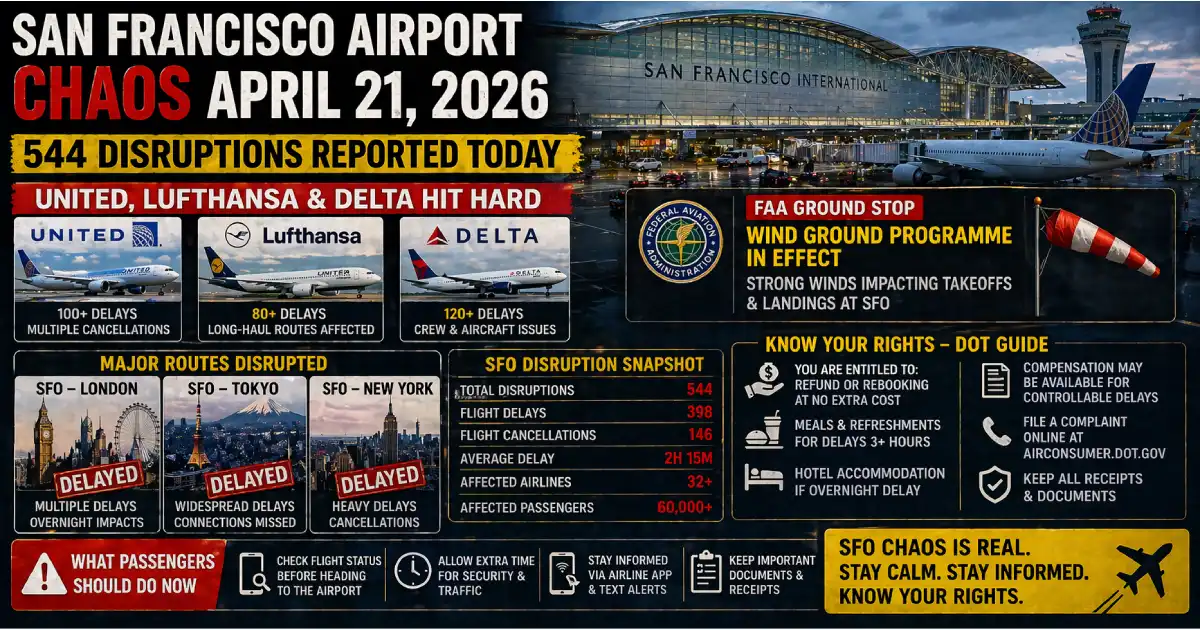
Breaking: San Francisco International Airport is recording one of its worst days of 2026 today — 475 flight delays and 69 cancellations, producing a total of 544 disruptions that are cascading across the national airspace and breaking transpacific, transatlantic, and transcontinental routes simultaneously. The Federal Aviation Administration has activated a wind-related traffic management programme at SFO, slowing arrival flow and forcing departure hold programmes that are rippling into United Airlines’ entire Pacific hub operation. Lufthansa, Delta Air Lines, Air Canada, and international carriers operating SFO’s long-haul transpacific and transatlantic routes are all affected. Flights to and from New York, London, Frankfurt, Chicago, Tokyo, and dozens of other cities are disrupted. Here is every number, every carrier, and exactly what you are owed.
Published: April 21, 2026 — Tuesday Airport: San Francisco International Airport (SFO/KSFO) — San Mateo County, California Today’s Total Disruptions: 544 (475 delays + 69 cancellations) Primary Cause: FAA wind-related Traffic Management Programme — average airborne delays exceeding one hour Contributing Causes: FAA permanent parallel-runway ban (54→36 arrivals/hour) · Runway 1R six-month construction closure (March 30 → October 2026) · Post-Easter national network strain Worst Carrier: United Airlines (dominant SFO hub carrier, ~50% of all traffic) International Carriers Hit: Lufthansa · Delta · Air Canada · British Airways · ANA · Singapore Airlines Routes Broken: New York (JFK/EWR) · London (LHR) · Frankfurt (FRA) · Chicago (ORD) · Tokyo (NRT/HND) · Los Angeles (LAX) · Sydney (SYD) · Seoul (ICN) Context vs April 17: April 17 = 231 disruptions. Today’s 544 = 135% larger — the worst SFO day of the April 2026 crisis National picture: 3,002 delays + 105 cancellations = 3,107 total US disruptions today — SFO is the single worst airport nationally TSA: SFO uses private contractor Covenant Aviation Security — wait times normal (not affected by DHS shutdown) Day: Day 21 of post-Easter US disruption streak
Your site covered SFO’s April 17 chaos at 231 disruptions. Today’s 544 is more than twice as bad. Understanding why requires understanding the four simultaneous pressures that have converged on SFO today.
The FAA has activated a wind-related Ground Delay Programme at SFO today — the acute trigger for the surge above April 17’s numbers. Unlike the marine fog that typically drives SFO delays in the early morning (which dissipates by late morning), wind programmes can persist throughout the entire operating day, hitting all three departure banks equally.
When wind conditions reduce approach speeds and increase required separation between aircraft, the FAA implements what is called a Ground Delay Programme (GDP): aircraft that would normally depart from other US cities toward SFO are held on the ground at their origin airport, absorbing the delay there rather than in the air over San Francisco Bay. This spreads the disruption nationally — an aircraft in Chicago heading for SFO is held at O’Hare until SFO can accept it. That aircraft then departs late. If it’s the inbound aircraft for an SFO→Tokyo departure, the Tokyo flight departs late. If the Tokyo crew has strict rest requirements, a flight might be cancelled entirely.
FAA status reports today confirm that aircraft inbound to SFO are facing average airborne delays exceeding one hour — a far more severe programme than the typical 30-minute marine fog delays seen on fog days. When average airborne delays exceed 60 minutes, the cascade into departures is disproportionate.
Since late March 2026, the FAA has permanently banned simultaneous side-by-side landings on SFO’s two closely-spaced east-west parallel runways (750 feet apart). This restriction cut SFO’s maximum arrival rate from 54 to 36 aircraft per hour — a 33% permanent reduction in capacity that applies every day, regardless of weather.
On a clear, no-wind day, this reduced baseline means SFO already reaches its arrival capacity ceiling earlier in the morning peak than before. When wind then reduces approach speeds further, the airport hits its operational limit faster and the queue builds faster. The wind programme today is not operating on a normal-capacity airport — it’s operating on an airport already running at two-thirds capacity.
SFO’s north-south Runway 1R has been closed since March 30 for a major resurfacing project expected to last until early October 2026. This removes one of the airport’s key runway options for crosswind operations and arrivals from different directions. During a wind programme — when standard runway approaches become more difficult — the closure of Runway 1R eliminates a potential relief valve that controllers would normally use to reroute aircraft onto an alternative approach path.
ABC7 and KQED confirmed the runway is set to reopen October 2, which means this constraint runs directly through the entire summer peak season.
Today is Day 21 of the post-Easter US flight disruption streak. Nationally: 3,002 delays and 105 cancellations. SkyWest leads national cancellations with 52. Southwest leads delays with 473 nationally. The aircraft and crews arriving at SFO from Chicago, New York, Denver, and Atlanta are themselves delayed — meaning every inbound rotation brings a late aircraft. With SFO operating at reduced capacity, late-arriving aircraft cannot recover their schedules by speeding up turnarounds, because gate and taxiway slot availability is equally constrained.
The result: today’s 544 disruptions are the highest single-day total recorded at SFO during the entire April 2026 crisis — surpassing the April 18 chaos (which saw 231) and the April 17 figure that your existing SFO article covered.
United is SFO’s hub carrier, accounting for approximately half of all passenger traffic at the airport. Every SFO wind programme day hits United harder than any other carrier in absolute terms, simply because United has more flights to delay.
Today’s United impact at SFO: United is the single most-disrupted carrier at the airport. Its delay count at SFO today is the largest of any carrier — consistent with its 81-delay performance on April 17, and expected to be higher today given the more severe wind programme.
United’s routes most affected today:
✈️ SFO → New York (JFK/EWR): United’s busiest transcontinental corridor from San Francisco. Multiple daily services. All running delayed today as aircraft positioning from east-to-west morning departures absorbs wind delays at SFO arrival.
✈️ SFO → Chicago O’Hare (ORD): United’s cross-hub route. O’Hare itself has 155 delays and 4 cancellations nationally today — the combined SFO-ORD pressure means passengers on any SFO–ORD routing face compounded delay risk on both ends.
✈️ SFO → Washington Dulles (IAD): United’s East Coast government travel route. Running delayed.
✈️ SFO → Denver (DEN): United’s Mountain hub connection. Aircraft cycling through Denver absorb Denver’s own national network pressure before arriving at SFO for outbound departures.
✈️ SFO → Tokyo Narita (NRT) / Haneda (HND): United’s flagship transpacific routes. These evening departures are the highest-risk flights of the day — they absorb the cumulative cascade of every morning and afternoon delay bank. A wind programme that starts at 06:00 has generated 12+ hours of cascade by the time United’s 18:00–21:00 Tokyo departure bank arrives. Even a 60-minute gate hold for a transpacific departure can cascade into a missed connection for 200+ passengers in Tokyo connecting to Southeast Asia, Australia, or domestic Japan routes.
✈️ SFO → Sydney (SYD): United’s direct Transpacific Australia service. Evening departure, maximum cascade exposure.
✈️ SFO → Seoul (ICN): United Polaris business class route. Running delayed today.
🇦🇺 Australian passengers note: United SFO→SYD is a direct non-stop service. If your SFO–SYD departs late by 2+ hours, document the delay time carefully — this may trigger DOT duty-of-care obligations.
What United passengers should do right now: ✅ Open the United app and check for travel waivers on your booking ✅ Search FlightAware (flightaware.com) for your flight number — click “Tracking” to see where your inbound aircraft currently is and its real-time delay ✅ For connections: United is rebooking passengers via Denver (DEN) and Los Angeles (LAX) to bypass SFO’s capacity constraint — ask United agents about DEN or LAX alternatives if your SFO connection is critically short
Contact United: 1-800-864-8331 | united.com → Manage Reservations → Check Travel Alerts
Lufthansa operates a direct SFO→Frankfurt (FRA) service — one of the few remaining long-haul European routes to operate out of SFO under the current Gulf airspace crisis. With Lufthansa’s transatlantic network still recovering from nine consecutive strike days (April 8–17), the carrier has less aircraft redundancy than normal. A wind-delayed departure from SFO means a late arrival in Frankfurt — and Frankfurt is a tight-connection hub where Lufthansa passengers often have 60–90 minute onwards connections to European capitals.
Today’s Lufthansa impact at SFO: Confirmed disrupted per Travel And Tour World April 21 reporting. Frankfurt-bound service affected. Passengers connecting in Frankfurt to Vienna, Milan, Berlin, Amsterdam, Prague, or Warsaw face the highest missed-connection risk.
Lufthansa compensation note: EU261 compensation applies if you depart SFO on a Lufthansa-operated flight and arrive at Frankfurt 3+ hours late due to an operational cause within the airline’s control (late aircraft positioning, crew issues). Today’s wind programme at SFO, however, is likely to be classified as extraordinary circumstances — meaning the €600 compensation may not apply. But refund and rebooking rights remain unconditional if your flight is cancelled.
Contact Lufthansa: lufthansa.com | US: 1-800-645-3880
Delta operates at SFO on transcontinental and international routes — Atlanta (ATL), Minneapolis (MSP), New York (JFK/LGA), and transpacific services to Tokyo and Seoul. Delta’s ATL hub has its own 180 delays today nationally, compounding the SFO–Atlanta corridor.
Most affected Delta SFO routes today:
Delta’s compensation rule for weather: Delta classifies wind Ground Delay Programmes as weather events — which are typically beyond the airline’s control and exclude the standard delay compensation amounts. However, meals and refreshments at 2+ hours remain a Delta commitment regardless of cause.
Contact Delta: 1-800-221-1212 | delta.com → My Trips → Check Travel Alerts
SkyWest is operating under the worst cancellation pressure of any carrier at SFO today. Nationally SkyWest has 52 cancellations — the highest of any US carrier. At SFO, SkyWest operates the feeder routes from smaller California and Mountain West cities: Sacramento (SMF), Fresno (FAT), Medford (MFR), Santa Rosa (STS), Monterey (MRY), Redding (RDD), Reno (RNO), and others.
When SFO’s capacity drops under a wind programme, these short-hop SkyWest feeder routes are the first to be proactively cancelled — the airport simply cannot process the volume, and regional feeders are lower-priority than long-haul mainline departures.
⚠️ Critical passenger note: SkyWest passengers are ticketed under United Express or Delta Connection. Your ticket says “United” or “Delta.” Contact United (1-800-864-8331) or Delta (1-800-221-1212) directly for rebooking — not SkyWest — because rebooking authority sits with the mainline carrier.
Alaska Airlines is SFO’s second-largest carrier by passenger share after United. Its SFO operation primarily serves West Coast routes (Seattle, Portland, Los Angeles, San Diego) and some transcontinental services. Alaska is recording delays today at SFO, though with generally lower cancellation counts than SkyWest.
Alaska’s most exposed SFO routes today:
Contact Alaska: 1-800-252-7522 | alaskaair.com
Air Canada operates SFO to Toronto Pearson (YYZ) and Vancouver (YVR). Both are critical transborder connections for passengers routing through SFO to Canada. Today’s wind delays at SFO push Air Canada’s afternoon arrivals from Toronto into peak-congestion overlap with United’s evening departure bank.
🇨🇦 Canadian passengers: If you are routing SFO→YYZ or SFO→YVR today, expect delays. Air Canada’s Toronto connection bank typically runs 14:00–17:00 ET — a delayed SFO departure can miss that bank entirely. Contact Air Canada (1-888-247-2262) proactively to request connection protection before you leave for SFO.
Several international carriers operate out of SFO’s International Terminal A:
ANA (All Nippon Airways) SFO→Tokyo Haneda: ANA’s SFO service is one of the primary Japan-connection options for West Coast US passengers. Running delayed today. Tokyo HND connections to Osaka, Sapporo, Fukuoka, and Southeast Asian destinations all at risk.
Singapore Airlines SFO→Singapore: Fully operational as a Singapore Airlines hub-to-hub service. SFO wind delays affect Singapore’s evening departure directly. Singapore Airlines is otherwise unaffected by the Gulf crisis, but today’s SFO wind programme hits its SFO departure.
British Airways SFO→London Heathrow: The SFO–LHR route is one of the most important transatlantic connections from the US West Coast. Running delayed today. EU261 compensation may apply if you arrive at Heathrow 3+ hours late and the cause is determined to be operational rather than weather.
SFO is the primary US gateway for transpacific flights to Japan, South Korea, China, Singapore, and Australia. Understanding the cascade from a wind day to a transpacific cancellation is essential for passengers on Asia-Pacific itineraries.
How a morning wind delay becomes an evening transpacific cancellation:
Morning (06:00–09:00): Wind programme begins. FAA holds inbound aircraft at their origins. First-bank SFO departures to LA, Denver, Chicago start running 30–45 minutes late.
Mid-morning (09:00–13:00): Late inbound aircraft arrive at SFO. Turnaround crews find gates congested. Second-bank departures begin running 60–90 minutes behind.
Afternoon (13:00–18:00): Aircraft that flew morning sectors — the same aircraft United will use for its Tokyo departure tonight — have accumulated 1–3 hours of delay across multiple rotations. Crew rest windows are being eaten into.
Evening (18:00–21:00): United’s Tokyo, Seoul, and Sydney departures are now scheduled on aircraft that have been delayed all day. If the delay on any single aircraft reaches the point where crew rest requirements cannot be met before the transpacific sector, the flight is cancelled outright.
For passengers on SFO–Tokyo, SFO–Seoul, or SFO–Sydney departures today: ✅ Check FlightAware for your inbound aircraft’s current position before leaving home ✅ If the inbound aircraft from its last sector is showing 2+ hours delayed at SFO, add that delay to your expected departure time ✅ Have hotel and alternative routing options ready — a cancelled transpacific flight typically means a 24-hour minimum delay before the next available departure
Today’s chaos is not a surprise to anyone tracking SFO through April 2026. It is the continuation of a structural crisis that has been building since late March.
The three permanent/long-term constraints active simultaneously today:
| Constraint | Start Date | End Date | Daily Impact |
|---|---|---|---|
| FAA parallel-runway ban | Late March 2026 | Indefinite | Arrivals cut 54→36/hour permanently |
| Runway 1R construction | March 30, 2026 | October 2, 2026 | Removes north-south runway flexibility |
| Post-Easter network strain | April 3, 2026 | Ongoing | Late-arriving aircraft from all national hubs |
The wind programme adds to these existing constraints rather than replacing them. On a clear day with no wind, SFO still faces a 33% capacity reduction from the FAA rule and the runway closure. Wind today compressed that reduced capacity even further — producing the 544-disruption figure that is more than twice the April 17 total.
The summer outlook: The Runway 1R construction doesn’t end until October 2. The FAA parallel-runway ban is indefinite. This means every wind day, every fog day, every marine layer morning from now through October will produce disruption at a level that a fully operational SFO would absorb without significant impact. Passengers booking SFO connections for summer 2026 should build 90-minute minimum buffers at SFO for every connection — not the official 45-minute domestic minimum.
Under US DOT automatic refund rules (in effect since April 2024):
✅ Full cash refund to your original payment method — automatically, within 7 business days (credit card) or 20 calendar days (other). No vouchers, no credits unless you specifically request them. ✅ Free rebooking on the next available service to your final destination — same airline or, in some cases, on a partner carrier ✅ Duty of care: Meals and refreshments if the cancellation is within airline operational control. Weather cancellations technically exempt airlines from duty of care — but most major carriers (United, Delta, Alaska) provide meal vouchers voluntarily as a service standard regardless of cause.
The exact words to use at the gate or on the phone: “My flight has been cancelled. Under the DOT automatic refund rule, I am requesting a full cash refund to my original payment method within 7 business days.”
This is where today’s SFO situation gets legally important. The FAA wind ground programme is the primary trigger for today’s disruption — this is a weather-adjacent cause (wind), which airlines will use to argue extraordinary circumstances and avoid delay compensation.
However, many of today’s delays at SFO are not directly caused by wind on the runway. They are caused by:
The practical rule: Ask your airline in writing: “Is this delay caused by weather conditions at SFO today, or by a late-arriving aircraft from another city?” If the airline’s answer is that your specific aircraft was delayed arriving from Chicago due to network strain — that is an operational delay, not a weather delay, and duty-of-care obligations apply more robustly.
Your rights by delay duration:
| Delay | Right |
|---|---|
| 2+ hours | Meals, refreshments, access to communication (phone call/email) — duty of care |
| 3+ hours domestic | Right to full refund and option not to travel |
| 5+ hours | Unconditional right to full refund and departure from the airport |
For EU261/UK261 (if flying Lufthansa SFO→FRA or British Airways SFO→LHR): Compensation (€250–€600) requires the delay to be within the carrier’s operational control. A wind programme will typically be classified as extraordinary circumstances. However, if your Lufthansa or BA flight is cancelled rather than delayed, refund and rebooking rights are unconditional — file immediately.
Action 1 — Check your inbound aircraft on FlightAware before leaving home Go to FlightAware.com, search your flight number, click the tail number to see where your aircraft physically is right now. If it hasn’t departed its origin city, add that departure delay directly to your expected SFO push-back time. This is the most accurate real-time information available.
Action 2 — Check the United app for travel waivers specifically United is the dominant carrier at SFO today. Open the United app → Manage Reservations → look for a “Travel Alert” or “Flexible Rebooking” banner on your booking. SFO wind days often trigger United flight-specific waivers allowing same-day rebooking onto earlier or later departures at no charge. This may not appear automatically — you need to check the app.
Action 3 — Build 90 minutes into any SFO connection today SFO’s official minimum connection is 45 minutes domestic / 60 minutes international. These standards assume normal airport capacity. Today’s wind programme, with average airborne delays exceeding 60 minutes, means any connection shorter than 90 minutes is at elevated risk of a miss. If your connection is under 90 minutes, call your airline now and request rebooking onto a departure with a longer buffer.
Action 4 — If transiting SFO to Asia-Pacific tonight, have a hotel option ready United SFO→Tokyo, SFO→Sydney, SFO→Seoul departures are in the high-risk zone today. The evening departure bank is fully exposed to the cascade from this morning’s wind programme. Research airport hotels near SFO (Hampton by Hilton SFO, SFO Grand Hyatt) and have an alternative routing via LAX or ORD bookmarked in case your transpacific is cancelled. Rebooking transpacific next-day can mean 24 hours at SFO.
Action 5 — Keep all receipts and screenshot all delay notifications Every meal you buy during a delay, every hotel you book if stranded, every rideshare you take because your connection missed — keep the receipt. If your delay is later determined to be operational rather than weather, you can claim these expenses back from your airline through their standard duty-of-care reimbursement process. Submit via united.com/feedback or delta.com/helpcenter within 30 days of travel.
If your SFO flight is cancelled and you need to reach your destination today, two Bay Area alternatives share significant route overlap:
Access: BART from SFO International Terminal → Oakland Coliseum station → AirBART shuttle. Total journey approximately 30 minutes. Cost approximately $12. Who operates from OAK: Southwest, Alaska, United, Frontier, Hawaiian Airlines Best for: Domestic US destinations — Las Vegas, Los Angeles, Phoenix, Denver, Seattle
Access: Rideshare approximately $40–$60. Caltrain from San Francisco to San Jose Diridon, then VTA light rail to airport. Who operates from SJC: American, Alaska, Southwest, United, Delta, Lufthansa (selected routes) Best for: Passengers whose SFO service is cancelled if the same route operates from SJC with a different carrier
⚠️ Important: If your SFO flight is cancelled and you rebook at OAK or SJC on a different carrier, you must first obtain a cash refund from your SFO carrier and purchase the OAK/SJC ticket independently. Airlines will not rebook you to a different Bay Area airport on a different carrier — they will only rebook within their own network.
The Bottom Line: Today’s 544 disruptions make April 21 the single worst SFO day of 2026 so far — 135% worse than April 17, which was itself a significant disruption event. The FAA wind ground programme is the acute trigger, but it’s hitting an airport already at two-thirds of normal capacity because of the permanent parallel-runway ban and the six-month Runway 1R construction. United Airlines’ dominant hub operation at SFO means its transpacific departures to Tokyo, Seoul, Sydney, and Singapore are in the highest-risk window of the day. Check FlightAware before leaving home. Build 90-minute connections. Keep receipts. And if you’re flying transpacific tonight out of SFO, have Plan B ready.
For More Resources:
Related Articles:
Posted By : Vinay
This article is provided for general informational purposes only and is based on information available at the time of publication. Travel advisories, airline schedules, airport operations, visa requirements, government regulations, and other travel-related information are subject to change without prior notice. While Travel Tourister makes reasonable efforts to verify information using official announcements, government publications, airline and airport communications, and other reliable sources, we cannot guarantee that all information remains complete, accurate, or up to date at all times. Readers should independently verify any information that may affect their travel plans with the relevant airline, airport authority, government agency, embassy, or other official source before making travel, financial, or other decisions. Travel Tourister shall not be liable for any direct or indirect loss, inconvenience, or damages arising from the use of or reliance on the information contained in this article. Nothing in this publication constitutes legal, immigration, financial, or professional travel advice. If you believe any information in this article is inaccurate or outdated, please contact our editorial team. We review all credible correction requests promptly and update our content whenever appropriate.
Lastest News
2nd Floor, 39, Above Kirti Club, DLF Industrial Area, Kirti Nagar, New Delhi, Delhi 110015



Travel Tourister is a leading Travel portal where we introduce travellers to trusted travel agents to make their journey hasselfree, memorable And happy. Travel Tourister is a platform where travellers get Tour packages ,Hotel packages deals through trusted travel companies And hoteliers who are working with us across the world. We always try to find new and more travel agents and hoteliers from every nook and corners across the world so that you could compare the deals with different travel agents and hoteliers and book your tour or hotel with the one you have chosen according to your taste and budget.
Copyright © Travel Tourister, India. All Rights Reserved

 Call
Call Enquiry