Published on : 17 Apr 2026
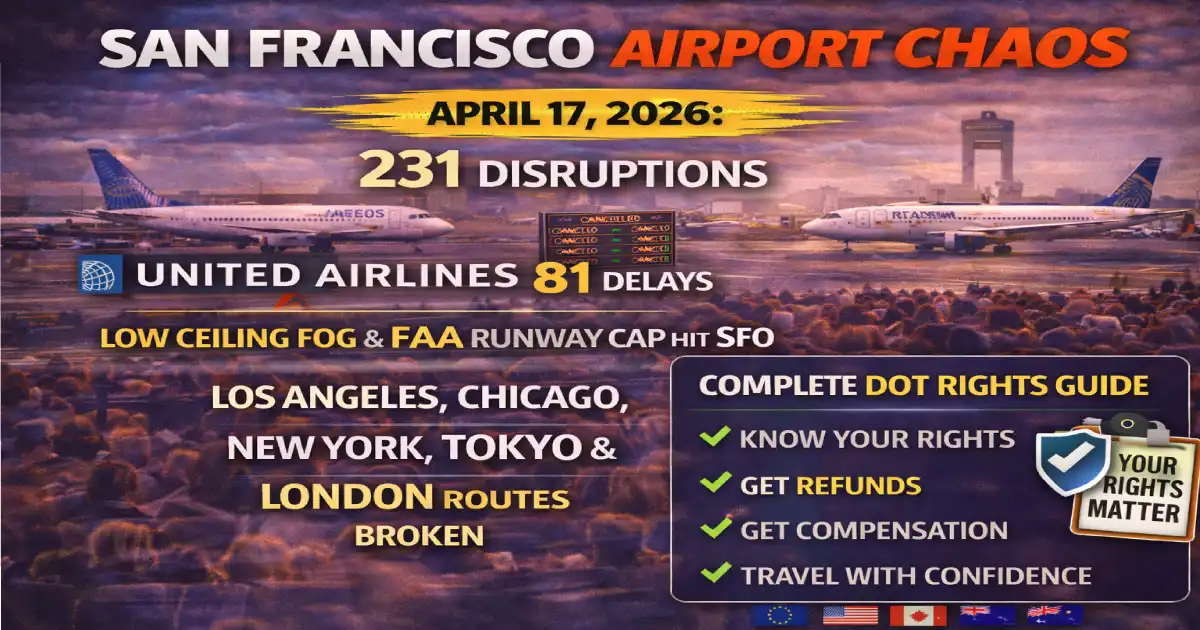
Breaking: San Francisco International Airport (SFO) is recording 224 delays and 7 cancellations today — 231 total disruptions — making it one of the most consistently disrupted airports in the United States this spring. United Airlines, SFO’s dominant hub carrier, is recording the single largest carrier count with 81 delayed flights — representing approximately 19% of the airport’s total delay volume. Delta Air Lines, SkyWest, Southwest Airlines, Air Canada, British Airways, and Lufthansa are all affected across domestic and international routes. Today’s disruption is the product of three forces operating simultaneously: the Bay Area’s chronic low-ceiling marine fog, a new FAA safety rule that has permanently halved SFO’s maximum arrival rate, and ongoing six-month runway construction that has further stripped away the airport’s capacity cushion. Flights to and from Los Angeles, Chicago, New York, Tokyo, London, and major US cities are all disrupted. Here is the complete picture and your full DOT rights.
Published: April 17, 2026 — Friday Airport: San Francisco International Airport (SFO/KSFO) — San Mateo County, California Total Disruptions Today: 231 (224 delays + 7 cancellations) Worst Carrier: United Airlines — 81 delays (19% of total delay volume) Also Hit: Delta Air Lines · SkyWest Airlines · Southwest Airlines · Air Canada · British Airways · Lufthansa Routes Broken: Los Angeles (LAX) · Chicago (ORD) · New York (JFK/EWR) · Tokyo (NRT/HND) · London (LHR) · Major domestic US hubs Cause 1: Bay Area low ceiling / marine fog — classic SFO weather driver Cause 2: FAA new parallel-runway ban — arrivals cut from 54 to 36 per hour (confirmed by KQED/FAA) Cause 3: Runway 1R construction closure — active since March 30, expected through early October 2026 TSA Status: SFO uses private contractor (Covenant Aviation Security) — wait times 10–25 mins (not affected by DHS shutdown) Context: Day 17 of US post-Easter elevated disruption streak
San Francisco International Airport has long held the unwanted distinction of being among the most delay-prone large airports in the United States. To understand today’s 231 disruptions, you need to understand the three layers of structural vulnerability that have converged on SFO in April 2026 — because they are all active simultaneously today and will remain active through at least October.
San Francisco sits on a peninsula at the edge of San Francisco Bay, bordered on three sides by water. The Pacific Ocean to the west drives one of the most predictable and persistent weather phenomena in US aviation: marine layer fog.
Throughout spring, summer, and autumn, a high-pressure system over the Pacific Ocean pushes cold, moist air inland over the Bay Area in the late afternoon and evening — a phenomenon Bay Area residents know as the “fog rolling in.” For aviation, it translates directly into reduced visibility at SFO’s two main east-west runways.
The physics that matter for passengers: SFO’s two parallel runways (28R and 28L) are separated by only approximately 750 feet — far closer than most parallel-runway airports. When visibility is good and conditions are clear, air traffic controllers can authorise simultaneous side-by-side landings, handling up to 60 aircraft arrivals per hour. When low cloud ceilings or fog reduce visibility, the parallel approach is abandoned for safety, and arrivals drop to approximately 30 per hour — cutting capacity by exactly half.
Under normal conditions, this 50% capacity reduction during foggy periods is manageable through morning recovery. But in 2026, SFO no longer has the runway flexibility to recover cleanly from fog periods — because of the two additional structural constraints now compounding on top of it.
In late March 2026, the FAA issued a permanent new safety rule prohibiting simultaneous side-by-side landings on SFO’s parallel east-west runways even in clear weather — when pilots have the other aircraft visually in sight.
This is a significant tightening of previous rules. The FAA confirmed to KQED that the new rule “requires staggered approaches, with one aircraft offset from the aircraft on the parallel runway” and has already led to delays averaging around 30 minutes per affected flight. SFO spokesperson Doug Yakel confirmed the change “will increase the delay potential to approximately 25% of arriving flights experiencing a delay of at least 30 minutes.”
The net effect: SFO’s maximum arrival rate has dropped from 54 to 36 aircraft per hour — a permanent 33% reduction in capacity that applies every single day, regardless of weather. Combined with the existing fog vulnerability, this means SFO on a foggy day can now handle as few as 30 arrivals per hour — exactly half of its previous clear-weather maximum.
The FAA has confirmed it is “exploring ways to safely increase the airport arrival rate” — but no timeline has been given for any relaxation of the new rules. The restriction is indefinite.
On March 30, 2026 — the same week the FAA issued its new parallel-landing rules — SFO closed Runway 1R (the north runway of its north-south pair) for a major resurfacing and infrastructure upgrade. The closure converts Runway 1L to a temporary taxiway, removing one of the airport’s key north-south runway options from service.
The construction project is expected to last approximately six months, with a target reopening in early October 2026. This means the constraint runs directly through the peak summer travel season — the busiest period of SFO’s annual schedule.
The triple convergence today: Low ceiling fog is reducing approach visibility → the FAA’s new staggered-approach rule has already cut maximum arrivals from 54 to 36/hour → the Runway 1R closure has further restricted operational flexibility for diversions and crosswind operations. All three are active simultaneously. The result is today’s 231 disruptions.
United Airlines operates San Francisco as one of its three major domestic hub airports — alongside Chicago O’Hare and Newark Liberty — and as its primary transpacific gateway. United accounts for approximately 50% of all passenger traffic at SFO, giving it the largest absolute exposure to any SFO disruption event.
Today’s 81 United delays at SFO represent 19% of the airport’s total delay volume — the single largest carrier contribution of the day.
United’s SFO route network most affected today:
✈️ Transcontinental — New York (JFK/EWR): United’s busiest SFO corridor. At least 3–4 daily roundtrips operating under delay today. ✈️ Chicago O’Hare (ORD): United’s Midwest hub — delays here cascade into United’s broader domestic network including Minneapolis, Detroit, and Dallas. ✈️ Los Angeles (LAX): United’s intra-California shuttle — high-frequency, tight turnarounds most vulnerable to SFO’s cascade. ✈️ Washington Dulles (IAD): Key East Coast hub connection — government travel market exposed. ✈️ Denver (DEN): Mountain hub — United is rerouting some SFO-delayed passengers through Denver to protect connections. ✈️ Transpacific — Tokyo Narita (NRT) / Tokyo Haneda (HND): United’s flagship transpacific routes depart SFO in the evening — today’s afternoon delay cascade means late push-backs on Japan-bound flights, affecting onward connections to Southeast Asia. ✈️ Transpacific — Seoul (ICN) / Singapore (SIN) / Manila (MNL) / Sydney (SYD): All United’s transpacific routes out of SFO face knock-on cascade from the morning and afternoon delay banks.
🇦🇺 Australian passengers: If you are routing SFO→SYD on United (operated in partnership with Air New Zealand on some services), check your United flight status immediately. A delayed SFO push-back on transpacific services reduces safety margins for the crew rest periods required on ultra-long-haul operations.
United’s adaptive response: United has publicly confirmed it is using Denver and Los Angeles as alternative routing hubs when SFO capacity is squeezed. Passengers on United SFO connections who face missed connections should specifically ask about rebooking via Denver or Los Angeles, as United often has more capacity available at those hubs.
Delta operates from SFO on transcontinental and international routes, including its Los Angeles, Atlanta, New York JFK, Minneapolis, Seattle, and Japan services. Today’s low-ceiling conditions are directly cascading into Delta’s afternoon departure bank — the period when Delta’s SFO operation is most concentrated.
Delta’s transpacific services: Tokyo Narita, Osaka, Seoul, and Manila services all depart SFO in the evening. Afternoon delays push back the final ground preparation for these long-haul departures. A 90-minute gate delay on a Delta SFO→NRT departure can cost connecting passengers in Tokyo an entire day of onward Asia connections.
SkyWest operates at SFO under the United Express, Delta Connection, and Alaska Airlines banners — the regional feeders that bring passengers in from smaller West Coast and Mountain West cities. Today’s SFO restrictions are cascading directly into SkyWest’s short-hop rotations from cities including Sacramento (SMF), Fresno (FAT), Redding (RDD), Santa Rosa (STS), and Monterey (MRY).
For passengers routing from these smaller California and Oregon cities through SFO to major hubs, SkyWest delays today mean the SFO arrival is late, which means the mainline connection is missed. Build a 90-minute minimum connection buffer at SFO for any SkyWest feeder today.
Southwest operates from SFO on domestic routes, primarily to Las Vegas, Phoenix, Denver, Los Angeles, and Seattle. Southwest’s point-to-point network means SFO delays cascade into its afternoon and evening departures without the hub-spoke recovery options available to United. No interline rebooking is available — if Southwest cancels, your options are rebooking within Southwest or a full cash refund.
Air Canada operates from SFO to Toronto Pearson (YYZ) and Vancouver (YVR). With Canada simultaneously recording its own 55 cancellations and 386 delays today (see our Canada flight chaos article), SFO→Toronto passengers face a dual disruption: delayed SFO departure AND disrupted Toronto connection environment.
🇨🇦 Canadian passengers: If your Air Canada SFO→YYZ is delayed today and you have an onward connection in Toronto, contact Air Canada proactively to request connection protection before you leave SFO. Air Canada’s call centre: 1-888-247-2262.
British Airways operates a daily SFO→LHR nonstop — one of the key transatlantic routes for California business and leisure travellers to the UK. Today’s SFO delays are affecting BA’s late-afternoon push-back for the overnight LHR service.
🇬🇧 UK passengers flying SFO→LHR today: If BA’s SFO departure is significantly delayed (3+ hours at final destination), UK261/EU261 may apply — BA is an EU/UK carrier and the delay compensation rules apply to this route. Keep your boarding pass and document the delay time at LHR arrival.
Today’s Lufthansa passengers at SFO face a double disruption: Lufthansa’s cabin crew strike (UFO, April 15–16, still cascading) has left Lufthansa’s Frankfurt hub operating at severely reduced capacity, and today’s SFO low-ceiling delays are pushing back any Lufthansa-operated services from the Bay Area.
If you are booked on Lufthansa SFO→FRA today, check your flight status immediately at lufthansa.com. Free rebooking is available through April 23 under Lufthansa’s extended strike waiver.
Today’s disruption is not an anomaly. It is a preview of SFO’s operating environment for the next six months — and every passenger with a summer 2026 SFO itinerary should factor this into their planning.
The hard timeline:
All three constraints are operating simultaneously through the entire summer peak travel season. United has confirmed it is evaluating schedule adjustments. The FAA has confirmed it is “exploring ways to safely increase the airport arrival rate.” But no specific timelines have been given for relief on either front.
The 25% delay floor: SFO spokesperson Doug Yakel confirmed the FAA restriction alone creates a baseline where approximately 25% of arriving flights will experience delays of at least 30 minutes. That is on clear, fog-free days. On foggy days — which are common in San Francisco from April through September — that percentage rises significantly higher.
The practical implication for summer bookings: If you are booking SFO connections for summer 2026 holidays:
Here is the one genuinely good news story for SFO passengers today: security wait times are 10–25 minutes.
While every other major US airport is struggling with TSA staffing crises driven by the DHS partial shutdown (now in its 61st day, with 500+ officers absent from rosters nationally), SFO is insulated. The airport uses Covenant Aviation Security — a private contractor operating under TSA oversight through the Screening Partnership Program — rather than direct federal TSA employment.
This means: ✅ SFO’s security staffing is not subject to the DHS partial shutdown ✅ No mass resignations from the January salary crisis ✅ Current confirmed wait times: 10–25 minutes across all terminals (confirmed April 17, 2026) ✅ Standard guidance: arrive 2 hours before domestic flights, 3 hours before international
This is a meaningful advantage. At Atlanta, JFK, and O’Hare, TSA queues are running 45–90+ minutes. SFO passengers today face the delays on the runway and in the air — but not at security. Factor this into your airport arrival time.
Immediate unconditional rights under US DOT rules: ✅ Full cash refund to your original payment method — within 7 business days for credit card, 20 calendar days for other payment ✅ Free rebooking on the next available flight to your final destination ✅ Meals and duty of care if the cancellation is within airline control ✅ Hotel accommodation if the cancellation causes an overnight stranding and the cause is operational
The exact words: “My flight has been cancelled. I am requesting a full cash refund to my original payment method under the DOT automatic refund rule.”
Today’s cause matters for compensation:
Weather (low ceiling/fog): The FAA’s capacity restrictions and marine fog that are partly driving today’s delays are weather-based — airlines can claim extraordinary circumstances for weather-caused delays and avoid the duty-of-care obligation in some cases.
Operational cascade (aircraft positioning): However, many of today’s delays at SFO are not directly caused by fog on the runway — they are caused by the network positioning failures from the post-Easter crisis now in its 17th day. An aircraft arriving late from Chicago because of Tuesday’s O’Hare thunderstorm is an operational delay, not a weather delay at SFO today.
The distinction matters:
Ask your airline: “Is this delay caused by weather conditions at SFO today, or by a late-arriving aircraft from another city?” The answer determines your compensation entitlement.
✅ 3+ hour domestic delay: Right to full refund and option not to fly ✅ Operational delays 2+ hours: Meals, refreshments, communication facilities ✅ Weather delays: Rebooking on next available flight; some airlines offer duty-of-care voluntarily even for weather
If you are flying on a European or UK carrier from SFO (British Airways, Lufthansa, Air France, Iberia):
EU261/UK261 applies differently to US departures on EU carriers. For flights departing from a third country (ie, the US) operated by an EU carrier, EU261 applies if the flight arrives at a European airport. That means:
File these claims at the respective airline’s customer relations portal. Time limit: 6 years in England and Wales.
Step 1 — Check your inbound aircraft on FlightAware Most of today’s SFO delays are cascade-driven — your flight’s aircraft has been delayed arriving from somewhere else. Go to FlightAware.com, search your flight number, and check where the aircraft physically is right now. If it has not yet departed its origin, add that delay to your expected departure time at SFO. This is more accurate than any departure board.
Step 2 — Check United’s app specifically for SFO waiver policies United is the dominant carrier at SFO today (81 delays, 19% of total). If you are on United, open the United app and check for any active travel waivers on your booking. United frequently issues SFO-specific waivers during operational disruption periods, allowing fee-free same-day flight changes. A waiver may not appear automatically on your booking — check the “My Trips” section and the travel alerts page (united.com/travelwaivers).
Step 3 — Build 90 minutes minimum into any SFO connection SFO’s official minimum connection time is 45 minutes domestic / 60 minutes international. These standards do not account for the current triple capacity constraint. With the FAA arrival cap, runway closure, and potential fog, connecting through SFO at the official minimums today carries material missed-connection risk. Request a rebooking to a connection with at least 90 minutes if yours is shorter.
Step 4 — Consider Oakland (OAK) or San Jose (SJC) as same-day rebooking targets If your SFO flight is cancelled and you need to reach Los Angeles, Las Vegas, or a West Coast city today, check Oakland International (20 minutes from SFO by BART) or San Jose Mineta (45 minutes south by road). Neither airport faces SFO’s runway constraints. Southwest, Alaska, and United operate from OAK. American, Alaska, Southwest, and United all serve SJC.
Step 5 — Keep all receipts; fog does not excuse all delays today File DOT complaints (airconsumer.dot.gov) and keep receipts for meals and accommodation if you experience a significant operational delay today. While fog itself is a weather exemption, the chain of post-Easter positioning failures contributing to today’s network strain is operational — document your experience carefully. The DOT complaint filing window is 2 years from travel date.
The Bottom Line: San Francisco International Airport’s 231 disruptions today are the visible result of a structural crisis that has been building for weeks. The FAA’s permanent parallel-runway ban, the six-month Runway 1R closure, and today’s marine fog have converged on the busiest day of the post-Easter recovery period. United Airlines, with 81 delays accounting for 19% of SFO’s total disruption volume, is the most exposed carrier — and its transpacific departures to Tokyo, Seoul, and Sydney face the highest cascading risk into Asian and Australian networks. The one advantage SFO passengers have today that travellers at most US airports do not: security is running 10–25 minutes thanks to the airport’s private contractor model. Get through security early, check FlightAware for your inbound aircraft, build 90-minute connection buffers, and document any delay over 2 hours for DOT claims.
For More Resources:
Related Articles:
Posted By : Vinay
This article is provided for general informational purposes only and is based on information available at the time of publication. Travel advisories, airline schedules, airport operations, visa requirements, government regulations, and other travel-related information are subject to change without prior notice. While Travel Tourister makes reasonable efforts to verify information using official announcements, government publications, airline and airport communications, and other reliable sources, we cannot guarantee that all information remains complete, accurate, or up to date at all times. Readers should independently verify any information that may affect their travel plans with the relevant airline, airport authority, government agency, embassy, or other official source before making travel, financial, or other decisions. Travel Tourister shall not be liable for any direct or indirect loss, inconvenience, or damages arising from the use of or reliance on the information contained in this article. Nothing in this publication constitutes legal, immigration, financial, or professional travel advice. If you believe any information in this article is inaccurate or outdated, please contact our editorial team. We review all credible correction requests promptly and update our content whenever appropriate.
Lastest News
2nd Floor, 39, Above Kirti Club, DLF Industrial Area, Kirti Nagar, New Delhi, Delhi 110015



Travel Tourister is a leading Travel portal where we introduce travellers to trusted travel agents to make their journey hasselfree, memorable And happy. Travel Tourister is a platform where travellers get Tour packages ,Hotel packages deals through trusted travel companies And hoteliers who are working with us across the world. We always try to find new and more travel agents and hoteliers from every nook and corners across the world so that you could compare the deals with different travel agents and hoteliers and book your tour or hotel with the one you have chosen according to your taste and budget.
Copyright © Travel Tourister, India. All Rights Reserved

 Call
Call Enquiry