Published on : 22 Apr 2026
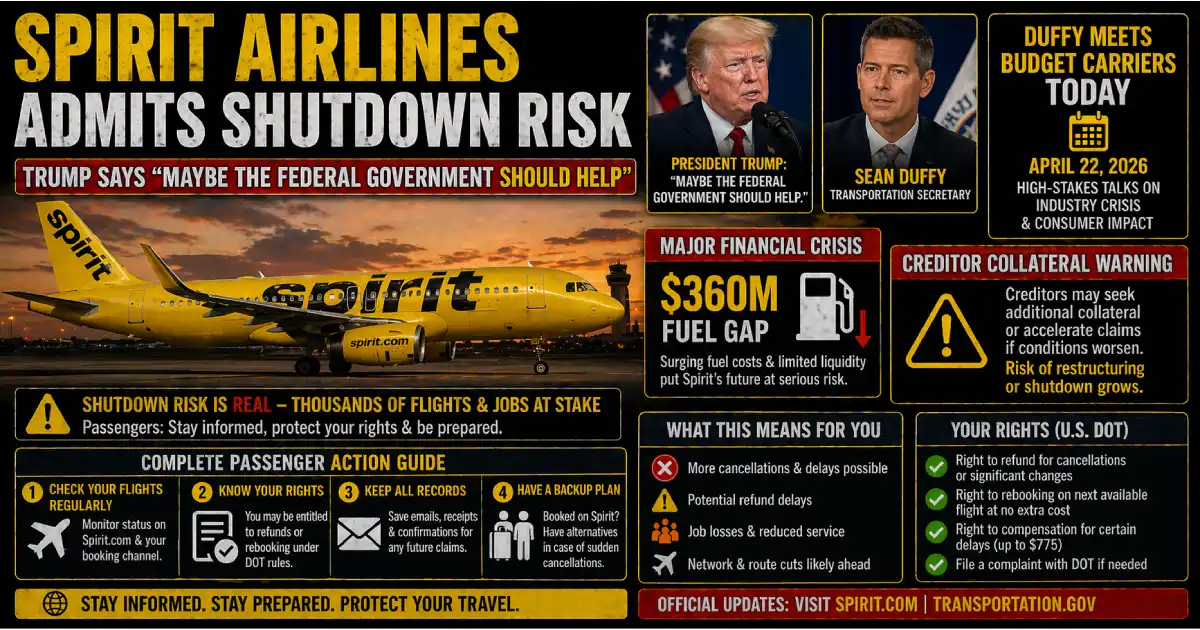
Breaking — April 22, 2026: The Spirit Airlines survival crisis has escalated to the White House. President Donald Trump said in a CNBC interview on Tuesday that the federal government may need to help Spirit Airlines survive — while also calling for a buyer to rescue the carrier. “Spirit’s in trouble and I’d love somebody to buy Spirit. It’s 14,000 jobs,” Trump said. “And maybe the federal government should help that one out.” Transportation Secretary Sean Duffy confirmed Tuesday that President Trump has directed the Department of Transportation to review possible rescue options. “He’s directed us to take a look. I’ll have a conversation with the president later today,” Duffy said — adding that he was also meeting with budget carrier CEOs Tuesday afternoon. That meeting is happening right now. Fuel prices have nearly doubled since Spirit built its restructuring plan. The airline’s incremental cost burden has grown to approximately $360 million — exceeding its total year-end cash balance. If you are holding a Spirit Airlines ticket, boarding pass, credit, or loyalty points today, here is everything you need to know and everything you need to do.
Published: April 22, 2026 — Wednesday Trump statement: “Maybe the federal government should help that one out. It’s 14,000 jobs. I’d love somebody to buy Spirit.” — CNBC interview, Tuesday April 21 Duffy confirmation (Tuesday April 21): “He’s directed us to take a look. I’ll have a conversation with the president later today.” — AP Today’s meeting: Transportation Secretary Duffy met with CEOs from Spirit, Frontier, Allegiant, Sun Country, and Avelo on Tuesday April 21 — confirmed by AP, Reuters, Bloomberg Represented by: Association of Value Airlines (AVA) Spirit’s cash at year-end 2025: ~$273 million (unrestricted) Fuel gap: Assumed $2.24/gallon in restructuring plan → Actual $4.24/gallon mid-April = $2.00/gallon gap Added cost burden: ~$360 million (J.P. Morgan estimate) — exceeds Spirit’s total cash Spirit’s current fleet: ~76–80 aircraft across 70 destinations Spirit’s debt at Chapter 11 entry: $7.4 billion → restructured to ~$2.1 billion Bailout proposal: Equity stake to US government in exchange for emergency cash (modelled on 2025 Intel deal) Creditor warning (Citi-represented, court filings): Whole plan could “unravel quickly” if fuel stays elevated or lenders seize engines and spare parts pledged as collateral DOT advice to Spirit passengers: File credit card chargebacks if flights are not provided; ask airlines for voluntary accommodation Henry Harteveldt (airline analyst), CBS News: “Spirit is flying on financial fumes. I would tell Spirit flyers to start looking for backup reservations just to be on the safe side.” Spirit operating: Still flying as of April 22 — do not cancel travel proactively
This story has moved extraordinarily fast. Understanding the sequence — from CBS’s initial report to Trump’s public CNBC statement in under a week — is essential for any Spirit passenger or travel industry observer tracking events.
February 26, 2026: Spirit announces a Restructuring Support Agreement with creditors. The plan projects exiting Chapter 11 by early summer 2026, operating a fleet of 76–80 Airbus aircraft, and returning to operating profitability by 2027. The entire plan is built on a fuel price assumption of $2.24 per gallon for 2026 — described in a March SEC filing.
February 28, 2026: The US-Israel military campaign against Iran begins. Within days, the Strait of Hormuz — through which roughly 20% of the world’s oil flows — is effectively closed. Jet fuel prices begin surging.
Mid-April 2026: Jet fuel reaches approximately $4.24 per gallon at major US airports — nearly double Spirit’s plan assumption. J.P. Morgan analyst Jamie Baker calculates the impact: at $4.60/gallon for the full year, Spirit’s projected 2026 operating margin collapses from the plan’s +0.5% to approximately -20%. The incremental cost burden reaches approximately $360 million — a figure that exceeds Spirit’s unrestricted cash balance of approximately $273 million at year-end 2025.
April 14, 2026: The Association of Value Airlines — representing Spirit, Frontier, Allegiant, Sun Country, and Avelo — sends a letter to Congressional leaders requesting a temporary suspension of the 7.5% federal excise tax on airline tickets and the $5.30 segment fee. The AVA states that cutting these charges would offset roughly a third of the higher fuel costs for budget carriers. The letter warns: “Absent relief, sustained fuel cost pressures will translate to higher total trip costs for passengers.”
April 17–18, 2026 (CBS News breaks the story): CBS News reports that Spirit has approached the Trump administration for an emergency bailout. A source tells CBS the carrier is “looking for a lifeline.” Analyst Henry Harteveldt tells CBS: “Spirit is flying on financial fumes.” The Air Current is first to report the government outreach.
April 20, 2026 (Bloomberg and WSJ confirm equity stake proposal): Bloomberg and the Wall Street Journal report that Spirit has specifically floated offering the US government an equity stake in the carrier in exchange for emergency cash — modelling the proposal on the Trump White House’s 2025 decision to become one of the largest shareholders in Intel Corporation as part of a domestic strategic initiative. People familiar with the matter confirm the proposal to both outlets.
April 21, 2026 (Trump speaks publicly; Duffy confirms Tuesday meeting): Trump tells CNBC: “Spirit’s in trouble and I’d love somebody to buy Spirit. It’s 14,000 jobs. And maybe the federal government should help that one out.” He does not specify what form of aid would be provided. Transportation Secretary Duffy tells reporters the same day: “He’s directed us to take a look. I’ll have a conversation with the president later today” — and confirms he is meeting with budget carrier CEOs that afternoon. Reuters confirms the meeting participants: Spirit, Frontier, Allegiant, Sun Country, and Avelo.
April 22, 2026 — TODAY: Yahoo Finance publishes: “Spirit Airlines admits it could shut down within days.” The US bankruptcy trustee has separately asked the court to delay Spirit’s Chapter 11 exit, citing insufficient detail in the revised recovery plan. No bailout deal has been announced. No liquidation date has been set. Spirit is still flying.
Understanding why a $2.00/gallon fuel price increase is existential for Spirit requires understanding the economics of ultra-low-cost aviation — a business model built on the thinnest margins in commercial flying.
Ultra-low-cost carriers like Spirit operate on an economics model built around two principles: maximise aircraft utilisation (keep planes in the air as much as possible) and transfer as many costs as possible to optional passenger choices (bag fees, seat selection, snacks). The base fare — sometimes as low as $29 or $39 — is essentially a loss leader. Revenue comes from ancillary charges.
This model only works when operating costs — especially fuel, which represents approximately 40% of an ULCC’s total costs — remain predictable and contained. Spirit’s entire restructuring plan was built on a fuel assumption of $2.24 per gallon, declining to $2.14 in 2027. These numbers were not aggressive — they were based on the fuel market as it stood on February 26, 2026.
| Metric | Spirit’s Plan | April 21 Reality | Gap |
|---|---|---|---|
| Fuel price/gallon (2026) | $2.24 | $4.24 | +$2.00 (+89%) |
| Operating margin target | +0.5% | ~-20% (J.P. Morgan) | -20.5 percentage points |
| Additional 2026 fuel cost | — | +$360M (J.P. Morgan) | $360M unplanned |
| Year-end 2025 cash (unrestricted) | ~$273M baseline | Same | Cash exhausted by fuel gap |
Fortune reported the plan’s actual fuel figure from a March 2026 SEC filing: “$2.24 per gallon in 2026 and $2.14 in 2027.” The gap between that assumption and reality is not a rounding error — it is an 89% increase in fuel costs hitting an airline that was already operating at near-zero margins.
J.P. Morgan’s Jamie Baker put it plainly: at $4.60/gallon (the late-March price), Spirit’s operating margin for fiscal 2026 would fall from the plan’s +0.5% to approximately -20%. The additional $360 million cost burden exceeds Spirit’s $273 million unrestricted cash balance. The numbers simply do not add up.
The most alarming detail in the Spirit Airlines story is not the fuel price — it is buried in court filings from Citi-represented creditors, as reported by Yahoo Finance and ts2.tech.
Citi-represented creditors cautioned in court filings that the whole plan could unravel quickly if fuel prices remain elevated or if lenders start grabbing the engines and spare parts pledged as collateral.
This is the tripwire that could trigger collapse faster than any bankruptcy court calendar. Spirit’s debt restructuring placed aircraft engines and spare parts as collateral against its credit facilities. If creditors determine that the restructuring plan is no longer viable — and the $360 million fuel gap gives them strong grounds to argue exactly this — they can begin exercising their rights over that collateral.
The mechanism is brutal in its speed: a creditor who decides the plan is broken can begin the legal process to repossess engines. Engines are not like office furniture. An aircraft without an engine doesn’t fly. If multiple creditors begin simultaneously exercising collateral rights, Spirit could face a situation where aircraft are grounded faster than any orderly wind-down process could accommodate — leaving passengers stranded with no warning.
This is why Henry Harteveldt told CBS: “If enough creditors decide to pull the plug, operations could cease almost immediately.”
Spirit has proposed offering the US government an equity stake in the airline in exchange for emergency cash — and the precedent it is drawing on is instructive.
The proposal directly models the 2025 Trump White House decision to become one of the largest shareholders in Intel Corporation as part of a domestic semiconductor strategic initiative. In that case, the government took an equity position (ownership stake) rather than making a loan, giving it upside if Intel recovered while providing the immediate cash Intel needed.
Spirit’s pitch to Washington: do the same for aviation’s low-cost sector. The argument:
The counterargument from analysts and the Journal: federal intervention for a single carrier mid-bankruptcy sets a precedent that other struggling carriers would immediately seek to exploit. JetBlue is already feeling fuel cost pressure. Frontier is benefiting from Spirit’s route retreat. The line between a strategic rescue and a bailout of bad corporate decisions is difficult to draw.
DOT spokesperson: The Transportation Department has acknowledged discussions “while also signaling broader concerns about the financial stability of low-cost carriers across the United States.”
Critically: no deal has been announced, no framework has been confirmed, and no Congressional action has been taken.
Spirit is not the only carrier under pressure from the Iran war fuel shock — but it is the one closest to the edge.
Frontier Airlines: The other major US ultra-low-cost carrier is actually reporting a pickup in demand as passengers shifted away from Spirit routes. Frontier has been picking up routes Spirit abandoned out West. However, Frontier faces the same fuel cost environment as Spirit — the difference is that Frontier entered 2026 with a stronger balance sheet and without an active Chapter 11 proceeding.
JetBlue Airways: CEO Joanna Geraghty told employees that fuel costs have made the market “more challenging than we had expected.” She explicitly stated JetBlue is not eyeing bankruptcy in 2026 — but the language of “more challenging” from a carrier that has struggled with profitability since 2022 is notable.
Allegiant and Sun Country: Both attended Tuesday’s DOT meeting. Allegiant operates primarily leisure routes with a leisure-focused pricing model. Sun Country has a hybrid charter/scheduled model. Both are more insulated than Spirit from fuel shocks due to different hedging positions and business mixes.
Avelo Airlines: The small regional carrier also attended Tuesday’s meeting. Less publicly exposed to the immediate Spirit-scale crisis, but watching the tax relief advocacy outcome closely.
The broader implication: If Spirit liquidates, the immediate competitive effect is an increase in fares on Spirit’s primary routes — particularly Fort Lauderdale (FLL), Orlando (MCO), Detroit (DTW), Las Vegas (LAS), and New York area airports. Spirit’s role as a “price disciplinarian” — forcing legacy carriers to keep fares low on routes it serves — would disappear. Passengers on those routes would face higher base fares on American, Delta, and United almost immediately.
The Association of Value Airlines and Spirit’s own advisors have articulated five possible paths forward. Here is the current probability weight on each:
Congress authorises emergency relief (comparable to 9/11 Airlines Stabilization Act or CARES Act aviation support) or the executive branch engineers a direct equity investment comparable to the Intel deal. Spirit receives hundreds of millions in emergency cash and buys time to reach summer peak season. Current probability: Low but non-zero — Trump’s public statement that “maybe the federal government should help” is the most favourable signal yet. No legal framework currently exists for the bailout at the required scale; Congress would need to act.
Congress suspends the 7.5% federal excise tax and $5.30 segment fee on a temporary basis, as the AVA has requested. This would offset approximately a third of the fuel cost increase — not enough to save Spirit alone, but combined with other measures could extend the runway. Current probability: Moderate — has precedent (COVID CARES Act) and bipartisan appeal (lower fares for passengers).
Trump specifically said “I’d love somebody to buy Spirit.” A buyer — most likely Frontier (which already attempted a merger) or a private equity firm — acquires Spirit’s assets in a distressed sale that keeps some operations running under new ownership. Current probability: Moderate — Frontier failed twice before; PE interest in distressed aviation assets is possible but requires confidence the fuel price normalises.
The Iran ceasefire is extended or a more permanent deal is struck, Hormuz reopens sustainably, and oil prices fall back to $75–$80/barrel — reducing jet fuel costs toward the $2.50–$2.75 range Spirit could survive at. Current probability: Uncertain — the ceasefire expires today (April 22) and talks have collapsed. Even if extended, fuel prices would take 4–6 weeks to fall meaningfully.
Creditors determine the plan is not viable, exercise collateral rights over engines and spare parts, and Spirit enters Chapter 7 liquidation. Operations cease. Passengers are stranded. This is the fast-collapse scenario Harteveldt described. Current probability: Elevated — the creditor dynamics, the bankruptcy trustee’s court filing requesting delay, and the mathematical insolvency of the fuel gap all point toward this outcome if no external intervention arrives quickly.
Spirit is currently still operating all scheduled flights. Do not cancel your booking unilaterally — if you cancel voluntarily you lose most passenger protections. But you need to take specific protective actions today.
How you paid matters enormously:
✅ Paid by credit card: You have the strongest protection. If Spirit cancels your flight and does not refund you, your credit card company can issue a chargeback under Section 75 of the Consumer Credit Act (UK cards) or Fair Credit Billing Act (US cards). File the chargeback within 60–120 days of the cancelled flight (varies by card issuer). Do this IMMEDIATELY if your flight is cancelled without a refund.
✅ Paid by debit card: Weaker protection, but many debit cards offer “chargeback” rights under card network rules (Visa/Mastercard). Contact your bank the day after a cancellation — time windows are shorter (typically 120 days from the charge date, not the flight date).
⚠️ Paid with Spirit Flight Flex credits or vouchers: These are the most vulnerable. In a liquidation, credits and vouchers become general unsecured claims in bankruptcy — meaning you queue behind secured creditors (the engine lessors, the Citi-represented lenders) for any recovery. You may receive cents on the dollar, or nothing. If you have Spirit vouchers, use them on bookings in the near term — do not let them sit.
⚠️ Travel insurance purchased before March 2026: Check your policy for “airline failure” or “financial default” coverage. If you bought before the Iran war began, your insurer may not be able to exclude this as a known risk. Call your insurer today and ask directly: “Does my policy cover airline insolvency or liquidation?” Get the answer in writing.
Harteveldt’s advice to CBS — “start looking for backup reservations” — is the single most important thing a Spirit passenger can do. You do not need to pay for backup flights yet. But you should:
✅ Identify the equivalent route on another carrier (American, Frontier, Southwest, JetBlue, Delta) ✅ Find the fully refundable or flexible fare on that route — note the price ✅ Set a price alert so you know if the backup gets more expensive as summer approaches and availability tightens
If Spirit cancels your flight, you will want to book that backup immediately — and Spirit’s collapse, if it happens, will create a surge in demand for competitor seats that will push prices up fast.
The immediate horizon is the highest-risk window. The DOT meeting happened Tuesday. Trump’s statement was Tuesday. The ceasefire expires today (April 22). The next 48–96 hours will determine whether there is a government rescue signal or a creditor escalation signal.
✅ Check spirit.com for any schedule change notices on your specific flight ✅ Download the Spirit app and enable all notifications ✅ Screenshot your booking confirmation, any credits, and your payment receipts today — before any possible disruption ✅ If your Spirit flight is critical (wedding, medical appointment, non-refundable accommodation), book the backup fare now on a refundable basis. You can cancel the backup if Spirit flies — a small cancellation fee is far cheaper than stranded travel
The Department of Transportation has issued specific guidance on what passengers should do if Spirit ceases operations:
✅ Passengers who used credit cards and did not receive flights should promptly file claims with their card issuers — this is the DOT’s own official advice ✅ Stranded passengers can request that other airlines accept their Spirit ticket or offer a cheaper replacement fare — but there is NO requirement for other carriers to comply. This is a voluntary accommodation, not a legal obligation ✅ All Spirit refund requests go through the bankruptcy court — if Spirit enters Chapter 7, refund claims become part of the liquidation process and may take months to resolve at partial value
There is no government travel protection fund for US domestic airline passengers equivalent to the UK’s ATOL. In the US, credit card chargeback is your primary practical protection.
🇺🇸 US passengers: Follow DOT guidance above. Credit card chargeback is your first line of defence. File immediately if any flight is not operated without a refund. DOT complaints: airconsumer.dot.gov.
🇬🇧 UK passengers flying Spirit from US airports: EU261/UK261 does not apply to US domestic carriers. However, if you purchased through a UK travel agent or on a UK credit card, Section 75 or chargeback may apply for credit card protection. Contact your bank.
🇨🇦 Canadian passengers: Air Passenger Protection Regulations (APPR) do not apply to foreign carriers operating domestic US routes. Credit card protection (Visa/Mastercard chargeback) remains your best practical option.
🇦🇺 Australian passengers: ACCC consumer protections may apply if you purchased in Australia. Contact your credit card issuer first. You are unlikely to be holding Spirit tickets for US domestic travel, but if you are connecting Spirit to/from a US gateway, the protections above apply.
Spirit’s Free Spirit loyalty program — points, status, co-branded credit card rewards — faces the same risk profile as the airline itself.
If Spirit restructures successfully: Free Spirit points continue with any adjustments Spirit announces during the process. The airline’s CEO Dave Davis stated in March that “flight bookings, tickets, credits, and loyalty points would all continue as usual.”
If Spirit liquidates: Free Spirit points become worthless. Unlike airline miles held with major carriers that have bilateral transfer agreements, Spirit’s program has no significant transfer partnerships. There is no way to convert Free Spirit points to another programme in a liquidation.
The practical recommendation: If you hold Free Spirit points and have a redemption option available for travel you would actually take, book it now. Don’t let points sit idle while the airline’s survival is uncertain. The alternative — points that survive a restructuring — loses you nothing. The downside — points that become worthless in a liquidation — loses you everything they were worth.
The Bottom Line: The Spirit Airlines story has moved from industry rumour to presidential comment in less than a week — and it happened today. Trump said on CNBC Tuesday the government may help. Duffy met with budget carrier CEOs Tuesday afternoon. Yahoo Finance is headlining “Spirit Airlines admits it could shut down within days.” The airline is still flying as of Wednesday April 22 — but the fuel mathematics are brutal, the creditor collateral warning is the fastest-moving risk, and no rescue deal has been confirmed. If you are holding a Spirit ticket: do not cancel voluntarily, book a flexible backup on another carrier for any critical travel, screenshot all your documentation now, and know that your best protection in a collapse is a credit card chargeback filed immediately. The next 48–96 hours will likely determine whether this ends in a rescue or a run on refunds.
For More Resources:
Related Articles:
Posted By : Vinay
This article is provided for general informational purposes only and is based on information available at the time of publication. Travel advisories, airline schedules, airport operations, visa requirements, government regulations, and other travel-related information are subject to change without prior notice. While Travel Tourister makes reasonable efforts to verify information using official announcements, government publications, airline and airport communications, and other reliable sources, we cannot guarantee that all information remains complete, accurate, or up to date at all times. Readers should independently verify any information that may affect their travel plans with the relevant airline, airport authority, government agency, embassy, or other official source before making travel, financial, or other decisions. Travel Tourister shall not be liable for any direct or indirect loss, inconvenience, or damages arising from the use of or reliance on the information contained in this article. Nothing in this publication constitutes legal, immigration, financial, or professional travel advice. If you believe any information in this article is inaccurate or outdated, please contact our editorial team. We review all credible correction requests promptly and update our content whenever appropriate.
Lastest News
2nd Floor, 39, Above Kirti Club, DLF Industrial Area, Kirti Nagar, New Delhi, Delhi 110015



Travel Tourister is a leading Travel portal where we introduce travellers to trusted travel agents to make their journey hasselfree, memorable And happy. Travel Tourister is a platform where travellers get Tour packages ,Hotel packages deals through trusted travel companies And hoteliers who are working with us across the world. We always try to find new and more travel agents and hoteliers from every nook and corners across the world so that you could compare the deals with different travel agents and hoteliers and book your tour or hotel with the one you have chosen according to your taste and budget.
Copyright © Travel Tourister, India. All Rights Reserved

 Call
Call Enquiry