Published on : 01 May 2026
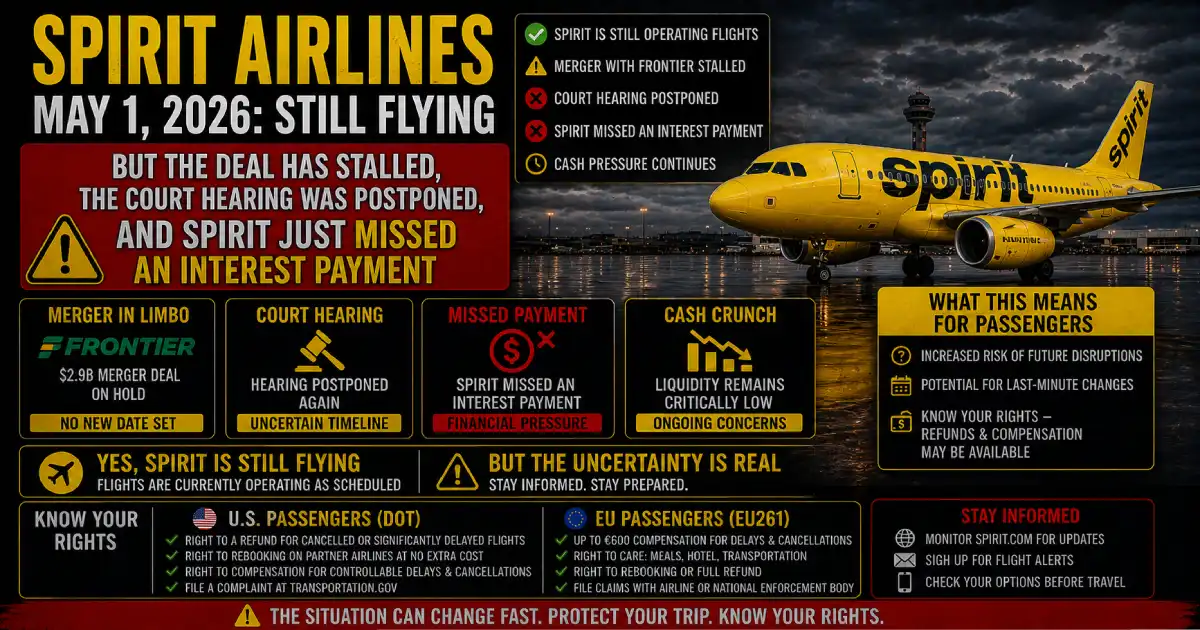
Breaking: Spirit Airlines survived April. It is flying today. But the $500 million government bailout has stalled — the April 30 court hearing was postponed, three creditor groups including Citadel, Ares Management, and Cyrus Capital are blocking the deal, Spirit has missed an interest payment that could trigger a default, and the airline has $250 million in cash it cannot access because creditors have a lien on it. This is your May 1 status check — everything that changed overnight and exactly what to do if you have a Spirit ticket.
Published: May 1, 2026 — Friday Spirit Status: ✅ STILL FLYING — operations not disrupted as of May 1 Deal Status: 🔴 STALLED — no signed agreement, no court approval, no disbursement Court Hearing: April 30 hearing POSTPONED — no new date confirmed Why Postponed: Spirit has not filed a motion to seek court permission to tap the financing — deal terms unresolved Cash Position: $250 million on hand — but creditors hold a lien on all of it Missed Payment: Spirit skipped an interest payment — potential default on DIP agreement Default Enforcement: ❌ Creditors have NOT yet delivered default notice — as of Thursday filing Creditor Split: 2 of 3 creditor groups tentatively supportive — 1 of 3 actively opposing Opposing Creditors: Citadel (Ken Griffin) + Ares Management Corp + Cyrus Capital Citadel Counterproposal: Submitted — rejected by the US government Government Response: “Conversations continuing” — White House says monitoring aviation industry Defense Production Act: Trump administration considering invoking DPA emergency powers to extend loan Transport Secretary Duffy: 🔴 “I don’t have that money” — public opposition unchanged United CEO Kirby: 🔴 “Spirit’s business model was fundamentally flawed” Industry Demand: Association of Value Airlines requests $2.5 billion liquidity pool for Frontier, Avelo, Allegiant, Sun Country + Spirit Fare Impact: 5 industry-wide fare hikes since start of 2026 — passengers paying ~20% more Spirit May Schedule: 9,353 flights — 52% reduction vs May 2025 Jobs at Risk: 17,000+ if liquidation ordered Fastest Refund: Credit card chargeback — “services not rendered” Spirit Refunds: spirit.com/refunds | Bankruptcy court: dm.epiq11.com/case/spirit
The April 30 court hearing that millions of Spirit passengers had been counting on for a verdict never happened.
Spirit Aviation Holdings said in a filing that the Thursday bankruptcy hearing would not be held because the company had not yet filed a motion to seek court permission to tap the potential government financing. Spirit said conversations with lenders and a committee representing the company’s unsecured creditors are continuing.
Bloomberg reported that Spirit Airlines had hit a halt in discussions regarding a possible $500 million US government rescue financing, citing sources. A group of lenders including hedge fund Citadel was fighting back against proposed terms which could significantly erode the value of their claims and limit recovery. Spirit’s rescue funding hit a roadblock just hours after it was reported that the airline had secured the support of two of three of its major creditor groups.
The sequence of April 30 in plain English: early morning reports suggested two of three creditor groups had agreed. Markets and passengers briefly hoped a deal was imminent. Then Bloomberg broke the Citadel resistance story. The court hearing was quietly cancelled via a filing. No vote, no verdict, no disbursement. Spirit went to bed on April 30 exactly where it woke up — in negotiations with no signed deal, no court approval, and no access to the cash it needs to survive May.
Today — May 1, 2026 — Spirit is still flying. It survived April. Whether it survives May depends on what happens in the next 7–14 days.
Ken Griffin’s Citadel submitted a counterproposal, but it was rejected by the government. Two other creditors — Ares Management Corp. and Cyrus Capital — are also opposed to the government plan, two US officials told CBS News.
Understanding who these creditors are and why they are resisting explains why the deal is harder than it looks from the outside.
Citadel is one of the world’s largest and most sophisticated hedge funds, founded by billionaire Ken Griffin. Citadel holds Spirit debt — meaning it is owed money by Spirit and expects to recover that money through the bankruptcy process. The government’s proposed deal structure — which would give the US government up to 90% equity ownership — would subordinate Citadel’s existing debt claims to the government’s new senior position.
The deal would give the government a large stake — up to 90% ownership — in exchange for emergency funding. However, the plan cannot move forward without approval from key creditors, and several major lenders are refusing to agree. Among those opposing the proposal are firms linked to Ken Griffin, whose company submitted a counteroffer that was rejected. Other investment groups, including Ares Management Corp. and Cyrus Capital, have also pushed back, worried the deal would reduce the value of what they are owed.
Citadel’s counterproposal — rejected by the government — was almost certainly an alternative deal structure that protected Citadel’s recovery position while still providing Spirit with some liquidity. The government’s rejection of that counterproposal suggests the White House is not willing to modify the 90% equity structure that makes this deal controversial.
Ares Management is one of the largest alternative asset managers in the world — with over $350 billion in assets under management. Ares holds Spirit debt as part of its credit and direct lending portfolio. Like Citadel, Ares is opposed because the government’s senior creditor position would leave Ares recovering significantly less from Spirit’s eventual reorganisation than it would under an alternative structure.
Cyrus Capital is a New York-based alternative investment firm specialising in distressed debt. Distressed debt investors — the category Cyrus Capital operates in — buy debt from struggling companies at a discount, specifically betting on recovering more than they paid through the bankruptcy process. The government’s deal structure threatens exactly the recovery premium that Cyrus Capital’s investment thesis depends on.
The structural problem: All three opposing creditors are rationally maximising their own recovery. The government’s insistence on 90% equity makes it the senior creditor — meaning the government gets paid before Citadel, Ares, and Cyrus in any recovery scenario. No rational creditor consents to being structurally subordinated to a new creditor that takes 90% of the company.
Last week, it was revealed in a bankruptcy court hearing that Spirit skipped an interest payment, which could put the airline in default on its debtor-in-possession agreement with creditors. The creditors have not delivered notice that they plan to enforce a default, according to a Thursday court filing.
This is the development that changes the risk calculation most significantly. Here is why it matters:
Spirit’s DIP (Debtor-In-Possession) financing — the emergency lending facility that has kept Spirit operating since its Chapter 11 filing — carries contractual terms including interest payment obligations. Skipping an interest payment is a technical default under most DIP agreements. It gives creditors the legal right to declare a formal default, accelerate the loan, and — in the most extreme scenario — force Spirit to cease operations.
Spirit has $250 million in cash, but creditors have a lien on it.
This is the cash trap that explains Spirit’s entire May crisis in one sentence. Spirit has enough money to keep flying. It has $250 million sitting in accounts. But every dollar of that $250 million is legally encumbered by a creditor lien — meaning Spirit cannot spend it without creditor consent. If creditors refuse to release the lien — as they are currently doing by withholding consent on the government deal — Spirit cannot access its own cash to pay its own bills. Including its interest payment.
The creditors, as of Thursday’s filing, have not yet delivered a formal default notice. That restraint — choosing not to accelerate the default — is the single most important reason Spirit is still flying today. But it is a choice that creditors can reverse at any time.
The Trump administration is considering invoking the Defense Production Act’s emergency powers to extend a loan to Spirit, CBS News was first to report last week.
The Defense Production Act (DPA) is a Korean War-era law that gives the President broad emergency powers to direct industrial production and financial resources toward national security objectives. It was most recently invoked during COVID-19 to compel medical equipment manufacturers to prioritise government contracts.
Invoking the DPA for an airline bailout would be unprecedented in the modern era. It would allow the Trump administration to extend the loan to Spirit without going through the normal creditor consent process — bypassing Citadel, Ares, and Cyrus Capital’s veto power over the deal structure. It would be legally aggressive, politically controversial, and constitutionally contested — but it would solve the creditor consent problem overnight.
A White House official said: “The Trump administration continues to monitor the health of the American aviation industry and explore possible options to help passengers and airline employees.”
The DPA option is the ace the White House has not yet played. Whether it will play it — or whether the creditor negotiations eventually reach a signed agreement — is the defining question of Spirit Airlines’ May survival story.
The Association of Value Airlines (AVA), a trade organisation for value airlines, said that its members were working collaboratively and looking for help from the Trump administration. Last week, member air carriers, which include Spirit, Frontier, Avelo Air, Allegiant Air, and Sun Country, met with Transportation Secretary Sean Duffy. AVA says that it has asked for the creation of a $2.5 billion liquidity pool to be used only to offset “incremental fuel costs, as a necessary and targeted measure to stabilise operations and keep airfares affordable.”
Spirit’s crisis is the most acute — but it is not isolated. Every US ultra-low-cost carrier is under severe fuel cost pressure from the Strait of Hormuz closure and the Iran war. The AVA’s request for a $2.5 billion industry-wide liquidity pool is a signal that the problem extends well beyond Spirit: Frontier, Avelo, Allegiant, and Sun Country are all under comparable fuel pressure with less public attention.
The fare impact for ordinary US passengers: Rising jet fuel prices have significantly undermined Spirit’s turnaround plan. The surge in fuel costs, linked in part to geopolitical tensions, has increased operating expenses to a level that some creditors believe makes the current restructuring plan unworkable. The possibility has led others to also ask the government for a bailout.
US domestic fares have risen approximately 20% since the start of 2026 through five separate fare hikes across the industry. Spirit’s collapse — if it occurs — would remove the price anchor that keeps American, Delta, United, and Southwest from charging more on every leisure route Spirit competes on. The passengers who suffer most would be those on exactly the income levels Spirit was designed to serve.
The White House modifies the 90% equity structure enough to win Citadel’s consent. Ares and Cyrus follow. A court hearing is set within 48–72 hours. Spirit accesses $240M+ in restricted cash. Operations continue. The airline enters a formal reorganisation period under partial federal ownership — potentially with a new board member appointed by the government.
What it means for passengers: Spirit survives. Your ticket is valid. May bookings are safe. Watch spirit.com for an official announcement.
The White House bypasses creditor consent entirely by invoking the DPA. The loan is extended unilaterally. Creditors challenge the action in court — likely successfully arguing the DPA does not cover commercial airline bailouts — but the legal challenge takes weeks, giving Spirit a window to reorganise.
What it means for passengers: Spirit continues flying during the legal challenge. Near-term bookings are safe. Medium-term (June+) remains uncertain depending on court outcome.
No full deal is reached this week, but creditors agree to release a limited portion of the liened cash — enough to cover Spirit’s immediate obligations through mid-May. The missed interest payment is cured. Negotiations continue with a new court hearing set for mid-May.
What it means for passengers: Spirit flies through mid-May. The uncertainty extends. Daily monitoring of spirit.com remains essential.
One or more creditors deliver a formal default notice on the missed interest payment. Spirit cannot cure the default without accessing liened cash. The bankruptcy court converts the Chapter 11 reorganisation to Chapter 7 liquidation. Operations cease — potentially within 24–48 hours of a court order.
What it means for passengers: All Spirit flights cancelled immediately. Credit card chargebacks are the fastest refund route. Every Spirit passenger needs a backup flight booked now.
Action 1 — Book a backup flight on another carrier today. American, Southwest, Frontier, Delta, or United for the same route and date. Fares on Spirit’s routes will surge within hours of any liquidation announcement as millions of displaced passengers compete for the same seats. Book the backup now at today’s fares. Most carriers offer 24-hour free cancellation — if Spirit survives the week, cancel the backup.
Action 2 — Verify your payment method. Credit card = chargeback available. Debit card or cash = bankruptcy court claims process (months, partial recovery). If you paid by debit for a high-value Spirit booking, consider switching to an alternative carrier now rather than risking the claims process.
Action 3 — Screenshot your booking tonight. Booking reference, fare paid, route, dates — email to yourself. Spirit’s systems may go offline quickly in a liquidation scenario.
Action 4 — Know your three refund routes:
Book a backup. Same logic as above. A Scenario D liquidation cancels every future Spirit flight on every future date simultaneously — not just the week’s departures.
Check your travel insurance. Policies purchased before today may include airline insolvency coverage depending on your provider and policy terms. Call your insurer and ask specifically.
Do not book new Spirit tickets until a signed deal is court-approved. Every dollar you spend on a new Spirit booking today carries full liquidation risk. Wait for a confirmed court order before booking.
Regardless of your travel date — check spirit.com right now. Look for any service announcement, travel advisory, or operational notice. Spirit will publish the outcome of any deal or default on its official channels before most news outlets can report it. Bookmark the page. Check it morning and evening until this situation resolves.
You are entitled to a full cash refund of your complete ticket price and all fees paid, returned to your original payment method. This is federal law regardless of the reason — including bankruptcy. Spirit cannot offer only a voucher.
State explicitly: “I am requesting a full cash refund to my original payment method under the DOT refund rule.”
If Spirit refuses or is unable to process due to bankruptcy proceedings: file a chargeback with your credit card issuer immediately. File a DOT complaint at airconsumer.dot.gov simultaneously.
Unlike major carriers (American, Delta, United, Southwest), Spirit does NOT have published commitments for meal vouchers or hotel accommodation for airline-caused delays or cancellations. Spirit’s minimum obligations are the DOT statutory requirements only — no voluntary extras.
Posted By : Vinay
This article is provided for general informational purposes only and is based on information available at the time of publication. Travel advisories, airline schedules, airport operations, visa requirements, government regulations, and other travel-related information are subject to change without prior notice. While Travel Tourister makes reasonable efforts to verify information using official announcements, government publications, airline and airport communications, and other reliable sources, we cannot guarantee that all information remains complete, accurate, or up to date at all times. Readers should independently verify any information that may affect their travel plans with the relevant airline, airport authority, government agency, embassy, or other official source before making travel, financial, or other decisions. Travel Tourister shall not be liable for any direct or indirect loss, inconvenience, or damages arising from the use of or reliance on the information contained in this article. Nothing in this publication constitutes legal, immigration, financial, or professional travel advice. If you believe any information in this article is inaccurate or outdated, please contact our editorial team. We review all credible correction requests promptly and update our content whenever appropriate.
Lastest News
2nd Floor, 39, Above Kirti Club, DLF Industrial Area, Kirti Nagar, New Delhi, Delhi 110015



Travel Tourister is a leading Travel portal where we introduce travellers to trusted travel agents to make their journey hasselfree, memorable And happy. Travel Tourister is a platform where travellers get Tour packages ,Hotel packages deals through trusted travel companies And hoteliers who are working with us across the world. We always try to find new and more travel agents and hoteliers from every nook and corners across the world so that you could compare the deals with different travel agents and hoteliers and book your tour or hotel with the one you have chosen according to your taste and budget.
Copyright © Travel Tourister, India. All Rights Reserved

 Call
Call Enquiry