Culebra vs Vieques: Which Puerto Rico Island Is Better? (2026 Guide)
Published on : 06 May 2026
Culebra vs Vieques — Puerto Rico’s Two Outer Islands, Finally Compared Honestly
By Travel Tourister | Updated May 2026
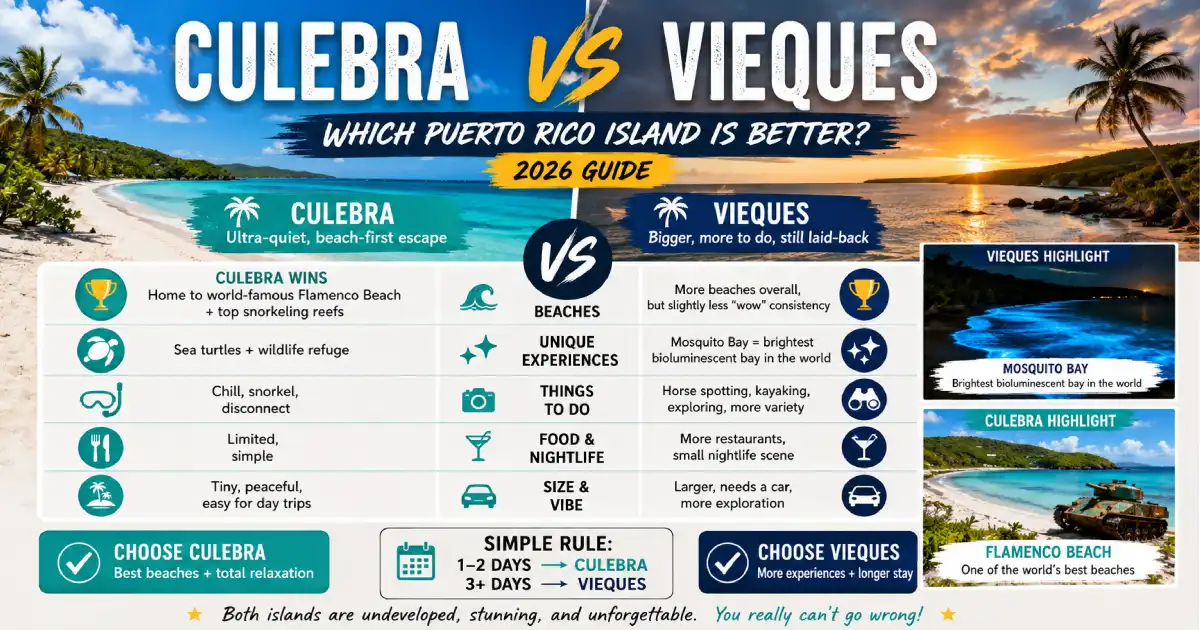
Puerto Rico’s two outer islands — Culebra and Vieques — are the most debated single travel decision in the Caribbean for the specific traveler who has already chosen Puerto Rico and now needs to choose which island to visit, whether to visit both, and how to allocate their limited days between the mainland and the outer islands. They sit 20 miles east of the Puerto Rico mainland, accessible via the same Ceiba ferry terminal, separated from each other by 18 miles of the Vieques Sound, and separated from each other in character by approximately everything that makes a small Caribbean island distinct. Culebra is the most beach-specific: Flamenco Beach, consistently rated among the world’s top 10 beaches, is the single most compelling reason to leave the Puerto Rico mainland, and Carlos Rosario’s shore snorkeling reef is the finest shore snorkeling in the Puerto Rico territory. Vieques is the most experientially layered: the Mosquito Bay bioluminescent bay (the Guinness World Record holder for the brightest bioluminescent bay on Earth), the Vieques National Wildlife Refuge (the largest nature reserve in the Caribbean managed by the US Fish and Wildlife Service, with 17,000+ acres of protected coastal wilderness and 40+ beaches), and the wild paso fino horses that roam the island’s roads and beaches freely constitute a combination of experiences unavailable at any comparable price in any other Caribbean destination.
For the complete Puerto Rico context, see our Things to Do in Puerto Rico and Best Beaches in Puerto Rico guides.
The Most Important Facts First
Key Fact
🏖️ Culebra
🌊 Vieques
Ferry from Ceiba
$4.50 / 90 min
$4.50 / 60 min
Island Size
11 sq miles
51 sq miles — 4.5x larger
Year-Round Population
~2,000
~9,000
#1 Attraction
Flamenco Beach — world top 10
Mosquito Bay — world’s brightest bio bay (Guinness)
Best For
World-class beach + snorkeling day trip
Bioluminescence + wild horses + multi-day
Hotels
Limited — guesthouses, Airbnb, campground
More options — W Hotel, boutiques, rentals
Bioluminescent Bay
No
✅ Mosquito Bay — world’s brightest
Wild Horses
No
✅ Paso fino horses roam freely
Shore Snorkeling
✅ Carlos Rosario — finest in Puerto Rico
Good at Blue Beach; less reef-rich than Culebra
Beach Count
~7 named beaches
40+ beaches inside the NWR
Quick Verdict: Culebra vs Vieques
Category
🏖️ Culebra Wins
🌊 Vieques Wins
Winner
Best Single Beach
Flamenco Beach — world top 10
Red Beach, Blue Beach — wild, pristine, horses
🏖️ Culebra
Shore Snorkeling
Carlos Rosario — sea turtles, coral, fish
Good at Blue Beach — less reef-rich
🏖️ Culebra
Bioluminescent Bay
No bio bay
Mosquito Bay — Guinness World Record
🌊 Vieques (unconditionally)
Wild Horses
No wild horses
Paso fino horses roam freely island-wide
🌊 Vieques (unconditionally)
Beach Variety
7 beaches — Flamenco dominant
40+ NWR beaches — most pristine variety in Caribbean
🌊 Vieques
Best for Day Trip
✅ Flamenco + Carlos Rosario = perfect day trip
Bio bay requires overnight; day trip less rewarding
Culebra: The World’s Best Beach at the Caribbean’s Best Price
1. Flamenco Beach — Why Culebra Exists on Every World Beach List
Why It’s World-Ranked: The horseshoe bay geometry (the hills on both ends creating protected calm swimming conditions), the powder-white coral sand (cool underfoot, fine-grained, produced by the specific Culebra Bank coral), and the turquoise water (the shallow bank’s white sand bottom reflecting sunlight through water carrying almost none of the Mississippi River sediment that colors mainland Puerto Rico brown-green) produce a beach that is, on most days, the most beautiful accessible in any US territory at any price — and accessible for $4.50 (the Ceiba ferry, one way) and $0 (every Puerto Rico beach is constitutionally guaranteed to be publicly free).
Getting there: Ferry from Ceiba terminal — $4.50 each way; book via the ATM Puerto Rico Ferry app; reserve 2–3 days ahead in peak season
From the Culebra ferry dock (Dewey): 10-minute taxi ($3–$4) or 25-minute walk to Flamenco
Facilities: Restrooms, showers, beach chair rental ($15–$20/set), food kiosks, and the Flamenco Beach campground (the most atmospheric beachfront camping in Puerto Rico — $20/night tent, $35/night cabin, reserve at recreation.gov)
Best arrival: First morning ferry (typically 9 AM from Ceiba, arriving Culebra 10:30 AM) — the beach before 11 AM is dramatically less crowded than the same beach at 1 PM when day-trippers from San Juan tours arrive
The WWII tanks: Two rusting US Army tanks at the beach’s western end — graffiti-painted by generations of visitors, left from the Navy’s Culebra training operations before 1975 — the most specifically Culebra detail on any world-ranked beach
2. Carlos Rosario — Finest Shore Snorkeling in Puerto Rico
Carlos Rosario Beach — a 15-minute walk west from Flamenco along the coastal trail — delivers the finest shore-entry snorkeling in Puerto Rico. The reef begins within 20 feet of shore, reaching 15–25 feet at the outer edge, with hawksbill sea turtles (the most reliably encountered large marine wildlife at any Puerto Rico snorkel site — present on most days), blue tang schools, French angelfish, sergeant majors, brain coral, and elkhorn coral. Bring your own gear or rent from the Flamenco kiosk ($10–$15/day). The coastal trail to Carlos Rosario is the most scenic shore hike on Culebra — the Culebra Sound visible to the left, the hill vegetation to the right, the salt-and-sea-grass smell of the outer islands.
Cost: Free (beach access + trail) + $10–$15 snorkel gear rental
The most important sea turtle nesting beach in Puerto Rico — leatherback turtles (the largest sea turtle species, reaching 6 feet in length and 1,500 lbs) nest at Tamarindo from April through July. The Culebra National Wildlife Refuge conducts nightly turtle watches (free, limited spots — sign up at the NWR office in Dewey by 7 PM on the evening you want to join). The most emotionally specific wildlife experience accessible on Culebra.
Cost: Free (NWR program); availability limited — sign up in person at Dewey NWR office
4. Zoni Beach — Most Dramatic Scenery
The northeast-facing beach with the most open Atlantic exposure and the most dramatic scenery — views of the Cayo Norte cay and, on clear evenings, the distant lights of the British Virgin Islands. The most consistent wave energy for bodyboarding on Culebra. No facilities.
5. Culebra Town (Dewey) — The Most Minimal Caribbean Town
Dewey is a single-canal community of ~2,000 residents: a handful of restaurants (Mamacita’s waterfront — most beloved, most complete menu; El Batey bar — most specifically local), a limited grocery (most expensive in Puerto Rico — bring snacks from the mainland), scooter and golf cart rental, and the ferry dock. Bring cash — the Dewey ATM is unreliable. The most minimal small Caribbean town accessible from a major US city in under 4 hours.
Vieques: The Most Experientially Complete Outer Puerto Rico Island
6. Mosquito Bay — The Most Vivid Natural Light Experience in the Western Hemisphere
Why It’s the World’s Brightest: Mosquito Bay’s dinoflagellates (Pyrodinium bahamense) at concentrations of up to 720,000 organisms per gallon produce a blue-green glow visible around every water disturbance: every paddle stroke, every trailing hand, every disturbed fish below the surface. On the darkest new moon nights in summer (June–September, when nights are longest and dinoflagellate populations peak), the bay produces the most vivid bioluminescent display accessible in the Western Hemisphere.
Tour operators: IslandAdventures Biobay Tours (most praised — electric boats with glass viewing areas for non-kayakers, $45–$65/person), Blue Canopy Kayaking ($65–$75/person), Aqua Frenzy Kayaks (most recommended for solo travelers)
New moon timing: Most vivid 3 nights before and 3 nights after the new moon — when the sky is darkest and the bay’s glow is uncompeted by moonlight. Check timeanddate.com/moon before booking; the single most important Vieques trip planning decision
Summer vs winter: June–September = most intense glow (warmest water, peak dinoflagellate population); December–February = clearest water, comfortable kayaking, somewhat less intense bio bay
Booking: Reserve 2–4 weeks ahead in peak season; new moon nights book fastest — the most in-demand single activity in Puerto Rico
Photography: ISO 3200+, 15–30 second exposure, wide aperture — or accept that the experience is for the eyes, not the Instagram feed. Both are fine outcomes.
Cost: $45–$75/person kayak or electric boat tour; new moon night strongly recommended
7. Wild Paso Fino Horses of Vieques
The paso fino horses roaming Vieques freely — descendants of Spanish colonial horses displaced by the US Navy’s 1941–1947 land acquisitions — are the most photogenically extraordinary and the most specifically Vieques wildlife in Puerto Rico. Genuinely wild (feral, not domesticated), belonging to no owner, managed as wildlife by the Puerto Rico DRNA. They walk the island’s roads, appear on beaches at dawn and dusk, wade in the surf at Red Beach and Blue Beach, and constitute the most specifically Caribbean wildlife encounter accessible without a boat or guide at any price.
Most productive encounters: Red Beach at dawn (horses emerge from the tree line 6:00–7:30 AM and walk to the water); the road between Esperanza and the NWR entrance late afternoon; Isabel Segunda main road before 8 AM
Cost: Free — horses are wild and encountered organically
8. Vieques National Wildlife Refuge — 40+ Beaches, 17,000 Acres
The Vieques NWR — administered by the US Fish and Wildlife Service since 2003 after the Navy’s departure — is the largest nature reserve in the Caribbean managed by any US federal agency. The refuge’s 40+ named beaches range from the easily accessible to the genuinely remote:
Red Beach (Bahía Corcho): The most photographically extraordinary beach in Vieques — orange-tinted coral sand, wild horses at dawn and dusk, calm turquoise water. 20 minutes from Esperanza on paved road through NWR. No facilities.
Blue Beach (Bahía de la Chiva): The highest water clarity on Vieques — the most productive snorkeling of any Vieques NWR beach, longest undeveloped beach on a paved road within the refuge. No facilities; bring water.
Sun Bay (Bahía Sun): The most facility-complete Vieques beach — restrooms, camping ($10–$15/night, most affordable in Puerto Rico), food kiosks on weekends. Less pristine than Red or Blue but the most accessible without a car.
Garcia Beach (east end): The most remote and the most pristine — 30-minute drive on unpaved road + 20-minute walk through former Navy range (stay on marked paths). A completely undeveloped beach with no other visitors on most weekdays.
Cost: Free NWR access; car rental required ($45–$65/day) for most NWR beaches
9. Esperanza — Best Small Caribbean Town Waterfront in Puerto Rico
Esperanza’s Malecón (waterfront) — a row of small restaurants and bars on the cliff above the water, with the bio bay visible in the distance and the paso fino horses grazing in the adjacent field at dusk — is the most specifically atmospheric small Caribbean town evening accessible in any US territory.
Bili: The most celebrated Vieques restaurant — rooftop bar on the Esperanza Malecón, finest cocktail program on the island, mofongo and fresh local fish ($25–$45/person)
El Quenepo: The most ambitious farm-to-table dining on Vieques — locally sourced Puerto Rican ingredients in the most refined casual fine dining accessible on the island ($35–$55/person)
Duffy’s: The most reliably local bar — cold Medalla, small-island social culture, no reservation required
10. Isabel Segunda — The Working Town of Vieques
The ferry port and administrative center of Vieques — the only pharmacy, hardware store, and government offices on the island. The most specifically Puerto Rican working town atmosphere accessible on either outer island, with the Spanish colonial fort (El Fortín Conde de Mirasol, the last Spanish fort built in the Americas, museum $2/adult) as the most historically specific attraction accessible from the ferry dock.
Culebra vs Vieques: Day Trip vs Overnight Comparison
11. Culebra as a Day Trip — The Most Rewarding Single-Day Island Excursion in Puerto Rico
The first morning ferry from Ceiba (9 AM, arriving Culebra 10:30 AM) → taxi to Flamenco Beach → morning on a world top-10 beach → 15-minute walk to Carlos Rosario for sea-turtle snorkeling → back to Flamenco for kiosk lunch → afternoon ferry home (4:30 PM from Culebra, arriving Ceiba 6 PM, San Juan by 7:30 PM). Total cost: $9 in ferry tickets, $6–$8 in taxis, $15–$20 beach chair rental, $20–$30 lunch. The most affordable world-class Caribbean beach day accessible from the US mainland.
12. Vieques as a Day Trip — Less Optimal Than Culebra
Vieques is significantly less rewarding as a day trip than Culebra — the primary attraction (Mosquito Bay bio bay) requires an evening stay, the NWR beaches require a car rental to access efficiently, and the horses are most reliably seen at dawn and dusk (requiring overnight timing). A Vieques day trip produces a pleasant NWR beach visit and Esperanza waterfront lunch — genuinely good, but not the specifically extraordinary Vieques experience.
13. Culebra Overnight — Most Relaxed Caribbean Island Camping
The Flamenco Beach campground ($20/night tent, $35/night cabin) or the Culebra guesthouses in Dewey (Casa Ensenada Waterfront Guesthouse and Posada La Hamaca are the most consistently reviewed) produce the most relaxed overnight available. The evening sequence: Mamacita’s dinner → El Batey bar → moonlit walk to Flamenco after the day-trippers have gone → the most specifically peaceful small-island Caribbean evening accessible without an international flight.
14. Vieques Overnight — The Most Experientially Complete Overnight in Puerto Rico
The W Retreat & Spa Vieques ($450–$750/night — the most luxurious accommodation in Puerto Rico outside San Juan), boutique guesthouses in Esperanza (Hacienda Tamarindo, Casa de Amistad), and Sun Bay camping ($10–$15/night) cover every budget tier. The optimal overnight sequence: arrive afternoon → Red Beach sunset + horses → Esperanza dinner at Bili → Mosquito Bay new moon bio bay kayak → Isabel Segunda morning → Blue Beach snorkeling → afternoon ferry home. The most specifically Puerto Rican and the most experientially dense overnight in any US territory.
15. The Ceiba Ferry — Both Islands’ Gateway
Both Culebra and Vieques are accessed from the same Ceiba ferry terminal on the Puerto Rico northeast coast (90 minutes from San Juan by car or público van). The ferries are separate — different docks at Ceiba for Culebra and Vieques, no direct ferry between the two islands. To visit both: return to Ceiba and take a separate ferry to the other island, or fly inter-island on Vieques Air Link or Air Flamenco ($60–$90 one way, 12-minute flight — the most efficient Culebra-to-Vieques transfer available).
Ferry cost: $4.50/person each way; book via ATM Puerto Rico Ferry app; both islands: book return tickets before departing the mainland
Culebra vs Vieques: Cost Comparison
Cost Item
🏖️ Culebra
🌊 Vieques
Ferry (one way)
$4.50
$4.50
Budget overnight
$20 tent / $35 cabin (Flamenco campground)
$10–$15 tent (Sun Bay)
Midrange guesthouse
$95–$165/night
$110–$195/night
Luxury hotel
None available
W Retreat $450–$750/night
Bio bay kayak tour
Not available
$45–$75/person
Beach transportation
$3–$4 taxi (Flamenco is 10 min)
$45–$65/day car rental (essential for NWR)
Total day trip
~$50–$75/person
~$60–$100/person (less rewarding)
Total overnight
~$150–$250/person
~$250–$400/person
More Essential Culebra and Vieques Activities
16. Culebra — Flamenco Beach Camping at Full Moon
The Flamenco campground on the night of a full moon — the beach illuminated by moonlight, the palm trees casting shadows on the white sand, the bioluminescent plankton creating faint sparkles in the breaking waves — is the most specifically atmospheric camping night accessible in any US territory. The full moon at Flamenco is not the bio bay (Vieques wins that category unconditionally) but is genuinely beautiful in a quieter, more accessible way.
Cost: $20/night tent; reserve at recreation.gov
17. Vieques — Horseback Riding Through the NWR
Multiple Vieques operators offer horseback riding tours through the island’s rural landscape and former Navy bombing range — the most specifically immersive wild horse culture experience accessible on the island, distinct from simply watching the feral horses. Riding through the NWR’s coastal trails on a paso fino horse constitutes the most uniquely Vieques activity accessible with a guide ($60–$85/person, 1.5-hour tour).
18. Culebra — Snorkeling and Diving Charters
Multiple Culebra charter operators offer snorkeling and scuba diving trips to the outer reefs and the Culebra Island chain’s underwater sites beyond Carlos Rosario — Flamenco reef, Soldier Key, and the Luis Peña Channel Natural Reserve (the most strictly protected marine area in Puerto Rico) collectively produce the most diverse reef diving accessible from the island ($60–$85/person snorkel charter; $100–$130/person 2-tank dive).
19. Vieques — Kayaking the Mangrove Lagoons
The mangrove lagoons on Vieques’s north coast (accessible by kayak from the Esperanza area via guided tours from the bio bay operators) produce the most serene and the most ecologically specific kayaking accessible on the island outside Mosquito Bay — the mangrove channels, the resident herons and egrets, and the clear shallow water through the root systems constitute the most nature-immersive daytime kayaking on Vieques ($45–$65/person guided mangrove tour).
20. Culebra — Kayaking to Culebrita Island
Culebrita — a tiny uninhabited island 1.5 miles northeast of Culebra accessible by water taxi ($15–$20 round trip) or sea kayak — has the most remote and the most consistently pristine beach accessible from Culebra: Tortuga Beach (tidal pools accessible at low tide, no other visitors on most weekdays) and the 1882 Culebrita Lighthouse (the most historically specific structure accessible from Culebra, abandoned and overgrown, accessible via a 20-minute trail from the beach landing).
June–September (peak bio bay); December–March (clearest water)
Ferry Booking
ATM Puerto Rico Ferry app; arrive Ceiba 30 min early; buy return ticket on arrival in Dewey
Same app, same terminal; book both ways before leaving mainland — return tickets sell out peak season
Getting Around
Golf cart ($50–$75/day) or taxi; walking distance for Flamenco and Melones
Car rental essential ($45–$65/day) — book 1–2 weeks ahead peak season; limited availability
Don’t Miss
Carlos Rosario snorkeling (walk from Flamenco — the most common mistake is not doing this); first ferry arrival at Flamenco
Mosquito Bay on new moon (check lunar calendar — the most important Vieques decision); Red Beach at dawn for horses
Avoid
Arriving without cash (Dewey ATM unreliable); expecting supermarkets to have everything — bring snacks from mainland
Bio bay tour on full moon night (dramatically less vivid); NWR beaches without water + sunscreen (no facilities)
Hurricane Awareness
Both outer islands are more vulnerable than mainland — travel insurance essential June–November; limited evacuation options in storm conditions
Same as Culebra — the most important single pre-trip purchase for June–November outer island visits
Frequently Asked Questions: Culebra vs Vieques
Which Puerto Rico outer island is better — Culebra or Vieques?
Vieques is the more experientially complete Puerto Rico outer island overall — the Mosquito Bay bioluminescent bay, the wild paso fino horses, the 40+ NWR beaches, and the Esperanza waterfront collectively produce a more diverse and more specifically extraordinary multi-day destination. However, Culebra is the better choice for the visitor with only one day available, for the beach purist who prioritizes the world’s finest single beach over the world’s finest bio bay, and for the tightest budget. The honest hierarchy: day trip → Culebra wins. Overnight → Vieques wins. Best of both → visit both.
Do I need to stay overnight to see Mosquito Bay?
Strongly recommended — bio bay tours depart around 7–8 PM and return around 9–10 PM, making the return ferry logistically challenging on most days. The most practical options: (1) Stay overnight on Vieques — most recommended; (2) Take the inter-island flight from San Juan to Vieques for an evening flight in and morning flight back ($60–$90 each way, Air Flamenco or Vieques Air Link, 12 minutes); (3) Some operators offer day-tripper packages with late-afternoon arrival and late-evening ferry return — available but limited and logistically tight.
Is Flamenco Beach or Vieques beaches better?
Flamenco Beach is the single finest beach in Puerto Rico — consistently world-ranked, with the most perfectly combined water color, sand quality, and bay geometry. The Vieques NWR beaches (Red Beach, Blue Beach) are pristine and uniquely photogenic (especially Red Beach with the horses) but do not match Flamenco’s water clarity or sand quality as individual beaches. The comparison: Flamenco wins as the single named beach. Vieques’s 40+ NWR beaches win as a collection. If you can only visit one specific beach: Flamenco. If you want the most diverse beach landscape: Vieques NWR.
What is the best month to visit Culebra and Vieques?
April is the optimal single month for visiting both islands — the dry season is fully established, the Easter spring break crowd peak has passed, the leatherback sea turtle nesting season begins at Culebra’s Tamarindo Beach, the Vieques bio bay delivers good (though not peak summer) intensity, and hotel pricing is below the December–March high season. For peak bio bay specifically: June–September on a new moon night. For peak beach conditions: December–March (driest, clearest water). Avoid Easter weekend on both islands — the most crowded single event of the year, with campground capacity reached and ferry reservations sold out weeks ahead.
Can I visit both Culebra and Vieques on the same trip?
Yes — and if your Puerto Rico itinerary includes 7+ days, visiting both produces the most complete outer island experience. The most efficient combined itinerary: San Juan 2 days → Culebra 1 day trip (first morning ferry, Flamenco + Carlos Rosario, last ferry return to Ceiba) → Vieques 2 nights (arrive Vieques next day, Red Beach + bio bay new moon night, Blue Beach morning, afternoon ferry) → San Juan 1 final day. The Culebra-to-Vieques transfer requires returning to Ceiba and taking a separate ferry (half-day transfer) or flying inter-island ($60–$90, 12-minute Air Flamenco flight — the most time-efficient transfer).
Final Verdict: Culebra vs Vieques
Culebra and Vieques serve genuinely different Puerto Rico traveler priorities — and the most honest final verdict depends entirely on what you came for. The single-sentence summary for each:
Choose Culebra if you want the world’s finest beach at the Caribbean’s most democratic price — Flamenco Beach for $4.50 in ferry fare and $0 in beach admission (constitutionally guaranteed to be free), the Carlos Rosario snorkeling reef where a hawksbill sea turtle may come within arm’s reach of your mask without a guide or a fee beyond your swim fins, and the most specifically unhurried and the most completely beach-immersed small-island Caribbean experience accessible in any US territory. Culebra is the correct choice for the day tripper, the beach purist, the budget camper, and the visitor who wants the single most rewarding beach day accessible from the United States without an international flight. It is an 11-square-mile island with the world’s best beach, excellent snorkeling, one reliable bar, and a ferry that costs $4.50. That is exactly what it is, and it is enough, and it is genuinely extraordinary.
Choose Vieques if you want Mosquito Bay on a new moon night — the most vivid natural light experience in the Western Hemisphere, the Guinness World Record holder for the brightest bioluminescent bay on Earth, the experience that no photograph has ever adequately captured and no verbal description has ever fully conveyed and no visitor who has done it on the right night has ever forgotten. And the paso fino horses at Red Beach at dawn. And the Garcia Beach solitude. And the Bili rooftop dinner on the Esperanza Malecón. Vieques is the correct choice for the overnight visitor, the bio bay seeker, the wild horse photographer, and the beach explorer who wants 40 beaches instead of one. The bio bay requires the lunar calendar coordination that most visitors forget and that makes the difference between the Guinness Record brightness and a very pleasant but significantly less dramatic paddle. Check the moon phase. Book the tour on the new moon. Arrive on the ferry in the afternoon. Watch the horses at sunset. Paddle into the glow at midnight. This is the most specifically extraordinary night available in any US territory at any price.
Visit Culebra first — the day trip is efficient, the beach is world-class, and the ferry costs $4.50. Stay on Vieques next — check the lunar calendar, book on the new moon, and understand that the bio bay on the right night is worth every dollar and every planning decision it took to get there. Both islands are genuinely extraordinary. Puerto Rico’s constitution guarantees that every beach on both of them is free. The ferry costs $4.50 each way. Take it.
—
For the most current visitor information, ferry schedules, wildlife refuge access, and travel planning resources for Culebra and Vieques, consult these official government sources:
Recreation.gov — Official US Federal Government Reservation System — Official US government reservation platform for the Flamenco Beach campground on Culebra (tent $20/night, cabin $35/night), Sun Bay camping on Vieques, and all Puerto Rico NWR camping reservations.
—
About Travel TouristerTravel Tourister’s Puerto Rico specialists have visited both Culebra and Vieques across multiple trips and seasons — from Flamenco Beach on the first morning ferry and Carlos Rosario’s hawksbill sea turtle encounters to Mosquito Bay new moon kayaking and Red Beach wild horse dawns — to provide the most honest and most specific comparison for Puerto Rico visitors choosing between the territory’s two most extraordinary outer islands.Need help planning your Culebra and Vieques itinerary? Our specialists can help you time Mosquito Bay on the optimal lunar phase, coordinate the Culebra-to-Vieques transfer, find the best budget accommodation, and build the most productive Puerto Rico outer island itinerary.
Posted By : Vinay
As a lead contributor for Travel Tourister, Vinay is dedicated to serving our Tier 1 audience (US, UK, Canada, Australia). His mission is to deliver precise, fact-checked news and actionable, data-driven articles that empower readers to make informed decisions, minimize travel risks, and maximize their adventure without compromising safety or budget.
Travel Tourister is a leading Travel portal where we introduce travellers to trusted travel agents to make their journey hasselfree, memorable And happy. Travel Tourister is a platform where travellers get Tour packages ,Hotel packages deals through trusted travel companies And hoteliers who are working with us across the world. We always try to find new and more travel agents and hoteliers from every nook and corners across the world so that you could compare the deals with different travel agents and hoteliers and book your tour or hotel with the one you have chosen according to your taste and budget.




 Call
Call Enquiry