Glacier National Park vs Yellowstone: Which Should You Visit in 2026?
Published on : 07 May 2026
Glacier vs Yellowstone — Alpine Glaciers vs Geothermal Wonderland: The Decision 5 Million Americans Make Every Year
By Travel Tourister | Updated May 2026
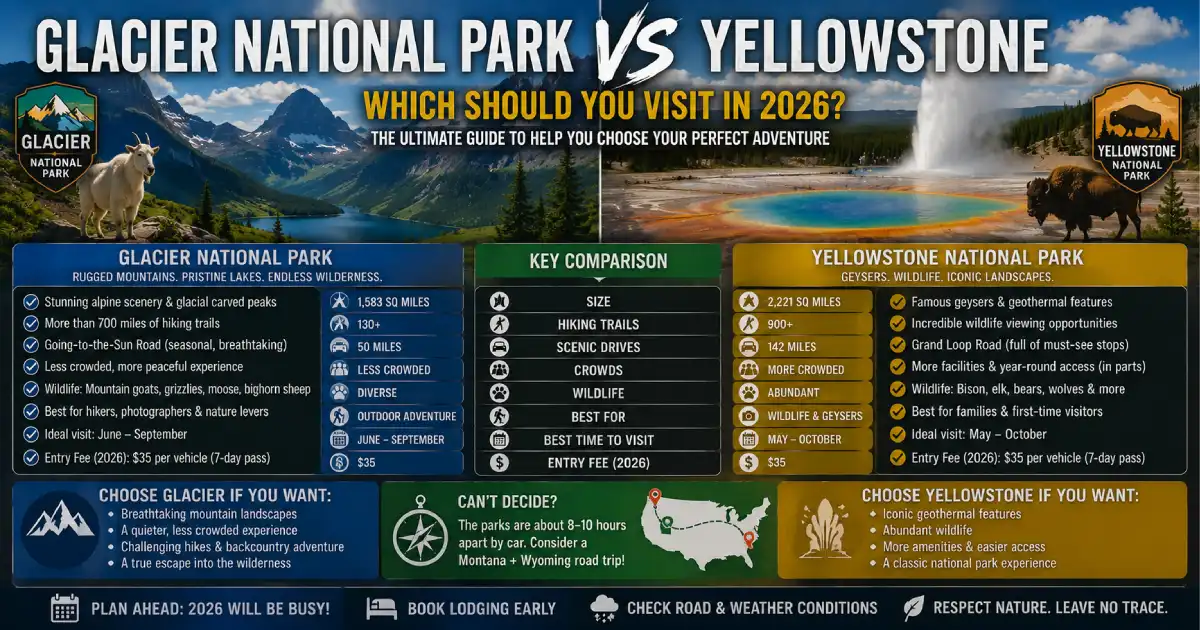
Glacier National Park and Yellowstone National Park are the two most-searched national parks in Montana and the Greater Yellowstone region — and they represent opposite sides of the most fundamental national park experience question: do you want glacially-carved alpine peaks with turquoise lakes and the Going-to-the-Sun Road engineering marvel, or do you want the world’s first national park with Old Faithful, 10,000+ geothermal features, and Lamar Valley wildlife densities rivaling the Serengeti? Glacier sits in Montana’s northwest corner — 1 million acres, 26 remaining glaciers (down from 150 in 1850), Going-to-the-Sun Road crossing the Continental Divide, grizzly bears and mountain goats on alpine trails, and the Crown of the Continent ecosystem spanning Canada. Yellowstone straddles the Montana-Wyoming-Idaho border — 2.2 million acres, the Yellowstone Caldera supervolcano producing 10,000+ geothermal features including Old Faithful (erupting every 90 minutes), Grand Prismatic Spring’s rainbow colors, Lamar Valley’s wolf packs and bison herds, and America’s first national park designation in 1872 protecting the most concentrated geothermal landscape on Earth.
The distance question alone surprises millions of first-time Montana visitors: Glacier to Yellowstone = 390 miles / 7+ hours driving (NOT close despite both being “Montana parks”), meaning you cannot casually visit both on a week-long trip without spending 14 hours total in the car just connecting parks. But for the 4+ million annual visitors who choose one park over the other, the comparison goes deeper — into seasonal access (Going-to-the-Sun Road open mid-June to mid-September only vs Yellowstone’s North entrance Gardiner open year-round), wildlife density (Glacier’s mountain goats and grizzlies vs Yellowstone’s 5,000 bison and 500+ wolves), geothermal uniqueness (Yellowstone’s 10,000 features exist nowhere else at this scale globally), alpine drama (Glacier’s glacially-carved peaks create North America’s most dramatic mountain scenery), crowds (both increasing but Yellowstone receives 4.5 million visitors vs Glacier’s 3 million), and accessibility (Yellowstone’s loop roads allow driving between attractions vs Glacier’s hiking-required backcountry).
This guide breaks down every meaningful category honestly and delivers the clearest verdict on which national park is right for your specific trip priorities in 2026.
For complete guides, see our Things to Do in Montana, Best Places to Visit in Montana guides.
The Most Important Facts First
Key Fact
🏔️ Glacier National Park
🌋 Yellowstone National Park
Location
Northwest Montana (Canadian border)
Wyoming (mostly), Montana, Idaho corners
Size
1 million acres (4th-largest US national park)
2.2 million acres (larger than Delaware + Rhode Island)
Glacier National Park to Yellowstone National Park = 390 miles / 7+ hours driving time (West Glacier to Gardiner North entrance the shortest route). This is the most commonly underestimated single fact by first-time Montana visitors who assume “both Montana parks” means they’re close together for easy combination visits. The reality: they’re separated by the entire width of Montana plus significant portions of Idaho, requiring either two separate trips or a 10-14 day comprehensive Montana journey acknowledging full days dedicated solely to driving between parks.
For visitors with limited vacation time (5-7 days), the choice between Glacier and Yellowstone is binary — attempting both means spending 2 full days driving (7+ hours each direction) plus gas costs ($150-200 roundtrip) and exhaustion, leaving only 3-5 days actual park time split between two destinations that each deserve minimum 3-4 days exploration. The most productive approach: choose one park, spend full time there, and plan a return Montana trip for the other park once you’ve properly experienced the first.
The 10-14 day combination itinerary works: Fly into Glacier (Kalispell FCA airport) → 4-5 days Glacier → drive 390 miles to Yellowstone (overnight Bozeman breaking trip) → 4-5 days Yellowstone → fly out Bozeman or Jackson Hole. This routing eliminates backtracking and allows proper time at each park without the rushed one-day-per-park disappointment that ruins so many first Montana visits.
Distance verdict: They are NOT close — plan accordingly. Choose one park for week-long trips. Combine both only on 10-14 day Montana adventures acknowledging full driving days between parks.
Glacier vs Yellowstone: Alpine Scenery & Geology
Glacier National Park — North America’s Most Dramatic Alpine Scenery
Glacier National Park represents the most glacially-carved and the most dramatically alpine landscape accessible by passenger car anywhere in the United States Lower 48. The Going-to-the-Sun Road (50 miles, National Historic Landmark, completed 1932 after 11 years construction) crosses the Continental Divide at Logan Pass (6,646 feet), providing passenger vehicle access to alpine environments that would require technical mountaineering to reach elsewhere. The dramatic 3,000-foot cliffs at the Garden Wall, the turquoise glacial Lake McDonald (10 miles long, 500 feet deep), and the alpine meadows at Logan Pass where mountain goats approach within feet create the most accessible high-alpine mountain scenery available to families and casual visitors anywhere in the American mountain West.
Glacier’s 26 remaining glaciers (down from 150 in 1850, may disappear by 2030-2050 current models) include Grinnell Glacier (accessible via 10.6-mile roundtrip hike from Many Glacier, the most-visited glacier in the park) and Jackson Glacier (visible from Going-to-the-Sun Road pullout, one of only five glaciers visible from roadside in the park). The specific turquoise color of Glacier’s lakes — Lake McDonald, St. Mary Lake, Hidden Lake — comes from glacial flour (fine rock particles ground by moving glaciers, suspended in meltwater, reflecting sunlight’s blue spectrum) producing the most vivid naturally-occurring turquoise lake color accessible in any Montana destination.
Yellowstone National Park — Supervolcano Geothermal Landscape
Yellowstone sits atop the Yellowstone Caldera — a supervolcano that last erupted 640,000 years ago, leaving a 30×45 mile collapsed magma chamber that produces the most concentrated geothermal activity on Earth. The park contains 10,000+ geothermal features (more than rest of world combined) — 500+ geysers (including Old Faithful, Castle Geyser, Grand Geyser), hot springs (Grand Prismatic Spring producing rainbow bacterial mat colors, Mammoth Hot Springs’ travertine terraces), mud pots (bubbling acidic clay), and fumaroles (steam vents). This geological uniqueness — active supervolcano producing predictable Old Faithful eruptions every 90 minutes — exists nowhere else globally at comparable scale or accessibility.
Yellowstone’s Grand Canyon — carved by the Yellowstone River through volcanic rhyolite — produces the Lower Falls (308 feet, twice Niagara’s height) and the Artist Point view that is the most photographed single vista in the park. The Yellowstone Caldera rim is visible from multiple roadside pullouts as the dramatic elevation changes between the central plateau (7,500 feet average) and the surrounding mountains (10,000+ feet peaks). The volcanic geology — rather than glacial carving — creates Yellowstone’s distinctive landscape: broad valleys, geothermal basins, and the rainbow-colored hot spring terraces that look extraterrestrial.
Scenery verdict: Glacier wins for alpine mountain drama; Yellowstone wins for geothermal uniqueness. Glacier’s Going-to-Sun Road and glacially-carved peaks create North America’s most accessible dramatic alpine scenery — the specific experience of driving across the Continental Divide at Logan Pass with 3,000-foot cliffs and mountain goats visible from passenger vehicle windows is unmatched. Yellowstone’s supervolcano geothermal landscape — 10,000+ features including Old Faithful’s predictable eruptions — represents the most concentrated and most accessible geothermal activity on Earth, a geological experience unavailable at Glacier or comparable scale anywhere globally.
Glacier National Park contains 1,000+ grizzly bears (Northern Continental Divide Ecosystem, highest concentration in Lower 48 outside Yellowstone) and mountain goats (several hundred, frequently visible at Logan Pass, Hidden Lake Overlook, and Highline Trail). The park’s wildlife encounters are the most specifically alpine-focused — mountain goats approaching within 25 yards at Logan Pass visitor center, bighorn sheep on cliff faces visible from Going-to-the-Sun Road, and black bears along roadsides feeding on serviceberries July-August. Grizzly encounters require backcountry hiking (Many Glacier area, Granite Park Chalet trail) where bear spray is mandatory and group-size minimums (3+ hikers recommended) reduce risk.
Glacier’s wildlife distribution is more dispersed and more backcountry-focused than Yellowstone — seeing grizzlies requires hiking wilderness trails rather than roadside viewing, and the park’s mountainous terrain means wildlife concentrates in specific valleys (Many Glacier, North Fork) rather than visible from loop roads. The specific Glacier wildlife advantage: mountain goats and bighorn sheep in alpine environments accessible nowhere else in Montana at comparable ease.
Yellowstone Wildlife — “America’s Serengeti” Density
Yellowstone’s Lamar Valley earned the nickname “America’s Serengeti” for wildlife density rivaling African savannas — 5,000+ bison (largest free-ranging herd in US, visible daily from Lamar Valley road), 500+ wolves (most successful reintroduction in conservation history, visible dawn/dusk Lamar Valley), 20,000+ elk (fall rut September-October produces bugling audible throughout valleys), and 1,000+ grizzly bears (Greater Yellowstone Ecosystem, comparable to Glacier’s density). The critical difference: Yellowstone’s wildlife viewing happens from roads and pullouts rather than requiring backcountry hiking.
Lamar Valley at dawn (6-8 AM May-September) produces the most reliable wolf viewing in North America — wolf packs visible with binoculars or spotting scopes from roadside pullouts, with “wolf jam” traffic backups indicating active sightings. Hayden Valley (south of Canyon area) rivals Lamar for bison herds and grizzly sightings. The Grand Loop Road’s wildlife accessibility — driving 142 miles encountering bison herds blocking roads, elk grazing roadside meadows, and bear jams (traffic stopped for bear sightings) — creates the most drive-through wildlife safari accessible in any US national park.
Wildlife verdict: Yellowstone wins for visibility density and roadside access; Glacier wins for alpine species uniqueness. Yellowstone’s Lamar Valley provides the most reliable and most roadside-accessible wildlife viewing in any US national park — wolves, bison herds, grizzlies, and elk visible from vehicle without hiking backcountry. Glacier’s mountain goats and bighorn sheep represent alpine wildlife unavailable at Yellowstone, but require hiking and are less reliably visible than Yellowstone’s valley-concentrated herds.
Glacier vs Yellowstone: The Iconic Feature Experience
Glacier — Going-to-the-Sun Road
Going-to-the-Sun Road is Glacier’s signature experience and the most dramatic single scenic drive in the US national park system — 50 miles crossing the Continental Divide, completed 1932, National Historic Landmark, featuring 3,000-foot cliff drop-offs with no guardrails in sections, stone arches and bridges, and Logan Pass alpine tundra at 6,646 feet. The road’s engineering achievement — blasted through solid rock using 1920s technology, maintaining original stone masonry retaining walls — creates the most historically significant mountain highway in America.
The Logan Pass visitor center (Continental Divide crossing, 6,646 feet) provides the road’s dramatic climax — alpine meadows with wildflowers July-August, mountain goats within 25 yards, and the Hidden Lake Overlook trail (2.7 miles roundtrip, boardwalked to protect fragile alpine tundra) accessing the most photographed alpine lake viewpoint in Montana. The road’s seasonal limitation (mid-June to mid-September only, snow-dependent opening) makes summer visits mandatory for the full Glacier experience.
Yellowstone — Old Faithful & Geothermal Basins
Old Faithful Geyser is Yellowstone’s signature feature and the world’s most famous geyser — erupting every 90 minutes ± 10 minutes (predicted within minutes by rangers using eruption duration formula), shooting 106-185 feet high for 1.5-5 minutes, witnessed by thousands daily from amphitheater-style seating. The predictability — not found at most geysers globally — combined with accessibility (paved path from massive Old Faithful Visitor Education Center) makes this the most democratically accessible natural wonder in the park system.
The Upper Geyser Basin (containing Old Faithful) includes 150+ geysers in one square mile — the highest concentration globally. The 2.3-mile boardwalk loop connects Castle Geyser (predictable eruptions), Grand Geyser (tallest predictable geyser in world, 200 feet), and Riverside Geyser (erupts over Firehole River). Grand Prismatic Spring (Midway Geyser Basin, 3 miles north of Old Faithful) produces the most vivid rainbow colors — 370 feet diameter, bacterial thermophiles creating orange/yellow/green rings around cobalt blue center, visible from Grand Prismatic Overlook trail (best photography spot, requires uphill hike).
Iconic feature verdict: Tie — different natural phenomena equally extraordinary. Going-to-the-Sun Road delivers the most dramatic and most historically significant mountain highway engineering in America, crossing Continental Divide with mountain goats and 3,000-foot cliffs. Old Faithful provides the most predictable and most globally famous geyser, erupting every 90 minutes in the most geothermally concentrated landscape on Earth. Both are genuinely world-class; preference depends on alpine driving versus geothermal viewing priorities.
Glacier vs Yellowstone: Seasonal Access & Crowds
Glacier’s Extreme Seasonality
Glacier National Park’s Going-to-the-Sun Road operates on the most restrictive seasonal schedule of any major national park road in the Lower 48 — typically mid-June to mid-September only (snow-dependent, varies annually). The road’s closure means Glacier is essentially two parks: summer Glacier (full access, all roads open, alpine hiking, Going-to-the-Sun Road driving) and limited-access Glacier (October-May, Going-to-the-Sun Road closed, Many Glacier inaccessible, park reduced to west-side limited road access and cross-country skiing).
Vehicle reservations required (May-September entry to Going-to-the-Sun Road corridor, implemented 2021, book advance via recreation.gov) add complexity but reduce roadside parking chaos that previously gridlocked Logan Pass. Peak summer crowds (July-August) concentrate at Logan Pass, Lake McDonald, and Many Glacier, with Hidden Lake Overlook trail seeing 1,000+ hikers daily mid-summer creating trail erosion concerns.
Yellowstone’s North entrance (Gardiner, Montana) remains the ONLY year-round vehicle entrance to the park — accessible 365 days regardless of snow. This makes Yellowstone the most seasonally flexible Montana national park for vehicle-based visitors. The Grand Loop Road operates May-October with all park areas accessible; winter access (November-April) requires snowmobile or snow coach for interior park travel from West Yellowstone, with the North entrance to Mammoth Hot Springs and Lamar Valley remaining vehicle-accessible year-round.
Yellowstone’s 4.5 million annual visitors (vs Glacier’s 3 million) create more crowded conditions at signature attractions — Old Faithful parking lots fill by 10 AM summer, Grand Prismatic Spring sees hour-long boardwalk congestion midday, and “bear jams” (traffic stopped for wildlife sightings) can back up miles. The park’s larger size (2.2 million acres vs Glacier’s 1 million) and 142-mile Grand Loop Road distribute crowds better than Glacier’s single Going-to-the-Sun Road bottleneck.
Seasonal access verdict: Yellowstone wins for year-round flexibility; Glacier wins for smaller summer crowds. Yellowstone’s North entrance Gardiner provides 365-day vehicle access with winter geothermal viewing (steaming features more dramatic in cold), making it the most seasonally accessible Montana park. Glacier’s Going-to-the-Sun Road seasonal limitation (mid-June to mid-September) restricts visits but results in 1.5 million fewer annual visitors than Yellowstone, creating less crowded summer conditions despite both parks experiencing significant congestion at signature sites.
Glacier vs Yellowstone: Hiking & Backcountry
Glacier Hiking — Alpine Focus, Grizzly Country
Glacier’s 700+ miles of trails focus on alpine hiking — crossing Continental Divide passes, accessing glacial cirques, and traversing high-country meadows where wildflowers bloom July-August. The signature hikes:
Hidden Lake Overlook (2.7 miles roundtrip from Logan Pass): The most accessible alpine lake vista in Montana — boardwalked to protect fragile tundra, mountain goats frequent, panoramic Continental Divide views. Family-friendly despite 6,646-foot elevation.
Highline Trail (11.8 miles one-way to Granite Park Chalet): The most dramatic cliff-edge trail in the park — traverses Garden Wall with 1,000-foot drop-offs, mountain goat encounters common, backpacker shuttle required for one-way hike. Experienced hikers only.
Grinnell Glacier (10.6 miles roundtrip from Many Glacier): The most-visited glacier in the park — turquoise glacial lake, ice cave (seasonal), and actively receding glacier visible. Strenuous but accessible to fit hikers.
Iceberg Lake (9.6 miles roundtrip from Many Glacier): Alpine lake containing icebergs through July — grizzly habitat (bear spray mandatory), wildflower meadows, dramatic cirque walls. Moderate difficulty.
Glacier’s grizzly density (1,000+ bears) makes bear safety paramount — bear spray mandatory on trails, group size 3+ recommended, and Many Glacier area seeing seasonal closures when bears concentrate on huckleberries. The park’s backcountry camping requires permits (available online recreation.gov, limited quotas) with designated campsites only to minimize human-bear conflicts.
Yellowstone Hiking — Geothermal & Wildlife Focus
Yellowstone’s 1,000+ miles of trails emphasize geothermal basins, canyon rims, and wildlife valleys rather than alpine summits. The park’s lower elevation (most trails 7,000-9,000 feet vs Glacier’s alpine 6,000-8,000 feet passes) and broader valleys create less strenuous hiking profile. Signature hikes:
Grand Prismatic Overlook (1.6 miles roundtrip): The only elevated viewpoint of Grand Prismatic Spring’s rainbow colors — essential photography spot, steep uphill but short. All fitness levels.
Mount Washburn (6.2 miles roundtrip): Panoramic Yellowstone Caldera views from 10,243-foot summit — bighorn sheep common, wildflowers July, fire tower at top. Moderate difficulty, high elevation.
Lamar Valley wildlife trails: Multiple short trails (Slough Creek, Specimen Ridge) for wildlife viewing — wolf watching dawn/dusk, bison herds, grizzly habitat. Easy terrain.
Canyon Rim trails: Uncle Tom’s Trail (328 steps) descends to Lower Falls base — dramatic but strenuous. Artist Point (0.5 miles paved) provides classic Grand Canyon of Yellowstone vista. All fitness levels.
Yellowstone’s backcountry camping (300+ designated sites) requires advance permits (opens online recreation.gov January for summer season, popular sites book immediately) with grizzly country precautions (bear canisters required, minimum distances from geothermal features).
Hiking verdict: Glacier wins for alpine drama and scenery; Yellowstone wins for easier terrain and geothermal uniqueness. Glacier’s trails access the most dramatic alpine scenery in Montana — glacial cirques, Continental Divide crossings, mountain goat encounters at elevation — but require fitness and elevation tolerance. Yellowstone’s lower-elevation trails (Grand Prismatic Overlook, Lamar Valley) provide easier access to geothermal and wildlife features for casual hikers and families. Both are grizzly country requiring bear spray and awareness.
Glacier vs Yellowstone: Photography
Glacier’s Alpine Photography
Glacier delivers the most dramatic alpine landscape photography in Montana — Going-to-the-Sun Road providing 50 miles of roadside compositions (Garden Wall cliff faces, Heaven’s Peak, Jackson Glacier pullout), Lake McDonald’s colored pebbles with mountain reflections, and Hidden Lake Overlook’s turquoise alpine lake. The glacial turquoise water color (Lake McDonald, St. Mary Lake, Hidden Lake) photographs more vividly than Yellowstone’s lakes due to glacial flour suspension. Sunrise at Lake McDonald (west side) and sunset at Many Glacier Hotel (east side) provide the most iconic Glacier photography opportunities.
Yellowstone’s Geothermal & Wildlife Photography
Yellowstone’s photography centers on geothermal colors and wildlife — Grand Prismatic Spring’s rainbow bacterial mats (best from Overlook trail afternoon light), Old Faithful eruption sequence (2-5 minutes duration, 90-minute intervals allow multiple attempts), Mammoth Hot Springs travertine terraces, and Lamar Valley wildlife (bison herds backlit at sunrise, wolf packs with spotting scope 400mm+ lens). The Grand Canyon of Yellowstone’s Lower Falls from Artist Point produces the most classic single Yellowstone photograph.
Photography verdict: Glacier wins for alpine mountain landscapes; Yellowstone wins for geothermal colors and wildlife variety. Glacier’s Going-to-the-Sun Road and turquoise glacial lakes create the most dramatic mountain photography in Montana. Yellowstone’s rainbow hot springs, predictable Old Faithful eruptions, and Lamar Valley wildlife provide the most unique geothermal and wildlife photography opportunities unavailable at Glacier.
Cost verdict: Glacier slightly cheaper overall; Yellowstone requires no vehicle reservations. Glacier’s smaller size (50-mile Going-to-Sun Road vs Yellowstone’s 142-mile Grand Loop) reduces gas costs, and Kalispell gateway hotels run cheaper than Gardiner/West Yellowstone peak season. Yellowstone’s lack of vehicle reservation system ($2 fee Glacier) simplifies entry but in-park lodging/dining runs slightly more expensive. Both parks require similar budgets ($1,200-1,800/person for 5-day midrange visit including lodging, food, entry, activities).
Who Should Visit Glacier National Park?
Choose Glacier if you:
Want the most dramatic alpine mountain scenery in North America — Going-to-the-Sun Road’s Continental Divide crossing with 3,000-foot cliffs and mountain goats is unmatched
Prioritize glacially-carved peaks and turquoise alpine lakes — Lake McDonald, Hidden Lake, and Grinnell Glacier deliver vivid glacial turquoise unavailable at Yellowstone
Want to see mountain goats in alpine environments — Logan Pass provides the most reliable and most accessible mountain goat viewing in the Lower 48
Prefer smaller crowds than Yellowstone — 3 million annual visitors vs Yellowstone’s 4.5 million creates less congested conditions at signature sites
Can visit mid-June to mid-September only — Going-to-the-Sun Road’s seasonal limitation requires summer visits but rewards with peak wildflowers and snow-free alpine access
Want the Crown of the Continent ecosystem — Glacier’s connection to Canadian Waterton Lakes National Park and Bob Marshall Wilderness creates the most intact wilderness complex in Lower 48
Are flying into Montana’s northwest — Kalispell (FCA) airport sits 35 miles from park, making Glacier more accessible from Pacific Northwest
Who Should Visit Yellowstone National Park?
Choose Yellowstone if you:
Want to see geothermal features — 10,000+ geysers, hot springs, and mud pots (including Old Faithful) exist nowhere else at this scale globally
Want the best wildlife viewing accessibility in any US park — Lamar Valley’s “America’s Serengeti” provides roadside bison herds, wolf packs, and grizzlies without backcountry hiking
Need year-round access — North entrance Gardiner remains open 365 days for vehicle access, making Yellowstone the only Montana park with winter vehicle accessibility
Want America’s first national park experience — established 1872, Yellowstone pioneered the national park concept with world-historical significance
Are visiting from Midwest/South US — Bozeman and Jackson Hole airports provide better flight connections than Glacier’s Kalispell for central/southern US travelers
Want Grand Canyon of the Yellowstone — 308-foot Lower Falls and dramatic canyon rim views provide unique canyon experience unavailable at Glacier
Want legendary fly fishing — Yellowstone, Madison, and Gallatin Rivers provide the most famous blue-ribbon trout fishing in Montana
Can’t secure Glacier vehicle reservations — Yellowstone requires no reservation system (though lodging books far advance), simplifying spontaneous visits
Can You Visit Both Glacier and Yellowstone?
Yes — but requires realistic planning around 390 miles / 7+ hours separation. The most efficient combination:
10-14 Day Montana National Parks Trip:
Days 1-5: Fly into Kalispell (FCA) → Glacier National Park (Going-to-the-Sun Road, Hidden Lake, Many Glacier, Grinnell Glacier hike) → stay Whitefish or West Glacier
Day 6: Drive Glacier to Yellowstone (390 miles / 7+ hours) → overnight Bozeman (break up drive, explore Montana State University town, craft breweries)
Days 7-11: Yellowstone National Park (Old Faithful, Grand Prismatic, Lamar Valley wildlife dawn, Grand Canyon of Yellowstone, Mammoth Hot Springs) → stay Gardiner or West Yellowstone
Day 12: Fly out Bozeman (BZN) or Jackson Hole (JAC)
This routing eliminates backtracking (fly into one region, out of another), allows proper time at each park (minimum 4 days each), and includes Bozeman overnight breaking the 7-hour drive. The 10-14 day timeframe represents the minimum for experiencing both parks without feeling rushed — attempting both on 7-day trip means 2 days driving, only 2-3 days per park (insufficient for either).
Glacier vs Yellowstone: Practical Tips
Topic
🏔️ Glacier National Park
🌋 Yellowstone National Park
Best Time to Visit
July-August (Going-to-Sun Road open, wildflowers peak); early September (fewer crowds, fall colors)
May-June (baby animals, fewer crowds); September (elk rut, fall colors, less crowded)
Worst Time
October-May (Going-to-Sun Road closed, park largely inaccessible)
Old Faithful parking 10 AM-4 PM (arrive early or late); approaching bison (25+ yards required, people gored annually); boardwalk shortcuts (thermal burns happen)
Key Reservations
Vehicle reservation Going-to-Sun Road (recreation.gov, 2-3 weeks advance peak); Many Glacier Hotel (1 year advance); backcountry permits (recreation.gov)
Old Faithful Inn (1 year advance, books in 2 hours); Canyon/Madison campgrounds (6 months advance); backcountry permits (recreation.gov January opening)
Bear Safety
Bear spray MANDATORY (grizzly country); hike groups 3+ recommended; Many Glacier high-density area
Going-to-Sun Road restrictions: vehicles over 21 feet long or 8 feet wide prohibited (RVs/trailers); reservations required May-Sep
No vehicle restrictions (Grand Loop accommodates RVs); no reservation system (lodging/camping separate)
Frequently Asked Questions: Glacier vs Yellowstone
Which is better, Glacier or Yellowstone National Park?
The honest answer divides by priority: Glacier wins for dramatic alpine mountain scenery (Going-to-the-Sun Road, glacially-carved peaks, turquoise lakes, mountain goats in accessible alpine environments). Yellowstone wins for geothermal features (10,000+ geysers/hot springs including Old Faithful, most concentrated globally) and wildlife viewing density (Lamar Valley “America’s Serengeti” roadside access to bison herds, wolves, grizzlies). Both are genuinely world-class national parks — Glacier provides North America’s most accessible dramatic alpine scenery via passenger car, Yellowstone provides the planet’s most concentrated geothermal landscape. Choose based on alpine mountains (Glacier) vs geothermal/wildlife (Yellowstone) preference rather than assuming one is objectively “better.”
Can you visit both Glacier and Yellowstone in one trip?
Yes — but requires 10-14 days minimum accounting for 390 miles / 7+ hours driving separation. The most productive routing: Fly into Kalispell (Glacier access) → 4-5 days Glacier → drive 390 miles (overnight Bozeman breaking trip) → 4-5 days Yellowstone → fly out Bozeman or Jackson Hole. This eliminates backtracking and allows proper time at each park. DO NOT attempt both parks on 7-day trip — 2 full days driving leaves only 2-3 days per park (insufficient for either). Choose one park for week-long trips; combine both only on 10-14+ day Montana adventures acknowledging full driving day between them.
Is Glacier harder to visit than Yellowstone?
Yes — Glacier requires more planning: (1) Vehicle reservations mandatory Going-to-the-Sun Road May-September (recreation.gov advance booking), (2) Seasonal access limited mid-June to mid-September only (Going-to-Sun Road closed rest of year), (3) Lodging/camping very limited (book 1 year advance), (4) No gateway city comparable to Bozeman/Jackson (Kalispell functional but smaller). Yellowstone allows spontaneous visits year-round (North entrance Gardiner always open), no vehicle reservations required, more lodging options, and better flight connections from most US cities. However, Yellowstone’s 4.5 million annual visitors vs Glacier’s 3 million create worse crowds at signature sites despite easier access.
Which park has better wildlife viewing?
Yellowstone wins decisively for wildlife viewing accessibility — Lamar Valley’s “America’s Serengeti” provides roadside viewing of bison herds (5,000+ park-wide), wolf packs (500+ Greater Yellowstone, visible dawn/dusk with binoculars), grizzly bears (1,000+ comparable to Glacier), and elk (20,000+ park-wide). Wildlife concentrates in valleys visible from roads rather than requiring backcountry hiking. Glacier has excellent wildlife (1,000+ grizzlies, mountain goats, bighorn sheep) but more dispersed across mountainous terrain requiring hiking for reliable sightings. Glacier wins for alpine species (mountain goats, bighorn sheep); Yellowstone wins for overall wildlife density and roadside accessibility without hiking.
When is the best time to visit Glacier vs Yellowstone?
Glacier best time: July-August (Going-to-the-Sun Road fully open, wildflowers peak, warmest weather) or early September (fewer crowds, fall colors, road still open). Avoid October-May entirely — Going-to-the-Sun Road closed, park largely inaccessible. Yellowstone best time: May-June (baby animals born, fewer crowds than July-August, most park accessible) or September (elk rut, fall colors, significantly less crowded than summer peak). Both parks July-August most crowded but also most accessible with all roads/facilities open. Yellowstone’s year-round North entrance access makes winter visits viable (geothermal features more dramatic steaming in cold) unlike Glacier’s seasonal closure.
Which park is better for families with kids?
Yellowstone wins for families — roadside wildlife viewing (kids see bison from car safely), predictable Old Faithful eruptions (schedule activities around 90-minute intervals), boardwalked geothermal basins (safe viewing without strenuous hiking), and year-round accessibility (flexible scheduling). Glacier requires more hiking to see highlights (Hidden Lake Overlook 2.7 miles minimal, most trails longer), steeper terrain, grizzly country requiring bear awareness, and Going-to-the-Sun Road’s cliff-edge driving may frighten some children/parents. Both are family-friendly national parks, but Yellowstone’s drive-through accessibility and geothermal “wow factor” (geysers erupting, rainbow hot springs, bubbling mud pots) engage children more easily than Glacier’s alpine hiking-required scenery.
Can you see glaciers at Glacier National Park?
Yes — but requires hiking. Glacier contains 26 remaining glaciers (down from 150 in 1850, may disappear 2030-2050). Jackson Glacier visible from roadside Going-to-the-Sun Road pullout (binoculars recommended, distant view). Grinnell Glacier accessible via 10.6-mile roundtrip hike from Many Glacier (most-visited glacier, turquoise lake, ice caves seasonal). Other glaciers (Sperry, Gem, Salamander) require multi-day backcountry trips. The “Glacier” name increasingly ironic as glaciers recede — visitors expecting extensive glacier viewing may disappoint. The glacially-CARVED scenery (turquoise lakes, U-shaped valleys, alpine cirques) remains spectacular regardless of remaining ice.
Is Old Faithful still erupting in 2026?
Yes — Old Faithful continues erupting every 90 minutes ± 10 minutes (predicted within minutes by rangers using eruption duration from previous eruption). Eruptions last 1.5-5 minutes, reach 106-185 feet height, and remain the world’s most predictable major geyser. The Yellowstone supervolcano remains active (last eruption 640,000 years ago, no eruption imminent despite sensational media). Old Faithful and the 10,000+ geothermal features continue functioning as they have for thousands of years, making Yellowstone’s geothermal landscape the most stable and most accessible on Earth despite underlying volcanic activity.
Which park requires bear spray?
BOTH parks require bear spray for hiking — Glacier and Yellowstone are prime grizzly habitat (1,000+ bears each ecosystem). Bear spray (capsaicin aerosol, effective 25-30 feet, $40-50/canister) mandatory for backcountry, strongly recommended for all trails. Grizzly encounters happen annually at both parks; proper spray deployment (when bear charges within 25 feet, spray 2-second burst aimed slightly downward creating cloud) stops attacks 90%+ of time per studies. Rent bear spray at gateway towns (Whitefish, Gardiner, West Yellowstone $10-15/day) if not purchasing. Hiking without bear spray in grizzly country is dangerously irresponsible — both parks require it, and both will cite/ban violators endangering themselves and habituating bears.
How far apart are Glacier and Yellowstone?
390 miles / 7+ hours driving (West Glacier to Gardiner North entrance shortest route). This is the single most underestimated fact by first-time Montana visitors who assume “both Montana parks” means close proximity. They’re separated by entire width of Montana requiring full driving day to connect. From Glacier to Yellowstone: Take US-2 east to Kalispell, I-90 east to Bozeman (break overnight recommended), US-89 south through Paradise Valley to Gardiner. The 7+ hour drive makes day-tripping between parks impossible — choose one park for week-long trips, or plan 10-14 day Montana adventure properly experiencing both without rushed driving.
Which park has better lodging options?
Yellowstone offers more in-park lodging (9 lodges vs Glacier’s 5) and better gateway towns (Gardiner, West Yellowstone, Jackson full-service vs Glacier’s Whitefish/Kalispell smaller). Yellowstone’s Old Faithful Inn (iconic 1904 log structure, largest log building in world), Lake Yellowstone Hotel, and Mammoth Hot Springs Hotel provide more variety than Glacier’s Lake McDonald Lodge and Many Glacier Hotel. Both parks’ in-park lodging books 1 year advance (opens at specific date annually, sells out within hours for peak summer). Gateway lodging: Yellowstone’s Gardiner/West Yellowstone/Jackson provide more hotels/restaurants/services than Glacier’s Whitefish/Kalispell (though Whitefish is charming ski town). Yellowstone wins lodging options both in-park and gateway areas.
Final Verdict: Glacier vs Yellowstone
Glacier National Park and Yellowstone National Park serve genuinely different visitor priorities so completely that choosing between them is less “which is better” and more “which matches what you came for.” The most honest single-sentence verdict:
Choose Glacier National Park if you want the most dramatic and most accessible alpine mountain scenery in North America — the Going-to-the-Sun Road that crosses the Continental Divide with 3,000-foot cliff drop-offs and mountain goats approaching your passenger window at Logan Pass, the turquoise glacial lakes (Lake McDonald, Hidden Lake, St. Mary Lake) colored by glacial flour suspension that photographs more vividly than any other Montana waters, the alpine wildflower meadows blooming July-August across tundra accessible via short boardwalked trails, and the Crown of the Continent ecosystem connecting Glacier to Canada’s Waterton Lakes and Bob Marshall Wilderness creating the most intact wilderness complex in the Lower 48 states. Glacier does not have geysers. It does not have Old Faithful. It does not have Lamar Valley’s roadside wildlife safari. What it has is the most specifically extraordinary alpine mountain landscape accessible to families via passenger car in any US national park — and that combination, available to anyone with a vehicle reservation and the willingness to drive the Going-to-the-Sun Road’s cliff-edge switchbacks, is the most specifically Glacier and the most specifically irreplaceable mountain experience available to American travelers in 2026.
Choose Yellowstone National Park if you want the world’s most concentrated geothermal landscape accessible as America’s first national park — Old Faithful erupting every 90 minutes with schedule-able predictability letting you plan activities around geyser viewing, Grand Prismatic Spring’s rainbow bacterial mats producing colors that look computer-generated but are entirely natural thermophile organisms, the 10,000+ geothermal features (more than rest of world combined) including Mammoth Hot Springs travertine terraces and Norris Geyser Basin’s acidic fury, Lamar Valley’s “America’s Serengeti” where bison herds block roads and wolf packs hunt at dawn visible from pullouts without hiking backcountry, and the Grand Canyon of the Yellowstone’s 308-foot Lower Falls accessible via rim trails providing the most dramatic canyon photography in the park system. Yellowstone requires a different kind of appreciation — it is not alpine peaks and glacial turquoise but supervolcano geology and geothermal chemistry creating landscape features that exist nowhere else on Earth at comparable scale. And the destination that pioneered the national park concept in 1872, protecting these wonders for 150+ years, remains one of the most specifically extraordinary and most globally unique protected landscapes accessible to visitors willing to navigate summer crowds, respect wildlife distances, and understand that Yellowstone’s magic lies in geothermal forces rather than alpine grandeur.
The best Montana life includes both. Visit Glacier first — it requires more seasonal planning (Going-to-the-Sun Road mid-June to mid-September only) and rewards with North America’s finest accessible alpine scenery. Visit Yellowstone next — get the year-round flexibility, witness Old Faithful’s predictable eruptions, watch Lamar Valley wolves at dawn. Return to both as many times as the calendar and the appetite allow. They are 390 miles apart and entirely different geological experiences, and both are genuinely worth the 7-hour drive between them.
For the most current visitor information, road conditions, vehicle reservation requirements, safety advisories, and travel planning resources for Glacier and Yellowstone National Parks, consult these official government sources:
Glacier National Park – National Park Service — Official NPS Glacier site covering Going-to-the-Sun Road opening/closing status, vehicle reservation system (May-September required), trail conditions, bear activity closures, backcountry permits, and all official Glacier visitor information including campground availability and ranger programs.
Yellowstone National Park – National Park Service — Official NPS Yellowstone site covering Grand Loop Road conditions, Old Faithful eruption predictions, Lamar Valley wildlife viewing reports, geothermal safety guidelines, backcountry permits, and all official Yellowstone visitor resources including lodging reservations opening dates and seasonal road closures.
Flathead National Forest – US Forest Service — Official USFS site covering the national forest lands surrounding Glacier National Park including Bob Marshall Wilderness Complex access, North Fork area trails, wilderness permits, and the Crown of the Continent ecosystem connecting Glacier to Canada, providing essential context for the greater Glacier region wilderness.
About Travel TouristerTravel Tourister’s Montana national parks specialists have extensively explored both Glacier and Yellowstone — from Going-to-the-Sun Road’s Logan Pass alpine tundra with mountain goats at arm’s length to Yellowstone’s Old Faithful eruptions and Lamar Valley dawn wolf watching, from Grinnell Glacier’s turquoise ice caves to Grand Prismatic Spring’s rainbow overlook photography, from Many Glacier’s grizzly country hikes to Yellowstone’s Grand Canyon Lower Falls — to deliver the most honest comparison available for travelers choosing between Montana’s two iconic national parks 390 miles apart.Need help planning your Glacier or Yellowstone trip? Our specialists can help you build the optimal itinerary, secure Going-to-the-Sun Road vehicle reservations on the correct dates, time Yellowstone visits around Old Faithful eruptions and Lamar Valley wildlife patterns, book the 10-14 day combination trip connecting both parks efficiently, and identify the best hikes, viewpoints, and photography spots at each destination for any travel style or fitness level.
Posted By : Vinay
As a lead contributor for Travel Tourister, Vinay is dedicated to serving our Tier 1 audience (US, UK, Canada, Australia). His mission is to deliver precise, fact-checked news and actionable, data-driven articles that empower readers to make informed decisions, minimize travel risks, and maximize their adventure without compromising safety or budget.
Travel Tourister is a leading Travel portal where we introduce travellers to trusted travel agents to make their journey hasselfree, memorable And happy. Travel Tourister is a platform where travellers get Tour packages ,Hotel packages deals through trusted travel companies And hoteliers who are working with us across the world. We always try to find new and more travel agents and hoteliers from every nook and corners across the world so that you could compare the deals with different travel agents and hoteliers and book your tour or hotel with the one you have chosen according to your taste and budget.




 Call
Call Enquiry