Big Sky vs Whitefish: Which Is Montana’s Best Ski Resort? (2026 Guide)
Published on : 07 May 2026
Big Sky vs Whitefish — Montana’s Two Great Ski Resorts, Finally Compared Honestly
By Travel Tourister | Updated May 2026
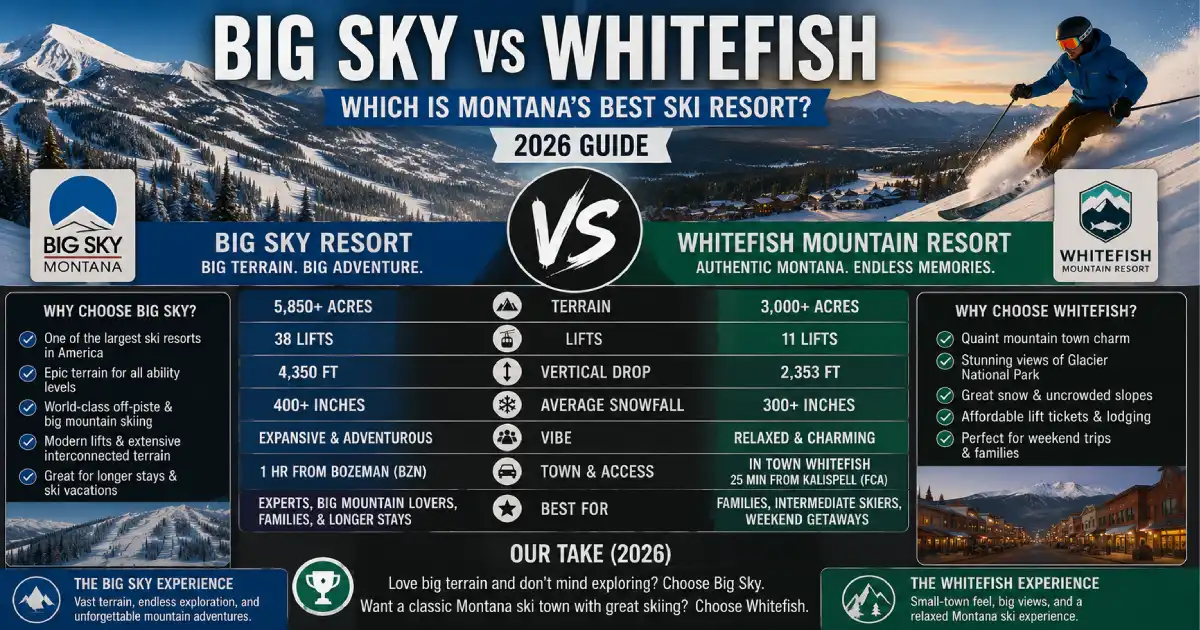
Montana has two genuinely great ski resorts — Big Sky and Whitefish Mountain Resort — and choosing between them is the most consequential single Montana ski trip planning decision available, because the difference between them is not merely a matter of terrain size or lift ticket price but of the most fundamental ski resort character questions: do you want the largest ski area in the United States by acreage, or do you want the most specifically atmospheric and the most town-integrated ski resort in the Northern Rockies? Big Sky Resort is the most terrain-generous ski mountain in the country — 5,850 acres, 4,350 vertical feet, the Lone Peak Summit Tram reaching 11,166 feet above sea level, the Headwaters expert terrain that produces the most dramatic steep skiing accessible in Montana, and a ski-in ski-out Mountain Village base area that has been expanding its hotel and restaurant infrastructure rapidly enough that it is now genuinely comparable to major Colorado resort villages in its amenities if not yet in its atmosphere. Whitefish Mountain Resort is the most specifically beautiful and the most town-connected ski resort in Montana — the snowghost trees (the rime ice formations on Big Mountain’s summit trees that produce the most dramatically atmospheric ski photographs in any Montana resort), the Flathead Lake and Glacier National Park panorama visible from the summit, the 10-minute drive to Whitefish town’s genuinely excellent Main Street restaurant and bar scene, and the specific character of a resort that has been serving the Flathead Valley community since 1947 without the self-conscious destination-resort ambition that has shaped Big Sky’s recent development trajectory.
I’ve skied both resorts across multiple winters — the Big Sky February powder morning when 18 inches had fallen overnight and the Headwaters terrain was producing the most specifically excellent steep powder skiing available in Montana, the Whitefish December morning when the snowghost trees were at their most dramatically rime-ice-specific and the visibility was 50 feet and the skiing was tactile and atmospheric rather than scenic, the Big Sky resort village Saturday evening when the slope-side restaurants were full and the après ski energy was the most Colorado-adjacent accessible in Montana, and the Whitefish Thursday afternoon when the mountain was 80% empty and the groomed cruiser runs on the front face were producing the most effortless and the most socially relaxed skiing accessible at any Montana resort in any week of any season. Each visit confirmed that both resorts are genuinely excellent and genuinely different — and that the right choice between them depends entirely on what kind of ski trip you came to Montana for.
For complete Montana guides, see our Things to Do in Montana and Best Time to Visit Montana guides.
Glacier NP (25 miles), dog sledding, snowshoeing, Flathead Lake
🌲 Whitefish (Glacier NP proximity)
Ikon Pass Value
5 days included (Ikon Pass); best for short visit
Unlimited days (Ikon Pass); exceptional value for week+ stays
🌲 Whitefish (unlimited Ikon days)
Beginner Terrain
Good beginner area at base; only 15% of mountain
20% beginner — better proportioned for mixed groups
🌲 Whitefish
Big Sky Resort: America’s Biggest Mountain
The Terrain: 5,850 Acres and What It Actually Means
Big Sky Resort’s 5,850 acres of skiable terrain — the most at any single ski resort in the United States, a figure that is cited so frequently that it risks becoming a marketing abstraction rather than a visceral skiing fact — is most honestly understood through the following specific comparison: Vail Mountain in Colorado covers 5,317 acres; Park City covers 7,300 acres across its combined terrain with Canyons Resort; Whistler Blackcomb in British Columbia covers 8,171 acres. Big Sky’s 5,850 acres makes it the largest ski resort in the contiguous United States by a meaningful margin over its nearest competitor (Park City’s original terrain, before the Canyons merger). What this means in practice: a competent intermediate skier spending a full week at Big Sky, skiing 5 hours per day on non-repeating runs, would struggle to ski every trail on the mountain. The terrain scale is genuinely extraordinary and genuinely distinctive.
The 5,850 acres is distributed across two connected mountains — Lone Mountain (the primary peak, with the Lone Peak Tram reaching 11,166 feet) and Andesite Mountain (the secondary peak, with the most intermediate-friendly terrain) — connected by the Swift Current lift and the Carabiner lift into a single continuous ski area. The ability to ski from Lone Mountain’s summit to Andesite’s base without removing skis, across terrain that would be a separate resort in most Rocky Mountain states, is the most specific expression of what Big Sky’s scale actually provides.
The Lone Peak Tram and Headwaters
The Lone Peak Summit Tram — a 15-person aerial tram accessing the 11,166-foot Lone Peak summit, the highest point accessible by lift at any Montana ski resort — is Big Sky’s most specifically dramatic single piece of infrastructure. The tram accesses:
The Big Couloir: The most celebrated single ski run at Big Sky — a 50-degree chute dropping 1,000 feet from the Lone Peak summit, requiring both a signed avalanche awareness waiver and a partner (solo skiing the Big Couloir is not permitted). The most specifically expert-only terrain at any Montana resort, comparable to the most extreme inbounds skiing in Colorado or Utah.
The Headwaters terrain: The expert chute complex below the Lone Peak Tram — multiple chutes of 40–50 degree pitch, accessible after the snowpack has built to a sufficient depth (typically not until January in most seasons). The most specifically rewarding expert skiing in Montana when the Headwaters are fully open and freshly covered.
The North Summit Snowfield: The most expansive high-alpine skiing at Big Sky — a wide-open snowfield below the Lone Peak summit producing the most Alaskan-feeling ski experience accessible at any Montana resort on a clear day.
The honest Headwaters caveat: the tram and the Headwaters terrain are not reliably open throughout the season. The Big Couloir requires a specific snowpack depth and avalanche stability that is not consistently achieved until late January or February, and some seasons never fully open to the required standard. The visitor who plans a Big Sky trip specifically for the Headwaters in late December or early January risks arriving to find it closed. The most reliable Headwaters window: January 20 through mid-March in most seasons.
Big Sky’s Snow Quality
Big Sky averages 400+ inches of snowfall annually — the most at any Montana resort and the most at any ski resort in the Northern Rockies outside of specific Utah and Wyoming locations. The snow quality is the most consistently light and dry of any Montana resort (the Madison Range’s position at the convergence of Pacific and Alberta Clipper storm tracks produces the most varied and the most frequent snowfall events of any Montana ski location), producing the cold-smoke powder conditions that make February powder skiing at Big Sky the most specifically joyful ski experience accessible in the state.
Big Sky’s Resort Village
The Big Sky Mountain Village — the ski-in ski-out base area at the foot of Lone Mountain — has been undergoing the most rapid development expansion in Montana resort history over the past decade, driven by the Boyne Resorts ownership group’s investment in hotel, restaurant, and retail infrastructure. The current village (2026 season) includes the Summit Hotel, the Wilson Hotel, the Huntley Lodge, the Shoshone Condominium Hotel, and multiple slope-side condominiums in a pedestrian village format that is the most functional ski-in ski-out base area in Montana. The restaurant scene (Peaks Restaurant for the most ambitious and the most panoramic dining in the village; the Everett’s 8800 slope-side bar for the most après ski-specific; Lone Peak Brewery for the most craft beer-specific) is improving rapidly but remains more Colorado-aspirational than Colorado-equivalent in its current execution.
The most important Big Sky village planning note: the Mountain Village is not a town. It is a resort base area — walkable for ski-related needs (rental shop, restaurants, hotel) but without the grocery stores, local bars, and community character of an established ski town. The visitor who wants the ski-in ski-out convenience and the resort village format will find the Mountain Village functional and improving. The visitor who wants a charming mountain town to walk in the evenings should plan a Bozeman base (55 miles, the most culturally complete Montana ski trip base city) or accept the Mountain Village’s current limitations.
Whitefish Mountain Resort: Montana’s Most Beautiful Ski Mountain
The Snowghost Trees: Montana’s Most Iconic Ski Image
The snowghost trees at Whitefish Mountain Resort — the rime ice formations on the summit trees of Big Mountain that develop when Pacific moisture meets sustained below-freezing temperatures, encasing the subalpine fir trees in white ice formations that transform them into ghostly sculptures visible from the summit chairs and the upper mountain runs — are the most specifically beautiful and the most specifically Montana atmospheric feature of any ski resort in the state. The snowghost trees are not guaranteed on every ski day (they require the specific weather combination of Pacific moisture and sustained cold temperatures to form and persist), but when present they produce the most dramatically atmospheric ski environment accessible in Montana: skiing through the forest of rime-ice-encased trees in low visibility, with the forms visible only at 20–30 feet and the entire upper mountain white and sculptural and silent, is the most specifically Whitefish experience and the one that most visitors describe as the single most memorable skiing moment of any Montana trip.
The snowghost trees are most reliably present and most dramatically formed in January and February — the months when Pacific moisture events combine with the sustained below-freezing temperatures that build the thickest rime ice formations. The most photogenically extraordinary snowghost conditions typically follow a Pacific storm by 24–48 hours, when the storm has deposited fresh rime on the trees and the visibility has cleared to reveal their forms against a blue sky. The most atmospheric skiing through the snowghosts occurs during the storm itself or immediately after, when the visibility is low and the forest is white in all directions and the experience is more sensory than visual.
The Terrain: 3,000 Acres and the Best Intermediate Mountain in Montana
Whitefish Mountain Resort’s 3,000 acres — half of Big Sky’s total — is distributed across the most intermediate-friendly and the most proportionately balanced terrain available at any Montana resort: 20% beginner, 50% intermediate, 30% advanced-expert. The intermediate percentage is the most important single terrain statistic for the majority of recreational skiers (self-assessed intermediate is the most common skill level among recreational ski trip participants), and Whitefish’s 50% intermediate proportion makes it the most specifically well-suited resort for intermediate-level groups or intermediate-level individuals who want the most sustained and the most varied blue-square terrain accessible in Montana without being overwhelmed by the expert-majority terrain distribution that characterizes Big Sky’s mountain.
The specific Whitefish terrain highlights:
The front face (groomed cruisers): The most consistently well-groomed intermediate terrain in Montana — the front-face runs (Toni Matt, Hell Fire, Inspiration) are the most effortless and the most socially relaxed Montana ski runs accessible on any given weekday, with the Flathead Valley panorama visible on clear days from the chair rides and the Flathead Lake visible on the clearest days as a silver sheet 2,000 feet below
The North Bowl: The most expert-facing terrain at Whitefish — steep tree skiing in the North Bowl is the most consistent challenge accessible without the extreme exposure of Big Sky’s Big Couloir
The Flower Point Chutes: The most specifically expert inbounds terrain at Whitefish — narrow tree chutes below the Flower Point chair producing the most sustained mogul and tree skiing accessible on the mountain
The Summit View: Glacier National Park and Flathead Lake
The view from Whitefish Mountain Resort’s 6,817-foot summit is the most panoramically specific of any Montana ski resort — on a clear day (the most reliably clear summit days in Montana occur in the post-storm high-pressure windows that typically follow the Pacific storms that build the snowghost formations), the Glacier National Park’s peaks are visible 25 miles to the northeast (the Garden Wall and the Livingstone Range visible as a white serrated horizon above the Flathead Valley’s forested floor), Flathead Lake is visible 2,000 feet below as the most dramatically scaled inland lake in the western continental United States, and the Cabinet Mountains of Idaho are visible to the west as a distant blue-grey ridge. The Big Sky summit view (of the Madison Range) is dramatic and alpine; the Whitefish summit view is the most specifically panoramic and the most geographically specific of any Montana ski resort view.
Whitefish Town: Montana’s Best Ski Town
Whitefish town — 8 miles from the Whitefish Mountain Resort base, accessible via the free resort shuttle — is the most charming, the most genuinely Montana, and the most complete ski town accessible within reasonable distance of any Montana resort. The downtown Whitefish Main Street (Central Avenue) produces the most walkable, the most independently owned, and the most specifically Northwest Montana après ski scene accessible in the state: the Bonsai Brewing Project (the most locally attended and the most craft-beer-specific Whitefish bar, with the most Montana-sourced beer program accessible in the Flathead Valley), the Loula’s Café (the most beloved breakfast in Whitefish — the huevos rancheros and the huckleberry French toast are the most frequently cited morning items on any Whitefish skier’s daily schedule), the Great Northern Bar and Grill (the most historically atmospheric and the most country-music-live-music-specific bar in Whitefish, with the most community-attended weekend dance floor in any Montana ski town), and the Wisconsin Bar (the most divey and the most specifically Whitefish-local bar accessible without pretense in a town that has maintained its character in the face of Flathead Valley resort development pressure).
Whitefish town’s non-skiing character extends beyond the après ski corridor — the Amtrak Empire Builder stops in Whitefish (the most romantic single rail approach to any Montana ski town, with the train arriving from either direction through the Flathead Valley mountains), the Whitefish Winter Carnival (late January, the most festive and the most community-specific winter event in northwest Montana, with a torchlight parade down the mountain and the most elaborate snow sculpture competition accessible in any Montana ski town), and the 25-mile proximity to Glacier National Park’s west entrance (the most accessible national park proximity of any Montana ski resort — cross-country skiing into Glacier’s winter wilderness from the park’s Apgar visitor center is the most specifically extraordinary winter non-skiing activity accessible from any Montana resort base town).
Big Sky vs Whitefish: The Ikon Pass Analysis
Both Big Sky and Whitefish Mountain Resort are on the Ikon Pass — the multi-resort ski pass that has become the most financially consequential single ski trip planning decision for the American destination skier. The Ikon Pass coverage difference between the two resorts is the most significant single financial planning factor in the Big Sky vs Whitefish comparison for the Ikon Pass holder:
Big Sky on Ikon Pass: 5 days included on the full Ikon Pass; Ikon Base Pass provides 2 days with blackout dates. The 5-day limit makes Big Sky the most efficiently used Ikon Pass resort for a 5-day ski trip but the most financially punishing for a 7+ day stay (days 6+ require purchasing additional day tickets at the full $185–$245/day rate)
Whitefish on Ikon Pass: Unlimited days with no blackout restrictions on the full Ikon Pass; 5 days on the Ikon Base Pass. The unlimited coverage makes Whitefish the most financially extraordinary Ikon Pass value in Montana — a 7-day Whitefish ski trip on the Ikon Pass costs $0 in lift tickets beyond the pass price, saving $693–$945 versus 7 days of Whitefish walk-up tickets and $1,295–$1,715 versus 7 days of Big Sky full-price tickets
The Ikon Pass analysis for the destination skier: if you are planning a 5-day Montana ski trip and hold an Ikon Pass, Big Sky and Whitefish are comparable in lift ticket cost. If you are planning a 7+ day Montana ski trip with an Ikon Pass, Whitefish’s unlimited coverage makes it the most financially extraordinary value available at any Montana resort by a substantial margin.
Big Sky vs Whitefish: Cost Comparison
Cost Category
⛷️ Big Sky
🌲 Whitefish
Cheaper?
Daily Lift Ticket (advance)
$185–$245
$99–$135
🌲 Whitefish (significantly)
Ikon Pass Days
5 days included
Unlimited days
🌲 Whitefish (for 6+ day trips)
Ski-in/Ski-out Hotel (peak)
$295–$550/night (Mountain Village)
$165–$280/night (slope-side condos)
🌲 Whitefish
Town Hotel (Bozeman / Whitefish)
$135–$225/night (Bozeman, 55 miles)
$125–$195/night (Whitefish town, 8 miles)
🌲 Whitefish
Ski Rental (per day)
$55–$85 (Mountain Village shops)
$40–$65 (on-mountain + Whitefish town shops)
🌲 Whitefish
On-Mountain Lunch
$18–$28/person (Rendezvous Lodge)
$15–$24/person (Summit House)
🌲 Whitefish
7-Day Trip Total (per person, midrange)
~$3,800–$5,200 (without Ikon)
~$2,200–$3,400 (without Ikon)
🌲 Whitefish (30–40% cheaper)
Cost verdict: Whitefish wins clearly across every cost category. The lift ticket differential alone ($185–$245/day at Big Sky vs $99–$135/day at Whitefish) saves a family of four $340–$440 per ski day. Over a 7-day trip, that differential is $2,380–$3,080 in lift tickets alone — enough to pay for flights to Montana and back. Big Sky’s Mountain Village hotel pricing (ski-in ski-out) is the most expensive resort accommodation in Montana; Whitefish’s combination of slope-side condos and the 8-mile town hotel option is the most affordable major resort lodging available in the state. Whitefish is 30–40% cheaper than Big Sky across all cost categories for comparable experiences.
Big Sky vs Whitefish: Non-Ski Activities
Big Sky Non-Ski Activities
Yellowstone winter tours (90 miles, 90 minutes): Big Sky’s proximity to Yellowstone National Park’s west entrance produces the most compelling single non-ski day trip accessible from any Montana ski resort — the Old Faithful snowcoach tour ($125–$175/person from West Yellowstone) delivers the geothermal landscape in the most dramatically steam-and-snow winter conditions, with the bison in the geyser basins and the wolves in the Lamar Valley visible from the snowcoach windows in conditions that the summer-season vehicle tour cannot approximate
Lone Mountain Ranch Nordic skiing: The most romantic and the most athletically serious Nordic ski operation in Montana — the Lone Mountain Ranch’s cross-country trail system through the Madison Range snow (75 km of groomed trails) is the most comprehensively developed Nordic infrastructure accessible from any Montana ski resort base area
Snowmobiling: The Big Sky area’s snowmobile trail network is the most extensive accessible from any Montana resort — guided snowmobile tours into the Gallatin National Forest from multiple Big Sky operators ($185–$265/person half day)
Bozeman (55 miles): The most culturally complete Montana ski trip base city — the Museum of the Rockies (the most significant paleontology collection in the Rocky Mountain region), the Bozeman restaurant scene (the most James Beard-adjacent in Montana), and the specific university-town intellectual energy that makes Bozeman the most sophisticated off-mountain experience accessible from any Montana ski resort
Whitefish Non-Ski Activities
Glacier National Park (25 miles): The most significant non-ski advantage of the Whitefish location — Glacier’s west entrance is 25 miles from Whitefish town (35 minutes), making the Apgar visitor center cross-country skiing, the Lake McDonald winter snowshoe, and the winter wildlife viewing (elk, moose, and mountain goats in the lower Glacier valleys) the most specifically extraordinary non-ski day accessible from any Montana resort base. No other major US ski resort is within 30 minutes of a national park of Glacier’s significance
Whitefish Winter Carnival (late January): The most community-specific and the most festive winter event in northwest Montana — the torchlight parade down the ski mountain on Friday evening, the Skijoring race on Central Avenue (horses pulling skiers through downtown Whitefish at speed), and the snow sculpture competition in City Beach Park produce the most specifically Whitefish winter cultural experience accessible at any Montana ski resort town
Dog sledding (multiple Flathead Valley operators): The most specifically winter-adventure non-ski activity accessible from Whitefish — guided dog sled tours through the Stillwater State Forest ($185–$245/person, 2 hours) are the most atmospheric and the most specifically Northwest Montana winter experience accessible without a snowmobile
Amtrak Empire Builder: The most romantic single transportation option available to any Montana ski resort visitor — the daily Empire Builder train (Chicago–Seattle route) stops in Whitefish, making it the only major Montana ski resort accessible by train from the continental US without a rental car. The most specifically Montana arrival experience accessible at any price.
Who Should Ski Big Sky?
Choose Big Sky if you:
Are an expert or advanced skier who wants the most extreme inbounds terrain in Montana — the Big Couloir (50-degree pitch, 1,000-foot drop) and the Headwaters chutes are unavailable at any other Montana resort at comparable steepness or scale
Want the largest ski area in the United States — 5,850 acres produces the most specifically liberating sense of ski terrain scale; the intermediate skier who never skis the same run twice in 5 days is experiencing a genuinely unique American ski resort characteristic
Want the most powder snow in Montana — 400+ inches annually, the most consistent cold-smoke powder conditions of any Montana resort, and the Lone Mountain summit snowfields that hold powder days longer than the more exposed intermediate terrain at Whitefish
Are on an Ikon Pass and visiting for exactly 5 days — the 5-day Ikon inclusion maximizes the pass value at the resort with Montana’s highest walk-up ticket price
Want to combine skiing with a Yellowstone winter snowcoach tour — Big Sky’s 90-mile proximity to Yellowstone’s Old Faithful snowcoach tours makes the most specifically extraordinary winter Yellowstone experience accessible as a ski trip day trip
Want a ski-in ski-out Mountain Village base area that is Montana’s most developed resort village infrastructure — the Mountain Village’s hotels, restaurants, and slope-side convenience are unmatched in Montana for the visitor who specifically wants the resort village format without a car or shuttle
Are bringing a group of expert skiers who want the most challenging and the most expansive terrain available in the United States at a price point significantly below comparable Colorado or Utah expert-terrain resorts
Who Should Ski Whitefish?
Choose Whitefish if you:
Are an intermediate skier or a mixed group (beginners through advanced) who wants the most proportionately balanced and the most sustainably enjoyable Montana ski resort — Whitefish’s 50% intermediate terrain ratio is the most specifically well-suited to the most common recreational skill level
Want the snowghost trees — the most iconic and the most dramatically atmospheric ski photographs accessible at any Montana resort; the rime ice formations are the single most specifically Whitefish experience and the one that most distinguishes it from every other Montana ski resort in atmospheric character
Are an Ikon Pass holder planning a 6+ day ski trip — Whitefish’s unlimited Ikon days make it the most financially extraordinary ski resort value in Montana for any trip longer than 5 days
Want the best ski town in Montana — Whitefish’s Main Street (Bonsai Brewing, Loula’s breakfast, Great Northern Bar) is the most charming, the most walkable, and the most specifically Montana ski town character accessible within 10 miles of any Montana resort base area
Are combining skiing with Glacier National Park — no other major US ski resort is within 30 minutes of a national park of Glacier’s significance; the Glacier winter wildlife viewing, the Apgar cross-country skiing, and the Lake McDonald winter snowshoe are the most specifically extraordinary non-ski activities accessible from any Montana resort
Are on a budget — Whitefish is 30–40% cheaper than Big Sky across lift tickets, accommodation, dining, and rentals; the savings are most dramatic for families (4 people × $100/day lift ticket savings × 7 days = $2,800 in lift tickets alone)
Want to arrive by train — the Amtrak Empire Builder’s Whitefish stop makes it the only major Montana ski resort accessible by passenger rail without a rental car
Can You Ski Both Big Sky and Whitefish in One Trip?
Yes — and for the dedicated Montana ski traveler with 10+ days, combining Big Sky and Whitefish produces the most complete Montana ski experience available. The two resorts are 270 miles apart (approximately 4 hours on US-93 and I-90 through Missoula), making the combination a road-trip rather than a day-excursion. The most efficient routing:
10-day Montana ski circuit: Fly into Bozeman (BZN) → Big Sky 5 days (5 Ikon days used) → drive to Whitefish via Missoula (4 hours) → Whitefish 5 days (unlimited Ikon days) → fly out of Glacier Park International (FCA) or return to Bozeman
The Missoula stop: The Missoula midpoint between Big Sky and Whitefish (2 hours from each) is the most culturally interesting Montana drive-through city — the Missoula Farmers Market, the Clark Fork River trail, and the University of Montana campus produce the most walkable Montana city experience accessible between the two ski destinations
Big Sky vs Whitefish: Practical Tips
Topic
⛷️ Big Sky
🌲 Whitefish
Best Months to Ski
January–February (deepest snowpack, Headwaters most reliably open; Presidents’ Week most crowded — book 8 weeks ahead)
January–February (snowghost trees most reliably formed; December for earliest season + lightest crowds)
Avoid
Christmas–New Year’s week (most expensive, longest lift lines of season); early December (Headwaters often closed)
Presidents’ Week (third week February — most crowded single week); spring break if crowd-averse
Where to Stay
Mountain Village (ski-in/out, most convenient); Bozeman (55 miles, most affordable, most town character)
Whitefish town (8 miles, best value + town character + shuttle access); slope-side condos (ski-in/out)
Lift Ticket Strategy
Buy online in advance (10–15% discount vs window); Ikon Pass holders: use your 5 days strategically; window rate is the most expensive lift ticket in Montana
Ikon Pass = unlimited free days (best single Ikon value in Montana); advance online purchase saves 15–20% vs window rate; multiday packages most economical without Ikon
Getting There
Fly Bozeman (BZN) — direct flights from most US hubs; shuttle to Big Sky ($40–$55 each way) or rental car; Gallatin Canyon road (US-191) can close briefly in avalanche events
Fly Glacier Park Int’l (FCA, Kalispell) — fewer direct routes than BZN; or fly Missoula (MSO, 2 hours); free resort shuttle from Whitefish town; Amtrak Empire Builder stops in Whitefish
Key First-Timer Tips
Start on Andesite Mountain (easier access, best intermediate terrain, less tram pressure); the Headwaters are expert-only — do not follow expert skiers off the tram without assessing your ability level honestly; the mountain is genuinely large enough to get oriented — study the trail map the night before
The Summit House top-of-mountain restaurant is the most dramatic and the most wind-exposed dining on the mountain — dress for alpine conditions even on the chairlift to the summit; the snowghost trees are most atmospheric in low visibility — don’t only ski the summit on clear days; take the free shuttle to town for dinner
Frequently Asked Questions: Big Sky vs Whitefish
Is Big Sky really the best ski resort in Montana?
Big Sky is the largest ski resort in Montana and the United States by skiable acreage — the most accurate superlative available — and for expert skiers seeking the most extreme inbounds terrain, the most powder accumulation, and the most vertically dramatic skiing in the state, it is genuinely the best Montana choice. For intermediate skiers, families, budget-conscious skiers, Ikon Pass holders planning trips longer than 5 days, and visitors who want the most charming and the most walkable ski town in Montana, Whitefish Mountain Resort is genuinely the better choice. “Best ski resort in Montana” is the most terrain-dependent and the most budget-dependent answer in Montana ski trip planning — the honest answer requires the question “best for whom and for what?”
Is Whitefish Mountain Resort worth visiting if I’m an expert skier?
Yes — Whitefish is worth visiting even for expert skiers, with the specific understanding that it is not Big Sky’s Headwaters in terms of extreme pitch and scale. The North Bowl’s tree skiing, the Flower Point Chutes, and the off-piste terrain accessible from the upper mountain produce genuinely challenging skiing for advanced-to-expert skiers, and the specific atmospheric experience of skiing the snowghost tree forest in low visibility is unavailable at Big Sky or any other Montana resort at any skill level. The expert skier who visits Whitefish specifically for the Headwaters-level challenge will be somewhat disappointed; the expert skier who visits Whitefish for the complete Montana ski resort experience — the snowghost trees, the Glacier NP day, the Whitefish town après ski, and the most affordable major Montana resort skiing — will find it one of the most rewarding ski resort experiences in the Northern Rockies.
Which is better for families — Big Sky or Whitefish?
Whitefish wins for most families — the 50% intermediate terrain ratio (vs Big Sky’s 25%) provides the most sustained and the most enjoyable terrain for the mixed-ability family group, the lift ticket savings ($340–$440 per day for a family of four) are the most significant single-day family budget advantage available at any Montana resort, the Whitefish town’s 8-mile proximity to the mountain means the family has the option to drive into town for the most affordable dinner rather than being captive to Mountain Village resort pricing, and the Glacier National Park day trip is the most family-appropriate non-ski activity accessible from any Montana resort base. Big Sky is the better family choice specifically for families with advanced-to-expert teen and adult skiers who want the most terrain scale and the most challenging runs accessible in Montana.
What are the snowghost trees and when are they best?
The snowghost trees are rime ice formations — the accumulation of supercooled water droplets from Pacific moisture events that freeze on contact with the surfaces of the subalpine fir trees at Whitefish Mountain Resort’s summit, encasing them in white ice formations that transform the upper mountain forest into a surreal landscape of white sculptural forms. They form during and immediately after the Pacific storm systems that move through northwest Montana in the January–February window, when the specific combination of Pacific moisture (above freezing in the cloud but below freezing at the mountaintop) and sustained sub-freezing summit temperatures produces the thickest and the most dramatically formed rime ice. The snowghost trees are most reliably present and most photographically extraordinary in January and February; they can form as early as November and as late as March but are most consistently available in the two-month peak window. The most atmospheric skiing through the snowghost forest occurs during the storm itself or within 24 hours after it, before wind and sublimation begin to reduce the formations; the clearest snowghost photography occurs 24–48 hours after the storm, when high pressure follows and the trees are visible against blue sky.
Final Verdict: Big Sky vs Whitefish
Big Sky and Whitefish Mountain Resort are Montana’s two greatest ski destinations — different enough that choosing between them is a genuinely productive ski trip planning decision, and both excellent enough that the visitor who makes an informed choice will not be disappointed. The most honest single-sentence verdict:
Choose Big Sky if you want the most terrain in the United States, the most extreme inbounds expert skiing in Montana, the most powder snow of any Montana resort, and the most specific expression of what “biggest mountain in America” actually feels like on skis — because 5,850 acres of Montana Rocky Mountain terrain served by the Lone Peak Tram at 11,166 feet and the Headwaters chutes at 50-degree pitch is the most genuinely scale-specific ski mountain in the country, and the February powder morning when the Headwaters are freshly filled and the Lone Peak Tram is running and there is nobody in the Big Couloir except the skier who knows what it is and has the skill to ski it is the most specifically and the most irreplaceably excellent expert skiing moment accessible in the state of Montana.
Choose Whitefish if you want the most beautiful, the most atmospheric, the most affordably priced, and the most town-integrated Montana ski resort — the snowghost trees on a January storm day when the visibility is 30 feet and the entire upper mountain is white and sculptural and silent are the most specifically and the most irreplaceably Whitefish experience in Montana skiing; the Glacier National Park 25 miles from the base lodge is the most extraordinary non-ski day trip accessible from any major US ski resort; the Whitefish Winter Carnival torchlight parade down the mountain is the most community-specific and the most festive winter event in northwest Montana; and the Ikon Pass unlimited days make Whitefish the most financially extraordinary ski resort value in the entire Ikon network for the visitor who plans a week or more. Whitefish is the most complete Montana ski resort experience for the most skiers at the most honest price — and the snowghost trees, when they form and when the cloud comes in and the summit forest is white in every direction and the skiing is more tactile than visual and more specifically Whitefish than any photograph can convey, are the most genuinely extraordinary ski resort atmospheric feature accessible in any US resort at any price.
Both resorts are worth visiting. Big Sky is the larger and the more dramatic mountain. Whitefish is the more beautiful and the more complete ski resort experience. The best Montana ski trip includes both — and the 270 miles of US highway between them through Missoula is the most specifically scenic ski-resort-connecting drive in the Rocky Mountain West.
—
For the most current ski conditions, road conditions, avalanche advisories, and Montana travel resources for Big Sky and Whitefish, consult these official government sources:
Visit Montana — Official Montana Office of Tourism (State Government) — Official Montana state government tourism resource covering Big Sky and Whitefish ski resort information, current Montana travel advisories, road conditions, and the most authoritative Montana visitor planning resources from the official state tourism office.
Montana Avalanche Center — Official State Avalanche Forecasting (Government-Funded) — Official Montana state avalanche forecasting center providing the most current avalanche danger ratings for the Gallatin Range (Big Sky) and the Glacier Country/Flathead Range (Whitefish), updated daily during the ski season; the most authoritative safety resource for any Big Sky Headwaters or Whitefish backcountry skiing visitor.
Glacier National Park — National Park Service (Official US Federal Government) — Official NPS resource for Glacier National Park winter access, Apgar visitor center hours, winter road and trail conditions, cross-country skiing opportunities accessible from Whitefish during the ski season, and all current Glacier NP visitor requirements and closures.
—
About Travel TouristerTravel Tourister’s Montana ski specialists have skied both Big Sky and Whitefish Mountain Resort across multiple winters — from the Big Sky February Headwaters powder morning and the Lone Peak Tram’s 11,166-foot summit to the Whitefish snowghost trees in January storm conditions and the Glacier National Park cross-country ski day from the Apgar visitor center — to provide the most honest and most specific comparison available for skiers choosing between Montana’s two finest and most genuinely different ski resorts.Need help planning your Montana ski trip? Our specialists can help you build the optimal Big Sky or Whitefish itinerary, maximize your Ikon Pass days, plan the Yellowstone winter snowcoach tour from Big Sky, time your Whitefish visit for the snowghost trees, and combine both resorts in the most efficient 10-day Montana ski circuit.
Posted By : Vinay
As a lead contributor for Travel Tourister, Vinay is dedicated to serving our Tier 1 audience (US, UK, Canada, Australia). His mission is to deliver precise, fact-checked news and actionable, data-driven articles that empower readers to make informed decisions, minimize travel risks, and maximize their adventure without compromising safety or budget.
Travel Tourister is a leading Travel portal where we introduce travellers to trusted travel agents to make their journey hasselfree, memorable And happy. Travel Tourister is a platform where travellers get Tour packages ,Hotel packages deals through trusted travel companies And hoteliers who are working with us across the world. We always try to find new and more travel agents and hoteliers from every nook and corners across the world so that you could compare the deals with different travel agents and hoteliers and book your tour or hotel with the one you have chosen according to your taste and budget.




 Call
Call Enquiry