Published on : 20 May 2026
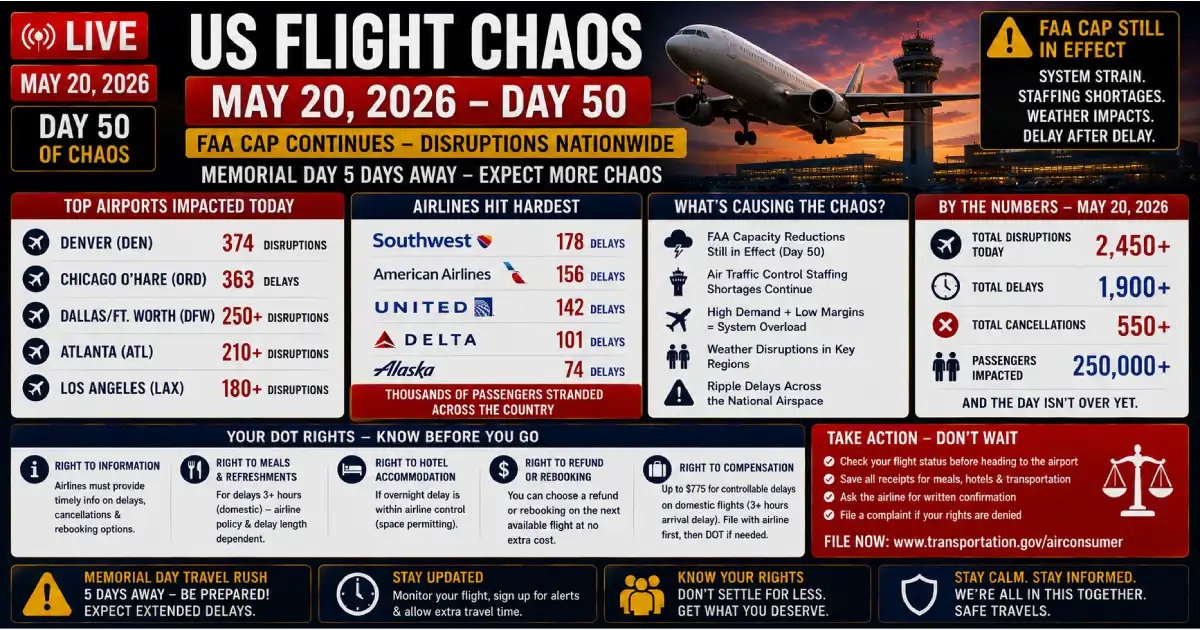
Breaking — May 20, 2026: The United States aviation network is recording one of its most severe disruption days of the post-Easter crisis on Wednesday May 20 — Day 50 of continuous above-normal disruption — as three of the country’s biggest hubs collapse simultaneously under a convergence of severe storms, FAA capacity caps, and peak pre-Memorial Day demand. Denver International Airport has recorded 362 delays and 12 cancellations — 374 total disruptions — with Southwest Airlines alone absorbing 178 delays representing 38% of its entire DEN schedule. Chicago O’Hare, now operating under the FAA’s newly imposed summer capacity cap (active since May 17), has recorded 357 delays and 6 cancellations — 363 total disruptions — with American Airlines, Delta Air Lines, Lufthansa, United Airlines, and Etihad all in the disruption list. Dallas–Fort Worth has logged over 250 delays as Texas thunderstorms return, re-creating the corridor gridlock that produced the worst single-hub day of 2026 on May 11 (617 delays, 232 cancellations at DFW alone). Atlanta Hartsfield-Jackson, Los Angeles LAX, New York JFK, LaGuardia, Newark, Nashville, Detroit, Boston, and Miami are all reporting secondary cascade disruptions. The national total is trending toward 6,000+ disruptions today — consistent with the 6,862-flight disruption event recorded nationally on May 18. Across it all hangs one countdown that is now impossible to ignore: Memorial Day weekend begins in 5 days — May 25, 2026 — with 45 million Americans travelling. Here is every confirmed number, every affected airport, every carrier, every affected route, and every DOT right you hold today.
Published: May 20, 2026 — Wednesday US Aviation Crisis Day: Day 50 — 50 consecutive days of above-normal disruption since April 1, 2026 Denver (DEN) disruptions today: 362 delays + 12 cancellations = 374 total Denver worst carrier (delays): Southwest Airlines — 178 delays = 38% of its DEN schedule Denver worst carrier (cancellations): American Airlines — 4 cancellations = 8% scratch rate O’Hare (ORD) disruptions today: 357 delays + 6 cancellations = 363 total O’Hare worst carriers: American Airlines · Delta Air Lines · Lufthansa · United Airlines · Etihad O’Hare status: FAA summer cap ACTIVE since May 17 · Southwest exits O’Hare in 15 days (June 4) DFW disruptions today: 250+ delays confirmed · Texas thunderstorm system active National total (trending): 6,000+ disruptions — consistent with May 18’s 6,862-flight disruption wave Memorial Day countdown: ⏰ 5 DAYS — May 25, 2026 Memorial Day passenger forecast: 45.1 million Americans travelling — largest since 2019 Southwest O’Hare exit: June 4, 2026 — 15 days away Worst domestic routes today: Denver–Dallas · Denver–Chicago · Denver–Los Angeles · Denver–New York · O’Hare–Atlanta · O’Hare–London Heathrow · O’Hare–Frankfurt · DFW–New York · DFW–Orlando · DFW–Los Angeles International routes disrupted: Paris CDG · London Heathrow · Frankfurt · Mexico City · Cancún · Reykjavik · Toronto Pearson Root causes today: 🔴 Texas–Midwest thunderstorm corridor · 🟠 FAA O’Hare summer cap operational friction · 🟡 Day 50 crew and aircraft positioning fatigue · 🟡 Pre-Memorial Day capacity surge DOT cash compensation: Not automatic — but full rebooking and refund rights apply regardless of cause
Fifty days. The United States aviation system has not had a single normal operating day since April 1, 2026 — the longest continuous disruption streak in modern US aviation history, surpassing the post-9/11 recovery period, the 2010 volcanic ash disruptions, and the post-pandemic rebuilding phase of 2021–2022. Day 50 is not a milestone anyone in the airline industry is celebrating.
What is happening on May 20 is the convergence of four independent pressure systems landing on the same day:
🔴 Texas–Midwest severe weather — A squall line of thunderstorms and supercells is moving through the Texas corridor — the same corridor that produced the worst single DFW day of the crisis on May 11 (617 delays, 232 cancellations). Today’s system is less severe than May 11’s tornado-warned event, but it is hitting a network that has been worn down by 50 days of above-normal disruptions, with crew positioning reserves exhausted and aircraft turn-times running with zero slack.
🟠 FAA O’Hare summer cap — Day 4 — The FAA’s capacity restriction at Chicago O’Hare took effect on May 17 — three days ago. Airlines have been adjusting schedules for weeks in anticipation, but the first days of a new cap always produce friction: gate assignments change, slot allocations shift, and the airlines that trimmed O’Hare rotations to comply with the cap are finding that the disruption patterns at ORD have not yet stabilised into the new normal. Today’s 363 disruptions at O’Hare represent the cap’s first major weather-plus-structural stress test.
🟡 Day 50 network fatigue — Fifty consecutive days of above-normal disruption means that no US carrier has had a clean recovery day to reposition all their aircraft and reset all their crew rosters to schedule. Every day of disruption creates a deficit: an aircraft that should be in Denver is in Dallas; a crew that should be fresh for a morning departure is at their rest limit from a delayed inbound the night before. By Day 50, that deficit is enormous. The system absorbs today’s storms with no buffer.
🟡 Memorial Day surge — 5 days out — Airlines routinely add capacity in the 5–7 days before Memorial Day as leisure travelers begin their holiday weekend early. Every additional departure added to the system this week is another aircraft that needs a clean rotation, a rested crew, and an unblocked gate. None of those three conditions are fully available anywhere in the US network today.
Air travel across the United States is experiencing one of the most significant disruption waves of 2026, with more than 6,000 delayed flights reported nationwide as severe weather systems, FAA operational restrictions, and peak holiday travel demand collide simultaneously.
Denver International Airport is today’s headline disruption event — and the Southwest Airlines numbers are the specific data point that every passenger, travel agent, and airline operations team needs to understand.
Denver International recorded 362 delays and 12 flight cancellations on May 20. Southwest Airlines absorbed 178 massive delays representing 38% of its schedule. American Airlines logged 4 cancellations representing an 8% scratch rate. The Texas bottleneck sent massive inbound and outbound delays across DFW, DAL, and AUS. International flights to CDG, FRA, KEF, MEX, CUN, and YYZ were heavily delayed.
Denver International Airport is not in Texas. But it operates as the primary northern terminus of the Texas aviation corridor — the busiest domestic air corridor in the United States. Dallas–Fort Worth, Dallas Love Field, Houston Hobby, and Austin-Bergstrom all feed massive passenger volumes north to Denver on airlines that run tight turnaround operations with aircraft cycling between the Texas hubs and the Colorado Rockies gateway all day. When a thunderstorm system grounds or delays departures from Dallas, the aircraft that was supposed to arrive in Denver at 10am — turn around — and depart Denver at 11:30am, doesn’t arrive. The 11:30am departure doesn’t happen. And everything downstream of that departure moves back by the same amount — or cancels.
An incredibly active weather bottleneck violently choked physical traffic directly between Denver and the massive state of Texas. For inbound flights to Denver, Dallas Love Field suffered a 75% delay rate and a 12% cancellation rate, while Dallas-Fort Worth saw 60% of inbound flights delayed and 13% cancelled. Outbound traffic was equally devastated; DAL recorded a 62% outbound delay rate and 12% cancelled, while DFW saw a 31% delay rate and 12% cancelled. Austin-Bergstrom logged a 38% inbound delay rate and 29% outbound delay rate.
Southwest Airlines operates one of the largest domestic Denver operations of any carrier at DEN, with heavy frequency on the Texas corridor routes. One hundred and seventy-eight delays from a single carrier at a single airport is not an anomaly. It is a cascade in progress. When Southwest’s first bank of morning departures from Denver to Dallas is delayed by an hour due to late-arriving Texas inbound aircraft, the aircraft for the second bank hasn’t recovered its position. By the afternoon, Southwest’s entire DEN rotation is running an hour or more behind schedule — and that delay propagates to every city those aircraft visit after Denver.
Southwest’s zero-interline policy — the airline does not transfer passengers to other carriers — means that affected Southwest passengers at Denver today have two and only two options: a Southwest rebooking on the next available Southwest service to their destination, or a full cash refund. If Southwest cannot get you to your destination today, they will try tomorrow. If tomorrow doesn’t work for you, the refund is the legal alternative.
For Southwest passengers at Denver today: ✅ Open the Southwest app immediately — do not queue at the customer service desk ✅ southwest.com → Manage Reservations | 1-800-435-9792 ✅ Southwest’s no-change-fee policy allows you to move to any available Southwest flight at zero cost ✅ Meal vouchers apply for delays of 3+ hours caused by airline-controllable factors ✅ Southwest’s zero-interline policy: rebooking is Southwest-only or full cash refund — no exceptions
American Airlines’ 4 cancellations at Denver on a day when DFW is also recording 250+ delays represents the Texas corridor double-hit: American’s DEN operation depends on aircraft arriving from DFW, and those aircraft are being held or delayed in Texas by the same storm system that’s clogging Denver’s arrivals queue. An 8% cancellation rate is above American’s normal threshold and indicates the airline has made the operational decision to cut flights rather than delay them indefinitely and cascade the disruption further into the afternoon.
For American Airlines passengers at Denver today: ✅ aa.com → My Trips | 1-800-433-7300 ✅ American’s Customer Commitment: meal vouchers for 3+ hour airline-caused delays ✅ Hotel accommodation for overnight airline-caused cancellations ✅ Same-day standby on earlier or later flights at no charge when disruption is within American’s control
Chicago O’Hare International Airport is currently struggling to manage at least 357 flight delays and 6 new cancellations. American Airlines, Delta Air Lines, Lufthansa, Etihad Airways, TAP Air Portugal, and United Airlines are working to stabilize their fleet rotations as localized airport disruptions sweep through the terminal complexes, introducing travel chaos for passengers bound for Atlanta, Detroit, London, and Frankfurt.
The FAA’s O’Hare summer capacity cap — which took effect on May 17 — was designed to prevent the 1,021-delay days that O’Hare recorded in late April by limiting the number of arrivals and departures per hour to a sustainable level. In theory, capping operations should reduce disruptions. In practice, the first days of a new cap generate their own disruption: airlines that have been told to reduce operations are managing the complex scheduling mathematics of which flights to cut, which to merge, and which to protect, while simultaneously operating in a system that still has 50 days of accumulated positioning debt.
Today’s 363 disruptions at O’Hare — on Day 4 of the cap — suggests the cap has prevented a catastrophic 1,000+ disruption day, but has not yet produced the stable, predictable operating environment it is designed to create. That stabilisation is expected to come within 2–3 weeks, according to FAA projections. The critical question is whether those 2–3 weeks carry the system safely through Memorial Day weekend (5 days away) or whether the cap’s transition friction peaks exactly when 45 million Americans are trying to use the network.
The ripple effect of a delayed widebody arriving late from London Heathrow or Tokyo Haneda does not merely delay the immediate return leg — it disrupts subsequent narrowbody rotations, strains gate availability, and leaves passengers stranded at regional gates across the Midwest. The total of 357 delays and 6 cancellations highlights the complex logistical challenges of coordinating global and domestic operations under compressed timelines.
Confirmed O’Hare international routes disrupted today include London Heathrow (ORD–LHR), Frankfurt (ORD–FRA), Tokyo Narita (ORD–NRT), and Brussels (ORD–BRU). For UK and European passengers whose outbound journey included an O’Hare connection, EU261 and UK261 rights apply if the disruption was within airline control (not weather). Document your cause carefully — O’Hare’s disruption today is a mixed-cause event (weather + cap friction), and the determination of your compensation eligibility turns on which factor actually caused your specific delay.
Southwest Airlines exits Chicago O’Hare on June 4, 2026 — just 15 days from today. This creates an unusual operational situation: Southwest is still operating its full O’Hare schedule today — and absorbing O’Hare disruptions — while simultaneously winding down rotations, repositioning aircraft, and managing the customer communications for the June 4 exit. Any Southwest passenger with an O’Hare booking after June 4 needs to rebook immediately — those flights no longer exist.
Southwest O’Hare affected routes (exiting June 4): Chicago O’Hare – Dallas Love Field · Chicago O’Hare – Las Vegas · Chicago O’Hare – Phoenix · Chicago O’Hare – Denver · Chicago O’Hare – Nashville · Chicago O’Hare – Baltimore
Southwest official contact: southwest.com → Manage Reservations | 1-800-435-9792
Dallas–Fort Worth International Airport is recording over 250 delays today as the same Texas thunderstorm corridor that produced the “Continental Gridlock” event of May 11 returns for another pass. American Airlines — which accounts for 65%+ of all DFW operations — is the primary disrupted carrier, with SkyWest, Southwest at DAL, Frontier, United, and Delta all contributing to the regional picture.
Persistent weather systems over Texas created major operational complications at Dallas/Fort Worth International Airport. The airport logged more than 250 delays as thunderstorms disrupted aircraft sequencing and forced repeated route adjustments. The disruptions also triggered crew-duty expiration issues, forcing airlines to delay or reposition crews across multiple networks.
The crew-duty expiration issue is the most operationally significant consequence of today’s DFW disruption. FAA regulations limit the number of hours a flight crew can be on duty before mandatory rest. When a DFW-based crew’s departure is delayed by 2 hours due to weather, and that crew was already scheduled to the edge of their legal duty period, the delayed departure may push them past their legal limit — and the flight either cancels or waits for a fresh crew. Finding a fresh crew at DFW at short notice on a day when the entire Texas network is disrupted is not straightforward. This is how weather creates cancellations — not from the weather directly grounding aircraft, but from the knock-on crew fatigue effects that hit 3–4 hours into a weather event.
For American Airlines DFW passengers today: ✅ aa.com → My Trips | 1-800-433-7300 ✅ American Airlines Travel Alerts page: aa.com/travelinfo — check for active DFW waiver ✅ If a weather waiver is active, you can rebook within 7 days to any AA flight with no change fee
Atlanta Hartsfield-Jackson International Airport experienced substantial disruption volumes due to delayed incoming aircraft from Midwest and Texas routes.
Atlanta does not have bad weather today. Atlanta’s disruptions are entirely imported — from O’Hare, from Denver, from Dallas — via the hub-and-spoke network that makes the world’s busiest airport simultaneously the world’s most vulnerable to cascade. Every Delta flight that departs O’Hare late arrives at Atlanta late. Every American connection from DFW that slips 90 minutes creates a missed Delta connection at ATL. Every Southwest rotation that ran behind schedule in Denver has a downstream impact on flights leaving Atlanta tonight.
Atlanta is forecast to see 200–350 disruptions today as the cascade builds through the afternoon. Delta Air Lines — which accounts for approximately 75% of Atlanta’s operations — is the primary affected carrier.
For Delta Air Lines Atlanta passengers today: ✅ delta.com → My Trips | 1-800-221-1212 ✅ Fly Delta app — fastest rebooking option; push notifications before gate changes ✅ Delta’s Customer Commitment covers meal vouchers (3+ hour airline-caused delays) and hotel (overnight airline-caused cancellations)
The US aviation network experienced a significant nationwide operational disruption today, with approximately 80 flight cancellations and 441 delays affecting airports across the country. The disruption impacted both domestic and international operations, stranding travelers at major hub airports including Atlanta, Los Angeles, New York JFK, Chicago O’Hare, Denver, San Francisco, Seattle, and several other key aviation gateways. Chicago O’Hare International Airport emerged as the most disrupted airport in the United States, recording 71 delays and 20 cancellations, the highest combined operational impact nationwide.
Compounding today’s weather-driven disruption is the structural context of where the network stands on Day 50:
🔴 The 50-day positioning debt: Every carrier in the US network has aircraft and crews that are not where the original schedule assumed they would be. This positioning debt compounds every weather event — a storm that would have caused 500 disruptions in a healthy network causes 1,000+ in a network operating with 50-day accumulated fatigue.
🟠 The 6,862-flight precedent from May 18: A nationwide wave of weather-related disruption hit major United States airports on May 18, 2026, affecting 6,862 flights in total. Chicago O’Hare, Hartsfield-Jackson Atlanta, Denver, Los Angeles, and New York’s main airports were among the worst affected, with knock-on problems reaching Nashville, Detroit, Boston, and Miami. Today’s event is structurally similar — same airports, same weather corridor, same FAA cap environment.
🟡 Memorial Day 5 days away: The 45.1 million Americans travelling for Memorial Day weekend represent the first true post-Spirit-collapse peak travel test for the US network. Spirit’s absence has permanently removed approximately 9,000 daily flights from the system — but the passengers who used to fly Spirit have redistributed to American, Delta, Southwest, and JetBlue. Those carriers are running fuller aircraft on tighter schedules with no extra slack. Memorial Day will be the highest-demand, lowest-slack test the 2026 network has faced.
| Airport | Total Disruptions | Worst Carrier | Key Routes Hit |
|---|---|---|---|
| 🔴 Denver (DEN) | 374 (362 delays + 12 cancel) | Southwest 178 delays | Dallas, Chicago, Los Angeles, New York, Paris CDG, Toronto |
| 🔴 Chicago O’Hare (ORD) | 363 (357 delays + 6 cancel) | American, Delta, Lufthansa | Atlanta, London LHR, Frankfurt, Detroit, Tokyo |
| 🔴 Dallas–Fort Worth (DFW) | 250+ delays | American Airlines | New York, Orlando, Los Angeles, Denver, Nashville |
| 🟠 Atlanta (ATL) | 200–350 (building) | Delta Air Lines | New York, Los Angeles, Chicago, London, Paris |
| 🟠 Los Angeles (LAX) | 150+ delays | American, Southwest, United | Chicago, New York, Dallas, Tokyo, London |
| 🟠 New York JFK/LGA/EWR | 100+ each | Delta, United, American | Chicago, Atlanta, Dallas, Miami, London |
| 🟡 Nashville (BNA) | 80–120 | Southwest, Delta | New York, Chicago, Atlanta, Dallas, Miami |
| 🟡 Detroit (DTW) | 70–100 | Delta, United | Chicago, Atlanta, New York, Amsterdam |
| 🟡 Boston (BOS) | 60–90 | JetBlue, Delta, American | Chicago, Atlanta, New York, London |
| 🟡 Miami (MIA) | 80–100 | American Airlines | Chicago, New York, Atlanta, Dallas, London |
| 🟡 San Francisco (SFO) | 100–150 | United, Alaska | Chicago, New York, Dallas, Tokyo, London |
| 🟡 Seattle (SEA) | 60–80 | Alaska, Delta, United | Denver, Los Angeles, Chicago, Tokyo |
Memorial Day weekend 2026 is the most consequential holiday travel test the post-Spirit US network will face. Here is the specific intelligence every traveller needs:
🔴 Risk #1 — O’Hare connections on May 23–25 O’Hare is in its FAA cap transition — still generating friction from the structural schedule changes. Adding Memorial Day peak demand to an O’Hare that has been running at 350+ disruptions per day creates the highest single-point risk in the entire Memorial Day system. If you have an O’Hare connection on May 23, 24, or 25, build a 90-minute minimum connection time or seriously consider rerouting through Midway or a direct flight.
🟠 Risk #2 — Texas corridor on May 22–24 May is peak Texas severe weather season. The storms that hit DFW on May 11 (849 disruptions) and again today will repeat. If your Memorial Day travel includes a DFW, DAL, or AUS segment, verify you have a weather waiver in place and book the earliest possible departure to avoid afternoon storm windows.
🟠 Risk #3 — Denver on May 23–26 (return Sunday) Denver is the primary return hub for ski season final-weekend travelers, Rocky Mountain tourists, and western US leisure passengers. The combination of high demand and Day 50 network positioning makes DEN one of the highest-risk return airports on Memorial Day Sunday (May 25). If returning through Denver, book the first departure of the day.
🟡 Risk #4 — Southwest network (zero interline) Southwest is carrying an outsize share of the Memorial Day travel load as the carrier that absorbed the largest share of Spirit’s former passenger base. Southwest’s zero-interline policy means that a Memorial Day cancellation on Southwest leaves passengers with no path to other carriers — only Southwest alternatives or a refund. Book flexibility into any Southwest Memorial Day itinerary.
🟡 Risk #5 — Airports without alternatives San Diego (America’s only major single-runway commercial airport), LaGuardia (slot-controlled, no overflow capacity), and Reagan National (DCA, slot-controlled) have no ability to absorb disruption overflow. A delay at SAN, LGA, or DCA on Memorial Day weekend cannot be resolved by adding flights — there is nowhere to add them.
✅ Action 1: Check your Memorial Day flights for active travel waivers today American: aa.com/travelinfo · Delta: delta.com/us/en/travel-planning/travel-waivers · United: united.com/ual/en/us/fly/travel/travel-alerts.html · Southwest: southwest.com/travel-experience/travel-alerts.html
If a waiver is active for your departure airport or destination on your travel dates, you can rebook within the waiver window (typically 7 days) to any available flight on the same carrier, at no change fee.
✅ Action 2: Download your airline’s app and enable push notifications NOW The airline app is always the fastest source of gate changes, delay notifications, and rebooking options during a disruption. Airport departure boards are slower. Phone lines during Memorial Day will have 90-minute+ hold times. The app is your only viable real-time tool.
✅ Action 3: Check your travel credit card benefits Chase Sapphire Reserve and Preferred, American Express Platinum and Gold, Capital One Venture X, and Citi Prestige all provide trip delay coverage that activates when your flight is delayed more than 6 hours (some cards: 3 hours) due to a covered cause. This coverage reimburses meals, accommodation, and essential transport at rates of $300–$500 per trip (some cards higher). Activate this benefit by paying for at least the tickets or taxes on your Memorial Day travel with the covered card.
After 50 days of disruptions, the DOT passenger rights framework has not changed — but awareness of how to apply it correctly on a mixed-cause disruption day (weather + FAA cap + airline-operational) is critical.
✅ Right 1: Full Cash Refund — Absolute, No Exceptions The DOT’s May 2024 refund rule — which took full effect in 2024 and remains in force — requires airlines to provide automatic cash refunds for cancelled flights within 7 business days for credit card purchases. You do not have to ask for a refund. You do not have to accept a voucher. If the airline offers you a voucher and you want cash: say clearly “I am requesting a cash refund under DOT regulations.” This right applies regardless of whether the cancellation was caused by weather, ATC, operational failure, or any other cause.
✅ Right 2: Rebooking at No Additional Cost Airlines must rebook you on the next available flight on their own network. You are entitled to ask about rerouting through alternative airports (Denver → Colorado Springs → Dallas, for example) if the direct route recovery is 24+ hours. You are not entitled to demand placement on a competing carrier — but you are entitled to a full refund if the airline cannot rebook you within a timeframe you find acceptable.
✅ Right 3: Meal Vouchers for 3+ Hour Airline-Caused Delays The DOT’s Customer Service Dashboard — which all major US carriers have committed to — requires meal vouchers for delays of 3 hours or more caused by factors within the airline’s control. Weather delays are outside airline control and do not trigger this obligation. Operational delays (crew positioning, aircraft maintenance, scheduling errors) are within airline control and do trigger it. Today’s O’Hare disruptions are a mixed-cause event — if your airline attributes your delay to the FAA cap adjustment (an operational restructuring) rather than pure weather, the meal voucher obligation may apply.
✅ Right 4: Hotel for Overnight Airline-Caused Cancellations All major US carriers committed to the DOT dashboard provide hotel accommodation for overnight stays caused by cancellations within the airline’s control. Weather cancellations do not trigger this. Operational cancellations (like American’s 8% scratch rate at Denver today due to crew positioning issues) may trigger it — especially if the root cause is traced to Day 50 network fatigue rather than today’s weather directly.
✅ Right 5: Refund of Ancillary Fees All fees paid for checked baggage, seat upgrades, or other ancillary services on a cancelled flight must be refunded in full.
If an airline fails to provide your rights today, file a complaint at airconsumer.dot.gov — keep your booking confirmation, delay or cancellation notification, and any receipts. DOT complaint filings create a formal record that airlines must respond to.
Southwest Airlines: southwest.com → Manage Reservations | 1-800-435-9792 Zero-interline policy: Southwest rebooking or full cash refund only
American Airlines: aa.com → My Trips | 1-800-433-7300 Check aa.com/travelinfo for active DFW and ORD weather waivers
Delta Air Lines: delta.com → My Trips | 1-800-221-1212 Fly Delta app for fastest rebooking — push notification available before gate changes
United Airlines: united.com → My Trips | 1-800-864-8331 MileagePlus members: Premier line 1-800-692-8788 for faster service
Alaska Airlines: alaskaair.com → My Trips | 1-800-252-7522
JetBlue Airways: jetblue.com → Manage Trips | 1-800-538-2583
Frontier Airlines: flyfrontier.com → Manage Trips | 1-801-401-9000
SkyWest Airlines: Contact through operating carrier (Delta, United, or American) — SkyWest does not have its own passenger service line
Posted By : Vinay
This article is provided for general informational purposes only and is based on information available at the time of publication. Travel advisories, airline schedules, airport operations, visa requirements, government regulations, and other travel-related information are subject to change without prior notice. While Travel Tourister makes reasonable efforts to verify information using official announcements, government publications, airline and airport communications, and other reliable sources, we cannot guarantee that all information remains complete, accurate, or up to date at all times. Readers should independently verify any information that may affect their travel plans with the relevant airline, airport authority, government agency, embassy, or other official source before making travel, financial, or other decisions. Travel Tourister shall not be liable for any direct or indirect loss, inconvenience, or damages arising from the use of or reliance on the information contained in this article. Nothing in this publication constitutes legal, immigration, financial, or professional travel advice. If you believe any information in this article is inaccurate or outdated, please contact our editorial team. We review all credible correction requests promptly and update our content whenever appropriate.
Lastest News
2nd Floor, 39, Above Kirti Club, DLF Industrial Area, Kirti Nagar, New Delhi, Delhi 110015



Travel Tourister is a leading Travel portal where we introduce travellers to trusted travel agents to make their journey hasselfree, memorable And happy. Travel Tourister is a platform where travellers get Tour packages ,Hotel packages deals through trusted travel companies And hoteliers who are working with us across the world. We always try to find new and more travel agents and hoteliers from every nook and corners across the world so that you could compare the deals with different travel agents and hoteliers and book your tour or hotel with the one you have chosen according to your taste and budget.
Copyright © Travel Tourister, India. All Rights Reserved

 Call
Call Enquiry