Published on : 21 May 2026
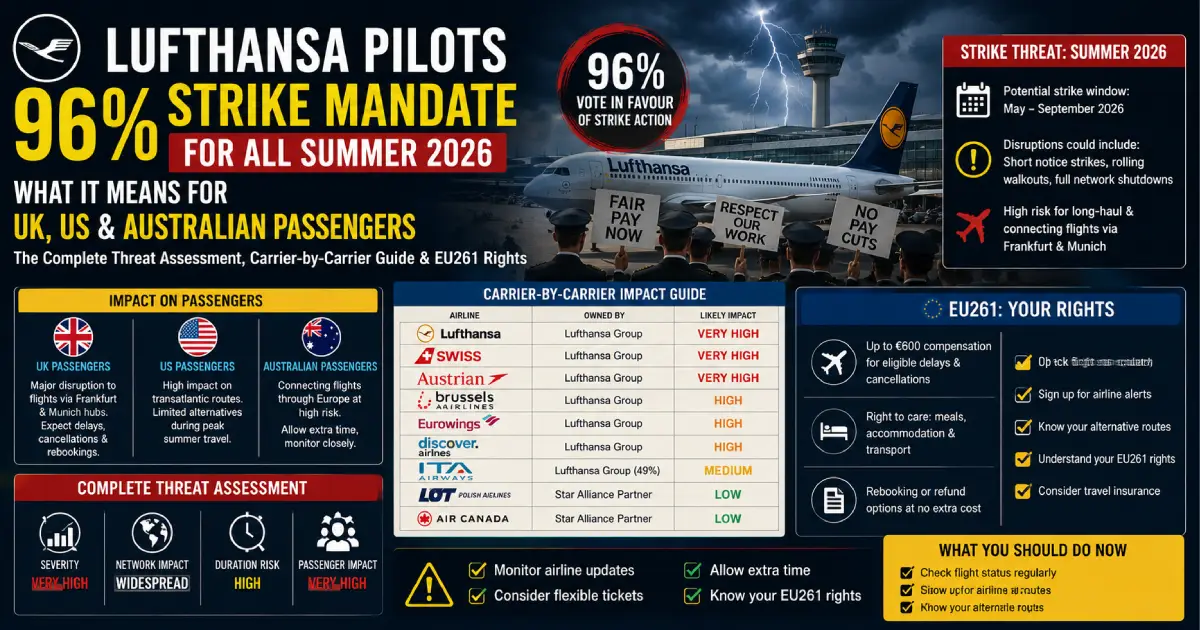
Warning — May 2026: The most dangerous unresolved threat to European summer travel is not a weather system, not a fuel crisis, and not a government policy change. It is a number: 96%. That is the proportion of Vereinigung Cockpit (VC) pilots — the union representing Lufthansa’s own flight crew — who voted in favour of strike action in a ballot that explicitly authorises industrial action throughout the entire summer 2026 season. The dispute that triggered this mandate remains completely unresolved. No new strike dates have been announced since May 5. But “no dates announced” does not mean “dispute resolved” — and in German labour law, a 96% mandate is the most powerful pre-strike signal a union can hold. It means VC can call a strike at 48 hours’ notice and have near-certain pilot participation at any point between now and October 26 when the summer timetable ends. If you have a Lufthansa-operated flight booked anywhere this summer — Frankfurt, Munich, Hamburg, Düsseldorf, Zurich, Vienna, or beyond — this article is the most important piece of pre-travel reading you can do.
Published: May 21, 2026 — Strike mandate holder: Vereinigung Cockpit (VC) — represents Lufthansa pilots Mandate strength: 96% in favour of industrial action Mandate scope: Entire summer 2026 timetable — authorises strikes until October 26, 2026 Current status: No further strike dates announced — Lufthansa operating normally as of mid-May Talks status: Both sides signalled openness to arbitration after May 4–5 strike — no agreement reached — dispute remains unresolved Core dispute: Pension scheme restructuring (final-salary → contribution-based) + inflation-tracking salary formula + rostering rules Strike history (2026 to date):
In German labour law, a strike ballot is not merely a symbolic exercise. When Vereinigung Cockpit achieves a 96% strike mandate from its membership, it acquires specific legal powers that fundamentally change the risk landscape for every Lufthansa passenger booked this summer.
What a 96% mandate legally enables:
Under German collective bargaining law, a strike mandate gives VC the authority to:
What a 96% mandate signals about pilot sentiment:
When 96% of pilots vote for strike action, it means there is effectively no dissenting faction within the pilot group that an airline can rely on to keep limited operations running. Previous Lufthansa strikes — including the April 15–17 wave — saw 80–90% of the schedule grounded precisely because this level of solidarity means almost no pilot crosses the picket line voluntarily. A 96% mandate suggests future strikes could be more complete than even April’s worst days.
Why “no current strike dates” is not reassurance:
The absence of announced strike dates means talks are ongoing — both sides signalled openness to arbitration after the May 4–5 stoppage. This is the quietest window in the dispute since it began in March 2026. But “quiet” is not “resolved.” The pension scheme dispute — the core issue — has not been settled. VC’s position on salary inflation-tracking has not been met. Lufthansa management’s restructuring plans that triggered the dispute have not been reversed. The mandate remains active. The match is still lit. The question is only when VC chooses to drop it.
Understanding the dispute is essential for passengers — because it determines whether EU261 compensation applies and how long the conflict is likely to last.
The central issue is Lufthansa’s decision to replace its final-salary (defined benefit) pension scheme for pilots with a contribution-based (defined contribution) scheme. For pilots, this is not an abstract accounting change — it directly affects their retirement income security. Under the old scheme, pension payments were linked to final salary. Under the new scheme, the pension value depends on investment returns that can fluctuate.
Vereinigung Cockpit has described this change as “a fundamental attack on the long-term financial security of our members.” Lufthansa argues it is necessary for the group’s long-term financial viability — particularly given the fuel cost pressures from the Iran war and the €2 billion+ over-budget jet fuel expenditure that IAG (British Airways’ parent) has also confirmed.
VC is demanding an inflation-tracking salary formula — automatic salary adjustments linked to the Consumer Price Index — so that real wages do not erode during periods of high inflation. Lufthansa has made offers that VC considers insufficient. Andreas Pinheiro, VC President, stated after the May 4–5 strike: “There is absolutely no movement on the part of the employers.”
Beyond pay and pensions, VC is also disputing changes to pilot rostering — the rules governing rest periods, maximum duty hours, and schedule patterns. These are safety-relevant issues, not just labour conditions, which gives VC additional moral authority in the dispute.
Pension scheme restructuring disputes in the airline industry are among the most prolonged and difficult to resolve. Unlike a pay dispute where a number can bridge the gap, a fundamental restructuring of a defined benefit scheme involves complex actuarial calculations, union trust, legal obligations to existing members, and long-term financial commitments that take months to negotiate. The Lufthansa-VC dispute is structurally similar to the British Airways cabin crew BASSA dispute of 2009–2011 — which lasted two years and produced repeated strike waves throughout the period.
The realistic resolution timeline: Industry analysts do not expect a full resolution before the autumn. Both sides must first accept binding arbitration, then appoint an arbitrator, then negotiate in mediated sessions, then reach a framework agreement, then ratify it with VC members — a process that takes 3–6 months minimum in German labour law practice.
Before looking at the summer threat, it is essential to understand what has already happened — because it establishes the precedent for how the next wave will operate:
Timeline of 2026 Lufthansa Industrial Action:
| Date | Strike Actor | Duration | Impact |
|---|---|---|---|
| March 12–13, 2026 | VC (pilots) | 2 days | 50%+ cancellations at Frankfurt and Munich |
| April 8–9, 2026 | Verdi (ground staff) | 2 days | Full ground stop |
| April 10, 2026 | UFO (cabin crew) | 24 hours | 500+ cancellations |
| April 13–14, 2026 | VC (pilots) | 2 days | 80%+ schedule grounded |
| April 15–16, 2026 | UFO (cabin crew) | 2 days | Combined with pilots — near-total shutdown |
| April 16–17, 2026 | VC (pilots) | 2 days | 80–90% schedule grounded — worst days |
| April 30, 2026 | UFO (cabin crew) | 8 hours | 500+ additional cancellations |
| May 4–5, 2026 | VC (pilots) | 48 hours | Hundreds of cancellations — FRA, MUC, DUS, BER |
| CURRENT | VC mandate active | Until Oct 26 | No dates announced — can be triggered 48hr notice |
The total damage from Wave 1 alone (April 8–17): More than 2,700 Lufthansa flights cancelled — the equivalent of grounding the airline’s entire operation for approximately 2.7 days straight. At peak strike days on April 15–17, 80–90% of Lufthansa’s schedule was grounded.
The CityLine shutdown context: During this period, Lufthansa also removed Lufthansa CityLine from its flight programme entirely, shutting down the subsidiary airline that operated regional feeder flights to Frankfurt and Munich hubs. This is a permanent change — CityLine is gone regardless of whether strikes continue.
This is the most practically important section for UK, Australian, and US passengers — because the 96% strike mandate does NOT apply to every Lufthansa Group airline.
All Lufthansa-branded flights operated from German airports are subject to VC pilot strikes. This includes:
🇬🇧 UK passengers: Lufthansa operates London Heathrow (LHR) and London City (LCY) to Frankfurt and Munich. Edinburgh, Birmingham, and Manchester routes to German hubs also affected on strike days. Any UK → Germany → onward Lufthansa itinerary is at risk.
🇦🇺 Australian passengers: Lufthansa’s Singapore–Melbourne and Singapore–Sydney services, operated under code-share arrangements, are affected when the originating Frankfurt or Munich departure is grounded. The typical Lufthansa Europe–Australia routing (Frankfurt → Singapore → Australia) is at risk if a strike day coincides with your travel.
🇺🇸 US passengers: Lufthansa’s New York JFK, Chicago O’Hare, Washington Dulles, Los Angeles, Miami, and Atlanta transatlantic routes from Frankfurt are all at risk on strike days.
Eurowings Germany is affected by VC pilot strikes. Critical distinction: Eurowings Europe — which operates from Vienna (Austria), Split, and other non-German bases — is not affected.
Eurowings routes from Germany at risk: All Eurowings Germany departures from Düsseldorf, Cologne, Berlin Brandenburg, Stuttgart, and Hamburg.
All Lufthansa Cargo air freight operations are subject to VC pilot strikes.
SWISS is a Lufthansa Group member based in Zurich (ZRH). SWISS pilots are represented by AEROPERS — a separate Swiss pilot union — not by Germany’s VC. SWISS has not been subject to any of the 2026 VC strikes.
✅ Implication for UK/Australian passengers: If your Lufthansa Group booking is operated by SWISS — i.e., if the flight number starts with LX rather than LH — your flight is not at risk from VC pilot strikes.
⚠️ Watch for rerouting: During Lufthansa mainline strikes, Lufthansa rebooks displaced LH passengers onto SWISS flights where available. This creates a surge in SWISS loads — expect SWISS flights to be fully booked on any Lufthansa strike day.
Austrian Airlines operates from Vienna (VIE) and is not subject to VC German pilot strikes. Austrian pilots are represented by a separate Austrian union.
✅ Austrian connections (Vienna hub) are a reliable alternative to Frankfurt and Munich during any VC strike.
⚠️ Austrian Airlines has a separate, unrelated dispute with its own cabin crew union — this has produced isolated Austrian disruptions in 2026 but is a distinct issue from the VC mandate.
Brussels Airlines operates from Brussels Airport and is not subject to VC. Belgian pilots have their own union.
✅ Brussels is an alternative Lufthansa Group hub during Frankfurt/Munich strikes — but note that Brussels Airport has its own Belgian trade union disruption risk (the May 12 nationwide strike being the most recent).
The new Lufthansa City Airlines — established as a lower-cost subsidiary — has its own separate employment contracts and is not covered by VC’s mandate.
Both charter/leisure operators within the Group are not subject to VC.
Both sides have signalled openness to arbitration following the May 4–5 stoppage. This is the most positive signal in the dispute since it began. But “signalling openness” and “agreeing to arbitration” are different things — and the pension scheme structural issue means arbitration, even if agreed, may not deliver a result before the peak July–August summer season.
The arbitration timeline problem:
Step 1: Both sides formally agree to binding arbitration → estimated 1–2 weeks to agree terms Step 2: Arbitrator appointed (must be agreed by both parties) → estimated 1–2 weeks Step 3: Mediated sessions (typically multiple rounds) → estimated 4–8 weeks Step 4: Proposed framework agreement → estimated 1–2 weeks Step 5: VC member ratification ballot → estimated 1–2 weeks
Minimum total: 8–16 weeks from the point arbitration is formally agreed. If arbitration talks do not begin before June 1, the dispute almost certainly will not be resolved before the August bank holiday peak — the highest-risk period for a repeat strike.
The most likely near-term scenario (industry consensus): No new strikes in the next 3–4 weeks while both sides talk. A specific summer date — likely mid-July or August when Lufthansa’s load factors are highest and a strike causes maximum financial pain — as VC’s next leverage point if talks stall.
This is the single most important legal point for every Lufthansa passenger planning European summer travel: Lufthansa pilot and cabin crew strikes are NOT extraordinary circumstances under EU261.
The principle was established in the European Court of Justice case Krüsemann v TUIfly (2018) and subsequent cases: strikes by an airline’s own staff — as distinct from external workers, ATC, or airport security — are within the airline’s sphere of control and do not constitute extraordinary circumstances. Lufthansa’s own industrial relations decisions directly caused the dispute. Therefore:
✅ EU261 cash compensation of up to €600 per person applies for delays of 3+ hours and cancellations with less than 14 days’ notice ✅ UK261 cash compensation of up to £520 per person applies for UK passengers ✅ This applies to ALL VC (pilot) and UFO (cabin crew) strikes at Lufthansa — not just the ones that have happened, but any future strikes this summer
Confirmed by Flightright: “Insurers stress that EU261 compensation — up to €600 per traveller — applies because a strike by an airline’s own staff is considered within the carrier’s control.”
| Distance | EU261 | UK261 | Examples |
|---|---|---|---|
| Under 1,500 km | €250 | £220 | Frankfurt–London, Munich–Amsterdam |
| 1,500–3,500 km | €400 | £350 | Frankfurt–Edinburgh, Munich–Lisbon |
| Over 3,500 km | €600 | £520 | Frankfurt–New York, Munich–Singapore, FRA–Sydney |
The 14-day advance notice exemption: If Lufthansa cancels your flight MORE than 14 days before departure (as it did during its proactive summer schedule adjustment), the €250–€600 cash compensation does NOT apply — but your full refund or free rebooking right is still unconditional.
If Lufthansa cancels with LESS than 14 days’ notice: Full cash compensation applies. During strikes, Lufthansa typically cancels flights on the morning of the strike day or with 24–48 hours’ notice — well within the 14-day threshold. This is when your full EU261 entitlement activates.
| Method | Details |
|---|---|
| Direct to Lufthansa | lufthansa.com → Customer Relations → Claim Compensation |
| AirHelp (no win, no fee) | airhelp.com — handles claim on your behalf for a % of payout |
| Flightright | flightright.com — similar service |
| UK CAA escalation | caa.co.uk/passengers — if Lufthansa rejects claim |
| AviationADR (UK) | aviationadr.org.uk — free ADR scheme, binding on airlines |
| Luftfahrt-Bundesamt (Germany) | lba.de — German national aviation authority |
| Time limit | 6 years in England and Wales · 3 years in Germany |
If you have a Lufthansa-operated summer booking:
Step 1: Check whether your specific flight is operated by LH (Lufthansa mainline) or by SWISS (LX), Austrian (OS), or Brussels Airlines (SN). Check the operating carrier in your booking confirmation — not just the marketed carrier. If it says LH, your flight is at risk.
Step 2: Check Lufthansa’s flexible rebooking policy. Lufthansa has issued open-ended flexible travel waivers for passengers whose flights were disrupted during the April–May strike period. Check lufthansa.com → My Bookings for any active waiver on your booking.
Step 3: For new bookings: book flexible fares only. The difference in price between a fixed fare and a flex fare on a Lufthansa summer route is worth every penny given the 96% strike mandate. A fixed Lufthansa fare booked today is at genuine risk of zero-value if a strike day coincides with your travel.
Step 4: Consider routing via SWISS (ZRH hub) or Austrian Airlines (VIE hub) rather than Lufthansa mainline via Frankfurt or Munich. Both are Lufthansa Group; both connect to the same global destinations; neither is subject to VC’s mandate.
Contact Lufthansa UK: lufthansa.com | 0371 945 9747 | via Star Alliance member carriers
For Australian passengers, the highest-risk Lufthansa itinerary is the Frankfurt/Munich → Singapore → Australia routing operated under code-share arrangements. When Lufthansa mainline is grounded by a pilot strike, the first-leg European departure does not operate — meaning the Singapore–Sydney or Singapore–Melbourne connection is also missed.
The 48-hour notice risk for long-haul: Because VC can announce strikes with just 48 hours’ notice, Australian passengers on 24–26 hour journeys are particularly vulnerable. A strike announced on Tuesday means Wednesday departures from Frankfurt are cancelled. An Australian passenger who flew Sydney→Singapore→Frankfurt arriving Tuesday evening to connect onto Wednesday’s Frankfurt–London service finds themselves stranded in Frankfurt with no forward connection.
The practical recommendation: If your Australian summer holiday includes a Frankfurt or Munich connection on a Lufthansa-operated flight: have the SWISS or Austrian alternative route identified in advance. ZRH (Zurich) and VIE (Vienna) are both fully operational alternatives that can connect you to Sydney, Melbourne, Brisbane, and Perth via their own connections.
🇦🇺 ACCC rights: Australian Consumer Law applies to ticket purchases made in Australia. If Lufthansa cancels your flight and does not provide alternative transport within a reasonable time, contact the ACCC at accc.gov.au in addition to filing EU261 directly.
Lufthansa operates multiple daily transatlantic services from JFK, ORD, IAD, LAX, MIA, and ATL to Frankfurt. These are the most popular German gateway routes for US-Europe travel. On Lufthansa pilot strike days, these routes have historically been among the first cancelled.
US DOT rights: Under DOT automatic refund rules, if Lufthansa cancels your flight, you are entitled to a full cash refund within 7 business days to your credit card — regardless of any extraordinary circumstances argument. EU261 cash compensation (€400–€600) on top of this applies because it is a pilot strike.
Contact Lufthansa US: lufthansa.com | 1-800-645-3880
1. Set a Lufthansa strike news alert on Google — right now Go to google.com/alerts → enter “Lufthansa strike” → set it to “As it happens.” When VC announces a new strike with 48 hours’ notice, you will receive the alert before most passengers know anything has changed. This gives you 48 hours to take action — rebook, reroute, or claim a refund — before the flight is officially cancelled.
2. Know whether your specific flight is operated by LH or a partner Open your booking confirmation. Find “operated by” next to each flight segment. LH = Lufthansa mainline = at risk. LX = SWISS = not at risk. OS = Austrian = not at risk. SN = Brussels = not at risk. This single check determines your entire summer 2026 strike risk profile.
3. Book only flexible fares on Lufthansa-operated routes from today forward Do not book fixed non-refundable fares on Lufthansa mainline for summer 2026. The 96% mandate is active. A non-refundable Lufthansa fare purchased today has a material probability of being worth zero if a strike coincides with your travel date. The flex fare premium is insurance.
4. If you have an existing Lufthansa fixed-fare summer booking — check for active waivers now Go to lufthansa.com → My Bookings → check your specific booking for any active travel waiver. Lufthansa has issued waivers covering the April–May strike period. If your future travel date is covered, you may be able to rebook to a flexible alternative date now at no charge.
5. File EU261 immediately if your Lufthansa flight is cancelled with less than 14 days’ notice If VC announces a summer strike and your flight is among the 80–90% cancelled on strike day, file your EU261 claim the moment you receive the cancellation notification. Go to lufthansa.com → Customer Relations → EU261 claim. On a Frankfurt–New York flight, that claim is worth €600 per person — plus your unconditional refund or free rebooking.
The Bottom Line: Lufthansa’s 96% strike mandate is the aviation industry’s equivalent of a live bomb sitting on the summer schedule. The dispute — pension restructuring plus pay — is structurally unresolved and will not be resolved quickly. VC can trigger a strike at any point before October 26 with just 48 hours’ notice, and the 96% mandate means near-total pilot participation is guaranteed when they do. The April–May strikes already grounded 80–90% of Lufthansa’s schedule on peak days. The next wave, when it comes, will do the same — potentially at the worst possible moment: August bank holiday weekend, or the last weekend in July when European schools break up. Set the Google alert. Know your operating carrier. Book flexible. And file your EU261 claim the moment Lufthansa cancels — because a pilot strike by the airline’s own staff is EU261 compensation territory, up to €600 per person, no extraordinary circumstances defence permitted.
For More Resources:
Related Articles:
Posted By : Vinay
This article is provided for general informational purposes only and is based on information available at the time of publication. Travel advisories, airline schedules, airport operations, visa requirements, government regulations, and other travel-related information are subject to change without prior notice. While Travel Tourister makes reasonable efforts to verify information using official announcements, government publications, airline and airport communications, and other reliable sources, we cannot guarantee that all information remains complete, accurate, or up to date at all times. Readers should independently verify any information that may affect their travel plans with the relevant airline, airport authority, government agency, embassy, or other official source before making travel, financial, or other decisions. Travel Tourister shall not be liable for any direct or indirect loss, inconvenience, or damages arising from the use of or reliance on the information contained in this article. Nothing in this publication constitutes legal, immigration, financial, or professional travel advice. If you believe any information in this article is inaccurate or outdated, please contact our editorial team. We review all credible correction requests promptly and update our content whenever appropriate.
Lastest News
2nd Floor, 39, Above Kirti Club, DLF Industrial Area, Kirti Nagar, New Delhi, Delhi 110015



Travel Tourister is a leading Travel portal where we introduce travellers to trusted travel agents to make their journey hasselfree, memorable And happy. Travel Tourister is a platform where travellers get Tour packages ,Hotel packages deals through trusted travel companies And hoteliers who are working with us across the world. We always try to find new and more travel agents and hoteliers from every nook and corners across the world so that you could compare the deals with different travel agents and hoteliers and book your tour or hotel with the one you have chosen according to your taste and budget.
Copyright © Travel Tourister, India. All Rights Reserved

 Call
Call Enquiry