Published on : 21 May 2026
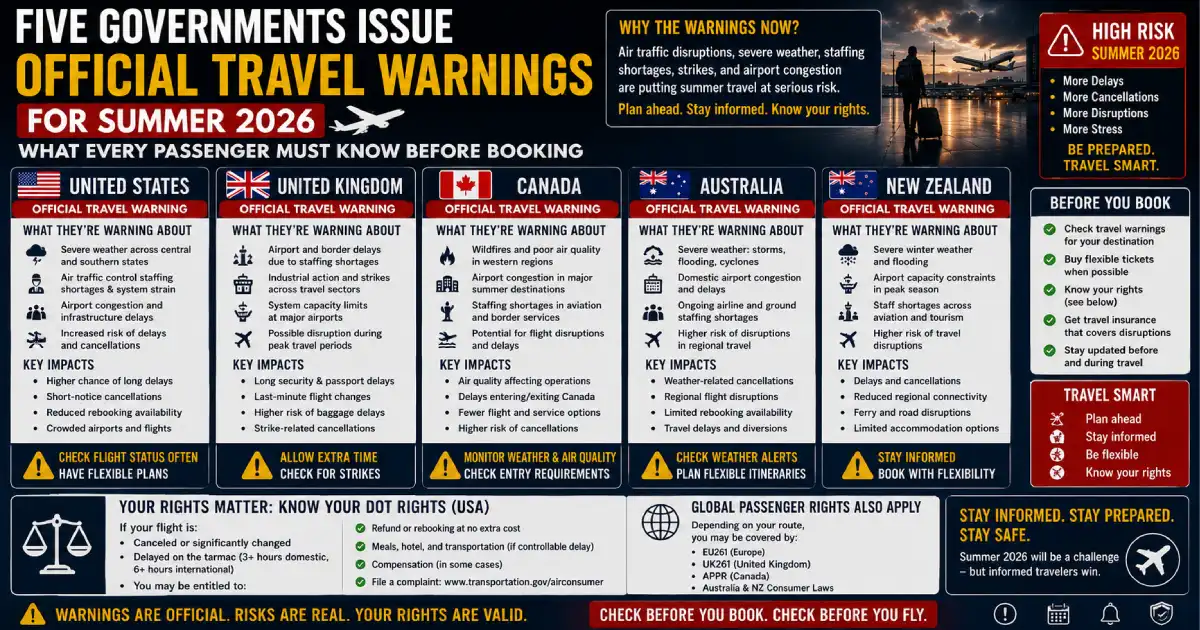
Breaking: In an unprecedented coordinated development, the governments of the United States, United Kingdom, Canada, Australia, and New Zealand have all issued official travel warnings for summer 2026 — the first time all five major English-speaking Tier 1 nations have simultaneously warned their citizens about the risks of international travel in peacetime. This is not about war zones. These warnings cover fuel supply disruptions, airspace closures, soaring airfares, operational aviation instability, and geopolitical risks that can affect your flights even if your destination is thousands of miles from the Middle East.
Published: May 21, 2026 Warning Status: 🔴 ACTIVE — all five governments — US · UK · Canada · Australia · New Zealand Historical Significance: First simultaneous Tier 1 five-nation travel advisory in modern peacetime aviation history Root Cause: Iran War fuel crisis + Strait of Hormuz + global aviation disruption cascade UK Jet Fuel: 296 UK airport departures cancelled in first 12 days of May alone — 150% increase Ryanair Seat Cuts: 700,000 seats removed from European network Lufthansa Group: 20,000 flights cancelled May–October 2026 TUI Fuel Statement: “No shortage in next 10 weeks” — but concern persists beyond that window New UK Government Rule: Potential easing of 20% slot cancellation limit — could allow 100,000+ additional cancellations Airfare Impact: Average fares up 23–40% on key leisure routes vs May 2025 Canada Warning: Global Affairs Canada — disruptions affect ALL international travel, not just Middle East US Warning: State Department — operational aviation challenges may affect trips worldwide UK Warning: FCDO — fuel supply disruptions and airspace management affecting schedules globally Australia Warning: DFAT — aviation resilience and geopolitical instability shaping 2026 travel NZ Warning: MFAT — soaring airfares and Middle East flight chaos affect all international routes Who This Affects: Every passenger from US · UK · Canada · Australia · NZ flying internationally this summer Memorial Day: May 25 — 5 days away — 45 million US passengers projecting into disrupted system
New Zealand joins Canada, US, Australia, UK, India and others as governments warn against international travel amid soaring airfares, Middle East flight chaos, fuel crisis and global tourism disruptions in 2026. Governments are no longer issuing advisories only for war zones or politically unstable countries. Official guidance now warns travelers that fuel supply disruptions, airspace closures and operational aviation challenges may affect trips worldwide, including destinations far from the Middle East. Governments across Canada, the US, Australia, the UK, New Zealand, India and other countries are increasingly treating international travel disruption as a broader economic and national preparedness issue rather than only a tourism challenge. Fuel security, aviation resilience, airspace management and geopolitical instability are now shaping official travel guidance across multiple continents.
This is the critical distinction that makes today’s warnings different from every previous travel advisory your government has ever issued: you do not need to be flying to the Middle East to be affected. You do not need to be transiting through Dubai, Doha, or Bahrain. You do not need to be within 3,000 miles of Iran. You could be booking a package holiday to Majorca. You could be planning a two-week road trip across the American Southwest. You could be taking a cruise from Southampton to Norway. Every international flight in 2026 is flying in an altered world — and five governments have simultaneously decided their citizens need to know that.
The simultaneous nature of these warnings is itself the story. For all five Tier 1 governments — with their distinct foreign ministries, intelligence services, aviation regulators, and political priorities — to issue coordinated travel caution about the same set of risks in the same week is, as Travel and Tour World notes, unprecedented in the modern era of civilian aviation.
The United States has drawn attention to operational aviation challenges, highlighting heightened caution partly linked to ripple effects from global conflicts and disruptions in international aviation logistics. Official guidance warns that fuel supply disruptions, airspace closures and operational aviation challenges may affect trips worldwide, including destinations far from the Middle East.
The State Department’s summer 2026 travel guidance represents a significant departure from its traditional role of warning Americans about specific destination risks — terrorism, crime, political instability. The new guidance explicitly acknowledges that the aviation system itself is a risk factor — not just the destination at the end of the journey. US passengers booking transatlantic, transpacific, or Caribbean routes this summer are being told to plan for disruption as a baseline assumption rather than an unexpected exception.
What US passengers should do: Check travel.state.gov for current guidance. Enrol in STEP (Smart Traveler Enrollment Program) at step.state.gov before any international trip — this ensures the State Department can contact you in a disruption event. Purchase comprehensive travel insurance that specifically covers aviation fuel-crisis-related disruptions.
The UK’s Foreign, Commonwealth & Development Office (FCDO) is warning British passengers about fuel supply disruptions and airspace management issues affecting flights globally. The UK warning is the most operationally specific of the five — because the UK is simultaneously experiencing a domestic jet fuel supply crisis that is distinct from the global Middle East fuel shock.
Data from aviation analytics company Cirium has revealed 296 cancelled departures from UK airports this month up to Tuesday 12 May. This is an increase of roughly 150 percent, with the cancellation number sitting at 120 for the six days previously. Heathrow and Gatwick airports are reported to have written to the Government over flight cancellation rules. TUI CFO Mathias Kiep told The Independent: “I’m very much convinced that we will see no shortage in the next 10 weeks.”
TUI’s “10 weeks” statement — made in mid-May — means the CFO is confident through approximately late July. What happens in August — peak UK summer holiday season — is explicitly left open. The 296-cancellation figure covering just the first 12 days of May is running at a 150% acceleration from the previous six days, suggesting the UK fuel supply situation is getting worse, not better, heading into the peak summer period.
Budget carriers and flagship airlines alike have struggled to keep schedules intact as mounting operational pressures, aircraft shortages and crew availability issues continue to squeeze the aviation sector. Disruptions are already sparking concern ahead of the peak summer holiday period, with experts warning airlines and airports may have little room for error as passenger numbers surge through June and July. Travellers affected by cancellations are being urged to check airline apps regularly and act quickly to secure alternative flights before replacement seats are snapped up.
The new Labour Government rule that could ease the 20% slot cancellation limit — potentially allowing more than 100,000 additional cancellations during the summer — is the most politically charged element of the UK situation. Heathrow and Gatwick have written to ministers opposing this change. If the government allows airlines to cancel more flights without losing their slots for the following season, the incentive to maintain schedules weakens precisely when UK passengers most need reliability.
What UK passengers should do: Check gov.uk/foreign-travel-advice for your destination. Contact your airline directly for flights July–August and ask explicitly about schedule stability. Ensure your travel insurance was purchased before today’s warnings became publicly known — “known event” exclusions may apply to policies purchased from this week onward.
As of May 2026, Global Affairs Canada warns that the ongoing Middle East conflict is causing widespread travel disruptions, including flight cancellations and fuel shortages affecting global travel. According to the government, travel plans could be affected whether you’re flying to the Middle East, transiting through it or travelling elsewhere entirely, as airlines worldwide continue adjusting routes and operations amid growing instability.
Canadians are warned about summer 2026 travel disruptions due to Middle East tensions, fuel shortages, and security concerns, with heightened risks for vacationers. With the summer travel season fast approaching, Canadians are being advised to prepare for potential chaos at airports and in their travel plans due to a combination of rising tensions in the Middle East, regional conflicts, and environmental risks such as the upcoming hurricane season.
Canada’s warning is the most comprehensive in scope — explicitly addressing the fuel supply chain challenge linked to restricted Strait of Hormuz access, the hurricane season risk for Caribbean travel, and the FIFA World Cup 2026 security concerns (the tournament is co-hosted by Canada, the US, and Mexico starting June 11). Canadian passengers booking summer travel face the convergence of all three factors simultaneously.
The latest Canadian government travel warnings make it clear that international travel in 2026 may be far more unpredictable than usual. With global flight disruptions, rising fuel shortages, increasing airfare costs, and ongoing Middle East tensions affecting airlines worldwide, Canadians are being urged to prepare carefully before travelling abroad. The Government of Canada says travelers must remain flexible, financially prepared, and fully informed before booking trips this summer.
What Canadian passengers should do: Register with the Registration of Canadians Abroad service at travel.gc.ca. Ensure comprehensive travel insurance coverage including trip cancellation, trip interruption, and supplier default. Budget for fares 23–40% above 2025 levels on key routes.
Australia’s Department of Foreign Affairs and Trade (DFAT) has updated Smartraveller (smartraveller.gov.au) to reflect aviation resilience and geopolitical instability as factors affecting summer 2026 travel. Australia’s warning is particularly significant for long-haul travellers — Australia has no short-haul escape routes. Every Australian travelling internationally must fly, and every Australian flight route to Europe, the UK, North America, and the Middle East has been affected by the crisis.
Travelers are being encouraged to monitor government advisories closely, prepare contingency plans and remain aware that international travel conditions may continue changing rapidly throughout 2026. The evolving situation highlights how deeply interconnected global aviation, tourism and energy markets have become during one of the most operationally volatile periods in recent years.
The specific Australian risk factors: Air New Zealand’s ongoing capacity cuts (4% May, 5% June) directly affect trans-Tasman routes. Jetstar’s 12% trans-Tasman cut reduces affordable options. Qantas is still evaluating its Europe-via-Dubai routing post-UAE reopening. Singapore Airlines (May 31 suspension end) and Cathay Pacific (June suspension end) are both in recovery mode from Gulf airspace closures that rerouted them away from normal operations.
What Australian passengers should do: Check smartraveller.gov.au before every international booking. Register trips at smartraveller.gov.au/plan-your-travel/register-your-trip. Ensure comprehensive travel insurance from a provider with supplier default and aviation disruption coverage. Book Australian-departure flights only with airlines confirming route stability — call and ask.
New Zealand joins Canada, US, Australia, UK, India and others as governments warn against international travel amid soaring airfares, Middle East flight chaos, fuel crisis and global tourism disruptions in 2026. International travel in 2026 is becoming increasingly unpredictable.
New Zealand’s Ministry of Foreign Affairs and Trade warning is the most recently issued of the five — making the simultaneous five-nation advisory complete. New Zealand faces the same structural challenge as Australia: it is an island nation with no alternative to aviation for international travel. The added NZ-specific risk is Air New Zealand’s ongoing capacity reduction programme, which has removed 1,100+ domestic and international flights through June, reducing the airline’s ability to reroute stranded passengers.
New Zealand’s Mondayisation Anzac Day (April 27) and the resulting travel disruptions earlier this month illustrated exactly the kind of peak-demand-meets-reduced-capacity scenario that MFAT is now warning about for the broader summer season.
What NZ passengers should do: Check safetravel.govt.nz for current destination advisories. Contact Air New Zealand directly to confirm May–August bookings are on confirmed operating services. Purchase travel insurance from a NZ provider with aviation fuel crisis coverage.
While the five-nation travel warnings focus on global disruption, the United Kingdom has a specific additional risk layer that affects UK passengers more than any other Tier 1 country: a domestic jet fuel supply squeeze that is operating independently of the Middle East fuel crisis.
In total, Cirium recorded 296 departures from UK airports scrapped this month as of Tuesday; a sharp rise from 120 cancellations just six days earlier. Flights from Heathrow, Gatwick and Manchester to Paris, Amsterdam and Dublin have all seen cancellations, causing missed onward connections for passengers travelling internationally. Services operated by airlines including British Airways, American Airlines, Air Canada, easyJet and WestJet have been pulled from schedules, disrupting journeys to major destinations including New York, Toronto, Mumbai, Paris, Amsterdam and Dublin.
Under current rules, airlines can scrap up to 20 percent of their peak-time airport slots while retaining the right to fly them the following season — a rule airports say is already lenient enough when it comes to allowing for a certain amount of cancellations. But under new Labour Government rules, this 20 percent limit could be eased to reportedly allow for more than 100,000 cancellations during the Iran War fuel crisis. More details around this are expected to be confirmed within days.
The 296-cancellation figure covering just 12 days means the UK is on track for approximately 750 cancellations in May alone — before the traditional summer holiday season even starts. The June–August risk window is when UK aviation faces its highest demand alongside its most constrained fuel supply. The combination is the exact scenario the FCDO warning is addressing.
Action 1 — Check your airline’s fuel contingency policy before booking. Not all airlines are equally exposed to fuel supply disruption. Emirates is currently most resilient — it has its own fuel supply infrastructure and benefits from the UAE reopening. British Airways, easyJet, Ryanair, and TUI are the UK carriers most exposed to the domestic UK fuel squeeze. Ask your airline specifically: “Has this flight been confirmed as operationally protected for the summer season?”
Action 2 — Purchase comprehensive travel insurance before this week ends. Travelers are being encouraged to monitor government advisories closely, prepare contingency plans and remain aware that international travel conditions may continue changing rapidly throughout 2026.
Insurance purchased after today’s five-nation warnings are publicly known risks will increasingly face “known event” exclusions for aviation disruption. If you have summer travel planned and have not yet purchased insurance: act today. Specifically ask your insurer whether fuel-crisis-related flight cancellations are covered under your policy’s “supplier default” or “trip cancellation” provisions.
Action 3 — Build financial contingency into every summer trip. Travelers should maintain enough funds to cover extended accommodation, meals, and transportation if stranded abroad. Evaluating credit access, banking options, and emergency cash availability can provide additional security.
The Canadian government’s specific guidance — maintain funds for extended accommodation if stranded — is practical advice every Tier 1 passenger should follow. A two-week summer holiday budget should include a contingency of 20–30% for disruption costs: hotel extensions, replacement flights, taxi transfers to alternative airports.
Action 4 — Book flexible fares only for July and August. Any non-refundable, non-changeable fare booked for July or August 2026 carries significant financial risk given the fuel situation. The premium for flexible fares is justified this summer. If your airline does not offer a flexible fare on your route, book through a travel agent on an ATOL-protected package — your refund rights are stronger under the UK Package Travel Regulations 2018.
Action 5 — Register with your government’s travel notification system.
Ryanair is already cutting its routes for later this year, with 700,000 seats lost across Europe.
Ryanair’s 700,000-seat European cut is the single largest capacity reduction in budget European aviation history. Ryanair carries approximately 200 million passengers per year — its 700,000-seat cut is a small percentage of its total capacity, but on the specific routes where those seats have been removed, the impact is total. For UK passengers who relied on Ryanair’s ultra-low fares to European leisure destinations: those specific routes are now either gone or significantly less frequent.
The Ryanair cut compounds the Lufthansa Group’s 20,000-flight cancellation programme, British Airways’ 19-route cuts, Virgin Atlantic’s Dubai winter suspension, Turkish Airlines’ 18-route cut, and Philippine Airlines’ Dubai suspension. Across the entire global aviation network, hundreds of thousands of seats that existed in summer 2025 simply do not exist in summer 2026.
The most concerning development buried in the UK situation is the Labour Government’s proposed easing of the slot cancellation limit. Under new Labour Government rules, this 20 percent limit could be eased to reportedly allow for more than 100,000 cancellations during the Iran War fuel crisis. More details around this are expected to be confirmed within days.
The current rule allows airlines to cancel up to 20% of peak-time slots while retaining those slots for the following season. Heathrow and Gatwick are opposing any easing of this limit. Their argument: if airlines can cancel more flights without losing their valuable peak-time slots, the financial penalty for schedule disruption is reduced — creating a perverse incentive to cancel rather than operate. The airports are saying the rule change would effectively give airlines government permission to strand passengers without consequence.
If this rule change is confirmed in the coming days — as the government spokesperson suggested it would be — it significantly worsens the UK passenger rights position for summer 2026. Airlines with slots at Heathrow could cancel up to 100,000 departures over the summer while retaining those slots for summer 2027, with reduced financial penalty for the disruption caused.
Memorial Day weekend is 5 days away (May 24–26). American Airlines expects 4.2 million passengers across 40,000 flights over the holiday. The FAA O’Hare summer cap has been pushed back to June 2 — meaning Memorial Day weekend flies with the old overcapacity O’Hare schedule still active.
US passengers flying Memorial Day weekend are entering the most disrupted period of the entire 2026 aviation year on the busiest holiday weekend of the spring. Spirit Airlines is gone. Fares are up 23% on leisure routes. Southwest has exited O’Hare. The FAA cap has not yet taken effect.
The Government of Canada says travelers must remain flexible, financially prepared, and fully informed before booking trips this summer. Whether traveling to the Middle East or elsewhere, Canadians should expect potential disruptions and closely monitor official travel advisories as the global situation continues evolving.
This guidance from Canada applies equally to American travellers this Memorial Day: be flexible, be financially prepared, and be informed. The five-nation warnings are not crying wolf. They reflect a genuine and documented deterioration in global aviation reliability that is already visible in the cancellation statistics — 296 UK departures cancelled in 12 days, Ryanair pulling 700,000 seats, Lufthansa cancelling 20,000 flights — and is expected to intensify through the peak summer months.
✅ Enrol in STEP: step.state.gov ✅ Purchase travel insurance today — before “known event” exclusions apply ✅ Book flexible fares only for July–August ✅ DOT mandatory cash refund for any cancelled US-operated flight: airconsumer.dot.gov ✅ Memorial Day: build 3-hour buffer at all airports May 22–26
✅ Check FCDO advice for every destination: gov.uk/foreign-travel-advice ✅ Book ATOL-protected packages for UK261 + Package Travel Regulations protection ✅ UK261 duty of care always owed regardless of cancellation cause ✅ Section 75 credit card protection for purchases over £100 ✅ Insurance: call your provider today about fuel-crisis disruption coverage ✅ UK flight cancellation refunds: caa.co.uk/passengers
✅ Register trips: travel.gc.ca/register ✅ APPR compensation: CAD $400–$1,000 for controllable cancellations ✅ File APPR claims within 30 days: otc-cta.gc.ca ✅ FIFA World Cup travel (June 11+): additional disruption risk at US, Canadian, Mexican airports ✅ Hurricane season (June 1+): Caribbean travel carries additional risk layer
✅ Register trips: smartraveller.gov.au ✅ Australian Consumer Law: full refund or rebooking for all cancellations ✅ ACCC airline complaints: accc.gov.au ✅ Airline Customer Advocate: airlinecustomeradvocate.com.au ✅ Confirm Air NZ and Qantas international bookings are on confirmed operating services
✅ Register trips: safetravel.govt.nz/register ✅ Consumer Guarantees Act 1993: full refund or rebooking for cancellations ✅ Commerce Commission NZ: comcom.govt.nz ✅ Air New Zealand capacity cuts: confirm all bookings at airnewzealand.com/manage-booking
Posted By : Vinay
This article is provided for general informational purposes only and is based on information available at the time of publication. Travel advisories, airline schedules, airport operations, visa requirements, government regulations, and other travel-related information are subject to change without prior notice. While Travel Tourister makes reasonable efforts to verify information using official announcements, government publications, airline and airport communications, and other reliable sources, we cannot guarantee that all information remains complete, accurate, or up to date at all times. Readers should independently verify any information that may affect their travel plans with the relevant airline, airport authority, government agency, embassy, or other official source before making travel, financial, or other decisions. Travel Tourister shall not be liable for any direct or indirect loss, inconvenience, or damages arising from the use of or reliance on the information contained in this article. Nothing in this publication constitutes legal, immigration, financial, or professional travel advice. If you believe any information in this article is inaccurate or outdated, please contact our editorial team. We review all credible correction requests promptly and update our content whenever appropriate.
Lastest News
2nd Floor, 39, Above Kirti Club, DLF Industrial Area, Kirti Nagar, New Delhi, Delhi 110015



Travel Tourister is a leading Travel portal where we introduce travellers to trusted travel agents to make their journey hasselfree, memorable And happy. Travel Tourister is a platform where travellers get Tour packages ,Hotel packages deals through trusted travel companies And hoteliers who are working with us across the world. We always try to find new and more travel agents and hoteliers from every nook and corners across the world so that you could compare the deals with different travel agents and hoteliers and book your tour or hotel with the one you have chosen according to your taste and budget.
Copyright © Travel Tourister, India. All Rights Reserved

 Call
Call Enquiry