Published on : 10 Aug 2026
By Travel Tourister | Updated Aug 2026
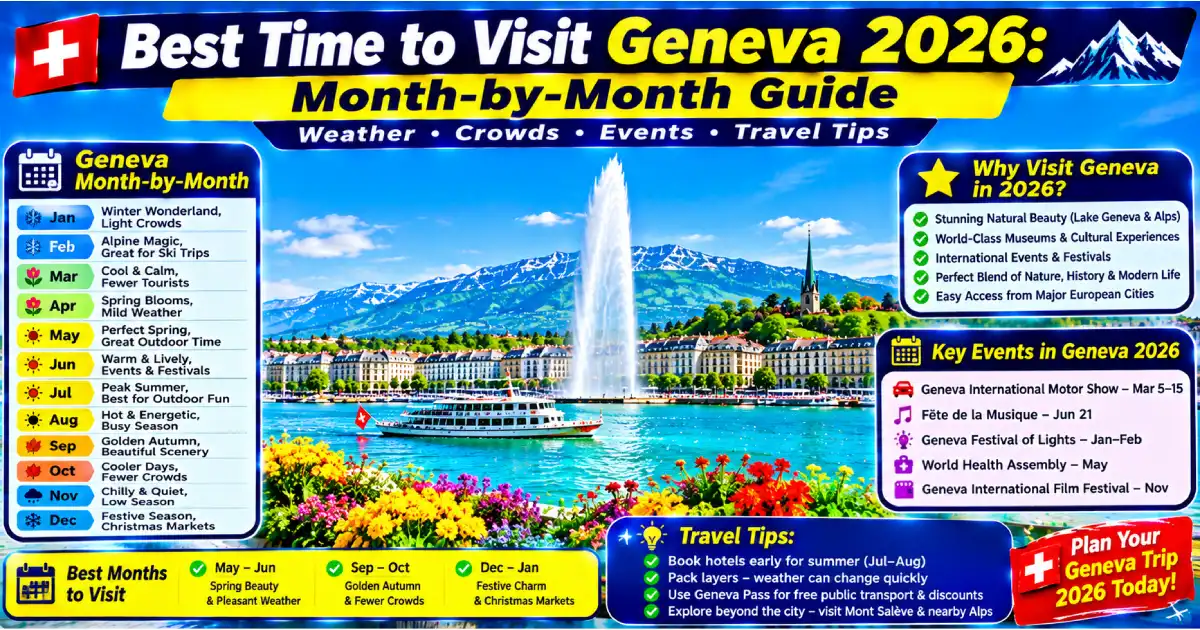
Geneva is a genuinely year-round destination — unlike Alpine ski resorts or Mediterranean beach destinations whose appeal concentrates in a single season, Switzerland’s international capital maintains its full cultural infrastructure (the UN headquarters, the ICRC Museum, the Old Town, the Patek Philippe Museum, the lakefront promenade, and the restaurant scene) across all twelve months, with weather and specific events determining which experiences are optimal rather than which are possible at all. The best time to visit Geneva depends on what you’re prioritizing: June through August delivers the lake swimming culture at the Bains des Pâquis, the outdoor terrace dining on the Quai du Mont-Blanc, and the long evenings where sunset extends past 9 PM over the French Alps across the lake; December brings the Escalade festival (Geneva’s most distinctively local annual celebration), the Christmas markets, and a festive atmosphere that transforms the Old Town; April and May offer comfortable spring conditions with blooming lakeside parks and the first terrace weather of the year at prices below summer’s peak; and the September–October autumn period combines the year’s most atmospheric lake light conditions with the Lavaux wine harvest just a train ride away.
What makes Geneva’s seasonal planning genuinely interesting is the city’s dual identity — as both a Swiss city (sharing Switzerland’s climate patterns, public holiday calendar, and seasonal price rhythms) and as an international city whose visitor flows are partly driven by conference and organizational calendars rather than purely by leisure tourism. The UN Human Rights Council, the World Health Assembly, and various other major international meetings create specific weeks of elevated hotel demand (and elevated prices) that have nothing to do with tourist seasons — understanding this organizational calendar allows visitors to avoid inadvertently booking during a major diplomatic conference week when hotels charge premium rates and fill quickly, or alternatively to book specifically around these events if the international Geneva atmosphere is part of the appeal.
This guide breaks down Geneva’s climate, crowd patterns, hotel pricing, and event calendar month by month — identifying the optimal visiting windows for specific traveler priorities and providing practical packing and planning advice for visitors booking 2026 Geneva trips from any international source market.
For specific Geneva recommendations, see our Best Places to Visit in Geneva 2026, Things to Do in Geneva 2026, Best Restaurants in Geneva 2026, and Geneva Travel Guide 2026 guides.
| Month | Avg High/Low (°C) | Avg High/Low (°F) | Crowd Level | Hotel Prices | Best For |
|---|---|---|---|---|---|
| January | 4°C / -2°C | 39°F / 28°F | Low | $ | Budget travel, quiet museums, winter city break |
| February | 6°C / -1°C | 43°F / 30°F | Low | $ | Budget, Escalade chocolate marmites, quiet |
| March | 11°C / 3°C | 52°F / 37°F | Low–Medium | $$ | Geneva Motor Show, spring beginning |
| April | 15°C / 6°C | 59°F / 43°F | Medium | $$ | Spring blooms, comfortable walking, Easter |
| May | 19°C / 10°C | 66°F / 50°F | Medium | $$$ | Best shoulder weather, first terrace season |
| June | 23°C / 14°C | 73°F / 57°F | Medium–High | $$$ | Lake swimming opens, long evenings, Fête de la Musique |
| July | 26°C / 16°C | 79°F / 61°F | High | $$$$ | Peak lake swimming, Montreux Jazz nearby |
| August | 25°C / 15°C | 77°F / 59°F | High | $$$$ | Peak swimming, National Day (Aug 1) fireworks |
| September | 20°C / 11°C | 68°F / 52°F | Medium–High | $$$ | Best all-round month, Lavaux harvest, reduced crowds |
| October | 14°C / 6°C | 57°F / 43°F | Medium | $$ | Autumn light, shoulder pricing, lake still warm |
| November | 7°C / 1°C | 45°F / 34°F | Low | $ | Quietest month, budget, pre-Escalade |
| December | 3°C / -1°C | 37°F / 30°F | Medium–High | –$$ | Escalade festival, Christmas markets, New Year |
Avg Temp: 11°C / 52°F | Rainfall: Moderate | Crowds: Low–Medium | Hotel Prices: $$
March in Geneva occupies the classic European early-spring position — genuinely transitional, with early March still delivering grey, cool, occasionally rainy days (temperatures regularly below 8°C, the lake surface calm and grey rather than blue under overcast skies) while late March brings the first reliable warmer days, the lakeside parks transitioning from winter bare-branch character toward the early blooms that signal spring’s genuine arrival. The Jardin Anglais’s first flowers (typically late March), the Bains des Pâquis beginning to attract walkers to its lakefront pier even before swimming season opens (the pier accessible year-round, CHF 2, with the café operating — only the swimming is seasonal), and the general lengthening of daylight create a perceptible mood shift in the city as March progresses.
The Geneva International Motor Show (Salon International de l’Automobile de Genève, typically early-to-mid March — check specific 2026 dates at salon-auto.ch as the exact dates vary annually) is the most significant single event in Geneva’s March calendar and one of the world’s most important automotive exhibitions — the Palexpo convention center adjacent to Geneva Airport hosting debuts of new models from virtually every major manufacturer, attended by approximately 660,000 visitors across 10 days. The Motor Show creates a specific hotel demand spike during its specific dates (Palexpo-adjacent hotels particularly affected, but the demand ripples across the city’s accommodation market), making advance booking essential for the Motor Show period and price awareness relevant for visitors whose dates overlap.
Hotel prices in March (outside the Motor Show period) remain at or near winter’s low levels — a meaningful discount compared to summer peak, with the city’s full cultural infrastructure (ICRC Museum, Palais des Nations tours, Patek Philippe Museum, Old Town) fully operational without meaningful crowd competition.
What to do: The International Motor Show (if the dates align and automotive exhibitions interest you — it’s genuinely one of the world’s most significant single-category events), the full museum circuit (ICRC Museum, Palais des Nations, Patek Philippe Museum — all operating normally in March with minimal visitor competition), and the Old Town walking circuit in early spring light. The Lavaux vineyards (a 35-minute train from Geneva — check our Things to Do in Geneva 2026 guide) in late March, when the vines are dormant but the terraced landscape is clear and the winter light creates specific photography conditions different from the vine-leaf-green summer version, rewards the specifically photography-oriented visitor.
Insider tip: The Geneva Motor Show’s hotel demand spike (specifically the 10-day period of the show, check 2026 exact dates) can be entirely avoided by visitors whose Geneva timing is flexible — booking either before or after the Motor Show dates provides equivalent March weather and cultural access at significantly better hotel prices and availability.
Avg Temp: 15°C / 59°F | Rainfall: Moderate | Crowds: Medium | Hotel Prices: $$
April brings Geneva’s most appreciated seasonal transition — the lakeside parks (Jardin Anglais, Parc des Eaux-Vives, Parc La Grange with its rose gardens in early development) reach their ornamental bloom peak in mid-to-late April, the Quai du Mont-Blanc’s lakefront plane trees leaf out in the specific bright green of early spring, and the outdoor restaurant terraces begin activating for their seasonal service as April temperatures allow comfortable outdoor dining on warmer afternoons. The Mont Blanc view from the lakefront (the French Alps across the lake, with the 4,808-meter summit visible in specific clarity on clear days) is often sharper in April’s pre-haze spring air than in summer’s occasionally heat-hazy visibility.
Hotel prices in April remain in spring shoulder territory — noticeably below June–August summer peak while the city’s full outdoor visitor experience (lakefront walks, Old Town exploration, terrace dining) is increasingly accessible as spring progresses. The Easter holiday period (date varies, typically falling in late March or April) brings a modest increase in domestic Swiss and European visitor numbers — primarily affecting weekend availability and pricing rather than creating the sustained peak that summer produces.
The CERN Beam Line for Schools competition (a scientific program whose activities happen year-round but with spring assessment periods — not a visitor event in itself, but indicative of CERN’s spring activity level that includes more public programming) and various cultural events at Victoria Hall and the Grand Théâtre (the main opera house) provide cultural programming in April alongside the outdoor spring activities.
What to do: April rewards the visitor who specifically wants the comfortable-weather outdoor Geneva experience (lakefront walking, Old Town exploration, Carouge morning market visits) without summer’s crowd and pricing pressures. The Bains des Pâquis opening for swimming (typically in May rather than April, but the pier and café open year-round) and the first outdoor terrace activation at lakefront restaurants create the beginning of Geneva’s outdoor summer culture in April’s final weeks when temperatures consistently reach 15–18°C on warmer days.
Insider tip: The Parc de la Grange rose gardens (Geneva’s finest formal garden, on the lake’s south shore east of the city center — accessible by bus or tram) begin their pre-bloom preparation in April, with the rose bushes showing early development before the full June bloom. Visiting in April provides a quieter, preparation-phase park experience quite different from the June peak-bloom crowds; returning in June (if a second Geneva visit is feasible) for the full bloom provides the most complete Parc de la Grange seasonal comparison.
Avg Temp: 19°C / 66°F | Rainfall: Moderate | Crowds: Medium | Hotel Prices: $$$
May represents Geneva’s most balanced visiting month — temperatures consistently warm enough for genuine outdoor enjoyment (17–22°C on most days), the Bains des Pâquis opening for lake swimming as the water temperature reaches acceptable levels (typically 16–18°C by late May — refreshing rather than warm, but swimmable for the motivated), outdoor restaurant terraces in full operation throughout the city, and the specific pleasure of Geneva in spring (the lime trees lining the Quai des Bergues in first full leaf, the Jardin Anglais at peak flower clock bloom, and the lakefront’s overall brightness and color after winter) providing distinctly seasonal visual character.
The Bains des Pâquis fondue service (September–May, concluding at the end of May as the facility transitions to its summer swimming identity) reaches its final days in late May — visiting specifically for the fondue on the lake pier in the last warm-but-not-hot May evenings, when the combination of outdoor warmth (comfortable in a light jacket) and the molten cheese’s warmth creates an evening experience unavailable in summer’s hotter conditions, is a specifically May Genevan pleasure that June’s transition to swimming season eliminates.
Hotel prices begin moving toward summer levels in May (noticeably above March/April’s low rates but not yet at the July–August ceiling) — May represents the final month where central Geneva hotels are bookable with 4–6 weeks’ advance notice rather than the 3–5 months that July–August requires for preferred properties.
What to do: The complete Geneva outdoor experience becomes available in May — Bains des Pâquis lake pier and beginning of swimming (late May), Lavaux vineyard walking during vine-flowering season (late May, when the Chasselas vines produce their delicate white flowers — one of the Lavaux’s most distinctive agricultural moments, visually and aromatically specific to this brief window), and the full lakefront terrace dining circuit of the Quai du Mont-Blanc and Quai Gustave-Ador restaurants.
Insider tip: The Lake Geneva CGN steamer service (included with Swiss Travel Pass, the most atmospheric lake crossing available to Montreux or Lausanne) operates year-round but achieves its full seasonal pleasure in May — the deck views (which January boat trips’ cold temperatures restrict) are fully enjoyable in May’s 17–20°C conditions, making May the first month where the full CGN steamer experience (deck seating, lake views, French Alps backdrop) operates as intended.
Avg Temp: 23°C / 73°F | Rainfall: Moderate (afternoon thunderstorms begin) | Crowds: Medium–High | Hotel Prices: $$$
June marks Geneva’s transition into full summer identity — lake temperatures climbing toward 20°C making Bains des Pâquis swimming genuinely pleasant rather than merely refreshing, restaurant terraces citywide at full operation from noon through evening, and the sunset extending past 9:15 PM at the June solstice creating evenings of extraordinary length for lakefront dining, walking, and the specific social culture of Geneva’s outdoor spaces. The Jet d’Eau (operational from approximately March through October) reaches its most photogenic summer conditions in June — the combination of blue sky, clear lake surface, and the Alpine backdrop achieves a visual balance that overcast or hazy summer days reduce.
The Fête de la Musique (June 21, summer solstice, free throughout Geneva’s streets) transforms the city into a continuous outdoor concert venue — the most democratic and most specifically Genevan single annual event, with 200+ performance spaces from the Old Town’s historic squares to the lakefront promenade and the Pâquis neighborhood streets. Geneva’s celebration reflects its French cultural integration despite Swiss political identity — the event is shared with France, where it originated in 1982.
June hotel prices represent the beginning of the summer premium — noticeably above May’s levels but not yet at July–August’s ceiling. The European school holidays haven’t fully activated (most Continental European school summers begin in July), keeping crowd levels more manageable than the following two months while the full summer activity program is operational.
What to do: Fête de la Musique (June 21, plan an evening specifically around the event — the Old Town’s Place du Bourg-de-Four, the lakefront, and the Pâquis each provide distinct festival atmospheres worth experiencing in sequence), Bains des Pâquis lake swimming at peak early-summer freshness (the water temperature rising through June toward its July–August maximum), and the CGN lake steamer service toward Montreux for the Montreux Jazz Festival (early July, but the pre-festival atmosphere begins in late June with the lakeside village activating for the season).
Insider tip: June provides the summer season’s best combination of available activities, pre-peak crowd levels, and pre-ceiling hotel prices — visitors who specifically want the full Geneva summer experience (lake swimming, outdoor terraces, long evenings, the Jet d’Eau in operational summer mode) but without July–August’s maximum crowd and pricing levels should specifically target June. Booking 2–3 months ahead provides access to preferred hotels at prices 15–25% below the July–August equivalent.
Avg Temp: 26°C / 79°F | Rainfall: Moderate (afternoon thunderstorms common) | Crowds: Very High | Hotel Prices: $$$$
July is Geneva at its summer peak — lake temperatures reaching 22–24°C (genuinely warm for comfortable extended swimming), the Bains des Pâquis at its most crowded and most socially energetic, restaurant terraces operating at full capacity from noon through late evening, and the specific combination of European school holidays (French, German, Swiss, Italian schools all beginning summer break in July) with Geneva’s always-present international visitor base creating the year’s highest hotel demand. The Jet d’Eau’s specific visual drama (the 140-meter water column against a blue sky with the French Alps in definition behind) peaks in the clear conditions that stable summer high pressure creates in the best July weeks.
The Montreux Jazz Festival (early July, approximately 50 minutes from Geneva by train or 3.5 hours by CGN lake steamer — the outdoor lakeside stages are free, indoor concerts ticketed) provides one of Europe’s most celebrated music events within easy reach. The combination of a Geneva base with a Montreux Jazz day trip (or overnight) creates a specific Lake Geneva summer itinerary that draws visitors specifically from North America, Asia, and the broader international music community.
Practical tradeoffs: July is Geneva’s most expensive month for accommodation (five-star lakefront hotels regularly CHF 600–1,200+/night, three-star central hotels CHF 250–400/night), most competitive for restaurant reservations at the city’s most-demanded establishments, and most crowded at the Bains des Pâquis pier (the CHF 2 entry fee does not limit visitor numbers — popular sunny days see the pier genuinely packed). Hotel booking 3–5 months ahead is minimum preparation for July; preferred lakefront properties often require 6+ months for July dates.
What to do: The full July Geneva experience — morning Bains des Pâquis swimming (arriving before 10 AM for space on the pier, or embracing the social crowd that characterizes peak season), afternoon Old Town exploration or ICRC Museum visit (air-conditioned relief from afternoon heat), Montreux Jazz Festival day trip (coordinating train or steamer with specific performance schedule — the free outdoor stages don’t require advance planning, the indoor ticketed concerts require booking months ahead), and lakefront terrace dinner as the sun sets past 9 PM over the French Alps.
Insider tip: The Montreux Jazz Festival’s free outdoor stages (the lakeside Stravinski Auditorium area and various outdoor positions along the Montreux lakefront) provide genuine quality programming without any ticket purchase — arriving by train from Geneva (50 minutes, frequent service) for an evening of free outdoor music, then returning by last train to Geneva (confirming the final train time before departing), constitutes one of the summer’s finest day-trip options from Geneva at essentially zero cost beyond the train fare (covered by Swiss Travel Pass).
Avg Temp: 25°C / 77°F | Rainfall: Moderate | Crowds: High | Hotel Prices: $$$$
August maintains July’s full summer conditions while adding Switzerland’s National Day celebrations (August 1, a public holiday) — Geneva’s lakefront fireworks display (launched from barges on the lake at nightfall, typically 10–10:30 PM, visible from the entire Quai du Mont-Blanc and Quai Gustave-Ador lakefront promenades without ticket or reservation) is one of Switzerland’s most spectacular annual fireworks events given the lake’s natural amphitheater geometry and the French Alps backdrop. The lakefront fills with Geneva residents and visitors from late afternoon on August 1 for the fireworks — arriving at the lakefront by 9 PM provides comfortable viewing positions before the display begins.
Late August begins a perceptible but subtle seasonal transition — the first coolness in early mornings, the evenings beginning to shorten toward 8:30 PM sunset by month’s end, and the slight reduction in European school-holiday tourism as French and German summer breaks begin concluding. This late-August transition makes the final week of August often the best practical window for visitors wanting summer lake conditions with marginally improved hotel availability and the beginning of post-peak-season pricing adjustment.
What to do: August 1 National Day (lakefront fireworks — position along either the north or south quay by 9 PM, the entire lakefront provides excellent views without specific premium positioning), continued Bains des Pâquis swimming (the lake’s warmest temperatures of the year, typically 23–24°C in August), and the CGN lake steamer in summer’s peak condition — deck space, clear visibility, the full Alps panorama, and the Lavaux vineyard terraces lush in late summer.
Insider tip: The August 1 lakefront fireworks are completely free and require no advance planning beyond arriving early enough to secure lakefront position — the event draws 100,000+ people to the Geneva quays but the lake’s long lakefront (extending kilometers in both directions from the Jet d’Eau) distributes the crowds sufficiently that any position along either quay provides an unobstructed view. The Bains des Pâquis pier specifically (on the north shore, open until midnight on August 1 for the event) provides a particularly atmospheric viewing position with the lake immediately surrounding the pier.
Avg Temp: 20°C / 68°F | Rainfall: Moderate | Crowds: Medium–High | Hotel Prices: $$$
September is the month that experienced Geneva visitors most frequently identify as their preferred — the summer warmth persists through the month (18–22°C, genuinely comfortable for outdoor activities), the Bains des Pâquis continues lake swimming through September as water temperatures remain warm (19–21°C early in the month, cooling toward 15–16°C by month’s end), the city’s cultural season restarts with renewed energy (the Grand Théâtre opens its new opera season, Victoria Hall’s concert programming activates fully for autumn, major galleries launch autumn exhibitions), and the most significant single regional food event — the Lavaux wine harvest (mid-September to mid-October, varying by year based on ripening conditions) — creates a specifically compelling day-trip opportunity from Geneva.
The Lavaux harvest (check specific 2026 timing through local Vaud wine tourism — the harvest date is assessed and announced 4–6 weeks ahead based on Chasselas grape maturity analysis) provides the most complete Lake Geneva regional food experience accessible from Geneva: visiting the terraced vineyards during active picking (hand-harvest teams working the impossible-angle terraces throughout the picking period), cellar door tastings of just-pressed juice (available at some domaines during harvest week), and the specific wine-harvest atmosphere of communities whose economy and culture center on this annual production cycle. The Lavaux in harvest is the Lake Geneva region’s most specifically seasonal single experience, and September–October timing is the only window it’s available.
What to do: The Lavaux harvest day trip (train from Geneva Cornavin to Cully or Rivaz, 35–40 minutes, then walk the terraces during harvest period), the full city cultural programming restart (opera, concerts, gallery exhibitions — the September cultural calendar is typically more ambitious than summer’s reduced institutional programming), continued Bains des Pâquis swimming in early September (the lake remains genuinely warm enough for swimming through mid-September), and the Old Town walks in September’s specifically golden autumn light quality (lower sun angle than summer, warmer directional color).
Insider tip: September’s combination of Lavaux harvest access, continuing lake swimming, full cultural programming, reduced tourist crowd pressure (below July–August’s peak), and pricing that hasn’t yet dropped to autumn’s lowest levels creates the most complete single-month Geneva experience of the year. Booking a September visit 6–8 weeks ahead provides preferred hotel availability at prices 20–30% below July–August peak while delivering equivalent or superior overall visitor experience.
Avg Temp: 14°C / 57°F | Rainfall: Moderate–High | Crowds: Medium | Hotel Prices: $$
October transforms Geneva’s visual character into its most autumnal — the plane trees lining the Quai des Bergues and the chestnut trees of the Parc des Bastions transition through yellows and golds, the Parc La Grange’s roses produce their final blooms before the season’s end, and the lake’s surface (cooling toward 12–14°C by October’s second half — too cold for swimming, but visually extraordinary in the specific October light) achieves the mirror-calm morning reflections that summer’s afternoon winds consistently disturb. The French Alps’ Mont Blanc is most clearly visible from the Geneva lakefront in October’s typically crisp, clear-air conditions — autumn’s reduced atmospheric haze delivering the sharpest Alps-across-the-lake views of the year.
Hotel prices in October drop meaningfully from September’s levels (the main tourist season’s waning creating genuine room-rate reductions at properties that July–August couldn’t discount without losing revenue) while the city’s cultural infrastructure continues at full autumn intensity. The Lavaux harvest concludes in early-to-mid October (the final picking typically complete by mid-October in most years), making the first weeks of October still viable for harvest-adjacent visiting before the vineyard activity winds down to post-harvest quiet.
What to do: October’s specific pleasures center on the visual Geneva — the autumn lakefront (the specific photographic conditions of calm October morning lake reflections, the Alpine backdrop at its clearest, and the warm golden light of October’s lower sun angle), the Parc des Bastions chess games (the outdoor giant chess boards in the park adjacent to the Reformation Wall, most reliably active on October weekend afternoons when mild weather draws Geneva chess enthusiasts to the outdoor boards), and the Old Town cafés (warming from the first seasonal chill in spaces whose historic character the autumn light flatters particularly).
Insider tip: October’s most productive single morning activity in Geneva is arriving at the Quai du Mont-Blanc lakefront between 7:30–9 AM on clear days — the combination of calm lake surface (before morning wind develops), clear Alps visibility, warm golden-hour light on the water, and the Jet d’Eau (still operational through mid-October) creates the most complete Geneva lakefront photography conditions of the year, in conditions where the summer crowd’s presence is reduced to early-morning joggers and dog walkers rather than tourists. This specific window represents Geneva’s finest photography morning of the year.
Avg Temp: 7°C / 45°F | Rainfall: High | Crowds: Low | Hotel Prices: $ (lowest of year)
November is Geneva’s quietest and most affordable month — the Bains des Pâquis has transitioned to its winter fondue service (the pier accessible for walkers and the café for warming drinks, with fondue service beginning as temperatures drop, making November the first month of the best Bains des Pâquis fondue atmosphere — the combination of genuine chill in the air and the warming cheese creates a sensory balance unavailable in summer’s heat or December’s festive crowd). Hotel prices reach their annual nadir in November — central Geneva properties that command CHF 300–400/night in July can be found for CHF 150–200/night in November’s demand trough.
The cultural calendar maintains full operation throughout November — the Grand Théâtre opera season is in progress, Victoria Hall’s concert schedule is active, and the museums (ICRC, Palais des Nations, Patek Philippe, MAMCO) operate normally without the crowd pressure that summer tourism creates. The specific experience of spending 90 minutes with the ICRC Museum in November’s quiet (the museum’s most affecting content requires emotional processing that crowded conditions in summer complicate) rewards visitors who prioritize depth of engagement over seasonal outdoor activities.
What to do: The November Geneva museum circuit (ICRC Museum + Palais des Nations tour + Patek Philippe Museum — all within 30 minutes of each other on the international organizations’ district north of the lake) represents a complete two-day cultural immersion available at the year’s lowest hotel prices without any crowd management required. The first Bains des Pâquis fondue evenings of the season (November’s transition into fondue service, when the pier’s regular fondue crowd re-establishes its autumn routine) and the pre-Escalade chocolate marmites appearing in Geneva’s confectioners complete the November calendar.
Insider tip: The Geneva Escalade preparations (the festival commemorating Geneva’s 1602 defeat of the Duke of Savoy’s surprise attack, celebrated annually in December — see December section) begin appearing in confectioner shop windows in November: the chocolate marmites (ceramic-pot-shaped chocolates filled with marzipan vegetables, one of Geneva’s most specifically distinctive seasonal food traditions) go on sale from early November onward. Purchasing a marmite from a Geneva confectioner in November provides the most time for enjoying this uniquely Genevan edible souvenir — the chocolate keeps well for several weeks.
Avg Temp: 3°C / 37°F | Rainfall: Moderate (snow occasionally possible) | Crowds: Medium–High | Hotel Prices: $$–$$$$ (Christmas–New Year = peak)
December is Geneva’s most specifically festive and most visually distinctive month — the Escalade (the festival commemorating the 1602 defense of Geneva against the Duke of Savoy’s surprise attack, held on the second weekend of December — check specific 2026 dates) transforms the Old Town into costumed historical pageantry with torch-lit processions, the traditional marmite-smashing ceremony, and the specific atmosphere of a civic commemoration that has been maintained for over 400 years. The Escalade is Geneva’s most locally authentic annual festival — predominantly attended by Geneva residents rather than tourists (unlike international events like the Motor Show), and therefore providing the most genuine glimpse of Geneva’s specific civic culture and historical self-understanding.
Geneva’s Christmas markets (the Marché de Noël on the Place du Rhône and adjacent squares, operating from late November through December 24) provide the typical Swiss Christmas market pleasures — Glühwein (mulled wine), artisan handicrafts, seasonal foods, and the festive atmosphere that the Old Town’s historic architecture frames particularly effectively. The specific Geneva contribution to the Christmas market tradition: the Escalade-themed items (chocolate marmites, Escalade wine, and various items referencing the 1602 historical narrative) that distinguish Geneva’s market from more generic Swiss Christmas market alternatives.
December hotel pricing divides sharply: early December (1–15) at moderate winter-shoulder rates (30–40% above November’s lows but below Christmas-week peak), and Christmas–New Year (December 20–January 2) at the year’s price peaks (comparable to or exceeding July–August summer peak, particularly for lakefront luxury properties where New Year’s Eve represents the single most expensive night of the year).
What to do: The Escalade festival (second weekend December — arrive in the Old Town by evening for the processions and the marmite ceremony, which is simultaneously a solemn historical commemoration and a raucously enjoyable community celebration with particular energy from Geneva’s schoolchildren who are taught the Mère Royaume legend from primary school onward), the Christmas markets (particularly atmospheric in the Old Town in early December before Christmas-week crowds arrive), and the Jet d’Eau illumination (the water jet is illuminated in the evenings during December’s holiday period when it’s otherwise out of its March–October operational season).
Insider tip: The Escalade festival’s marmite-smashing ceremony (the traditional Genevan Escalade conclusion, in which a large chocolate marmite is broken open and the marzipan vegetables distributed among participants with the pronouncement “Ainsi périssent les ennemis de la République”) is most authentically experienced in the Place du Bourg-de-Four (the Old Town’s main square) rather than in the commercial areas where tourist-facing versions of the ceremony occur with higher frequency and less genuine community participation. Positioning in the Place du Bourg-de-Four before the ceremony begins provides the most authentic version.
Avg Temp: 4–6°C / 39–43°F | Rainfall: Moderate | Crowds: Low (except conference weeks) | Hotel Prices: $ (lowest period)
January and February combine Geneva’s lowest prices and lowest visitor volumes with the city’s most concentrated international conference calendar — the World Economic Forum (held in Davos but with significant Geneva-based participation and side events), the UN Human Rights Council sessions (held at the Palais des Nations, January–February sessions), and various WHO and other agency meetings create specific weeks of elevated hotel demand and prices that punctuate otherwise quiet winter months. Identifying these conference weeks before booking Geneva in January–February (checking the UN Geneva calendar at ungeneva.org and the main international organization meeting schedules) allows specifically avoiding or targeting these periods based on preference.
The Bains des Pâquis fondue service (September–May, at its most atmospheric in the genuine cold of January–February when the contrast between the outdoor chill and the warming cheese is greatest), the ICRC Museum and Palais des Nations in their least-crowded conditions, and the specific winter lakeside atmosphere (the lake occasionally partially frozen at its Geneva shore in severe winters, the Jet d’Eau out of its operational season, and the French Alps visible with winter clarity on clear days) create a Geneva experience quite different from the summer version — quieter, more intimate, and more focused on the cultural and institutional identity that tourism marketing sometimes obscures beneath the summer lake images.
What to do: January–February rewards the visitor whose priorities are cultural depth (unhurried museum visits, the ICRC Museum with adequate time for emotional processing, the Patek Philippe Museum without weekend afternoon crowds), budget optimization (the year’s lowest hotel rates, fondue at Bains des Pâquis for CHF 20–25 as the most affordable quality meal in Geneva), and the specific winter character of a city that most visitors see only in summer.
Insider tip: The Geneva winter lake (January–February) at sunrise — the lakefront at 7:30–8 AM on clear days, when the Alps are sharply visible across the calm water in the cold morning light and the Quai du Mont-Blanc is occupied only by early-morning joggers — provides one of the year’s most striking Geneva photography opportunities at absolute minimum cost and zero crowd management. The combination of crystal-clear Alps visibility (January–February’s characteristic clear, cold air), mirror-calm lake surface, and warm golden-hour light on the Alps’ snow-covered peaks creates lakefront photography conditions unavailable in summer’s haze and crowd.
Best months: June and September. Both provide the complete Geneva experience — the Bains des Pâquis in its swimming-season operation, the outdoor restaurant terraces active, the CGN lake steamers at full seasonal service, and the city’s cultural institutions operating normally. June is slightly more vibrant and slightly more expensive; September slightly quieter and slightly better value. Both deliver everything Geneva has to offer.
Best months: January, February, November. Winter month hotel prices drop 35–50% below summer peak while all of Geneva’s indoor cultural attractions (ICRC Museum, Palais des Nations, Patek Philippe Museum, MAMCO) operate normally. The Bains des Pâquis fondue (CHF 20–25) operates November–May, providing the most atmospheric and most affordable quality meal in Geneva regardless of season.
Best months: September–October for the Lavaux wine harvest (the most compelling single regional food event accessible from Geneva), and November–April for the Bains des Pâquis fondue season at its most atmospheric. The International Geneva Food Festival (check annual dates) and various other food-focused events add specific programming to the winter calendar.
| Subject | Best Month | Specific Timing |
|---|---|---|
| Mont Blanc reflection in lake | January–February | 7:30–9 AM on clear days |
| Jet d’Eau in blue sky | June–July | Morning, before haze develops |
| Flower Clock in bloom | May–July | Morning before crowds |
| Lavaux harvest vineyards | September–October | Golden hour on terrace paths |
| Escalade processions | December | Evening, Old Town |
| National Day fireworks | August 1 | 10–10:30 PM lakefront |
| Autumn lake reflections | October | 7:30–9 AM on calm mornings |
| Event | Month | Specific Dates |
|---|---|---|
| Geneva International Motor Show | March | Check salon-auto.ch for 2026 |
| Fête de la Musique | June 21 | Free throughout the city |
| Montreux Jazz Festival (day trip) | July | Early July — check montreuxjazzfestival.com |
| Swiss National Day Fireworks | August 1 | 10 PM lakefront |
| Lavaux Wine Harvest | September–October | Check Vaud wine tourism for 2026 |
| Escalade Festival | December | Second weekend December |
| Geneva Christmas Markets | Late November–December 24 | Place du Rhône and Old Town |
| UN Human Rights Council | January–February | Palais des Nations (conference period) |
Waterproof jacket essential — April Geneva rains are genuine. Layers for the 12–18°C temperature variation between morning and afternoon. Comfortable walking shoes for Old Town cobblestones. Light scarf and mid-layer for March evenings that drop quickly after sunset.
Light clothing for warm (24–26°C) to hot conditions. Swimwear for Bains des Pâquis (essential for the full summer experience). Sunscreen (the lakefront provides significant sun exposure without shade). Light jacket or cardigan for air-conditioned indoor spaces (the ICRC Museum and Palais des Nations are noticeably cooler than summer outdoor temperatures). Compact umbrella for the afternoon thunderstorm possibility that June–August afternoons occasionally produce.
Medium-weight layers — September still warm (18–20°C), October requiring genuine jacket by month’s end. Rain jacket for October’s increasing precipitation frequency. Comfortable walking shoes for Old Town and Carouge exploration.
Proper winter coat — temperatures regularly below 5°C, occasionally approaching 0°C. Waterproof shoes or boots for potential rain, sleet, and the occasional Geneva dusting of snow. Multiple warm layers for extended outdoor time. The city’s excellent indoor infrastructure (cafés, restaurants, museums) makes extended outdoor cold-weather exposure optional rather than necessary.
About Travel Tourister Travel Tourister’s destination specialists have visited Geneva across all twelve months — from January’s crystal-clear Mont Blanc lake reflections and the Bains des Pâquis fondue season through June’s Fête de la Musique Old Town concerts and July’s National Day fireworks to October’s Lavaux harvest walks and December’s Escalade torchlit processions — to deliver the most practical and honest month-by-month guide for planning your 2026 Geneva trip.
Posted By : Vinay
Latest Article
2nd Floor, 39, Above Kirti Club, DLF Industrial Area, Kirti Nagar, New Delhi, Delhi 110015



Travel Tourister is a leading Travel portal where we introduce travellers to trusted travel agents to make their journey hasselfree, memorable And happy. Travel Tourister is a platform where travellers get Tour packages ,Hotel packages deals through trusted travel companies And hoteliers who are working with us across the world. We always try to find new and more travel agents and hoteliers from every nook and corners across the world so that you could compare the deals with different travel agents and hoteliers and book your tour or hotel with the one you have chosen according to your taste and budget.
Copyright © Travel Tourister, India. All Rights Reserved

 Call
Call Enquiry