Published on : 10 Aug 2026
By Travel Tourister | Updated Aug 2026
Geneva delivers more genuinely world-class activities per square kilometer than virtually any European city of comparable size — a city of 200,000 residents that simultaneously hosts the UN European headquarters, the International Red Cross, over 200 international organizations, the world’s largest particle physics laboratory, Switzerland’s finest concentration of luxury watchmaking, and a lake (Lac Léman — the largest in Western Europe) whose clear waters warm sufficiently in summer for swimming from city-center piers within 15 minutes’ walk of the main train station. The best things to do in Geneva span completely free experiences (watching the Jet d’Eau from the lakefront promenade, swimming at the Bains des Pâquis for CHF 2, walking the medieval Old Town lanes, attending free guided tours at the UN on specific open days) through moderate-cost activities (the ICRC Museum, the Patek Philippe Museum, a CGN lake steamer crossing to Montreux or Lausanne) to Geneva’s specific luxury pleasures (fine dining at the Beau-Rivage’s lakefront restaurant, a Geneva watchmaking workshop, a private lake tour).
What distinguishes Geneva’s activity landscape from other European cities of equivalent size is the extraordinary concentration of genuinely unique-in-the-world experiences within a compact, walkable city — CERN (the only particle physics laboratory of this scale on Earth), the Palais des Nations (one of only two UN headquarters globally), the International Red Cross Museum (the founding city of humanitarian law), and the Bains des Pâquis (one of the very few places in Europe where city-center public lake swimming is genuinely excellent) are all within 30 minutes of each other by public transport, creating an activity density that much larger cities struggle to match. The Geneva Transport Card (provided free to all hotel guests for the duration of their stay, covering all public transport within Geneva — trams, buses, and lake boats — at zero additional cost) makes navigating between these destinations essentially free for visitors staying in any Geneva accommodation.
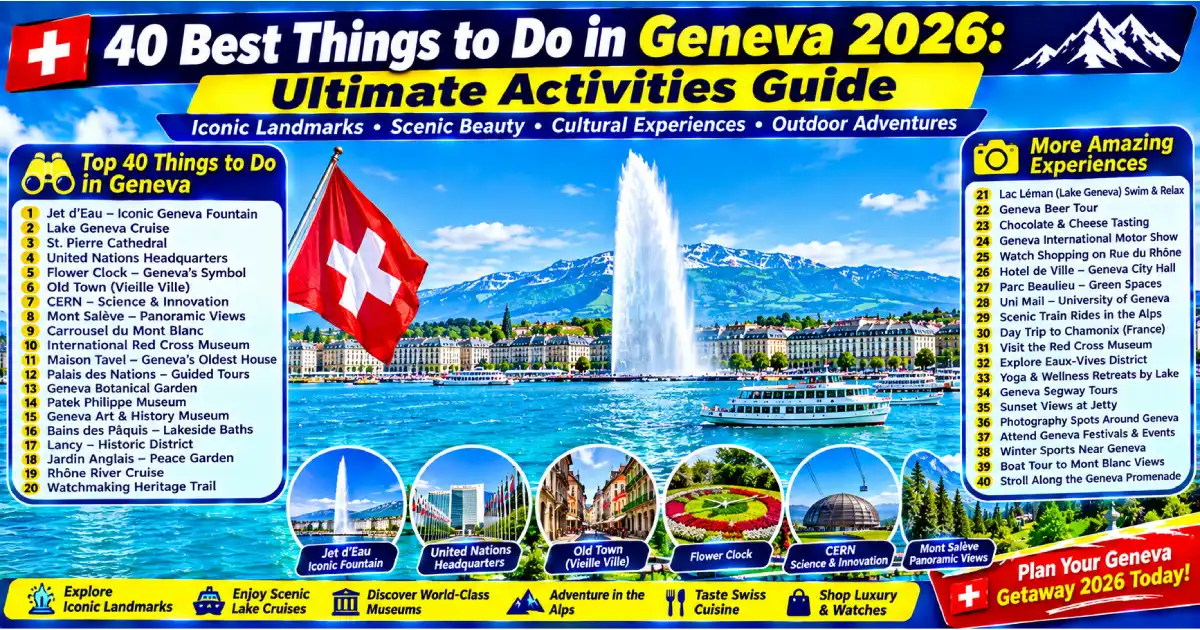
This guide covers the 40 best things to do in Geneva organized by category — culture and history, outdoors and lake activities, food and drink experiences, day trips, and special experiences — with practical details on costs, transport, booking requirements, and insider timing for 2026 visitors.
For complete guides, see our Best Places to Visit in Geneva 2026, Best Restaurants in Geneva 2026, Best Time to Visit Geneva, Best Places to Visit in Switzerland 2026, and Switzerland Travel Guide 2026 guides.
| # | Activity | Category | Cost | Time Needed | Book Ahead? |
|---|---|---|---|---|---|
| 1 | Visit the Palais des Nations (UN) | Culture | CHF 15 | 1.5–2 hrs | Yes (recommended) |
| 2 | Explore the International Red Cross Museum | Museum | CHF 15 | 1.5–2 hrs | No |
| 3 | Swim at Bains des Pâquis | Outdoors | CHF 2 | 2–4 hrs | No |
| 4 | Walk Geneva’s Old Town (Vieille Ville) | Sightseeing | Free | 2–4 hrs | No |
| 5 | See the Jet d’Eau at Sunset | Outdoors | Free | 30 min | No |
| 6 | Visit CERN | Science | Free (exhibition) | 1.5–2 hrs | Yes (guided tours) |
| 7 | Take a CGN Lake Steamer to Montreux | Day Trip | Swiss Travel Pass | 3.5 hrs each way | No |
| 8 | Eat Fondue at Bains des Pâquis | Food | CHF 20–25 | 1.5 hrs | No |
| 9 | Visit the Patek Philippe Museum | Museum | CHF 10 | 1.5 hrs | No |
| 10 | Explore Carouge Neighborhood | Sightseeing | Free | 2 hrs | No |
| 11 | Walk the Quai du Mont-Blanc Promenade | Outdoors | Free | 1 hr | No |
| 12 | Visit the Musée d’Art et d’Histoire | Museum | Free | 1.5–2 hrs | No |
| 13 | Visit the Reformation Wall | History | Free | 20 min | No |
| 14 | Day Trip to Lausanne | Day Trip | Swiss Travel Pass | Full day | No |
| 15 | Take a Watchmaking Workshop | Experience | CHF 80–200 | 2–3 hrs | Yes (weeks) |
| 16 | Explore the Pâquis Neighborhood | Sightseeing | Free | 1.5 hrs | No |
| 17 | Visit MAMCO Contemporary Art Museum | Museum | CHF 15 | 1.5 hrs | No |
| 18 | Walk the Lavaux Vineyards (Day Trip) | Day Trip | Swiss Travel Pass + free | Half day | No |
| 19 | Attend the Geneva International Motor Show | Event | CHF 20–30 | Half day | March only |
| 20 | Take a Chocolate and Fondue Workshop | Food | CHF 60–100 | 2 hrs | Yes |
| 21 | Visit the Barbier-Mueller Museum | Museum | CHF 15 | 1 hr | No |
| 22 | Cycle Along Lake Geneva | Outdoors | CHF 20–30 (bike rental) | 2–4 hrs | No |
| 23 | Attend the Fête de la Musique | Festival | Free | June 21 | No |
| 24 | Visit the Natural History Museum | Museum | Free | 1–1.5 hrs | No |
| 25 | Explore Plainpalais and its Flea Market | Market | Free | 1–2 hrs | No |
| 26 | Day Trip to Chillon Castle | Day Trip | Swiss Travel Pass + CHF 13.50 | Full day | No |
| 27 | Visit the Ariana Museum | Museum | Free | 1 hr | No |
| 28 | Take a Jet d’Eau Boat Tour | Boat | CHF 25–40 | 1 hr | No |
| 29 | Attend the Montreux Jazz Festival (Day Trip) | Festival | Free (outdoor) | July | No |
| 30 | Explore Rue du Rhône Luxury Watches | Shopping | Free to browse | 1 hr | No |
| 31 | Attend a Victoria Hall Concert | Entertainment | CHF 20–80 | 2 hrs | Yes |
| 32 | Visit Château de Penthes | Museum | CHF 10 | 1.5 hrs | No |
| 33 | Take a Geneva Craft Beer Tasting | Food/Drink | CHF 30–50 | 2 hrs | Recommended |
| 34 | Day Trip to Gruyères (Cheese and Castle) | Day Trip | Swiss Travel Pass + CHF 6 | Full day | No |
| 35 | Take a Geneva Chocolate Tour | Food | CHF 40–70 | 2 hrs | Yes |
| 36 | Walk to the Île Rousseau | Sightseeing | Free | 15–20 min | No |
| 37 | Visit the Maison Tavel | Museum | Free | 45 min | No |
| 38 | Attend the Geneva Escalade Festival | Festival | Free | December | No |
| 39 | Take a Sailing Lesson on Lake Geneva | Outdoors | CHF 80–150 | 2–3 hrs | Yes |
| 40 | Visit the Petit Palais (Fine Arts) | Museum | CHF 10 | 1 hr | No |
Cost: CHF 15 | Transport: Bus 8 or 28 to Nations | Book: Advance booking recommended at ungeneva.org | Duration: 1.5 hours | Note: Passport or national ID required
The Palais des Nations guided tour provides the most direct engagement with Geneva’s identity as the world’s diplomatic capital — access to the assembly halls and committee rooms of the United Nations Office at Geneva (UNOG), where over 10,000 meetings take place annually covering everything from arms control negotiations and climate conferences to human rights reviews and trade dispute resolution. The building itself (the former League of Nations headquarters, built 1929–1938 in a specific architectural style that blends monumental classical tradition with Art Deco detailing, surrounded by the Ariana Park’s formal gardens) is visually extraordinary — the Salle des Pas Perdus (the grand reception hall), the various Assembly Hall spaces, and the Council Chamber all carry the specific gravitas of rooms where significant history has been made.
The tour includes the Broken Chair sculpture at the entrance (the 12-meter wooden chair with a broken leg, installed in 1997 to commemorate landmine victims and now one of Geneva’s most recognized public artworks), the assembly rooms and their historical context, the UN’s Geneva operations (the second-largest UN office globally after New York), and the Ariana Park exterior surrounding the complex.
Insider tips: The specific passport/ID requirement (no exceptions, enforced by UN security) catches some visitors off-guard — carrying a valid passport or national identity card (not just a driver’s license or hotel card) is the essential pre-visit preparation. Photography is permitted in most areas of the guided tour; guides identify the specific rooms where photography restrictions apply.
Cost: CHF 15 | Transport: Bus to Nations (adjacent to Palais des Nations) | Duration: 1.5–2 hours | Address: Avenue de la Croix-Rouge 17
The ICRC Museum provides the most emotionally engaging museum experience in Geneva — a carefully curated journey through the history of humanitarian law and the Red Cross movement, from Henry Dunant’s 1863 founding inspiration (witnessing the Battle of Solferino’s untended wounded) through the development of the Geneva Conventions (the foundational documents of international humanitarian law, signed in Geneva and now binding on virtually every nation-state on Earth) to the contemporary global operations of the Red Cross and Red Crescent in over 80 countries.
The museum’s design (European Museum of the Year Award recipient) uses space, light, and object curation to create emotional engagement rather than merely intellectual understanding — the specific artifacts (WWII prisoner of war tracing cards, the actual telegrams through which ICRC delegates communicated during conflicts, personal objects of humanitarian workers killed in the field) create human-scale connection to what statistical accounts of humanitarian operations cannot produce.
What to see: The “Defending Human Dignity” gallery (covering the Geneva Conventions and their contemporary application in active conflicts), the “Restoring Family Links” section (the ICRC’s century-plus work reconnecting separated families across conflict borders), and the temporary exhibition (changing annually, typically covering a specific recent humanitarian crisis or aspect of humanitarian law in depth).
Insider tips: Allow the full 2 hours rather than rushing — the museum’s emotional content requires processing time rather than rapid information acquisition. The museum shop’s products (ethically produced items, books, and Red Cross merchandise, with purchases supporting the ICRC’s humanitarian operations) provide an alternative to the standard souvenir purchase that aligns specifically with Geneva’s humanitarian identity.
Cost: Free | Transport: Tram to Rive, then uphill walk | Duration: 2–4 hours | Best Time: Morning or late afternoon
Geneva’s Old Town rewards the slowest possible pace — the medieval and early modern lanes (Grand-Rue, Rue de l’Hôtel-de-Ville, Rue des Granges, the small alleys connecting them) reveal their character through accumulated detail rather than single landmarks. The essential Old Town circuit: Grand-Rue (main axis, Rousseau’s birthplace at number 40 marked with a plaque, continuous 16th–18th century facade line), Cathedral of St. Pierre (Calvin’s Reformation pulpit, tower climb for city views, underground archaeological site for Roman-era remains), Place du Bourg-de-Four (Geneva’s oldest square, Roman forum site, café terraces), Maison Tavel (Geneva’s oldest surviving house, now a free city history museum), Parc des Bastions and Reformation Wall (the commemorative monument to Calvin, Farel, Bèze, and Knox), and the Promenade de la Treille (the elevated terrace walk along the Old Town’s southern edge with views over the lower city).
Insider tips: The Promenade de la Treille’s chestnut tree (Geneva officially records the first day of spring as the date of this specific tree’s first blossom — a tradition maintained by the official cantonal observer who has recorded the date annually since 1818) and the Treille’s benches (the longest wooden bench in the world, according to Geneva’s unofficial claims — 120 meters of continuous bench along the promenade) are specifically Genevan oddities worth knowing for the specific local character they represent.
Cost: Free (Universe of Particles exhibition); guided tours require booking | Transport: Tram 18 to CERN | Book: home.cern for guided tours | Duration: 1.5–2 hours | Location: Route de Meyrin, 6 km from center
CERN’s visitor program provides the most accessible engagement with cutting-edge fundamental physics available to the general public anywhere in the world — the permanent Universe of Particles exhibition (free, daily, no booking required) presents particle physics from atomic basics through the Standard Model to the Higgs boson discovery in interactive exhibition format genuinely accessible to non-specialist visitors of all ages. The exhibition’s design (using scale models, interactive demonstrations, and carefully explained conceptual progressions rather than technical language) makes CERN’s science genuinely comprehensible to curious visitors without physics backgrounds.
The additional guided tours (the ATLAS detector, LHC tunnel, and various CERN facility tours, requiring advance booking at home.cern) provide physical access to the actual particle physics infrastructure — the ATLAS detector (one of four detectors on the LHC, 46 meters long and 25 meters high, the largest volume detector ever built) is visible from a dedicated observation gallery on guided tours, providing direct encounter with the actual machine that detected the Higgs boson in 2012.
What to do: Universe of Particles exhibition (free, no booking — start here for context before a guided tour if both are planned), the CERN Globe of Science and Innovation (the wooden geodesic dome immediately outside the main gate, with free exhibitions and the external architecture worth experiencing independently), and the online CERN visitor booking system for specific detector and accelerator tours if interest extends beyond the permanent exhibition.
Insider tips: CERN operates on the Swiss-French border — entering the CERN campus crosses the international border without passport control (the Swiss-French border at this specific point is managed through the CERN security checkpoint rather than a conventional border crossing). The campus cafeteria (open to visitors during guided tours) provides meals at CERN employee-subsidy prices — significantly lower than Geneva city center restaurant prices and a practical lunch option for visitors on the CERN campus during midday.
Cost: Free | Date: Second weekend of December (check specific 2026 dates) | Location: Old Town | Character: Geneva’s most authentic local festival
The Geneva Escalade (Festival de l’Escalade), held annually in December to commemorate Geneva’s 1602 defeat of the Duke of Savoy’s attempted surprise attack on the city (during which, according to the historical account that has become festival legend, the widow Mère Royaume poured a pot of boiling vegetable soup from her window onto the invading soldiers — a story now celebrated by the ritual smashing of chocolate marmites filled with marzipan vegetables that is one of the festival’s most distinctive traditions), represents Geneva’s most specifically local public celebration. The Old Town illuminates for costumed processions, historical reenactments, the marmite-smashing ceremony, and the general festive atmosphere of a civic commemoration that has been maintained for over 400 years.
Insider tips: The chocolate marmites (ceramic pot-shaped chocolates filled with marzipan vegetables, sold by confectioners throughout Geneva from November onward and smashed during the Escalade with the traditional pronouncement “Ainsi périssent les ennemis de la République” — “Thus perish the enemies of the Republic”) represent Geneva’s most specifically distinctive food tradition and one of the more unusual edible souvenirs available in any Swiss city.
Cost: Free | Transport: Walk from Old Town or tram to Plainpalais | Duration: 20–30 minutes | Best Time: Anytime
The 98-meter Reformation Wall (four 4.5-meter-high relief figures of Calvin, Farel, Bèze, and Knox flanked by smaller-scale Reformation figures and events) in the Parc des Bastions provides Geneva’s most visually concentrated single summary of the Protestant Reformation’s significance — standing before this monument in the city where Calvin created what became Reformed Protestant Christianity creates a specific historical grounding that European religious history reading alone doesn’t produce. The surrounding Parc des Bastions (Geneva’s central urban park, occupying the site of the 17th-century city fortifications demolished in the 19th century to allow urban expansion) provides a pleasant outdoor space combining the Reformation monument with the chess players who gather at the park’s oversized outdoor chess tables regardless of season — one of Geneva’s most distinctively local daily scenes.
Insider tips: The outdoor chess games in the Parc des Bastions (oversized board, waist-high pieces, game sets available from the park’s chess infrastructure) are a specific Geneva tradition particularly active on weekend afternoons — watching or participating in these games provides the most authentically local Parc des Bastions experience beyond the Reformation monument’s historical tourism.
Cost: Free | Transport: Walk from Cornavin station (10 minutes) | Best Time: 1 hour before sunset on clear days | Distance: 1.5 km lakefront walk
The Quai du Mont-Blanc — Geneva’s most celebrated lakefront promenade, lined with the grand façades of the luxury hotels (Beau-Rivage, Kempinski, Four Seasons) that have defined Geneva’s lakefront character since the 19th century — provides the most classically Geneva lakeside photography in the golden hour before sunset: the Jet d’Eau visible to the south, the Old Town cathedral visible above the Rive Gauche, and the French Alps (on clear days including the Mont Blanc massif in sharp definition as late-afternoon haze settles) filling the eastern horizon across the lake. The walking distance (approximately 1.5 kilometers from the Pont du Mont-Blanc to the Bains des Pâquis at the northern end) allows a complete lakefront experience in 30–45 minutes of unhurried walking.
Insider tips: The lake’s surface conditions (critical for the specific mirror-reflection photographs that make Lake Geneva imagery distinctive) are most calm in the morning hours (before afternoon wind typically develops) and again in the evening after wind subsides — the late-afternoon/evening Golden Hour combines both calm lake surface and warm directional light for the most complete lakefront photography conditions.
Cost: CHF 2 | Transport: Walk from Cornavin (15 minutes) | Season: May–September (swimming); September–May (fondue) | Address: Quai du Mont-Blanc 30
The Bains des Pâquis (see Best Places guide for full description) provides Geneva’s finest lake swimming — CHF 2 entry to the historic 1930s bath house, wooden pier extending into Lake Geneva, diving board, café service, and the specific pleasure of swimming in lake water of drinking-water quality with the French Alps visible on clear days. The institution’s combination of architectural character (the 1930s bathhouse infrastructure, maintained rather than modernized), social demographics (genuinely mixed — students, families, professionals, tourists — in one of Europe’s most economically stratified cities), and the lake’s specific water quality create an urban swimming experience essentially unique in European cities.
Insider tips: The Bains des Pâquis hamam (Turkish bath, separate from the outdoor lake swimming area — open year-round, admission CHF 18–22) provides an indoor wellness option for cooler days when lake swimming isn’t appealing but the baths’ social atmosphere is. The hamam has been a specific feature of the Pâquis baths since 2012 and is popular with Geneva residents across seasons.
Cost: Included with Swiss Travel Pass; individual tickets CHF 15–42 depending on destination | Transport: CGN piers at Jardin Anglais or Pâquis | Duration: Lausanne 3.5 hours; Montreux 3.5–4 hours | Best Time: Summer (April–October for deck enjoyment)
The Compagnie Générale de Navigation (CGN) lake steamer service provides the most atmospheric crossing of Lake Geneva — departing from Geneva’s Jardin Anglais pier or the Pâquis pier, the lake steamers (including the historic paddle steamers that constitute the CGN’s most celebrated vessels — the Savoie, La Suisse, and Simplon, early 20th-century coal-fired paddle steamers still operating on specific routes) cross the lake toward Lausanne and beyond toward Vevey, Montreux, and the Château de Chillon. The journey (3.5 hours to Montreux, with multiple intermediate stops) passes along the Lavaux UNESCO vineyard terraces (the 12th-century Cistercian-established terraced vineyards of the Lake Geneva north shore, visible from the lake as the steamer approaches the Vaud section), the villages of Nyon, Morges, Lausanne, and Vevey, and arrives at Montreux with the Chillon Castle visible to the east.
Insider tips: The Belle Époque paddle steamers (running on specific routes — check the CGN timetable for which departures use historic vessels versus modern motor boats) provide an experience meaningfully different from the standard CGN motor ferry fleet — the paddle wheel mechanism visible from the deck, the coal-fired (now sometimes electrically assisted) propulsion, and the period vessel atmosphere create a lake crossing of specific historical character.
Cost: CHF 20–30/day (bike rental) | Transport: Pick up at Cornavin station area rental shops | Distance: Geneva to Lausanne 62 km (one-way); shorter loops available | Best Time: May–September
The Lake Geneva cycle path (EuroVelo 17, the Rhône Cycle Route, running continuously along the lake’s north shore from Geneva toward Lausanne and beyond) provides cycling on dedicated infrastructure with continuous lake views, passing through the Lavaux vineyard terraces (UNESCO World Heritage Site, the 12th-century hand-cultivated terraced vineyards descending to the lake shore), the lakeside villages of Coppet, Nyon, Rolle, Morges, and eventually Lausanne. The full Geneva-to-Lausanne route (62 km) suits confident cyclists for a full day, while shorter out-and-return routes (Geneva to Nyon at 27 km, or Geneva to Coppet at 14 km) provide lake cycling in 2–4 hours.
Insider tips: E-bikes (available from Geneva’s rental operators, providing motor-assist for the occasional lake shore gradient and the modest elevation changes in the vineyard sections) make the full Geneva-to-Lausanne route accessible to casual cyclists who would find 62 km of conventional cycling too demanding — the CGN boat return service (from Lausanne or intermediate stops back to Geneva, bikes accepted on designated boat services with advance reservation) completes the circuit without requiring the return cycle journey.
Cost: CHF 80–150 (introductory lesson) | Multiple sailing schools | Season: May–September | Book: Yes, several days ahead
Lake Geneva’s 72-kilometer length, consistent westerly wind patterns (the Bise from the northeast and the Vent du Lac from the southwest alternating in predictable seasonal patterns that sailors have worked with for centuries), and the French Alps backdrop create one of Europe’s finest inland sailing environments. Multiple Geneva sailing schools offer introductory and advanced instruction on the lake — the Société Nautique de Genève (one of Switzerland’s oldest sailing clubs, founded 1872, base on the south lake shore) and various commercial sailing schools provide access ranging from introductory 2-hour lessons to full certification courses.
Insider tips: The lake’s afternoon wind patterns (the Bise typically developing in late morning and reaching its strongest in early-to-mid afternoon) create specific timing considerations for first-time sailors — introductory lessons scheduled for morning departures (before the wind fully develops) provide more controlled learning conditions than afternoon lessons in full Bise conditions that experienced sailors enjoy but beginners may find overwhelming.
Cost: Free (walking the terraces); wine tastings vary | Transport: Train to Cully, Epesses, or Rivaz (between Geneva and Lausanne, Swiss Travel Pass covered) | Duration: Half day | Best Time: September–October (harvest), May–June (vine flowering)
The Lavaux UNESCO World Heritage vineyard terraces (see our Best Places to Visit in Switzerland guide) extend along Lake Geneva’s north shore between Lausanne and Montreux — accessible by train from Geneva (approximately 35–45 minutes to the main Lavaux villages) and walkable through clearly marked paths that traverse the terraced vineyards above the lake. The walking path connecting the village of Cully through Epesses and Rivaz to Chexbres (approximately 6 km one-way) provides the most complete Lavaux terrace experience — close-range access to the 12th-century stone-walled terraces, Lake Geneva below, and the French Alps across the water, with individual domain cellar doors open for wine tasting throughout the route.
Insider tips: The Chasselas grape (the dominant variety of the Lavaux, producing Switzerland’s most distinctive white wines — floral, mineral, with a specific “goût de terroir” that Swiss wine enthusiasts describe as unmistakably Lavaux) is best tasted specifically here rather than in Geneva’s restaurants, where the Lavaux’s finest micro-terroir domaines are typically underrepresented on wine lists dominated by international selections. Asking specifically for domaine-direct Lavaux Chasselas at the cellar doors provides access to wines not available in retail.
Cost: CHF 20–25/person | Season: September–May | No reservation | Best Time: Autumn and winter evenings
The Bains des Pâquis fondue (moitié-moitié — half Gruyère, half Vacheron Fribourgeois — served on the outdoor wooden pier over Lake Geneva, with the French Alps occasionally visible in the background on clear autumn days) represents one of Switzerland’s most atmospheric and most democratic fine food experiences: genuinely excellent traditional fondue at CHF 20–25 per person (approximately half the price of equivalent quality fondue at Geneva’s restaurant establishments), on a wooden pier extending into Lake Geneva, in a setting that no purpose-built restaurant could replicate. The combination of the baths’ democratic social character (no dress code, no reservation, CHF 2 entry) with the specific atmosphere of eating hot cheese fondue on a lake pier in autumn weather creates a specifically Genevan pleasure available nowhere else.
Insider tips: The Bains des Pâquis fondue operates as a café service rather than formal restaurant — ordering at the counter and carrying to an outdoor table, sharing communal tables with strangers if needed, and the general informality of the operation is precisely the environment’s charm rather than a service limitation. Arriving at fondue opening time (approximately 7 PM in autumn/winter season — check current hours) provides table selection before the service fills.
Cost: CHF 40–70/person | Multiple operators | Duration: 2 hours | Book: Yes
Geneva’s chocolate culture (Switzerland’s most globally recognized food export, with Geneva specifically hosting several of the country’s finest artisan chocolatiers alongside the Läderach chain’s fresh chocolate shops and various other specialty producers) is best experienced through guided tours that visit 4–6 chocolate establishments in sequence, providing tastings at each and context about the Swiss chocolate tradition, the specific Geneva interpretations of it, and the technical differences between industrial and artisan production. Geneva-specific chocolatiers worth seeking out independently or through tour inclusion: Rohr (a multi-generation Geneva family chocolatier, producing some of the finest truffles in the city), Auer (another historic Geneva chocolatier), and the Geneva branch of Läderach (whose fresh chocolate bars, made without preservatives and requiring refrigeration, represent a specifically Swiss chocolate product available only in Switzerland).
Insider tips: The “fresh chocolate” concept (chocolate produced without preservatives that requires refrigeration and has a short shelf life, available from Läderach and some artisan chocolatiers in Geneva) provides a chocolate experience genuinely unavailable in most of the world’s markets — the texture, flavor intensity, and aromatic complexity of fresh chocolate without preservative stabilization is meaningfully different from shelf-stable chocolate, and Geneva’s concentration of producers offering this format makes it a specifically worthwhile Geneva food purchase.
Cost: CHF 80–200 (depending on workshop content) | Multiple providers | Duration: 2–3 hours | Book: Weeks ahead
Geneva’s position as the historic center of high-end mechanical watchmaking (the specific “Haute Horlogerie” tradition — hand-finishing of movement components to aesthetic standards exceeding functional necessity, the 1:1 ratio of finishing time to functional assembly time that characterizes Geneva’s watch industry at the highest level) has generated a visitor workshop market offering hands-on engagement with the craft. Watchmaking workshops (available through the Patek Philippe Museum’s educational program, through the Geneva Tourism visitor program, and through various independent watchmaking schools) range from assembly exercises using pre-manufactured components (producing a functioning watch movement from constituent parts under a watchmaker’s guidance) to more advanced courses covering specific hand-finishing techniques.
Insider tips: The Patek Philippe Museum’s educational activities program (check the museum’s website for current offerings — availability varies) provides the most historically-grounded workshop context, combining the hands-on component with the museum’s extraordinary collection as a reference framework. The experience of assembling a watch movement under guidance — experiencing the scale of the components (some parts invisible to the naked eye, assembled with watchmaking forceps under magnification) and the precision required — creates an understanding of Swiss watchmaking craft that no museum display, however excellent, fully replicates.
Cost: Free | Date: June 21 (summer solstice, annually) | Location: Throughout Geneva’s streets, squares, and public spaces | Character: Geneva’s largest free music festival
The Fête de la Musique (celebrated simultaneously across France and in Geneva on June 21 each year — Geneva’s participation reflecting the city’s French cultural integration despite Swiss political identity) transforms Geneva’s streets, squares, parks, and pub exteriors into simultaneous outdoor performance spaces for a single day and evening of completely free music across every genre (classical, jazz, rock, electronic, folk, world music, and various other categories all represented simultaneously across 200+ stages and performance spaces). The event’s specifically democratic character (no tickets, no wristbands, simply wandering between performances throughout the city) and the Old Town’s narrow lanes transformed into outdoor concert venues create one of Europe’s most distinctive annual urban music experiences.
Insider tips: The Place du Bourg-de-Four (the Old Town’s oldest square) typically hosts some of the Fête’s most atmospheric performances — the combination of the historic square, the warm June evening, and the specifically French-Swiss celebration character creates a Fête experience that the more centrally-located large stages can’t replicate in atmosphere.
Cost: Swiss Travel Pass covers train to Montreux; Chillon entry CHF 13.50 | Transport: Train Geneva → Montreux (50 min), then walk/bus 2 km to Chillon | Duration: Full day | Best Time: May–October for outdoor path enjoyment
Château de Chillon (13th-century island fortress on Lake Geneva between Villeneuve and Montreux, one of the best-preserved medieval castles in Europe and the site that inspired Byron’s “The Prisoner of Chillon” in 1816) provides Geneva’s finest full-day day trip combining the lake steamer experience (if using CGN from Geneva rather than train) or the scenic rail journey through the Lavaux with the castle itself (interior tour covering 750 years of Savoy, Bernese, and Swiss history, the original medieval chambers and torture room, and the specific prison vault where François Bonivard was chained to a pillar for four years — the imprisonment Byron immortalized in his poem). The lakeside path from Montreux to Chillon (3.5 km, flat, along the lake) provides the most photogenic approach — the castle appearing progressively larger as visitors approach from the north, with the Alps above Villeneuve visible beyond.
Insider tips: The lakeside approach path from Montreux (rather than the bus or taxi alternative) provides the most photogenic castle approach — the castle’s island position (walls rising directly from the lake on three sides, the mountain backdrop behind) is most dramatically experienced from the path rather than from a vehicle arrival at the castle’s land-side entrance.
Cost: Swiss Travel Pass + CHF 6 (castle) + CHF 10–12 (cheese dairy) | Transport: Train Geneva → Fribourg → Bulle → Gruyères (approximately 1.5 hours total) | Duration: Full day | Best Time: Year-round
Gruyères (the medieval hilltop village and its surrounding cheese-producing landscape, approximately 1.5 hours from Geneva by train) provides one of Switzerland’s most complete small-town day trips — the medieval castle (11th-century Château de Gruyères, CHF 12 adults, with period furnishings and a comprehensive history of the counts of Gruyères), La Maison du Gruyère cheese dairy (in the village below, CHF 10–12, with live morning production observation), the HR Giger Museum (the surrealist artist’s collection in medieval stone rooms — the most unexpected cultural juxtaposition in Switzerland), and the HR Giger Bar (decorated entirely in Giger’s biomechanical aesthetic). The combination of Alpine cheese culture, medieval history, and surrealist art within a single compact destination creates a day trip of remarkable variety from Geneva.
Insider tips: The morning timing (departing Geneva early enough to arrive at La Maison du Gruyère before 11 AM) allows watching the active cheese production — milk arrives from surrounding farms in the morning and the curd-cutting, pressing, and initial production process is visible through viewing windows from the gallery above the production floor. Visiting the cheese dairy first (for production context) and the Gruyères castle and village afterward (for historical and cultural context) creates the most logical day structure.
Cost: CHF 20–80 depending on concert and seat | Transport: Tram to Bel-Air | Book: Advance booking recommended for popular concerts | Address: Rue du Général-Dufour 14
Victoria Hall, Geneva’s principal concert hall (built 1894 in a specifically English Baroque style by Daniel Menn, donated to the city of Geneva by British businessman Daniel Sheldon Hall and named for Queen Victoria at the time of its donation), provides Geneva’s finest classical music venue — the Orchestre de la Suisse Romande (OSR, the premier Swiss-French orchestra, founded 1918 by conductor Ernest Ansermet and holding a historically significant position in French-language Swiss musical culture) performs a substantial portion of its season here alongside visiting international orchestras and chamber ensembles. The hall’s acoustics (refined through various modifications since its construction) and its Victorian-era interior (gilded ornament, red plush seating, and the specific grand-concert-hall atmosphere that purpose-built 19th-century halls provide) make attending an OSR or equivalent-quality concert here a specifically Geneva cultural experience.
Insider tips: The OSR season (September–June) includes numerous concerts at Victoria Hall that are open to general public ticket purchase — checking the OSR and Victoria Hall websites in the months before a Geneva visit identifies available concerts during the specific travel dates.
Cost: Free | Transport: Walk from Cornavin (10 minutes) | Best Time: Evening for restaurant scene | Duration: 1.5–2 hours
The Pâquis neighborhood (between Cornavin station and the lakefront, Geneva’s most culturally diverse district) provides the most vivid experience of Geneva’s extraordinary national diversity — 170+ nationalities represented in a district of approximately 20,000 residents, with the corresponding concentration of immigrant-community restaurants (Turkish, Ethiopian, West African, Southeast Asian, Sri Lankan, South American) on the Rue de Berne and surrounding streets. The contrast between the Pâquis’s multicultural density and the luxury hotel facades immediately east on the Quai du Mont-Blanc constitutes one of Geneva’s most striking urban juxtapositions — Geneva as simultaneously a city of global institutional power and a city of economic immigrants living in close proximity within a few hundred meters.
Insider tips: The Marché de la Rive-Gauche (Plainpalais flea market, Wednesday and Saturday mornings) and the Pâquis evening restaurant scene together provide the most complete budget-accessible Geneva food experience — street-level food from the Pâquis’s immigrant restaurants alongside the baths’ fondue represents the most affordable quality eating available in Switzerland’s most expensive city.
Cost: CHF 15 (MAMCO) | Transport: Bus to École-de-Médecine | Duration: 1.5 hours | Best Time: Weekday afternoons
MAMCO (Musée d’Art Moderne et Contemporain) and the Patek Philippe Museum share the same Plainpalais street (Rue des Vieux-Grenadiers), and both sit within easy walking distance of the Musée d’Art et d’Histoire — creating Geneva’s most concentrated arts district for museum-focused visitors. The Plainpalais neighborhood itself (historically Geneva’s working-class district, now transitioning into a creative and student quarter anchored by the University and the arts institutions) provides a complement to the Old Town’s historical character — a more contemporary, less formal, more socially mixed version of Geneva available within 15 minutes’ walk of the lakefront.
Insider tips: Wednesday and Saturday mornings bring the Plainpalais flea market (Marché des Antiquaires, on the large Plaine de Plainpalais space — antiques, vintage clothing, and collectibles from approximately 200 vendors) — combining a MAMCO visit with a flea market morning provides the most complete Plainpalais experience in a single half-day itinerary.
About Travel Tourister Travel Tourister’s destination specialists have experienced Geneva’s full activity range — from Palais des Nations tours and CERN Universe of Particles exhibitions through Bains des Pâquis fondue evenings and Lavaux vineyard cycling afternoons to Carouge market mornings and Fête de la Musique Old Town concerts — to deliver the most practical and honest guide to the best things to do in Geneva for every type of 2026 visitor.
Posted By : Vinay
Latest Article
2nd Floor, 39, Above Kirti Club, DLF Industrial Area, Kirti Nagar, New Delhi, Delhi 110015



Travel Tourister is a leading Travel portal where we introduce travellers to trusted travel agents to make their journey hasselfree, memorable And happy. Travel Tourister is a platform where travellers get Tour packages ,Hotel packages deals through trusted travel companies And hoteliers who are working with us across the world. We always try to find new and more travel agents and hoteliers from every nook and corners across the world so that you could compare the deals with different travel agents and hoteliers and book your tour or hotel with the one you have chosen according to your taste and budget.
Copyright © Travel Tourister, India. All Rights Reserved

 Call
Call Enquiry