Published on : 10 Aug 2026
By Travel Tourister | Updated Aug 2026
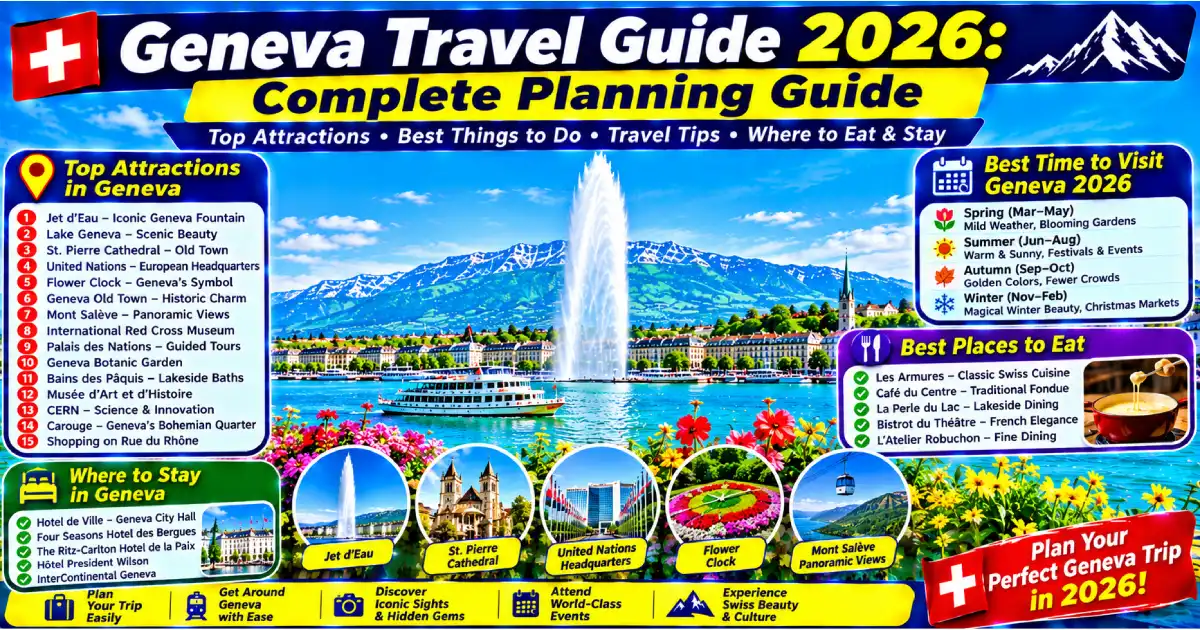
Geneva rewards planning more than most European city destinations — not because the city is difficult to navigate (Geneva’s public transport network is among Europe’s most efficient, and English is universally understood in a city where 40% of residents hold foreign nationality) but because the combination of Switzerland’s general price premium with Geneva’s specific position as Europe’s most internationally-networked city (the UN, the Red Cross, the WTO, the WHO, and 200+ other international organizations headquartered here) creates a hotel and restaurant market whose pricing reflects institutional demand as much as tourist season — and that institutional demand doesn’t follow the same seasonal calendar that leisure tourism does. A visitor who books Geneva accommodation without knowing that a major UN Human Rights Council session or the Geneva Motor Show is happening that specific week may find prices 40–60% above what the same week’s calendar position would suggest based purely on the tourist season.
Beyond the pricing complexity, Geneva’s logistical fundamentals are genuinely excellent for visitors: the free Geneva Transport Card (provided to all hotel guests for the duration of their stay, covering all trams, buses, and lake boats in the city — one of the most visitor-friendly transport systems in Europe), the Swiss Travel Pass (extending coverage to the entire national rail network for day trips to Lausanne, Montreux, Bern, and Zurich), the compact city geography (the Old Town, the UN quarter, the lakefront, and the Pâquis neighborhood all within 30 minutes’ walk of each other), and the exceptional quality of the city’s cultural institutions (ICRC Museum, Palais des Nations, Patek Philippe Museum, MAMCO) create a visitor experience of genuine density and quality once the planning basics are understood. This Geneva Travel Guide 2026 provides those basics — comprehensively, practically, and with the specific insider knowledge that separates a well-planned Geneva trip from an inadvertently expensive one.
For specific Geneva recommendations, see our companion guides: Best Places to Visit in Geneva 2026, Things to Do in Geneva 2026, Best Restaurants in Geneva 2026, and Best Time to Visit Geneva.
| Category | Details |
|---|---|
| Country | Switzerland |
| Canton | Geneva (Genève/Genf) |
| Language | French (official); English universally understood |
| Currency | Swiss Franc (CHF) — NOT Euro |
| Exchange Rate | Approximately 1 CHF = 1.10–1.15 USD / 0.95–1.00 GBP (check current rates) |
| Population | 200,000 city; 600,000 metropolitan area |
| Main Airport | Geneva Airport (GVA) — Switzerland’s second international hub |
| Time Zone | CET (UTC+1); CEST (UTC+2 in summer) |
| Electricity | 230V / 50Hz — Type J plugs (unique 3-pin, NOT standard European — adaptor required) |
| Emergency | 112 (universal); Police 117; Ambulance 144 |
| Tipping | Not mandatory; rounding up or 5–10% for good service appreciated |
| Average Daily Budget (Mid-Range) | CHF 200–350/person (hotel, food, transport, activities) |
| Geneva Transport Card | Free for all hotel guests — covers all city transport |
| Best Visiting Months | June, September, April–May |
Geneva Airport (Aéroport International de Genève, GVA) is Switzerland’s second-largest international airport and one of the most efficiently organized airports in Europe — direct flights to over 150 destinations globally, including multiple daily connections to London (approximately 2 hours, served by British Airways, Swiss, easyJet, and others), Paris (1.5 hours), New York (approximately 9 hours on Swiss and Delta), and comprehensive European coverage. The airport’s specific compact efficiency (from aircraft door to city center train in under 30 minutes is consistently achievable) makes it one of the most stress-free entry points for international visitors to Switzerland.
Airport to City Center:
The SBB/CFF train station is directly within the airport terminal (take the escalators from Arrivals to the underground station — approximately 3 minutes walking from baggage claim to the train platform). Trains depart every 6–12 minutes to Geneva Cornavin (the main city train station), journey time 7 minutes, cost CHF 3.50 single. This airport train is the most efficient connection available:
The free 80-minute transit ticket: Geneva Airport specifically provides free 80-minute public transport tickets (from white machines in the Arrivals Hall, no personal information required, simply press the button) valid on all Geneva TPG trams and buses. This free ticket covers the airport train to Cornavin AND an onward tram to your hotel. Visitors who miss this machine (it’s not prominently marketed) and purchase a separate tram ticket effectively pay for something available free — one of Geneva’s most visitor-friendly practical details that the signage undersells.
Taxi from airport: CHF 35–50 to most central Geneva hotels (15–25 minutes depending on traffic). Worthwhile for groups with significant luggage or for very early/late arrivals outside comfortable train hours. Rideshare (Uber operates in Geneva) provides similar pricing with app convenience.
Geneva’s position at the western end of the Swiss rail network makes it accessible from all major Swiss cities by direct or single-change connection:
All SBB intercity connections to Geneva arrive at Geneva Cornavin (the main station) — one of Switzerland’s largest stations, with immediate tram connections to all city areas.
From Paris: TGV Lyria direct Paris Gare de Lyon → Geneva Cornavin, 3 hours 10 minutes, multiple daily departures. One of Europe’s finest high-speed rail connections for an international journey of this distance.
From Lyon: TGV or TER services, approximately 2 hours.
From Milan: EC services via Lausanne, approximately 4 hours.
From Barcelona: High-speed to Lyon then TGV, approximately 5–6 hours total — a viable train alternative to flying for environmentally-conscious travelers.
Geneva is accessible by motorway from France (A40/A41 from Lyon and Paris, and from the Geneva airport’s French side — Geneva airport is physically in France, though the Swiss terminal portion is Swiss territory), and from Switzerland’s national motorway network. Driving into Geneva city center is generally not recommended for visitors:
If arriving by car, the Park+Ride facilities on Geneva’s periphery (Bernex, Genève-Bachet, Lancy-Pont Rouge — all with free parking and direct tram connections to the city center) provide the most practical car-based arrival option.
The Geneva Transport Card is the single most important practical tool for visitors staying in any Geneva hotel, hostel, or paid accommodation — provided free of charge to all registered guests for the full duration of their stay (delivered with the hotel check-in paperwork as a standard Geneva accommodation benefit funded by the city’s tourism tax). The card covers:
Fully included:
Not included:
How to get it: Automatically provided at hotel check-in. If not offered spontaneously, ask the reception specifically — “Do you have the Geneva Transport Card for me?” Every registered accommodation provider is required to issue this card.
If you’re not staying in a hotel: Day visitors arriving from Lausanne or on day trips from Zurich do not receive the free card — they pay standard TPG single tickets (CHF 3.50/single, CHF 10/day pass) or use the Swiss Travel Pass.
Geneva’s tram network (operated by TPG — Transports Publics Genevois) provides the city’s primary public transport — 19 lines covering the city center, the residential neighborhoods, and connections to the French border communities (lines operating into France as part of the cross-border agglomeration transport system). Trams run frequently (every 6–10 minutes on major lines during daytime) and reliably, with real-time information displayed at every stop.
Key tram lines for visitors:
Navigation: The TPG app (available in English) provides real-time departures, route planning, and the network map — the most practical navigation tool for visitors. Paper maps are available at the Geneva Tourist Information office at Geneva Cornavin.
The Mouettes Genevoises — small electric ferry boats crossing Lake Geneva between the north and south shores at several city-center crossing points (Pâquis–Eaux-Vives being the most useful tourist crossing) — provide a specifically atmospheric and practically useful short water transit. Crossing from the Pâquis lakefront to the south shore (Eaux-Vives or Jardin Anglais) takes 3–5 minutes and costs CHF 2 (or is included in the Geneva Transport Card and Swiss Travel Pass). The crossing provides a brief but memorable lake perspective — the Jet d’Eau visible, the Old Town above the south shore, and the French Alps behind — that no land-based transit delivers.
The CGN (Compagnie Générale de Navigation) operates full-size lake steamers between Geneva and communities along Lake Geneva’s north and south shores, including Lausanne (3.5 hours), Montreux (3.5–4 hours), and various intermediate stops. CGN services are included in the Swiss Travel Pass (and the Geneva Transport Card for the immediate Geneva zone only). Booking individual CGN tickets is done at the lakeside piers or via the CGN website — advance booking is not required but recommended for the historic paddle steamer services which have more limited capacity.
Geneva’s PubliBike bicycle sharing system (dock-based stations throughout the city, CHF 3–5/hour or day passes) provides urban cycling access — particularly useful for the lakefront cycling path (Uferweg along Lac Léman toward Lausanne) and the Carouge neighborhood exploration. The city center’s mixed tram-and-pedestrian character makes some central streets less comfortable for cycling than for walking, but the dedicated lake cycling infrastructure is genuinely excellent.
Swiss taxis are expensive (CHF 6–8 flagfall plus CHF 3–5/km, producing CHF 20–40 for most central Geneva journeys). Uber operates in Geneva with broadly similar pricing. Taxis are practical for airport connections with luggage, for Cologny and out-of-tram-network restaurant visits (Auberge du Lion d’Or), and for late-night returns from venues not on the nighttime tram routes.
The north bank of the Rhône River encompasses the Pâquis neighborhood (the city’s most multicultural quarter, between the main Cornavin station and the lakefront north shore), the Place de Cornavin area (the main station’s commercial surroundings), and extending north to the international organizations’ quarter (the Palais des Nations, CERN, the ICRC, and the WHO are all on the north/northwest of the city). Hotels here: primarily international chain hotels around the main station (Cornavin area), the luxury lakefront properties on the Quai du Mont-Blanc (Beau-Rivage Palace, Kempinski Hotel des Bergues, Four Seasons Hôtel des Bergues), and various mid-range and budget options in the Pâquis commercial streets.
Best for: Airport connections (the train connection runs directly through Cornavin), the Palais des Nations and ICRC Museum visits (the tram 15 runs directly from Cornavin to the international organizations quarter), and the lakefront’s luxury hotel experience on the Quai du Mont-Blanc.
The south bank of the Rhône River encompasses the Old Town (Vieille Ville — on the elevated central hill), the Plainpalais district (contemporary arts, university, the flea market), the Eaux-Vives neighborhood (residential, lakeside, with the Parc La Grange), and the separately administered commune of Carouge (Italian-character bohemian neighborhood, 15 minutes by tram from the center). Hotels here: the Old Town has limited accommodation (fewer hotels due to the historic building constraints, but including the historic Hôtel Les Armures), Plainpalais and Eaux-Vives have a range of mid-range options, and Carouge has boutique properties within its distinctive neighborhood character.
Best for: Old Town immersion (walking distance to St. Pierre Cathedral, Place du Bourg-de-Four, the Reformation Wall), the museum district (Musée d’Art et d’Histoire, MAMCO, Patek Philippe Museum within walking distance of each other in Plainpalais), and Carouge’s neighborhood restaurant scene as a dinner base.
| Area | Budget (CHF/night double) | Mid-Range | Luxury |
|---|---|---|---|
| Quai du Mont-Blanc (lakefront) | Not available | CHF 300–500 | CHF 500–1,500+ |
| Cornavin / Pâquis | CHF 100–150 | CHF 180–300 | CHF 300–500 |
| Old Town / Plainpalais | CHF 120–180 | CHF 200–350 | CHF 350–600 |
| Eaux-Vives | CHF 100–160 | CHF 180–280 | CHF 280–450 |
| Carouge | CHF 90–150 | CHF 160–260 | CHF 260–400 |
Geneva is Switzerland’s most expensive city for standard visitor cost metrics — accommodation, restaurant meals, and paid activities consistently price above Zurich equivalents by 10–20%, reflecting the institutional demand that international organizations, diplomatic missions, and the watchmaking industry create alongside standard tourism demand. Understanding the cost structure and applying specific strategies produces a manageable experience rather than sticker-shock frustration.
Budget (CHF 100–160/day/person):
Mid-Range (CHF 200–350/day/person):
Luxury (CHF 400+/day/person):
The Migros/Coop Supermarket Strategy: Geneva’s Migros and Coop supermarkets (multiple locations throughout the city, easily found on Google Maps) provide excellent-quality Swiss cheese, charcuterie, bread, fruit, and prepared foods at standard supermarket prices — significantly lower than the equivalent in any Geneva café or restaurant. Building breakfast and lunch from supermarket provisions reduces daily food spend by CHF 30–50 per person compared to three restaurant meals.
The Bains des Pâquis Dinner Strategy: The most atmospheric quality dinner in Geneva at CHF 20–25/person (moitié-moitié fondue on a lake pier) is one of Switzerland’s most remarkable value propositions. Building the evening’s primary restaurant meal around Bains des Pâquis fondue (September–May fondue season) or the café’s lake terrace café service (summer) provides quality and atmosphere that CHF 60–80/person lakefront hotel restaurant meals don’t necessarily improve upon.
The Tagesmenü/Menu du Jour Strategy: Most Geneva restaurants offer a fixed-price weekday lunch (two courses, often including a drink, CHF 22–35) that provides the same kitchen quality as evening à la carte service at approximately half the price. Building the day’s primary restaurant experience around the Tagesmenü lunch reduces restaurant spending by 40–50% compared to dinner service at equivalent establishments.
The Free Museum Days Strategy: Several Geneva museums offer free admission days or free permanent collection access year-round — the Musée d’Art et d’Histoire (permanent collection always free), the Natural History Museum (permanent collection free), the Ariana Museum (free), and the Maison Tavel (free) together provide 4–5 hours of quality museum content at zero cost, supplementing the paid ICRC and Palais des Nations visits.
Geneva is French-speaking — French is the language of daily life, restaurant menus (though English menus are typically available in tourist areas), street signs, and public communication. The Geneva French accent (more “Swiss” in its delivery than Parisian French, slightly slower and with some regional vocabulary) is generally easier for French learners to follow than Parisian French. English is universally spoken in all tourist-facing contexts — hotels, restaurants, museums, CERN, and the UN headquarters — and in most professional and commercial interactions. No French knowledge is required for a standard Geneva visitor experience.
Useful French phrases for Geneva:
Geneva uses the Swiss Franc (CHF) exclusively — not the Euro, despite being surrounded on three sides by France (where Euros are used). While some Geneva businesses accept Euros (particularly those near the French border zones), the exchange rate applied is less favorable than using CHF. Withdrawing CHF from a Geneva ATM (widely available throughout the city, accepting all major international cards) immediately on arrival provides the best practical exchange rate.
Key price reference points:
Switzerland uses Type J plugs — a three-round-pin configuration unique to Switzerland, incompatible with standard European two-pin plugs (used throughout France, Germany, Italy, and the rest of Europe). The Swiss border position means that the French wall plugs immediately across the border don’t work in Swiss sockets and vice versa — a source of genuine confusion for visitors arriving from France. Purchase a Switzerland-specific adaptor before departure or from Geneva Airport’s shops on arrival.
Swiss Sunday trading rules apply in Geneva — most retail shops (including food shops beyond convenience stores) close on Sundays, with exceptions for Geneva Cornavin station shops (open Sunday standard retail hours) and specific tourist-area exemptions. Planning grocery shopping for weekday or Saturday mornings avoids Sunday-closure frustration. Restaurants and cafés generally operate normally on Sundays.
Geneva is surrounded on three sides by France — the Canton Geneva’s unusual geography (an island of Swiss territory connected to the rest of Switzerland by a narrow strip of land) means that crossing the French border is a routine daily activity for Geneva residents (300,000+ cross-border commuters work in Geneva from French territory daily). For visitors, the French border proximity creates:
Geneva’s identity as the world’s diplomatic capital is most tangible in the specific geographic concentration of international organizations on the city’s north side — the “Cité internationale” area between the main station and the French border contains the:
This concentration creates a specific neighborhood character (serious, multilingual, cosmopolitan in the institutional rather than tourist sense) that distinguishes the Place des Nations area from any comparable urban zone in Europe. Walking through this quarter (Tram 15 from Cornavin to Nations, then walking south through the embassy quarter back toward the lake) provides the most direct encounter with Geneva’s international identity — the flags of 193 UN member states lining the Avenue de la Paix, the Broken Chair sculpture at the Palais des Nations entrance, and the constant movement of diplomatic vehicles through the surrounding streets.
Conference weeks: The major international organization calendars (UNOG conference schedule at ungeneva.org, WHA at who.int) publish meeting schedules annually — checking these before booking Geneva accommodation identifies the weeks of highest institutional-demand hotel pricing and allows either avoiding or planning around them.
Day 1: International Geneva and the Lake Morning: Palais des Nations guided tour (book ahead, 1.5 hours, CHF 15, bring passport) → ICRC Museum (adjacent, 1.5 hours, CHF 15) → tram to lakefront for lunch (Café du Centre or supermarket provisions for the lakefront). Afternoon: Quai du Mont-Blanc promenade walk → Jet d’Eau (walk to the pier, CHF 0) → Bains des Pâquis (CHF 2 entry, lake swimming in summer or café visit). Evening: Dinner at Bains des Pâquis fondue (September–May, CHF 20–25/person) or Café du Centre brasserie (year-round, CHF 30–50/person, no reservation required).
Day 2: Old Town, Culture, and Carouge Morning: Cathedral of St. Pierre (free, Calvin’s chair, tower climb CHF 5) → Old Town walk (Grand-Rue, Rousseau birthplace, Maison Tavel — free) → Place du Bourg-de-Four café for coffee. Afternoon: Parc des Bastions (Reformation Wall, chess games, free) → Plainpalais museum circuit (Patek Philippe Museum CHF 10, or MAMCO CHF 15, depending on interest) → tram to Carouge for the afternoon neighborhood exploration. Evening: Dinner in Carouge (L’Adresse or Café Remor for risotto — reservation recommended).
Add to the 2-day itinerary: Day 3: CGN lake steamer to Lausanne (3.5 hours, included Swiss Travel Pass) → Olympic Museum Lausanne (CHF 20, 2 hours) → Lausanne Old Town → late afternoon return by train (35 minutes, much faster than boat — trains are the efficient option, steamers are the atmospheric option). OR: CERN visit (Tram 18 from central Geneva, 30 minutes, free Universe of Particles exhibition + booked guided tour if secured in advance) for a completely different day focused on particle physics.
Days 1–2: As above (Geneva city essentials). Day 3: CERN (morning + afternoon, guided tour if booked). Day 4: Lavaux vineyards day trip (train to Cully/Rivaz, walking the terraces, cellar door tastings, boat or train return). Day 5: Chillon Castle (train to Montreux 50 min, walk 3.5 km to Chillon, interior tour CHF 13.50, return by train or lake steamer).
Every hotel guest in Geneva receives the free Transport Card at check-in — but it’s not always offered spontaneously, and visitors who don’t know to ask miss free public transport for their entire stay. The first action at any Geneva hotel reception: “Do you have my Geneva Transport Card?” This single question saves CHF 10–30/day per person for multi-day visitors.
The Palais des Nations guided tour (one of Geneva’s most important visitor experiences) requires a valid passport or national identity card — no exceptions. Arriving without ID means being turned away at the UN security checkpoint regardless of pre-booking status. Pack the passport specifically for the UN tour day.
The UN Human Rights Council, the World Health Assembly (May), the Geneva Motor Show (March), and various other major international meetings create specific hotel demand spikes. Checking the UN Geneva conference calendar (ungeneva.org/en/events) and the major organization meeting schedules before booking identifies whether any specific Geneva dates coincide with these demand spikes — and allows booking either before/after or accepting the premium with budget awareness.
Geneva uses the Swiss Franc. While some establishments accept Euros (typically at unfavorable exchange rates), relying on Euros in Geneva consistently costs 5–10% more than paying in CHF. Withdrawing CHF from a Geneva ATM upon arrival is the most practical approach.
The Bains des Pâquis fondue service (September–May) is one of Switzerland’s finest value propositions and one of Geneva’s most atmospheric dining experiences — consistently overlooked by visitors who focus on the lakefront hotel restaurants. CHF 20–25 for excellent moitié-moitié fondue on a wooden pier over Lake Geneva, without reservation, in genuinely mixed company, is worth specifically planning around during the fondue season.
Most Geneva itineraries stop at the Old Town and the lakefront, skipping Carouge (the independently-administered commune immediately south, 15 minutes by tram) — which provides the most distinctively non-Swiss character available in Geneva, with its Italian Baroque planning, creative community, excellent restaurant scene, and the Wednesday/Saturday market. Including Carouge for at minimum an evening dinner provides a specific Geneva dimension unavailable anywhere else in the city.
CERN is approximately 6 kilometers west of Geneva’s center — a 30-minute Tram 18 journey from the main station, not a 10-minute walk from anywhere central. Planning CERN as a “quick visit between other activities” consistently results in either the CERN visit being rushed or the surrounding Geneva activities being compressed. CERN deserves a dedicated half-day minimum (Universe of Particles exhibition 1.5 hours minimum; add 2 hours for a guided detector tour if booked).
About Travel Tourister Travel Tourister’s destination specialists have navigated Geneva across all practical dimensions — from Geneva Airport free transit tickets and Transport Card collection strategies through Palais des Nations passport logistics and Bains des Pâquis fondue discovery to CERN tram journeys and Carouge neighborhood dinners — to deliver the most practical and honest planning guide for 2026 Geneva visitors of every experience level and budget.
Posted By : Vinay
Latest Article
2nd Floor, 39, Above Kirti Club, DLF Industrial Area, Kirti Nagar, New Delhi, Delhi 110015



Travel Tourister is a leading Travel portal where we introduce travellers to trusted travel agents to make their journey hasselfree, memorable And happy. Travel Tourister is a platform where travellers get Tour packages ,Hotel packages deals through trusted travel companies And hoteliers who are working with us across the world. We always try to find new and more travel agents and hoteliers from every nook and corners across the world so that you could compare the deals with different travel agents and hoteliers and book your tour or hotel with the one you have chosen according to your taste and budget.
Copyright © Travel Tourister, India. All Rights Reserved

 Call
Call Enquiry