Published on : 10 Aug 2026
By Travel Tourister | Updated Aug 2026
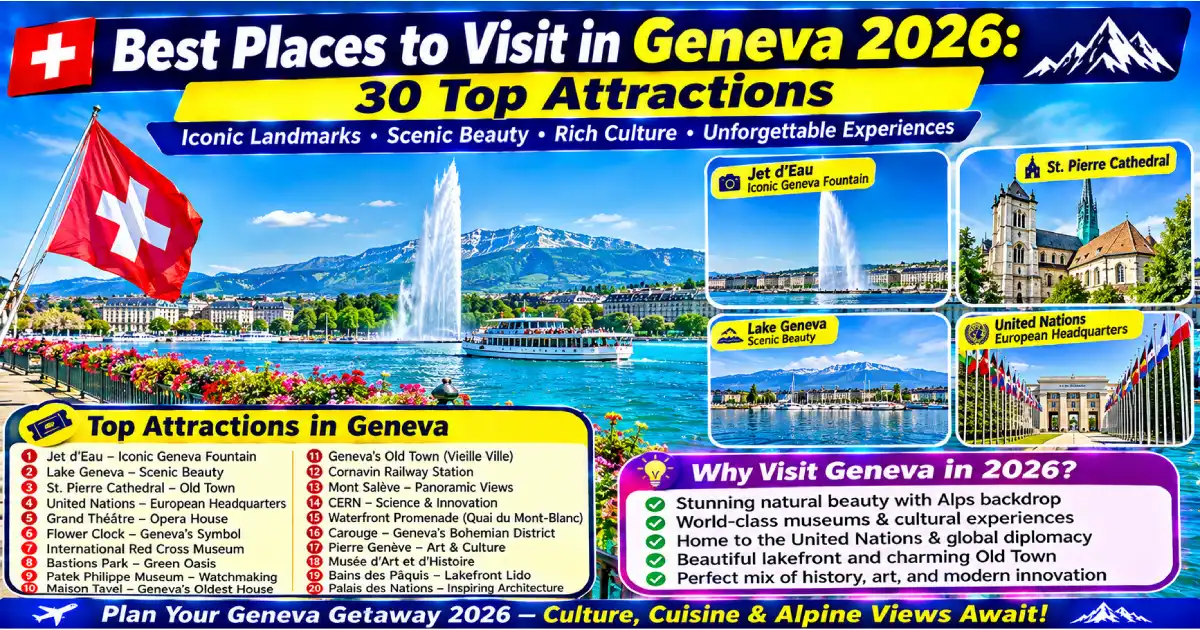
Geneva occupies a singular position in European cities — simultaneously Switzerland’s most cosmopolitan urban environment (approximately 40% of the city’s 200,000 residents hold foreign nationality, representing one of the highest proportions of any European city), the global headquarters of international diplomacy and humanitarian law (the UN European headquarters, the Red Cross, the WHO, and over 200 other international organizations are based here), and the world capital of luxury watchmaking and private banking. Yet it sits on the southwestern tip of Lake Geneva (Lac Léman — the largest lake in Western Europe at 582 square kilometers, shared between Switzerland and France), with the French Alps including Mont Blanc visible across the water on clear days, the Jet d’Eau (the 140-meter water jet that has become Geneva’s visual symbol) shooting from the lake surface into the sky, and a specifically French-Swiss cultural character — the espresso culture, the brasserie dining tradition, the lake-adjacent lifestyle — that distinguishes Geneva from Switzerland’s German-speaking cities in ways that feel more national than regional.
The best places to visit in Geneva span the Palais des Nations (the UN European headquarters, where guided tours provide access to the assembly halls and chambers where some of the 20th century’s most consequential diplomatic negotiations have occurred), the International Red Cross and Red Crescent Museum (one of the most emotionally powerful museum experiences in Europe, covering the history of humanitarian aid from its Swiss founding through its contemporary global operations), the Old Town’s Cathedral of St. Pierre (where John Calvin preached the Reformation that shaped Geneva’s subsequent centuries of religious refugee hospitality and intellectual culture), and the lakefront’s extraordinary public infrastructure (the Jardin Anglais flower clock, the Bains des Pâquis lakeside baths, and the full sweep of the Quai du Mont-Blanc promenade). This guide covers the 30 best places to visit in Geneva with practical details — how to get there, what to pay, and the insider knowledge that makes each experience complete.
For complete guides, see our Things to Do in Geneva 2026, Best Restaurants in Geneva 2026, Best Time to Visit Geneva, Best Places to Visit in Switzerland 2026, and Switzerland Travel Guide 2026 guides.
| Place | Type | Entry Cost | Best For | Time Needed |
|---|---|---|---|---|
| Jet d’Eau | Landmark | Free | Iconic Geneva symbol, lake views | 20–30 min |
| Old Town (Vieille Ville) | Historic Quarter | Free | Medieval history, architecture | 2–4 hrs |
| Cathedral of St. Pierre | Cathedral | Free (tower CHF 5) | Reformation history, city views | 30–60 min |
| Palais des Nations (UN) | International Org. | CHF 15 (guided tour) | Diplomacy, history, architecture | 1.5–2 hrs |
| Red Cross and Red Crescent Museum | Museum | CHF 15 | Humanitarian history, powerful exhibits | 1.5–2 hrs |
| Lake Geneva Lakefront Promenade | Lakefront | Free | Walking, views, the Jet d’Eau | 1–3 hrs |
| Bains des Pâquis | Swimming / Fondue | CHF 2 | Lake swimming, fondue, local culture | 2–4 hrs |
| Jardin Anglais and Flower Clock | Park | Free | Flower clock, lakefront garden | 20–30 min |
| Musée d’Art et d’Histoire | Museum | Free | Art and history collections | 1.5–2 hrs |
| Patek Philippe Museum | Watch Museum | CHF 10 | Swiss watchmaking history | 1.5–2 hrs |
| MAMCO (Contemporary Art Museum) | Museum | CHF 15 | Contemporary Swiss and international art | 1.5–2 hrs |
| Maison Tavel | Museum | Free | Oldest house in Geneva, city history | 45 min |
| Place du Bourg-de-Four | Square | Free | Geneva’s oldest square, cafés | 20–30 min |
| Reformation Wall (Mur des Réformateurs) | Monument | Free | Protestant Reformation history | 20 min |
| Parc des Bastions | Park | Free | Chess, relaxation, Reformation Wall | 30–45 min |
| Quai du Mont-Blanc | Promenade | Free | Lake promenade, luxury hotels | 30–60 min |
| Carouge (Little Turin) | Neighborhood | Free | Bohemian arts quarter, Italian character | 2 hrs |
| Plainpalais | Square / Market | Free | Flea market (Wed/Sat), student life | 1–2 hrs |
| CERN (Particle Physics Lab) | Science | Free (exhibition) | Particle physics, Hadron Collider | 1.5–2 hrs |
| Pâquis Neighborhood | Neighborhood | Free | Multicultural Geneva, lakefront | 1–2 hrs |
| Île Rousseau | Island | Free | Small island, Rousseau statue | 15–20 min |
| Musée Rath | Museum | Varies | Temporary exhibitions | 1 hr |
| Natural History Museum | Museum | Free | Natural history, dinosaurs | 1–1.5 hrs |
| Philatelic and Postal Museum | Museum | Free | Postal history, stamps | 45 min |
| Barbier-Mueller Museum | Museum | CHF 15 | Pre-Columbian and tribal art | 1 hr |
| Château de Penthes | Museum | CHF 10 | Swiss abroad, estate gardens | 1.5 hrs |
| Ariana Museum | Museum | Free | Ceramics and glass, UN park setting | 1 hr |
| Plainpalais Flea Market | Market | Free | Antiques, vintage, local atmosphere | 1–2 hrs |
| Rue de Rive and Rue du Rhône | Shopping | Free | Geneva’s luxury retail heart | 1 hr |
| Victoria Hall | Concert Hall | Ticket prices vary | Classical concerts, architecture | 2 hrs |
Entry: Free | Location: Lake Geneva, Quai Gustave-Ador (or viewed from Quai du Mont-Blanc across the lake) | Best Time: Daytime for photography; illuminated at night | Season: March–October (operational); December–January (holiday illumination)
The Jet d’Eau — a 140-meter column of water shooting from a pier in Lake Geneva at 200 km/h, 500 liters per second, visible from 50 kilometers on clear days and instantly recognizable as Geneva’s most emblematic single image — was installed in its current lake position in 1891 (the original 1891 installation was a pressure-release valve for a hydraulic power network that subsequently became a deliberate decorative feature as its popular appeal became clear). The jet’s specific visual drama — the white column against the blue lake and Alps background, the mist created around the pier base that catches rainbows in the right light conditions, and the sheer improbability of a 140-meter water column in the middle of a lake — makes it Geneva’s most immediately recognizable landmark and the starting point for most visitors’ Geneva visual orientation.
The jet operates from approximately March through October, with specific illumination programs during December holidays — checking the SIG (Services Industriels de Genève) website for the specific 2026 operational schedule confirms exact start/end dates. During operational periods, the jet can be approached from the Quai Gustave-Ador pier (walking out to the jet’s base, where the mist makes umbrella-carrying advisable in any wind), viewed from the Quai du Mont-Blanc across the lake (the most classic photography position, with the jet framed against the Old Town’s cathedral towers), or seen from the Bains des Pâquis pier (a side-angle view with the French Alps visible behind).
Insider tips: The Jet d’Eau’s most dramatic visual moment is at dusk in clear weather — when the lake surface is relatively calm (afternoon winds typically subside by early evening), the jet catching the last golden light while the city illumination begins activating behind it creates a photography window of approximately 20–30 minutes that produces the most sought-after Geneva sunset images. The jet is deliberately switched off during high winds (wind speeds exceeding a specific threshold cause the water plume to scatter and potentially soak the surrounding pier area and lake-adjacent pedestrians) — checking the operational status before specifically walking to the pier for photography avoids the occasional disappointment of finding the jet non-operational.
Entry: Free | Transport: Tram or bus to Rive or Bel-Air, then walk uphill | Best Time: Morning (quieter) or late afternoon | Duration: 2–4 hours for comprehensive exploration
Geneva’s Old Town (Vieille Ville) occupies the elevated terrain of the central hill above the Rhône River — a compact medieval and early-modern urban fabric of 16th–18th century buildings, narrow lanes paved in original cobblestone, and the specific architectural character of a Protestant city that rejected Catholic ornament in favor of the restrained elegance that Calvin’s influence produced in Geneva’s building culture from the 16th century onward. The Old Town’s concentrated historic character rewards unhurried walking rather than attraction-ticking — the streets themselves, with their painted facades, lantern-lit passages, and the occasional glimpse into private courtyards through arched entryways, constitute the primary experience.
The hill’s elevated position (approximately 50–60 meters above the lake level) provides elevated views from multiple vantage points — the Terrasse Agrippa d’Aubigné behind the Maison Tavel, the Place de la Taconnerie adjacent to St. Pierre, and the Promenade de la Treille (a long terraced promenade along the Old Town’s southern edge, Geneva’s official “first day of spring” measurement point — the promenade’s famous chestnut tree’s first blossom date is officially recorded as Geneva’s spring beginning) all provide views across the lower city and toward the lake.
The Old Town’s most significant streets: Grand-Rue (the main east-west axis, lined with 16th–18th century houses, birthplace of Jean-Jacques Rousseau at number 40 — a plaque marks the house where the philosopher was born in 1712), Rue de l’Hôtel-de-Ville (the institutional center, housing the Hôtel de Ville/Town Hall and the Maison Tavel), and Rue des Granges (the most architecturally distinguished residential street, with the finest 18th-century patrician houses remaining in Geneva’s Old Town).
Insider tips: Grand-Rue 40 — the birthplace of Jean-Jacques Rousseau, marked with a plaque and easily missed by visitors who don’t specifically look for it — is one of Geneva’s most historically significant single addresses. Rousseau’s “Confessions,” “The Social Contract,” and “Émile” were written in the philosophical context of a man who grew up in this specific Protestant, Republican, watchmaking city; the birthplace address provides a specific geographical anchoring of philosophy in place that adds dimension to subsequent reading of his work.
Entry: Cathedral free; tower CHF 5; archaeological site CHF 8 | Transport: Walk from Rive tram stop (10 minutes uphill) | Best Time: Morning for interior; tower for views | Address: Cour de St-Pierre
The Cathedral of St. Pierre (Cathédrale Saint-Pierre) — the dominant architectural presence of Geneva’s Old Town skyline, its 18th-century neoclassical facade (an unusual addition to an otherwise Romanesque-Gothic structure) visible from the lake and from multiple lakefront viewpoints — is where Jean Calvin preached the Protestant Reformation from 1536 until his death in 1564, making it one of the most historically significant Reformation sites in the world (comparable in importance to Wittenberg for Lutherans or Canterbury for Anglicans). Calvin’s specific chair (the original wooden chair from which he delivered his Geneva sermons, one of the most historically significant pieces of ecclesiastical furniture in Protestant Christianity) is preserved in the cathedral’s interior.
The cathedral’s deliberately austere interior (the whitewashed walls reflecting Calvin’s specific Reformation rejection of Catholic imagery and decoration — the contrast between the cathedral’s architectural scale and the near-complete absence of decorative art creates a specific visual severity that communicates Protestant theology more effectively than any explicit statement) contains Calvin’s chair, the early Gothic St. Chapel (the only portion of the building retaining medieval wall paintings), and various memorial tablets to significant Reformation figures. The tower climb (CHF 5, 157 steps to the upper viewing platform) provides Geneva’s finest elevated city view — the cathedral’s elevated hill position added to the tower height creates panoramic views across the lake, the Rhône, and on clear days the full Mont Blanc massif.
The Site Archéologique de Saint-Pierre (underground, accessed from inside the cathedral — CHF 8) contains excavated remains of the previous religious buildings on this site, including mosaic floors from a 4th-century Christian building that represents Geneva’s earliest documented Christian presence and various building phases spanning 1,600 years of continuous religious architecture.
Insider tips: Calvin’s chair (displayed in a specific location within the cathedral nave, clearly labeled) is routinely missed by visitors who walk through the cathedral without specifically seeking it — asking a cathedral staff member to point it out (or checking the self-guided tour map available at the entrance) ensures engaging with this historically significant specific object.
Entry: CHF 15 (guided tour, approximately 1 hour) | Transport: Bus 8 or 28 to Nations stop | Book: Advance booking strongly recommended | Address: Avenue de la Paix 14 | Note: Passport or national ID required for entry
The Palais des Nations, the main building of the United Nations Office at Geneva (UNOG) — the UN’s second headquarters after New York, occupying the former League of Nations headquarters built 1929–1938 — receives approximately 100,000 visitors per year on guided tours that provide access to the assembly halls and committee rooms where some of the 20th century’s most consequential multilateral diplomacy has occurred. The building’s specific historical resonance (the League of Nations’ failure to prevent World War II, then the UN’s subsequent occupation of the same spaces for 75+ years of post-war international governance), the assembly halls’ specific architectural character (the Council Chamber, the Assembly Hall, and the recently restored Salle des Pas Perdus), and the surrounding Ariana Park (see #27 below) create a visit that functions simultaneously as architectural tour, historical immersion, and active political institution engagement.
The tour covers the main assembly hall (where UN conferences, peace negotiations, and various international treaty negotiations have occurred), the Council Chamber (where the League of Nations’ Council met and where various UN bodies subsequently met), the “Salle des Pas Perdus” (the grand reception hall connecting the building’s major spaces), and the UN memorial areas including the Broken Chair sculpture (outside the entrance — a 12-meter wooden chair with a broken leg, a 1997 installation by artist Daniel Berset commissioned by the NGO Handicap International to represent victims of landmines, now one of Geneva’s most recognized public artworks).
Insider tips: The Palais des Nations tour requires a valid passport or national identity card (no exceptions — this is a UN security requirement, not a Swiss tourism bureaucracy point). Arriving without ID means being turned away regardless of pre-booking status. Photography is permitted in most areas of the tour, with specific exceptions noted by guides at relevant points.
Entry: CHF 15 | Transport: Bus 8 or 28 to Nations stop (adjacent to Palais des Nations) | Best Time: Weekday mornings for most immersive experience | Duration: 1.5–2 hours | Address: Avenue de la Croix-Rouge 17
The International Red Cross and Red Crescent Museum provides one of the most emotionally powerful museum experiences in Europe — a carefully designed permanent exhibition covering the history of the International Committee of the Red Cross (founded by Geneva businessman Henry Dunant in 1863 following the Battle of Solferino, whose wounded soldiers Dunant witnessed left untended by either side, inspiring the foundational concept of neutral humanitarian assistance to combatants regardless of nationality) through the development of international humanitarian law (the Geneva Conventions) to the contemporary work of the Red Cross and Red Crescent network in conflict zones worldwide.
The museum’s design (winner of the Museum of the Year award from the European Museum Forum) uses architecture, light, and careful exhibition sequencing to create a visitor journey that begins with the historical genesis of humanitarian concern and progresses through the ICRC’s work in major 20th-century conflicts (World War I’s prisoner of war tracing service, World War II’s Holocaust-era documentation and advocacy controversies, various post-WWII conflicts through contemporary operations) to arrive at an emotionally engaged understanding of the fundamental principles — humanity, impartiality, and neutrality — that have governed the organization’s work for 160 years.
Insider tips: The museum’s most affecting space — the “Walls of Time” installation (thousands of index cards representing ICRC prisoner of war tracing records, covering the Wall in a specific visual metaphor of scale that the statistics alone cannot produce) — rewards spending 10–15 minutes rather than walking through quickly. The gift shop (one of the few museum shops whose purchases directly support the organization’s humanitarian mission) provides ethically produced items alongside the standard museum retail.
Entry: Free | Location: Along the lake’s Geneva shore, both sides of the Rhône outlet | Best Time: Morning and evening; summer for swimming; winter for clear Alps views | Length: 8+ km of walkable lakefront
Geneva’s lakefront promenades — the Quai du Mont-Blanc (the right bank, north shore, lined with luxury hotels including the Beau-Rivage and the Kempinski), the Quai des Bergues (along the Rhône river), the Quai Gustave-Ador (the left bank, south of the Jet d’Eau, extending toward the Bains des Pâquis and the Parc La Grange), and the connecting lake-shore path toward the Botanical Garden — constitute Geneva’s finest public outdoor space and the city’s primary people-watching and physical activity corridor throughout the year.
The north shore promenade (Quai du Mont-Blanc and eastward) provides the classic Geneva lake view — the Jet d’Eau visible to the left (south), the Old Town’s cathedral tower visible above the left bank, and the French Alps (including the distinctive pyramid of the Dent du Midi and, on clearest days, Mont Blanc at 4,808 meters — the highest mountain in the Alps) filling the eastern horizon across the lake surface. The south shore promenade (Quai Gustave-Ador and eastward) passes the Bains des Pâquis (see below), several public lakeside parks, and approaches the Parc de la Grange (Geneva’s most elegant formal garden, with rose gardens and an 18th-century villa) in the eastern lake park zone.
Insider tips: The lakefront’s most photogenic morning conditions occur on still, clear days when the lake surface acts as a mirror for the Alps behind it — arriving at the Quai du Mont-Blanc between sunrise and 9 AM on clear mornings provides the specific combination of warm light, still water, and the Mont Blanc view that Geneva tourism has used as its defining image for generations. Late-autumn and winter (October–February) consistently produce the clearest Alps visibility, as summer haze reduces Mont Blanc’s definition despite warmer conditions.
Entry: CHF 2 (access to the baths and pier) | Transport: Walk from Cornavin station (15 minutes) or tram to Monthoux | Season: Year-round (swimming May–September; fondue service September–May) | Address: Quai du Mont-Blanc 30
The Bains des Pâquis — a 1930s public bath house extending into Lake Geneva on wooden jetties in the Pâquis neighborhood — operates as simultaneously one of Geneva’s finest free-entry swimming destinations (during the warm months when lake temperatures allow comfortable bathing) and one of the city’s most beloved fondue restaurants (during the September–May cooler months when the same wooden platform structure serves cheese fondue at CHF 20–25 per person in an atmosphere that mixes students, professors, office workers, and tourists with genuine democratic indifference to social category). The CHF 2 entry fee (among the most remarkable value propositions in Geneva’s expensive visitor economy) provides access to the full pier structure, the indoor changing rooms, the outdoor diving board, and the café service that operates throughout the year.
The Bains des Pâquis functions as Geneva’s most democratic social institution — in a city where income inequality is among Europe’s highest and where the luxury hotel promenade immediately east creates a specific wealth-signaling environment, the baths’ CHF 2 entry and mixed-demographic user base create the most socially complete cross-section of Geneva available in any single public space. The specific pleasure of swimming in Lake Geneva from these wooden platforms (the lake’s water clarity allowing underwater visibility of 5–8 meters in clear conditions) is one of the most genuine outdoor experiences available in any major European city.
Insider tips: The Bains des Pâquis fondue service (September through May, weather permitting for the outdoor platform — the fondue is served outdoors on the wooden pier, with the lake and the French Alps visible behind the tables) represents one of Geneva’s most specifically atmospheric dining experiences — moitié-moitié fondue at CHF 20–25, on a wooden jetty over Lake Geneva, with Mont Blanc occasionally visible on clear autumn days, at a price that makes it one of Switzerland’s best value restaurant experiences.
Entry: Free | Location: Quai du Général-Guisan, lake south shore | Best Time: Morning for photography before crowds | Season: Year-round; flowers best May–October
The Jardin Anglais (English Garden) on Geneva’s south lake shore provides a combination of formal garden, lakefront promenade access, and the Horloge Fleurie (Flower Clock) — Geneva’s most photographed single attraction, a 5-meter-diameter working clock whose face is planted with approximately 6,500 flowering plants changed seasonally (typically representing approximately 60 plant species in a composition that the city’s horticultural staff replant several times annually to maintain the design’s precision and seasonal appropriateness). The clock has been operating since 1955 and has become Geneva’s most universally reproduced single image — appearing on virtually every Geneva tourism material produced since its installation, to the point where it functions as shorthand for “Geneva” in the same way the Jet d’Eau functions as shorthand for the lake.
The garden’s broader lakefront character (mature plane trees, formal planting, benches facing the lake and the Jet d’Eau visible across the water) provides a comfortable outdoor space for the specific pleasure of watching Geneva’s lake activity — the CGN lake steamers departing from the adjacent pier, private boats, windsurfers in summer, and the constant visual backdrop of the Alps on clear days.
Insider tips: The Flower Clock’s most visited (and most photographed) period is July–August when summer plantings are at peak bloom — but the spring replanting (typically May, when the new season’s plant composition is installed) and the autumn planting (October, when chrysanthemums and other autumn species replace the summer composition) both provide specific photographic moments when the clock’s face is being actively changed by the garden staff, creating more dynamic imagery than the static peak-bloom periods.
Entry: Free (permanent collection) | Transport: Bus to Rath or tram to Plainpalais | Hours: Tuesday–Sunday, closed Monday | Address: Rue Charles-Galland 2
The Musée d’Art et d’Histoire (MAH), Geneva’s largest and most comprehensive museum, houses the permanent collections of Swiss and European art history (from Egyptian antiquities and classical Greek and Roman objects through medieval applied arts to 17th-19th century European painting and Swiss art of all periods) alongside significant archaeological holdings representing the pre-Roman and Roman periods of the Geneva area. The museum building itself (a late 19th-century beaux-arts structure on the Rive Gauche hill above the lake) and the garden connecting to the adjacent Villa La Grange park create a cultural precinct that extends beyond the museum’s walls.
The museum’s most significant single work — the altarpiece panels of Konrad Witz (the “Miraculous Draught of Fishes,” 1444, the earliest known painting to depict an identifiable landscape rather than a symbolic background — the Lake Geneva shoreline clearly identifiable in the specific altarpiece panels, making it both great art and a specific Geneva local-history document) — provides a specific reason for art historically-oriented visitors to make the MAH a priority visit.
Insider tips: The Witz altarpiece panels (displayed in the museum’s medieval European painting section) represent one of the most historically significant paintings in Switzerland — the identifiable Lake Geneva landscape in a 1444 religious painting, predating the Renaissance landscape tradition by decades, makes this an extraordinary document in both art history and Geneva-specific history. Standing before the painting and looking south toward the actual Lake Geneva shore that Witz depicted 580 years ago creates a specific time-collapse experience available at very few art-historical sites.
Entry: CHF 10 | Transport: Bus or tram to Rive | Hours: Tuesday–Friday, Saturday; closed Sunday–Monday | Address: Rue des Vieux-Grenadiers 7, Plainpalais
The Patek Philippe Museum, housed in a converted 19th-century industrial building in Geneva’s Plainpalais neighborhood, presents one of the world’s most extraordinary collections of antique timepieces — approximately 2,000 watches and clocks spanning from the 16th century through the present, including the most significant surviving examples of Geneva’s specific watchmaking tradition (the enamel miniature paintings on watch cases, the engine-turning patterns, and the specific technical complications — perpetual calendars, tourbillons, minute repeaters — that Geneva’s craftsmen developed and that continue to define high-end mechanical watchmaking globally). The collection includes works from every major period of European watchmaking alongside Patek Philippe’s own historic production, displayed with museum-quality interpretation that provides genuine education in the craft history even for visitors with no prior watch expertise.
Insider tips: The museum’s second floor (the Patek Philippe company’s own historical production, including the extraordinarily complicated Calibre 89 — the most complex portable timepiece ever made at the time of its completion in 1989, containing 33 complications including a star chart, a sidereal time display, and a mechanism that calculates the date of Easter for any year) rewards specific attention from visitors with any mechanical or precision-engineering interest.
Entry: Free (permanent exhibition); guided tours available | Transport: Tram 18 to CERN | Book: Guided tours require advance booking at home.cern | Address: Route de Meyrin (Swiss-French border, approximately 6 km from city center)
CERN (Conseil Européen pour la Recherche Nucléaire — the European Organization for Nuclear Research), headquartered on the Swiss-French border approximately 6 kilometers west of Geneva’s city center, is the world’s largest particle physics laboratory — home of the Large Hadron Collider (LHC, a 27-kilometer underground circular particle accelerator in which protons are accelerated to 99.9999991% of the speed of light before being made to collide, generating conditions that replicate the universe’s state in the first microseconds after the Big Bang). CERN is where the Higgs boson was discovered in 2012, where the World Wide Web was invented by Tim Berners-Lee in 1989, and where the most fundamental questions about the universe’s structure are approached through the most complex machines ever built by human civilization.
The CERN visitor program provides public access to the Universe of Particles permanent exhibition (free, no booking required — a well-designed interactive exhibition covering particle physics from the atom through the Standard Model to the Higgs boson discovery, appropriate for all educational levels) and periodic guided tours of the facility’s surface installations and underground accelerator infrastructure (requiring advance online booking at home.cern, with specific tours opening weeks to months ahead). The LHC itself (27 kilometers of accelerator tunnel, 100 meters underground, straddling the Swiss-French border) is not visible on standard public tours but is explained through models and displays.
Insider tips: CERN’s guided tours (specifically the ATLAS detector and the LHC tunnel tours, where the actual particle physics infrastructure is visible at close range) book out rapidly — checking the tour availability calendar at home.cern and booking as soon as tours for the desired date open provides the most complete CERN experience beyond the permanent exhibition. The Universe of Particles exhibition (no booking, free, daily 8 AM–6 PM) is genuinely excellent for visitors who can’t secure a guided tour.
Entry: Free | Transport: Tram 12 or 13 to Carouge | Best Time: Morning (market days Wednesday and Saturday) | Character: Distinctly different from central Geneva
Carouge, a commune immediately south of Geneva that was deliberately planned as a separate city-state by the Savoy (the kingdom controlling the surrounding French-speaking territory before Geneva’s 1815 incorporation into Switzerland) in the 18th century as a commercial and manufacturing rival to Geneva’s restrictive Protestant guild economy, retains a specifically Italian architectural character (Baroque churches, arcaded streets, interior courtyards — the Sardinian architects of the House of Savoy imported northern Italian urban planning principles into what was intended to become an alternative commercial center to Geneva) combined with a contemporary identity as Geneva’s most creative and most relaxed neighborhood. Carouge’s artists’ studios, independent boutiques, wine bars, and the specific cultural atmosphere of a neighborhood whose residents specifically chose it over Geneva’s more formal character create a distinctly alternative experience to the international-organizations and luxury-watch identity that central Geneva projects.
The Wednesday and Saturday morning market (on Place du Marché) provides the most complete Carouge experience — local vegetables, cheese, bread, flowers, and the specific sociable market atmosphere of a neighborhood that operates as a genuine community rather than primarily as a tourism infrastructure.
Insider tips: The architectural contrast between Carouge’s Sardinian Baroque planning (the street grid, the arcaded walkways, and the Baroque church facades) and Geneva’s more severe Calvinist architectural tradition is immediately perceptible within minutes of arriving — the specific cultural micro-distance (2 kilometers by tram from Geneva’s center to a neighborhood whose character feels genuinely Italian) is one of the most striking examples of the Switzerland’s internal cultural diversity.
Entry: CHF 15 | Transport: Bus to École-de-Médecine | Hours: Tuesday–Sunday; closed Monday | Address: Rue des Vieux-Grenadiers 10 (Plainpalais), adjacent to Patek Philippe Museum
MAMCO (Musée d’Art Moderne et Contemporain de Genève) provides Geneva’s most ambitious contemporary art programming — a museum occupying a converted factory building in the Plainpalais creative district whose curatorial approach (large-scale installations, rotating exhibitions that reconfigure the permanent collection in conversation with temporary shows, and a specific international network of artist relationships) has established it as one of Switzerland’s most respected contemporary art institutions. The building’s industrial character (exposed concrete, large open floor plates, service infrastructure visible rather than concealed) complements the contemporary art’s own frequent industrial-aesthetic references.
Insider tips: The MAMCO’s adjacency to the Patek Philippe Museum (on the same street in Plainpalais) and the proximity of both to the Musée d’Art et d’Histoire (10 minutes’ walk) creates one of Geneva’s most efficient cultural itinerary sequences — three significant museums within a 15-minute walking radius of each other, covering Swiss watchmaking heritage, art history, and contemporary art in a single neighborhood afternoon.
Entry: Free | Location: Old Town, adjacent to St. Pierre Cathedral | Best Time: Evening for café atmosphere | Character: Historic marketplace, now café-filled square
Place du Bourg-de-Four, located in the Old Town immediately southeast of the Cathedral of St. Pierre, is Geneva’s oldest public square — occupying the site of a Roman forum (the settlement predating medieval Geneva), subsequently a medieval marketplace, and now a charming café-lined urban space whose restaurant terraces, fountain, and cobblestone character provide the most historically resonant outdoor sitting destination in the Old Town. The square’s function (daily life, café culture, the occasional market, and the general social gathering that public squares serve in French-speaking Swiss cities) and its architectural character (18th-century facades, the Fontaine du Bourg-de-Four in the center, the Old Town’s specific patinated building surfaces) create a specific atmosphere that the more formally tourist-facing areas of the lakefront don’t replicate.
Insider tips: Early evening at Place du Bourg-de-Four (approximately 6–8 PM on warm days) provides the most complete experience of the square’s social character — the café terraces full with Geneva residents after work, the light falling warmly on the 18th-century facades, and the sound of French conversation across a square that has been hosting similar gatherings for 2,000 years creates one of Geneva’s most pleasurable urban atmosphere experiences.
Entry: Free | Location: Parc des Bastions, Old Town southern edge | Best Time: Anytime | Duration: 20 minutes
The Reformation Wall (Mur des Réformateurs), a 98-meter-long relief sculpture installed in the Parc des Bastions in 1909 to commemorate the 400th anniversary of Calvin’s birth and the 350th anniversary of the Academy of Geneva (the predecessor institution of the University of Geneva), provides Geneva’s most visually concentrated single summary of the Protestant Reformation’s significance. The central figures — Guillaume Farel, Jean Calvin, Théodore de Bèze, and John Knox (each rendered in approximately 4.5-meter-high bas-relief, with their names and dates inscribed) — are flanked by smaller-scale representations of Reformation figures and events across the wall’s full length, creating a visual narrative of 16th-century European Protestant Christianity centered on Geneva’s specific role as the “Rome of Protestantism” during Calvin’s leadership.
Insider tips: The wall’s inscription (POST TENEBRAS LUX — “After Darkness, Light” — the motto of the Geneva Reformation, also Geneva’s official city motto) appears in multiple places throughout the monument and throughout the Old Town itself — recognizing it on building facades, on official city documents, and on various Geneva-associated objects connects the visitor to the specific historical identity that this phrase represents in Geneva’s self-understanding.
Entry: Free | Location: Small island in the Rhône River, accessible from the Pont des Bergues | Best Time: Any time; pleasant afternoon stop
Île Rousseau, a small artificial island in the Rhône River (created in the 18th century as a protective measure against flooding, subsequently converted to a public garden) honors Jean-Jacques Rousseau (born in Geneva in 1712 — at Grand-Rue 40 in the Old Town — and one of the most influential philosophers of the European Enlightenment, whose political and educational theories formed foundational intellectual material for the French Revolution and subsequent democratic political thought) with a 1835 bronze statue by James Pradier. The island’s combination of historical resonance (the birthplace-honoring statue of a man who was simultaneously Geneva’s most celebrated native and a man expelled from Geneva for the subversive content of his political philosophy), the pleasant riverside garden setting, and the specific pleasure of sitting on a small island in a major European river with the city visible on both banks creates a 15–20 minute stop of genuine quality.
Insider tips: The Pont des Bergues (the bridge connecting to Île Rousseau from the right bank) provides views both upstream and downstream along the Rhône — upstream toward the Pont de l’Île and the Île de la Cité’s historic buildings, downstream toward the lake junction where the Rhône exits Lake Geneva. These views provide the clearest orientation to Geneva’s specific geography (a city on a river-and-lake system simultaneously) available from any single point.
Entry: Free | Transport: Walk from Cornavin station (10 minutes) | Best Time: Evening for restaurant scene | Character: Geneva’s most diverse and most unpretentious neighborhood
The Pâquis neighborhood (between the Cornavin main station and the lakefront Bains des Pâquis) is Geneva’s most culturally diverse and most gastronomically interesting neighborhood — a dense urban fabric of residential buildings, immigrant-community restaurants (Turkish, West African, Southeast Asian, South Asian, and virtually every other cuisine represented in the two-square-kilometer area), independent shops, and the specific energy of a neighborhood where Geneva’s extraordinary national diversity (40%+ foreign-national residents) expresses itself most visibly in everyday commercial and social life. The Pâquis contrast with the luxury hotel promenade immediately adjacent (the Quai du Mont-Blanc’s five-star hotels are literally 200 meters from the Pâquis’s most densely multicultural blocks) creates one of Geneva’s most striking urban juxtapositions.
Insider tips: The Pâquis restaurant scene (particularly the side streets perpendicular to the Rue de Berne and Rue de Lausanne axes) provides Geneva’s most diverse and most affordable restaurant options — the contrast with the lakefront fine dining establishments represents the full economic and cultural range of one of Europe’s most economically unequal cities within a single neighborhood’s walking distance.
Entry: Free | Transport: Tram to Rive | Best Time: Weekday mornings | Character: Global luxury brands, Swiss watchmaking flagship stores
Rue du Rhône and Rue de Rive constitute Geneva’s primary luxury retail axis — the Swiss watchmaking industry’s flagship stores (Rolex, Patek Philippe, IWC, Audemars Piguet, Vacheron Constantin, and virtually every other significant Swiss watchmaker maintaining a presence), global luxury fashion houses (Hermès, Chanel, Cartier, and others), and the specific architectural character of Geneva’s 19th-century commercial buildings (now housing international luxury brands in their carefully preserved facades) create a retail environment that reflects Geneva’s specific intersection of Swiss precision manufacturing and global financial wealth.
Insider tips: The watch shops on Rue du Rhône serve as the most accessible introduction to Swiss watchmaking culture for visitors with no prior expertise — the window displays of Patek Philippe, Vacheron Constantin, and Audemars Piguet (all Geneva-area manufacturers) alongside the associated price information create an immediate visceral education in what differentiates a CHF 2,000 watch from a CHF 200,000 watch in terms of visible craft.
About Travel Tourister Travel Tourister’s destination specialists have explored Geneva across all seasons and all neighborhoods — from Bains des Pâquis fondue evenings and Palais des Nations guided tours to Carouge market mornings and Jet d’Eau sunset photography — to deliver the most practical and honest guide to the best places to visit in Geneva for every type of 2026 visitor.
Posted By : Vinay
Latest Article
2nd Floor, 39, Above Kirti Club, DLF Industrial Area, Kirti Nagar, New Delhi, Delhi 110015



Travel Tourister is a leading Travel portal where we introduce travellers to trusted travel agents to make their journey hasselfree, memorable And happy. Travel Tourister is a platform where travellers get Tour packages ,Hotel packages deals through trusted travel companies And hoteliers who are working with us across the world. We always try to find new and more travel agents and hoteliers from every nook and corners across the world so that you could compare the deals with different travel agents and hoteliers and book your tour or hotel with the one you have chosen according to your taste and budget.
Copyright © Travel Tourister, India. All Rights Reserved

 Call
Call Enquiry