Published on : 11 Aug 2026
By Travel Tourister | Updated Aug 2026
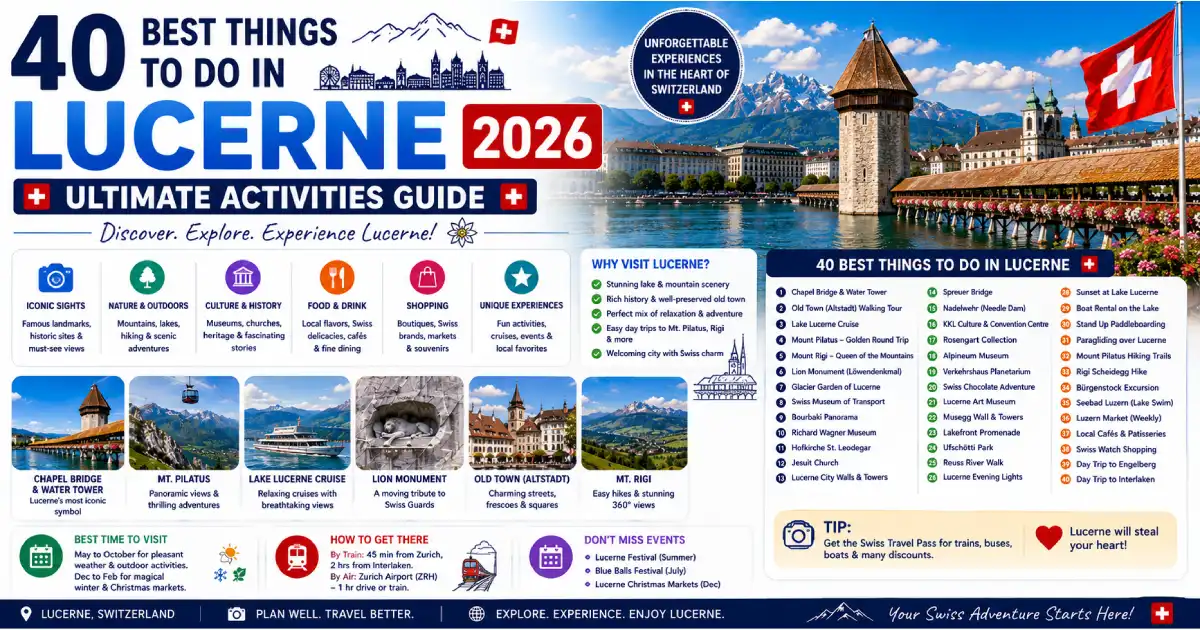
Lucerne delivers more genuinely extraordinary experiences per day than virtually any other Swiss city — a medieval urban core so perfectly preserved that its painted guild house facades and 14th-century wooden bridges appear unchanged since the era when Lucerne served as the gateway between the Alpine passes and the broader European trade network, surrounding a lake (Vierwaldstättersee — the Lake of the Four Forest Cantons) whose mountain-framed geometry creates the most dramatically beautiful Alpine lake landscape in Switzerland, with two of Europe’s most remarkable mountain railways (the world’s steepest rack railway to Mount Pilatus, and the continent’s first mountain railway ascending Mount Rigi) departing from piers literally adjacent to the city’s historic bridges. The best things to do in Lucerne span completely free experiences (walking the Musegg Wall towers for panoramic Old Town views, crossing the Chapel Bridge slowly with attention to the 17th-century ceiling paintings, sitting in the Jesuit Church’s extraordinary Baroque interior) through moderate-cost experiences (the SGV lake steamers to Rigi and Pilatus included with Swiss Travel Pass, the Rosengart Collection’s Picasso and Klee, the Swiss Museum of Transport) to the signature Lucerne splurge experiences (the full Pilatus Golden Round Trip combining boat, rack railway, aerial cable car, and gondola in a complete mountain circuit).
What makes Lucerne’s activity landscape specifically compelling for visitors from across the world’s tourist source markets is the accessibility without sacrifice of quality — Lucerne’s core experiences (the Chapel Bridge, the lion monument, the Old Town, and the lake) can be genuinely appreciated in a single day visit from Zurich (48 minutes by train, multiple departures hourly), but each rewards extending to multiple days as the mountain excursions, the museum circuit, the festival programming (the Lucerne Festival, one of Europe’s most significant classical music events), and the surrounding lake’s destinations (Rütli meadow, William Tell’s Chapel, Bürgenstock resort) add depth unavailable in any single-day framework. This guide covers the 40 best things to do in Lucerne organized by category — historic Old Town, mountain excursions, lake activities, museums, festivals, and day trips — with practical details for 2026 visitors of every interest and budget.
For complete guides, see our Best Places to Visit in Lucerne 2026, Best Restaurants in Lucerne 2026, Best Places to Visit in Switzerland 2026, and Switzerland Travel Guide 2026 guides.
| # | Activity | Category | Cost | Season | Book Ahead? |
|---|---|---|---|---|---|
| 1 | Cross the Chapel Bridge at Dawn | Sightseeing | Free | Year-round | No |
| 2 | Climb the Musegg Wall Towers | History | Free | April–October | No |
| 3 | Take the Pilatus Golden Round Trip | Mountain | CHF 72–89 | May–November | No |
| 4 | Ride the SGV Steamer on Lake Lucerne | Boat | Swiss Travel Pass | Year-round | No |
| 5 | Hike Mount Rigi at Sunrise | Mountain | CHF 65–78 | Year-round | Overnight: Yes |
| 6 | Visit the Lion Monument | Sightseeing | Free | Year-round | No |
| 7 | Walk the Old Town (Altstadt) | Sightseeing | Free | Year-round | No |
| 8 | Visit the Rosengart Collection | Museum | CHF 18 | Year-round | No |
| 9 | Attend the Lucerne Festival | Music | CHF 30–250+ | August–September | Yes (months) |
| 10 | Take the Rigi Rack Railway | Mountain | CHF 65–78 | Year-round | No |
| 11 | Visit the Swiss Museum of Transport | Museum | CHF 32 | Year-round | No |
| 12 | Walk the Spreuer Bridge Dance of Death | History | Free | Year-round | No |
| 13 | Hike the Pilatus Dragon Path | Hiking | Included with Pilatus | May–November | No |
| 14 | Take a Lake Lucerne Night Cruise | Boat | CHF 20–45 | May–October | No |
| 15 | Visit the Glacier Garden | Museum | CHF 14 | Year-round | No |
| 16 | Explore the Bourbaki Panorama | Museum | CHF 12 | Year-round | No |
| 17 | Attend a KKL Concert | Music | CHF 30–150 | September–July | Yes |
| 18 | Day Trip to Rütli Meadow | History | Swiss Travel Pass | May–October | No |
| 19 | Ride the Stanserhorn CabriO | Mountain | CHF 72+ | May–October | No |
| 20 | Swim at the Lido Lucerne | Outdoors | CHF 8 | June–September | No |
| 21 | Explore the Weinmarkt Square | Sightseeing | Free | Year-round | No |
| 22 | Day Trip to Bürgenstock | Mountain | CHF 30–40 (funicular) | May–October | No |
| 23 | Visit the Hofkirche | Culture | Free | Year-round | No |
| 24 | Take a Fondue Dinner Cruise | Food/Boat | CHF 60–90/person | Year-round | Yes |
| 25 | Visit the Jesuit Church | Culture | Free | Year-round | No |
| 26 | Day Trip to Engelberg and Titlis | Mountain | Swiss Travel Pass + CHF 90+ | Year-round | No |
| 27 | Cycle Around Lake Lucerne | Outdoors | CHF 20–35 (rental) | April–October | No |
| 28 | Visit the Richard Wagner Museum | Museum | CHF 10 | April–November | No |
| 29 | Watch Luzerner Fasnacht Carnival | Festival | Free | February | No (book hotel) |
| 30 | Hike the Swiss Path (Weg der Schweiz) | Hiking | Free | May–October | No |
| 31 | Visit the Historisches Museum | Museum | CHF 10 | Year-round | No |
| 32 | Take a Chocolate Workshop | Food | CHF 50–80 | Year-round | Yes |
| 33 | Explore Nidwalden/Stansstad | Day Trip | Swiss Travel Pass | Year-round | No |
| 34 | Kayak on Lake Lucerne | Outdoors | CHF 30–50 | May–September | No |
| 35 | Take a Guided Old Town Walking Tour | Culture | CHF 20–35 | Year-round | Recommended |
| 36 | Visit the KKL Architecture | Architecture | Free | Year-round | No |
| 37 | Day Trip to Tell’s Chapel | History | Swiss Travel Pass boat | May–October | No |
| 38 | Attend Luzerner Theater | Entertainment | CHF 20–80 | September–July | Yes |
| 39 | Sunrise Photography at the Chapel Bridge | Photography | Free | Year-round | No |
| 40 | Take the Boat to Weggis and Hike | Hiking/Boat | Swiss Travel Pass + free | May–October | No |
Cost: Free | Location: Chapel Bridge (Kapellbrücke), Old Town | Best Time: 30–60 minutes after sunrise | Duration: 20–30 minutes
Walking the Chapel Bridge at dawn — when the Reuss River’s surface reflects the bridge’s flower-box exterior and the Water Tower’s octagonal silhouette in the specific stillness of pre-tourist morning, before the mid-morning tour groups arrive to fill the bridge with foot traffic and the riverside cafés with coffee queues — is Lucerne’s most consistently recommended single free activity. The experience is so fundamentally different from midday Chapel Bridge crossing that they are effectively different activities: the empty dawn bridge, the sound of the river below the wooden planks, the paintings in the gable panels visible without crowds beneath them, and the lake’s early morning character (typically still, reflecting both the bridge and the surrounding pre-Alps) create a contemplative experience that the bridge’s midday tourist-trail character completely replaces.
The specific photography: the Chapel Bridge exterior photograph (from the south bank, showing the full bridge length with Mount Pilatus in the background) is best in the hour after sunrise when the eastern light illuminates the flower boxes on the bridge’s north-facing exterior, the water is calm enough to reflect the structure, and the morning clouds (if any) are lit in warm colors rather than the flat white of midday. This is Lucerne’s most rewarding photography morning and requires no equipment beyond a smartphone.
Insider tips: The water level of the Reuss River affects the Chapel Bridge’s appearance significantly — in spring snowmelt periods (May–June) when the river runs high and fast, the turbulence below the bridge adds dramatic energy to the photography that summer’s lower-water calm doesn’t provide. Checking the river level (visible from the bridge approach) before specifically planning photography around the reflection conditions allows realistic expectation-setting.
Cost: Free | Location: Musegg Wall, northern edge of Old Town | Season: April–November | Duration: 1–1.5 hours | Best Time: Morning
The Musegg Wall (Museggmauer) free tower climbs (three towers accessible: Zytturm, Männliturm, Luegislandturm) provide the most comprehensive elevated view of Lucerne available at zero cost — the wall parapet walk between towers and the staircase climbs to each tower’s upper viewing position delivering progressive panoramas across the Old Town’s rooftops toward the lake, Mount Pilatus, and (on clear days) the more distant Bernese Alps. The experience of walking the medieval wall’s parapet (the original defensive walkway, with the Old Town’s medieval street pattern visible below and the Alpine landscape beyond) provides a physical connection to Lucerne’s 14th-century defensive history that the more-visited attractions in the valley below don’t replicate.
The Zytturm specifically (the Clock Tower, containing Lucerne’s oldest town clock, running one hour ahead of other clocks by medieval tradition) allows close inspection of the 1535 clock mechanism — still operational after nearly 500 years, keeping time visible from the Old Town’s main squares below.
Insider tips: The Musegg Wall towers close in winter (November–March, check exact opening dates on the luzern.com tourist website) — visiting during the open season (April–October) is essential for tower access. The wall itself (the exterior rampart walk between towers) is accessible during open hours without entering individual towers, providing a less-visited promenade walk above the Old Town that the majority of Lucerne visitors never discover.
Cost: Free | Location: Weinmarkt, Hirschenplatz, Kornmarkt | Best Time: Early morning or late afternoon for best facade light | Duration: 1.5–2 hours
Lucerne’s Old Town walking circuit — connecting the major painted squares (Weinmarkt’s late-Gothic guild facades, Hirschenplatz’s commercial character, the Kornmarkt/Rathaus square’s Renaissance civic architecture) with the minor lanes connecting them (Kramgasse, Metzgerrainle, and the various lanes running perpendicular to the main axis) and the 12 medieval fountain sculptures distributed through the Old Town — provides the most authentic medieval Central Swiss urban environment still functioning as a living city rather than a museum reconstruction. The fountain sculptures (the oldest dating to the 16th century, each individually carved and painted with heraldic or allegorical figures specific to the square they inhabit) provide the most overlooked Old Town detail — visitors who slow down to look at the fountain sculptures specifically discover a concentrated program of Renaissance civic art distributed through the streets at ground level.
What to specifically look for: The Weinmarkt fountain (the most elaborate, with painted heraldic panels on the base), the Fritschibrunnen (the carnival fool figure whose specific Fasnacht-connected identity places him year-round in the Kapellplatz), and the Rathausbrunnen (the civic fountain in the Kornmarkt square, with the Lucerne bear on its shaft) each carry specific content worth reading rather than simply photographing.
Insider tips: The Hirschenplatz square’s north-side facade (the Gasthaus zum Goldenen Sternen and adjacent buildings, with the most complete surviving example of the 17th-century Lucerne facade painting tradition) is lit most dramatically in the late afternoon when the western sun reaches the north-facing facades — a specifically useful timing insight for the photographer seeking the most complete facade color saturation rather than the flat illumination that midday flat light produces.
Cost: Free (Lion Monument) + CHF 14 (Glacier Garden) | Location: Denkmalstrasse 4 | Duration: 1.5–2 hours combined | Best Time: Morning before tour groups
The Lion Monument and Glacier Garden occupy the same Denkmalstrasse site (the Glacier Garden immediately adjacent to the Lion Monument’s viewing garden) and create the most efficient combination of Lucerne’s most emotionally affecting attraction (the Lion Monument) with its most geologically surprising (the Glacier Garden’s Ice Age potholes and the Belle Époque mirror maze). Visiting both in sequence (Lion Monument first — the more famous, requiring less physical navigation, suitable as an introduction — then the Glacier Garden for the geological and mirror maze content) creates a complete 1.5–2 hour experience at a total cost of CHF 14.
The Glacier Garden’s mirror maze (the Belle Époque installation with original 19th-century mirrors, one of the few surviving examples in Europe) provides an experience that most visitors describe as their most unexpected Lucerne discovery — the specifically playful character of the Victorian entertainment installation in a garden otherwise focused on Ice Age geology creates a delightful incongruity that the museum presentation acknowledges rather than apologizes for.
Insider tips: The Lion Monument’s peak visiting time (midday, when tour groups from coaches parked on the nearby access road arrive simultaneously) creates the least contemplative version of the encounter that Mark Twain described as producing the most moving emotional response he experienced in travel. Morning visits (before 10 AM) or late afternoon visits (after 4 PM) provide the quiet encounter that the monument’s specific character rewards.
Cost: Free | Location: 500 meters west of the Chapel Bridge | Duration: 20 minutes | Best Time: Any time; less crowded than the Chapel Bridge
Walking the Spreuerbrücke (Chaff Bridge) with specific attention to the 67 triangular ceiling panels of Caspar Meglinger’s 1625–1635 “Dance of Death” (Totentanz) series provides the most historically concentrated single art experience available for free in Lucerne. The series — Death (depicted as a skeletal figure with various attributes) leading representatives of every social class and profession in a universal procession — covers the full social spectrum from pope and emperor through merchant and monk to ploughman and peasant, each panel with small text captions moralizing on the futility of earthly status distinctions when Death arrives for everyone regardless.
The intellectual content (the Dance of Death tradition in European art, the specific historical context of Lucerne’s 1625 commissioning of this series during a period of plague anxiety, and the Meglinger’s specific compositional choices compared to other European Death Dance traditions) rewards the visitor who prepares by reading the basic historical background before crossing the bridge — even 10 minutes of context significantly enriches the ceiling panel encounter.
Insider tips: The Spreuerbrücke panels are most easily viewed by standing in the middle of the bridge, looking upward — the triangular panel positions (each gable contains a single composition) require specifically looking upward rather than forward, a bodily orientation that most visitors walking the bridge without knowing about the paintings never adopt. A reminder to “look up” before crossing transforms the experience.
Cost: CHF 72–89 (full circuit); Swiss Travel Pass provides 50% discount on rack railway | Duration: Full half-day | Season: May–November (rack railway); year-round (aerial gondola) | Departure: Lucerne lake pier (boat to Alpnachstad) or Kriens (aerial gondola)
The Pilatus Golden Round Trip — departing from Lucerne’s lake pier by SGV boat to Alpnachstad (40 minutes, included in Swiss Travel Pass), ascending by the world’s steepest rack railway (Pilatus-Bahn, maximum gradient 48%, 30 minutes) to the 2,132-meter summit, exploring the summit complex (Dragon Path, viewing terraces, optional hotel stop for lunch), then descending by aerial cable car (5 minutes to Fräkmüntegg) and gondola (30 minutes to Kriens), and returning to Lucerne center by bus (20 minutes) — provides Lucerne’s most complete single mountain excursion in a half-day format. The four distinct transport modes (boat, rack railway, cable car, gondola) and the two completely different visual perspectives on Mount Pilatus (ascending the eastern face by rail, descending the northern face by cable) make this more experientially varied than a standard up-and-back mountain excursion.
The summit Dragon Path (Drachenpfad) — a hiking trail connecting the two summit hotels (Pilatus-Kulm and Hotel Bellevue) along the exposed ridge, with dramatic drops on both sides and the lake visible below — provides the adrenaline dimension of the excursion. The path requires reasonable balance and has some exposed sections but is achievable by most visitors without technical hiking experience.
Insider tips: The Golden Round Trip can be completed in either direction (boat up/cable car down OR cable car up/boat down) — the conventional direction (boat to Alpnachstad for the rack railway ascent) is recommended because the rack railway’s steepest-in-the-world gradient is more dramatic experienced as an ascent (when the grade’s steepness is fully felt by the body’s orientation) than as a descent (when sitting facing forward somewhat masks the steepness). The Swiss Travel Pass’s 50% discount on the rack railway portion makes the Golden Round Trip’s cost significantly more manageable — calculating the actual cost with and without the pass before purchasing individual tickets confirms the pass’s value.
Cost: CHF 65–78 return (from Vitznau, lake steamer included in Swiss Travel Pass) | Duration: Full morning (including pre-dawn ascent) | Overnight option: Rigi Kulm Hotel | Best Time: Clear mornings, any season
The Rigi sunrise experience — ascending the summit by rack railway (first morning train from Vitznau, departing approximately 7 AM, check current timetable for 2026) and watching the sunrise panorama before the day visitors arrive — is one of Switzerland’s most historically resonant experiences, practiced since the early 19th century when writers, painters, and royalty made specific Rigi sunrise pilgrimages. The 360-degree panorama from Rigi Kulm (1,797 meters, the rounded summit above the tree line) encompasses Lake Lucerne, Lake Zug, Lake Lauerz, the Bernese Alps on the southern horizon (Eiger, Mönch, and Jungfrau identifiable on clear days), and the Swiss Mittelland extending northward — a comprehensiveness of view available at very few accessible Swiss summits.
For the full sunrise experience, staying overnight at the Rigi Kulm Hotel (advance booking essential, particularly for weekends and summer season) allows watching the sunrise from the summit hotel terrace before returning by the morning’s first trains — an experience shared with generations of previous visitors in a historically continuous tradition that gives the Rigi specifically strong resonance as a place where human relationship with the Alpine landscape has been sustained across centuries.
Insider tips: The famous “colored sunrise” over the Alps (when low-angle pre-sunrise light illuminates the Bernese Alps’ snow-covered peaks in progressive pinks, oranges, and golds while the valleys below remain in shadow — the specific “alpenglühen” effect) is visible from Rigi Kulm on clear mornings when the Alps’ southern aspect catches the light before the lake below does. The probability of this specific effect is highest in autumn and winter (when cleaner air produces more vivid color contrasts) and lowest in July–August (when summer haze reduces color definition).
Cost: CHF 72+ return from Stans; connection from Lucerne by boat or train included in Swiss Travel Pass | Altitude: 1,898 meters | Season: May–October | Duration: Half day
The Stanserhorn CabriO — the world’s first open-top double-decker aerial cable car, introduced 2012 and ascending from Stans (accessible from Lucerne by lake steamer to Stansstad or by train) to the 1,898-meter Stanserhorn summit — provides the most specifically unusual aerial experience available from Lucerne’s immediate region. The CabriO’s open upper deck (standing passengers exposed to the wind and sky above the surrounding Alpine landscape, with 360-degree open air rather than enclosed cabin views) creates a cable car experience genuinely different from standard enclosed gondola travel — the wind, the changing sound as the car crosses towers, and the open-air vertigo of standing exposed at height are tactile dimensions that photographs don’t convey.
The Stanserhorn summit (with a 360-degree panorama including Lake Lucerne directly below, the Bernese Alps to the south, and the broader Central Swiss landscape extending north) provides views comparable to Pilatus at a higher elevation but with less visitor traffic — one of the region’s finest summit panoramas at a lower price point and with shorter queues than the more famous alternatives.
Insider tips: The CabriO’s open upper deck is weather-dependent — clear, calm days provide the intended experience while rain or strong wind makes the open deck uncomfortable and potentially closes it. Checking the Stanserhorn website’s mountain camera (stanserhorn.ch) before departing from Lucerne allows weather assessment. The lower-level enclosed cabin provides an acceptable alternative in less favorable conditions but loses the defining characteristic of the experience.
Cost: Swiss Travel Pass covers train to Engelberg (45 minutes); Titlis cable car CHF 90+ additional | Altitude: 3,238 meters (Titlis summit) | Season: Year-round | Duration: Full day
Mount Titlis (3,238 meters, accessed by a sequence of cable cars from Engelberg including the world’s first revolving aerial cable car — the Rotair, which completes a 360-degree rotation during its 5-minute ascent to allow continuous panoramic viewing) provides Lucerne-area visitors access to genuine glacier-level Alpine experience in a full-day excursion. The Titlis summit (glacier, year-round snow, the ice cave carved within the glacier, and an outdoor cliff walk that provides the highest suspension bridge in Europe at 3,041 meters — the Titlis Cliff Walk, a 100-meter suspension bridge spanning a gap in the cliff face) is one of Central Switzerland’s most complete high-altitude day trip destinations.
Engelberg itself (the valley town at the cable car base, a well-preserved Benedictine monastery — one of the finest Baroque abbeys in Switzerland — providing cultural content alongside the mountain activities) extends the day trip beyond pure mountain excursion into combined cultural and natural experience.
Insider tips: The Engelberg Benedictine Abbey (Kloster Engelberg, guided tours available in German and English, check schedule at kloster-engelberg.ch) is genuinely one of Switzerland’s most significant surviving monastic complexes — the Baroque church interior (completed 1730), the library (containing medieval manuscripts and early printed books), and the cheese and chocolate production that the monastery maintains as economic activity create an abbey visit of specific substance. Combining the abbey visit (morning) with the Titlis cable car (afternoon) creates the most complete Engelberg day.
Cost: Included in Swiss Travel Pass; individual tickets CHF 10–35 depending on route | Transport: SGV piers at Bahnhofquai | Duration: 40 minutes (to Vitznau for Rigi) to 4 hours (to Flüelen) | Best Time: Clear days; summer for deck enjoyment
Lake Lucerne’s SGV fleet (Schifffahrtsgesellschaft des Vierwaldstättersees) provides the most atmospheric method of engaging with the lake’s extraordinary mountain-framed landscape — the five-armed lake shape creates a continuously changing panorama as steamers navigate between destinations, with Mount Pilatus visible from some positions, the Rigi from others, and the more distant Bernese Alps framing the southern horizon throughout the longer routes toward Flüelen.
The historic paddle steamers (Uri, Unterwalden, Schiller, and Stadt Luzern — early 20th century vessels still coal-fired, with period dining saloons and the specific deck experience of a paddle steamer’s slight rolling motion) represent the most distinctive Lake Lucerne experience — the SGV timetable identifies which departures use paddlesteamers versus motor vessels, and specifically boarding a paddlesteamer rather than the standard fleet provides an authentically historic lake crossing.
Key SGV routes from Lucerne:
Insider tips: The full Flüelen route (4 hours one-way to the lake’s southeastern terminus) is Switzerland’s finest lake journey available on public transport — the landscape progressively becomes more dramatic as the lake narrows through the Urner See section, with vertical cliff walls approaching from both sides and the lake becoming fjord-like in character. Returning by train from Flüelen to Lucerne (45 minutes via Erstfeld and Arth-Goldau) rather than by the 4-hour return boat creates a time-efficient day of maximum variety.
Cost: CHF 60–90/person (including fondue and cruise) | Transport: SGV pier, Bahnhofquai | Season: Year-round (more atmospheric October–April) | Book: Yes, advance booking required
The SGV fondue cruises (departing from Lucerne’s Bahnhofquai pier, typically evening departures of 2–2.5 hours, with moitié-moitié or Valais fondue served on board while the steamer navigates the central lake basin) provide one of Switzerland’s most specifically atmospheric fondue dining experiences — the combination of traditional Swiss fondue with Lake Lucerne’s mountain-and-water setting, the gentle motion of the vessel, and the specific evening lake atmosphere (mountain silhouettes darkening around the lit cabin, the reflection of the city’s lights on the water as the cruise returns toward Lucerne) creates a dining context unavailable at any land restaurant.
Insider tips: The fondue cruise quality varies by season — autumn and winter (October–March) provide the most atmospheric conditions (the mountain silhouettes more dramatic, the evening darkness arriving earlier to enhance the lit-cabin contrast with the darkened lake, and the cheese’s warming effect more contextually appropriate than in summer) while summer (June–August) provides lingering daylight that delays the atmospheric dark-lake effect until late in the cruise. Both seasons work; the autumn/winter version of the experience is specifically more evocative.
Cost: CHF 30–50/hour (kayak or paddleboat rental from various lakeshore operators) | Season: May–September | Best Time: Morning (calmest water conditions) | Rental: Multiple operators on the lake shore
Lake Lucerne’s kayak and paddleboat rental (available from several operators along the city’s lake shore, near the Strandbad Lido and the main lakefront) provides the most intimate lake experience available — at water level, in a human-powered vessel, with the surrounding mountains appearing from a perspective that both the pedestrian lakefront walkway and the larger SGV steamers can’t replicate. The specific experience of paddling out onto the lake from Lucerne and looking back at the Chapel Bridge, the Jesuit Church spire, the Musegg Wall towers, and the pre-Alpine peaks behind the city in a single composition unavailable from any land position rewards the 30-minute effort of reaching a position 300–400 meters offshore.
Insider tips: Morning rentals (the first available time slot, typically 8–9 AM) provide the calmest water conditions on Lake Lucerne — afternoon winds (developing in response to solar heating of the surrounding mountain faces) can produce choppy conditions that make paddling less pleasant and increase the physical exertion required to maintain position. Checking wind conditions before booking a rental allows schedule optimization.
Cost: Swiss Travel Pass covers the SGV boat | Transport: SGV steamer from Lucerne (approximately 2 hours to Rütli pier) | Duration: 2–3 hours at the site | Season: May–October | Note: Accessible only by boat — no road access deliberately maintained
The Rütli (the meadow above the southwestern shore of Lake Lucerne where the representatives of the original three Swiss Confederation cantons — Uri, Schwyz, and Unterwalden — swore the foundational oath in 1291, the event commemorated in Switzerland’s August 1 National Day celebrations) is accessible exclusively by SGV boat — the Swiss Confederation has deliberately maintained the absence of road access to preserve the site’s historical isolation and to ensure that visitors must arrive by the same mode (water, as the original oath-takers did) as the founding generation. The meadow itself (a sloping Alpine pasture above the lake, with a small monument and a flagpole representing the three original cantons, views across the lake toward Uri and Schwyz) is historically significant but visually modest — the experience’s value lies in the historical imagination the site generates and in the boat journey (the two-hour SGV crossing from Lucerne through the lake’s most dramatic sections) rather than in the site’s physical impressiveness.
Insider tips: The Rütli visit is most meaningful combined with the Tell’s Chapel (a few minutes’ boat journey from the Rütli landing — the chapel marking the traditional location of William Tell’s legendary escape from Gessler’s boat) into a complete Swiss Confederation founding mythology day trip. Both sites are modest physically; both are extremely resonant historically for visitors who know the founding narratives they reference.
Cost: CHF 30–250+ (depending on performance and seat category) | Dates: Late August through September (main festival) | Venue: KKL Luzern (main concerts) | Book: Months ahead for major concerts
The Lucerne Festival (established 1938, interrupted by WWII, reestablished and progressively expanded into one of the world’s most significant classical music events) takes place in late August through September annually, centered on the KKL Luzern concert hall and using various secondary venues throughout the city. The festival’s specific identity: a concentration of orchestral music of the highest international standard (the Lucerne Festival Orchestra — assembled annually from the world’s leading orchestral musicians who specifically commit to the Lucerne season — alongside visiting orchestras including the Berlin Philharmonic, Vienna Philharmonic, and other world-class ensembles) in a concert hall (the KKL’s Konzertsaal, designed by Jean Nouvel with specific acoustic engineering by Russell Johnson, consistently rated among the finest concert hall acoustics in the world) of extraordinary quality.
The Lucerne Festival additionally programs chamber music, contemporary music, educational events, and free outdoor performances that extend the festival’s reach beyond the premium ticketed concerts — the free outdoor events and moderately-priced chamber concerts provide access to the festival atmosphere without the full orchestral concert ticket investment.
Insider tips: The Lucerne Festival Orchestra concert (typically one or two per festival season, featuring the assembled global-virtuoso ensemble under the music director — currently Riccardo Chailly — representing the festival’s single most sought-after event) requires booking immediately when the festival program is announced (typically January for the August–September festival). These specific concerts are the reason that serious music travelers specifically schedule international trips around the Lucerne Festival.
Cost: Free (street events) | Dates: Determined by the liturgical calendar — the Thursday before Ash Wednesday through Shrove Tuesday (typically February) | Location: Throughout Old Town | Note: Hotels book out months ahead
The Luzerner Fasnacht (Lucerne Carnival) is Switzerland’s most energetically celebratory carnival — a week-long event centered on the Old Town’s streets and squares, with a specific theatrical character (the Fritschivater figure — a carnival fool on a horse figure whose appearance marks the official carnival opening — leading the Ueli character, the Holzwurm band, and the various carnival guilds through the streets in a specifically Lucerne carnival tradition that differs from Basel’s more formally artistic Fasnacht in its democratic, participatory energy). The Fritschiumzug (the major Saturday parade through the Old Town) and the Monsterkonzerte (the late-night musical gatherings in Old Town squares) provide the festival’s most concentrated energy.
Insider tips: The Lucerne Fasnacht’s hotel demand (an event that draws the city’s permanent resident population into the streets more completely than any other annual event) requires booking accommodation 3–6 months ahead — the Old Town hotels (most directly in the celebration’s geography) are most competitive, while hotels on the city’s periphery remain bookable later. The carnival’s informal, participatory character (costumes not strictly required for spectators but worn by the overwhelming majority of participants) means visitors who arrive in costume integrate into the celebration far more completely than observers — even a simple Fasnacht mask (available from Lucerne shops from January onward) signals participation rather than spectator status.
Cost: CHF 30–150 depending on event and seat | Venue: KKL Luzern, Europaplatz 1 | Season: September–July (main concert season) | Book: Weeks to months ahead for major events
The Lucerne Symphony Orchestra (Luzerner Sinfonieorchester, Switzerland’s oldest existing symphony orchestra, founded 1806) performs its regular season at the KKL’s Konzertsaal — providing access to world-class orchestral performances in Jean Nouvel’s architecturally celebrated concert hall at prices significantly below the Lucerne Festival’s seasonal premium. The KKL additionally programs recitals, chamber concerts, jazz events, and various other genres throughout the season in the main hall and in the smaller Luzerner Saal.
Insider tips: The KKL’s Konzertsaal acoustics (specifically engineered by acoustic consultant Russell Johnson, achieving a reverberation time of 1.9 seconds — optimal for the romantic orchestral repertoire that forms the core of the Lucerne Symphony’s programming) make any concert here an acoustically exceptional experience regardless of the specific program — the hall itself is as much the reason to attend as the specific performers or repertoire.
Cost: CHF 50–80/person | Multiple operators | Duration: 2 hours | Book: Yes, several days ahead
Lucerne’s chocolate workshop offerings (available from specialist confectioners and workshop spaces in the city center, providing hands-on chocolate tempering, molding, and decoration under professional guidance) provide the most accessible introduction to Swiss chocolate craft available in Central Switzerland. The workshops typically produce a take-home selection of hand-made chocolates as the session’s conclusion — creating both the educational experience and the specific pleasure of eating chocolate you’ve personally produced.
Insider tips: The combination of a Lucerne chocolate workshop with the Swiss Museum of Transport’s Swiss Chocolate Adventure exhibit (a separately ticketed walk-through experience within the Transport Museum complex covering the history of Swiss chocolate production) creates a complete Swiss chocolate day — workshop in the morning for hands-on craft experience, Transport Museum in the afternoon for historical and industrial context.
Cost: CHF 12 | Transport: 5 minutes walk from the Chapel Bridge | Address: Löwenplatz 11 | Duration: 45–60 minutes | Best Time: Any time
The Bourbaki Panorama — a circular oil painting 112 meters in circumference and 10 meters high, painted in 1881 by Edouard Castres to commemorate the French Bourbaki Army’s retreat into Switzerland during the Franco-Prussian War of 1870–71 (when 87,000 French soldiers crossed into Switzerland and were interned by the Swiss in an episode that established Switzerland’s specific humanitarian neutrality tradition) — is displayed in a purpose-built rotunda allowing visitors to stand in the center of the 360-degree composition and experience the illusion of standing within the depicted scene. The panoramic painting format (one of the few surviving 19th-century panoramas remaining in its original display context) creates a visual immersion impossible through any other medium — the combination of actual-size scale, 360-degree composition, and the dramatic scene depicted (thousands of soldiers, horses, and artillery crossing a frozen landscape in defeat) produces a specifically affecting historical encounter.
Insider tips: The Bourbaki Panorama’s specific historical content (the Swiss humanitarian response to the interned French army, including the Red Cross’s role in coordinating relief — creating a direct connection to the founding of international humanitarian law that the ICRC Museum in Geneva covers from the Swiss organizing perspective) provides an important complement to the ICRC’s narrative for visitors traveling the Swiss itinerary of both cities.
Cost: Free (trail access); SGV boat to Rütli (Swiss Travel Pass) | Distance: 35 km (full circuit); sections walkable as day hikes | Season: May–October | Difficulty: Easy–Moderate | Starting point: Rütli (by SGV boat)
The Swiss Path (Weg der Schweiz), created for Switzerland’s 700th anniversary in 1991, circles the Urnersee (the southernmost arm of Lake Lucerne) in a 35-kilometer trail divided into cantonal sections (each of Switzerland’s 26 cantons maintaining a specific section proportional to its population — the most populous cantons walking the longest sections). The path begins at the Rütli meadow (the Swiss Confederation’s founding site, accessible by SGV boat from Lucerne — see activity #13 above) and proceeds clockwise around the lake, passing through the Tell’s Chapel area, the small town of Flüelen, and connecting various lakeside communities before completing the circuit at Brunnen.
The full 35-kilometer circuit (typically walked over 2 days with accommodation in Sisikon, Flüelen, or another lakeside village) or specific section hikes provide walking in the specific landscape where Swiss national identity and mythology are most concentrated — the Rütli, Tell’s Chapel, and the Uri Rotstock’s dramatic cliff faces above the lake.
Insider tips: The Rütli-to-Brunnen section (approximately 20 km, walkable in a single long day) is the most historically resonant Swiss Path section — beginning at the confederation founding site, passing Tell’s Chapel, and arriving at Brunnen (with its own lake steamer return connection to Lucerne) creates a complete historical narrative walk in the landscape where the Swiss national story is most geographically anchored.
Cost: CHF 8 | Location: Lidostrasse 6 (adjacent to the Swiss Museum of Transport) | Season: June–September | Best Time: Weekday mornings
The Lido Lucerne (the city’s main lake swimming complex, with a 50-meter outdoor pool, a children’s pool, diving platforms, grass areas, and direct access to the lake for open-water swimming) provides the most organized lakeside swimming experience in Lucerne — the facility’s infrastructure (changing rooms, café, lifeguard service) and the specific combination of pool and lake swimming within a single facility creates a complete summer swimming destination. The adjacent Swiss Museum of Transport allows combining a Lido swim (morning) with a Transport Museum visit (afternoon) in a single efficient lakeside afternoon.
Insider tips: The Lido’s direct lake access (a swim platform extending into Lake Lucerne from the facility’s eastern side) provides the open-water swimming experience that the facility’s pools supplement rather than replace — the specific pleasure of swimming in Lake Lucerne with Mount Pilatus visible above the water to the southwest is available from the Lido’s lake platform at CHF 8 entry.
About Travel Tourister Travel Tourister’s destination specialists have experienced Lucerne’s full activity range — from Chapel Bridge dawn crossings and Spreuerbrücke Dance of Death walks through Pilatus Golden Round Trip mornings and Rigi sunrise rail journeys to Lucerne Festival concerts in the KKL and Fasnacht carnival Old Town parades — to deliver the most practical and honest guide to the best things to do in Lucerne for every type of 2026 visitor.
Posted By : Vinay
Latest Article
2nd Floor, 39, Above Kirti Club, DLF Industrial Area, Kirti Nagar, New Delhi, Delhi 110015



Travel Tourister is a leading Travel portal where we introduce travellers to trusted travel agents to make their journey hasselfree, memorable And happy. Travel Tourister is a platform where travellers get Tour packages ,Hotel packages deals through trusted travel companies And hoteliers who are working with us across the world. We always try to find new and more travel agents and hoteliers from every nook and corners across the world so that you could compare the deals with different travel agents and hoteliers and book your tour or hotel with the one you have chosen according to your taste and budget.
Copyright © Travel Tourister, India. All Rights Reserved

 Call
Call Enquiry