Published on : 18 Jul 2026
By Travel Tourister | Updated July 2026
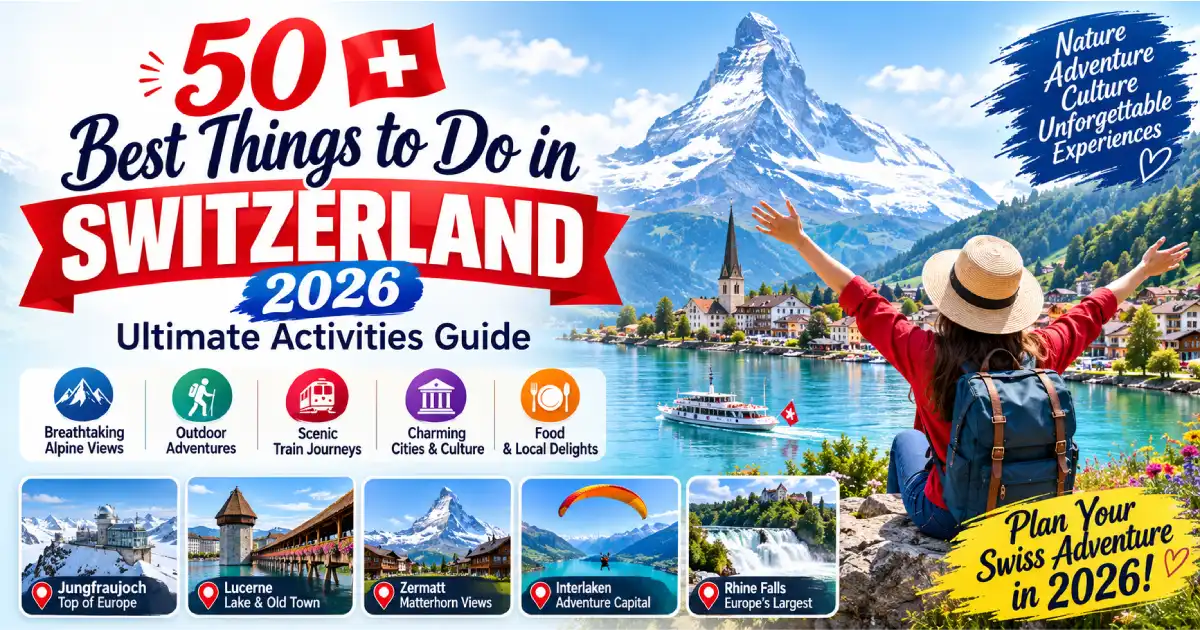
Switzerland packs more genuinely world-class activities into a small geographic area than virtually any other country on Earth — the Jungfraujoch summit railway delivering visitors to 3,454 meters without mountaineering skills, the Glacier Express panoramic train crossing 291 bridges in a single 7-hour journey through the Alps, Lake Zurich’s crystalline water warm enough for swimming from city-center beaches in July, the Basel Fasnacht carnival generating one of Europe’s most extraordinary street events in the pre-dawn darkness of February, and 65,000 kilometers of marked hiking trails covering every conceivable terrain from lakeside promenades to glacier approaches. The best things to do in Switzerland span activities that are uniquely impossible elsewhere (standing at the Jungfraujoch’s 3,454-meter saddle between the Mönch and Jungfrau peaks while viewing the Aletsch Glacier without any mountaineering equipment, floating down the Rhine River through the center of Basel on a summer afternoon, watching the Lauberhorn World Cup downhill race from a cowbell-ringing Swiss crowd) to activities that Switzerland simply does better than anywhere else (cheese fondue in a Zermatt mountain guesthouse after a day hiking toward the Matterhorn, riding the Bernina Express through Graubünden’s UNESCO-recognized mountain landscapes).
What distinguishes Switzerland’s activity landscape is the Swiss transportation system’s role in making everything accessible — the Swiss Travel Pass enables a visitor to combine a morning of urban museum browsing in Zurich, an afternoon lake swim in Lucerne, and an early evening arrival at a Grindelwald mountain guesthouse, all on public transport that runs to the minute. The activities in this guide reflect this accessibility — from completely free experiences (hiking 65,000 kilometers of marked trails, swimming in glacier-fed lakes, watching the Rhine Falls) through moderate costs (mountain railway excursions, cheese-making visits, cooking classes) to significant splurges (Glacier Express dining car, Zermatt helicopter tours, fine dining in St. Moritz) — organized to help visitors of every budget build Switzerland trips that are authentically extraordinary rather than merely expensive.
For complete guides, see our Best Places to Visit in Switzerland 2026, Best Time to Visit Switzerland, and Switzerland Travel Guide 2026 guides.
| # | Activity | Category | Cost | Time Needed | Book Ahead? |
|---|---|---|---|---|---|
| 1 | Ride the Jungfraujoch Railway | Scenic Railway | CHF 80–220 | Full day | No (but check weather) |
| 2 | Hike the Five Lakes Walk in Zermatt | Hiking | CHF 30–50 (cable car) | 4–5 hrs | No |
| 3 | Ride the Glacier Express | Scenic Railway | CHF 175+ | Full day | Yes (seat reservation) |
| 4 | Swim in Lake Zurich | Outdoors | CHF 5–8 | 2–4 hrs | No |
| 5 | Eat Cheese Fondue in a Mountain Hut | Food | CHF 25–40/person | 1.5–2 hrs | Yes (weekends) |
| 6 | Hike the Aletsch Glacier Viewpoints | Hiking | CHF 30+ (Bettmerhorn lift) | 3–5 hrs | No |
| 7 | Visit Chillon Castle | Culture | CHF 13.50 | 1.5–2 hrs | No |
| 8 | Ride the Bernina Express | Scenic Railway | CHF 65+ | 4 hrs (St. Moritz–Tirano) | Yes (seat reservation) |
| 9 | Walk Lucerne’s Chapel Bridge | Sightseeing | Free | 30 min | No |
| 10 | Float Down the Rhine in Basel | Outdoors | CHF 5–10 | 1–2 hrs | No |
| 11 | Visit the Trümmelbach Falls | Outdoors | CHF 13 | 1 hr | No |
| 12 | Hike to the First Cliff Walk | Hiking | CHF 36–42 (gondola) | 2–3 hrs | No |
| 13 | Take a Lake Steamer on Lake Geneva | Boat | Included Swiss Travel Pass | 3.5 hrs | No |
| 14 | Experience the Basel Fasnacht | Festival | Free | 3 days | No (but book hotel early) |
| 15 | Watch the Lauberhorn World Cup Race | Sports | Free (course viewpoints) | Half–full day | No (book hotel early) |
| 16 | Hike the Schynige Platte Alpine Garden | Hiking | CHF 40–55 (rack railway) | 3–4 hrs | No |
| 17 | Ski in Zermatt or Verbier | Skiing | CHF 70–90/day (lift pass) | Full day | Yes (accommodation) |
| 18 | Ride the Pilatus Golden Round Trip | Scenic | CHF 89–110 | Half day | No |
| 19 | Visit the Lavaux Vineyards | Wine/Culture | Free (walking); tastings vary | 2–3 hrs | No |
| 20 | Paraglide over Interlaken | Adventure | CHF 170–200 | 2–3 hrs total | Yes |
| 21 | Hike the Rigi Kulm Summit | Hiking/Railway | CHF 65–78 (rack railway) | Half day | No |
| 22 | Attend the Montreux Jazz Festival | Music | Free (outdoor) / CHF 50–150 (indoor) | 2–3 hrs per event | Yes (indoor tickets) |
| 23 | Eat Raclette in the Valais | Food | CHF 25–45/person | 1.5–2 hrs | Yes (popular restaurants) |
| 24 | Visit the Gruyères Cheese Dairy | Culture/Food | CHF 10–12 | 1 hr | No |
| 25 | Hike the Haute Route (Chamonix–Zermatt) | Hiking | CHF 100–200/day (guides/huts) | 14 days | Yes (hut reservations) |
| 26 | Visit the Zurich Kunsthaus | Art | CHF 26 | 2–3 hrs | No |
| 27 | Swim at Lugano’s Lido | Outdoors | CHF 8–10 | 2–4 hrs | No |
| 28 | Ride the Titlis Rotair (Revolving Cable Car) | Scenic | CHF 90+ | 3–4 hrs | No |
| 29 | Walk the Bern Rose Garden Overlook | Sightseeing | Free | 30–60 min | No |
| 30 | Take a Chocolate Factory Tour | Food | CHF 10–15 | 1.5 hrs | Yes |
| 31 | Hike the Eiger Trail | Hiking | Red Rock Pass | 3–4 hrs | No |
| 32 | Visit the Olympic Museum Lausanne | Culture | CHF 20 | 2 hrs | No |
| 33 | Take a Boat Trip on Lake Lucerne | Boat | Included Swiss Travel Pass | 2–3 hrs | No |
| 34 | Attend the Locarno Film Festival | Culture | Free (outdoor) / ticketed (indoor) | 2–3 hrs | Yes (indoor tickets) |
| 35 | Hike the Matterhorn Base Trail | Hiking | Free (to specific viewpoints) | 2–4 hrs | No |
| 36 | Visit the Swiss National Museum Zurich | Culture | CHF 10 | 1.5–2 hrs | No |
| 37 | Try Via Ferrata (Fixed Rope Climbing) | Adventure | CHF 40–80 (guide/gear) | 3–5 hrs | Yes |
| 38 | Watch the Engadin Skimarathon | Sports | Free (spectators) | Half day | No (book hotel early) |
| 39 | Take a Cooking Class (Fondue or Swiss) | Food | CHF 80–150 | 2.5–3 hrs | Yes |
| 40 | Walk the Appenzell Landsgemeinde | Culture | Free | 2 hrs | No |
| 41 | Mountain Bike in Graubünden | Outdoors | CHF 40–70/day (rental) | Half–full day | No |
| 42 | Visit the Foundation Beyeler Basel | Art | CHF 30 | 2–3 hrs | No |
| 43 | Take a Cheese Making Course | Food | CHF 60–100 | 2–3 hrs | Yes |
| 44 | Hike the Lauterbrunnen Valley Floor | Hiking | Free | 1–3 hrs | No |
| 45 | Visit the Einstein Museum Bern | Culture | CHF 16 | 1.5 hrs | No |
| 46 | Take a Sunrise Hike in the Bernese Oberland | Hiking | CHF 25–40 (first gondola) | 3–4 hrs | No |
| 47 | Explore Lugano by Lake Boat | Boat | Included Swiss Travel Pass | 2–3 hrs | No |
| 48 | Visit the Tell Museum (William Tell) | Culture | CHF 10 | 1 hr | No |
| 49 | Night Skiing in Laax or Verbier | Skiing | CHF 40–55 (night pass) | 3–4 hrs | No |
| 50 | Hike the Swiss Path (Weg der Schweiz) | Hiking | Free | 1–3 days | No |
Cost: CHF 160–220 standard; CHF 80–110 with Swiss Travel Pass (50% discount) | Duration: Full day (2 hours each way from Interlaken) | Season: Year-round | Book: No reservation required; check weather first
The Jungfraujoch railway experience begins long before the summit — the journey from Interlaken Ost (or directly from Grindelwald or Lauterbrunnen) passes through classic Bernese Oberland scenery before reaching Kleine Scheidegg (2,061 meters), where the Jungfrau Railway begins its 9-kilometer tunnel ascent through the interior of the Eiger and Mönch mountains. The tunnel journey itself (approximately 50 minutes of darkness punctuated by two window stations carved into the mountain face — the Eigerwand and Eismeer stations, where passengers disembark briefly to peer through windows in the cliff face at the glacier below and the valley above) is an engineering experience as remarkable as the summit destination.
At 3,454 meters, the Jungfraujoch offers the Sphinx Observatory viewing terrace (360-degree panorama encompassing the Aletsch Glacier — the longest glacier in the Alps at 23 kilometers — the Swiss Mittelland below, and on clear days Mont Blanc on the French-Italian border), the Ice Palace (300 meters of tunnels carved within the glacier itself, maintained at temperatures below freezing year-round, lined with ice sculptures), the Lindt Swiss Chocolate Heaven attraction (a recent addition — more commercial than scientific, but the chocolate tasting is a pleasant high-altitude interlude), and the Jungfrau Plateau (the outdoor glacier area, accessible with appropriate footwear — the 3,454-meter altitude produces genuine altitude effects in some visitors, with headache and shortness of breath normal given the rapid ascent from valley).
Insider tips: The Jungfraujoch’s weather cameras (available at jungfrau.ch/en-gb/planning/webcams/) provide real-time summit visibility — checking these in the 24 hours before visiting and being prepared to shift the excursion date if cloud cover is forecast saves the significant cost of visiting when the summit is obscured. The “Good Morning Ticket” (available for the first departures of the day, discounted approximately 25% below standard prices) rewards early risers with both savings and the best statistical chance of clear skies before afternoon cloud-building typically begins over the Alps in summer.
Cost: From CHF 175 second class Zermatt–St. Moritz (or CHF 13 seat reservation + Swiss Travel Pass); Dining car additional | Duration: 7 hours 45 minutes (full route) | Season: Daily year-round | Book: Seat reservation required
The Glacier Express traverses 291 kilometers between Zermatt and St. Moritz (or the reverse), crossing 291 bridges, passing through 91 tunnels, and climbing over the Oberalp Pass at 2,033 meters in a journey that has been marketed as “the world’s slowest express train” — a self-aware branding of the 7-hour-45-minute travel time that in any other context would indicate failure but in Switzerland indicates that the scenery along the route is sufficiently extraordinary to justify the hours. The panoramic rail cars (floor-to-ceiling curved windows accommodating the mountain scale visible throughout the journey) transform a train journey into a moving cinema of Alpine landscape — the Matterhorn visible at departure from Zermatt, the Rhône Valley vineyards passing outside the windows through the Valais, the dramatic Landwasser Viaduct curve appearing and disappearing in minutes near Filisur, and the Engadine’s lake-dotted high valley receiving the train at the terminus.
The dining car service (available for lunch during the journey, with panoramic windows and Swiss-German cuisine — roast meats, Rösti, wines from the Valais vineyards passed earlier in the journey) transforms a portion of the crossing into a moving restaurant experience with arguably the most extraordinary dining room view of any restaurant in Europe. Lunch is CHF 45–65 per person; booking simultaneously with seat reservation is strongly recommended.
Insider tips: Partial Glacier Express journeys (riding the most scenic sections without committing to the full 7-hour-45-minute experience) are entirely possible — the Zermatt to Brig section (45 minutes, Matterhorn departure views), the Disentis to Chur section (Rhine Gorge canyon, visually extraordinary), or the Chur to Filisur section (including the Landwasser Viaduct) represent the most scenically concentrated portions available as standalone rail segments on standard SBB tickets or Swiss Travel Pass without the Glacier Express pricing.
Cost: From CHF 65 second class St. Moritz–Tirano; seat reservation CHF 13–49 additional; Swiss Travel Pass valid | Duration: 2.5 hours (St. Moritz to Tirano) | Season: Year-round; snow landscapes dramatic in winter | Book: Seat reservation required
The Bernina Express connects St. Moritz to Tirano (Italy) via the Bernina Pass (2,253 meters — the highest railway point in the Alps accessible without a rack system, on regular adhesion railway), crossing between the world’s of alpine Central Europe and Mediterranean Italy within a single 2.5-hour journey. The route’s engineering marvels (the Brusio spiral viaduct — a complete circular loop that gains elevation by curling back over itself in a 360-degree spiral visible in its entirety from the train, one of the most photographed railway structures globally; the Montebello and Palü Glacier approaches; the Morteratsch Glacier panorama) and the dramatic climate transition (snow-covered Alpine passes giving way to Italian palm trees within the journey’s final hour) create the most concentrated single rail experience in Switzerland.
The Bernina Express name refers to the panoramic train variant of a route that runs multiple times daily on standard Rhaetian Railway trains — Swiss Travel Pass holders can ride the same route on non-panoramic services with a CHF 13 reservation (vs. CHF 49 for the designated Bernina Express) for equivalent scenery at a fraction of the total cost.
Insider tips: Sitting on the right side of the train (traveling southbound from St. Moritz toward Tirano) provides the best views of the Morteratsch Glacier approach and the Brusio spiral viaduct — though the viaduct briefly becomes visible from both sides as the train circles back through the spiral, the right side provides the most extended viewing angle. The Italian terminus at Tirano allows a brief Italian lunch before the return journey or onward connection to Milan (2 hours by Italian regional train from Tirano).
Cost: CHF 89–110 depending on season | Duration: Half day | Season: April–November (rack railway seasonal); gondola year-round | Departure: Lucerne
The Pilatus Golden Round Trip combines three distinct Swiss transport modes in a single circular excursion from Lucerne — lake steamer from Lucerne across Lake Lucerne to Alpnachstad (45 minutes, the SBB lake steamer included in Swiss Travel Pass), the world’s steepest rack railway from Alpnachstad to the Pilatus summit (30 minutes ascending a maximum gradient of 48%, the steepest rack railway in the world, CHF 50+ return), and descent by gondola and cable car to Kriens (then bus back to Lucerne). The Pilatus summit (2,132 meters) provides panoramic views of Lake Lucerne and the Central Swiss Alps, including on clear days views extending to the Black Forest in Germany and the Vosges in France.
Insider tips: The Golden Round Trip’s combination of lake steamer, rack railway, and aerial cable car in a single circuit provides three fundamentally different transport experiences within a half-day, making it more experientially varied than other Swiss mountain excursions that rely on a single uplift mode. The summit’s two historic hotels (Hotel Pilatus-Kulm and Hotel Bellevue, both operating since the 19th century) provide overnight stays with sunrise panoramas that day visitors miss entirely — worth considering for visitors wanting a less-common Swiss mountain overnight experience.
Cost: CHF 65–78 return from Vitznau or Arth-Goldau | Duration: Half day | Season: Year-round | Departure: Vitznau (accessible by lake steamer from Lucerne)
Mount Rigi (1,797 meters, the “Queen of the Mountains” as Mark Twain memorably described it after his 1871 visit) provides central Switzerland’s most accessible panoramic summit — the first mountain railway in Europe (opened 1871) ascending from Vitznau on Lake Lucerne via rack railway to the Rigi Kulm summit, with 360-degree views encompassing Lake Lucerne, Lake Zug, Lake Lauerz, the Bernese Alps, and the distant Central Swiss plateau. The lake steamer from Lucerne to Vitznau (40 minutes, included in Swiss Travel Pass) combined with the rack railway creates a complete half-day excursion that combines water and mountain transport in a classic Swiss format.
Insider tips: The Rigi sunrise experience (staying overnight at the Rigi Kulm Hotel and watching the sunrise panorama from the summit before the day visitors arrive) has been celebrated since the 19th century when Queen Victoria and other European royalty specifically came for the dawn view — combining a Rigi overnight with the sunrise produces one of Switzerland’s most historically resonant experiences at a relatively modest cost compared to more famous Swiss mountain stays.
Cost: CHF 30–50 (Sunnegga Paradise cable car or Rothorn combination) | Distance: 9.6 km | Difficulty: Moderate | Best Time: June–October | Starting point: Sunnegga (cable car from Zermatt)
The Five Lakes Walk (Fünf-Seen-Wanderung) is consistently listed among Switzerland’s most beautiful hiking routes — a marked trail above Zermatt connecting five high-altitude lakes (Leisee, Grindjisee, Grünsee, Moosjisee, and Stellisee), each reflecting the Matterhorn at a different angle and in a different foreground environment, creating five compositionally distinct Matterhorn photographs within a single manageable hike. The trail’s relatively modest difficulty (some elevation gain/loss between lakes, but no technical terrain) and extraordinary reward-to-effort ratio make it accessible to a wide range of fitness levels while delivering some of the most sought-after photography in the Alps.
The Stellisee reflection (the fifth lake, at 2,537 meters, where the Matterhorn’s pyramid reflects in the lake’s surface when wind is calm — typically morning) is the most famous specific composition of the walk and the most sought-after photography position in the entire Zermatt hiking network.
Insider tips: Morning departures (first cable car from Zermatt to Sunnegga, typically 8:30 AM) provide the calmest lake surfaces for reflection photography (afternoon wind often disrupts the reflection conditions) and the best chance of clear skies before afternoon cloud-building. The walk can be done in either direction — starting at Sunnegga and finishing at Rothorn (requiring the Rothorn cable car descent back to Zermatt) or the reverse — with the Sunnegga-start providing a more gradual warm-up before the most photographed sections.
Cost: Red Rock Pass / Free from Eigergletscher station | Distance: 6.4 km (Eigergletscher to Alpiglen one-way) | Difficulty: Moderate | Best Time: June–October
The Eiger Trail descends along the base of the Eiger’s north face — one of the most technically legendary mountain walls in the world (the 1,800-meter north face, scene of the 1938 first ascent by Harrer, Kasparek, Heckmair, and Vörg after six days of climbing, and of dozens of subsequent tragedy and triumph narratives that have made it the most mythologized single mountain wall in Alpine history) — at close range, providing eye-level perspective on a cliff face that typically appears only as a distant backdrop from valley viewpoints. The trail’s exposure to the north face (visible directly overhead throughout sections of the route, rockfall guards positioned at specific points where falling debris is a genuine concern) creates an atmosphere of mountain proximity unavailable from any other non-technical position near the Eiger.
Insider tips: The Eigergletscher station (starting point, reachable by train from Kleine Scheidegg on the Jungfrau Railway route) can be reached by Swiss Travel Pass train, making the one-way Eiger Trail descent to Alpiglen (where trains depart back to Grindelwald or Kleine Scheidegg) a complete circuit without returning the same direction. The trail’s north-facing orientation means it can retain ice and mud longer into the season than south-facing equivalents — checking current trail conditions before setting out in May and early June is worthwhile.
Cost: CHF 30–45 (Bettmerhorn lift from Betten or Riederalp) | Distance: Variable (2–8 km depending on chosen viewpoints) | Difficulty: Easy–Moderate | Best Time: June–October
The Aletsch Glacier — the longest glacier in the Alps at 23 kilometers, the largest ice mass in the Alps, and a UNESCO World Heritage Site within the Swiss Alps UNESCO region — is most dramatically viewed from the viewpoints above Bettmeralp and Riederalp on its eastern flank, where the glacier’s full length becomes visible as a continuous river of ice descending through the valley below the observation positions. The combination cable car (from Betten, accessible by train from Brig) and the hiking trail system connecting the viewpoints above the glacier provide the most comprehensive on-foot glacier experience available in Switzerland without technical mountaineering equipment.
Insider tips: The Aletsch Glacier is most dramatically visible when snow conditions on the surrounding mountains contrast with the glacier’s blue-grey ice — spring (when fresh snow whitens the surrounding peaks while the glacier surface remains exposed) and autumn (similar conditions) provide more visually dramatic viewpoints than midsummer when the entire landscape, including some glacier areas at lower elevations, may show less contrast. The glacier has been visibly retreating for decades — interpretive signs at specific viewpoints mark the glacier’s position in 1870, 1950, and subsequent years, providing a sobering and visually concrete demonstration of climate change that remains one of the most powerful “live” data visualizations available to visitors in Switzerland.
Cost: Free | Distance: Variable (2–10 km depending on route) | Difficulty: Easy | Best Time: May–October | Starting point: Lauterbrunnen village
The Lauterbrunnen Valley floor walk is Switzerland’s most accessible extraordinary hiking experience — a completely flat path along the valley floor between Lauterbrunnen village and Stechelberg (approximately 6.5 km one-way), passing waterfalls that descend from 300-meter cliff walls on both sides, the Trümmelbach Falls entrance (see below), and the view down the valley that inspired Tolkien’s Rivendell (Tolkien visited Lauterbrunnen in 1911 and his subsequent Rivendell descriptions in The Lord of the Rings match the valley’s geology and character specifically — a detail his estate has confirmed). The path requires no hiking experience, no special footwear beyond comfortable walking shoes, and no upward exertion — an extraordinarily rare combination of accessibility and visual impact.
Insider tips: The Staubbachfall (a 297-meter free-falling waterfall visible from the village, the third highest in Switzerland) is most dramatically seen after winter and spring when snowmelt maximizes the water volume — visiting in late May or June before summer’s reduced flow provides the most powerful single waterfall view in the valley. The walk back from Stechelberg can be made by PostBus (returning to Lauterbrunnen village) rather than on foot for visitors preferring a one-direction walk rather than a round trip.
Cost: CHF 40–55 return (rack railway from Wilderswil, near Interlaken) | Duration: 3–4 hours on the plateau | Season: Late May–October | Best Time: Late June–July (peak wildflower)
The Schynige Platte (1,967 meters, above Wilderswil south of Interlaken, accessible by a 1893 rack railway that has operated continuously for over 130 years) hosts Switzerland’s oldest alpine botanical garden (Alpengarten Schynige Platte, founded 1928, free with rail ticket), containing over 600 alpine plant species in their natural growing conditions — the most comprehensive accessible display of Swiss alpine flora available to visitors without specialist botanical knowledge. The surrounding plateau provides Bernese Oberland panoramic views (the Eiger, Mönch, and Jungfrau from a different angle than the standard Kleine Scheidegg perspective) alongside the botanical garden’s educational content.
Insider tips: The rack railway from Wilderswil (a 10-minute walk or local train from Interlaken Ost) departs at specific scheduled times — checking the timetable before departure allows planning around the seasonal first/last train timing, which determines the window available at the plateau. The plateau’s hiking trail network (several marked routes of 1–3 hours connecting viewpoints around the plateau) extends the visit for walkers who want more than botanical garden exploration.
Cost: Free | Distance: 35 km (full route around Lake Uri) | Difficulty: Easy–Moderate | Best Time: May–October | Starting point: Rütli meadow (accessible by lake steamer from Lucerne or Flüelen)
The Swiss Path (Weg der Schweiz), created for Switzerland’s 700th anniversary in 1991, circles the Urnersee (the southernmost arm of Lake Lucerne) in a 35-kilometer marked trail beginning at the Rütli meadow (the field where the original Swiss Confederation’s founding oath was sworn in 1291, accessible only by lake steamer — no road access, a deliberate preservation of the site’s historical isolation). Each Swiss canton maintains a specific section of the trail proportional to its population, creating a collaborative national monument in hiking form. The full 35-kilometer circuit is typically walked over 2 days with an overnight in Bauen, Isleten, or another small Uri lakeshore village, while specific sections (particularly the Rütli to Brunnen section past the dramatic lakeside cliffs) can be walked as day trips.
Insider tips: The lake steamer to Rütli (a specific historical pilgrimage that Swiss schoolchildren make regularly — the steamer service is specifically designed to serve the meadow’s visitors who would otherwise have no motorized access) begins at Lucerne and passes through the dramatic Seelisbergtunnel bored landscape — arriving by steamer rather than hiking to Rütli captures the historical experience of approaching Switzerland’s founding site by water, as the original participants would have.
Cost: CHF 5–8 | Season: June–September | Best Locations: Seebad Utoquai, Frauenbadi, Männerbadi Schanzengraben | Best Time: Weekday mornings or evenings
Zurich’s Badis — traditional lakeside and riverside swimming facilities, some dating to the 19th century — are one of the most extraordinary urban swimming experiences in Europe. The Seebad Utoquai (a historic bath house extending over Lake Zurich’s surface on wooden platforms, mixed gender) and the historic gender-separated Frauenbadi and Männerbadi (female and male bathing establishments on the Limmat River, also on floating wooden structures, historic 1880s–1900s architecture) provide crystalline lake and river water warm enough for comfortable swimming from late June through mid-September (Lake Zurich typically reaching 20–24°C at peak summer), combined with sun lounging, café service, and the specific urban beach culture that Zurich maintains with exceptional quality given the city’s landlocked location.
Insider tips: The Frauenbadi (women only during daytime, mixed evenings) and the Männerbadi (men only) represent Switzerland’s specific early 20th-century bathing culture maintained in functional form — the historic wooden changing rooms, café service from the floating platforms, and the experience of swimming in the Limmat’s current (the river flows from Lake Zurich through the city, providing clear, cold water even in the urban center) create a Zurich experience unavailable in most major European cities. Evening mixed hours at the Frauenbadi (typically after 7 PM) have developed into one of Zurich’s most atmospheric summer social gatherings.
Cost: CHF 5–10 (Wickelfisch waterproof bag rental/purchase) | Season: June–September | Starting points: Rheinschwimmbad or various Rhine entry points | Best Time: Weekday afternoons
Basel’s Rhine swimming is the city’s most distinctive summer activity and one of Europe’s most unusual urban outdoor experiences — residents enter the Rhine at various points upriver and float downstream carried by the current, keeping clothes and valuables dry in a traditional waterproof bag (the Wickelfisch — “wound fish” — a sausage-shaped neoprene bag that seals waterproof and provides buoyancy) over a 20-40 minute downstream drift past Basel’s Old Town, bridges, and the confluence of Swiss, French, and German territories. The Rhine’s current (swift but predictable at normal summer water levels) requires no significant swimming ability — the float is more current-assisted drift than active swimming — though swimming ability for emergency situations is standard safety advice.
Insider tips: The Wickelfisch bags (available in tourist shops and Rhine-side kiosks, CHF 15–20 to purchase, CHF 5–10 to borrow/rent) are Basel’s most distinctive souvenir — practical (they work precisely as designed, keeping phones and wallets completely dry during the float) and specifically Swiss in a way that generic souvenirs aren’t. Multiple Rhine entry points allow customizing the float length — entering further upriver extends the drift time, entering closer to the traditional exit points near the city center keeps the float brief.
Cost: Included with Swiss Travel Pass; individual tickets vary | Duration: 3.5 hours (Geneva–Montreux full crossing) | Season: Year-round (reduced winter schedule) | Best Time: May–October for deck enjoyment
The CGN (Compagnie Générale de Navigation) lake steamer service on Lake Geneva — operating historic paddle steamers and modern vessels on routes connecting Geneva, Nyon, Lausanne, Vevey, Montreux, and smaller lakeside villages — provides the most atmospheric Lake Geneva transit experience and one of Switzerland’s finest included-with-Swiss-Travel-Pass activities. The Geneva to Montreux crossing (3.5 hours, stopping at numerous intermediate lakeside communities) passes along the Lavaux UNESCO vineyard terraces (visible from the water as the steamer approaches Vevey and Montreux from the west), the Chillon Castle (arriving in Montreux with the castle visible on its lake rock to the east), and the full panorama of French Alps across the water throughout the journey.
Insider tips: The Belle Époque steam paddle ships (La Suisse, Savoie, Simplon — historic paddle steamers operated since the early 20th century, still coal-fired) operate specific routes on the lake and can be identified in the CGN schedule — traveling on a historic paddle steamer rather than a standard motor vessel adds considerable period atmosphere to the lake crossing. The deck above the paddle wheels provides the best position for photography and viewing — front-of-steamer positions toward the bow are less stable but provide the clearest forward views.
Cost: CHF 13 | Location: Lauterbrunnen Valley (15 min walk from Lauterbrunnen village or 10 min from Stechelberg) | Hours: April–November | Duration: 1 hour
Trümmelbach Falls, a series of ten glacial meltwater waterfalls inside the mountain (the only such accessible underground waterfall complex in the world open to visitors), processes up to 20,000 liters of water per second from the Eiger, Mönch, and Jungfrau glaciers through a limestone mountain interior — the falls are accessed via a tunnel system with a spiral elevator and a series of walkways providing progressively closer approaches to the cascading water within the mountain’s interior. The experience of standing within the mountain beside 10,000–20,000 liters of rushing glacial water per second, in a natural limestone cathedral amplifying the sound and mist into a genuinely overwhelming sensory experience, is entirely unlike any surface waterfall visit.
Insider tips: The falls’ volume varies dramatically with season — spring snowmelt (May–June) and late-summer glacier melt periods provide the most dramatic flow, while autumn visits may encounter reduced but still impressive volumes. The spray within the tunnel system is significant — waterproof layers or willingness to get wet is appropriate attire, and camera equipment benefits from protective covers given the continuous mist throughout the accessible sections.
Cost: CHF 25–40/person | Best Locations: Zurich, Zermatt, Gruyères, any mountain guesthouse | Season: September–April (traditional); year-round at tourist restaurants
Swiss cheese fondue — melted Gruyère and Vacherin Fribourgeois (or Appenzeller, or various regional variations) in a ceramic caquelon over a small flame, with bread cubes (and sometimes potatoes, vegetables, or small meats) for dipping — is Switzerland’s most culturally significant dish, governed by specific customs that Swiss diners follow with varying degrees of seriousness. The cultural canon includes: use a long-handled fork to dip the bread and maintain a stirring motion as you withdraw (preventing the cheese from separating), drink white wine or herbal tea alongside (not water, which is traditionally said to ball the cheese in the stomach), and eat the crust (croûte — the thin layer of caramelized cheese that forms at the bottom of the caquelon as the evening progresses) as a prize for the last diners remaining.
The geographic context of fondue varies enormously — eating fondue in a Zermatt mountain guesthouse after a day of hiking, with the Matterhorn visible through the window in evening alpenglow, constitutes one of the most complete Swiss cultural experiences available; eating fondue in a touristy Lucerne restaurant on a rainy afternoon achieves the same dish in considerably less atmospheric circumstances.
Insider tips: The Fribourg fondue (moitié-moitié — “half and half” — combining Gruyère and Vacherin Fribourgeois in equal proportions, the foundational recipe considered the benchmark by Swiss fondue enthusiasts) differs from the “Swiss fondue” served at many tourist restaurants (which may incorporate additional melting cheeses or flavoring agents that smooth the flavor but lose specificity). Seeking specifically moitié-moitié fondue or a fondue made with a named Swiss AOC cheese (Gruyère AOC, Appenzeller, Raclette du Valais) provides the most authentic version.
Cost: CHF 25–45/person | Best Locations: Sion, Sierre, Zermatt restaurants | Season: Year-round | Tradition: The Valais as raclette’s origin region
Raclette — the semi-hard cow’s milk cheese (produced in the Valais and, with different character, in the Fribourg region) melted by open fire or specialized electric grill and scraped directly onto the plate — is best experienced in the Valais, where the specific Raclette du Valais AOP cheese (made only from summer milk from Valais cows, with a distinctive earthy character) and the regional serving tradition (accompanied by boiled potatoes, gherkins, silverskin onions, and increasingly pickled vegetables) differ meaningfully from the generic “raclette” available throughout Switzerland. Traditional Valais raclette restaurants serve the cheese from a half-wheel held against a radiant heat source — each serving is a fresh scraping from the melted surface, allowing diners to judge desired browning and proceed at their own pace.
Insider tips: The Valais is the most straightforward base for authentic raclette experiences — the villages of Sion (the canton capital), Sierre, and various smaller Valais communities have raclette restaurants that serve the specific regional cheese with traditional accompaniments. Zermatt’s restaurants (within the Valais but at resort prices) provide the combination of Valais authenticity and alpine mountain atmosphere, though at a premium above valley-town equivalents.
Cost: CHF 10–12 | Location: Pringy (adjacent to Gruyères village) | Hours: Daily | Duration: 1–1.5 hours
La Maison du Gruyère, the show dairy adjacent to the medieval hilltop village of Gruyères, allows visitors to observe the complete Gruyère cheese production process through viewing windows above the working production floor — milk arrives from surrounding Fribourg farms in the morning, the curd-cutting, scalding, pressing, and initial salting process visible through the observation gallery, with the finished rounds (each weighing approximately 35 kg) headed to aging cellars for a minimum of 5 months (and up to 18+ months for the most complex flavors). The adjacent exhibition covering Gruyère cheese’s history, the specific milk quality requirements (Gruyère AOP requires milk from cows fed on fresh grass and hay — no silage, which would affect the cheese’s flavor), and tasting stations providing side-by-side comparison of young (douce, 5 months) and aged (surchoix, 10+ months) Gruyère rounds extend the experience beyond purely production observation.
Insider tips: Production typically occurs during morning hours (most milk arrives early) — visiting before 11 AM provides the best chance of seeing active cheese-making rather than an empty production floor between batches. The dairy’s shop carries genuine Gruyère AOC in ages not widely available in standard retail — purchasing a piece of 12-month or 18-month aged Gruyère for subsequent Swiss picnics provides superior quality to supermarket versions while supporting the AOC system that protects traditional Swiss cheese production.
Cost: CHF 10–15 | Best Options: Maison Cailler (Broc, near Gruyères), Lindt Home of Chocolate (Kilchberg, near Zurich) | Duration: 1.5 hours | Book: Yes, particularly for weekends
The Maison Cailler tour in Broc (the Cailler chocolate factory, operated since 1898, the oldest Swiss chocolate brand still producing in Switzerland, now part of Nestlé) provides a multi-sensory guided journey through Swiss chocolate history — from the cacao origin regions through the specific conching technique that Swiss chocolate pioneers (Lindt, Cailler) developed in the 19th century to create the smooth milk chocolate texture that defines Swiss chocolate globally, concluding with an unlimited tasting station of current Cailler production. The Broc location (30 minutes from Fribourg by regional train) and the combination with the adjacent Gruyères village and La Maison du Gruyère dairy creates a natural Swiss “cheese and chocolate” day trip from Bern or Lausanne.
Insider tips: The Lindt Home of Chocolate (Kilchberg, 20 minutes from Zurich by train) offers a more contemporary museum experience with an extraordinary 9-meter-high chocolate fountain centerpiece, at a slightly higher price point than Cailler but in a format that Lindt’s global brand recognition makes more universally recognizable. For visitors choosing between the two, Cailler in Broc provides greater historical depth and the natural combination with Gruyères, while Lindt in Kilchberg is significantly more convenient for visitors based in Zurich.
Cost: CHF 79–92/day (lift pass, varies by season); accommodation varies dramatically | Season: Year-round skiing on high glacier; full resort mid-December–April | Best Time: January–March | Book: Accommodation 3–6 months ahead
Zermatt’s ski area (the Matterhorn Ski Paradise, connected cross-border with Cervinia in Italy) spans 360 kilometers of marked pistes across 3 ski areas (Rothorn, Stockhorn, and Kleine Matterhorn) reaching maximum elevation at 3,883 meters — the highest ski terrain in the Alps open to recreational skiers. The Matterhorn’s visual presence throughout the skiing day (the peak visible from most piste positions throughout the resort) adds a specific drama to Zermatt skiing unavailable at other European resorts where the mountain you’re skiing on is simply a mountain rather than the world’s most famous recognizable peak.
The cross-border Cervinia connection (available to skiers who obtain the relevant international day supplement to the Zermatt lift pass) allows skiing from Switzerland into Italy in a single run — a genuinely extraordinary border-crossing experience available for the cost of a single additional lift pass supplement.
Insider tips: The Matterhorn Glacier Paradise (the highest cable car station in the Alps at 3,883 meters, requiring a specific additional lift pass segment) provides summer skiing on the permanent glacier snow — visiting in summer specifically to ski in shorts-weather above the valley while the valley floor is at 25°C is one of Switzerland’s most peculiar and specifically Zermatt pleasures. The run from Klein Matterhorn down to Zermatt (Theodul Glacier run, 22 km, one of the longest ski descents in the Alps) is achievable by intermediate skiers with guidance.
Cost: CHF 80–95/day (lift pass) | Season: December–April | Best Time: January–March | Book: Accommodation 4–6 months ahead for peak weeks
Verbier, the anchor of the 4 Vallées ski area (412 km of marked pistes connecting Verbier, Nendaz, Veysonnaz, Thyon, and La Tzoumaz), is Switzerland’s most varied and most challenging major ski destination — the Mont Fort area (3,330 meters) provides glacier skiing, extreme terrain, and the specific double black-diamond runs that have made Verbier the preferred destination for advanced and expert skiers who find the more groomed piste-skiing of Zermatt and Grindelwald insufficiently challenging. The off-piste terrain (Verbier’s Vallon d’Arbi and various steep couloir approaches are among the most sought-after backcountry skiing in the Alps) draws ski mountaineers and freeride enthusiasts specifically.
Insider tips: Verbier’s après-ski scene (the Farm Club, Pub Mont Fort, and various other venues that have made Verbier’s evening culture as famous internationally as its skiing) operates at a social intensity that distinguishes the resort from more family-oriented Swiss ski destinations — visitors specifically seeking the après-ski dimension of Swiss skiing choose Verbier deliberately over quieter alternatives.
Cost: Free | Dates: Three days beginning the Monday after Ash Wednesday (check 2026 specific dates at fasnacht.ch) | Location: Basel Old Town | Best Time: 4 AM Monday morning (Morgestraich)
The Basel Fasnacht is Switzerland’s most extraordinary cultural event and one of the most remarkable public celebrations in Europe — three days (Monday through Wednesday, the week after Ash Wednesday, making it the most specifically anti-carnival of European carnivals by occurring after Ash Wednesday rather than before) organized around the 4 AM Monday morning Morgestraich: a complete city lights-out in which Basel’s Old Town plunges into total darkness (electricity switched off, streetlights extinguished, businesses darkening) while thousands of costumed parade groups (the Cliques, each with their own distinctive costume design and musical arrangement) materialize from the darkness carrying elaborately painted illuminated lanterns, walking through the Old Town in silence except for the haunting, simultaneous sound of hundreds of fifes and drums playing the traditional Fasnacht marches.
The Morgestraich is unlike any other public event in Europe — the specific combination of total darkness, simultaneous appearance of thousands of lit lanterns, and the fife-and-drum music that fills the Old Town streets for the following hours creates an atmosphere that even visitors who’ve attended multiple times describe as genuinely otherworldly. The subsequent two and a half days extend the carnival through daytime parades, the Cortège (the main procession, Tuesday and Thursday afternoons), and continuous musical performances throughout Basel’s streets.
Insider tips: Arriving in Basel before 3 AM on the Morgestraich Monday (to secure a viewing position in the Old Town before the darkness begins at 4 AM) is necessary for the full experience — arriving after 4 AM when the Morgestraich has already begun means navigating by phone light in crowds. Basel accommodation during Fasnacht books out months in advance — booking the specific Fasnacht hotels as soon as 2026 dates are confirmed (typically announced by early autumn 2025) provides the only reliable way to secure central accommodation.
Cost: Free (outdoor lakeside stages); CHF 50–150+ (indoor concerts) | Dates: Early-to-mid July (check 2026 specific dates at montreuxjazzfestival.com) | Location: Montreux lakefront | Book: Indoor tickets weeks–months ahead
The Montreux Jazz Festival (founded 1967, held annually for two weeks in July) presents a paradox — one of the world’s most famous jazz festivals that has expanded far beyond jazz to encompass pop, rock, electronic, R&B, and world music in its main program while maintaining its jazz identity through dedicated programming in smaller venues. The lakeside outdoor stages (Montreux’s lakefront stages providing the festival’s most atmospheric setting, with the mountains across Lake Geneva visible behind the performers, free access for all visitors) and the indoor auditoriums (Casino, Miles Davis Hall — ticketed, hosting the main international headliners) together create a festival that can be experienced completely free or at significant cost depending on interest in specific performers.
Insider tips: The free outdoor stages provide genuinely high-quality programming — not simply the warm-up acts for ticketed main shows, but dedicated programming of artists specifically selected for the outdoor format, often representing the festival’s strongest jazz and roots music programming. Arriving on the Montreux lakefront at 6 PM on any festival evening and spending three hours between outdoor stages costs nothing except train fare from wherever you’re based.
Cost: Free from public course viewpoints; grandstand tickets CHF 30–80 | Dates: Third weekend of January (check specific 2026 dates at lauberhorn.ch) | Location: Wengen, Bernese Oberland | Book: Accommodation 6–12 months ahead
The Lauberhorn World Cup downhill race (held annually since 1930 with wartime interruptions) is the longest, fastest, and most prestigious downhill ski race on the FIS World Cup circuit — a 4,270-meter course descending from the Lauberhorn through the Wengen village area to the Grindelwald valley floor, with speeds exceeding 150 km/h on specific sections, attracting 30,000+ spectators along the course and television audiences in 40+ countries. The specific culture of the Lauberhorn race (cowbell-ringing Swiss crowds, the distinctive finish-area atmosphere of Wengen’s car-free village, the multi-day format incorporating slalom and super-G races alongside the downhill) creates a sports event that feels specifically Swiss in its combination of technical seriousness and celebratory gemütlichkeit.
Insider tips: Wengen’s accommodation (the village is car-free, accessible only by Wengernalp Bahn from Lauterbrunnen) fills completely during Lauberhorn weekend — booking the specific January race weekend accommodation immediately when the FIS race calendar confirms dates for the following season (typically released in spring–summer of the preceding year) is the only reliable approach. Day-visitors arriving by train from Interlaken or Grindelwald for race day without accommodation are entirely feasible, but involve early trains and potential crowding on the descent.
Cost: Free | Date: Last Sunday of April (check specific 2026 date) | Location: Appenzell main square, eastern Switzerland | Best Time: Arrive before 11 AM
The Appenzell Innerrhoden Landsgemeinde — the annual open-air cantonal parliament where citizens of the half-canton gather in the main square with traditional costume (traditional dress expected from participants, visitors welcome in regular clothing), raise their hands to vote on cantonal matters, and elect cantonal officials in an unbroken tradition dating to 1378 — represents the most ancient form of direct democracy still functioning in the Western world. The Landsgemeinde is not a reenactment or a museum event but a functioning governmental meeting in which actual cantonal decisions are made — visitors attend as observers of a genuine democratic proceeding rather than a cultural performance.
Insider tips: The Landsgemeinde begins at a specific announced time (typically late morning) and proceeds through its agenda in Swiss German — understanding the proceedings requires either German comprehension or a prepared context from advance research, but the visual experience (several thousand citizens in traditional dress, yellow cantonal flags, the landscape of the Appenzell square) is meaningful even without linguistic comprehension of the specific votes being conducted. Arriving well before the start time provides better viewing positions and the opportunity to observe participants arriving in traditional dress.
Cost: CHF 170–200 (tandem paraglide with instructor) | Duration: 20–30 minutes flight time (2–3 hours total including transport and preparation) | Season: April–October | Book: Yes, 1–2 days ahead minimum
Tandem paragliding from the Beatenberg launch site above Interlaken (the most common Interlaken paragliding approach) provides aerial views of the Bernese Oberland that no mountain railway can replicate — flying at altitudes of 1,500–2,500 meters above Interlaken, with Lake Thun and Lake Brienz visible simultaneously below, the Eiger-Mönch-Jungfrau trio looming above in direct eyeline, and the Interlaken valley spread below in the precise geographic configuration that maps show but that standing at valley level or mountain summit level never reveals simultaneously. The tandem format (a qualified instructor controls the paraglider while the passenger sits in a harness in front, requiring no prior experience) makes this accessible to essentially any visitor.
Insider tips: Multiple Interlaken paragliding operators compete on the same launch site — pricing is similar across operators (CHF 170–200 is the consistent market rate), so the primary selection criterion is guide experience and equipment quality. Booking the previous day (or the morning of, if weather is clear) provides flexibility to choose ideal flying conditions over advance scheduling convenience. Photography is best with a GoPro-style action camera mounted on a selfie stick or the guide’s helmet — phone cameras risk being dropped during the launch/landing phases.
Cost: CHF 40–80 (harness/equipment rental); guided via ferrata CHF 80–150 | Best Locations: Mürren, Grindelwald, Zermatt, various locations throughout Switzerland | Season: June–October | Difficulty: Beginner to expert routes available
Via ferrata (Italian: “iron road” — fixed-steel-cable routes bolted into mountain rock faces, allowing non-technical climbers to ascend terrain that would otherwise require full rock climbing skills and equipment) is one of Switzerland’s fastest-growing activities, with dozens of established routes across the Alps ranging from beginner-friendly (family-grade, minimal exposure, short distances) to genuinely terrifying expert routes (vertical cliff faces, exposed traverses, significant commitment required). The harness-and-carabiner system used on via ferrata attaches the climber to the fixed cable throughout the route, preventing any fall of more than 1–2 meters — a safety system that makes vertical rock faces accessible to visitors with basic fitness and no prior climbing experience.
Insider tips: Via ferrata in Switzerland requires renting or bringing a specific harness and two-cable “Y-shaped” lanyard system designed for via ferrata clipping (different from standard rock climbing harnesses — the two-cable system ensures the climber is always attached to the cable while transitioning between cable anchors). Rental is available at outdoor sports shops near major via ferrata routes. Guided via ferrata (available from mountain guide companies in Mürren, Grindelwald, and other alpine centers) provides safety assessment, route selection, and technique instruction valuable for first-time participants.
About Travel Tourister Travel Tourister’s destination specialists have experienced Switzerland’s activities across all seasons — from Jungfraujoch Good Morning Ticket dawn arrivals and Glacier Express dining car lunches to Basel Fasnacht Morgestraich pre-dawn positioning and Zermatt Five Lakes Walk alpenrosen photography — to deliver the most practical and honest guide to the best things to do in Switzerland for every type of 2026 visitor.
Posted By : Vinay
Latest Article
2nd Floor, 39, Above Kirti Club, DLF Industrial Area, Kirti Nagar, New Delhi, Delhi 110015



Travel Tourister is a leading Travel portal where we introduce travellers to trusted travel agents to make their journey hasselfree, memorable And happy. Travel Tourister is a platform where travellers get Tour packages ,Hotel packages deals through trusted travel companies And hoteliers who are working with us across the world. We always try to find new and more travel agents and hoteliers from every nook and corners across the world so that you could compare the deals with different travel agents and hoteliers and book your tour or hotel with the one you have chosen according to your taste and budget.
Copyright © Travel Tourister, India. All Rights Reserved
 Call
Call Enquiry