Published on : 03 Aug 2026
By Travel Tourister | Updated Aug 2026
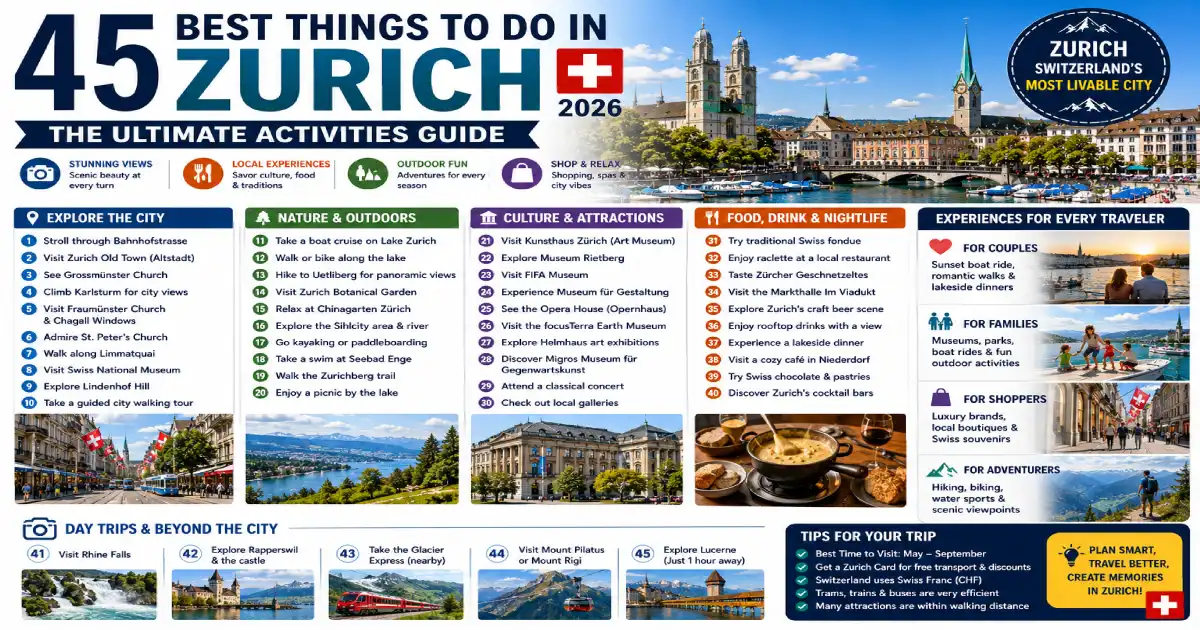
Zurich operates at a pace and quality level that consistently surprises visitors who arrive expecting a sterile financial center — the city’s reputation as a banking capital and luxury shopping destination (accurate on both counts) coexists with genuinely extraordinary outdoor swimming culture, one of Europe’s most vibrant contemporary art scenes, a nightlife infrastructure that has drawn international attention since the techno movement established Zurich as one of its European capitals in the late 1980s, and a public transportation system so comprehensive that visitors can reach the Swiss Alps for a day hike and return to a riverside restaurant for dinner without ever touching a taxi app. The best things to do in Zurich span genuinely free experiences — swimming in the Limmat River through the city center, walking the medieval Altstadt’s cobblestone lanes, visiting the Grossmünster and Fraumünster churches, climbing the Üetliberg by S-Bahn for panoramic lake-and-Alps views — through moderate-cost experiences (the Kunsthaus Zürich’s extraordinary Giacometti collection, day trips to the Rhine Falls and Stein am Rhein by train, wine tasting in the surrounding Zürich wine region) to specific splurges (Zurich Opera, Kronenhalle dinner, a day trip to the Jungfraujoch by rail).
What distinguishes Zurich’s activity landscape from other major European cities is the remarkable density of quality per square kilometer — the Old Town (Altstadt), the lakefront (Zürichsee), and the Zurich West creative district are each walkable from the Hauptbahnhof (main station) within 15–20 minutes, while day trips to some of Switzerland’s finest natural and cultural destinations (Rhine Falls at 45 minutes by train, Lucerne at 48 minutes, the Rhine Falls and Stein am Rhein combined at under 90 minutes) are accessible as casual single-day excursions. The Zurich Card (24-hour CHF 29, 72-hour CHF 59 — covering all public transport, free entry to 43 Zurich museums, and various discounts) and the Swiss Travel Pass make the financial logistics of a Zurich visit significantly more manageable than the city’s price-per-meal reputation might suggest.
This guide covers the 45 best things to do in Zurich organized by category — art and museums, outdoor and swimming, food and drink, day trips, nightlife, and seasonal experiences — with practical details on costs, transport, booking requirements, and insider timing for 2026 visitors planning trips of any length.
For complete guides, see our Best Places to Visit in Zurich 2026, Best Restaurants in Zurich 2026, Best Places to Visit in Switzerland 2026, and Switzerland Travel Guide 2026 guides.
| # | Activity | Category | Cost | Time Needed | Book Ahead? |
|---|---|---|---|---|---|
| 1 | Visit the Kunsthaus Zürich | Art/Museum | CHF 26 | 3–5 hrs | No |
| 2 | Swim in the Limmat River | Outdoors | Free | 1–2 hrs | No |
| 3 | Walk the Altstadt (Old Town) | Sightseeing | Free | 2–4 hrs | No |
| 4 | Day Trip to Rhine Falls | Day Trip | CHF 5–10 | Full day | No |
| 5 | Ride the Polybahn to ETH Zurich | Sightseeing | CHF 1.60 | 45 min | No |
| 6 | Visit the Grossmünster Cathedral | Culture | Free | 30–60 min | No |
| 7 | See the Fraumünster Chagall Windows | Culture | Free | 20–30 min | No |
| 8 | Swim at Seebad Utoquai | Outdoors | CHF 8 | 2–3 hrs | No |
| 9 | Day Trip to Lucerne | Day Trip | Swiss Travel Pass | Full day | No |
| 10 | Visit the Swiss National Museum | Museum | CHF 10 | 1.5–2 hrs | No |
| 11 | Walk Bahnhofstrasse | Shopping/Sightseeing | Free | 1 hr | No |
| 12 | Watch Sunset from Üetliberg | Outdoors | CHF 14 (S-Bahn) | 3–4 hrs | No |
| 13 | Explore Zurich West (Industriequartier) | Neighborhood | Free | 2–3 hrs | No |
| 14 | Visit Cabaret Voltaire | Culture | CHF 10 | 45 min | No |
| 15 | Take a Lake Zurich Boat Trip | Outdoors | Included Swiss Travel Pass | 1–3 hrs | No |
| 16 | Attend a Zurich Opera Performance | Entertainment | CHF 30–250+ | 3 hrs | Yes (weeks) |
| 17 | Visit the Foundation Beyeler | Art/Museum | CHF 30 | 2–3 hrs | No |
| 18 | Explore Langstrasse at Night | Nightlife | Free | 3–4 hrs | No |
| 19 | Day Trip to Stein am Rhein | Day Trip | Swiss Travel Pass | Full day | No |
| 20 | Take a Cooking/Fondue Class | Food | CHF 80–150 | 2–3 hrs | Yes |
| 21 | Visit the Kunsthalle Zürich | Art | CHF 12 | 1 hr | No |
| 22 | Swim at the Männerbadi | Outdoors | Free | 1–2 hrs | No |
| 23 | Explore Niederdorf’s Lanes | Sightseeing | Free | 1–2 hrs | No |
| 24 | Day Trip to Rapperswil | Day Trip | Swiss Travel Pass | Half day | No |
| 25 | Visit the Rietberg Museum | Art/Museum | CHF 18 | 1.5–2 hrs | No |
| 26 | Attend a Concert at Tonhalle | Entertainment | CHF 20–120 | 2 hrs | Yes |
| 27 | Take a Zurich City Walking Tour | Sightseeing | CHF 25–35 | 2 hrs | Yes |
| 28 | Explore the Zürichhorn Park | Outdoors | Free | 1 hr | No |
| 29 | Visit Thermalbad & Spa Zürich | Wellness | CHF 39–55 | 2–3 hrs | Yes |
| 30 | See a Film at Filmpodium | Entertainment | CHF 15 | 2 hrs | No |
| 31 | Walk the Uferweg Lake Path | Outdoors | Free | 2–3 hrs | No |
| 32 | Visit the Zurich Zoo | Family | CHF 29 | 3–4 hrs | No |
| 33 | Explore the Hürlimann Areal | Food/Culture | Free | 1–2 hrs | No |
| 34 | Try Zurich’s Street Food Markets | Food | CHF 10–20 | 1–2 hrs | No |
| 35 | Day Trip to Jungfraujoch | Day Trip | CHF 80–220 | Full day | No (check weather) |
| 36 | Visit the Zurich Botanical Garden | Outdoors | Free | 1–2 hrs | No |
| 37 | Attend the Street Parade (September) | Festival | Free | 4–6 hrs | No |
| 38 | Walk the Zürichberg Forest Trails | Outdoors | Free | 2–3 hrs | No |
| 39 | Visit the Museum of Design | Museum | CHF 14 | 1.5 hrs | No |
| 40 | Try Fondue at Kronenhalle | Food | CHF 60–100 | 2 hrs | Yes |
| 41 | Day Trip to Schaffhausen | Day Trip | Swiss Travel Pass | Half–full day | No |
| 42 | Cycle Around Lake Zurich | Outdoors | CHF 20–35 (bike rental) | Half–full day | No |
| 43 | Visit the Migros Museum | Art | CHF 12 | 1 hr | No |
| 44 | Experience the Zurich Christmas Market | Seasonal | Free | 2 hrs | No |
| 45 | Take a Zurich Food Tour | Food | CHF 80–110 | 2.5–3 hrs | Yes |
Cost: CHF 26 | Transport: Tram to Kunsthaus | Hours: Tuesday–Sunday, closed Monday | Best Time: Weekday afternoons; free first Wednesday evening of month
The Kunsthaus Zürich, expanded dramatically in 2021 with a David Chipperfield-designed new building connected to the original 1910 Moser building by an underground passage, now constitutes Switzerland’s largest art museum and one of Europe’s most important — the combined collection spans from medieval Swiss painting through Old Masters, Impressionism, Expressionism, and into the contemporary, with specific depth that justifies calling it genuinely world-class rather than merely regionally significant. The collection’s headline assets: the world’s most significant public Alberto Giacometti collection outside the Fondation Giacometti in Paris (assembled through the sculptor’s direct personal relationship with Zurich across his career), an exceptional Monet series (the large-format water lily paintings in their own dedicated room), the Merzbacher Collection of German Expressionism (among the finest private collections of Kirchner, Heckel, and Schmidt-Rottluff ever assembled, now on long-term loan), and Andy Warhol’s “Shadows” series (a room-filling monumental installation in the new building).
The practical experience of the museum benefits from planning — both buildings warrant significant time, and the underground connection passage (itself an architectural experience with installed artworks) requires navigation that first-time visitors occasionally find confusing. Allocating a full afternoon (3–5 hours) rather than treating the Kunsthaus as a quick stop produces a genuinely transformative art experience rather than a rushed overview.
Insider tips: The free first Wednesday evening of each month (approximately 5–8 PM, confirm current hours on kunsthaus.ch) provides access to both buildings without admission cost — the evening atmosphere (younger crowd, wine available from the museum bar, the new building’s architecture particularly atmospheric in artificial lighting) differs meaningfully from standard daytime visiting. The Giacometti wing (dedicated gallery in the new building, specifically designed for the elongated bronze sculptures at various scales from intimate cabinet pieces to monumental standing figures) rewards the slowest possible pace — standing in the room with multiple Giacometti figures creates a spatial experience that moving through quickly destroys.
Cost: CHF 30 | Transport: Tram 6 to Riehen Dorf (Basel journey — requires either a day trip or a Zurich-Basel train) | Note: Technically in Riehen, near Basel — most efficiently combined with a Basel day trip | Best Time: Weekday afternoons
The Foundation Beyeler in Riehen (a suburb of Basel, approximately 60 minutes from Zurich by train) — though technically outside Zurich, it’s accessible as a day trip and is so exceptional that serious art visitors to Switzerland specifically include it — houses Ernst Beyeler’s private collection of 20th-century masterworks in a Renzo Piano-designed building of extraordinary refinement. The permanent collection (Picasso, Mondrian, Rothko, Bacon, Warhol, Giacometti, Klee, and others — all major works rather than secondary pieces) is supplemented by rotating temporary exhibitions that have included some of the most significant single-artist retrospectives staged in Europe over the past two decades.
The building itself (natural materials — wood, stone, and glass — in a one-story Renzo Piano structure that integrates the gardens outside with the gallery spaces inside through floor-to-ceiling glazing on the garden side of each room) creates a museum environment where art and architecture are equally worthy of attention — Piano’s specific handling of natural light (roof panels filtering daylight throughout the gallery spaces without direct sun exposure) creates optimal art-viewing conditions for paintings that have hung here for 30 years under consistent conservation-grade conditions.
Insider tips: The Foundation Beyeler’s temporary exhibitions (check fondationbeyeler.ch for current programming) often justify the journey from Zurich independently — major exhibitions here attract European art visitors specifically, and the combination of a permanent collection visit with a significant temporary exhibition produces a museum day of quality that few European institutions can match. The museum restaurant (garden-level, Renzo Piano-designed dining space with views into the sculpture garden) provides excellent quality lunch at Swiss-premium prices that are nonetheless better value than equivalent-quality central Basel or Zurich restaurant alternatives.
Cost: CHF 12 | Transport: Tram to Escher-Wyss-Platz (Zurich West) | Address: Limmatstrasse 270, Löwenbräu Areal | Best Time: Weekdays
The Migros Museum für Gegenwartskunst (Migros Museum for Contemporary Art), housed within the Löwenbräu Areal (a converted brewery complex in Zurich West that also contains Kunsthalle Zürich, a cinema, restaurant, and multiple commercial galleries), represents Switzerland’s most serious institutional commitment to international contemporary art — not Swiss art specifically, but the globally-active contemporary scene that Zurich’s art market participates in as a secondary market center (Art Basel being the primary, but Zurich’s private gallery scene operating at a level that puts it among Europe’s significant art trade cities). The museum’s program (approximately 4–6 major exhibitions per year, each typically a solo or focused group exhibition of significant ambition) has over 30 years established a reputation for presenting artists before they achieve wider international recognition alongside major retrospectives of established figures.
Insider tips: The Löwenbräu Areal complex is worth treating as a destination rather than specifically targeting any single institution within it — visiting the Migros Museum and Kunsthalle Zürich simultaneously (both within the same converted brewery building) and browsing the commercial galleries on the same visit provides a comprehensive overview of Zurich’s contemporary art landscape within a single afternoon.
Cost: CHF 14 | Transport: Tram to Toni Areal (Zurich West) | Address: Toni-Areal, Pfingstweidstrasse 96 | Best Time: Weekdays
The Museum für Gestaltung Zürich (Museum of Design), relocated to the Toni-Areal (a former dairy factory converted into a cultural campus housing the Zurich University of the Arts) in Zurich West, maintains Switzerland’s most comprehensive design collection — graphic design, typography, product design, and poster art across 500,000+ items including the world’s most significant collection of Swiss graphic design posters (the Swiss Poster Collection, covering the 20th century’s development of the specific Swiss style — the “International Typographic Style” or “Swiss Style” — that shaped global graphic design from the 1950s through the 1980s). The poster collection alone (accessible in rotating exhibition format since the full 500,000+ items cannot be displayed simultaneously) provides the most concentrated overview of Swiss visual culture available in any single institution.
Insider tips: The Museum für Gestaltung’s satellite exhibition space (the Schaudepot in the main Ausstellungsstrasse building, near the Hauptbahnhof) shows permanent collection highlights including furniture, industrial design, and graphic works — a more centrally-located complement to the main Toni-Areal building that’s worth noting for visitors with limited time for Zurich West.
Cost: CHF 10 | Transport: Tram to Rathaus, walk | Address: Spiegelgasse 1, Niederdorf | Best Time: Any time; check for special events
Cabaret Voltaire, where Hugo Ball, Emmy Hennings, Tristan Tzara, and Jean Arp founded the Dada movement on February 5, 1916, operates today as a living cultural institution — part museum (permanent documentation of Dada’s founding, the specific manifestos, performance photographs, and publications that defined the movement), part contemporary art space (rotating exhibitions commissioning new works that engage with Dada’s legacy), and part functioning bar (accessible during café hours without museum admission, allowing anyone to sit in the room where one of the 20th century’s most influential art movements was invented). The physical intimacy of the space (a narrow Niederdorf lane building, the performance area genuinely small — perhaps 50 people maximum at the original scale) makes the historical imagination particularly vivid: the anarchic, anti-rational performances that scandalized Zurich bourgeoisie in 1916 happening in this specific room with this specific street outside.
Insider tips: The building’s Spiegelgasse address places it within 200 meters of where Lenin lived during his Zurich exile in 1916–1917 (at number 14 Spiegelgasse) — the historical coincidence of the Dada movement and Bolshevism gestating simultaneously on the same 200-meter street in the same city in the same year represents one of European history’s most remarkable geographic collisions, worth contemplating while walking between the two addresses. A small plaque at number 14 marks Lenin’s former residence.
Cost: Free | Transport: Tram to Escher-Wyss-Platz or 15-minute walk from Hauptbahnhof | Season: June–September | Best Time: Warm summer afternoons, or early evening
Flussbad Oberer Letten is Zurich’s most democratic outdoor swimming experience — a free-entry river swimming facility on the Limmat, historically associated with the working-class Industrie Quartier west of the main station, where the river’s fast-flowing current carries swimmers downstream in a natural drift that requires no swimming prowess beyond basic water comfort. The facility (a beach volleyball court, a kiosk selling food and drinks, toilets and changing areas, and extensive grass and concrete areas for sunbathing and socializing) operates as one of Zurich’s most genuinely social summer gathering spaces — the mix of Zurich residents (students, young professionals, families) creates an atmosphere more authentically local than the tourist-facing lake facilities further south.
The river swim itself involves entering the Limmat at the upstream end and drifting to the downstream exit — the current handles forward momentum, making the experience closer to floating than swimming in the conventional sense, in water that runs at 18–22°C at peak summer from its Lake Zurich source. The water quality (tested regularly by the city, consistently rated excellent for bathing) reflects the lake origin — urban river swimming in water of this quality is genuinely uncommon in major European cities.
Insider tips: The evening session (approximately 6–8 PM on summer weekdays, when office workers arrive after work and the facility reaches its most social atmosphere) provides the most vibrant Letten experience — the post-work crowd creates an energy distinct from midday sunbathing sessions. The kiosk’s beer and prosecco (CHF 5–7) alongside the riverside setting makes a Flussbad Oberer Letten evening one of Zurich’s best cheap summer nights out.
Cost: CHF 8 | Transport: Tram 2 or 4 to Feldeggstrasse, 5-minute walk | Season: May–September | Best Time: Early morning (7–9 AM) or late afternoon
Seebad Utoquai, the Victorian-era lake bathing establishment extending over Lake Zurich on wooden pontoons and jetties since the 1890s, provides the most historically resonant Zurich swimming experience — the wooden structure (original architecture maintained through successive renovations), diving platform, café, and the crystalline Zürichsee water combine into something that functions simultaneously as outdoor recreation and as an immersion in specifically Zurich urban life. Swimming here, with the Grossmünster towers visible above the Old Town roofline and the Alps occasionally visible at the southern lake horizon, locates the visitor physically within the city’s most characteristic geography.
The facility’s café (coffee, pastries, and simple food items available from opening through afternoon service) operates on the wooden platform directly over the lake — breakfast at the Seebad Utoquai café after an early morning swim, with the lake calm and the city beginning its day around you, is one of Zurich’s most specifically local morning rituals.
Insider tips: The Seebad Utoquai opens early (typically 7 AM during peak season) — the early morning hours (7–9 AM) are dramatically less crowded than midday and provide the calmest lake surface for swimming. The facility closes for the season in September when lake temperatures drop — visiting specifically in late May or early September (shoulder season) provides access without the peak July–August crowds.
Cost: Free | Transport: Tram to Bürkliplatz (start) or any lakeside tram stop | Distance: Approximately 10 km to Kilchberg (one-way) | Best Time: Morning or late afternoon
The Uferweg (Lake Shore Path) runs along the western bank of Lake Zurich from Bürkliplatz (at the foot of Bahnhofstrasse, the city-lake interface) southward through a continuous sequence of lakeside parks, residential waterfront, private villa gardens, swimming areas, and the lake villages of Wollishofen, Rüschlikon, and eventually Kilchberg (home of the Lindt & Sprüngli chocolate factory museum) — a 10-kilometer walk that progressively moves from urban Zurich through suburban and eventually semi-rural lakeside landscape while maintaining continuous lake views and access.
The first 3–4 kilometers (Bürkliplatz through Zürichhorn Park to Riesbach) contain the densest concentration of points of interest — the Zürichhorn lakeside park, the Le Corbusier Heidi Weber Museum, the Chinese Garden (a gift from Zurich’s sister city Kunming, open seasonally), and various lakeside cafés and swimming facilities — making this section viable as a standalone 2-hour stroll without committing to the full path.
Insider tips: The return trip from any point south of Zurich city is easily managed by boat (ZSG lake steamer service stopping at various lakeside piers) or by S-Bahn from the lakeside villages — making the Uferweg a natural one-direction walk with lake steamer return rather than a there-and-back walk that retraces the same path.
Cost: Free | Transport: Tram 6 to Zürichberg or Zoo | Duration: 2–3 hours | Best Time: Spring (wildflowers), autumn (foliage)
The Zürichberg (Zurich Hill), the forested ridge northeast of the city housing the Zurich Zoo, ETH Zurich, and the university, provides the city’s most accessible urban forest hiking — a network of marked footpaths through mature beech and oak forest connecting the hill’s various cultural institutions with viewpoints overlooking the city, the lake, and (on clear days) the pre-Alpine foothills south of the metropolitan area. The Zürichberg trails require no equipment beyond comfortable walking shoes and provide a genuine forest immersion within 20 minutes of the Hauptbahnhof by tram.
Insider tips: The Zürichberg’s southern slopes (accessible from the area near the university) provide views back over the city and lake that are less known than the Üetliberg panorama but require significantly less travel time — a 30-minute walk from the ETH Zurich area reaches specific viewpoints with equivalent quality for photography of the city and lake below.
Cost: CHF 14 return (S10 S-Bahn from Hauptbahnhof) | Duration: 3–4 hours | Transport: S10 from Hauptbahnhof (25 min to Üetliberg terminus) | Best Time: Late afternoon for sunset, clear days for Alps views
Üetliberg (871 meters, Zurich’s “local mountain” immediately southwest of the city) provides the most complete aerial perspective on the Zurich metropolitan area available without leaving the city limits — the observation tower at the summit (30 meters above the hotel, free to climb, narrow stairs) delivers 360-degree views encompassing Lake Zurich below with its characteristic finger-lake shape, the city spreading north in its bowl between surrounding hills, and the snow-capped Alps forming the southern horizon on days with sufficient visibility (typically clearest in winter and spring before summer haze develops).
The afternoon-to-sunset timing (arriving at Üetliberg approximately 90 minutes before sunset, watching the city transition from afternoon light through golden hour into the beginning of city lights visible from the summit) creates a specifically dramatic experience — the Alps catching the last direct sunset light while the city lights begin appearing below creates one of Switzerland’s finest accessible evening viewpoints.
Insider tips: The “Planetenweg” ridge trail from Üetliberg to Felsenegg (6 km, approximately 1.5 hours walking, with scale models of the solar system placed at proportional distances along the route as an educational path) and the subsequent cable car descent to Adliswil (then S-Bahn back to Zurich) creates a complete Üetliberg circuit without retracing steps — the most efficient way to experience the mountain while also experiencing the forested ridge walking that the summit alone doesn’t provide.
Cost: Included in Swiss Travel Pass; CHF 8–42 otherwise depending on route | Transport: ZSG boats depart from Bürkliplatz | Duration: 1.5–3.5 hours depending on route | Best Time: Summer afternoons; May–October for best deck weather
The Zürichsee Schifffahrtsgesellschaft (ZSG) lake steamer service operates year-round on Lake Zurich — connecting Zurich’s Bürkliplatz with lakeside communities extending south to Rapperswil (a medieval walled town at the lake’s eastern turn, 40 km from Zurich, accessible in 1.5 hours by boat or 40 minutes by S-Bahn). The boat journey to Rapperswil provides the most complete introduction to Lake Zurich’s character — the gradual narrowing of the lake as it moves away from urban Zurich, the progression of lakeside vineyard villages on both shores, and the medieval Rapperswil castle (visible from the boat as it approaches the harbor) creating a narrative journey that the S-Bahn’s inland routing cannot replicate.
Rapperswil itself (the “Town of Roses,” named for its extensive rose gardens, with a well-preserved medieval old town, the castle housing a Polish National Museum, and the causeway across the lake to Hurden providing a unique lake-crossing on foot) provides a half-day destination worth lingering in before the return boat or train to Zurich.
Insider tips: The smaller lake “Circular Tours” (shorter boat journeys departing Bürkliplatz and returning without a specific lakeside destination) provide the lake experience in 1–2 hours without the commitment of a Rapperswil day trip — useful for visitors who want the boat atmosphere with limited time, though the destination journey provides more contextual interest.
Cost: CHF 20–35/day (PubliBike city bike rental system, or independent rental shops) | Distance: Full lake circuit approximately 80 km; shorter loops available | Best Time: May–October | Starting point: Bürkliplatz or any lakeside bike station
The Lake Zurich cycle path (part of the Swiss national cycling route network) provides continuous lake views along both shores — the western bank (more built-up, connecting Zurich through the lakeside suburbs) and the eastern bank (quieter, passing through smaller villages and vineyard areas) each offering distinct cycling experiences. The full lake circuit (approximately 80 km, feasible as a full day ride for fit cyclists) or shorter sections (the city to Horgen and return on the western bank, approximately 30 km, 2–3 hours riding, is a manageable half-day route) provide active lakeside exploration that the pedestrian path and boat trips cannot match in geographic coverage.
Insider tips: PubliBike (Zurich’s city bike-sharing system, e-bikes and standard bikes, available at docking stations throughout the city and lakeside suburbs) provides the most flexible access without requiring advance rental booking — cards purchasable at the Hauptbahnhof tourist information provide multi-day access at reasonable daily rates. E-bikes (available through PubliBike and independent rental shops) make the lake circuit’s occasional elevation changes (the eastern shore particularly has rolling terrain) accessible to less fit cyclists.
Cost: CHF 20–40 | Transport: Tram to Sihlstrasse | Address: Sihlstrasse 28 | Hours: Daily, until midnight | Reservation: No
Hiltl (operating since 1898, Guinness World Record holder as the world’s oldest continuously operating vegetarian restaurant) remains one of Zurich’s most genuinely local food institutions — the pay-by-weight buffet (CHF by 100g) offering an extensive rotating selection of vegetarian and vegan preparations covering cuisines from Europe, Asia, and the Americas in a modern dining room that attracts Zurich professionals, students, and food-curious visitors seeking quality without the full-service restaurant price commitment. The buffet changes daily and seasonally — the formula of plentiful choice at predictable pricing has sustained a loyal following across 125 years of Zurich dining evolution.
What to order: Build a buffet plate spanning both hot and cold sections — the Indian curry preparation (a Hiltl staple, reflecting the restaurant’s early-20th-century interest in South Asian vegetarian traditions that predated mainstream European engagement with Indian cuisine by decades), the daily soup, and whatever the current seasonal specials highlight. The house-made Hiltl chai is one of Zurich’s most distinctively flavored non-alcoholic restaurant drinks.
Insider tips: The Hiltl’s weekday lunch service (the busiest period, when Zurich professionals fill the dining room at noon) creates a specific energy that evening visits don’t replicate — the restaurant at its most authentically everyday-Zurich. The weekend brunch (CHF 39 per person, extended buffet with brunch-specific items) provides the most comprehensive overview of the kitchen’s range for visitors wanting to experience Hiltl specifically.
Cost: CHF 60–100/person | Transport: Tram to Bellevue | Address: Rämistrasse 4 | Season: Fondue available September–April | Reservation: Required
Eating fondue at the Kronenhalle — Zurich’s most historically significant restaurant, whose walls carry original works by Miró, Chagall, Picasso, and Giacometti accumulated over a century of institutional operation — represents the most concentrated single Swiss cultural experience available in Zurich’s restaurant landscape. The fondue itself (Kronenhalle’s version is moitié-moitié, half Gruyère and half Vacherin Fribourgeois, served in the traditional caquelon with bread and cornichons) represents the city’s benchmark preparation against which other versions are measured, served by career waiters in a dining room that has changed essentially nothing since the 1950s beyond the accumulation of more celebrity photographs.
Insider tips: Fondue season at the Kronenhalle runs September through April — summer visits cannot experience the fondue, Kronenhalle’s most culturally specific offering. The bar (a separate room maintaining the same art and atmosphere, with an excellent Swiss wine and cocktail program) provides access to the space at lower cost than a full dinner for visitors wanting the Kronenhalle experience without the full meal commitment.
Cost: CHF 10–20 | Locations: Geroldsgarten, Bürkliplatz (Tuesday and Friday mornings) | Best Time: Summer evenings (Geroldsgarten), Friday mornings (Bürkliplatz flower and food market)
Zurich operates multiple seasonal street food and market formats that provide the most accessible and most varied introduction to the city’s food culture at reasonable cost. Frau Gerolds Garten (a converted industrial yard in Zurich West, operating as an outdoor bar and food market space) hosts various street food events throughout summer — the rotating international food vendor format (Thai, Peruvian, Middle Eastern, and other cuisines alongside Swiss options) and the outdoor bar (Swiss craft beers, natural wines, and cocktails) create a specifically Zurich West creative-quarter atmosphere. The Bürkliplatz market (Tuesday and Friday mornings, adjacent to the lake, featuring fresh produce from surrounding Swiss farms, specialty food products, and cut flowers) represents Zurich’s most authentic local retail market — shopping here provides the most direct access to seasonal Swiss produce at prices reflecting actual agricultural production rather than tourist-destination markup.
Insider tips: The Bürkliplatz Tuesday market begins early (approximately 6 AM) and finishes by noon — arriving at 9–10 AM provides the best combination of full market presence and manageable crowds. The morning lake light at Bürkliplatz during the market creates excellent photography conditions combining the market activity, the lake, and the Zurich skyline behind.
Cost: CHF 80–110/person | Duration: 2.5–3 hours | Multiple operators | Book: Yes, several days ahead minimum | Best Time: Weekday tours for best market and shop access
Guided food tours of Zurich — walking tours covering specific neighborhoods (the Old Town, Zurich West, Wiedikon) with tastings at 5–7 stops — provide the most efficient introduction to Swiss food culture for visitors whose time doesn’t allow independent exploration across multiple days. Tours typically combine traditional Swiss items (cheese, chocolate, charcuterie, bread) with neighborhood-specific stops (the Hiltl for vegetarian Swiss cooking context, independent cheesemongers, chocolate shops, and specialty food producers operating away from tourist-facing retail areas) and cultural context about Zurich’s food history and current scene.
Insider tips: Food tours that specifically cover Zurich West’s food scene (as distinct from Old Town tours) provide different content and different cultural context — the converted industrial buildings, independent food producers, and immigrant-community restaurants of the Industriequartier represent contemporary Zurich food culture as meaningfully as the historic Old Town institutions.
Cost: Swiss Travel Pass covers train; Rhine Falls CHF 5 viewing platform; Stein am Rhein free | Transport: S-Bahn to Schaffhausen (approximately 45 min), then regional train to Neuhausen (Rhine Falls) or Stein am Rhein | Duration: Full day (or half day to just one destination) | Best Time: May–July for maximum Rhine Falls flow
The Rhine Falls (Rheinfall) — Europe’s largest waterfall by volume, approximately 23 meters high and 150 meters wide, thundering at up to 600 cubic meters per second at peak spring snowmelt flow — combined with Stein am Rhein (a medieval village 20 kilometers upriver whose main square is entirely covered in elaborate painted frescoes, arguably the most visually striking historic streetscape in German-speaking Switzerland) creates Zurich’s finest single day trip. Both destinations are accessible from Schaffhausen (a city with its own well-preserved Old Town and the medieval Munot fortress) by regional train, allowing a logical three-stop circuit from Zurich.
Visiting Rhine Falls specifically in May–July (when Alpine snowmelt drives the falls to their highest annual flow) produces the most dramatic waterfall experience — the difference between a May visit (600+ cubic meters per second, spray reaching the viewing platforms significantly) and a September visit (potentially 200 cubic meters per second or less) is genuinely striking.
Insider tips: The Schloss Laufen (a castle sitting directly above the falls on the Swiss right bank) provides the most dramatic falling-water views from its descending series of viewing platforms, with the lowest platform at the river’s edge producing genuine spray and the most powerful acoustic experience of the falls. The boat service (small tourist vessels navigating close to the falls from Rheinfall pier, seasonal) provides river-level perspective unavailable from any fixed platform.
Cost: Swiss Travel Pass covers train (48 minutes from Zurich) | Duration: Full day recommended | Best Time: Year-round | First Train: From Zurich Hauptbahnhof, multiple departures hourly
Lucerne — Switzerland’s most photogenic city, with the medieval Chapel Bridge (Kapellbrücke, the oldest preserved wooden bridge in Europe), the lion monument, the Musegg Wall fortifications, and Lake Lucerne’s deep blue surface reflecting the surrounding mountains — is the most visited Swiss day trip from Zurich and fully merits that status. The 48-minute direct train from Zurich Hauptbahnhof (covered by Swiss Travel Pass, approximately CHF 46 return without pass) delivers visitors to Lucerne’s main station immediately adjacent to the lakefront, with the Chapel Bridge visible within minutes of exiting the station.
A complete Lucerne day: Chapel Bridge and the Old Town walking circuit (2–3 hours), the lion monument (15 minutes), the Musegg Wall towers (30–45 minutes, several towers climbable free for lake and mountain views), a lake steamer crossing to Weggis or Vitznau (with optional Rigi rack railway ascent), and return to Zurich by early evening — a fully satisfying day achievable on the Swiss Travel Pass without additional planning.
Insider tips: The lake steamer from Lucerne (ZSG Vierwaldstättersee service, included in Swiss Travel Pass) provides a completely different perspective on Lucerne’s geography — seeing the Chapel Bridge and the old town from the water, with Mount Pilatus looming behind the city, creates the visual composition that lake-level photography produces and that walking the bridge doesn’t communicate. Even a 45-minute round trip to the first steamer stop and back delivers this perspective without committing to the full lake circuit.
Cost: Swiss Travel Pass covers S-Bahn (40 min) or ZSG boat (1.5 hrs) | Duration: Half day | Best Time: May–June (rose season), September–October (quiet and autumnal)
Rapperswil, a medieval walled town on Lake Zurich’s eastern bank approximately 40 kilometers south of Zurich, provides one of the most complete small-town Swiss medieval experiences accessible as a quick day trip — the 13th-century castle (housing the Polish National Museum, CHF 12, reflecting Rapperswil’s specific role as a Polish exile community center during the 19th and early 20th centuries), the medieval old town streets, the rose gardens (for which the town is named, blooming magnificently in May–June), and the causeway across the lake to the island of Hurden (a wooden walking bridge across a protected lake section, one of the most pleasant flat walks in the Lake Zurich region) together create a destination that rewards 3–4 hours of exploration.
Insider tips: The combination of S-Bahn outward journey (40 minutes, allowing morning arrival) and ZSG lake steamer return (1.5 hours, allowing the lake journey in relaxing afternoon light) creates the most complete Rapperswil day — different modes in each direction, with the boat providing extended lake views that the inland-routing S-Bahn doesn’t offer.
Cost: CHF 80–110 with Swiss Travel Pass (50% discount); CHF 160–220 without | Duration: Full day (depart Zurich by 7–8 AM for best summit conditions) | Transport: Train to Interlaken Ost (2 hours from Zurich), then Bernese Oberland mountain railways | Book: Check weather first (jungfrau.ch webcams)
The Jungfraujoch day trip from Zurich — taking the early train from Zurich Hauptbahnhof to Interlaken Ost, then the sequence of mountain railways (Wengernalpbahn to Kleine Scheidegg, then Jungfrau Railway through the Eiger tunnel to the 3,454-meter summit station) — represents Switzerland’s single most ambitious and most rewarding day excursion available from a Swiss city base. The full journey (2 hours Zurich to Interlaken, then 2+ hours ascending through the Bernese Oberland mountain railway system to the summit) requires an early departure but produces access to Europe’s highest railway station, the Aletsch Glacier viewing terrace, and the specific high-alpine environment that constitutes Switzerland’s most iconic single experience.
Insider tips: The critical planning variable is weather — the Jungfraujoch regularly sits above cloud cover that makes the CHF 80–220 round trip investment produce nothing but white cloud views and disappointment. Checking the Jungfrau Railways live webcams (jungfrau.ch/en-gb/planning/webcams/) the evening before and the morning of departure provides the best weather assessment. The “Good Morning Ticket” (first train departure, discounted by approximately 25%) rewards early departures from Zurich with both cost savings and the best summit visibility statistics before afternoon cloud-building.
Cost: CHF 30–250+ depending on performance and seat | Transport: Tram to Opernhaus | Address: Sechseläutenplatz 1 | Book: Weeks ahead for popular productions | Season: September–June
The Zurich Opera (Opernhaus Zürich), housed in a late-19th-century building on the Sechseläutenplatz at the lake’s northern end, is one of Europe’s most respected opera companies — consistently ranking among the top 10 opera houses globally in terms of production quality, conducting talent, and ensemble performance standards. The building (1891, Fellner and Helmer design, the same Viennese architects responsible for numerous Central European opera houses of the same period) provides an architecturally magnificent performance environment whose red-and-gold auditorium and excellent acoustics create the specific atmosphere of grand European opera performance that the art form’s architecture requires.
Zurich Opera’s specific reputation rests on unusually consistent high production standards across its full season — not merely the marquee productions that any major house delivers well, but the full repertoire from baroque to contemporary, including Swiss premieres and works rarely performed at comparable institutions.
Insider tips: The Opernhaus’s standing room tickets (Stehplatz, available at the box office on performance day, typically CHF 15–30 for a position at the rear of the stalls or upper circle) provide access to performances at a fraction of seat prices — a legitimate and widely used access route for budget-conscious opera-goers that the Zurich Opera system accommodates explicitly rather than discouraging. Arriving at the box office 30–45 minutes before performance time provides the best standing room position selection.
Cost: Free | Date: First or second Saturday of September (check specific 2026 date at streetparade.com) | Location: Zurich lakefront (Utoquai and surrounding streets) | Attendance: 900,000+
The Zurich Street Parade, the world’s largest techno music parade, began in 1992 as a pro-dancing demonstration (technically a political demonstration, using Swiss law that permits demonstrations to justify the event’s scale) and has grown into one of Europe’s most significant single-day music events — 30+ “Love Mobiles” (elaborately decorated sound trucks carrying DJ equipment and dancers) moving along the Zurich lakefront from Bellevue to Bürkliplatz, drawing approximately 900,000 participants to the lakeside in a single afternoon. The event is free to attend (no wristband, no ticket, simply joining the lakefront crowd), operates from approximately noon to 10 PM, and transforms the Zürichsee lakefront into one of Europe’s most concentrated single-day outdoor music experiences.
Insider tips: The Street Parade’s lakefront route (Utoquai, the lakeside promenade) becomes genuinely impacted by 900,000 people — central positions along the Love Mobile route are extremely crowded by mid-afternoon. Arriving by 11 AM for a prime lakeside position provides manageable entry, while the elevated positions on the Bürkliplatz area (where the final procession terminates) provide a viewing position above the crowd for photography.
Cost: Free | Location: Zurich Hauptbahnhof (main station) and Werdmühleplatz | Season: Late November through December 24 | Best Time: Weekday evenings for minimal crowds
Zurich’s twin Christmas markets — the Christkindlimärkt inside the Hauptbahnhof (one of Europe’s largest indoor Christmas markets, operating under the station’s vaulted ceiling below the Niki de Saint Phalle sculpture) and the outdoor Werdmühleplatz market (a 10-minute walk from the station, smaller, more traditionally outdoor in character) — create together a festive experience that specifically rewards visiting in the quieter weeks of early December before the Christmas-week crowding peaks. The indoor market’s combination of Swiss handicrafts stalls, the architectural setting of the historic station ceiling, and the mulled wine (Glühwein) service creates an atmospheric warmth that counteracts the December cold immediately outside.
Insider tips: The Werdmühleplatz market’s outdoor ice rink (a small skating area added in recent years, CHF 8–12 skate rental) provides a skating experience within the Christmas market atmosphere — uniquely combined with market stalls, hot chocolate, and a Zurich Old Town backdrop that indoor skating facilities cannot replicate.
Cost: CHF 15–25/screening | Date: Late September to early October (check specific 2026 dates at zff.com) | Location: Multiple Zurich cinemas | Book: Individual screenings via zff.com
The Zurich Film Festival (ZFF), held annually in late September through early October (typically 11 days), has grown since its 2005 founding into one of the significant European film festivals of the autumn circuit — occupying the gap between Venice and Toronto’s September festivals and the October release season, with a programming approach emphasizing world cinema, Swiss film, and international emerging directors alongside industry events that have made it a genuine platform for film discovery rather than purely a local cultural event. The festival’s distribution across multiple Zurich cinemas (rather than a single venue) integrates it into the city’s existing cultural geography.
Insider tips: The Opening Night gala and major award screenings book out quickly — checking the ZFF website at program release (typically 2–3 weeks before the festival) and booking immediately for priority screenings provides access to the events that generate international attention. Daytime weekday screenings in the festival’s non-competition sections typically offer walk-up ticket availability.
Cost: CHF 20–120 depending on concert and seat | Transport: Tram to Tonhalle-Museumstrasse | Address: Claridenstrasse 7 | Book: Advance booking recommended for major concerts
The Tonhalle Gesellschaft Zürich (the Zurich Concert Hall, home of the Tonhalle Orchestra Zürich) operates in a newly renovated historic hall (the original 1895 building was reopened in 2021 after a major renovation restoring its acoustic properties and period character while upgrading technical infrastructure) on the lakefront near the Opera House. The Tonhalle Orchestra (founded 1868, conducting alumni including Hans von Bülow and Johannes Brahms in its early history, and a continuing tradition of distinguished principal conductors) provides Zurich with orchestral programming of international caliber throughout the September–June concert season.
Insider tips: The Tonhalle’s chamber concert series (held in the smaller Kleiner Saal within the same building, CHF 20–45 for many programs) provides access to high-caliber performance at lower cost and in more intimate setting than the main hall’s symphony concerts — often featuring the Tonhalle Orchestra’s principals and guest artists in chamber repertoire that the orchestral season doesn’t accommodate.
Cost: Free to explore; drinks CHF 8–15 at bars | Transport: Tram to Helvetiaplatz or Langstrasse | Best Time: Thursday–Saturday from 9 PM | Note: Adult-oriented area; not family-focused
Langstrasse has operated as Zurich’s primary nightlife corridor for decades — a dense concentration of bars, clubs, and restaurants along the Langstrasse axis and surrounding streets (Militärstrasse, Ankerstrasse, and the lanes between) that operates across a wider range of formats than any other Zurich neighborhood. The nightlife infrastructure includes everything from quiet wine bars and DJ bars (the Bogen33 bar, the LaSalle, various small independent venues) through to the full-scale techno clubs that have given Zurich international underground music credibility (the Hive, the Kaufleuten, and the Zurich club circuit that operates on Friday and Saturday from midnight to Sunday morning). The Langstrasse’s specific energy — genuinely multicultural, mixing office workers, students, and creatives in a way that Zurich’s more affluent neighborhoods don’t — makes it the most authentically Zurich after-dark environment.
Insider tips: The Langstrasse area’s concentration is specifically in the blocks between Helvetiaplatz (north) and Stauffacherstrasse (south) — this relatively compact area contains the highest density of quality venues. Exploring on foot between venues, rather than targeting specific destinations, discovers the neighborhood’s character most effectively.
Cost: CHF 39–55 | Transport: Tram to Helvetiaplatz | Book: Advance reservation recommended for weekend evenings | Best Time: Winter evenings (contrast between cold air and warm pool water)
The Thermalbad’s rooftop thermal pool (year-round heated to 36°C, open air) provides Zurich’s most dramatically atmospheric evening experience in winter — soaking in warm thermal water while cold air surrounds the pool, the Zurich West industrial-creative skyline visible in all directions, and the specific pleasure of a heated outdoor pool in cold weather that Swiss thermal bathing culture has elevated to an art form. The experience requires advance booking for weekend evenings (the pool’s capacity is limited and its popularity has grown consistently since opening).
Insider tips: A weekday evening visit (Tuesday through Thursday) provides the best combination of atmospheric experience and manageable booking — weekend slots book out significantly ahead, while weekday evenings offer equivalent thermal pool quality with greater booking accessibility.
About Travel Tourister Travel Tourister’s destination specialists have experienced Zurich across all seasons and all activity categories — from early-morning Limmat river swims and Kunsthaus Giacometti afternoons to Üetliberg sunset hikes, Rhine Falls day trips, and Street Parade lakefront afternoons — to deliver the most practical and honest guide to the best things to do in Zurich for every type of 2026 visitor.
Posted By : Vinay
Latest Article
2nd Floor, 39, Above Kirti Club, DLF Industrial Area, Kirti Nagar, New Delhi, Delhi 110015



Travel Tourister is a leading Travel portal where we introduce travellers to trusted travel agents to make their journey hasselfree, memorable And happy. Travel Tourister is a platform where travellers get Tour packages ,Hotel packages deals through trusted travel companies And hoteliers who are working with us across the world. We always try to find new and more travel agents and hoteliers from every nook and corners across the world so that you could compare the deals with different travel agents and hoteliers and book your tour or hotel with the one you have chosen according to your taste and budget.
Copyright © Travel Tourister, India. All Rights Reserved

 Call
Call Enquiry