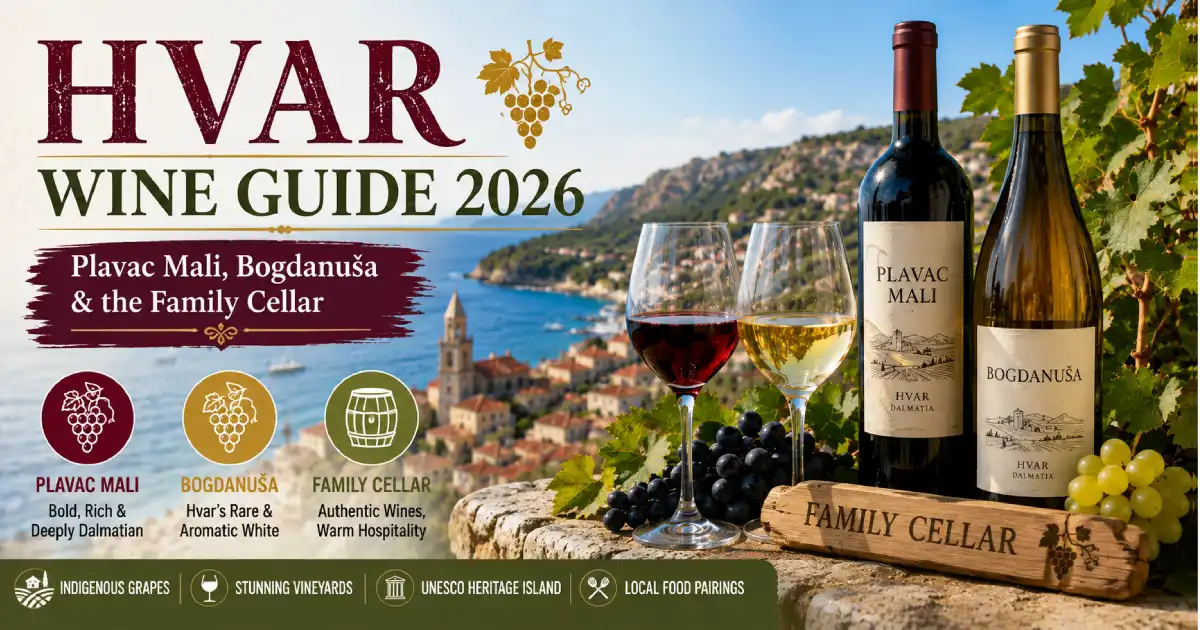
Hvar grows wine on ground nobody sensible would choose. The south side of the island drops off the ridge toward the Adriatic at an angle that looks like a surveying error — and the vines are on it, sitting on terraces cut into the slope and propped up by dry-stone walls that need rebuilding every few winters. Seen from a boat on the crossing between Sveta Nedjelja and Ivan Dolac, they appear as thin green bands stitched across a near-vertical wall of pale limestone, with no road worth the name reaching most of them.
That is not a picturesque inconvenience. It is the entire story of Hvar wine — why it tastes the way it does, why it costs what it does, and why a visit to one of the island’s family cellars feels nothing like any winery experience you have had before. This guide covers the key grape varieties, the best cellars to visit, what to buy and take home, how tasting actually works on Hvar, and the local wine culture that most visitors walk straight past.
| Detail | Information |
|---|---|
| Island | Hvar, Dalmatia, Croatia |
| Primary Red Grape | Plavac Mali |
| Primary White Grape | Bogdanuša |
| Other Indigenous Varieties | Prč, Darnekuša |
| Key Red Wine Zones | Sveta Nedjelja, Ivan Dolac, Zavala (south slope) |
| Key White Wine Zones | Jelsa, Vrbanj, Svirče (inland, flatter terrain) |
| Harvest Method | Hand-picked — no machinery possible on terraced slopes |
| Cellar Type | Mostly small family operations; no formal tasting rooms |
| Booking Method | Phone call the day before — no online slot system |
| Payment | Cash recommended — card machines unreliable at small cellars |
| Plavac Mali Relation | Descendant of the same family as Zinfandel |
| Local Wine Culture | Bevanda (red + water) and gemišt (white + sparkling water) |
Plavac Mali is the defining red of Hvar and of the wider Dalmatian coast — a thick-skinned, late-ripening grape that belongs to the same genetic family as Zinfandel and Primitivo. On Hvar’s south-facing terraces, it receives something most vineyards cannot offer: sunlight twice over, once directly from the sky and again reflected off the sea below. The result is a wine that runs dark in colour, high in alcohol, and firmly tannic when young — structured enough to age, dense enough to demand food.
The serious bottles come from the steepest sites — Sveta Nedjelja, Ivan Dolac, and Zavala — where the gradient makes every stage of viticulture a physical undertaking. These are not wines that are expensive because of marketing. They are expensive because of geometry. A single steep hectare on those terraces can absorb a full working week of hand labour at harvest alone, with crates carried up and down the slope — sometimes to a waiting boat rather than a road — by people, not machines.
| Characteristic | Detail |
|---|---|
| Colour | Deep ruby to near-black; high pigmentation from sun exposure |
| Alcohol Level | Typically 14–16% ABV from south-slope sites |
| Tannin | Firm and structured when young; softens significantly with age |
| Flavour Profile | Dark cherry, dried fig, plum, tobacco, Mediterranean herbs |
| Acidity | Moderate — lower than Pinot Noir; higher than many New World reds |
| Best Paired With | Lamb, game, aged cheese, grilled meats, rich fish stews |
| Drinking Window | Good young with decanting; best 3–8 years from vintage |
| Price Range (cellar door) | 100–250 HRK (€13–€33) for quality south-slope bottles |
| Price Range (harbourfront shop) | 20–40% premium over cellar-door pricing |
Bogdanuša is the Hvar white that most visitors never order and most wine lists never explain properly. It is an indigenous grape grown primarily on the flatter inland ground around Jelsa, Vrbanj, and Svirče — terrain that is less dramatic than the south slope but better suited to producing the fresher, more delicate style that Bogdanuša delivers best.
It is not a blockbuster. It does not have the weight or the aromatic power that wine writing tends to reach for. What it has is something more precise: dry, clean, faintly saline from the proximity of the sea, and built with an almost structural logic for grilled fish and a hot afternoon on a shaded terrace. If a wine list pushes you toward Pošip from the nearby island of Korčula instead — and many will, because Pošip is better known and easier to sell — order the Bogdanuša. The Pošip is the safer and considerably duller choice.
If you want to go further into Hvar’s indigenous white varieties, Prč and Darnekuša also survive here in small quantities, maintained almost exclusively by growers who were too stubborn to replant with more commercially viable alternatives. Neither is easy to find. Both are worth the effort if you encounter them.
| Factor | Bogdanuša (Hvar) | Pošip (Korčula) |
|---|---|---|
| Style | Light, dry, faintly saline | Fuller, rounder, more aromatic |
| Availability on Hvar | Limited — ask specifically | Widely available on most lists |
| Food Pairing | Grilled fish, shellfish, light seafood | Richer fish dishes, white meat, seafood pasta |
| Tourist Familiarity | Low — often overlooked | High — the default Croatian white for visitors |
| Price (approx.) | Comparable | Comparable |
| Reason to Choose It | Indigenous, site-specific, honest | Easier to find; familiar style |
| Reason to Skip It | Harder to find; lighter style divides opinion | Less distinctive; does not reflect Hvar specifically |
Every vine on Hvar’s south-facing terraces is picked by hand. There is no alternative. No harvesting machine climbs a terrace built on a gradient that most people would hesitate to walk down unloaded. The narrow stone-walled plots cannot accommodate machinery of any practical size, and the approach roads — where they exist at all — are tracks rather than routes.
At harvest, crates of fruit are carried by hand — up or down the slope depending on where the closest access point is, sometimes passed down to a boat anchored below rather than up to a road above. A single steep hectare can absorb a working week of labour. Wine writing has a tendency to frame this as romantic heritage. It is really just obedience to a hillside that has never offered any other option.
| Factor | Flat Vineyard (Mechanical Harvest) | Hvar South Terrace (Hand Harvest) |
|---|---|---|
| Harvest method | Machine — 1 day per hectare | Hand — 5–7 days per hectare |
| Labour required | Minimal (machine operator + 2–3 staff) | 8–15 people for peak harvest days |
| Access | Road vehicle to vineyard edge | On foot; sometimes by boat |
| Crate transport | Tractor or vehicle | Human carry — up or down slope |
| Cost per hectare (harvest only) | Low | Very high — labour is dominant cost |
| Terrace maintenance | Not applicable | Dry-stone wall rebuilding every few winters |
| Replanting feasibility | Straightforward | Difficult and expensive; slope limits options |
Cellars on Hvar open and close, change hands between generations, and merge or split over time. Many of the smaller operations barely advertise in any formal sense, and a producer that received good coverage three years ago may have scaled back, changed ownership, or stopped doing visits entirely. A current and maintained producer list — the kind kept updated at resources like Hvar.com — saves a significant amount of time driving up the wrong track in the wrong direction.
Once you have names, the booking process is straightforward: call. Almost everything on Hvar runs on a phone call the day before. Online booking systems do not exist at most family cellars. Email responses are not guaranteed. The phone works, and the person who answers it is almost always the person who made the wine.
| Step | What to Do | What to Avoid |
|---|---|---|
| Finding producers | Use updated local directories; ask accommodation staff | Relying on 3-year-old travel blog recommendations |
| Booking | Call the day before — phone only at most cellars | Turning up unannounced; emailing and assuming a reply |
| Timing | Mid-morning or early afternoon | Arriving in the evening expecting a tasting |
| Group size | 2–6 people is ideal | Large groups without prior agreement |
| Number of cellars per day | One, possibly two | Three or more — you will not leave the first one in time |
| Payment | Bring cash; cards are unreliable at small operations | Assuming a card machine will work |
| Duration | Plan 2–3 hours minimum | Treating it as a 45-minute stop |
| Language | A few words of Croatian go a long way | Assuming English throughout |
Forget the visitor centre model entirely. Hvar is not Napa, and it is not the Barossa, and the cellars here have no interest in pretending otherwise. Most operations are family properties attached to a house — no dedicated tasting room, no scheduled hourly slots, no laminated tasting notes, and no card reader you can rely on to work.
You call ahead. You turn up at the agreed time. Somebody’s father or grandmother pours from bottles with handwritten labels or a marker line indicating the vintage. The dog makes an appearance. There is often food that nobody mentioned in advance — bread, cheese, cured meat, something pickled — and declining it is more awkward than accepting it. It is polite to buy at least one bottle. It is rude to arrive at nine in the evening expecting a structured comparative tasting and a printed price list.
That informality is not a limitation. It is the product. The conversation, the context, the specific gravity of sitting in someone’s working cellar while they explain why they kept this particular barrel back — that is worth more than any formal tasting format. Come prepared for it, not disappointed by the absence of what you expected instead.
The purchase decisions are simpler than the visit logistics. Buy from the cellar rather than the harbourfront shop — prices at the dock are consistently 20 to 40 percent higher and the selection reflects what moves quickly rather than what is actually good. Ask the grower what they keep for themselves rather than what they sell to restaurants. That question changes the conversation reliably, every time.
| Wine | Buy If | Why | Travel Consideration |
|---|---|---|---|
| Plavac Mali (south slope) | You have hold luggage | Ages well; travels without issue; worth opening in 2–4 years | Heavy bottles — check weight allowance |
| Bogdanuša | You will open it within weeks | Freshness is the entire point; does not improve with long ageing | Fine in cabin bag if under liquid limits for EU domestic |
| Prč or Darnekuša | You find them | Rare; genuinely indigenous; will not be available at home | Same as Bogdanuša — drink soon |
| Prošek | You want a dessert wine | Rich, sweet, traditional; excellent with aged cheese | Not prosecco — unrelated and the confusion is not appreciated |
| Olive oil | Always | Hvar olive oil is outstanding and frequently overlooked by wine-focused visitors | Wrap carefully; check container rules |
Most wine drunk on Hvar never sees a label. It arrives at the table in a glass jug poured from a cousin’s barrel, and it is frequently served diluted — red wine mixed with water in a ratio of roughly two-to-one to make bevanda, or white wine with sparkling water to make gemišt. Visitors who encounter this for the first time often treat it as a form of vandalism. Locals treat it as lunch.
The logic becomes obvious immediately in the right context. Try a bevanda in Vrboska at two in the afternoon in July, sitting outside with the heat off the stone, with half a working day and a hill to navigate still ahead of you. The dilution is not about economy or about disguising bad wine. It is about proportion. It is a drink designed for the middle of a Mediterranean day, not the end of a European one.
| Term | What It Is | When You’ll Encounter It |
|---|---|---|
| Bevanda | Red wine mixed with still water (approx. 2:1 wine to water) | Lunch at local konobas; anywhere outside tourist-facing restaurants |
| Gemišt | White wine mixed with sparkling water | Same settings as bevanda |
| Prošek | Traditional sweet dessert wine from dried grapes | Offered after meals; sold at cellar doors |
| Vino od kuće | House wine — from the owner’s own production | Jug service at traditional konobas |
| Plavac | Shorthand for Plavac Mali on Hvar and across Dalmatia | Wine lists; cellar conversations |
| Konoba | Traditional Croatian tavern or family restaurant | Where most authentic Hvar eating and drinking happens |
Q: What is the best wine to try on Hvar? Start with Plavac Mali from the south-slope sites — Sveta Nedjelja, Ivan Dolac, or Zavala — for the wine that most directly reflects what makes Hvar viticulture distinctive. For white, order Bogdanuša specifically rather than defaulting to Pošip. If the restaurant or cellar has Prč or Darnekuša available, try them — both are genuinely rare indigenous varieties that you are unlikely to find outside the island.
Q: How do I book a wine tasting at a Hvar cellar? Call the day before. Online booking does not exist at most family cellars, and email responses are inconsistent. Phone is the only reliable method. Ask a local accommodation provider or an updated regional directory for current producer names and contact numbers — the cellar landscape changes regularly, and information more than two years old may be inaccurate.
Q: Why is Plavac Mali wine from Hvar so expensive? The price reflects the cost of production on steep, terraced slopes that cannot be harvested by any mechanical means. Every grape is picked by hand, every crate is carried by people up or down the hillside, and a single hectare of the steepest south-facing vineyards can take a full working week to harvest. Dry-stone terrace walls require regular rebuilding. There are no economies of scale and no shortcuts. The price is what it costs to produce the wine — no more, no less.
Q: What is Bogdanuša and why should I order it? Bogdanuša is an indigenous white grape variety grown primarily on Hvar’s flatter inland terrain around Jelsa, Vrbanj, and Svirče. The wine it produces is dry, clean, faintly saline, and built for seafood and warm-weather drinking. It is rarely found outside Hvar, which makes it a genuine local experience rather than a wine available at home. Most wine lists on the island push visitors toward Pošip from Korčula — the safer and less distinctive choice. Bogdanuša is what Hvar actually tastes like.
Q: What is bevanda and should I try it? Bevanda is red wine mixed with still water, typically in a ratio of roughly two parts wine to one part water. Gemišt is the white equivalent, made with sparkling water. Both are genuine local drinking customs rather than tourist compromises. The dilution is practical — it allows moderate, sustained drinking through a long, hot afternoon without the effects of full-strength wine. Try it in a traditional konoba at lunchtime rather than at a tourist-facing restaurant, and the logic will be immediately clear.
Q: How many cellars should I visit in one day on Hvar? One, and possibly two if the first ends early and the second is close. Hvar cellar visits are not quick structured tastings — they are extended conversations with the people who made the wine, often accompanied by food, and leaving within an hour would be both rushed and impolite. Scheduling three cellars in a single day almost never works. The first visit will run long, the logistics between locations are more complicated than they appear on a map, and the experience of each visit is better when it is not compressed by a following appointment.
Q: Should I buy wine at the cellar or at a shop in Hvar Town? Always buy at the cellar when possible. Harbourfront and town-centre shops charge 20 to 40 percent more than cellar-door prices and stock what sells quickly rather than what is best. At the cellar, ask what the grower keeps for their own drinking rather than what they sell to restaurants — this question consistently surfaces the best bottles and often opens a different and more honest conversation about the wine.
Q: What is the difference between prošek and prosecco? They are entirely unrelated. Prošek is a traditional Croatian dessert wine made from partially dried grapes — rich, sweet, amber-coloured, and served in small amounts after a meal or with aged cheese. Prosecco is an Italian sparkling wine from the Veneto region. The phonetic similarity causes frequent confusion. On Hvar, conflating the two is not appreciated by anyone who takes the local wine culture seriously.
Q: What food pairs best with Hvar wines? Plavac Mali from the south slope pairs best with lamb, game, grilled meats, rich fish stews, and aged hard cheese. The wine’s firm tannin and high alcohol need food with matching weight. Bogdanuša pairs with grilled fish, shellfish, light seafood dishes, and anything from the konoba grill that arrived from the sea the same morning. Prošek works well with dessert, dried fruit, walnuts, and aged pecorino-style cheeses.
Q: Is it worth visiting Hvar specifically for the wine? Yes — with the caveat that the experience requires more planning than simply arriving and pointing at a label. The wines from the steepest south-facing terraces around Ivan Dolac and Sveta Nedjelja are genuinely distinctive and not reproducible elsewhere. The cellar visit experience is unlike any formal wine tourism format and delivers something that takes hours and a specific kind of unhurried attention to access. For a traveller with genuine interest in wine and a few days on the island, it is one of the most rewarding wine experiences in the Mediterranean.
Q: When is the best time to visit Hvar for wine tourism? Late September through October is the most rewarding period. Harvest typically falls in September, making cellar visits immediately post-harvest particularly interesting — growers are present, the winery is active, and conversation about the most recent vintage is fresh. The summer peak season (July–August) makes cellar visits harder to arrange as some growers reduce availability, and the heat affects both travel comfort and the experience of tasting. Spring (April–May) is the quietest and most accessible period outside harvest.
About Travel Tourister Travel Tourister’s editorial team researched Hvar’s wine culture using on-ground reporting, producer conversations, and current regional tourism data — so you arrive with the right expectations and leave with the right bottles.
Posted By: Vinay
As a lead contributor for Travel Tourister, Vinay is dedicated to serving our Tier 1 audience (US, UK, Canada, Australia). His mission is to deliver precise, fact-checked news and actionable, data-driven articles that empower readers to make informed decisions, minimise travel risks, and maximise their adventure without compromising safety or budget.

As an upcoming travel agent I got much support from travel tourister. We are getting very good leads from travel tourister and they mend our website which is also very commendable.... Excellent work Hope to do more business forward.... Thanks and regards CEO,Andaman Unlocked
Rating:
10/20/2018
As an upcoming travel agent I got much support from travel tourister. We are getting very good leads from travel tourister and they mend our website which is also very commendable.... Excellent work Hope to do more business forward.... Thanks and regards CEO,Andaman Unlocked
Rating:
10/20/2018
2nd Floor, 39, Above Kirti Club, DLF Industrial Area, Kirti Nagar, New Delhi, Delhi 110015



Travel Tourister is a leading Travel portal where we introduce travellers to trusted travel agents to make their journey hasselfree, memorable And happy. Travel Tourister is a platform where travellers get Tour packages ,Hotel packages deals through trusted travel companies And hoteliers who are working with us across the world. We always try to find new and more travel agents and hoteliers from every nook and corners across the world so that you could compare the deals with different travel agents and hoteliers and book your tour or hotel with the one you have chosen according to your taste and budget.
Copyright © Travel Tourister, India. All Rights Reserved



 Call
Call Enquiry