Published on : 18 Sep 2026
A single afternoon of severe weather in the Midwest was enough to ripple across nearly every corner of the US air travel network yesterday.
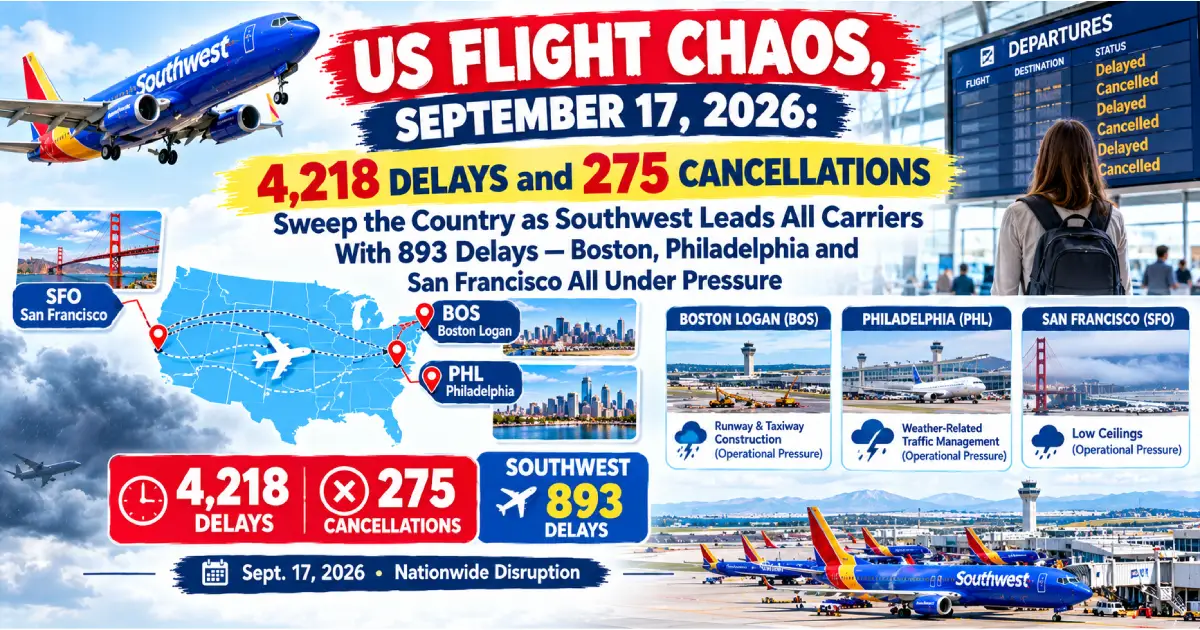
Flight tracking data logged via FlightAware at 1:41 PM ET yesterday, September 17, 2026, confirmed 4,218 delays and 275 cancellations across flights within, into, and out of the United States. Southwest Airlines absorbed the heaviest carrier-level impact of any airline, recording 893 delayed flights, followed by American Airlines with 524 and SkyWest with 332. Republic Airways and Envoy Air also reported meaningful disruption across their networks.
Beyond the Midwest’s severe weather (covered in detail in this site’s dedicated Chicago O’Hare report), FlightAware’s tracking flagged Boston Logan, San Francisco, and Philadelphia as airports carrying elevated disruption risk yesterday — Boston due to its ongoing runway construction project, and San Francisco and Philadelphia tied to their own regional weather and traffic-management conditions.
Published: September 18, 2026 — Thursday (Covering September 17 Data) National total: 4,218 delays + 275 cancellations Worst airline: Southwest Airlines — 893 delays Also heavily affected: American Airlines (524 delays) · SkyWest (332 delays) · Republic Airways · Envoy Air Airports flagged nationwide: Chicago O’Hare (see our dedicated report) · Chicago Midway · Boston Logan · San Francisco · Philadelphia Boston’s ongoing factor: Runway 9/27 EMAS closure, continuing through mid-November Data source: FlightAware, logged September 17, 2026, 1:41 PM ET DOT cash refund rule: ✅ Full refund to original payment method for any airline-cancelled flight — no vouchers required
Yesterday’s national total illustrates a pattern this site has tracked repeatedly throughout 2026: severe weather concentrated in a single region doesn’t stay contained to that region’s statistics. When a major connecting hub like Chicago O’Hare absorbs a large-scale disruption, the ripple effect touches every airline’s nationwide schedule simultaneously, since aircraft, crews, and passengers scheduled to connect through that hub are immediately affected regardless of their own local weather conditions. Southwest’s nationwide total of 893 delays, for instance, reflects far more than just its Chicago-area operations — it’s the cumulative effect of a disrupted network trying to recover across dozens of connected routes simultaneously.
Southwest’s position atop yesterday’s national delay count is worth reading alongside the broader airline reliability picture this site has tracked throughout the year. Federal data compiled earlier this year showed Southwest generally posting one of the lowest delay rates among major US carriers, a pattern industry analysts attribute to its point-to-point network structure and single-aircraft-type fleet, which allows spare 737s and crews to cover disrupted routes more flexibly than hub-and-spoke carriers can. Yesterday’s result is a reminder that even a generally reliable network-wide performer can post an outsized single-day number when a major disruption event happens to land squarely on one of its busiest regional bases. American Airlines’ 524 delays and SkyWest’s 332 both reflect their own substantial Midwest and connecting-hub exposure, while Republic Airways and Envoy Air — both regional carriers operating on behalf of larger network airlines — absorbed disruption tied to the same underlying weather system working through their own smaller aircraft and shorter-haul route networks.
While Chicago dominated yesterday’s disruption, three other major airports carried their own distinct risk factors. Boston Logan continues operating under its planned runway closure, now well into its second week of this site’s tracking, with Massport confirming afternoon and evening delays will persist through mid-November as part of a project installing an Engineered Materials Arresting System at the end of Runway 27. San Francisco and Philadelphia both saw disruption tied to their own regional conditions, compounding the difficulty of a day already strained by the Midwest’s weather system — a reminder that on any given disruption day, multiple independent causes are often operating simultaneously across different parts of the network rather than a single unified event.
Days like yesterday typically produce a recovery tail that extends beyond the original disruption. Aircraft and crews displaced by a major single-day event — particularly one concentrated at a hub as central to national connectivity as O’Hare — often take a full additional day or more to fully reposition into their scheduled rotations. Travelers connecting through any of yesterday’s affected airports today, or even tomorrow, should factor in a meaningfully elevated risk of inherited delays even if today’s weather conditions themselves are clear.
Regardless of cause, any of yesterday’s cancellations entitled affected passengers to a full refund to their original payment method if they declined rebooking. Airlines cannot substitute a travel credit without your explicit consent.
Weather-driven delays, including yesterday’s national pattern, are generally classified as outside airline control — making the standard DOT-tracked compensation commitment (up to $775 for controllable delays of 3+ hours) unlikely to apply in most cases. Boston’s ongoing construction-related delays fall into a similar category, generally treated as outside airline control in the same way infrastructure work and weather are. Ask your airline for the specific stated cause in writing if you’re unsure how your particular delay was classified — this matters even more as DOT’s newly finalized delay-reporting rule (covered separately on this site) begins reshaping how these causal classifications are recorded ahead of its October 19 effective date.
Given how many carriers were affected simultaneously yesterday, ask about rebooking on partner or competing airlines if your own carrier’s next available flight involves an unreasonable wait. With inventory across the network unusually tight following a disruption of this scale, being flexible about which airline gets you home can meaningfully shorten your wait.
For significant delays tied to yesterday’s disruption, particularly any resulting in an overnight wait, airlines generally provide meals and, where necessary, hotel accommodation as a customer service commitment, even though this isn’t uniformly mandated the way EU261 duty-of-care rules are in Europe.
Get the specific stated cause in writing → file directly with the airline first → escalate to airconsumer.dot.gov if unresolved. For card purchases, consider a chargeback if a refund isn’t processed within 7 business days.
✅ Check your specific flight status before heading to the airport, particularly if connecting through any of yesterday’s affected hubs ✅ Expect residual disruption today even without new storms — aircraft and crews displaced yesterday often take a full extra day to fully reposition ✅ Build extra buffer time for Boston Logan specifically, given its construction continuing through mid-November ✅ If your flight was cancelled yesterday, contact your airline directly rather than assuming automatic rebooking has occurred ✅ Consider your carrier choice for any last-minute rebooking — Southwest’s point-to-point structure may actually work in your favor for finding an alternative seat despite yesterday’s high delay count, given the airline’s typically strong spare-capacity flexibility
| Airline | Action | US Phone |
|---|---|---|
| Southwest Airlines | southwest.com → Travel Advisories | 1-800-435-9792 |
| American Airlines | aa.com → Travel Alerts | 1-800-433-7300 |
| United Airlines | united.com → Travel Alerts | 1-800-864-8331 |
DOT complaint portal: airconsumer.dot.gov FAA live status: fly.faa.gov
Related Articles:
Posted By : Vinay
This article is provided for general informational purposes only and is based on information available at the time of publication. Travel advisories, airline schedules, airport operations, visa requirements, government regulations, and other travel-related information are subject to change without prior notice. While Travel Tourister makes reasonable efforts to verify information using official announcements, government publications, airline and airport communications, and other reliable sources, we cannot guarantee that all information remains complete, accurate, or up to date at all times. Readers should independently verify any information that may affect their travel plans with the relevant airline, airport authority, government agency, embassy, or other official source before making travel, financial, or other decisions. Travel Tourister shall not be liable for any direct or indirect loss, inconvenience, or damages arising from the use of or reliance on the information contained in this article. Nothing in this publication constitutes legal, immigration, financial, or professional travel advice. If you believe any information in this article is inaccurate or outdated, please contact our editorial team. We review all credible correction requests promptly and update our content whenever appropriate.
Lastest News
2nd Floor, 39, Above Kirti Club, DLF Industrial Area, Kirti Nagar, New Delhi, Delhi 110015



Travel Tourister is a leading Travel portal where we introduce travellers to trusted travel agents to make their journey hasselfree, memorable And happy. Travel Tourister is a platform where travellers get Tour packages ,Hotel packages deals through trusted travel companies And hoteliers who are working with us across the world. We always try to find new and more travel agents and hoteliers from every nook and corners across the world so that you could compare the deals with different travel agents and hoteliers and book your tour or hotel with the one you have chosen according to your taste and budget.
Copyright © Travel Tourister, India. All Rights Reserved

 Call
Call Enquiry