Published on : 26 Sep 2026
By Travel Tourister | Updated Sep 2026
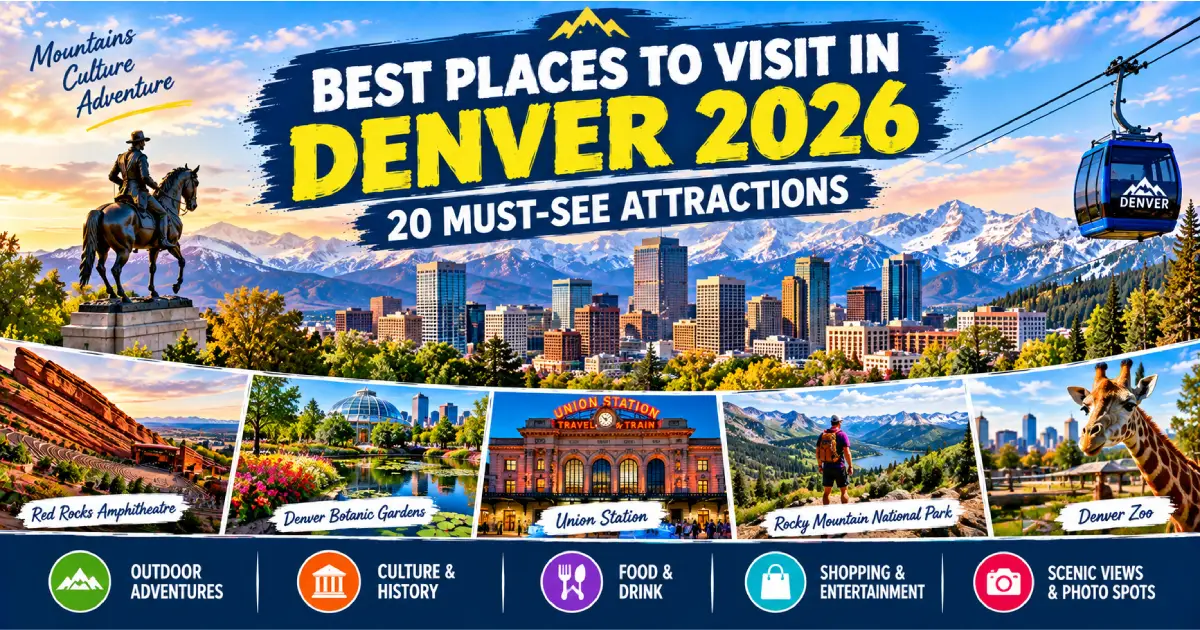
Denver is the American city where the places themselves most specifically reflect the tension between what the city was and what it is becoming — the Red Rocks Amphitheatre (the 600-million-year-old geological formation that the city’s founders had the specific wisdom to preserve rather than quarry), the Union Station (the 1914 Beaux-Arts transportation hub that the city’s current generation had the specific wisdom to restore rather than demolish), and the RiNo Art District (the former meatpacking warehouse district that the creative community had the specific wisdom to colonize and the city had the specific wisdom to support rather than gentrify into banality) all representing the same fundamental Denver quality: the recognition that the most specifically extraordinary places are the ones that the people who build cities normally destroy. The best places to visit in Denver in 2026 reflect this quality — the geological, the historic, and the creative all preserved and activated in a city that has become, almost by accident, one of the most interesting urban destinations in the American interior.
Understanding the best Denver places requires understanding the city’s specific geography — the 5,280-foot elevation that creates the specific clarity of the air (the high-altitude transparency that makes the Rocky Mountain peaks visible at 100 miles on clear days and makes the sunsets burn with the specific orange-and-purple intensity that the thin air amplifies), the Denver metro’s position at the precise meeting point of the Great Plains (the flat, grass-covered interior stretching east to Kansas and Nebraska) and the Rocky Mountain Front Range (the 14,000-foot peaks rising abruptly from the plains with none of the gradual foothills that the Appalachians provide further east, the mountains appearing as a sudden wall rather than a graduated rise), and the specific 300-days-of-annual-sunshine that makes the outdoor places (the Washington Park running path, the Red Rocks geological formations, the Cherry Creek Trail) the most consistently used single urban outdoor spaces in America. This guide covers the 20 best places to visit in Denver with the depth that makes each genuinely rewarding.
For related guides, see our Things to Do in Denver 2026, Denver Travel Guide 2026, Best Restaurants in Denver 2026, and Day Trips from Denver 2026.
| Place | Type | Cost | Best For | Duration |
|---|---|---|---|---|
| Red Rocks Amphitheatre | Nature/Music | Free (daytime); $35–$150 (concert) | Most iconic Denver experience | 2–3 hrs |
| Rocky Mountain National Park | National Park | $35/vehicle | Wildlife, hiking, Trail Ridge Road | Full day |
| Union Station | Historic Hub | Free | Architecture, food, atmosphere | 1.5–2 hrs |
| RiNo Art District | Creative Neighborhood | Free | Murals, breweries, galleries | 1.5–2 hrs |
| Denver Art Museum | Museum | $20 | American Indian art, architecture | 2–3 hrs |
| Larimer Square | Historic Block | Free | Victorian architecture, dining | 1.5 hrs |
| Colorado State Capitol | Historic Building | Free | Mile High marker, gold dome | 45 min |
| Denver Botanic Gardens | Garden | $17 | Seasonal blooms, special exhibits | 1.5–2 hrs |
| Meow Wolf Convergence Station | Immersive Art | $45–$55 | Art experience, sci-fi narrative | 2–3 hrs |
| Washington Park | Urban Park | Free | Running, cycling, local culture | 1–2 hrs |
| City Park | Urban Park | Free | Mountain view, Denver Zoo, DMNS | 2–3 hrs |
| Confluence Park | Waterfront Park | Free | South Platte River, kayaking | 1 hr |
| Cherry Creek Trail | Trail | Free | Cycling, running, 40-mile route | 1–3 hrs |
| Clyfford Still Museum | Museum | $14 | Unique art collection | 1–1.5 hrs |
| History Colorado Center | Museum | $16 | Colorado history, interactive | 1.5–2 hrs |
| Five Points Jazz District | Historic Neighborhood | Free | Jazz history, community culture | 1–1.5 hrs |
| Capitol Hill and Molly Brown House | Historic Neighborhood | Free ($14 museum) | Victorian architecture, history | 1.5–2 hrs |
| Coors Field | Stadium | $20–$80 (game) | Baseball, LoDo views, architecture | 3 hrs |
| Stanley Marketplace | Food Hall | Free | Local food, craft market | 1.5 hrs |
| Buffalo Bill Museum and Grave | History | $8 | Colorado frontier history, views | 1.5 hrs |
Cost: Free (daytime park); $35–$150+ (concerts) | Location: 18300 W. Alameda Pkwy, Morrison (15 miles west of Denver) | Hours: Park open daily 5 AM–11 PM | Access: Car (25 min from Denver); RTD bus on concert nights; rideshare ($35–$45 from downtown) | Season: Year-round (concerts May–October)
Red Rocks Park and Amphitheatre (the naturally occurring pair of 300-foot sandstone monoliths flanking a natural bowl that the City of Denver converted into the world’s most beautiful outdoor concert venue in 1941 — the 9,525-seat amphitheatre at 6,450 feet elevation, the Ship Rock and Creation Rock formations creating a natural acoustic environment of extraordinary quality while framing a view that includes the Denver skyline to the east on clear days) is the single most specifically iconic Denver place and the one most specifically irreplaceable: no other American city has a concert venue embedded in a 600-million-year-old geological formation, no other American city has free access to formations of this scale and quality within 30 minutes of downtown, and no other American music venue has the specific acoustic-meets-visual quality that Red Rocks maintains simultaneously.
The geological story: The Red Rocks formations (the Lyons sandstone, deposited 300 million years ago in a shallow sea that covered the Colorado region, subsequently tilted by the tectonic forces that created the Rocky Mountains 65 million years ago, and eroded into their current vertical monolith form over the past 40 million years) represent the most dramatic accessible geological formation in the Denver metropolitan area — the specific iron oxide content of the sandstone creating the rust-and-crimson color that gives the park its name, and the specific geological layering (visible in horizontal bands across the face of both Ship Rock and Creation Rock) documenting 300 million years of Colorado’s geological history in a single visible cross-section.
Red Rocks by time of day:
Sunrise (5–7 AM): The most dramatic single Red Rocks light condition — the rising sun illuminating the eastern face of the formations in the specific warm orange that the iron-oxide sandstone achieves at low sun angles, the Denver skyline visible to the east in the early morning clarity before the day’s atmospheric haze develops. The specific Red Rocks sunrise photography (the eastern sun on the formations, the amphitheatre bowl in shadow, and the distant skyline creating the most tonal-contrast single Red Rocks composition) is most achievable in the 6–7 AM window.
Morning (7–10 AM): The hikers, the yoga practitioners (the Sunday morning Red Rocks Yoga sessions — check redrocksonline.com for the 2026 schedule — the outdoor yoga in the amphitheatre at this hour representing the most specifically meditative Red Rocks experience), and the trail runners (the Red Rocks Trading Post Trail, the Fountain Valley Trail, and the various park trails serving the most consistently active morning outdoor community in the Denver area) defining the park’s most genuinely recreational single character.
Concert evening: The specific transformation — the afternoon preparation (the stage setup, the sound checks, and the crew working in the empty amphitheatre visible for the afternoon visitors), the line formation (the general admission crowd arriving hours before showtime for the specific hillside position that the GA section’s unreserved standing area rewards), and the specific concert-in-the-rock-formations experience (the band performing with the monoliths behind them, the Denver city lights visible in the distance, and the specific Red Rocks acoustic character creating the most specifically immersive single American concert environment).
Insider tips: The specific Red Rocks altitude caution (the 6,450-foot elevation being meaningfully more demanding than Denver’s city altitude — the two beers that feel comfortable at Denver’s 5,280 feet feel like three at Red Rocks, the altitude amplifying alcohol’s effect and the dehydration rate simultaneously) is the single most consistently under-prepared-for single concert variable at Red Rocks. Arriving hydrated, eating before the show, and dressing in layers (the temperature drop from afternoon to late-evening is 20–30°F) are the most specifically Red Rocks-concert-success single preparation factors.
Cost: $35/vehicle (7-day pass) | Distance: 72 miles northwest | Drive time: 1.5 hours | Timed entry: Required May–October (recreation.gov) | Season: Year-round (full access June–October)
(See full description in Day Trips from Denver 2026 and Things to Do in Denver 2026)
Rocky Mountain National Park is the single most specifically extraordinary place accessible as a day trip from Denver — the 77 mountains exceeding 12,000 feet, the Trail Ridge Road (the highest continuous paved road in the US, reaching 12,183 feet), and the September–October elk rut (the most specifically wildlife-dramatic single Colorado annual event) together creating the most complete mountain wilderness encounter available within a 90-minute drive of any major American city.
The Trail Ridge Road perspective: The specific Trail Ridge Road experience that most completely reveals why Colorado is called the Mountain State — the 30-minute drive from Deer Ridge Junction to the Alpine Visitor Center at 11,796 feet traverses 6 distinct ecosystem zones (the montane ponderosa pine forest, the subalpine spruce-fir, the krummholz [the wind-twisted tree zone at the extreme upper treeline], the alpine tundra, the fellfields [the rocky tundra above the continuous vegetation], and the summit zone) and provides the most comprehensive single Colorado ecological education available on a single paved road.
Cost: Free to enter | Location: 1701 Wynkoop St, LoDo | Hours: Open daily (6 AM–midnight for the Great Hall; Crawford Hotel 24 hours) | Duration: 1.5–2 hours | Character: The most successfully restored American train station
Denver Union Station (the 1914 Beaux-Arts transportation hub — the specific “Travel by Train” neon sign illuminating the Great Hall at night, the restored 65-foot ceilings with their original plasterwork detailing, and the specific Terminal Bar installation [the working cocktail bar in the center of the Great Hall whose visual presence [the bar floating in the vast historic space, the patrons visible from every angle of the Great Hall’s expanse] makes the Union Station Great Hall the most specifically lively single historic public interior in Denver]) is the most architecturally significant and most socially activated historic building in Colorado. The 2014 restoration (the Union Station Alliance’s $54 million transformation of the decade-shuttered station into a combined hotel, food hall, and transit hub) is the most celebrated single American historic building rehabilitation of the current generation — the specific balance of historic preservation (the Great Hall’s original Beaux-Arts detailing maintained in extraordinary completeness) with contemporary activation (the Terminal Bar, the Mercantile, the Snooze, and the various other tenants creating the most commercially vibrant historic train station in the US) representing the most specifically successful formula for historic building reuse.
The Union Station experience: The Great Hall entry (the specific experience of entering the high-vaulted space from the Wynkoop Street entrance — the scale visible immediately, the Terminal Bar in the center, and the various tenants along the ground-floor perimeter creating the most complete single impression of the restoration’s specific achievement), the Terminal Bar (the most specifically Union Station-identity single experience — the cocktails, the crowd [the most demographically mixed single Denver bar scene, the business travelers, the transit users, the LoDo residents, and the tourists sharing the Great Hall space in the most naturally integrated single Denver social environment], and the specific location [the center of the Great Hall, the bar surrounded by the historic space rather than tucked in a corner] creating the most dramatically positioned single Denver bar), and the evening train-watching (the RTD light rail and commuter trains visible through the station’s glass windows from the Great Hall interior, the specific combination of the 1914 architecture and the contemporary transit operations creating the most specifically layered single Denver temporal experience).
Cost: Free to walk | Location: 1400 block of Larimer Street, LoDo | Best time: Evening (string lights, restaurant activity) | Duration: 1.5 hours | Character: Denver’s oldest commercial block
Larimer Square (the 1400 block of Larimer Street — the single oldest commercial block in Denver, saved from 1960s urban renewal demolition by developer Dana Crawford and subsequently listed on the National Register of Historic Places, the specific Victorian commercial facades [the 1870s–1880s brick commercial buildings with their ornamental ironwork, their cast-stone details, and their specific proportion and scale creating the most intact single Denver Victorian commercial streetscape] maintained through a preservation easement that prevents the specific facades from being altered) is the most specifically historic single Denver street block and the most consistently festive single Denver evening destination: the string-light canopy (the overhead lights strung between the buildings on both sides of the pedestrian-priority street, the specific warm amber illumination creating the most specifically romantic single Denver outdoor evening atmosphere), the restaurant concentration (the specific Larimer Square restaurants — Rioja, Tamayo, and the various other high-quality restaurants that the premium pedestrian commercial location attracts creating the most specifically complete single Denver restaurant block), and the Victorian architecture (the specific 1870s–1880s commercial building facades whose preservation provides the most concrete single connection to Denver’s founding-decade commercial character) together creating the most completely atmospheric single Denver outdoor evening space.
Cost: Free | Location: 200 E. Colfax Ave | Hours: Monday–Friday 7:30 AM–5 PM | Duration: 45 minutes | Highlight: The 13th step — exactly one mile above sea level; the gold dome
The Colorado State Capitol (the 1901 Neoclassical building whose specific gold dome — the dome covered in 200 ounces of 24-karat Colorado gold leaf, the specific historical symbolism [the Gold Rush that founded Denver, the Colorado gold that the state seal commemorates] made literal in the dome’s surface treatment — the Colorado rose onyx interior [the most complete single collection of a rare stone variety in the world, the marble quarry that provided it exhausted during the Capitol’s construction, making the building’s rose onyx wainscoting irreplaceable], and the specific “one mile above sea level” marker on the 13th step of the western entrance staircase [the surveyed exact location of 5,280 feet above sea level, the most specifically photographic single Denver location for the one-photo visit that every Denver first-timer specifically takes]) provides the most uniquely Colorado-identity single building visit.
The interior architecture: The Capitol rotunda (the specific rose onyx wainscoting covering the lower 2/3 of the rotunda walls, the most extensive single rose onyx installation in the world — the quarry near Beulah, Colorado that provided the stone being exhausted during the Capitol’s construction, the existing installation being literally the only significant concentration of this specific stone variety remaining), the stained glass portraits (the 16 stained glass windows in the dome depicting Colorado governors and historical figures), and the specific dome interior (the gold leaf visible on the interior dome surface during the dome tour, the most dramatically gilded single Colorado interior space) together create the most comprehensively Colorado-identity single building interior.
Cost: $14 (adults) | Location: 1340 Pennsylvania St, Capitol Hill | Hours: Tuesday–Sunday 10 AM–4 PM | Duration: 1 hour | Significance: The “Unsinkable Molly Brown” — Titanic survivor and Colorado mining heiress
The Molly Brown House Museum (the 1889 Victorian mansion of Margaret “Molly” Brown — the Colorado mining heiress who survived the Titanic’s April 14, 1912 sinking [the specific Molly Brown Titanic story: she helped organize lifeboat loading, reportedly rowed through the night, and motivated the survivors in Lifeboat No. 6 with the specific determination that earned her the “Unsinkable Molly Brown” designation], the Denver community activist, and the most specifically Colorado-famous single Titanic survivor) provides the most dramatically narrative-specific single Denver historic house: the specific 1889 Queen Anne Victorian architecture (the turret, the decorative shingles, and the specific Capitol Hill neighborhood position among the Victorian mansions of Pennsylvania Street), the restoration to the 1910–1912 period (the most specifically pre-Titanic-era Brown family period, the specific décor and furnishings representing Molly Brown’s most socially ambitious single Denver period), and the specific Molly Brown narrative (the Irish immigrant mining family’s specific Colorado Gold Rush wealth story, the social climbing in the Denver Gilded Age establishment, and the Titanic survival creating the most specifically dramatic single personal narrative associated with any Colorado Victorian house).
Cost: $20 (adults); $10 (ages 6–18) | Location: 100 W. 14th Ave Pkwy, Golden Triangle | Hours: Tuesday–Sunday 10 AM–5 PM (Friday until 9 PM) | Duration: 2–3 hours | Architecture: Daniel Libeskind (2006 addition) + Gio Ponti (1971 original)
The Denver Art Museum (the two-building complex in the Golden Triangle neighborhood — the 1971 Gio Ponti building [the seven-story “castle” with its specific castellated window pattern referencing the mountain profile] alongside the 2006 Daniel Libeskind Frederic C. Hamilton Building [the most dramatically architecturally adventurous single Denver building, the faceted titanium-panel exterior whose specific angular geometry creates the most dynamically shadowed and most photographically complex single building facade in the Denver skyline]) houses the most comprehensively documented American Indian art collection of any US museum: the 18,000-object American Indian collection (the most extensively documented Native American material culture collection in the American West), the Western American art collection (the Frederic Remington bronzes, the Charles Russell paintings, and the specific Rocky Mountain landscape tradition), and the Architecture, Design, and Graphics collection (the most specifically surprising collection for first-time DAM visitors — the Bauhaus-heritage furniture and the mid-century graphic design history).
The Hamon Tower (free without admission): The glass-enclosed observation tower at the DAM’s northern end provides 360-degree Golden Triangle and mountain panorama views without requiring a museum ticket — the most specifically cost-effective single Denver elevated view accessible at any cultural institution.
Cost: $14 (adults) | Location: 1250 Bannock St, Golden Triangle (adjacent to the Denver Art Museum) | Hours: Tuesday–Sunday 10 AM–5 PM | Duration: 1–1.5 hours | Significance: The most concentrated single-artist museum collection in the world
The Clyfford Still Museum (the purpose-built museum housing the estate of Clyfford Still — the Abstract Expressionist painter whose specific condition [his estate to be kept intact and transferred to a single American museum committed to housing the collection permanently, the condition that the Denver Art Museum met in 2004] resulted in 94% of Still’s lifetime output [approximately 800 paintings, 2,000+ works on paper, and the artist’s complete archives] being housed in Denver in a museum built specifically for the collection) provides the most concentrated single-artist collection experience available at any American museum: the specific Clyfford Still canvases (the large-scale Abstract Expressionist works — the specific Still palette [the jagged vertical color field compositions, the specific orange, yellow, and black-against-white combinations that Still developed in the 1940s and 1950s and that most directly influenced the Abstract Expressionist movement’s subsequent development], and the specific Still philosophy [the refusal to sell individual works commercially, the insistence on the collection’s integrity as the artist’s complete statement rather than individual market commodities creating the most specifically anti-market single American museum collection concept]).
Cost: Free to explore | Location: River North neighborhood, between downtown and I-70 | Best time: Saturday afternoon | Duration: 1.5–2 hours | Character: The most specifically contemporary creative Denver neighborhood
The RiNo Art District (the River North neighborhood whose specific mural program — 50+ large-scale works covering the warehouse walls of the Larimer Street and Brighton Boulevard corridors, commissioned and spontaneous works by nationally-recognized street artists alongside local Denver talent, creating the most extensively muraled single Denver streetscape) is the most specifically creative current Denver place: the murals (the most immediately visual single RiNo character — the specific works range from the photorealistic to the abstract, the political to the whimsical, the Colorado-landscape-inspired to the globally-sourced, creating the most diverse single outdoor mural program in Colorado), the brewery cluster (Great Divide, Ratio Beerworks, Black Shirt Brewing, Breckenridge Brewery, and the various other RiNo taprooms within walking distance of each other), and the restaurant concentration (Safta, The Bindery, Cart-Driver, and the various other RiNo restaurants representing Denver’s most current food culture).
The RiNo mural walk: The most naturally structured single RiNo experience — beginning at the Brighton Boulevard and Larimer Street intersection (the specific corner with the most concentrated single-block mural density in the neighborhood), walking the Larimer Street mural corridor north to the Great Divide taproom, then doubling back on the parallel Blake Street to the Ratio Beerworks and Cart-Driver, the circuit covering the most specifically mural-rich single RiNo route in approximately 90 minutes at a leisurely pace.
Cost: $45–$55 (adults); $30–$40 (children) | Location: 1338 1st St (near Union Station) | Hours: Wednesday–Sunday (check meowwolf.com for current hours) | Duration: 2–3 hours | Book: Yes | Character: The most immersive indoor art experience in Denver
(See full description in Things to Do in Denver 2026)
The Meow Wolf Convergence Station is the most dramatically unconventional single Denver cultural institution — the 90,000-square-foot immersive art environment in a converted industrial building near Union Station, the five alien worlds connected by an interdimensional transit hub creating the most specifically science-fiction-narrative-integrated single American art experience. The discovery-based exploration (no guided route, no correct path, the visitor’s own curiosity determining the experience) provides the most specifically visitor-agency-centered single Denver art encounter.
Cost: Free | Location: East Virginia Ave at South Downing St, South Denver | Best time: Morning (running, cycling) and afternoon (social) | Duration: 1–2 hours | Character: Denver’s most beloved community park
Washington Park (the 165-acre South Denver park — the most specifically beloved single Denver public space by resident community consensus, the specific combination of the two lakes [Smith Lake and Grasmere Lake], the formal rose garden, the refectory building, and the 2.5-mile perimeter running/cycling path that the South Denver running and cycling communities have adopted as the most consistently used single urban workout route in Colorado) provides the most authentically local single Denver outdoor experience: the morning runners (the 6–8 AM window when the most dedicated South Denver running community is at its most concentrated on the perimeter path), the Sunday afternoon social culture (the families picnicking, the lawn games, and the specific community gathering that makes the Sunday Wash Park afternoon the most genuinely participatory single Denver public space experience), and the mountain view (the Front Range panorama visible from the park’s western edge on clear days, the 14,000-foot peaks creating the most specifically Denver-identity landscape backdrop for the park’s recreational activities).
Cost: Free (park); $22 (Denver Zoo); $22 (Denver Museum of Nature & Science) | Location: East 17th Ave and Colorado Blvd | Duration: 2–3 hours | Best time: Morning for wildlife viewing; any time for the mountain view
City Park (the 330-acre public park east of downtown — larger than the Golden Gate Park district of San Francisco, the park housing the Denver Zoo and adjacent to the Denver Museum of Nature & Science, and providing the most dramatically framed single Rocky Mountain panorama from any Denver city park) is the most completely programmed single Denver public park: the specific City Park pavilion (the historic 1896 pavilion on the park’s lake island — the most specifically romantic single Denver park structure, the pavilion accessible by paddleboat and providing the most lake-framed single Denver mountain view), the Denver Zoo (the 80-acre zoological park within City Park — the most comprehensively programmed single Denver family attraction after the Denver Museum of Nature & Science), and the mountain view (the specific panorama from the western portion of City Park — the entire Front Range visible on clear days, the distance from the park to the nearest visible summit [10 miles] creating the most dramatically close-range single mountain view available from any Denver city park).
Cost: Free | Location: 15th St and Little Raven St, LoDo | Best time: Summer afternoons | Duration: 1 hour | Character: The confluence of Cherry Creek and the South Platte River; Denver’s outdoor water hub
Confluence Park (the park at the junction of Cherry Creek and the South Platte River — the specific geographic point where Denver was founded in 1858 when gold prospectors established the first Denver settlement at the creek-river confluence, the most historically significant single outdoor location in Denver’s founding) provides the most specifically historically-layered single Denver outdoor space: the kayak chutes (the engineered whitewater features in the South Platte River channel, the most accessible single urban whitewater kayaking in the Denver metro), the Cherry Creek Trail connection (the 40-mile paved multi-use trail that begins at Confluence Park and extends southeast to the Cherry Creek Reservoir, the most complete single Denver car-free cycling corridor), and the summer social culture (the specific Confluence Park summer afternoon scene — the kayakers in the river, the cyclists on the trail, the office workers from the adjacent Union Station area eating lunch on the river’s grassy banks creating the most specifically active single Denver outdoor park community).
Cost: $20–$80 (Colorado Rockies game); free (exterior) | Location: 2001 Blake St, LoDo | Season: April–October (MLB season) | Duration: 3 hours | Significance: One of the finest MLB stadiums in America; the most beer-selection-extensive ballpark
Coors Field (the Colorado Rockies’ home stadium, opened 1995 — the most architecturally thoughtful of the 1990s “retro-classic” baseball stadium design wave, the specific brick exterior with its ornamental ironwork, the open concourse providing mountain views from the upper deck, and the specific LoDo neighborhood integration [the stadium’s exterior at street level contributing to the LoDo fabric rather than imposing a suburban-arena blank wall on the neighborhood] creating the most specifically urbanist-successful single 1990s baseball stadium).
The Coors Field beer selection: The most specifically celebrated single Colorado baseball stadium amenity — the Coors Field craft beer selection (the most extensively Colorado-craft-beer-sourced single American baseball stadium, the specific taprooms within the stadium serving Great Divide, Odell, New Belgium, and various other Colorado craft producers creating the most specifically Colorado-identity single stadium concessions experience), the Rooftop Bar (the specific Coors Field upper-level bar area, the most dramatically panoramic single stadium bar position — the LoDo skyline visible beyond the left field wall, the Rocky Mountain foothills visible beyond the right field wall creating the most specifically Denver-cityscape single baseball game view).
Cost: $16 (adults); $8 (children 6–12) | Location: 1200 Broadway, Golden Triangle | Hours: Daily 10 AM–5 PM | Duration: 1.5–2 hours | Character: The most comprehensively interactive Colorado history museum
History Colorado Center (the 2012-opened Colorado history museum — the most dramatically interactive single Colorado history institution, the specific “Destination Colorado” interactive exhibit [the virtual Colorado road trip through a 1950s road-trip car simulator — the most specifically engaging single History Colorado experience for children and the most specifically nostalgic for adults who have Colorado family history], the specific Colorado statehood story [the Denver founding in 1858, the Colorado Territory established in 1861, the statehood achieved in 1876 — the specific “Centennial State” designation reflecting the exact 100-year celebration of American independence at which Colorado’s statehood was granted], and the specific Native American cultural history [the Sand Creek Massacre memorial [the most difficult and most specifically necessary single History Colorado exhibit — the 1864 massacre of approximately 230 Cheyenne and Arapaho people at Sand Creek, the most specifically challenging single event in Colorado’s relationship between the white settler community and the Indigenous nations whose land Colorado’s settlement occupied]) provides the most specifically Colorado-identity educational institution in Denver.
Cost: Free to explore | Location: Welton Street corridor, Five Points | Duration: 1–1.5 hours | Character: America’s historically most significant Black jazz neighborhood outside of Harlem; the “Harlem of the West”
Five Points (the Denver neighborhood whose specific 1920s–1950s character — the most specifically African American cultural and commercial neighborhood in the American West, the specific jazz and entertainment culture [the Rossonian Hotel [the historic jazz hotel and club where Count Basie, Billie Holiday, Duke Ellington, Nat King Cole, Ella Fitzgerald, and virtually every significant Black American jazz musician of the 1930s–1960s performed when the era’s segregation prevented them from staying at Denver’s white-owned downtown hotels — the Rossonian’s specific role as the most specifically racially significant single Denver entertainment venue], the Blair-Caldwell African American Research Library [the Denver Public Library branch specifically dedicated to African American history and culture in Colorado and the American West], and the specific Five Points neighborhood history [the great migration community, the specific social and economic culture that the neighborhood maintained through the post-war period and the subsequent urban renewal that significantly altered the neighborhood’s physical character while the cultural memory remains]) provides the most specifically historically-layered single Denver neighborhood walk for visitors interested in African American history and jazz culture.
Cost: $8 (adults) | Location: Lookout Mountain, Golden (25 miles west of Denver, near Red Rocks) | Hours: Tuesday–Sunday 9 AM–5 PM | Duration: 1.5 hours | Access: Car required | Views: Denver panorama from the summit
The Buffalo Bill Museum and Grave (the museum and burial site of William Frederick “Buffalo Bill” Cody on the summit of Lookout Mountain — the most specifically Western-frontier-history single Denver area museum, the specific Buffalo Bill collection [the Colt revolvers, the Wild West Show memorabilia, the Sitting Bull artifacts, and the specific 19th-century American frontier-entertainment history documentation] and the burial site [the grave on the Lookout Mountain summit, the specific controversy [both Wyoming and Colorado claimed Buffalo Bill’s burial rights, the Cody, Wyoming city specifically claiming that Denver “stole” the body with alcohol-induced deathbed authorization — a claim that Denver’s Colorado officials have consistently denied] making the Buffalo Bill grave the most specifically contested single Colorado historic site]) provides the most specifically American frontier-mythology single Denver experience alongside the most panoramic single Denver city view available from any roadside overlook: the Lookout Mountain summit view (the entire Denver metropolitan area visible from the mountain’s eastern edge, the Front Range stretching north and south, and the specific topographical relationship between the Great Plains and the Rocky Mountain uplift most clearly visible from Lookout Mountain’s specific elevation and position).
Cost: $17 (adults); $13 (seniors/students) | Location: 1007 York St, Congress Park | Hours: Daily 9 AM–5 PM (summer evenings for concerts) | Duration: 1.5–2 hours | Season: Year-round; peak April–September | Special events: Summer Concert Series (Friday and Saturday evenings)
Denver Botanic Gardens (the 24-acre botanical garden in the Congress Park neighborhood — the most extensively curated single Colorado botanical collection, the specific Colorado-native plant garden [the most comprehensive display of Rocky Mountain and Colorado Plateau native flora in any public garden], the Japanese Garden [the authentic Japanese stroll garden featuring the most specifically crafted single Denver garden water element], the tropical conservatory [the most dramatically climate-contrasting single Denver indoor space, the tropical plant collection maintaining a warm, humid environment regardless of the exterior February temperature], and the Summer Concert Series [the most beloved single Denver outdoor music event that doesn’t involve Red Rocks — the Friday and Saturday evening concerts in the gardens, the attendees spreading blankets on the garden lawns with picnic provisions, the music secondary to the specific romantic garden atmosphere]) provides the most specifically sensory-rich single Denver outdoor cultural experience.
Cost: Free to enter | Location: 2501 Dallas St, Aurora (15 minutes from downtown) | Hours: Variable by vendor; generally 8 AM–9 PM | Access: Car or rideshare | Character: The most comprehensively local food market in the Denver metro
Stanley Marketplace (the converted 1954 Stanley Aviation factory in Aurora — the 170,000-square-foot former aircraft factory whose specific industrial-character conversion [the exposed steel roof trusses, the aircraft-hangar scale, and the specific mid-century industrial architecture preserved in the conversion] housing 50+ local businesses [the most comprehensively local-businesses-focused single Denver metro market, the specific tenant selection philosophy [all local, all independent, no national chains] creating the most specifically community-rooted single large Denver market space]) provides the most specifically Denver-independent-business-supporting single market experience: the food vendors (the rotating and permanent food vendors representing the most diverse single cuisine selection in any Denver market — the Korean, the Mexican, the Japanese, the American barbecue, and the various other food traditions creating the most internationally diverse single Denver casual-food destination), the retail (the local artists, the Colorado-made goods, and the specific artisan businesses that the Stanley curation philosophy attracts), and the beer and spirits (the Colorado craft brewery taprooms and the Colorado distillery presence within the market creating the most specifically Colorado-producer single marketplace spirits and beer experience).
About Travel Tourister Travel Tourister’s destination specialists have explored every place in this guide across multiple Denver visits and all seasons — from Red Rocks 6 AM sunrise formation photography sessions and concert-evening altitude-amplified-beer self-calibration learning experiences through Rocky Mountain National Park September elk rut 5 AM Horseshoe Park arrival position-selection and Trail Ridge Road newly-opened June first-drive pristine-condition encounters, Union Station Terminal Bar Great Hall midafternoon cocktail sessions with the commuter-rail arrivals visible through the historic windows, RiNo Larimer Street mural-by-mural Saturday afternoon circuit walks into the Great Divide taproom Yeti Imperial Stout first-pour, Denver Art Museum American Indian collection deep-dive afternoons into the most underknown world-class collection in the American West, Larimer Square string-light patio Rioja dinner evenings, Washington Park 6 AM January run in 18°F with the Front Range pink-lit by the rising sun, and Confluence Park July kayak chute sessions with the LoDo skyline overhead — to deliver the most completely experienced and most honestly descriptive Denver places guide for 2026 visitors.
Posted By : Vinay
Latest Article
2nd Floor, 39, Above Kirti Club, DLF Industrial Area, Kirti Nagar, New Delhi, Delhi 110015



Travel Tourister is a leading Travel portal where we introduce travellers to trusted travel agents to make their journey hasselfree, memorable And happy. Travel Tourister is a platform where travellers get Tour packages ,Hotel packages deals through trusted travel companies And hoteliers who are working with us across the world. We always try to find new and more travel agents and hoteliers from every nook and corners across the world so that you could compare the deals with different travel agents and hoteliers and book your tour or hotel with the one you have chosen according to your taste and budget.
Copyright © Travel Tourister, India. All Rights Reserved

 Call
Call Enquiry