Published on : 25 Sep 2026
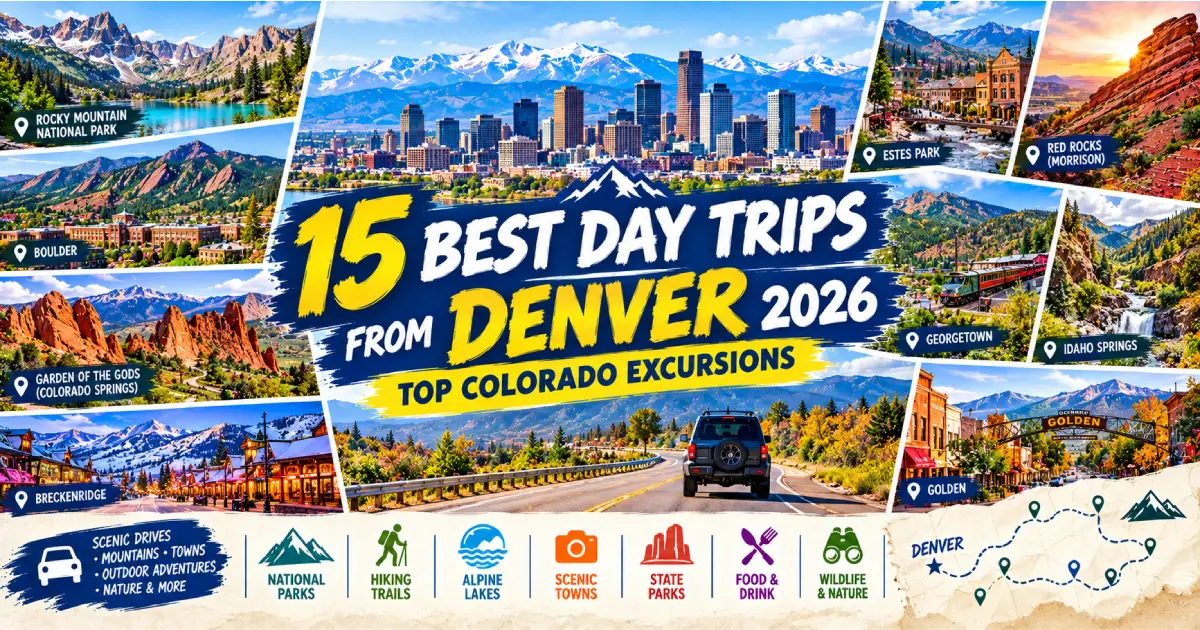
By Travel Tourister | Updated Sep 2026
Denver’s geographic position at the base of the Rocky Mountains makes it the single best day-trip hub in the American interior — the specific combination of the Front Range foothills beginning literally at the city’s western suburbs, the world-class ski resorts 1.5–2 hours west on I-70, Rocky Mountain National Park 1.5 hours northwest, the Colorado Springs attractions 1 hour south, and the high desert landscapes of the eastern plains creating a day-trip radius of extraordinary variety within a single tankful of gas. No other major American landlocked city provides the range of landscape types accessible within 2 hours: the 14,000-foot alpine tundra of Rocky Mountain National Park and Mt. Evans, the Victorian mining town character of Breckenridge and Leadville, the red rock geological drama of Red Rocks and Garden of the Gods, the historic frontier character of Colorado Springs, and the specific Colorado wilderness (the Rocky Mountain Arsenal, the Chatfield Reservoir, and the Cherry Creek State Park for closer-range nature access) all available as genuine day-trip options from a Denver base.
The best day trips from Denver in 2026 require understanding the specific I-70 corridor reality that shapes all westward Denver day-trip planning: the interstate west of Denver (the I-70 mountain corridor connecting Denver with the ski resorts and the Rocky Mountain interior) is simultaneously the most scenically spectacular and the most traffic-congested single highway in Colorado — the Friday-afternoon westbound rush (the Denver ski population departing simultaneously for the mountain resorts, the specific traffic pattern that routinely extends a 1.5-hour Breckenridge drive to 3.5+ hours) and the Sunday-afternoon eastbound return creating specific timing requirements for mountain-direction day trips. The Saturday early-morning departure (6–7 AM) and the Sunday midday return (before 2 PM or after 4 PM) are the most consistently recommended single I-70 traffic management strategies for the mountain day trips that compose the majority of the Denver day-trip calendar.
For complete Denver planning, see our Things to Do in Denver 2026, Denver Travel Guide 2026, Best Restaurants in Denver 2026, and Best Time to Visit Denver 2026.
| Destination | Distance | Drive Time | Cost | Best Season | Book Ahead? |
|---|---|---|---|---|---|
| Rocky Mountain National Park | 72 miles | 1.5 hrs | $35/vehicle | June–Oct; Sept (elk) | Yes (timed entry) |
| Red Rocks Amphitheatre | 15 miles | 25 min | Free (daytime) | Year-round | No (concert: yes) |
| Breckenridge | 85 miles | 1.5–2 hrs | Ski: $180–$220/day | Nov–Apr (ski); Jun–Sep (summer) | Yes (ski: epic/ikon pass) |
| Garden of the Gods | 70 miles | 1 hr | Free | Year-round | No |
| Pikes Peak | 90 miles | 1 hr 30 min | $20/person | May–Oct (summit road) | Yes |
| Colorado Springs | 70 miles | 1 hr | Free to explore | Year-round | No |
| Vail | 100 miles | 1.5–2 hrs | Ski: $200–$250/day | Nov–Apr (ski); Jun–Sep (summer) | Yes |
| Georgetown and Clear Creek Canyon | 45 miles | 45 min | Free | Year-round | No |
| Mt. Evans Scenic Byway | 70 miles | 1.5 hrs | $35/vehicle | Late May–Oct | No |
| Estes Park | 72 miles | 1.5 hrs | Free to town | Year-round | No (RMNP: yes) |
| Boulder | 30 miles | 45 min | Free to explore | Year-round | No |
| Fort Collins | 65 miles | 1 hr | Free to explore | Year-round | No |
| Leadville | 100 miles | 1.5–2 hrs | Free to explore | Year-round | No |
| Colorado National Monument | 245 miles | 3 hrs 30 min | $20/vehicle | Apr–Oct (best weather) | No |
| Dinosaur National Monument | 210 miles | 3 hrs | $20/vehicle | Apr–Oct | No |
Distance: 72 miles northwest of Denver | Drive time: 1.5 hours via US-36 through Boulder | Entry cost: $35/vehicle (7-day pass) | Duration: Full day | Timed entry: Required May–October (recreation.gov — book 2–4 weeks ahead) | Season: Year-round (full road access June–October); Best specific timing: September for the elk rut; July–August for wildflower peak
Rocky Mountain National Park (the 415-square-mile national park stretching across the Continental Divide — the 77 mountains exceeding 12,000 feet, the 450 miles of hiking trails, and the Trail Ridge Road [the highest continuous paved road in the US, reaching 12,183 feet at its apex] creating the most complete mountain wilderness experience accessible within day-trip distance of any major American city) is the single most essential Denver day trip and the one most fundamentally worth planning the entire Denver visit around.
The Trail Ridge Road experience (open approximately June–October): The 48-mile scenic drive across the Continental Divide — beginning at the Deer Ridge Junction on the park’s eastern edge and reaching the Alpine Visitor Center (11,796 feet) before descending to the park’s western entrance at Grand Lake — provides the most dramatically elevation-ascending single drive available from Denver: the treeline crossing (the specific transition at approximately 11,400 feet from the subalpine spruce-fir forest to the open alpine tundra landscape — the moment when the trees end and the 360-degree mountain panorama begins is the most specifically dramatic single mile on Trail Ridge Road), the tundra communities (the specific plant adaptations visible from the pullouts — the cushion plants, the dwarf willows, and the specific alpine wildflowers that bloom in the 6-8 week alpine summer [late June–August] creating the most concentrated single wildflower display in Colorado), and the west side overlooks (the view from the Fairview Curve pullout [11,650 feet] looking west into the Never Summer Mountains and the Colorado River headwaters valley below providing the most specifically dramatic single western-facing panorama on Trail Ridge Road).
The September elk rut: The single most specifically extraordinary RMNP experience — the bull elk bugling in the meadows during the breeding season (September through mid-October, the peak intensity typically in the third and fourth weeks of September). The specific elk rut encounter: arriving at Horseshoe Park or Moraine Park meadows before dawn (the elk activity most concentrated in the first and last hours of daylight), the bull elk bugling (the specific multi-note vocalization — ascending to a high-pitched shriek before descending to a series of grunts — audible across the valley in the still morning air), and the specific behavioral displays (the bulls herding their harems, the occasional confrontations between competing bulls, and the specific urgency of the breeding season’s compressed timeline creating the most specifically wildlife-dramatic single annual event accessible as a Denver day trip).
The Bear Lake hiking circuit: For visitors who want hiking rather than scenic driving, the Bear Lake trailhead (accessible by the Bear Lake Road shuttle [free, highly recommended — the shuttle eliminates the parking congestion that the Bear Lake Road’s limited parking creates at peak summer hours]) provides the most varied single-day hiking circuit in RMNP:
Practical RMNP day trip planning:
Distance: 70 miles west of Denver | Drive time: 1.5 hours (Highway 103 from Idaho Springs) | Cost: $35/vehicle | Season: Late May–early October (snow-dependent; check cotrip.org for current road conditions) | Duration: Half day | Altitude: 14,130 feet at summit
The Mt. Evans Scenic Byway (the 28-mile state highway from Echo Lake at 10,600 feet to the Mt. Evans summit at 14,130 feet — the highest paved road in North America, surpassing Pikes Peak Toll Road by 78 feet) provides the most dramatically altitude-ascending single Colorado drive accessible as a day trip from Denver: the ecosystem transitions (the subalpine forest of Echo Lake giving way to the alpine tundra above 11,500 feet, then the barren rock moonscape of the upper summit zone above 13,000 feet), the Summit Lake (the glacier-carved cirque lake at 12,830 feet — the most dramatically positioned single Colorado mountain lake visible from a paved road), and the mountain goats and bighorn sheep (the wild mountain goat colony that regularly appears at the summit parking area, the animals remarkably habituated to human presence and approaching vehicles at close range — the most specifically accessible mountain wildlife encounter in Colorado).
The summit experience: The Mt. Evans summit at 14,130 feet (the parking area at the summit ridge, the short walk [0.4 miles, strenuous at this altitude] to the actual summit marker on the rocky peak above) provides the most dramatically high-altitude single day trip from any major American city — the 14,130-foot perspective (the Denver skyline visible to the east on clear days, the Rocky Mountain main range extending in every direction, and the specific thin-air clarity that high altitude provides) unlike any accessible landscape within driving distance of any other major US city.
The practical summit altitude note: The Mt. Evans summit at 14,130 feet is 8,850 feet above Denver’s base elevation — the specific altitude effect (significantly more demanding than Denver’s city altitude) can produce genuine altitude sickness in visitors who have been in Denver for fewer than 2–3 days. The recommendations: limit summit time to 15–20 minutes for very recently-arrived visitors, ascend gradually (spend 30 minutes at Summit Lake before proceeding to the summit), and descend immediately at the first sign of altitude symptoms (headache, nausea, unusual fatigue, or the specific “cotton brain” cognitive fuzziness that high altitude produces).
Distance: 85 miles west of Denver | Drive time: 1.5 hours (normal); 2.5–3.5 hours (Friday afternoon ski season) | Season: November–April (skiing); June–September (summer hiking, biking, Main Street) | Best for: Skiing, Victorian Main Street, summer mountain activities
Breckenridge (the 150-year-old Colorado mining town at 9,600 feet elevation — the most visited single ski resort in the United States in recent years, the 2,908 skiable acres and 5 peaks providing the most specifically complete single-mountain ski terrain of any I-70-corridor resort) provides the most specifically complete single Colorado mountain destination: the Victorian Main Street (the 400+ historic buildings whose specific 1870s–1890s gold and silver mining heritage is maintained in the commercial district’s specific architectural character), the world-class ski and snowboard terrain (the Imperial Bowl above 13,000 feet providing the most demanding accessible expert terrain at any Colorado resort; the Peak 8 learning area providing the most beginner-appropriate single Breckenridge zone), and the summer character (the hiking, mountain biking, white-water kayaking, and the specific Breckenridge summer festival calendar creating the most completely programmed single Colorado mountain town summer).
Skiing at Breckenridge: The Breckenridge ski day from Denver — the Saturday 7 AM departure on I-70 West, the arrival at 9 AM, and the first chair at 9:15 AM (Breckenridge’s primary lifts typically opening at 8:30–9 AM depending on peak conditions and season) — provides the most specifically complete single-day ski experience accessible from Denver: the beginner terrain (Peak 8’s specific learning slopes providing the most organized single-day beginner ski instruction environment at any Front Range-accessible ski resort), the intermediate terrain (the specific Peaks 8 and 9 blue runs providing the most consistently varied single-day intermediate skiing), and the expert terrain (the Imperial Express SuperChair [one of the highest-operating chairlifts in North America at 12,840 feet] providing the most specifically expert-available terrain including the above-treeline bowl skiing that defines Colorado’s most dramatic single ski experience).
Epic Pass and Ikon Pass: The major Colorado ski resort season passes — the Epic Pass (Vail Resorts’ pass covering Breckenridge, Vail, Keystone, Beaver Creek, and various other resorts) and the Ikon Pass (the competing pass covering Arapahoe Basin, Copper Mountain, Winter Park, and various other resorts) each provide significantly discounted lift ticket pricing relative to the walk-up window rate ($180–$220/day) — the most cost-effective single Colorado ski planning decision for visitors planning 2+ ski days.
Summer Breckenridge: The specific summer Breckenridge character — the Main Street in full Colorado summer weather (the wildflowers in the surrounding mountain meadows, the hiking trails accessible from town, and the specific absence of the ski season’s crowd density creating the most relaxed single Colorado mountain town atmosphere) alongside the specific summer activities (the Breckenridge Epic Discovery [the mountain coaster, the alpine slides, and the various summer-season lift-served activities on Peak 8 — the most specifically family-oriented single summer mountain activity program at any I-70-corridor Colorado resort]).
Distance: 100 miles west of Denver | Drive time: 1.5–2 hours (normal); 3–4 hours (Friday afternoon ski season) | Ski cost: $200–$250/day walk-up; Epic Pass significantly reduces | Season: November–April (skiing); June–September (summer) | Best for: World-class skiing, the Vail Village pedestrian character
Vail (the 5,289-acre ski resort — the largest single ski mountain in the United States by skiable acreage, the specific terrain variety [the Back Bowls, the Blue Sky Basin, and the Vail Village front side together creating the most varied single-mountain ski experience in Colorado] and the Vail Village pedestrian commercial district [the most specifically European-feeling single Colorado mountain town, the car-free main village and the specific alpine architecture creating the most specifically Tyrolean-influenced American ski resort environment]) provides the most prestigious single Colorado ski day from Denver: the specific Vail Back Bowls (seven individual bowls totaling 2,731 acres of above-treeline south-facing terrain — the most specifically dramatic single Colorado bowl skiing), the Blue Sky Basin (the more remote western expansion of the Vail ski area, the two additional bowls providing the most specifically backcountry-feeling lift-served skiing at any Colorado resort), and the Vail Village (the pedestrian village whose specific Austrian-influenced architecture and the pedestrian-only main street create the most European-feeling single American ski resort town experience).
Vail vs. Breckenridge for day trip: For visitors choosing between Vail and Breckenridge as a single Denver ski day:
Distance: 15 miles west of Denver | Drive time: 25–30 minutes via C-470 and Morrison Road | Cost: Free (daytime park visit); $35–$150+ (concert events) | Season: Year-round (park); May–October (concerts) | Duration: 2–3 hours daytime; Evening for concerts
(See full description in Things to Do in Denver 2026 — Red Rocks is covered in extensive detail there)
The closest significant day trip from Denver — the specific Red Rocks combination (the 1-hour roundtrip drive, the 2–3 hour daytime geological exploration or the evening concert, and the Morrison town lunch or dinner) providing the most efficiently structured single Denver day trip: entirely achievable as a half-day morning excursion that allows an afternoon and evening back in Denver.
The Morrison town addition: Morrison (the small town at the base of Red Rocks, 1 mile from the amphitheatre) provides the most specifically convenient single Red Rocks lunch: the Cactus Jack’s Restaurant (the most beloved single Morrison restaurant by the local Denver hiking community — the specific Front Range breakfast burrito tradition and the outdoor patio overlooking the foothills), the Mt. Vernon Canyon Club, and the various other Morrison restaurants and bars creating the most natural single Red Rocks day complement.
Distance: 70 miles south of Denver | Drive time: 1 hour via I-25 South | Entry cost: Free | Duration: Half day | Season: Year-round | Best time: Morning (for the most dramatic eastern-sun light on the red formations)
Garden of the Gods (the Colorado Springs city park containing the extraordinary collection of 300-million-year-old red sandstone formations — the specific geological record of the ancient sea floor that once covered the Colorado region, the erosion exposing the tilted sedimentary layers in the dramatic vertical formations [the Cathedral Spires, the Kissing Camels, and the various other named formations that the specific erosion pattern has created] against the Pikes Peak backdrop creating the most specifically dramatic single free geological park in the continental United States).
The specific Garden of the Gods character: the formations’ red-to-orange color (the iron oxide content of the Lyons sandstone creating the specific rust-and-crimson color palette that distinguishes the Garden formations from the grey granite of the surrounding mountain peaks), the formations’ scale (the largest individual formations reaching 300 feet above the surrounding park surface — the Gateway Rocks [the two massive formations flanking the park’s main entrance creating the most specifically dramatic single park arrival sequence in Colorado] being the most immediately awe-inspiring), and the Pikes Peak backdrop (the specific 14,114-foot summit visible above the red formations from the park’s central flat area creating the most compositionally complex single Colorado landscape photograph available at any free outdoor site).
The Garden of the Gods hiking: The 15 miles of hiking trails within the park range from the paved perimeter path (accessible by bicycle and stroller — the most specifically family-accessible Garden trail) through the specific formation-close trails (the Siamese Twins formation trail [0.75 miles], the Perkins Central Garden Trail [1.5 miles], and the various other formation-proximity routes providing the most engaging single Garden geological encounter) to the rock climbing routes (the specific sandstone climbing [a Colorado Springs tradition since the 1950s] — check with the park visitor center for current 2026 climbing permit requirements).
Distance: 90 miles south of Denver | Drive time: 1 hour 30 minutes to the Pikes Peak Toll Road entrance | Cost: $20/person (Pikes Peak Highway toll road) | Altitude: 14,115 feet at summit | Season: May–October for summit road (weather-dependent) | Duration: Full day | Book: Yes — pikespeakcolorado.com for timed entry
Pikes Peak (the 14,115-foot Colorado “14er” most specifically visible from Denver and Colorado Springs — the mountain that Katherine Lee Bates climbed in 1893 and that inspired her to write “America the Beautiful” [the specific view from the Pikes Peak summit providing the specific visual inspiration: “purple mountain majesties above the fruited plain” referring specifically to the Pikes Peak vista looking east toward the Great Plains]), accessible by both the Pikes Peak Highway (the 19-mile toll road from the Cascade Highway entrance to the summit) and the Barr Trail (the 12.6-mile round-trip hiking trail from the Manitou Springs trailhead — the most specifically demanding single Colorado day hike from Denver, the 7,400-foot elevation gain the equivalent of three Empire State Buildings stacked vertically).
The Pikes Peak Highway: The most accessible summit route — the 19-mile paved and gravel toll road (the upper sections transitioning to gravel above the Glen Cove visitor center at 11,425 feet, the final 3 miles to the summit being the most dramatically exposed single segment of the drive) provides the most comprehensive single-road sampling of Colorado’s ecosystem transitions: the ponderosa pine forest of the lower section, the aspen grove zone at mid-mountain, the subalpine fir and Engelmann spruce at the upper forest, and the barren alpine tundra above treeline.
The summit Cripple Creek Donuts: The Pikes Peak summit house (the new facility completed in 2021 — the most dramatically elevated single Colorado visitor center, the panoramic views from the building’s glass walls providing the most complete single 360-degree Rocky Mountain vista accessible to non-hikers) and the specific summit Cripple Creek Donuts (the plain cake donuts that the Pikes Peak Summit Visitor Center has been baking and selling since the early 20th century — the only food item specifically available at the summit, the specific dough recipe adjusted for the altitude’s baking chemistry) together create the most specifically Pikes-Peak-identity single summit experience.
Distance: 70 miles south of Denver | Drive time: 1 hour via I-25 South | Cost: Free to explore; individual attraction costs | Duration: Full day | Season: Year-round
Colorado Springs (the Colorado city immediately at the base of Pikes Peak — the second-largest Colorado city [476,000 residents], the specific combination of the extensive military presence [Fort Carson, Peterson Space Force Base, the Air Force Academy], the Olympic Training Center [the US Olympic & Paralympic Training Center, the most specifically Olympic-heritage single US city location], and the dramatic natural landscape [the Garden of the Gods, Pikes Peak, and the Cheyenne Mountain complex surrounding the city]) provides the most attraction-dense single Colorado day trip destination outside of the mountain resorts:
The US Air Force Academy: The military academy campus 12 miles north of Colorado Springs (free visitor access to the Visitor Center and the Cadet Chapel — the most architecturally dramatic single Air Force Academy building, the specific 17-spire modernist chapel [completed 1962, the most distinctive single piece of American military architecture of the 20th century] representing the most specifically unusual single Colorado Springs visitor attraction).
The Broadmoor Hotel area: The most specifically prestigious Colorado Springs destination — the 1918 resort hotel at the base of Cheyenne Mountain (the Forbes Five-Star resort whose specific Spanish Colonial architecture, the lake, and the surrounding mountain landscape creating the most dramatically positioned single hotel in Colorado) providing a specific Broadmoor coffee or lunch as the most naturally elegant single Colorado Springs midday stop.
Manitou Springs: The quirky Victorian-era spa town immediately west of Colorado Springs (the specific Manitou Springs character — the natural mineral water springs [8 separate springs throughout the town whose specific mineral content made Manitou a 19th-century health resort destination], the Manitou Incline [the 2,744-step staircase on the former cog railway bed — the most specifically demanding single Front Range fitness challenge, the 2,000-foot elevation gain in 0.88 miles creating a 68% average grade that the Colorado Springs fitness community specifically prizes], and the downtown Emma Crawford Coffin Races [the October festival whose specific coffin-racing tradition is the most specifically Manitou-character single annual event]).
Distance: 30 miles northwest of Denver | Drive time: 45 minutes via US-36 | Cost: Free to explore | Duration: Half to full day | Season: Year-round | Character: University town, Pearl Street Mall, Flatirons, outdoor culture
Boulder (the University of Colorado city 30 miles northwest of Denver — the most specifically outdoor-culture-defined single Colorado city, the Flatirons [the five tilted sandstone slabs forming the most specifically recognizable single Boulder geological formation, visible from throughout the city and providing the most accessible single Front Range rock climbing and hiking within a major Colorado city], the Pearl Street Mall [the 4-block pedestrian mall through historic downtown Boulder — the most specifically vibrant single Colorado pedestrian commercial district, the street performers, the independent restaurants, and the specific Boulder retail character creating the most engaging single Colorado outdoor commercial space], and the University of Colorado campus [the Tuscan-influenced red-tile-roof buildings creating the most specifically architecturally consistent single Colorado university campus environment]) provides the most specifically university-outdoor-culture combined single Colorado day trip.
The Flatirons hike: The most specifically essential single Boulder outdoor experience — the Royal Arch Trail (3.4 miles round-trip, strenuous — the 1,380-foot elevation gain rewarded by the natural stone arch at the trail’s terminus and the most specifically comprehensive Boulder valley view from any trail-accessible Front Range viewpoint), the Bear Peak Trail (5.2 miles round-trip, very strenuous — the most demanding accessible Front Range summit hike from the Boulder trailheads), and the First Flatiron Trail (2.5 miles round-trip, moderate — the most specifically Flatiron-adjacent accessible non-technical trail, the proximity to the sandstone formations providing the most dramatically close-range single Boulder geological encounter).
The Pearl Street Mall: The 4-block pedestrian mall (between 11th and 15th Streets on Pearl Street — the most specifically walkable single Colorado commercial district) provides the most complete single Boulder urban experience: the street performers (the specific Boulder street performance culture — the jugglers, the musicians, the artists, and the various performers that the Pearl Street pedestrian environment has supported for decades creating the most vibrant single Colorado outdoor commercial atmosphere), the independent restaurants (Frasca Food and Wine [the most critically acclaimed single Boulder restaurant, the northern Italian wine bar whose cellar program is the most specifically wine-enthusiast-oriented single Colorado dining experience], the Kitchen Boulder [the farm-to-table restaurant whose specific local sourcing philosophy most directly expresses the Boulder food community’s values], and the various other Pearl Street restaurants representing the most diverse single Colorado food corridor outside of Denver).
Distance: 65 miles north of Denver | Drive time: 1 hour via I-25 North | Cost: Free to explore | Duration: Half to full day | Highlight: New Belgium Brewery, Odell Brewing, Old Town
Fort Collins (the Colorado State University city 65 miles north of Denver — the specific Fort Collins craft beer identity [the home of New Belgium Brewing [Fat Tire — the most nationally distributed single Colorado craft beer, the New Belgium campus tour the most specifically architecture-tour-worthy single Colorado brewery visit, the outdoor amphitheatre, the solar power installations, and the specific New Belgium community culture], Odell Brewing [the specific Fort Collins brewing tradition whose 1989 founding predates the Colorado craft beer movement’s mainstream period], and the various other Fort Collins craft breweries creating the most craft-brewery-per-capita Front Range city beyond Denver itself) and the Old Town historic district (the Victorian commercial streetscape of Mountain Avenue and College Avenue providing the most specifically preserved single Colorado Front Range historic downtown character) together create the most naturally structured single Fort Collins day: the Old Town morning walk → the New Belgium tour (reservations recommended at newbelgium.com) → the Odell taproom afternoon.
The New Belgium Brewing tour: The most specifically worthwhile single Colorado brewery tour experience — the New Belgium campus (the 35-acre brewery complex on the Poudre River, the specific New Belgium design philosophy visible throughout the facility [the employee ownership culture, the sustainability infrastructure, and the specific community values that New Belgium has maintained since 1991 creating the most specifically mission-driven single large Colorado craft brewery]) and the tour (1.5 hours, $20, including tastings — the most comprehensive single brewery tour in Colorado, the fermentation tanks, the wood barrel aging room, and the specific Fat Tire and Voodoo Ranger production visible throughout) providing the most complete single Colorado craft brewery education.
Distance: 45 miles west of Denver | Drive time: 45 minutes via I-70 West | Cost: Free (town); $22–$40 (Georgetown Loop Railroad) | Duration: Half day | Season: Year-round
Georgetown (the most specifically intact Victorian mining town accessible from Denver — the 1860s silver mining heritage visible in the 200+ Victorian buildings that the Georgetown-Silver Plume National Historic Landmark District preserves, the most comprehensively documented single Colorado mining town townscape) and the Clear Creek Canyon (the spectacular granite canyon visible throughout the I-70 approach to Georgetown — the specific canyon walls rising 1,000+ feet above the interstate creating the most dramatic single I-70 scenery between Denver and the major ski resorts) together provide the most historically-specific and most scenically-dramatic single half-day Denver day trip available without reaching the ski resort distances.
The Georgetown Loop Railroad: The historic narrow-gauge railroad (the 1884 engineering achievement — the specific loop [the spiral track designed to gain elevation in the compressed Georgetown valley, crossing the Devil’s Gate High Bridge [the 95-foot-high trestle bridge whose specific height-to-support ratio was the most ambitious single 19th-century Colorado railroad engineering challenge] four times in gaining the 640-foot elevation between Georgetown and Silver Plume) providing the most specifically historic single Colorado railroad experience accessible as a day trip from Denver.
Distance: 100 miles southwest of Denver | Drive time: 1.5–2 hours via I-70 West and Highway 91 | Cost: Free to explore | Altitude: 10,152 feet (the highest incorporated US city) | Season: Year-round (winter requires snow tires or chains on mountain approaches)
Leadville (the 10,152-foot Colorado mining city — the highest incorporated city in the United States, the 1880s silver mining boom’s most specific remaining architectural landscape [the Tabor Opera House, the National Mining Hall of Fame, and the specific Victorian streetscape of Harrison Avenue providing the most dramatically high-altitude Victorian commercial streetscape in the US], and the specific Leadville geography [the Sawatch Range rising above the city, the 14,000-foot peaks of Mt. Elbert [the highest point in Colorado at 14,440 feet] and Mt. Massive [the second-highest at 14,427 feet] both beginning their trailheads within 10 miles of Leadville]) creates the most dramatically altitude-immersive single Colorado historical town.
The Leadville altitude reality: At 10,152 feet, Leadville is 4,872 feet above Denver — the specific altitude effect (the town’s air significantly thinner than Denver’s already-notable altitude) creates a genuine physical experience that casual visitors frequently underestimate. The first hour in Leadville produces the most specifically noticeable single altitude response available on any Denver day trip: the breathlessness climbing Leadville’s Harrison Avenue hill (a modest incline at sea level that becomes noticeably demanding at 10,152 feet), the specific light-headedness that the town produces, and the dramatic sky clarity (the thin air filtering less UV than lower elevations, the sky appearing a specifically darker blue at Leadville’s altitude than anywhere visible in Denver).
Distance: 245 miles west of Denver | Drive time: 3.5 hours via I-70 West to Grand Junction | Cost: $20/vehicle | Duration: Full day | Season: April–October (best weather) | Character: The Grand Canyon’s less-visited Colorado cousin
Colorado National Monument (the red-rock canyon country near Grand Junction — the specific erosion of the Uncompahgre Plateau’s sandstone and granite creating canyon walls, monoliths [Independence Monument — the 450-foot sandstone tower whose specific isolation from the surrounding canyon walls creates the most dramatically freestanding single Colorado geological formation], and the Rim Rock Drive [the 23-mile scenic highway along the monument’s canyon rim providing the most comprehensive single visit to the monument’s geological formations]) is the most specifically Utah-canyon-country equivalent available within a day trip of Denver — the specific canyon character (the Wingate sandstone walls, the pinyon-juniper plateau landscape, and the Colorado River visible below the monument’s western edge) providing the most dramatic single geological landscape accessible from Denver at the cost of the longest day-trip drive.
The single most practically important Denver day trip planning consideration — the I-70 westbound mountain corridor traffic:
| Day/Time | I-70 Westbound Conditions | Recommendation |
|---|---|---|
| Friday 12–8 PM (ski season) | Very heavy — 1.5 hr drive takes 3–4 hrs | Avoid or depart before 11 AM |
| Saturday 6–8 AM (ski season) | Light — normal drive times | Ideal departure window |
| Saturday 9 AM–12 PM | Building — 1.5–2.5 hr drive | Acceptable but not optimal |
| Sunday 10 AM–2 PM | Moderate eastbound — plan return after 3 PM | Fine for one-way; return timing critical |
| Sunday 2–6 PM | Very heavy eastbound — 2.5–4 hrs Denver-bound | Avoid or wait until after 5 PM |
| Weekdays (ski season) | Normal except holidays | Most efficient mountain day-trip timing |
| Summer weekends | Moderate — 15–30 min above normal | Better than ski season; still warrants early departure |
Year-round:
Winter additions:
Summer additions:
About Travel Tourister Travel Tourister’s destination specialists have completed every day trip in this guide from Denver — from Rocky Mountain National Park pre-dawn Horseshoe Park elk rut positioning in September fog and Trail Ridge Road 12,183-foot Alpine Visitor Center panorama mornings through Breckenridge ski-season I-70 Saturday 7 AM departures that arrive before the lift lines build and Vail Back Bowl spring-snow afternoon sessions, Garden of the Gods morning Cathedral Spires eastern-light photography and Mt. Evans summit 14,130-foot mountain goat close-encounter afternoons, Pearl Street Mall Boulder street performer lunch-hour wanderings and New Belgium Fort Collins brewery tour tasting room finales, Georgetown Loop Railroad Devil’s Gate High Bridge crossings, and Leadville Harrison Avenue first-visit altitude-breathlessness-realization moments — to deliver the most practically calibrated and most altitude-honestly assessed Denver day trip guide for every type of 2026 visitor.
Posted By : Vinay
Latest Article
2nd Floor, 39, Above Kirti Club, DLF Industrial Area, Kirti Nagar, New Delhi, Delhi 110015



Travel Tourister is a leading Travel portal where we introduce travellers to trusted travel agents to make their journey hasselfree, memorable And happy. Travel Tourister is a platform where travellers get Tour packages ,Hotel packages deals through trusted travel companies And hoteliers who are working with us across the world. We always try to find new and more travel agents and hoteliers from every nook and corners across the world so that you could compare the deals with different travel agents and hoteliers and book your tour or hotel with the one you have chosen according to your taste and budget.
Copyright © Travel Tourister, India. All Rights Reserved

 Call
 Enquiry