Published on : 30 Sep 2026
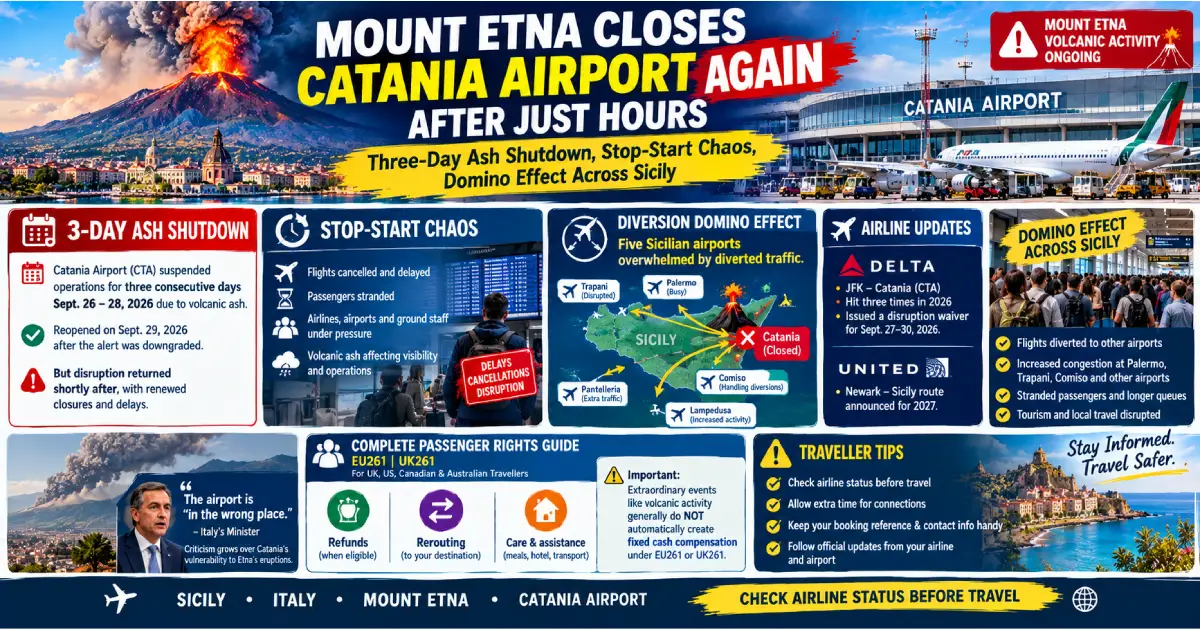
The most fundamental problem with Catania-Fontanarossa Airport has never been its runways, its terminals, its airlines, or its ground crews. The problem is that it was built in the shadow of Europe’s most active volcano — and the mountain does not care about your travel plans. Mount Etna’s North-East Crater began emitting heavy ash on Saturday September 26, 2026, triggering a three-day complete suspension of all flight operations at Sicily’s busiest airport. The airport reopened Monday evening, September 28, after SAC — the airport’s operator — confirmed that the volcanic alert level had been lowered from red to orange and ordinary operations had resumed. Then, on Tuesday morning, September 29, ash emissions forced a further brief suspension. Today, September 30, Catania is operating — but with Etna still active above the city, every departure board at the terminal carries an asterisk: open, for now. Italy’s Civil Protection Minister has said the airport is in the wrong place. Europe’s most disruptive volcanic neighbour has closed Catania to all flights three separate times in 2026 alone. And Delta Air Lines — the only US carrier serving the route from New York JFK — has issued travel waivers three times this summer for the same airport.
Crisis timeline: September 26: Complete shutdown begins — all flights suspended from Saturday morning due to Etna ash from North-East Crater September 27: Closure extended all day — airport closed until 23:59 — second consecutive day of total suspension September 28: Closure extended a third day — airport closed until 9:59 PM Monday at the earliest — then reopened Monday evening September 29: Brief further suspension Tuesday morning — ash cloud forces second temporary halt within 24 hours of reopening September 30 — TODAY: Airport operating. Etna still active. No guarantee of sustained operations Flights diverted September 26: 10 aircraft — five to Palermo, three to Trapani, two to Comiso Volcanic alert level at closure: VONA Red — highest aviation alert level Volcanic alert level at reopening: VONA Orange — reduced but still elevated Airport operator: SAC (Società Aeroporto Catania) Airport ranking: Italy’s fifth-busiest — behind Rome Fiumicino, Milan Malpensa, Milan Bergamo, Naples Only US carrier serving Catania: Delta Air Lines — nonstop New York JFK (DL244/DL245) Delta flight frequency: Six times per week — Tuesday through Sunday Delta aircraft type: Boeing 767-300ER — 211 seats United plans: Newark–Catania service announced for 2027 2026 Etna disruptions at Catania: August closure, September 14 closure, September 26–29 closure — three separate events Delta travel waivers issued in 2026: Three separate waivers for Catania disruption EU261 compensation: Up to €600 per passenger for controllable cancellations departing EU airports UK261 compensation: Up to £520 per passenger for controllable cancellations departing UK airports Catania airport live status: aeroporto.catania.it
Mount Etna, Europe’s highest and most active volcano, resumed significant eruptive activity from its North-East Crater on Saturday September 26, 2026. The emission was not a dramatic lava spectacle — it was something operationally far more dangerous for an airport: a sustained, heavy release of volcanic ash into the atmosphere under wind conditions that drove the ash cloud directly across the approach and departure corridors of Catania-Fontanarossa Airport, 28 kilometres to the south.
Catania-Fontanarossa Airport suspended all flights on September 26, 2026 because of volcanic ash from Mount Etna’s North-East Crater. Closures also occurred in August and on September 14, 2026.
SAC, the company that manages the airport, announced the closure of the relevant airspace because of the heavy emission of ash into the atmosphere and unfavourable wind conditions. The statement from air traffic control was precise: “Due to the emission of volcanic ash into the atmosphere, the closure of the airspace corresponding to sector C1 has been ordered.”
The closure initially ran until noon on Sunday September 27 — before another assessment on September 27 resulted in the closure being prolonged for the remainder of the day.
The practical effect was immediate and severe. The suspension of flights triggered a domino effect at other Sicilian airports such as Comiso, Palermo and Trapani, which suddenly became congested with the many aircraft diverted there in emergency.
Before the full closure on September 26, ten flights were diverted from Catania: five to Palermo, three to Trapani, and two to Comiso, according to ANSA.
Etna’s ash cloud pushed south from the summit across exactly the wrong part of the sky. The approach corridor into Catania’s single runway runs directly beneath the atmospheric zone where ash accumulation poses the greatest risk to jet engines. All arrivals and departures were officially suspended until 23:59 on Sunday September 27. Flights were initially halted until 12:00, before the stop was extended.
For passengers who arrived at Catania’s terminal on Saturday morning expecting to fly home — to the UK, Germany, the Netherlands, Scandinavia, or New York — the day became a study in uncertainty. Airport authorities urged passengers not to go to the terminal without first checking the status of their flight with their respective airlines. Hundreds of passengers who had already made the journey to the airport faced the choice of waiting in a terminal whose departure boards showed uniform cancellations, or making the hour-long journey back to their accommodation with no certainty about when they would be able to leave.
The cascading effect hit Sicily’s regional airports hard. On Saturday, the shutdown had serious repercussions across the entire regional transport network, as Comiso, Palermo and Trapani suddenly became congested with the many aircraft diverted there in emergency. Comiso Airport, approximately 80 kilometres west of Catania, began showing delay notifications within hours of the diversion traffic arriving. Palermo’s Falcone Borsellino Airport — Sicily’s second-largest, with 9.2 million passengers handled in 2025 — absorbed the largest share of the overflow but was not built for simultaneous management of its own schedule plus a significant portion of Catania’s.
Catania Airport would remain closed to all arrivals and departures throughout Sunday September 27 after volcanic ash from Mount Etna forced authorities to extend a complete suspension of flight operations for a second consecutive day.
A further assessment on Sunday morning produced the same result as Saturday’s. Ash was still present in the approach corridors at concentrations that made safe operations impossible. The closure was extended to 23:59 on September 27 — effectively closing the airport for the entire day.
Passengers whose flights were cancelled found themselves rebooked through another Sicilian airport, although alternative capacity became limited quickly when a major airport such as Catania remained closed for an extended period.
By Sunday afternoon, Palermo, Trapani, and Comiso were all reporting congestion. The regional ground transport network — the coaches, taxis, and rental cars connecting eastern Sicily to the western airports — was overwhelmed by the combined demand of thousands of passengers trying to reach alternative departure points. Journey times between Catania and Palermo Airport, normally 2h30, stretched to 3h30–4h00 as traffic built on the A19 motorway.
The Volcano Observatory Notice for Aviation was reduced from red to orange as the significant eruptive cloud disappeared, allowing authorities to reopen the airspace surrounding Catania. The airport had experienced a complete shutdown during much of September 26, 27 and 28 as volcanic ash repeatedly entered airspace used by arriving and departing aircraft.
Italy’s Catania airport reopened on Monday evening after three days of stoppage due to volcanic ash interference from the nearby Mount Etna. “The state of alert has ended, ordinary status has been restored, and full services have resumed,” airport operator SAC wrote on social media.
The reopening came too late for hundreds of passengers who had already been rerouted through Palermo or who had made the difficult decision to abandon their Sicily plans entirely and return home via Rome or Milan.
The stop-start nature of Etna’s ash pattern produced exactly the scenario that aviation authorities most dread: a volcanic ash cloud disrupted air traffic again, forcing the airport to suspend flights for a further brief period on Tuesday morning, September 29. The airport confirmed operations resumed once the alert level permitted, but the pattern — three days closed, one day open, brief closure again — illustrates with uncomfortable clarity why Catania-Fontanarossa Airport is one of the most operationally vulnerable commercial airports on the European continent.
Understanding why a volcano 28 kilometres away can completely close an international airport requires understanding what volcanic ash actually does to a jet engine — because it is not intuitive. The ash is not hot by the time it reaches the airport. It looks like fine grey dust. It seems impossible that dust could stop a modern widebody jet.
But volcanic ash is not dust in any conventional sense. Etna can remain highly active without affecting Catania Airport when ash moves away from flight paths, but a change in wind can quickly push volcanic material directly across the approach and departure corridors.
Volcanic ash particles are composed of sharp-edged microscopic fragments of rock, glass, and minerals. When ingested by a jet engine at cruise speed, those particles:
1. Melt inside the combustion chamber. The melting point of volcanic ash is typically around 1,100°C. Jet engine combustion chambers operate at 1,300–1,600°C. The ash melts inside the engine, then re-solidifies as it passes through the cooler turbine stages — coating turbine blades and restricting airflow. Multiple engine failures have occurred from ash ingestion.
2. Sandblast cockpit windows. Ash particles moving at approach speed (approximately 250 knots) erode cockpit windows within minutes, significantly reducing pilot visibility at exactly the moment when the clearest possible view of the runway is required.
3. Block pitot tubes. The pitot tubes that provide airspeed data to a modern aircraft’s flight computers can be blocked by ash deposits, producing false airspeed readings — one of the most dangerous possible instrument failures.
4. Settle on the runway. Ash settled on runway surfaces reduces friction dramatically, extending the distance required for safe braking. A contaminated runway is effectively slippery regardless of weather conditions.
A researcher at the National Institute of Geophysics and Volcanology’s Etna Observatory described volcanic ash as posing “a great risk for aircraft.” This is understatement. The combination of engine ingestion risk, visibility reduction, and runway contamination means that aviation authorities have a legal obligation to close airports when ash concentrations in the approach airspace exceed safe thresholds — there is no operational workaround and no way to fly through it safely.
The most striking statement to emerge from this week’s Catania closure came not from the airport operator or the airlines, but from Italy’s Civil Protection Minister Nello Musumeci — a politician who knows Catania Airport intimately, because he spent nine years trying to move it.
Italy’s Civil Protection Minister Nello Musumeci said Catania airport is in the wrong place — adding that he tried unsuccessfully to get the airport moved when he was the president of the province of Catania between 1994 and 2003. The statement is extraordinary in its directness. A serving national minister, responsible for Italy’s disaster response, is saying publicly that one of the country’s major commercial airports should not exist where it currently stands.
Mount Etna, Europe’s highest and most-active volcano, frequently disrupts flights at Catania, and ash emissions have been particularly intense this summer, affecting thousands of travelers during the peak holiday season.
The history of Catania Airport’s location is a story of infrastructure built before the modern understanding of volcanic hazard mapping. Catania Airport’s history dates back to 1924, when it was the region’s first airport. The enlarged modern facility opened in 1950 — two decades before satellite imagery, ash dispersion modelling, or aviation volcanic hazard protocols existed in their current form. The airport was built where it was built because that was where flat land existed near the city. The volcano’s behaviour was not considered a determining factor in airport siting decisions in 1950.
Musumeci’s argument — now echoed by aviation analysts following the September 2026 triple-closure pattern — is that the accumulated economic cost of Catania’s repeated closures now exceeds any reasonable estimate of what a new airport on a less volcanically exposed site would cost to build. In 2026 alone, three separate closure events have disrupted Catania’s operations during August, September 14, and September 26–29 — the busiest and most commercially valuable months of the Italian aviation calendar.
The argument has not translated into a plan, a budget, or a site selection process. Moving a major commercial airport is a generational infrastructure project requiring political will, land availability, environmental assessment, and multi-billion euro investment. What Musumeci’s statement does is shift the political framing of the problem: from “how do we manage Etna disruption at Catania” to “should Catania airport be at Catania at all?”
This month’s three-day closure was not an isolated event. It was the third time in 2026 that Etna has forced Catania to suspend all flight operations:
Closure 1 — August 2026: Catania suspended flights in August, when Euronews reported the ash cloud drifting as far as Libya. The ash cloud’s reach to Libya — approximately 1,500 kilometres from Etna’s summit — illustrated the potential continental scale of Etna’s ash dispersal under certain wind conditions.
Closure 2 — September 14, 2026: There was also major disruption on September 14 because of volcanic ash, which poses a “great risk for aircraft,” according to a researcher at the National Institute of Geophysics and Volcanology’s Etna Observatory, Boris Behncke. Delta issued a travel waiver covering September 16–18 following this closure.
Closure 3 — September 26–29, 2026: Three full days of complete airport suspension, followed by a brief further closure on September 29.
Three major closures in a single summer-autumn season is unprecedented at Catania in recent years. It reflects the particular intensity of Etna’s eruptive cycle in 2026 — which volcanologists at the National Institute of Geophysics and Volcanology have described as one of the most sustained activity periods since the major eruptive sequence of 2021–2022.
For context on the frequency risk: Etna erupts in some form on average every two to three months. Major ash-producing events — the ones that force Catania closures — occur roughly four to six times per year in active cycles. In 2026’s particularly active period, three major closures have already occurred in less than two months. The statistical probability of a fourth closure before the year ends is significant.
Delta is the only US airline currently serving Catania, with nonstop flights from New York-JFK. United plans to serve Catania from Newark, New Jersey, starting next year.
Delta’s New York JFK–Catania service (DL244 outbound, DL245 return) operates six times per week on Boeing 767-300ER aircraft with 211 seats. The route is one of Delta’s most operationally vulnerable in its European network — it serves a single destination with no nearby alternative airport capable of seamlessly absorbing a full 767 diversion, and it operates under the perpetual shadow of Etna’s activity calendar.
In September 2026 alone, Delta issued two separate Etna-related travel waivers covering Catania passengers. The September 14 disruption produced a waiver covering travel September 16–18. The September 26 closure produced a separate waiver.
Due to weather conditions associated with the Mount Etna volcano eruption, travel to, from, or through the Catania area may be impacted. Delta has issued a travel waiver allowing passengers to change their flight at no extra cost. The September waiver covered impacted travel dates September 16–18, with rebooking required by September 21 on new travel by September 21.
What Delta passengers need to know about rebooking during an Etna closure: Delta’s Etna travel waivers allow affected passengers to change their flights without a fare difference or change fee, but the rebooking window is typically short — check delta.com → Travel Advisories immediately when a VONA Red alert is issued for Catania. Do not wait for a direct email from Delta; the waiver page activates faster than customer notifications reach individual passengers.
For passengers whose Delta JFK–Catania flights were cancelled September 26–29: If you have not yet claimed your EU261 compensation or filed for a full refund, the process remains open. See the full rights guide below.
The market dynamics that have driven Delta to operate the only US nonstop to Catania are about to change. United plans to serve Catania from Newark, New Jersey, starting next year.
The United Newark–Catania announcement is significant for several reasons. First, it validates Catania as a commercially viable transatlantic destination — Delta’s load factors on the JFK route have been strong enough to attract a second US entrant. Second, it dramatically improves access for US travellers who live in or connect through the New York area. Third, and most relevant given this week’s events, it means a second US carrier will be exposed to Etna’s disruption risk from 2027 onward.
United passengers booking the Newark–Catania service when it opens should note: the Etna disruption pattern documented in 2026 is not an anomaly. It is the operating baseline for Catania. Build flexibility into any Sicily booking. Avoid non-refundable hotel pre-payments for the first night in Catania. And ensure your travel insurance policy explicitly covers volcanic ash disruption — standard policies often contain exclusion language for geological events that you need to read carefully.
When Catania closes due to ash, airlines have four alternative Sicilian airports:
Palermo is Sicily’s second-largest airport. It absorbed the largest share of Catania’s diverted traffic during the September 26–29 closure. From Palermo, passengers face a ground transfer to Catania of approximately 2h30–3h00 by bus or car under normal conditions — longer when the A19 motorway is congested by diversion traffic. Palermo–Catania direct trains run approximately every hour at 2h00 duration.
The critical problem: Palermo’s runway and gate infrastructure was not designed to absorb a major portion of Catania’s schedule simultaneously. During the September 26–29 closure, Palermo experienced its own congestion — aircraft parking, gate allocation, and turnaround scheduling all became compressed as Palermo attempted to function as a dual-airport hub.
Comiso Airport, approximately 80 kilometres west of Catania, received two of the ten diverted aircraft on September 26. Comiso is a smaller facility — a former military airbase converted to civilian use — with limited passenger processing capacity. Ground transfer from Comiso to Catania takes approximately 1h15 under normal conditions.
Trapani is in western Sicily — approximately 3 hours by road from Catania. Three aircraft were diverted to Trapani on September 26. The ground transfer distance makes Trapani the least convenient diversion point for passengers who need to reach eastern Sicily.
On the Italian mainland directly across the Strait of Messina from Sicily, Reggio Calabria is occasionally used as an overflow diversion for Catania closures when Sicilian alternatives are congested. The transfer requires a ferry crossing of the Strait of Messina (approximately 20 minutes boat crossing) plus ground transport on both sides.
Catania airport reopened on Monday evening after three days of stoppage due to volcanic ash interference from the nearby Mount Etna. “The state of alert has ended, ordinary status has been restored, and full services have resumed,” airport operator SAC wrote on social media.
Today, September 30, Catania is operating. The VONA alert level is orange — reduced from the red that forced the closure — meaning Etna remains active but ash dispersal is not currently reaching the airport’s critical flight path corridors in concentrations that require suspension.
The honest caveat your readers need: A VONA Orange alert at Etna does not mean the disruption is over. It means the disruption is paused. Mount Etna remains one of Europe’s most active volcanoes, and airport operations depend heavily on the height and direction of ash emissions. The same wind shift that triggered Tuesday morning’s brief secondary closure can recur at any time without warning. Passengers booked through Catania in October 2026 should monitor the Etna Observatory’s INGV live feed and SAC’s social media daily.
Live Catania airport status: aeroporto.catania.it Etna Observatory live monitoring: ingv.it/en VONA alert level checker: aviationweather.gov → Volcanic Ash Advisories → European area
Yes — unambiguously. Volcanic ash closures at Catania are classified as extraordinary circumstances under EU Regulation 261/2004, UK261, and their equivalent frameworks globally. A volcanic eruption is a natural event entirely outside the airline’s control, and the ENAC directive requiring SAC to close the airport is a regulatory act that airlines cannot override.
What this means practically: Airlines are not required to pay compensation under EU261 or UK261 for cancellations caused by Catania’s volcanic ash closures. However — and this is critically important — airlines are still required to provide:
✅ A full cash refund within 7 days to the original payment method — unconditionally ✅ Or rebooking on the next available flight at no additional cost ✅ Duty of care — meals, refreshments, and hotel accommodation for overnight disruption
What airlines are NOT required to pay during an extraordinary circumstances closure: ❌ The €250–€600 EU261 compensation lump sum ❌ The £220–£520 UK261 compensation lump sum
Every passenger on a cancelled Catania flight — September 26, 27, 28, or 29 — is entitled to choose between a full cash refund to their original payment method or rebooking at no cost. This right exists regardless of extraordinary circumstances.
The voucher trap: Airlines may offer travel vouchers as a first response to cancellation requests. You are not obligated to accept them. State clearly: “I am requesting a full cash refund under EU Regulation 261/2004 to my original payment method, not a travel voucher.”
Airlines | Refund contact:
Even for extraordinary circumstances closures, airlines must provide duty of care to stranded passengers:
2+ hour delay before cancellation:
Overnight stay required:
For passengers diverted to Palermo, Comiso or Trapani:
Keep every receipt. Every taxi, every hotel night, every meal purchased because of the Catania closure is potentially reimbursable under duty of care provisions — regardless of extraordinary circumstances.
Travel insurance is where most Catania passengers have been caught out by the 2026 disruption pattern. Many standard travel insurance policies contain exclusion language for geological events — including volcanic eruptions — that removes the insurer’s obligation to pay for disruption caused by ash.
Before buying or renewing travel insurance for any future Sicily trip, check your policy specifically for:
Policies from specialist travel insurers (Battleface, SafetyWing, World Nomads) typically offer more explicit volcanic disruption coverage than standard bank credit card travel insurance products.
Action 1 — Set a VONA alert for Catania. Sign up for volcanic aviation notices at ingv.it/en — Italy’s National Institute of Geophysics and Volcanology sends automatic notifications when Etna’s alert level changes. A move from Orange to Red gives you the earliest possible warning of an impending closure.
Action 2 — Monitor SAC’s social media. Airport operator SAC announces closures and reopenings on its official social media channels before most airlines update their booking systems. Following SAC on social media is your fastest source of real-time Catania status.
Action 3 — Check your Delta travel advisory page before every Catania flight. Go to delta.com → Travel Advisories. If a waiver is active, use it immediately — don’t wait to see if the flight actually cancels.
Action 4 — Never book non-refundable first-night accommodation in Catania. The probability of a Catania closure in any given month is not negligible — three closures in summer-autumn 2026 alone. Booking refundable accommodation for the first night of any Sicily trip is cheap insurance against exactly this scenario.
Action 5 — Know your diversion airport options before you fly. If diverted to Palermo: allow 2h30–3h00 for the ground transfer to Catania. If diverted to Comiso: allow 1h15. If diverted to Trapani: allow 3h00 minimum. Have these options researched before you board so you can make rebooking decisions quickly.
Action 6 — Check your travel insurance volcanic ash exclusion NOW. Do it before you need to claim, not after. Call your insurer if the policy language is ambiguous.
Action 7 — If cancelled September 26–29 and not yet refunded — act now. Your refund right under EU261 or the airline’s own conditions of carriage does not expire quickly, but the evidence of your cancellation is freshest now. File the refund request today at your airline’s manage-booking portal.
Action 8 — If you were diverted and incurred ground transport costs — claim duty of care. Keep every receipt from Palermo, Comiso, or Trapani transfers and claim reimbursement from your airline as duty of care costs — these are not covered by the extraordinary circumstances exemption.
Action 9 — Consider flying into Palermo instead of Catania for October Sicily trips. Palermo is on the western coast of Sicily, away from Etna’s immediate ash dispersal zone. Ryanair, Wizz Air, Vueling, and others serve Palermo extensively from UK and European airports. For October travel, a Palermo arrival with a car hire to eastern Sicily removes the Etna disruption risk entirely.
Action 10 — Save these emergency contacts.
| Contact | Details |
|---|---|
| Catania Airport Live Status | aeroporto.catania.it |
| Etna Observatory — INGV | ingv.it/en |
| SAC Airport Operator | SAC Facebook / Twitter for live updates |
| Delta Airlines CTA waivers | delta.com → Travel Advisories |
| Delta refund / rebooking | delta.com → My Trips | 1-800-221-1212 |
| EU261 claims (no-win-no-fee) | airhelp.com or airadvisor.com |
| UK CAA passenger rights | caa.co.uk/passengers |
| Palermo Airport | palermo-airport.it |
| Comiso Airport | comiso-airport.it |
| Reggio Calabria ferry (Strait of Messina) | caronte.it |
Catania Airport has returned to full operations after three days of severe disruption caused by volcanic ash from Mount Etna, bringing relief to travelers across eastern Sicily.
The airport is open today. Sicily is beautiful in October. The island is one of Europe’s great travel destinations — Taormina, Syracuse, the Valley of the Temples at Agrigento, the Baroque towns of the Val di Noto, and Etna itself as a hiking destination are all entirely safe and accessible.
The disruption risk is not to Sicily as a destination. It is specifically to Catania Airport as an arrival and departure point during periods of Etna ash activity. The three September 2026 closures disrupted travellers at the airport, not travellers inside Sicily. Tourists who had already arrived in Sicily were inconvenienced by return flight disruptions — but their time on the island itself was not affected by the volcanic activity.
For October travellers planning Sicily holidays: the island is open, safe, and spectacular. Book flexible accommodation for your first and last nights. Check the Etna Observatory alert level in the 48 hours before departure and before your return flight. Have Palermo Airport’s details saved as a backup departure option. And purchase travel insurance that explicitly covers volcanic ash disruption.
The mountain will erupt again. The airport will close again. The question for every Sicily traveller is not whether they should visit — they absolutely should — but whether they have prepared intelligently for the possibility that the journey home might take a slightly different route than planned.
Related Articles:
Posted By : Vinay
This article is provided for general informational purposes only and is based on information available at the time of publication. Travel advisories, airline schedules, airport operations, visa requirements, government regulations, and other travel-related information are subject to change without prior notice. While Travel Tourister makes reasonable efforts to verify information using official announcements, government publications, airline and airport communications, and other reliable sources, we cannot guarantee that all information remains complete, accurate, or up to date at all times. Readers should independently verify any information that may affect their travel plans with the relevant airline, airport authority, government agency, embassy, or other official source before making travel, financial, or other decisions. Travel Tourister shall not be liable for any direct or indirect loss, inconvenience, or damages arising from the use of or reliance on the information contained in this article. Nothing in this publication constitutes legal, immigration, financial, or professional travel advice. If you believe any information in this article is inaccurate or outdated, please contact our editorial team. We review all credible correction requests promptly and update our content whenever appropriate.
Lastest News
2nd Floor, 39, Above Kirti Club, DLF Industrial Area, Kirti Nagar, New Delhi, Delhi 110015



Travel Tourister is a leading Travel portal where we introduce travellers to trusted travel agents to make their journey hasselfree, memorable And happy. Travel Tourister is a platform where travellers get Tour packages ,Hotel packages deals through trusted travel companies And hoteliers who are working with us across the world. We always try to find new and more travel agents and hoteliers from every nook and corners across the world so that you could compare the deals with different travel agents and hoteliers and book your tour or hotel with the one you have chosen according to your taste and budget.
Copyright © Travel Tourister, India. All Rights Reserved

 Call
Call Enquiry