Published on : 30 Sep 2026
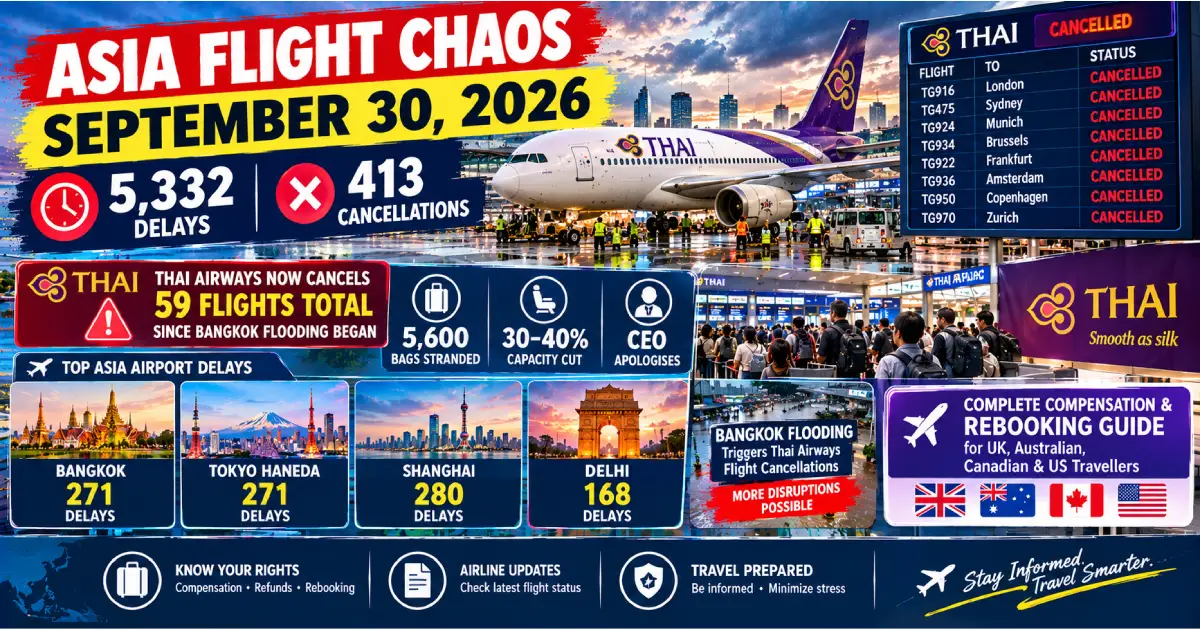
This is day five of Asia’s worst aviation crisis of 2026. What began as a weekend of severe Bangkok flooding on September 26 has now produced a cascading regional aviation failure that is in its second consecutive day of breaking records. Today, September 30, Asia’s airports have recorded 5,332 delays and 413 cancellations — the second-largest single-day disruption total in the Asia-Pacific region in all of 2026, exceeded only by yesterday’s record 6,108 delays and 591 cancellations. Thai Airways, at the epicentre, has now cancelled 59 flights since the flooding began — including today’s services to London, Sydney, Munich, Brussels, Frankfurt, Amsterdam, Copenhagen and Zurich. The airline’s CEO has issued a public apology. Around 5,600 pieces of luggage are still stranded at Suvarnabhumi. Thailand Post vehicles are delivering bags to passengers’ homes and hotels. And the airline has admitted it got it wrong — cutting capacity by 30–40% and deploying government agencies and military personnel to clear a baggage hall that has become, in the words of Thai Examiner, a “baggage flood.”
Crisis day: Wednesday September 30, 2026 — Day 5 of Bangkok flooding aviation crisis Data source: FlightAware real-time airspace monitoring / Bangkok Post / Malay Mail / Aviation24 / ASEAN NOW Total Asia delays today: 5,332 flights Total Asia cancellations today: 413 flights Compared to yesterday: 6,108 delays / 591 cancellations (September 29 — Asia’s worst day of 2026) Combined 2-day total: 11,440 delays + 1,004 cancellations across Asia Bangkok Suvarnabhumi today: 304 delays — 63 cancellations — highest single-hub cancellation count in Asia Tokyo Haneda today: 271 delays — 5 cancellations Shanghai Pudong today: 280 delays — 12 cancellations Delhi Indira Gandhi today: 168 delays — 12 cancellations SpiceJet today: 30 delays (40% of schedule) — 8 cancellations (10%) IndiGo today: 195 delays — 3 cancellations Thai Airways total cancellations since Sept 26: 59 flights confirmed Thai Airways capacity cut: 30–40% reduced schedule Baggage still stranded: Approximately 5,600 pieces Thai Airways CEO statement: Public apology issued — Chai Eamsiri Government agencies involved: Thailand Post vehicles deployed for bag delivery; military personnel at Suvarnabhumi Thai Airways 24hr contact: +66 2 356 1111 | EU261 compensation ceiling: Up to €600 per passenger departing EU airports UK261 compensation ceiling: Up to £520 per passenger departing UK airports
To understand September 30’s 5,332 delays and 413 cancellations, you have to understand the five days that produced them.
September 24–25: A weather system over the Gulf of Thailand intensified into the most destructive rainfall event Bangkok has experienced in years, delivering more than 330mm of rain — roughly a full month’s worth — in a 48–72 hour window over the Thai capital and surrounding provinces.
September 26: Floodwaters rose across Bangkok’s 50 districts. Low-lying eastern neighbourhoods — home to the largest concentration of Suvarnabhumi Airport’s ground handling workforce — saw floodwater reach chest height in some areas. Hundreds of Thai Airways ground staff living in those neighbourhoods could not reach the airport. The baggage system began to fail. Aircraft continued to arrive and depart, but luggage stopped moving at normal speed.
September 27: Bangkok Governor Chadchart Sittipunt declared all 50 city districts disaster-affected zones. Approximately 329,000 households — around 700,000 people — were affected. Baggage from Thai Airways flights operated on September 26 and 27 began piling up in the arrivals halls. Some passengers waited six to eight hours at carousels. Bags were lined up in terminal hallways, visible to arriving passengers who had no information about when their luggage would appear.
September 28: The Thai government deployed 69 Thai Air Force personnel to Suvarnabhumi to support ground handling. The Prime Minister declared Bangkok and surrounding provinces disaster zones and approved 2 billion baht ($59.5 million) in emergency relief. Thai Airways reported 34 delayed flights on Monday alone. The airline began its first wave of cancellations covering September 29 and 30, affecting routes to Frankfurt and Munich.
September 29 — Asia’s worst day of 2026: Thai Airways announced 22 domestic and international cancellations covering Tuesday and Wednesday. The regional cascade produced 6,108 delays and 591 cancellations across Asia — the single worst aviation day the region had recorded in all of 2026. Hundreds of South Korean passengers were stranded at Suvarnabhumi for up to 14 hours waiting for flights home.
September 30 — TODAY: Thai Airways announces 37 more cancellations on top of the original 22 — bringing the total to 59 cancelled flights since September 26. The cancellation list expands to include Bangkok–London, Bangkok–Sydney, Bangkok–Osaka, Bangkok–Tokyo (both Narita and Haneda), Bangkok–Copenhagen, Bangkok–Zurich, Bangkok–Amsterdam, Bangkok–Manila, and Bangkok–Hong Kong. Around 5,600 bags remain stranded. Thailand Post vehicles are now being used to deliver delayed baggage directly to passengers at hotels and home addresses. Government agencies have been drawn directly into the recovery operation. And across Asia, the regional cascade from Bangkok’s apron flooding and schedule disruption is still producing 5,332 delays and 413 cancellations from Tokyo to Istanbul.
The Bangkok Post and ASEAN NOW have published the confirmed cancellation list. Every flight below is officially cancelled for today.
| Flight | Route | Sector |
|---|---|---|
| TG201 | Bangkok (BKK) → Phuket (HKT) | Domestic |
| TG205 | Bangkok (BKK) → Phuket (HKT) | Domestic |
| TG217 | Bangkok (BKK) → Phuket (HKT) | Domestic |
| TG102 | Bangkok (BKK) → Chiang Mai (CNX) | Domestic |
| TG040 | Bangkok (BKK) → Khon Kaen (KKC) | Domestic |
| TG020 | Bangkok (BKK) → Ubon Ratchathani (UBP) | Domestic |
| TG002 | Bangkok (BKK) → Udon Thani (UTH) | Domestic |
| Flight | Route | Market |
|---|---|---|
| TG916 | Bangkok (BKK) → London Heathrow (LHR) | 🇬🇧 UK |
| TG924 | Bangkok (BKK) → Munich (MUC) | 🇩🇪 Europe |
| TG934 | Bangkok (BKK) → Brussels (BRU) | 🇧🇪 Europe |
| TG922 | Bangkok (BKK) → Frankfurt (FRA) | 🇩🇪 Europe |
| TG950 | Bangkok (BKK) → Copenhagen (CPH) | 🇩🇰 Europe |
| TG970 | Bangkok (BKK) → Zurich (ZRH) | 🇨🇭 Europe |
| TG936 | Bangkok (BKK) → Amsterdam (AMS) | 🇳🇱 Europe |
| TG638 | Bangkok (BKK) → Hong Kong (HKG) | Asia |
| TG632 | Bangkok (BKK) → Taipei (TPE) | Asia |
| TG622 | Bangkok (BKK) → Osaka (KIX) | 🇯🇵 Japan |
| TG656 | Bangkok (BKK) → Seoul (ICN) | 🇰🇷 Korea |
| TG642 | Bangkok (BKK) → Tokyo Narita (NRT) | 🇯🇵 Japan |
| TG660 | Bangkok (BKK) → Tokyo Haneda (HND) | 🇯🇵 Japan |
| TG417 | Bangkok (BKK) → Kuala Lumpur (KUL) | Malaysia |
| TG403 | Bangkok (BKK) → Singapore (SIN) | Singapore |
| TG407 | Bangkok (BKK) → Singapore (SIN) | Singapore |
| TG315 | Bangkok (BKK) → New Delhi (DEL) | 🇮🇳 India |
| TG317 | Bangkok (BKK) → Mumbai (BOM) | 🇮🇳 India |
| TG475 | Bangkok (BKK) → Sydney (SYD) | 🇦🇺 Australia |
| TG620 | Bangkok (BKK) → Manila (MNL) | Philippines |
| TG600 | Bangkok (BKK) → Hong Kong (HKG) | Asia |
⚠️ Also announced on September 29 (Tuesday): Bangkok–Dhaka TG339, Bangkok–Seoul TG658, Bangkok–Bengaluru TG325, Bangkok–Sapporo TG670, Bangkok–New Delhi TG331.
⚠️ Thursday October 1: Additional cancellations covering Paris, and further routes, have been announced. Check thaiairways.com and the Thai Airways Facebook page for the October 1 list.
Thai Airways has now cancelled 59 flights since September 26. The airline has not indicated how long the disruption will continue beyond October 1.
Bangkok is today’s undisputed epicentre of the Asian aviation crisis. With 304 delays and 63 cancellations, Suvarnabhumi is recording the highest single-hub cancellation count in Asia today — for the second consecutive day.
The physical reality at Suvarnabhumi right now is extraordinary. Bags from 52 flights operated on September 26 and 27 are still being delivered to passengers who registered their details — Thai Airways has deployed Thailand Post vehicles to ferry luggage to hotels and homes across Bangkok and surrounding provinces. Public areas inside the terminal have been photographed by Reuters and local media showing mountains of unclaimed suitcases lining terminal hallways. The scenes prompted Thai Examiner’s headline: “Thai Airways admits it got it wrong as Suvarnabhumi airport public areas are swamped by a baggage flood.”
Thai Airways has cut its capacity by approximately 30–40%. The carrier is operating a sharply reduced schedule while simultaneously trying to clear the backlog, rebook thousands of displaced passengers, and reposition aircraft and crews that are now out of sequence across its entire global network.
Aviation24 Belgium confirmed that Thai Airways has cancelled its Bangkok–Brussels flight TG934 on Wednesday September 30 and Thursday October 1 as it reduces services to recover. The airline’s notice listed the corresponding Brussels–Bangkok flight TG935 on September 30 as also cancelled.
For the TG916 Bangkok–London Heathrow cancellation specifically: This is Thai Airways’ flagship UK service and the primary connection for hundreds of British passengers who have been in Thailand for holiday or business travel. The cancellation of TG916 today means affected passengers face a significant rebooking challenge. The next available Bangkok–London routing would need to come from another carrier — British Airways, Qantas (via Hong Kong or Singapore), Cathay Pacific, or a Gulf carrier via Dubai or Doha.
For TG475 Bangkok–Sydney: This is the most important cancellation for Australian readers today. Thai Airways TG475 is the direct Bangkok–Sydney service that connects the Australian market to Southeast Asia via Bangkok. Passengers booked on TG475 today have already received cancellation notifications. Australian travellers should immediately check qantas.com, jetstar.com, and singaporeair.com for alternative routings.
Tokyo Haneda is today’s second most-delayed airport in Asia with 271 delays and 5 cancellations. Yesterday’s 650-delay record at Haneda has not been repeated — the Japanese domestic network is partially recovering — but 271 delays at Haneda still represents significant disruption across Japan Airlines, All Nippon Airways, and the regional carriers that feed into Haneda from across Japan’s domestic network.
The particular risk for Haneda today: Thailand’s cancelled Thai Airways flights to Tokyo (TG642 Narita and TG660 Haneda) mean passengers who were due to connect through Bangkok onto Thai Airways services to Japan are now stranded without their inbound aircraft. Japan Airlines and ANA’s Bangkok–Tokyo connections remain operational, but are absorbing displaced Thai Airways passengers who are rebooking.
Tokyo’s New Chitose (Sapporo), Fukuoka, and Osaka Itami airports are all reporting secondary delays as Haneda’s congestion cascades into Japan’s domestic network.
Shanghai Pudong continues to carry significant operational stress with 280 delays and 12 cancellations. China Eastern — whose home hub is Pudong — is absorbing the bulk of Shanghai’s delay load as its regional network continues to recover from the weather-driven flow management restrictions that have characterised Chinese airspace throughout late September.
Shanghai Hongqiao — Pudong’s domestic companion airport — is also recording elevated delays, compressing the aviation system across the Yangtze Delta region.
Guangzhou Baiyun, Beijing Capital, and Shenzhen Bao’an are all recording additional delays as China’s airspace flow control programmes continue through the transition from peak summer to winter slot allocations — a routine annual process that, under the accumulated pressure of late September’s disruption, is producing a more severe cascade than normal.
Delhi Indira Gandhi International is recording 168 delays and 12 cancellations today. The Delhi disruption is being driven by two simultaneous pressures: the cascading rotation deficit from Bangkok’s cancelled Thai Airways flights (TG315 and TG331 Delhi–Bangkok services cancelled on September 29 and 30 mean Thai Airways aircraft that should be positioned in Delhi are not there), and the ongoing monsoon-season runway maintenance throttling that has affected Delhi throughout September.
SpiceJet at Delhi today: SpiceJet is recording 8 cancellations (10% of its total schedule) and 30 delays (40%) — the worst delay rate percentage of any airline across Asia today. SpiceJet’s structural vulnerability to cancellation-cascade events reflects its thinner rotation buffer compared to larger carriers. Passengers on SpiceJet today should treat any connection involving a SpiceJet feeder as elevated risk.
IndiGo at Delhi and across India today: IndiGo is recording 195 delays and 3 cancellations across its India network — the highest delay volume of any individual airline operating in the Asian market today by total number. IndiGo operates India’s largest domestic network and its rotation deficit from earlier this week is still propagating through today’s schedule.
Mumbai’s Chhatrapati Shivaji Maharaj International Airport is also recording elevated delays as the Thai Airways Mumbai cancellation (TG317) removes a Bangkok-positioning aircraft from the network.
The mechanism by which a flooding event in eastern Bangkok’s residential neighbourhoods produces a cancelled flight at London Heathrow is worth explaining, because it is not immediately obvious — and because understanding it tells passengers exactly what their legal position is.
Thai Airways operates a hub-and-spoke network centred entirely on Bangkok Suvarnabhumi. Every long-haul Thai Airways flight to London, Sydney, Munich, Frankfurt, Zurich, Amsterdam, Copenhagen, and Brussels begins at Bangkok and requires:
1. An aircraft at Bangkok, in serviceable condition, loaded with fuel, catering, and baggage. 2. A crew at Bangkok, fully rested, within their duty-hour limits, holding valid licences for the specific aircraft type. 3. A ground handling team at Bangkok, capable of loading 200–400 pieces of checked luggage, fuelling the aircraft, completing the pushback, and turning the aircraft around in the scheduled window.
When Bangkok flooded on September 26, condition three failed across Thai Airways’ entire operation. The ground handling team — whose members live predominantly in the eastern Bangkok neighbourhoods that flooded first and deepest — could not reach the airport. The airlines can operate without many things; they cannot operate without the people who physically load the aircraft.
The aircraft were there. The runways were open. But bags could not be loaded. And when bags cannot be loaded, flights cannot depart with passengers who have checked luggage aboard — because checked bags must travel with their registered passenger for security reasons. When flights cannot depart, aircraft fall behind schedule. When aircraft fall behind schedule across a network, the crews assigned to the next rotation accumulate towards their duty-hour limits. When crews hit their duty limits, flights cancel.
Thai Airways’ Bangkok–London TG916 cancelled today is not a consequence of London weather or a London ground crew failing. It is a direct consequence of a flooding event in eastern Bangkok on September 26, transmitted forward through four days of cascading operational failure.
This matters for your passenger rights claim.
The baggage crisis at Suvarnabhumi is the human face of this aviation disaster — and it is the story that generates the most reader search traffic, because it affects the most people across the widest range of nationalities.
What happened: Flooding prevented hundreds of ground staff from reaching work at Bangkok’s Suvarnabhumi Airport. Thai Airways said almost all its flights were delayed over the preceding two days. Around 5,600 bags were caught in the disruption. The airline has now brought in additional personnel and delivery providers to help reunite passengers with their luggage.
Thailand Post joins the recovery: In an extraordinary development, Thailand Post — the national postal service — has provided personnel and vehicles to help sort and transport Thai Airways baggage. The decision to involve Thailand Post reflects the scale of the logistical challenge: Thai Airways’ own baggage delivery infrastructure cannot process 5,600 stranded bags fast enough without external reinforcement.
Military personnel at the terminal: Government agencies have been drawn directly into the recovery operation, including the 69 Thai Air Force personnel deployed to support ground operations at Suvarnabhumi. Their presence — visible in uniform across the terminal’s baggage halls — underscores that this is no longer simply an airline operational problem. It is a national emergency response.
CEO apology: Thai Airways chief executive Chai Eamsiri issued a public apology after mounting criticism from passengers and government officials. The Thai Examiner reported that he admitted the airline “got it wrong” — an unusually direct admission from an airline CEO during an active operational crisis.
The 72-hour clearance target: Thai Airways has said it aims to clear the baggage backlog within 72 hours of September 29 — meaning the target is midnight on October 2. Bags from September 27 flights are being processed as priority; bags from September 28 flights are following.
If your bag is still stranded: Go to the Thai Airways baggage services desk at Suvarnabhumi or contact Thai Airways directly at +66 2 356 1111 (24 hours) or contact@thaiairways.com. Register your details if you have not already done so — Thai Airways confirmed it is delivering to registered passengers.
One of the most widely covered human stories from the Bangkok flood aviation crisis involves hundreds of South Korean passengers who were stranded at Suvarnabhumi Airport for up to 14 hours waiting for flights home. Record rains and citywide flooding in Bangkok left passengers unable to board, unable to reach their accommodation if they deplaned, and unable to obtain reliable information from airline staff who were themselves operating in a severely degraded environment.
The Korean passenger community in Bangkok — which includes a significant proportion of holiday visitors from South Korea who use Bangkok as a Southeast Asian leisure hub — was disproportionately affected because Thai Airways TG658 and TG656 Seoul services were among the cancelled flights. With few direct Seoul alternatives available and Suvarnabhumi unable to process connections efficiently, Korean passengers faced a situation where neither staying nor leaving was operationally viable.
Korean media coverage of the Suvarnabhumi situation has been extensive, adding international pressure on Thai Airways to resolve the baggage and flight cancellation crisis faster than it would otherwise have been compelled to act.
Every passenger rights framework — EU261, UK261, Australian Consumer Law, Canada’s APPR — distinguishes between disruptions caused by factors within the airline’s control (for which compensation is payable) and extraordinary circumstances outside the airline’s control (for which compensation is typically not payable, though refunds and duty of care remain mandatory).
Thai Airways will argue that the Bangkok flooding constitutes an extraordinary circumstance — a natural disaster that forced cancellations outside their control.
The passengers’ counter-argument, which is legally credible:
The flooding began on September 26. Thai Airways had multiple days to pre-cancel flights, reposition aircraft and crews to avoid the disruption, issue travel waivers, and advise passengers to change their plans before arriving at the airport. Airlines that fail to take available preventive action during a developing weather event — choosing instead to let passengers arrive at airports for flights that cancel at short notice — have historically faced stronger regulatory scrutiny over extraordinary circumstances claims.
Additionally: the baggage cart equipment failures at Suvarnabhumi, which compounded the staffing shortage, are within Thai Airways’ operational control. When multiple controllable failures combine with an external event to produce a cancellation, the extraordinary circumstances defence becomes more difficult to sustain in full.
Practical advice: File the claim. Let the regulator — not Thai Airways’ claims department — determine whether your specific cancellation qualifies. Most passengers accept the airline’s first refusal. Those who escalate recover significantly more.
Passengers departing from Heathrow, Gatwick, Manchester, Edinburgh, Birmingham, or any other UK airport on any airline are covered by UK Air Passenger Rights regulations:
| Route | Compensation |
|---|---|
| London to Bangkok (over 3,500 km) | £520 per passenger |
| Medium-haul connections (1,500–3,500 km) | £350 per passenger |
| Short-haul under 1,500 km | £220 per passenger |
For TG916 Bangkok–London Heathrow passengers today: You are departing from Bangkok (non-EU, non-UK airport) on a non-EU, non-UK carrier. UK261 does not apply to the Bangkok departure leg. However, if your ticket originated in the UK and Bangkok was a connection point, your original departure from a UK airport may bring UK261 into scope for the outbound journey. Seek advice from airhelp.com or the UK CAA.
File claims: Civil Aviation Authority — caa.co.uk → Passenger Rights No-win-no-fee: airhelp.com or airadvisor.com Time limit: 6 years from the date of disruption (England and Wales)
Passengers departing from any EU airport (Frankfurt, Munich, Brussels, Amsterdam, Copenhagen, Zurich) on Thai Airways are covered by EU Regulation 261/2004:
| Route | Compensation |
|---|---|
| Over 3,500 km (European cities to Bangkok) | €600 per passenger |
For TG924 Munich, TG934 Brussels, TG922 Frankfurt, TG936 Amsterdam, TG950 Copenhagen, TG970 Zurich — all cancelled today: Passengers holding tickets from these EU departure points on today’s cancelled services have a strong EU261 claim. EU261 applies to any airline departing from an EU airport — including Thai Airways — regardless of nationality.
File claims: European national aviation authority or no-win-no-fee: airhelp.com Time limit: 2 years in most EU member states from the date of disruption
Australia does not have a statutory EU261-equivalent. Australian Consumer Law and Thai Airways’ own conditions of carriage require:
For TG475 Bangkok–Sydney cancelled today: Australian passengers on TG475 are departing from Bangkok — a non-EU, non-UK airport. EU261 and UK261 do not apply. Australian Consumer Law applies to the extent the contract was formed in Australia. The Montreal Convention applies to baggage delay compensation (up to approximately AUD 2,700 per passenger for provable losses from delayed bags).
File claims: Airline Customer Advocate — airlinecustomeradvocate.com.au Baggage claims: File a Property Irregularity Report (PIR) at the Thai Airways baggage desk before leaving the airport
Under Canada’s Air Passenger Protection Regulations, for cancellations with less than 14 days’ notice on large airlines:
| Delay | Compensation |
|---|---|
| 3–6 hours | CAD $400 |
| 6–9 hours | CAD $700 |
| 9+ hours | CAD $1,000 |
Thai Airways is classified as a large airline under APPR.
File claims: otc-cta.gc.ca → Air Travel Complaints
Every passenger on a cancelled Thai Airways flight today — regardless of nationality or departure airport — is entitled to:
The voucher trap: Thai Airways may offer a travel credit or voucher as the first option. You are not obligated to accept it. State clearly: “I am requesting a full cash refund to my original payment method, not a travel voucher.”
If you booked via a travel agent or tour operator: Contact them directly — they hold the ticketing contract and can process the refund more quickly in some cases. Package travel regulations in the UK, EU, Canada, and Australia may also entitle you to additional protections under package travel regulations beyond the airline’s own conditions.
For passengers whose bags have not yet arrived from their September 26–29 flight:
Under the Montreal Convention (ratified by Thailand, the UK, the EU, Australia, and Canada), airlines are liable for damages caused by delayed checked baggage up to a maximum of approximately 1,288 Special Drawing Rights per passenger — approximately:
To claim: You must file a written claim with Thai Airways within 21 days of receiving your delayed bag. Keep every receipt for essential replacement items you purchased because your bag had not arrived — toiletries, clothing, medication replacements. Photograph every receipt and email it to yourself immediately.
If your bag contained essential medication: Flag this immediately to Thai Airways baggage services. Thai Airways has a duty to prioritise delivery of bags containing medical equipment or medication under their conditions of carriage.
Action 1 — Check your flight. Go to thaiairways.com → Manage Booking or the Thai Airways app. If your flight is listed above or appears cancelled on the app, you are in the affected group.
Action 2 — Choose: refund or rebook. You have two clear options. A full cash refund to your original payment method (request this in writing via contact@thaiairways.com or the Thai Airways chat function). Or rebooking on the next available Thai Airways service — or, if Thai Airways cannot accommodate you, on an alternative carrier such as British Airways, Qantas, Emirates, Cathay Pacific, or Singapore Airlines.
Action 3 — If your bag is stranded at Bangkok. Register your contact details with Thai Airways baggage services at Suvarnabhumi if you are in Bangkok, or call +66 2 356 1111 if you are outside Thailand. Thai Airways is delivering to registered passengers — those who have not registered will wait significantly longer. File a Property Irregularity Report (PIR) in writing.
Action 4 — Alternative routings for TG916 London passengers. British Airways operates daily Bangkok–London Heathrow (BA9). Qantas QF1 operates Bangkok–London via Sydney. Emirates connects Bangkok–Dubai–London. Qatar Airways connects Bangkok–Doha–London. Cathay Pacific connects Bangkok–Hong Kong–London. Check all options — fares will be elevated but alternatives exist.
Action 5 — Alternative routings for TG475 Sydney passengers. Qantas QF25 operates daily Bangkok–Sydney. Singapore Airlines SQ211 connects Bangkok via Singapore. Jetstar JQ7 operates Bangkok–Melbourne and Bangkok–Sydney. Thai Vietjet and AirAsia X also offer connecting options via Kuala Lumpur or Ho Chi Minh City.
Action 6 — File your EU261 or UK261 claim today. If you are departing from a UK or EU airport on any cancelled or significantly delayed service today, start the claim process now, while the disruption is fresh. Go to airhelp.com or airadvisor.com — both operate no-win-no-fee. Do not wait for Thai Airways to contact you proactively about compensation.
Action 7 — Keep all receipts. Every meal, hotel night, transport cost, and essential purchase you incur because of this disruption is potentially reimbursable under EU261, UK261, APPR, or the Montreal Convention. Photograph receipts immediately and email them to yourself with a note of the date and reason.
Action 8 — Do not accept a voucher. You are legally entitled to cash. If Thai Airways offers a travel credit, voucher, or eWallet credit, decline it and request a cash refund in writing.
Action 9 — Allow 3 hours extra for Suvarnabhumi. If you are travelling through Bangkok today for any reason — even on a non-Thai Airways carrier — allow 3 additional hours beyond your normal airport arrival time. The Tourism Authority of Thailand advises arriving 2–3 hours earlier than usual due to severe traffic congestion as flood recovery operations continue across eastern Bangkok road networks.
Action 10 — Save these contacts.
| Contact | Details |
|---|---|
| Thai Airways 24hr Contact Centre | +66 2 356 1111 |
| Thai Airways Email | contact@thaiairways.com |
| Thai Airways Facebook | facebook.com/ThaiAirways |
| Thai Airways Manage Booking | thaiairways.com → Manage Booking |
| Suvarnabhumi Airport Live | suvarnabhumi.airportthai.co.th |
| EU261 / UK261 Claims | airhelp.com or airadvisor.com |
| UK CAA Passenger Rights | caa.co.uk/passengers |
| Australian Airline Advocate | airlinecustomeradvocate.com.au |
| Canada APPR Claims | otc-cta.gc.ca |
| British Airways alt routing | ba.com → Book a Flight |
| Qantas alt routing | qantas.com → Book a Flight |
| Singapore Airlines alt routing | singaporeair.com → Book a Flight |
Beyond Bangkok, the September 30 disruption picture across Asia reflects the compounding cascade of two consecutive record-disruption days:
Istanbul Airport is recording significant delays as a transiting hub absorbing the downstream effects of Asian schedule disruption — aircraft arriving late from Bangkok, Delhi, and Shanghai into Istanbul are delaying their own onward European rotations.
Jakarta Soekarno-Hatta continues to record elevated disruption as Indonesia’s aviation system absorbs the after-effects of the nor’easter in the US (which displaced United and Delta transoceanic rotations) combined with the Bangkok cascade.
Kuala Lumpur International is under additional pressure as airlines reroute displaced Bangkok passengers through KUL connections — AirAsia X, Malaysia Airlines, and Batik Air all absorbing rebooking traffic.
Hanoi Noi Bai and Ho Chi Minh City Tan Son Nhat are both recording delays as VietJet Air and Vietnam Airlines absorb rotation pressure from Bangkok schedule changes.
The cumulative two-day disruption total across Asia — 11,440 delays and 1,004 cancellations — represents an aviation crisis that has affected an estimated 1.5 to 2 million passengers across the Asia-Pacific region since September 26.
Floodwaters in Bangkok are receding. The Thai government confirmed on September 27 that drainage is improving, and the Bangkok Flood Control Center reported that conditions were improving enough to accelerate drainage efforts by Monday, though residual flooding in low-lying areas and near canals will persist.
The aviation recovery will lag the flood drainage by several days. Here is why:
Thai Airways has 59 confirmed cancelled flights. Each cancellation displaces an aircraft from its intended position. Each displaced aircraft means a crew that should be resting in London, Sydney, Munich, or Frankfurt is instead sitting in Bangkok awaiting reassignment. Each displaced crew means the outbound service from London or Sydney carrying passengers home to Bangkok has no inbound aircraft to turn around. The rotation debt from 59 cancellations will take approximately 5–7 operating days to fully absorb — meaning the disruption effects will be felt through at least October 7.
Our assessment for passengers planning travel through Bangkok in October:
Monitor thaiairways.com and the Thai Airways Facebook page daily. The airline is publishing updated cancellation lists as they are confirmed. We will update this article immediately when new cancellation announcements are made.
Related Articles:
Posted By : Vinay
This article is provided for general informational purposes only and is based on information available at the time of publication. Travel advisories, airline schedules, airport operations, visa requirements, government regulations, and other travel-related information are subject to change without prior notice. While Travel Tourister makes reasonable efforts to verify information using official announcements, government publications, airline and airport communications, and other reliable sources, we cannot guarantee that all information remains complete, accurate, or up to date at all times. Readers should independently verify any information that may affect their travel plans with the relevant airline, airport authority, government agency, embassy, or other official source before making travel, financial, or other decisions. Travel Tourister shall not be liable for any direct or indirect loss, inconvenience, or damages arising from the use of or reliance on the information contained in this article. Nothing in this publication constitutes legal, immigration, financial, or professional travel advice. If you believe any information in this article is inaccurate or outdated, please contact our editorial team. We review all credible correction requests promptly and update our content whenever appropriate.
Lastest News
2nd Floor, 39, Above Kirti Club, DLF Industrial Area, Kirti Nagar, New Delhi, Delhi 110015



Travel Tourister is a leading Travel portal where we introduce travellers to trusted travel agents to make their journey hasselfree, memorable And happy. Travel Tourister is a platform where travellers get Tour packages ,Hotel packages deals through trusted travel companies And hoteliers who are working with us across the world. We always try to find new and more travel agents and hoteliers from every nook and corners across the world so that you could compare the deals with different travel agents and hoteliers and book your tour or hotel with the one you have chosen according to your taste and budget.
Copyright © Travel Tourister, India. All Rights Reserved

 Call
Call Enquiry