Published on : 05 Oct 2026
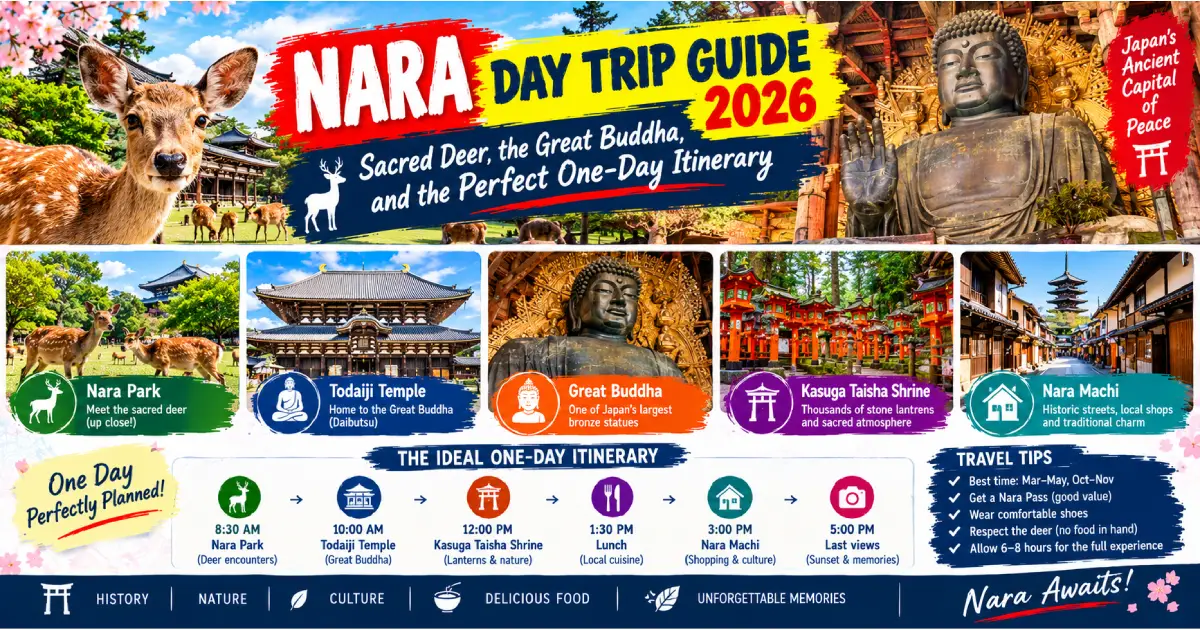
Nara was Japan’s first permanent imperial capital, established in 710 AD, more than eight decades before Kyoto assumed that role — a historical head start that left the city with some of Japan’s oldest and most significant Buddhist monuments, concentrated within a single walkable park alongside over 1,000 free-roaming sika deer considered sacred messengers of the gods in Shinto belief. For a tier-1 visitor based in Kyoto or Osaka, Nara is the single most popular and most straightforward day trip in the entire Kansai region — reachable in under an hour, requiring no overnight stay, and delivering a genuinely different historical register from either base city.
This guide covers everything needed to plan a complete Nara day trip: how to get there, a full one-day itinerary, the specific etiquette around Nara’s famous deer, and the practical details that make the day run smoothly.
| Distance from Kyoto | ~45 minutes by JR Nara Line |
| Distance from Osaka | ~45 minutes by JR or Kintetsu line |
| Recommended Time Needed | Full day (6–8 hours), though a condensed half-day version is possible |
| Best Time to Visit | Spring (cherry blossoms) or autumn (foliage); avoid peak midday heat in summer |
| Entry Cost | Nara Park is free; individual temples charge ¥500–¥800 |
| Known For | Free-roaming sacred deer, Todai-ji’s Great Buddha, Japan’s oldest surviving wooden structures |
From Kyoto: The JR Nara Line runs directly from Kyoto Station to JR Nara Station in approximately 45 minutes (JR Pass-covered). This is the standard, most convenient route for visitors based in Kyoto.
From Osaka: Both the JR line (from Osaka or Tennoji Station) and the Kintetsu Nara Line (from Namba Station) connect to Nara in approximately 35–45 minutes — the Kintetsu line’s Nara Station sits slightly closer to the park entrance and is often marginally faster, though it isn’t JR Pass-covered.
From the station to the park: JR Nara Station and Kintetsu Nara Station are both within a comfortable 15–20 minute walk of Nara Park’s entrance, and the walk itself passes through pleasant shopping streets — a taxi or bus is available but rarely necessary.
9:00 AM — Arrive at Nara Park and begin with the deer themselves — purchase shika senbei (deer crackers, ¥200 per pack) from one of the park’s vendor stalls, and spend 20–30 minutes among the park’s over 1,000 free-roaming sika deer before the day’s heaviest crowds arrive.
9:45 AM — Todai-ji Temple, a 10-minute walk into the park, houses the Daibutsu — a 15-meter bronze Great Buddha statue cast in 752 AD — inside the Daibutsuden, which remains the largest wooden building on Earth despite having been rebuilt at roughly two-thirds its original scale after historical fires. Budget at least 45 minutes here; the scale of both the building and the statue inside genuinely requires time to absorb.
10:45 AM — Continue uphill past Todai-ji to Nigatsu-do, a smaller temple hall offering one of the best panoramic views over Nara Park and the city beyond — a worthwhile, less crowded detour most same-day visitors skip entirely.
11:30 AM — Kasuga Taisha, a roughly 20-minute walk east through the park, is approached along a forested path lined with thousands of stone lanterns (and, inside the shrine itself, thousands more bronze lanterns) — one of Japan’s most atmospheric shrine approaches, especially in the dappled morning or late afternoon light filtering through the surrounding primeval forest.
12:30 PM — Lunch near the park or in the shopping streets closer to the station — kakinoha-zushi (persimmon-leaf-wrapped sushi, a Nara regional specialty with a history dating back centuries) is the local dish worth specifically seeking out.
1:30 PM — Kofuku-ji, near the park’s entrance, is home to a five-story pagoda (Japan’s second tallest, after Kyoto’s Toji) and a National Treasure Museum housing some of Japan’s finest surviving Buddhist sculpture, including the striking multi-armed Ashura statue.
2:30 PM — Naramachi, Nara’s preserved former merchant district immediately south of the park, offers a genuinely different register from the temple-heavy morning — narrow lanes of traditional wooden townhouses (machiya) now housing small cafes, craft shops, and museums, with noticeably fewer crowds than the main park.
3:30 PM — Isuien Garden (optional), a landscaped Meiji-era garden near Todai-ji, uses the Nara hills and Todai-ji’s own Nandaimon Gate as borrowed scenery — a peaceful final stop before heading back to the station.
4:30 PM — Return train to Kyoto or Osaka.
Nara’s deer are genuinely unique among Japan’s wildlife encounters — habituated to humans over centuries, free-roaming throughout the park and even into surrounding streets, and specifically trained (through generations of feeding) to bow their heads before receiving a cracker, one of the park’s most charming and widely photographed behaviors.
Beyond kakinoha-zushi, Nara’s food scene is generally lower-key than Kyoto’s or Osaka’s, reflecting its role as a day-trip rather than overnight destination for most visitors — narazuke (vegetables pickled in sake lees, a specifically Nara preservation technique) and a handful of good traditional restaurants in Naramachi round out a day’s eating, though most visitors find a single good lunch is sufficient given the day trip’s shorter overall timeframe compared to a full city stay.
Spring (cherry blossoms, typically early April, concentrated particularly around Yoshinoyama slightly outside central Nara) and autumn (foliage, mid-to-late November, especially around Todai-ji and Kasuga Taisha’s forested approach) are Nara’s most beautiful and most crowded windows — see our Japan in Spring and Japan in Autumn guides for broader regional timing. Summer brings genuine heat and humidity that can make a full day of walking tiring; winter offers the thinnest crowds and a specific, quiet beauty to the park’s bare trees, with the deer arguably easier to interact with given fewer competing visitors.
About Travel Tourister Travel Tourister’s destination specialists have made the Nara day trip from both Kyoto and Osaka across multiple visits — bowing to deer for crackers at dawn, standing before Todai-ji’s Great Buddha, and walking Kasuga Taisha’s lantern-lined forest approach — to put together a complete, practical guide for 2026 visitors planning their own day in Nara.
Posted By : Vinay
Latest Article
2nd Floor, 39, Above Kirti Club, DLF Industrial Area, Kirti Nagar, New Delhi, Delhi 110015



Travel Tourister is a leading Travel portal where we introduce travellers to trusted travel agents to make their journey hasselfree, memorable And happy. Travel Tourister is a platform where travellers get Tour packages ,Hotel packages deals through trusted travel companies And hoteliers who are working with us across the world. We always try to find new and more travel agents and hoteliers from every nook and corners across the world so that you could compare the deals with different travel agents and hoteliers and book your tour or hotel with the one you have chosen according to your taste and budget.
Copyright © Travel Tourister, India. All Rights Reserved

 Call
Call Enquiry