Published on : 18 Sep 2026
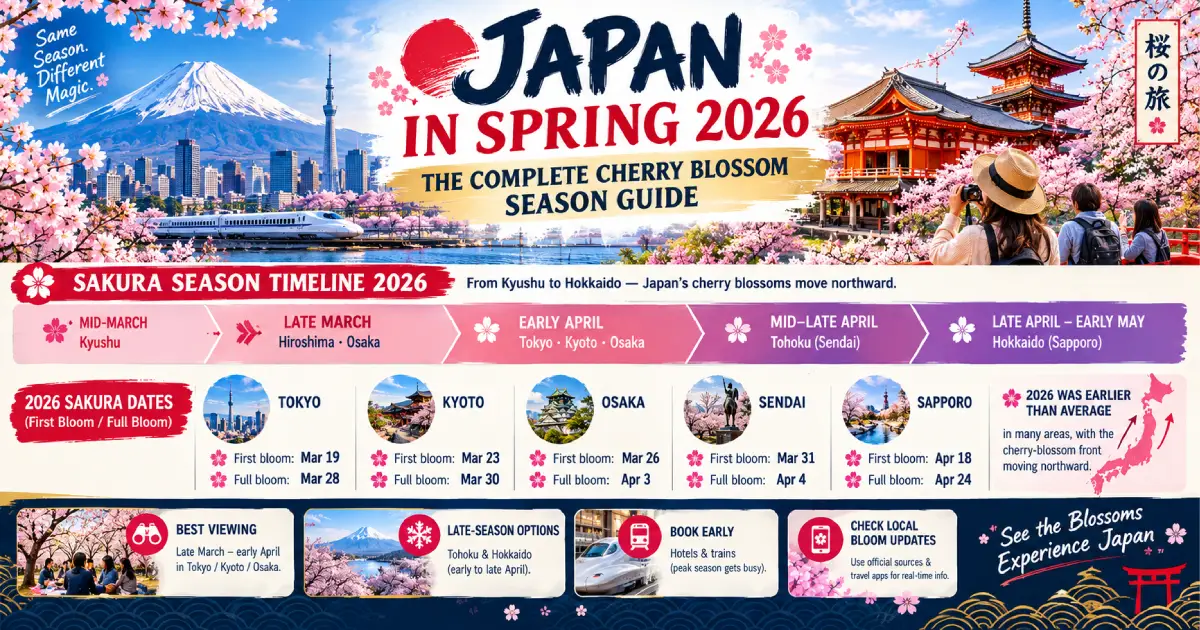
Spring in Japan is built around a single, genuinely extraordinary two-week event that most of the country organizes its entire cultural and social calendar around: sakura, the cherry blossom bloom, which sweeps the country from south to north over roughly six weeks but delivers its most dramatic, camera-ready peak in any single city for only a handful of days — a specific, narrow window that makes spring simultaneously the most rewarding and most logistically demanding season for a tier-1 first-time visitor to plan around. The reward is real: entire riverbanks, temple grounds, and castle moats transformed into tunnels and clouds of pale pink and white blossom, hanami (flower-viewing) picnics spreading blue tarps under blooming trees in every park in the country, and a specific, collectively shared national mood — a kind of public, unembarrassed appreciation of transient beauty — that has no close equivalent in Western tier-1 travelers’ home cultures. The demand is equally real: cherry blossom season is Japan’s single most expensive, most crowded, and least flexible travel window of the year, and a visitor who plans around it without understanding its specific unpredictability (the bloom date itself varies year to year by 1–2 weeks and is only reliably forecast about a month in advance) risks landing either a week before the trees open or a week after the petals have already fallen.
Spring runs roughly from early March through late May in Japan, and cherry blossoms are only the season’s headline act rather than its entirety — plum blossoms (ume) bloom several weeks earlier and are frequently overlooked by tier-1 visitors despite genuine beauty and dramatically thinner crowds, wisteria and azaleas take over in late April and May after the sakura have fallen, and the specific weather window (mild temperatures, relatively low humidity, before the June rainy season arrives) makes even a non-blossom-timed spring trip one of the two best-weather windows of the Japanese year alongside autumn. This guide covers the cherry blossom forecast logic, the best viewing spots by city, what else spring offers, and the specific crowd and pricing realities a first-time tier-1 visitor needs to plan around.
| Period | Weather | Cherry Blossom Status | Crowd Level | Price Level |
|---|---|---|---|---|
| Early March | 8–13°C (46–55°F), still cool | Plum blossoms peak; sakura not yet open | Low–moderate | Normal |
| Mid–Late March | 10–16°C (50–61°F), warming | Kyushu and Kansai sakura begin | Rising sharply | Rising |
| Late March–Early April | 12–18°C (54–64°F) | Peak bloom, Tokyo/Kyoto/Osaka (typical window) | Highest of the year | Highest of the year |
| Mid-April | 14–20°C (57–68°F) | Petals falling in Kansai/Kanto; still blooming further north | Very high (Golden Week approaches) | Very high |
| Late April–Early May | 16–22°C (61–72°F) | Tohoku and Hokkaido sakura peak | Extreme (Golden Week, Apr 29–May 5) | Extreme |
| Mid–Late May | 18–24°C (64–75°F) | Wisteria and azaleas; sakura finished except Hokkaido | Moderate, easing | Easing |
Japan’s cherry blossom front (sakura zensen) moves reliably from south to north and low to high elevation each year, but the exact date it reaches any given city shifts by as much as 1–2 weeks year to year depending on winter and early spring temperatures, which is why the Japan Meteorological Corporation and several private forecasters release rolling predictions starting in January and firming up through late February and March.
| City/Region | Typical First Bloom | Typical Full Bloom (Peak) |
|---|---|---|
| Fukuoka (Kyushu) | Mid-March | Late March |
| Hiroshima | Mid–Late March | Late March–Early April |
| Kyoto | Late March | Early April |
| Osaka | Late March | Early April |
| Tokyo | Late March | Early April |
| Kanazawa | Early April | Mid-April |
| Sendai (Tohoku) | Mid-April | Late April |
| Hokkaido (Sapporo) | Late April–Early May | Early–Mid May |
Booking strategy for an uncertain bloom date: Since precise dates aren’t reliable until roughly 3–4 weeks out, most experienced Japan-spring travelers book flights and initial accommodation around the historical average peak (last week of March through first week of April for Tokyo/Kyoto/Osaka) and build in flexibility — refundable hotel rates, or a itinerary that can shift 2–3 days between cities depending on which is currently at peak — rather than fixing an inflexible date months in advance and hoping.
The “chasing the bloom” strategy: Because the bloom front moves north over roughly six weeks, a longer spring trip can genuinely follow it — starting in Kyushu or Kansai in mid-to-late March and moving north through Tokyo, then Tohoku, arriving in Hokkaido by late April or early May, potentially catching peak or near-peak blossoms in multiple regions on a single trip rather than gambling on one city’s narrow window.
Best for: Classic temple-and-blossom photography | Peak timing: Early April
Maruyama Park’s massive weeping cherry tree (shidarezakura), illuminated at night during peak bloom, anchors Kyoto’s most famous single hanami gathering point, while the Philosopher’s Path — a stone walkway following a canal lined with hundreds of cherry trees between Ginkaku-ji and Nanzen-ji temples — offers the more contemplative, walkable version of the same experience with meaningfully thinner crowds if visited before 8 AM.
Best for: Blossoms over water | Peak timing: Late March–Early April
The moat surrounding the Imperial Palace’s northwest section is lined with hundreds of cherry trees whose branches arch out over the water — rental rowboats (book early during peak bloom, queues form well before opening) let visitors paddle directly beneath the canopy, and the evening illumination during peak bloom is among Tokyo’s most photographed single cherry blossom scenes.
Best for: Blossoms with a castle backdrop, large hanami crowds | Peak timing: Early April
Osaka Castle’s surrounding park, home to roughly 3,000 cherry trees, becomes one of the city’s largest and liveliest hanami gathering points — this is the spot for experiencing the full, unfiltered version of Japanese hanami culture: blue tarps, bento boxes, and convenience-store beer shared in groups beneath the blossoms from mid-morning well into evening.
Best for: Japan’s most beautiful castle, framed by blossoms | Peak timing: Early April
Himeji Castle — Japan’s best-preserved original feudal castle and a UNESCO World Heritage Site, nicknamed the White Heron Castle for its brilliant white facade — surrounded by roughly 1,000 cherry trees, is widely considered the single most photogenic castle-and-blossom combination in the country, reachable as a day trip from Osaka or Kyoto via Shinkansen.
Best for: A mountainside of 30,000 cherry trees | Peak timing: Early–Mid April (later than Kansai’s cities due to elevation)
Yoshinoyama’s specific character — an entire mountain terraced with roughly 30,000 cherry trees across four elevation zones (each blooming slightly later than the one below it, extending the viewing window), historically significant enough to have been celebrated in Japanese poetry for over a thousand years — makes it the most genuinely awe-inspiring single cherry blossom destination in the country for visitors willing to make the roughly 90-minute trip from Kyoto or Osaka.
Best for: Tohoku’s most celebrated cherry blossom destination | Peak timing: Late April
For visitors extending a trip north to chase the later bloom, Hirosaki Castle Park’s roughly 2,600 trees, combined with a moat where fallen petals collect into a pink “flower raft” (hanaikada) effect on the water’s surface, make this one of Japan’s most photographed later-season blossom spots.
Plum blossoms bloom several weeks before sakura, typically peaking in February and early March, in a deeper range of pink, red, and white than cherry blossoms, with a distinct fragrance sakura lacks entirely. Kairaku-en in Mito (one of Japan’s three most celebrated traditional gardens) and Yushima Tenjin in Tokyo are the two most-recommended plum blossom destinations — genuinely beautiful, and visited by a small fraction of the crowds that descend for sakura season a few weeks later.
After cherry blossoms fall in mid-to-late April, wisteria (fuji) takes over through early-to-mid May — Ashikaga Flower Park’s illuminated wisteria tunnels (roughly 90 minutes from Tokyo) are the country’s most celebrated single wisteria destination. Azaleas (tsutsuji) follow close behind, with Nezu Shrine in Tokyo hosting a specific late-April azalea festival across thousands of blooming shrubs.
Golden Week (April 29–May 5, a cluster of four separate national holidays) is Japan’s single busiest domestic travel week of the year, when a significant share of the country’s own population travels simultaneously — hotel prices spike, trains sell out days in advance, and popular attractions see their highest annual crowds. A first-time tier-1 visitor planning a spring trip should treat Golden Week as a period to specifically avoid or work around rather than a convenient extension of cherry blossom season, even though the two occasionally overlap in northern regions.
Hanami — literally “flower viewing,” the practice of picnicking beneath blooming cherry trees — is one of the most participatory, tourist-welcoming traditions in Japan, and a genuinely worthwhile experience for a tier-1 visitor to join rather than simply photograph from the sidelines.
Cherry blossom season is, without qualification, Japan’s most expensive and most crowded travel window of the year — flights and hotels for the peak week in Tokyo and Kyoto routinely run 30–60% above shoulder-season pricing, and popular hanami spots and nearby restaurants operate at capacity for the roughly 10–14 day peak window nationally. For a full breakdown of what a Japan trip costs across seasons, see our Is Japan Expensive in 2026? guide. Visitors specifically prioritizing value over guaranteed peak blossoms should consider early April (just past peak in Kansai/Kanto, with blossoms still excellent and crowds noticeably thinner) or shifting the entire trip to late April/early May in Tohoku or Hokkaido, where the bloom is just as spectacular with meaningfully better availability outside the Golden Week window itself.
About Travel Tourister Travel Tourister’s destination specialists have tracked the sakura front from Fukuoka’s early March blooms through Kyoto’s Philosopher’s Path peak and up to Hokkaido’s early-May finale, timing hanami picnics at Osaka Castle and dawn photography sessions at Chidorigafuchi to deliver a realistic, crowd-honest guide to Japan in spring for 2026 first-time visitors.
Posted By : Vinay
Latest Article
2nd Floor, 39, Above Kirti Club, DLF Industrial Area, Kirti Nagar, New Delhi, Delhi 110015



Travel Tourister is a leading Travel portal where we introduce travellers to trusted travel agents to make their journey hasselfree, memorable And happy. Travel Tourister is a platform where travellers get Tour packages ,Hotel packages deals through trusted travel companies And hoteliers who are working with us across the world. We always try to find new and more travel agents and hoteliers from every nook and corners across the world so that you could compare the deals with different travel agents and hoteliers and book your tour or hotel with the one you have chosen according to your taste and budget.
Copyright © Travel Tourister, India. All Rights Reserved

 Call
Call Enquiry