Published on : 18 Sep 2026
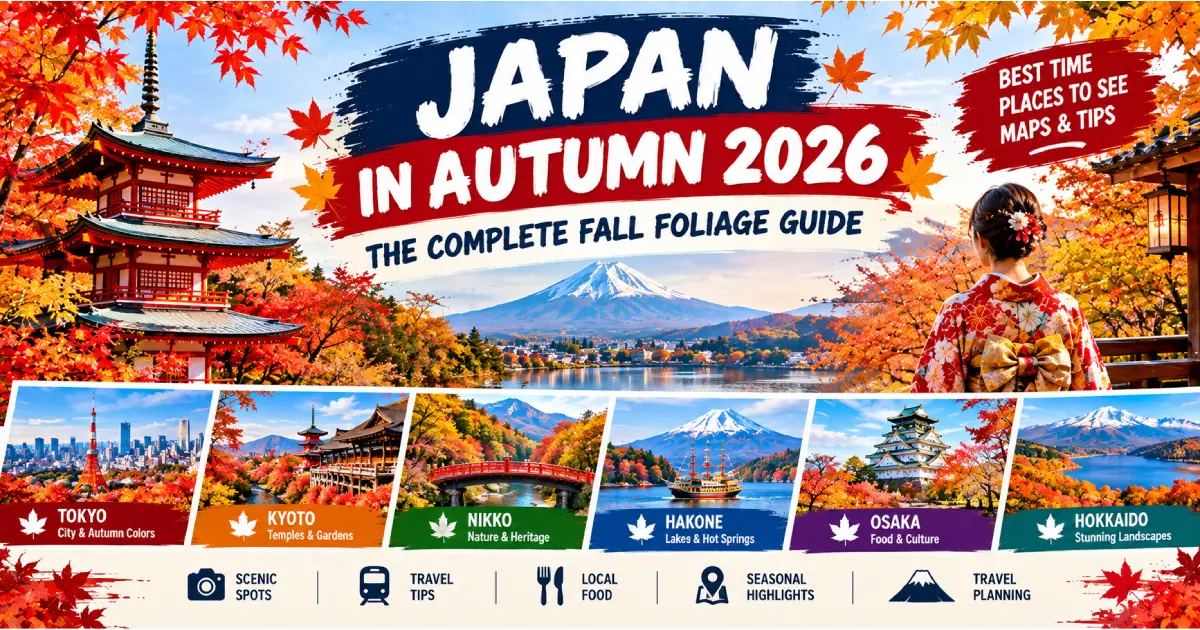
Autumn in Japan runs on the same basic logic as cherry blossom season — a color-change front (koyo, the autumn foliage equivalent of sakura) that sweeps the country over roughly two months, delivering a narrow, camera-ready peak in any single location for only 1–2 weeks — but with three practical advantages that a meaningful number of repeat visitors and Japan-based travel specialists rate above spring: the foliage color palette (deep reds, oranges, and golds from Japanese maples, ginkgo, and beech against the country’s characteristic dark-wood temple architecture) reads as genuinely more dramatic in photographs than cherry blossom’s paler pink; the peak window runs longer and is somewhat more forgiving to forecast than sakura’s more famously fickle timing; and — the detail that surprises most first-time tier-1 visitors — autumn crowds and prices, while still elevated, run consistently lower than cherry blossom season’s absolute peak, making it the better-value of Japan’s two signature shoulder seasons for a visitor who cares more about the experience than about specifically catching sakura.
Autumn foliage moves in the opposite direction from cherry blossoms: where sakura sweeps south to north and low to high elevation starting in Kyushu each March, koyo begins in Hokkaido and the high-elevation Japan Alps in late September and moves south and downhill through October and November, typically reaching its most photographed peak in Kyoto in mid-to-late November before finishing in Kyushu in early December. This reversed direction means an autumn trip can be planned with a genuinely different strategy than a spring one — starting in the mountains for early color and finishing in Kyoto’s temples for the grand finale — and this guide covers exactly that regional timing, the best viewing spots, and the specific crowd and pricing realities of Japan’s second signature season.
| Period | Weather | Foliage Status | Crowd Level | Price Level |
|---|---|---|---|---|
| Early–Mid September | 22–28°C (72–82°F), still humid | No color change yet | Low | Normal |
| Late September–Early October | 18–24°C (64–75°F) | Hokkaido and high Japan Alps begin turning | Low–moderate | Normal |
| Mid-October | 15–21°C (59–70°F) | Tohoku and Nikko peak; Japan Alps past peak at altitude | Moderate | Rising |
| Early–Mid November | 10–17°C (50–63°F) | Tokyo parks turning; Kyoto beginning | Rising sharply | Rising |
| Mid–Late November | 8–15°C (46–59°F) | Kyoto peak (the single most-searched koyo window) | Highest of autumn | Highest of autumn |
| Early–Mid December | 5–12°C (41–54°F) | Kyushu peak; Kyoto/Tokyo finishing | Easing | Easing |
Unlike sakura’s roughly two-week national sweep, koyo unfolds over a longer two-and-a-half-month window, and because it’s driven by temperature drops that are somewhat more predictable year to year than the specific biological triggers behind cherry blossom timing, autumn forecasts (released by the Japan Meteorological Corporation and several private forecasters starting in late summer) tend to firm up a little earlier and prove a little more reliable than their spring counterparts.
| Region | Typical First Color | Typical Peak |
|---|---|---|
| Hokkaido (Daisetsuzan, Sapporo) | Mid–Late September | Early–Mid October |
| Japan Alps (Kamikochi, Norikura) | Late September–Early October | Early–Mid October |
| Nikko (Tochigi) | Mid-October | Late October–Early November |
| Tokyo | Late November | Early–Mid December |
| Hakone | Early–Mid November | Mid-November |
| Kyoto | Mid-November | Late November |
| Osaka | Mid-November | Late November |
| Hiroshima/Miyajima | Mid-November | Late November |
| Kyushu (Fukuoka) | Late November | Early December |
Booking strategy: Kyoto’s late-November peak is Japan’s single most in-demand autumn travel window — book Kyoto accommodation 4–6 months ahead for this period specifically. Visitors with more date flexibility can watch the season’s early forecasts (released around late September) and adjust a Kyoto-focused trip within a roughly 10-day window once the picture firms up in early-to-mid November.
The “chasing the color” strategy: Because koyo moves north-to-south and high-to-low elevation, a longer autumn trip can follow the front in reverse of a spring “chasing the bloom” trip — starting in Hokkaido or the Japan Alps in early October for the season’s first color, then moving south through Nikko and Tokyo, and finishing in Kyoto in late November for the peak — potentially catching excellent foliage in three or four distinct regions on a single well-timed trip.
Best for: Kyoto’s most iconic autumn scenery | Peak timing: Mid–Late November
Arashiyama’s already-famous bamboo grove is joined in autumn by maple-covered hillsides along the Katsura River, best viewed from the Togetsukyo Bridge, while Tofuku-ji Temple’s Tsutenkyo Bridge overlooks a ravine so densely packed with maples that the entire valley turns a near-uniform deep red at peak — widely considered Kyoto’s single most photographed autumn scene, and correspondingly crowded; arriving at opening (8:30 AM) is the only reliable way to see it without a dense crowd in every frame.
Best for: Nighttime illuminated maples | Peak timing: Mid–Late November
Eikando’s evening illumination during peak season (maples lit from below against the dark temple architecture, with a reflecting pond doubling the effect) is one of Kyoto’s most atmospheric single autumn experiences — significantly different in character from the same grounds seen by day, and worth the separate evening admission ticket.
Best for: Foliage combined with Japan’s most ornate shrine complex | Peak timing: Late October–Early November
Nikko’s Toshogu Shrine — the elaborately gilded and carved mausoleum complex of shogun Tokugawa Ieyasu, a UNESCO World Heritage Site — sits within forested mountains that turn early relative to Kyoto, making Nikko (a 2-hour train ride from Tokyo) the correct day-trip or overnight addition for visitors whose main trip window falls in late October, before Kyoto and Tokyo have turned.
Best for: Alpine foliage against mountain scenery | Peak timing: Early–Mid October
Kamikochi’s pristine, car-free alpine valley (framed by the jagged peaks of the Hotaka mountain range, with the Azusa River running through birch and larch forest that turns gold rather than red) offers a genuinely different autumn palette and setting from anywhere in this guide’s temple-focused entries — the single best choice for visitors prioritizing mountain scenery over historic architecture.
Best for: Foliage framing the floating torii gate | Peak timing: Mid–Late November
Momijidani Park, a short walk from Itsukushima Shrine, is Miyajima’s dedicated maple valley (its name literally translates to “Maple Valley”), and the combination of autumn color with the island’s famous floating torii gate and free-roaming deer makes this the single best pairing of Japan’s two most photographed natural and cultural icons on one island.
Best for: A Tokyo-accessible foliage day trip with Mount Fuji potential | Peak timing: Mid-November
Hakone’s Gora Park and the Hakone Open-Air Museum’s sculpture grounds turn in mid-November, and on clear days the added possibility of a snow-capped Mount Fuji visible beyond the autumn-colored foreground (from the Lake Ashi cruise or the Owakudani ropeway) makes Hakone a genuinely efficient single-day addition for a Tokyo-based itinerary.
Autumn’s cooler, drier air (a marked contrast to Japan’s humid summer) makes September through November the country’s best hiking season outside of early autumn’s residual heat — the Kumano Kodo pilgrimage trails, the Japan Alps’ lower-elevation routes, and Mount Fuji’s official climbing season (which actually closes by early September, making autumn a viewing-only rather than climbing season for Fuji specifically) are all at their most comfortable.
Autumn is Japan’s harvest season for several specifically prized foods: matsutake mushrooms (an expensive, intensely aromatic wild mushroom central to autumn kaiseki menus), sanma (Pacific saury, a fatty grilled fish specifically associated with autumn), and the season’s new-crop rice — restaurant menus shift noticeably to reflect these ingredients, and a kaiseki dinner booked specifically in October or November will differ meaningfully from the same restaurant’s spring or summer menu.
Unlike spring’s Golden Week (a specific, unavoidable week of extreme nationwide crowding), autumn has no directly equivalent single mega-holiday — Japan’s autumn public holidays (Respect for the Aged Day and Autumnal Equinox Day in September, Sports Day in October, Culture Day in early November) create moderate three-day-weekend crowd bumps rather than the week-long nationwide surge Golden Week produces, making autumn’s crowding somewhat more evenly distributed and predictable.
Autumn is Japan’s second-most expensive and crowded season after cherry blossom, but consistently runs slightly below spring’s absolute peak on both counts — Kyoto’s late-November koyo peak is the closest autumn equivalent to spring’s early-April sakura peak in terms of hotel pricing and temple crowding, while October and early November offer noticeably better value and availability with still-excellent color in northern and high-elevation regions. For a full breakdown of what a Japan trip costs by season, see our Is Japan Expensive in 2026? guide. Visitors prioritizing value over guaranteed peak Kyoto foliage should consider timing a trip around Nikko or the Japan Alps in mid-October instead, or accepting slightly past-peak Kyoto color in early December, when hotel rates and crowds both ease noticeably from the late-November high.
About Travel Tourister Travel Tourister’s destination specialists have followed the koyo front from Kamikochi’s golden early-October larches through Nikko’s gilded-shrine backdrop and Miyajima’s Momijidani maple valley to Kyoto’s late-November Tofuku-ji ravine, to deliver a realistic, crowd-honest guide to Japan in autumn for 2026 first-time visitors.
Posted By : Vinay
Latest Article
2nd Floor, 39, Above Kirti Club, DLF Industrial Area, Kirti Nagar, New Delhi, Delhi 110015



Travel Tourister is a leading Travel portal where we introduce travellers to trusted travel agents to make their journey hasselfree, memorable And happy. Travel Tourister is a platform where travellers get Tour packages ,Hotel packages deals through trusted travel companies And hoteliers who are working with us across the world. We always try to find new and more travel agents and hoteliers from every nook and corners across the world so that you could compare the deals with different travel agents and hoteliers and book your tour or hotel with the one you have chosen according to your taste and budget.
Copyright © Travel Tourister, India. All Rights Reserved

 Call
Call Enquiry