Published on : 18 Sep 2026
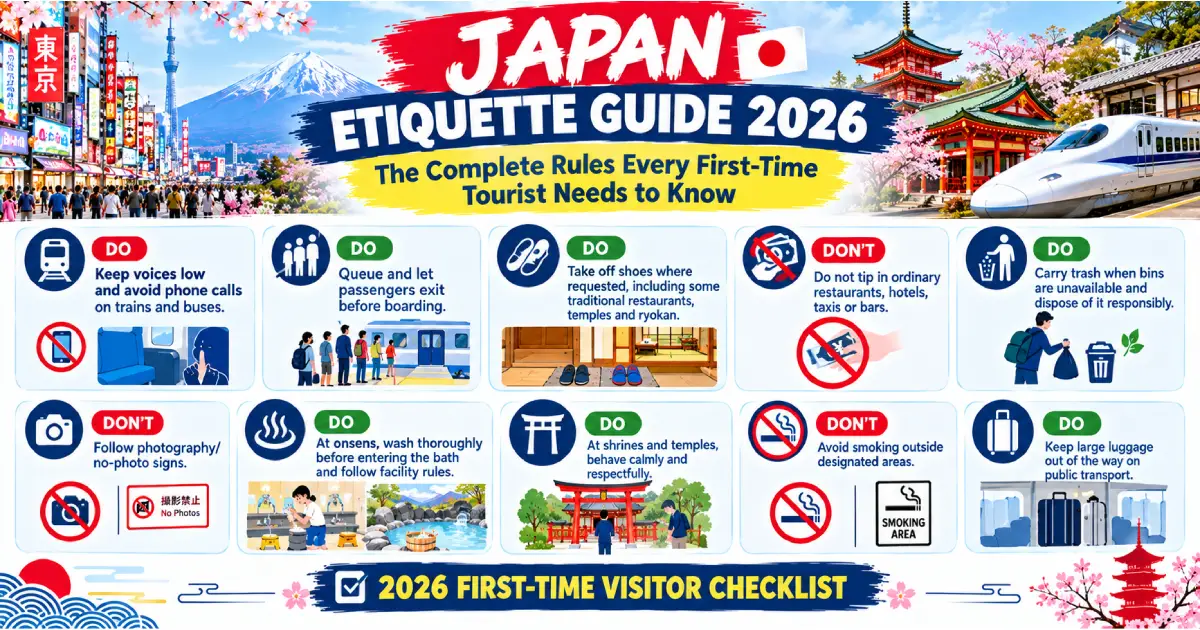
Japan has an international reputation as a country of elaborate, easily-broken etiquette rules, and that reputation causes a specific and largely unnecessary anxiety among first-time tier-1 visitors — the fear of committing some unforgivable social error in a country famous for politeness. The genuinely useful correction to that fear is this: Japanese people are, without exception among the destinations this site covers, extraordinarily forgiving of visible foreigner mistakes, and the vast majority of “rules” that circulate in Western Japan-travel content are either significantly overstated, apply only in specific narrow contexts (a formal business meeting, a traditional ryokan, a high-end kaiseki restaurant), or matter far less to Japanese people themselves than to anxious tourists convinced they’re about to cause offense. What actually matters is a much shorter, more practical list — a handful of behaviors that genuinely do register as rude or that will get a visitor genuinely turned away or corrected (removing shoes at the right threshold, not tipping, handling chopsticks correctly, understanding onsen rules before a first hot spring visit) — and this guide covers exactly those, in the specific contexts a first-time visitor will actually encounter them.
The single most useful mental model for a tier-1 visitor arriving in Japan for the first time is this: most Japanese etiquette is really just consideration for the people around you, expressed through specific, learnable conventions rather than universal instinct — quiet trains because a crowded commuter society values shared calm, no tipping because service excellence is already the baseline rather than an earned bonus, specific queueing behavior because a dense population makes orderly waiting a genuine public good. Understanding the why behind each rule makes the what far easier to remember, and this guide is organized around exactly that logic, covering dining, temples and shrines, onsen hot springs, public transport, money and tipping, and the small set of everyday social conventions that make the biggest practical difference to a first-time visitor’s trip.
| # | Rule | Context | Consequence of Breaking It |
|---|---|---|---|
| 1 | Never tip | Restaurants, taxis, hotels | Confusion, occasionally chasing you down to return money |
| 2 | Remove shoes at the genkan | Homes, ryokan, some restaurants, temples | Genuinely considered rude; often physically blocked from entering |
| 3 | Don’t stick chopsticks upright in rice | Any meal with rice | Strongly associated with funeral rites; visibly uncomfortable for hosts |
| 4 | No tattoos (or cover them) at most onsen | Public hot springs, sento | Refused entry at many traditional establishments |
| 5 | Keep phone calls off trains | All trains and buses | Dirty looks, occasional direct request to stop |
| 6 | Bow, don’t shake hands (or accept both) | General greetings | No real offense either way — Japan is very forgiving here |
| 7 | Queue in marked lines, don’t cut | Train platforms, popular restaurants | Visible, though rarely confronted directly |
| 8 | Don’t eat while walking in most areas | Streets, train platforms | Mildly frowned upon, not a hard rule everywhere |
| 9 | Use both hands to give/receive business cards, gifts, and money at tills | Business, formal, and retail settings | Minor faux pas, essentially only matters in business contexts |
| 10 | Cash still matters | Small restaurants, temples, rural areas | Practical problem, not a social one — carry cash regardless |
Tipping is not customary in Japan and functions differently than in most tier-1 visitors’ home countries: service excellence is considered the baseline standard already included in the price, not something to be separately rewarded, and leaving cash on a table is more likely to cause a server to chase you down the street to return it than to be received as a generous gesture. This is the single most consistently surprising rule for American visitors specifically, given how deeply tipping culture is embedded in US dining. High-end restaurants and some hotels add an explicit service charge to the bill in place of tipping — check for this line item before considering leaving anything extra.
Two chopstick behaviors carry genuine cultural weight, not just tourist-guide superstition: never stick chopsticks upright in a bowl of rice (this specifically mimics incense sticks at a funeral altar, and is one of the few Japanese etiquette points that will visibly unsettle Japanese diners around you), and never pass food directly from your chopsticks to someone else’s chopsticks (this mimics a specific funeral rite involving cremated bone fragments). Resting chopsticks across the top of your bowl or on the provided chopstick rest between bites is the correct default.
Contrary to Western table-manner instinct, audibly slurping ramen, soba, or udon is standard practice in Japan, not a breach of etiquette — some specifically argue it enhances the flavor by aerating the broth. First-time visitors who arrive expecting to suppress this instinct can relax; it’s one Japanese eating convention that’s easier, not harder, than the Western equivalent.
Itadakimasu (“I humbly receive,” said before eating) and gochisousama deshita (“thank you for the meal,” said after finishing) are small, genuinely appreciated verbal conventions — not mandatory, and no one will correct a visitor for skipping them, but using them (even slightly awkwardly) is consistently well-received by restaurant staff.
Shinto shrines (jinja, identifiable by torii gates) and Buddhist temples (tera or -ji, identifiable by larger gate structures and incense) have slightly different visitor rituals, though the core respect-based behavior (quiet voices, no photography of worshippers without permission, dressing reasonably modestly) applies to both.
At a Shinto shrine’s temizuya (water basin near the entrance): take the ladle in your right hand, rinse your left hand, switch to your left hand and rinse your right hand, then pour a small amount of water into your cupped left hand to rinse your mouth (do not drink directly from the ladle), and finally rinse the ladle handle by tilting it upright. This looks more complicated described than it is in practice — watching the person ahead of you for 10 seconds is usually enough to follow along.
A brief bow before passing through a shrine’s torii gate, and another before leaving, is a small but specifically noticed courtesy — the torii marks the boundary between the ordinary world and sacred space, and walking through the center of the gate is traditionally considered the path reserved for the resident deity, so walking slightly to one side is the more correct approach, though this is a nuance few visitors are expected to know and no one will comment if you don’t.
At most shrines, the standard visitor sequence at the main hall is: toss a coin into the offering box (a 5-yen coin, go-en, is considered particularly auspicious due to a pun on the word for “connection” or “fate”), bow twice, clap twice, make a silent wish or prayer, then bow once more. Temples follow a quieter version without the clapping. Watching other visitors immediately ahead of you is, again, the easiest way to get this right.
Onsen and sento (public bathhouses) carry the strictest and most consistently enforced etiquette of anywhere in this guide, and getting it wrong here is the one genuine way a tier-1 visitor can be turned away outright rather than simply forgiven.
The washing stations (a low stool, handheld showerhead, soap, and shampoo) that line the walls of the changing/washing room exist for a specific reason: the communal bath itself is for soaking, not washing, and entering it without first washing thoroughly and rinsing all soap off is the single most important onsen rule.
Tattoos remain historically associated in Japan with organized crime (yakuza), and while attitudes are gradually shifting — particularly at hotel-affiliated and more internationally-oriented onsen — a meaningful number of traditional public bathhouses still refuse entry to visibly tattooed guests outright. Practical options: search specifically for “tattoo-friendly onsen” before booking, use waterproof cover-up patches (widely sold in Japan specifically for this purpose) for small tattoos, or book a private ryokan room with its own in-room bath (kashikiri-buro), which sidesteps the issue entirely.
Onsen are entered fully nude — swimsuits are not permitted in traditional bathing areas, a rule that surprises many first-time tier-1 visitors expecting a Western-style pool-and-spa setup. A small modesty towel can be carried to and from the bath and used to cover yourself while walking, but should never enter the water itself — it’s typically folded and placed on your head or set aside at the water’s edge.
Hair should be tied up and kept out of the water entirely — another small, consistently enforced rule at most traditional establishments.
Talking on the phone during a train or bus journey is one of the most consistently observed etiquette breaches by tourists, in a country where commuter trains are treated as a shared quiet space by cultural default — texting and silent phone use is entirely fine; audible calls are not. Train cars often have signs specifically requesting phones be set to silent (“manner mode”) for this reason.
The priority seating areas near train doors (marked with specific signage for elderly, pregnant, disabled, and injured passengers) are treated as a genuine social expectation rather than a token gesture — giving them up promptly when needed is noticed and appreciated.
Train platforms are marked with floor indicators showing exactly where each car’s doors will open, and passengers queue single-file at these markers, allowing alighting passengers to exit before boarding begins — cutting this queue, even unintentionally, is one of the more visible tourist mistakes on Japan’s rail system.
Tokyo convention is to stand on the left side of an escalator, leaving the right side clear for walking; Osaka (and the broader Kansai region) conventionally does the opposite — stand right, walk left. This regional split genuinely exists and catches visitors moving between the two regions off guard.
Despite Japan’s reputation for technological sophistication, a meaningful share of small restaurants, temples, traditional shops, and rural establishments remain cash-only. Carrying cash throughout a Japan trip is a practical necessity, not merely a backup plan — 7-Eleven ATMs reliably accept foreign cards and are the most consistent cash source for tier-1 visitors.
Most Japanese retail counters provide a small tray beside the register specifically for placing cash or cards rather than handing them directly to the cashier — using it (rather than handing money hand-to-hand) is the expected convention, though skipping it is a minor, easily forgiven slip rather than a genuine faux pas.
For any tier-1 visitor doing business in Japan: exchanging business cards (meishi) is a small ritual of its own — offer and receive with both hands, take a moment to actually look at a card you’ve received before putting it away, and never write on or pocket a card carelessly in front of the person who gave it to you. This matters specifically in business contexts and essentially not at all for leisure travelers.
Japan is genuinely relaxed about this with foreign visitors — a slight nod or small bow is appreciated but a handshake will not cause offense, and many Japanese people in tourism-facing roles will offer a handshake first specifically because they expect it from Western visitors. This is one etiquette point tier-1 visitors can stop worrying about entirely.
Audibly blowing your nose in public, particularly at a restaurant table, is considered somewhat impolite in Japan — stepping away to a restroom, or at minimum turning away and doing so as quietly as possible, is the more considerate approach; sniffling repeatedly, by contrast (the more common Western instinct to avoid the “rudeness” of nose-blowing), is not seen as a problem in Japan at all.
Based on the specific patterns that repeat most often among American, British, Canadian, and Australian first-time visitors:
None of these rules, individually broken, will ruin a trip or cause a genuine international incident — Japanese hospitality culture (omotenashi) is built specifically around making guests, including visibly first-time foreign visitors, feel comfortable rather than judged. The rules in this guide that carry real weight (no tipping, onsen washing and tattoo rules, chopstick etiquette, quiet trains) are worth genuinely internalizing before arrival; the rest can be picked up naturally by watching the people around you, which is, in practice, exactly how most Japanese people learn context-specific etiquette too.
About Travel Tourister Travel Tourister’s destination specialists have navigated Japan’s etiquette in practice across dozens of trips — from onsen washing-station first-timer nerves and Fushimi Inari torii bows to Tokyo train quiet-car habits and Kyoto ryokan genkan shoe rituals — to deliver a practical, non-anxiety-inducing etiquette guide for 2026 tier-1 visitors.
Posted By : Vinay
Latest Article
2nd Floor, 39, Above Kirti Club, DLF Industrial Area, Kirti Nagar, New Delhi, Delhi 110015



Travel Tourister is a leading Travel portal where we introduce travellers to trusted travel agents to make their journey hasselfree, memorable And happy. Travel Tourister is a platform where travellers get Tour packages ,Hotel packages deals through trusted travel companies And hoteliers who are working with us across the world. We always try to find new and more travel agents and hoteliers from every nook and corners across the world so that you could compare the deals with different travel agents and hoteliers and book your tour or hotel with the one you have chosen according to your taste and budget.
Copyright © Travel Tourister, India. All Rights Reserved

 Call
Call Enquiry