Published on : 23 Oct 2026
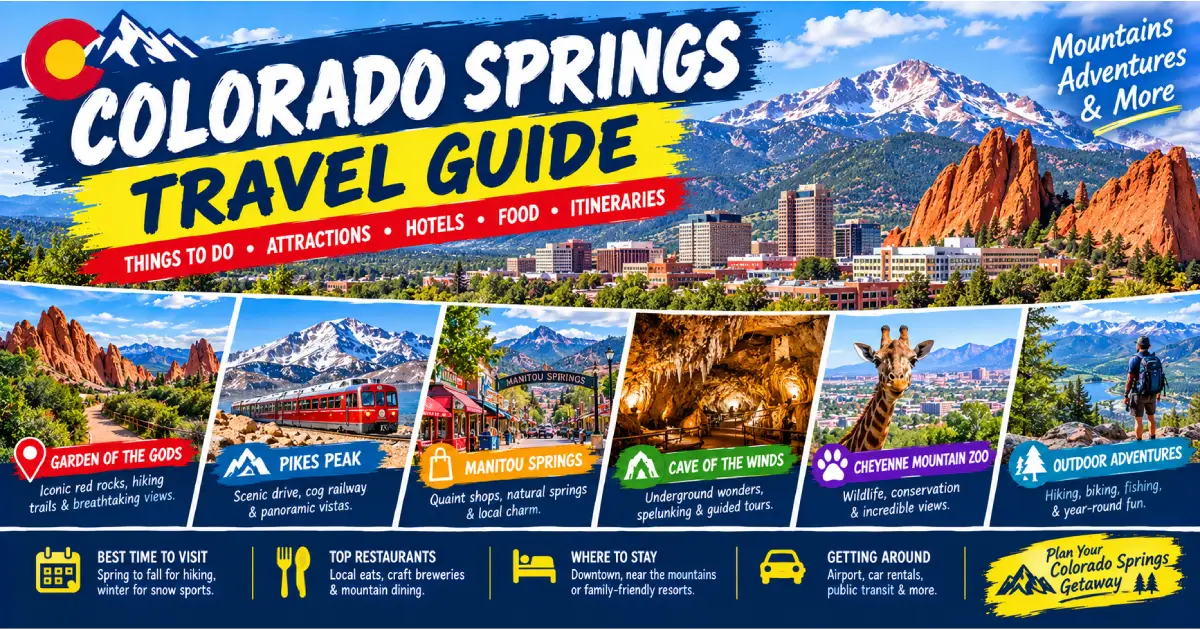
Colorado Springs sits at the foot of Pikes Peak on the southern Front Range of the Rocky Mountains — 6,035 feet above sea level, 70 miles south of Denver, and ringed by one of the most extraordinary concentrations of natural and military landmarks in the American West. The city of 500,000 is Colorado’s second-largest and one of its most surprising: a sprawling military and aerospace hub (five major military installations, including NORAD, Peterson Space Force Base, Fort Carson, Schriever Space Force Base, and the United States Air Force Academy) that exists cheek-by-jowl with some of the most dramatic sandstone formations, hot springs, and wilderness trailheads in Colorado. Visitors who dismiss Colorado Springs as a stopover between Denver and the southern mountains frequently discover they’ve allocated too little time: Garden of the Gods, Pikes Peak, the Cheyenne Mountain Zoo, Manitou Springs, the Air Force Academy Chapel, and the Broadmoor resort collectively represent a full two to three days of genuinely excellent travel.
What distinguishes Colorado Springs from most Front Range cities is its relationship with Pikes Peak — the 14,115-foot summit that rises directly above the city’s western edge and is visible from nearly every point in town. The mountain was the inspiration for Katherine Lee Bates’s “America the Beautiful,” written after she ascended Pikes Peak on a mule in 1893 and saw the Great Plains stretching east and the Rockies rolling west from the summit. Pikes Peak is not the tallest mountain in Colorado (it ranks 32nd among the state’s 58 Fourteeners) but it is the most accessible, the most visited, and the most historically significant — the summit has been accessible by carriage road since 1888, by cog railway since 1891, and by paved highway since 1916. Approximately 500,000 people summit Pikes Peak every year by one means or another, making it one of the most-visited mountain summits in the world.
The city’s other defining feature is its geology. The Colorado Springs area sits at the junction of the Great Plains and the Rocky Mountains, where the Fountain Formation — a 300-million-year-old sequence of Permian-era red sandstone and arkosic conglomerate — has been tilted and eroded into fins, spires, and balanced rocks by millions of years of uplift and weathering. Garden of the Gods, Red Rock Canyon Open Space, and Roxborough State Park south of Denver all owe their dramatic formations to the Fountain Formation. These red rock landscapes, accessible by free city park trails within 10 minutes of downtown Colorado Springs, are the second reason the city rewards a dedicated visit rather than a quick pass-through on I-25.
| Factor | Details |
|---|---|
| Location | Southern Front Range, 70 miles south of Denver |
| Altitude | 6,035 feet (city); 14,115 feet (Pikes Peak summit) |
| Population | ~500,000 (El Paso County ~750,000) |
| Airport | Colorado Springs Airport (COS) |
| Nearest Major Airport | Denver International (DEN), 80 miles north |
| Time Zone | Mountain Time (UTC−7 / UTC−6 DST) |
| Sales Tax | 8.2% (city + county + state) |
| Best Season | May–October |
| Emergency | 911 |
| Tourism Info | visitcos.com |
Colorado Springs Airport (COS) serves the city with nonstop flights from major US hubs:
COS is a compact, easy airport — 15 minutes from downtown. Rideshare to downtown: $12–18. Rental cars available from all major companies at the airport.
Denver International Airport (DEN) — 80 miles north on I-25 — offers dramatically more flight options and is the practical choice for international arrivals and travelers from cities not served by COS. From DEN, drive I-25 south (1.25–1.5 hours in normal traffic); or take the Bustang bus (bustangcolorado.com, $16 one-way) between Denver Union Station and downtown Colorado Springs.
From Denver: I-25 south, 70 miles, approximately 1–1.25 hours. From Pueblo: I-25 north, 45 miles, 45 minutes. From Albuquerque: I-25 north, 290 miles, approximately 4.5 hours. From Kansas City: I-70 west to Limon, CO-24 west, 560 miles, approximately 8 hours.
Bustang (CDOT’s intercity bus, bustangcolorado.com): Denver Union Station → Colorado Springs (downtown transfer center), approximately 1.5 hours. Fares $9–16/person. Buses run every 1–2 hours throughout the day.
Greyhound operates routes through Colorado Springs on the Denver–Pueblo–Albuquerque corridor.
Colorado Springs is a spread-out, car-oriented city. The major attractions (Garden of the Gods, Pikes Peak Highway, Cheyenne Mountain Zoo, Fort Carson, Air Force Academy) are distributed across a wide area and require a car or rideshare. Mountain Metro Transit operates the city bus network, adequate for downtown movement but impractical for the main attractions.
Rideshare (Uber/Lyft): Available throughout the city; fares $8–20 for most in-city trips.
Car rental: Available at COS airport and at several downtown locations (Enterprise, Hertz, Avis, National). Recommended for any visitor planning to explore the full range of attractions.
Address: 1805 N 30th St, Colorado Springs, CO 80904 Hours: Daily 5 AM–9 PM (May–October); 5 AM–7 PM (November–April) Cost: Free (city park) Website: gardenofgods.com
Garden of the Gods is the centerpiece of Colorado Springs tourism — a 1,341-acre city park containing some of the most dramatic sandstone formations in the American West, accessible for free. The park’s signature feature is the Balanced Rock group (Gateway Rocks): 300-foot-tall vertical sandstone fins rising from a pine forest with Pikes Peak as backdrop, the kind of landscape that looks designed for a movie set but is entirely natural. The formations — created over 300 million years by the tilting, uplift, and differential erosion of the Fountain Formation — include the North and South Gateway Rocks, Balanced Rock, Three Graces, Cathedral Spires, and Kissing Camels.
What to do:
Practical tips: The main parking lot fills by 9 AM in summer; arrive at 7–8 AM for easy access or use the shuttle from the Gateway Visitor Center. The sunrise at Garden of the Gods — when the low angle light turns the red formations deep orange against a blue sky — is the finest photography window. The park is free; the nature center and café are the only revenue components.
Address: Pikes Peak Highway — 5069 Pikes Peak Hwy, Cascade, CO 80809 Hours: Highway: Daily 7:30 AM–6 PM (May–September); reduced hours/closures October–April Cost: Pikes Peak Highway: $50/vehicle (up to 4 passengers; $15 each additional passenger) Cog Railway: $40–55/adult; cogwheeltrain.com Website: pikespeakcolorado.com
Pikes Peak at 14,115 feet is the most visited mountain summit in Colorado and one of the most visited in the world. It is extraordinary for a Fourteener summit in terms of accessibility — three separate ways to reach the top (drive, train, hike) ensure that altitude sickness and physical condition are not barriers to the summit experience. The summit views — 360-degree panorama across the Great Plains to the east and the Front Range and southern Rockies to the west — were the view that inspired “America the Beautiful” in 1893.
Ways to the summit:
Pikes Peak Highway (drive): The most popular route — a paved 19-mile toll road with 156 turns that climbs from 9,400 feet at the entrance to 14,115 feet at the summit. The road is paved throughout (resurfacing of the final section completed in 2021 after years of partial gravel). Allow 1.5–2 hours for the ascent. The Devil’s Playground area (12,780 feet) is where lightning most frequently strikes — turn around here if thunderstorms develop.
Summit facilities: The Summit Complex (opened 2021, replacing the historic Summit House) is a $60 million facility with a high-altitude café (serving the legendary Pikes Peak Summit Donuts — a tradition since 1916, sold at the summit store, $3–4 each), exhibits on the mountain’s history, and 360-degree viewing terraces. Cars over 25 feet are not permitted on the highway.
Pikes Peak Cog Railway (Manitou Cog): The oldest cog railway in the United States (operating since 1891, rebuilt 2021) runs 8.9 miles from Manitou Springs (6,350 feet) to the summit (14,115 feet) in approximately 1 hour. The round trip takes approximately 3 hours (45 min up, 40 min on the summit, 45 min down). The railway experience is excellent — the mountain engineering, the treeline transition, the alpine tundra section — and eliminates the driving challenge of the highway’s switchbacks for travelers uncomfortable with mountain driving.
Reserve in advance: The Cog Railway sells out 2–4 weeks ahead in summer. Book at cogwheeltrain.com.
Barr Trail (hike): The 13-mile (one-way) Barr Trail from Manitou Springs is the standard hiking route to the summit — a full-day or 2-day undertaking (Barr Camp, at 10,200 feet, has a campsite and bunkhouse). Starting elevation 6,700 feet; 7,200 feet of elevation gain. Summit before noon to avoid afternoon thunderstorms. Only for experienced hikers with appropriate gear. Total hike time: 8–14 hours round-trip depending on fitness.
Altitude warning: The Pikes Peak summit at 14,115 feet is a significant altitude for visitors arriving from sea level. Altitude sickness symptoms (headache, nausea, fatigue) are common. Ascending slowly, drinking water, and descending at the first sign of serious symptoms are the protocols. Visitors driving from sea level should spend one night in Denver or Colorado Springs before attempting the summit.
Address: 4250 Cheyenne Mountain Zoo Rd, Colorado Springs, CO 80906 Hours: Daily 9 AM–5 PM (last entry 4 PM) Cost: $29/adult, $24/child (3–11), under 3 free Website: cmzoo.org
The Cheyenne Mountain Zoo is the highest zoo in the United States (6,800 feet elevation), built on the slopes of Cheyenne Mountain above Colorado Springs. The zoo’s setting — steeply terraced into the mountainside, with mountain views from every level — is as distinctive as any zoo in the country, and the animal collection is excellent: approximately 170 species and 800 animals, with an African Rift Valley exhibit (giraffes, rhinos, hippos), a Rocky Mountain Wild area (mountain lions, river otters, wolverines), and a strong conservation focus across the collection.
Giraffe feeding: The most popular activity at the zoo — a giraffe encounter deck where visitors hand-feed the herd (romaine lettuce from an outstretched hand, $6 extra). The giraffes are gentle and habituated to hand feeding; families with children consistently rate it as the finest single experience at the zoo. Morning feeding sessions (9–10 AM) are less crowded than afternoon.
Mountain Majesties carousel and Sky Ride: The Sky Ride gondola ($5/person, summer only) runs between the upper and lower zoo levels; the view from the top of the gondola arc — over the entire zoo to the Colorado Springs skyline and the plains beyond — is exceptional.
Evening Zoolights (November–January): The zoo’s after-hours holiday lights event, with the terraced zoo levels covered in animated light displays; $18–22/adult. One of the finest holiday light events in Colorado.
Address: 2346 Academy Dr, USAF Academy, CO 80840 (Visitor Center: North Gate off I-25 Exit 156B) Hours: Visitor Center 9 AM–5 PM daily; Cadet Chapel 9 AM–5 PM Mon–Sat, 1–5 PM Sun Cost: Free Website: academyadmissions.com/visiting
The United States Air Force Academy is the finest piece of mid-20th-century institutional architecture in Colorado and one of the finest in the United States — the 18,500-acre campus was designed in 1954–1962 by Skidmore, Owings & Merrill (SOM), the firm responsible for the Lever House and the Sears Tower, and the Cadet Chapel (completed 1962) is Walter Netsch’s masterpiece: 17 aluminum-clad spires rising 150 feet from a Colorado hilltop, visible from I-25, containing a Protestant chapel (the 17-spire main structure), a Catholic chapel, a Jewish chapel, and smaller worship spaces for additional faiths, all interlocked in a single structure.
What to see:
Self-guided driving tour: A designated 2-mile driving tour route circles through the Academy grounds (obtain a vehicle pass at the main gate). Walking tours depart from the Visitor Center on summer mornings; free.
Note: Military ID or civilian photo ID required for entry; background checks at the gate are quick for civilian vehicles. Camera restrictions apply in some areas.
Location: 6 miles west of downtown Colorado Springs via US-24 / Manitou Ave Website: manitousprings.org
Manitou Springs is the most character-rich neighborhood in the Colorado Springs area — a Victorian spa town (founded 1872 around the natural carbonated mineral springs that were already sacred to the Ute people) with independent galleries, vintage shops, and restaurants in 19th-century storefronts, compressed into a narrow canyon at the foot of Pikes Peak. The eight free mineral springs scattered through the town — each slightly different in mineral composition and carbonation level — were the town’s original attraction; sampling them from the original stone fountains is still worth doing (the waters are acquired tastes, ranging from mildly mineral to intensely sulfurous).
The Manitou Incline: The most difficult and most-popular single fitness hike in Colorado — a 0.88-mile trail ascending 2,000 vertical feet in less than a mile on the retired wooden ties of a former cable car railway. The average grade is 41%; some sections reach 68%. The Incline attracts elite military athletes from the surrounding bases training for mountain operations, and fitness tourists from across the country who have heard about it. Free; trailhead at the Hiawatha Gardens parking area (require a free permit for peak season from inclineclub.com). The descent is via the Barr Trail (about 3 miles) rather than the Incline itself (too steep for safe descent).
Cliff Dwellings Museum (10 Cliff Rd): A collection of Ancestral Puebloan structures relocated from the Mesa Verde area in 1906 and reconstructed at Manitou. Historically controversial (removal predated NAGPRA) but provides close-up access to real pre-Columbian stonework. $12/adult.
Cave of the Winds (100 Cave of the Winds Rd, Manitou Springs): Limestone cave system in Williams Canyon, accessible by guided tour ($25–30/adult for the 45-minute Discovery Tour) or the more adventurous Lantern Tour and crawl options. Discovered in 1880; operated as a tourist attraction continuously since 1881.
Miramont Castle (9 Capitol Hill Ave): A 46-room Victorian castle (1895) built in nine architectural styles by a French Jesuit priest, now a museum. $10/adult.
Address: 2850 S Cheyenne Canyon Rd, Colorado Springs, CO 80906 Hours: Daily 8 AM–6 PM (May–September); reduced hours/closures in winter Cost: Free (now part of South Cheyenne Canyon Park) Website: coloradosprings.gov
Seven Falls is the most dramatic waterfall scenery accessible from Colorado Springs — a 181-foot series of seven distinct waterfalls cascading down a box canyon of pink Pikes Peak granite in South Cheyenne Canyon. The falls were once a privately operated attraction (charging admission); they are now part of the city park system and free. A trail from the canyon floor climbs 224 steps up the canyon wall to the top of the falls and the Eagles Nest observation platform (open with handrails); the view from the top looking down the falls and out the canyon mouth to the plains is exceptional.
Combined trip: Seven Falls is 3 miles south of the Cheyenne Mountain Zoo; visit both on the same afternoon.
Address: 3550 W High St, Colorado Springs, CO 80904 Hours: Daily 5 AM–9 PM (May–October); 5 AM–7 PM (November–April) Cost: Free Website: redrockcanyoncolorado.org
Red Rock Canyon Open Space is the lesser-known alternative to Garden of the Gods — a 1,474-acre city park containing similar red sandstone formations (also Fountain Formation) on the western edge of Colorado Springs, with quieter trails and less crowded parking than Garden of the Gods. The Mesa High Trail (3.1 miles) provides the best overview of the formations; the Greenlee Trail (1.9 miles) descends into the canyon among the rock faces. Rock climbing is permitted without permit; the canyon walls have over 200 established routes.
Combined visit: Garden of the Gods and Red Rock Canyon are 3 miles apart; visiting both in the same morning/afternoon provides the full Fountain Formation experience from two different perspectives.
Address: 1 Lake Ave, Colorado Springs, CO 80906 Phone: 1-800-755-5011 Website: broadmoor.com
The Broadmoor is the defining luxury institution of Colorado Springs — a 5,000-acre resort opened in 1918 at the foot of Cheyenne Mountain, comprising three hotel towers (779 rooms), five golf courses, 10 restaurants, a full spa, and a collection of facilities that make it essentially a self-contained town. The resort has been awarded the AAA Five Diamond designation every year since 1964 — the longest streak of any hotel in North America.
Even for visitors not staying at the resort, the Broadmoor provides the finest dining and the most impressive architectural setting in Colorado Springs. Summit (the fine dining restaurant in the main hotel tower) and the Broadmoor Tavern (casual lakeside dining) are both open to non-guests for dinner. The Broadmoor Hiking Trail System — 22 miles of trails above the resort connecting to Cheyenne Mountain State Park — is accessible to non-guests through the Forest Hiking Trail tickets ($10/non-guest).
Colorado Wolf Center and Cheyenne Mountain State Park are immediately adjacent to the Broadmoor’s south side, connected by the same trail network.
Address: 4729 Twin Rocks Rd, Divide, CO 80814 (30 miles west) Hours: Tours at 10 AM, 12 PM, 2 PM, 4 PM daily Cost: $20/adult Website: wolfeducation.org
The Colorado Wolf and Wildlife Center in Divide (30 miles west of Colorado Springs on US-24) operates educational tours that place visitors within arm’s reach of habituated wolves — Mexican gray wolves, gray wolves, and wolf-dog hybrids — in large natural enclosures. The 45-minute guided tour includes extended close-range observation of the pack behavioral dynamics. The most unusual wildlife experience accessible from Colorado Springs; not crowded outside summer weekends.
Address: 200 S Sierra Madre St, Colorado Springs, CO 80905 Hours: Daily 9 AM–5 PM (closed Tuesdays, September–May) Cost: $25/adult, $18/child (3–12) Website: usopm.org
Colorado Springs has been the home of the United States Olympic and Paralympic Training Center since 1978, and the U.S. Olympic & Paralympic Museum opened in 2020 as a world-class interactive exhibit space — 60,000 square feet designed by Diller Scofidio + Renfro (the High Line, Lincoln Center) with interactive athlete training simulations, 100 years of Olympic artifact display, and accessible design throughout (the museum received the AIA’s national Architecture Award for accessible design in 2021). The torchbearer experience, the athletics simulations (bobsled, speed skating, rowing), and the Paralympic athlete exhibits are the standout experiences.
The Broadmoor (1 Lake Ave): Colorado’s finest resort — 779 rooms, 5 restaurants, 5 golf courses, full spa, lakeside setting below Cheyenne Mountain. $350–800+/night. The standard for special-occasion travel in southern Colorado.
The Mining Exchange, a Wyndham Grand Hotel (8 S Nevada Ave): Colorado Springs’ finest downtown hotel — 117 rooms in a restored 1902 Mining Exchange building, full bar, spa, walking distance to Olympic Museum. $200–350/night.
Cheyenne Mountain Resort (3225 Broadmoor Valley Rd): Golf resort on a lake, immediately adjacent to Broadmoor; all the amenities at lower prices. $150–280/night.
Antlers Hotel (4 S Cascade Ave): Downtown landmark since 1883 (current building 1967); well-positioned for walkable downtown access. $130–220/night.
The Cliff House at Pikes Peak (306 Canon Ave, Manitou Springs): Victorian boutique hotel in the heart of Manitou Springs, 1874 building extensively renovated. $180–350/night.
Holden House 1902 Bed & Breakfast (1102 W Pikes Peak Ave): Award-winning Victorian B&B, innkeepers nationally recognized, central location. $165–225/night.
Garden of the Gods Resort and Club (3320 Mesa Rd): Resort adjacent to the park, golf, views. $200–400/night mid-range to premium.
Drury Inn Colorado Springs (8155 N Academy Blvd): Reliable chain with free hot breakfast and evening kickback (free drinks and light meal). $100–160/night.
Colorado Springs KOA (8100 Bandley Dr): RV and tent camping near I-25. Sites $40–75/night.
The Broadmoor — Summit Restaurant ($$$$, 1 Lake Ave): The finest restaurant in Colorado Springs — New American cuisine with Colorado-sourced proteins, James Beard-level execution, views over the Broadmoor lake. Reserve 1–2 weeks ahead.
Craftwood Inn ($$$, 404 El Paso Blvd, Manitou Springs): Colorado wild game cuisine in a 1912 English Tudor hunting lodge — elk tenderloin, bison short ribs, Colorado lamb. The most distinctive food experience in the Colorado Springs area. Reserve ahead.
The Rabbit Hole ($$$, 101 N Tejon St): The finest restaurant in downtown Colorado Springs — contemporary American, excellent local sourcing, inventive cocktail program.
Uchenna Ethiopian Cuisine ($$, 2501 W Colorado Ave): Consistently rated one of the top 10 Ethiopian restaurants in the Rocky Mountain West. Extraordinary value; injera bread, doro wot, vegetarian combo.
Adam’s Mountain Café ($$, 26 Manitou Ave, Manitou Springs): The beloved Manitou Springs café — natural, local, and organic ingredients, excellent brunch, one of the few entirely vegetarian-friendly menus in the Springs.
Front Range Barbeque ($$, 2330 W Colorado Ave): Colorado’s best BBQ — brisket, pulled pork, house-made sauces. Counter service, no reservations; expect a line at lunch.
Story Coffee ($, 2306 W Colorado Ave): The specialty coffee anchor of the Colorado Avenue arts corridor; also serves natural wine and light food.
The finest gold-rush ghost town accessible from Colorado Springs — a Victorian mining camp at 9,494 feet that produced $340 million in gold at peak (1890–1910), declined to near abandonment, and was resurrected by legalized limited-stakes gambling in 1991 (Colorado voters approved small-stakes casino gambling for three historic mining towns: Cripple Creek, Central City, and Black Hawk). The gambling is not the attraction; the Victorian streetscape, the Cripple Creek and Victor Narrow Gauge Railroad ($18, 40-minute round trip), and the Mollie Kathleen Gold Mine tour ($20, descend 1,000 feet into an operating gold mine) are.
A 6,000-acre national monument preserving one of the world’s finest Eocene-era fossil deposits — petrified redwood stumps up to 40 feet in circumference (the largest petrified wood in the world), fossilized insects, fish, and leaves from 34 million years ago. Paved trail through the petrified stumps: 1-mile loop, free with park entry ($5/person). Combine with Cripple Creek for a full western day trip.
The Royal Gorge Bridge — 955 feet above the Arkansas River, the highest suspension bridge in the United States (built 1929) — spans a dramatic granite canyon of the Arkansas River west of Cañon City. The bridge itself is the attraction; an amusement park at the canyon rim includes a gondola over the gorge, zip lines, and a mountain coaster. $32/adult. royalgorgebridge.com.
Colorado’s “Steel City” — a working-class industrial city with an unexpectedly fine arts scene and the finest green chile in Colorado. The Pueblo Chile and Frijoles Festival (September) is the largest chile festival in Colorado; the Pueblo Mild Green Chile — a locally grown variety with distinctive character — is the basis of Colorado’s green chile cuisine. The Riverwalk through downtown Pueblo was completed in 2006 and provides a pleasant pedestrian amenity along the Arkansas River.
US-24 west from Colorado Springs through Woodland Park and Florissant to the high basin of South Park (11 Park County Road communities in a 900-square-mile mountain grassland at 9,000 feet) — one of the largest high-altitude valleys in the world and the inspiration for the animated series of the same name. Continue to Fairplay (the real “South Park”), the historic mining town of Alma, and the Continental Divide.
Morning (7–9 AM): Garden of the Gods at sunrise — the formations at low-angle golden light with Pikes Peak behind them. Arrive at 7 AM for empty parking; walk the Perkins Central Garden Trail (1.5 miles). Photograph the Gateway Rocks.
Mid-morning (9–11 AM): Drive to Manitou Springs (15 min); walk Manitou Avenue, try the mineral springs, browse the independent shops.
Late morning (11 AM–1 PM): Cheyenne Mountain Zoo — giraffe feeding ($6 extra for lettuce), African Rift Valley exhibit, mountain views.
Afternoon (1–4 PM): Pikes Peak Highway — drive to the summit, spend 30–45 minutes at the Summit Complex, purchase the requisite summit donuts. Allow 2.5–3 hours total.
Evening: Dinner at Craftwood Inn (Manitou Springs) or The Rabbit Hole (downtown) — reserve ahead.
Day 1: Pikes Peak Highway (full morning, depart early) → Garden of the Gods (afternoon) → Red Rock Canyon Open Space (late afternoon for different perspective on the formations) → dinner downtown.
Day 2: Air Force Academy Chapel (9–10:30 AM) → Olympic Museum (11 AM–1 PM, allows 2 hours) → Manitou Incline attempt or Manitou Springs afternoon → Broadmoor lakeside walk and dinner.
As the 2-day itinerary plus: Day 3 — Cripple Creek and Florissant Fossil Beds day trip, or Royal Gorge Bridge, or a Colorado Springs area trail day (Palmer Park, Bear Creek Regional Park, Section 16/Palmer Trail for a Front Range ridge traverse).
| Budget Level | Daily Cost Per Person | What’s Included |
|---|---|---|
| Budget | $70–110/day | Budget hotel or Airbnb; meals at counter-service restaurants ($12–20/meal); Garden of the Gods and Red Rock Canyon (free); one paid attraction |
| Mid-Range | $150–250/day | Mid-range hotel downtown; restaurant meals ($25–50/person); Pikes Peak Highway + one other paid attraction; rideshare |
| Luxury | $400–900+/day | Broadmoor resort; fine dining (Summit, Craftwood Inn); multiple paid attractions; Cog Railway |
Best free things in Colorado Springs:
Colorado Springs averages 300 sunny days per year and 14 inches of annual precipitation — significantly less than Denver (16 inches) and the mountain ski resorts (Aspen: 200 inches of snow). Summer temperatures average 85–90°F in July but rarely exceed 95°F; afternoon thunderstorms develop 3–5 PM most summer afternoons and typically last 30–60 minutes. Winters are mild for Colorado: average January temperatures of 20–45°F with occasional heavy snowstorms.
At 6,035 feet, most visitors from sea level notice mild altitude effects (slightly increased heart rate, minor headache, reduced alcohol tolerance) but rarely significant altitude sickness. Pikes Peak at 14,115 feet is a different matter — see the Pikes Peak entry above for altitude protocols.
Colorado Springs has the highest per-capita military population of any US city — approximately 25% of the city’s economy is defense and aerospace-related. Fort Carson, Peterson Space Force Base, Schriever Space Force Base, NORAD, and the Air Force Academy are all within the city limits or immediate surroundings. Military culture is visible throughout the city; the USO operates at COS airport.
Recreational cannabis is legal in Colorado for adults 21+ and widely available at licensed dispensaries throughout Colorado Springs. Consumption is restricted to private property — consuming in public, in cars, or at hotels is illegal. Colorado Springs is in El Paso County, which has some localities with additional restrictions; confirm dispensary locations before visiting if cannabis is part of your trip plan.
Posted By : Vinay
Latest Article
2nd Floor, 39, Above Kirti Club, DLF Industrial Area, Kirti Nagar, New Delhi, Delhi 110015



Travel Tourister is a leading Travel portal where we introduce travellers to trusted travel agents to make their journey hasselfree, memorable And happy. Travel Tourister is a platform where travellers get Tour packages ,Hotel packages deals through trusted travel companies And hoteliers who are working with us across the world. We always try to find new and more travel agents and hoteliers from every nook and corners across the world so that you could compare the deals with different travel agents and hoteliers and book your tour or hotel with the one you have chosen according to your taste and budget.
Copyright © Travel Tourister, India. All Rights Reserved

 Call
 Enquiry