Published on : 22 Oct 2026
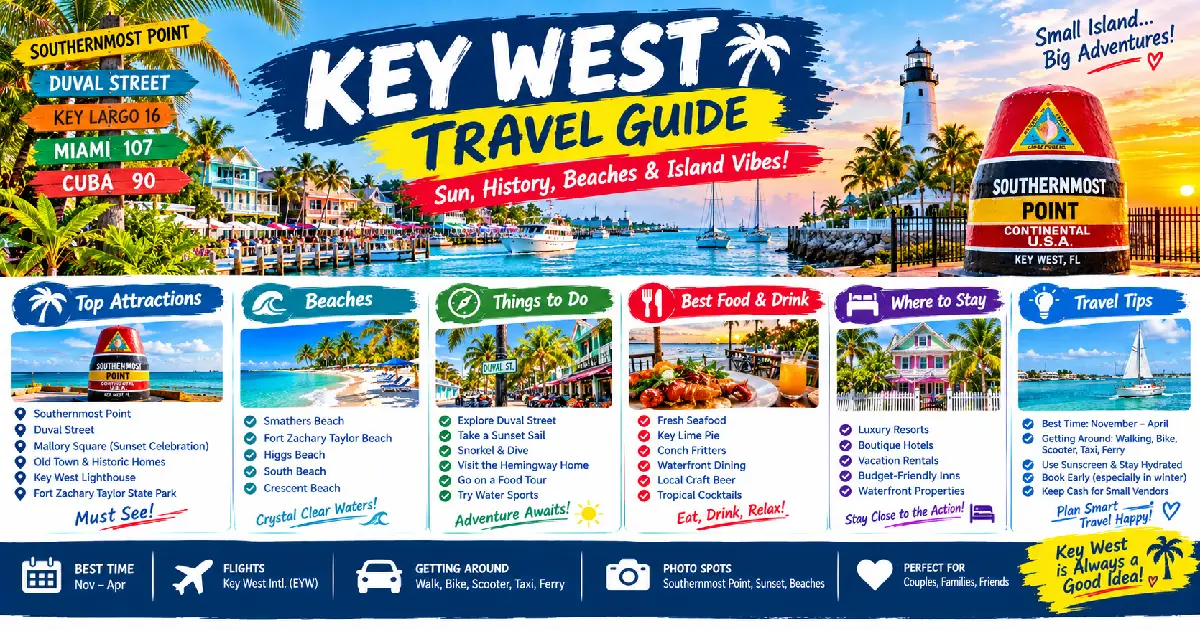
Key West occupies a position in the American imagination that very few places can claim — it is simultaneously a real place and a mythology. The real place is a 4-by-2-mile coral island at the end of a 113-mile chain of islands trailing southwest from the Florida mainland, connected by the most dramatic highway in the continental United States. The mythology is everything it has accumulated in the centuries since it was briefly the wealthiest city per capita in the United States: the wrecking industry that made fortunes in the 19th century, the cigar factories, the sponge divers, the writers and painters who arrived and never left, the Hemingway house, the Tennessee Williams house, the Cuban influence that still runs through the food and the music, the sunset celebration at Mallory Square that has been happening every evening without fail for half a century, and the libertarian social culture that made the city the first in the United States to elect an openly gay mayor. All of this is packed into a compact, walkable island at the end of the road, 90 miles from Cuba and 130 miles from Miami.
What strikes first-time visitors most forcefully is how different Key West is from the rest of Florida. The architecture is not Florida architecture — it is a hybrid of New England ship captain’s houses, Bahamian shotgun houses, and Caribbean veranda culture that developed when the island was more connected to the sea lanes than to the Florida mainland. The vegetation is not Florida vegetation — the banyans, palms, and frangipani create a tropical canopy that turns the residential neighborhoods into something approaching jungle. The social culture is not Florida social culture — Key West has always attracted people who left somewhere else, and that accumulated population of artists, sailors, writers, retirees, and people who simply stopped here has produced a civic atmosphere of tolerance and eccentricity that is genuinely unusual. The food is unmistakably Keys cuisine: conch fritters, key lime pie (the real thing, tart and custard-dense, in a graham cracker shell, absolutely not green), the freshwater wells that made the island livable before the Overseas Aqueduct, and the pink shrimp that come from Key West’s still-active commercial fishing fleet.
Getting to Key West is part of the experience. The Overseas Highway (US-1) is 113 miles of two-lane road crossing 42 bridges — including the Seven Mile Bridge, one of the most extraordinary driving experiences in the United States — with the Atlantic on one side and Florida Bay on the other, and the awareness that you are driving to the end of the continental United States. The Key West Express high-speed ferry from Fort Myers Beach is the other primary option. Getting there takes effort; what you find when you arrive is worth considerably more than the effort.
| Factor | Details |
|---|---|
| Location | Monroe County, Florida Keys — Mile Marker 0 |
| Size | 4 miles long × 2 miles wide (approximately) |
| Distance from Miami | 160 miles / ~3.5 hr driving via US-1 |
| Distance from Fort Lauderdale | 200 miles / ~4 hr driving |
| Distance from Tampa | 410 miles / ~6 hr driving |
| Time Zone | Eastern Time (UTC−5 / UTC−4 DST) |
| Population | ~25,000 year-round (significantly more in winter season) |
| Best Neighborhoods | Old Town, Bahama Village, Duval Street, Truman Annex |
| Getting Around | Walking, cycling, scooter — car largely unnecessary once here |
| Currency | USD |
| Sales Tax | 7.5% (Monroe County) |
| Closest Airport | Key West International Airport (EYW) |
Driving to Key West via the Overseas Highway (US-1) is the definitive Key West arrival experience and one of the great American road trips. The 113-mile stretch from Florida City (the last mainland town) to Key West crosses 42 bridges over the Atlantic Ocean and Florida Bay — including the Seven Mile Bridge (actually 6.79 miles), which runs arrow-straight over open ocean water with no land visible in either direction. The highway was built on the route of the Florida East Coast Railway (Henry Flagler’s extraordinary engineering project that ran a railroad to Key West from 1912 until the Labor Day Hurricane of 1935 destroyed it); in many places you can see the original railroad bridge paralleling the modern highway.
From Miami: 160 miles / 3.5–4 hours (US-1 south through Homestead, then the Keys) From Fort Lauderdale: 200 miles / 4–4.5 hours (Florida Turnpike south to US-1) From Tampa: 410 miles / 6–6.5 hours (I-75 south to FL-41/Tamiami Trail to US-1, or FL Turnpike south) From Orlando: 390 miles / 5.5–6 hours (FL Turnpike south to US-1)
Driving tips: The Overseas Highway is two lanes for most of its length, with passing zones at intervals. The speed limit varies (45–55 mph through the Keys communities, 70 mph on the Seven Mile Bridge open stretch). Allow for stops — John Pennekamp Coral Reef State Park at Key Largo (Mile Marker 102.5) is worth a morning visit, and Bahia Honda State Park (Mile Marker 36.8) has one of the finest swimming beaches in Florida. Fuel up before entering the Keys at Florida City; gas stations exist throughout the Keys but prices increase the further south you go.
Parking in Key West: Once in Key West, park the car and walk or cycle for the duration of your stay. Parking is genuinely difficult and expensive in high season. The best strategy: Park at a garage or lot on the edge of Old Town and leave the car there. Main garages: Old Town Garage (1111 Grinnell St, $15–25/day), Caroline Street Lot, and the Hilton Key West Resort parking. Most hotels charge $25–40/night for parking.
The Key West Express high-speed catamaran operates from Fort Myers Beach (239) to Key West — a 3.5-hour crossing covering 100 miles of Gulf of Mexico open water.
The Key West Express is the most relaxed way to arrive — no traffic, no bridges, a morning crossing that deposits you at the Key West Historic Seaport in time for lunch. The return evening crossing is timed for the sunset. Highly recommended for those coming from the Fort Myers / Cape Coral / Naples area.
Key West International Airport (EYW) is a small regional airport 3 miles east of Old Town, receiving direct flights primarily from major Florida hubs and East Coast cities.
Direct routes (2026):
Key fares: Miami–Key West round-trip starts around $80–150 on Silver Airways; New York–Key West nonstop runs $200–450 depending on season and booking lead time. The flight from Miami is 45 minutes; it eliminates the 3.5-hour drive but costs more and skips the highway experience.
From the airport: Rideshare (Uber/Lyft) to Old Town $10–15; taxi $15–20; bicycle rental pickup available from several shops near the airport.
The Keys Shuttle and Greyhound both serve the Keys corridor from Miami and Fort Lauderdale. Not a comfortable or particularly practical option for Key West specifically, but budget-minded travelers willing to sacrifice time for price use the Keys Shuttle ($40–60 from Miami, 4+ hours). Reservations: keysshuttle.com.
The best thing about Key West’s small size (4×2 miles) is that it requires almost no transportation infrastructure once you’re here. The worst thing about bringing a car is that it is genuinely not necessary and creates parking headaches. The best approach: arrive, park the car once, and navigate the entire island on foot, bicycle, or scooter for the duration of your stay.
Key West is one of the finest cycling cities in the United States — completely flat, compact, and with a culture that treats cyclists as full participants in the road. Bicycle rentals are available from dozens of shops throughout Old Town: Eaton Bikes (830 Eaton St), Keys Moped and Scooter (523 Truman Ave), and numerous others. Rates: $15–25/day for a cruiser bike, $30–50/day for a beach cruiser with basket (the classic Key West bicycle aesthetic). Cycling the perimeter of the island, through Bahama Village, down to the Southernmost Point, and along the Atlantic-facing White Street takes 45–60 minutes at a leisurely pace.
Old Town Key West — which contains essentially all of the major sights, restaurants, and bars — is fully walkable. The distance from the Key West Historic Seaport (north end of Old Town) to the Southernmost Point Buoy (south end) is about 1.4 miles; from Duval Street to the Ernest Hemingway Home is a 5-minute walk; from Mallory Square to Sloppy Joe’s is 2 blocks. Walking is the default mode of transportation for most Key West visitors, especially in the evening when cycling gets complicated by cocktails.
Scooter rentals are a Key West institution — every other block has a rental shop. Keys Moped (523 Truman Ave) and Adventure Scooter (536 Duval St) are the largest operators. Rates: $40–65/day for a 50cc moped (no motorcycle license required for 50cc in Florida); $80–120/day for a full scooter. Scooters extend your range beyond Old Town to the Salt Ponds, Stock Island, and the East Side without the parking difficulty of a car.
Uber and Lyft operate in Key West; the island’s small size means no ride exceeds $10–15. Taxis are also available; the Duval Street corridor and Old Town are serviced throughout the evening and night. Designated driver services (for after sunset celebrations at Mallory Square have extended into Duval Street bar crawls) are also available.
The Conch Train (departing from Mallory Square) and Old Town Trolley (multiple boarding points) are 1.5-hour narrated tours of Key West by open-air tram — not public transportation but excellent orientation tools for first-time visitors. The Conch Train ($35/adult) covers all major neighborhoods and provides the historical context that makes the architecture make sense. The Old Town Trolley ($35/adult) is a hop-on/hop-off format with 12 stops. Either is worth doing on arrival day.
The historic core of Key West, roughly everything west of White Street, is listed on the National Register of Historic Places and contains the greatest concentration of 19th-century wooden structures in the United States outside of New England. The architecture ranges from large conch houses (two-story wooden homes with wrap-around verandas, cupolas, and Bahamas-influenced detailing) to small shotgun cottages and workers’ houses. The streets are shaded by enormous banyan trees and Cuban laurels planted over a century ago. Old Town contains virtually all of Key West’s major attractions — the Hemingway House, the Key West Lighthouse, the Key West Butterfly and Nature Conservatory, Mallory Square, the Key West Historic Seaport, and the western end of Duval Street.
Duval Street runs the full 1.2-mile north-south length of Old Town from Mallory Square at the Gulf end to the Atlantic Ocean at the south end — a lineup of bars, restaurants, T-shirt shops, art galleries, and small hotels that is simultaneously the city’s commercial backbone and its most tourist-saturated zone. The northern end (Mallory Square end) and the southern end (near South Beach) are more manageable; the middle stretch between Greene and Angela Streets is the densest concentration of bars and nightlife in Key West. The famous “Duval Crawl” — working your way south along Duval with a stop at each bar — is a Key West institution; it is inadvisable to attempt the full crawl in one evening but entirely reasonable to do in two or three.
The neighborhood immediately south and west of Duval Street’s southern half is Bahama Village — a working-class, culturally Bahamian neighborhood that has been part of Key West’s identity since the 19th century. The streets here are quieter and more residential, the architecture smaller and more vernacular, and the restaurants (Blue Heaven, Camille’s) represent the city’s best casual dining. The weekly Bahama Village Market on Petronia Street brings local vendors, musicians, and food sellers to the neighborhood’s central gathering space.
The former Naval Station Annex at the western edge of Old Town was decommissioned in the 1970s and converted into a planned residential community in the 1980s. The Annex contains Truman’s Little White House (the summer presidential residence used by Truman, Eisenhower, JFK, and Clinton), the Fort Zachary Taylor State Park (Key West’s finest beach), and a collection of well-maintained mid-20th-century naval buildings converted to private residences. The neighborhood is quiet and well-kept.
East of White Street lies a more ordinary South Florida suburban landscape — the airport, chain hotels, shopping centers — that few visitors spend time in beyond transit. Worth knowing: the Key West Cemetery (700 block of Angela St, technically on the Old Town/Midtown border) is one of the most extraordinary historic cemeteries in the United States — above-ground burials due to the island’s shallow bedrock, famously irreverent epitaphs (“I told you I was sick”), and 19th-century monuments to the victims of the USS Maine.
The island immediately east of Key West, connected by US-1, is Key West’s working waterfront — commercial fishing boats, shrimp processing, boatyards, and an emerging arts and restaurant scene that has attracted chefs and artists priced out of Key West proper. The Stoked and Matt’s Stock Island Kitchen are among the best restaurants in the Keys; the Key West Bight/Hogfish Marina area has raw bars and waterfront dining. Worth a scooter trip for a different perspective on the Keys economy.
The evening gathering at Mallory Square — the open plaza at the northwest tip of Key West facing the Gulf sunset — is the single most iconic ritual in Key West and one of the most genuinely joyful public events in the United States. Two hours before sunset, performers begin setting up: tightrope walkers, acrobats, trained-cat performers, jugglers, psychics, and every variety of street artist. The crowd builds steadily; the energy peaks as the sun drops toward the Gulf horizon; and the moment the sun sets, the crowd applauds. This happens every single evening, weather permitting, and has been happening without significant interruption since the early 1970s. It costs nothing to attend; arriving 45–60 minutes before sunset secures a good viewing position.
907 Whitehead St. Open daily 9 AM–5 PM. $17/adult, $6/child (6–12).
The Spanish Colonial house where Hemingway lived from 1931 to 1940, writing A Farewell to Arms, To Have and Have Not, For Whom the Bell Tolls, and The Snows of Kilimanjaro during his Key West years. The house is essentially preserved as Hemingway left it — his writing studio above the pool house (the first swimming pool in Key West, built by his second wife Pauline over Hemingway’s dramatic objection that she had spent “his last cent” on it — the penny he had thrown into the wet concrete is still there), his hunting trophies, his fishing equipment, and the 40–50 six-toed cats who are descendants of his original polydactyl cat Snow White and now have the run of the property. The tour guides are excellent; allow 90 minutes.
1316 Duval St. Open daily 9 AM–5 PM. $15/adult.
A stunning enclosed butterfly house with 50+ species of live butterfly from around the world — morphos, swallowtails, monarchs, heliconians — in a climate-controlled garden of flowering plants and small waterfalls. A genuinely beautiful experience that requires only 45–60 minutes and is underrated relative to the more famous Key West attractions.
938 Whitehead St. Open daily 9:30 AM–4:30 PM. $15/adult.
The 1848 lighthouse (replacing an earlier one destroyed by a hurricane) stands 86 feet tall; the 88-step climb to the top yields the best panoramic view of Key West available from any public location. The keeper’s quarters are preserved as a museum of lighthouse history. Directly across from the Hemingway House — combine both in a single morning walk.
111 Front St. Tours daily 9 AM–4:30 PM. $25/adult.
President Harry Truman used this 1890 Naval Station commandant’s house as his winter retreat 11 times during his presidency, spending more vacation time here than at any other location. The house is preserved in its Truman-era configuration and is one of the finest presidential historic sites in the Southeast. Guided tours only; tours depart every 20 minutes and cover the full house and its history. Well worth the visit even for those without a strong presidential history interest.
End of Southard St, Truman Annex. Open daily 8 AM–sunset. $6/vehicle.
The best beach in Key West and one of the finest on the Atlantic side of the Florida Keys. Fort Zachary Taylor is a Third System fortification begun in 1845 and named for President Taylor; the fort was used by Union forces during the Civil War (Key West, despite being in Florida, remained in Union hands throughout the war due to the naval garrison). The fort itself has been excavated and partially restored, and contains the largest collection of Civil War-era cannons in the United States. The beach on the Atlantic side of the park is wide, with excellent snorkeling directly from shore (coral reef 50–100 yards offshore), clear blue-green water, and shade from the Australian pines along the beachfront.
Between William and Margaret Streets, north waterfront.
The working waterfront at the north end of Old Town — a collection of charter boats, dive boats, sunset cruise vessels, and the Key West Bight Marina — is the departure point for the city’s water-based activities: reef snorkeling trips, sunset sails, deep-sea fishing charters, dolphin tours, and the glass-bottom boat tour of the reef. The Historic Seaport Boardwalk restaurant and bar strip (Schooner Wharf Bar, Half Shell Raw Bar, Turtle Kraals) is among the most atmospherically authentic dining in the city — open-air waterfront, working fishing boats at the docks, roosters wandering beneath the tables.
Corner of South and Whitehead Streets.
The large painted concrete buoy marking the southernmost point of the continental United States (90 miles to Cuba) is perhaps Key West’s most photographed landmark and one of the most cheerfully touristy things you will do — the line for a photo can run 30–45 minutes on winter weekends. Worth doing; better done at dawn when the line is short.
701 Passover Lane (Angela St at Frances St). Open daily sunrise–6 PM. Free.
The 19-acre above-ground cemetery is required Key West visiting — a historic record of the island’s history in marble and concrete, dating from 1847 after a hurricane swept the island’s previous cemetery into the sea. Above-ground burial is necessary because Key West sits on coral bedrock with virtually no topsoil. The monuments range from elaborate 19th-century marble tombs to simple limestone slabs, with epitaphs that range from dignified to famously sardonic (“I told you I was sick” on B.P. Roberts’ marker; “At least I know where he’s sleeping tonight” on a wife’s stone). The Cuban section, the Bahamian section, and the USS Maine memorial (for those killed in the 1898 Havana harbor explosion that started the Spanish-American War) provide a layered historical account of the city.
Ocean Key Resort and Spa — 0 Duval St. Zero Street address — literally at the foot of Duval Street on the Gulf waterfront, adjacent to Mallory Square. Full-service resort, spa, private pool, sunset views from the Hot Tin Roof restaurant. $400–750/night.
The Marker Waterfront Resort — 200 William St. New (opened 2016), largest pool complex in Key West, Historic Seaport location, excellent water views. $350–650/night.
The Casa Marina Key West, Curio by Hilton — 1500 Reynolds St. Historic 1921 Henry Flagler resort on the Atlantic side, private beach (rare in Key West), grande dame atmosphere. $350–700/night.
The Gardens Hotel — 526 Angela St. Boutique luxury in a Victorian conch house with lush tropical gardens, saltwater pool, 17 rooms. Exceptional character. $350–600/night.
The Southernmost Beach Resort — 508 South St. Atlantic-facing location at the end of Duval Street, two pools, private beach access, good value for the location. $200–380/night.
Key West Inn — 3420 N Roosevelt Blvd. Chain-quality mid-range on the east side, away from Old Town noise, good value. $130–220/night.
Curry Mansion Inn — 511 Caroline St. Victorian B&B in a historic conch house, full breakfast, pool, quiet Old Town location. $185–300/night.
The Pilot House — 414 Simonton St. Adults-only guesthouse, Old Town, pool, full breakfast. $160–280/night.
Southernmost Point Hostel — 1327 Duval St. The sole proper hostel in Key West, dorms from $45, private rooms $90–130. Old Town location. Community atmosphere.
Key West Youth Hostel and Seashell Motel — 718 South St. Dorms + private motel rooms, a short walk from Duval Street and the Atlantic beach. $80–150/night for private rooms.
Boyd’s Key West Campground — 6401 Maloney Ave, Stock Island. RV and tent camping on the waterfront, 10 minutes by bike from Old Town. $50–90/night. One of the most unusual camping experiences in the United States.
Key West is one of Florida’s most expensive destinations — comparable to a mid-tier Caribbean resort destination for hotels, and with restaurant prices that reflect the island’s geographic isolation and the cost of trucking everything 160 miles from Miami.
| Budget Level | Daily Cost | What’s Included |
|---|---|---|
| Budget | $120–180/day | Hostel dorm or budget motel; conch fritters and a Cuban mix for lunch; dinner at Blue Heaven or Half Shell Raw Bar; bike rental; Mallory Square (free); 2–3 drinks on Duval |
| Mid-Range | $250–400/day | Mid-range guesthouse; full restaurant meals; snorkeling or sailing excursion; Hemingway House + Lighthouse admissions; 4–5 cocktails |
| Luxury | $600–1,200+/day | Boutique resort or historic inn; fine dining at Café Marquesa or Louie’s Backyard; sunset sail; spa; fishing charter |
Free and low-cost Key West:
Eat where the locals eat: Blue Heaven (Bahama Village), Pepe’s Café (410 Wall St, oldest restaurant in Key West since 1909), half shell raw bar at Half Shell Raw Bar (Historic Seaport). Avoid the tourist-trap pricing of front-of-Duval restaurants.
Drink strategically: Happy hour runs 4–7 PM at most bars; half-price drinks at many establishments. Sloppy Joe’s and Captain Tony’s are tourist-priced; the bars on the southern half of Duval and in Bahama Village run cheaper.
Day 1 — Old Town Classics
Day 2 — Water and Fort
Day 1: As above Day 1 Day 2: As above Day 2, extended with an afternoon reef snorkeling charter ($45–65) from the Seaport Day 3: Day trip to Dry Tortugas National Park (see Day Trips); or: morning kayaking in the mangrove backcountry; afternoon at Smathers Beach or Fort Zach; evening at B.O.’s Fish Wagon (Conch cuisine, Caroline St)
Dry Tortugas National Park — 70 miles west of Key West by fast ferry, accessible only by boat or floatplane. The park encompasses seven coral islands, the extraordinary Fort Jefferson (the largest brick masonry structure in the Western Hemisphere, begun in 1846 and never completed), and some of the most pristine coral reef in the continental United States. The Yankee Freedom III fast ferry departs Key West at 8 AM daily, arriving at Garden Key by 10:30 AM ($200–215/adult RT including snorkel gear; yankeefreedom.com). Camping is available on Garden Key (permits required, 10 campsites, reservations through Recreation.gov). One of the most remarkable travel experiences available in the continental United States.
Bahia Honda State Park — Mile Marker 36.8, 37 miles north on US-1 (50 minutes). Often described as the finest swimming beach in the Florida Keys — a wide Atlantic strand with shallow clear water, the ruins of Flagler’s original railroad bridge visible alongside, and a state park infrastructure (concession, kayak rentals, snorkeling excursions). $8/vehicle. Worth a stop on the drive to or from Key West.
Big Pine Key and the Key Deer — Mile Marker 30–31, 30 miles north. Big Pine Key is home to the Key deer — the world’s smallest subspecies of white-tailed deer, standing 24–32 inches at the shoulder, endemic to the lower Keys. The National Key Deer Refuge (free, accessible by road on Big Pine Key) has reliable Key deer sightings in the early morning and late afternoon, particularly around the Blue Hole (a former quarry that is now a freshwater pond with alligators and turtles). A unique wildlife experience available nowhere else on Earth.
The feral chickens — roosters, hens, and chicks — that wander freely through Key West’s streets are a genuine civic institution and a minor annoyance in equal measure. They arrived with Cuban immigrants in the 19th century and have been breeding freely ever since. They crow at dawn (and periodically throughout the night). They are protected under Key West ordinance and cannot be harassed or removed. Accept them; they add to the atmosphere.
Key West is the birthplace of key lime pie, and the locals are serious about its standards. A genuine key lime pie is: (1) made with real key lime juice (not Persian lime juice from supermarkets), (2) custard-dense and tart, not sweet and fluffy, (3) light yellow in color — NOT green. Any green key lime pie on the island is using food coloring; the locals regard it as fraud. The best on the island: Kermit’s Key West Key Lime Shoppe (200 Elizabeth St, also sells key lime pie on a stick dipped in chocolate), Better Than Sex (dessert restaurant on 926 Simonton St), and Blond Giraffe (629 Duval St).
Key West seceded from the United States on April 23, 1982 — technically. The “secession” was a political protest against US Border Patrol roadblocks set up on US-1 near Homestead that were treating Keys residents like illegal aliens. Mayor Dennis Wardlow declared independence as the Conch Republic, declared war on the US, immediately surrendered, and demanded foreign aid. The roadblock was removed. The Conch Republic identity (flag, passports, Conch Republic products) remains a Key West institution and cultural touchstone.
Key West has the most tropical climate in the continental United States, with genuinely mild winters (average high 75°F in January) and warm summers (average high 89°F in August) moderated by consistent trade winds. Rain falls mostly in summer (May–October) in afternoon thunderstorms. Hurricane season (June 1–November 30) requires monitoring; Key West is below sea level in many areas and a direct hurricane hit is the city’s most serious recurring threat. The city has a well-established evacuation plan; follow local authority instructions during any watch or warning.
Key West has been a welcoming destination for LGBTQ+ travelers for decades and has one of the most developed and integrated LGBTQ+ travel cultures in the country. The Bourbon St Pub and 801 Bourbon Bar (both 801 Duval St) anchor the southern end of Duval Street; Pride events, Fantasy Fest (late October), and the Womenfest calendar draw tens of thousands of LGBTQ+ visitors annually. Key West Pride: early June. Fantasy Fest (adults-oriented street festival): late October annually.
Key West’s Fantasy Fest (late October, 10 days) is one of the most celebrated adult festivals in the United States — a costume parade, street party, and arts festival that draws 70,000+ visitors to a city of 25,000. Accommodation books out 6–12 months in advance for Fantasy Fest dates; prices triple or quadruple. The 2026 Fantasy Fest runs October 23–November 1. If you are visiting in late October: you will be at Fantasy Fest whether you planned to or not.
Monroe County sales tax is 7.5% on retail and restaurant purchases.
Posted By : Vinay
Latest Article
2nd Floor, 39, Above Kirti Club, DLF Industrial Area, Kirti Nagar, New Delhi, Delhi 110015



Travel Tourister is a leading Travel portal where we introduce travellers to trusted travel agents to make their journey hasselfree, memorable And happy. Travel Tourister is a platform where travellers get Tour packages ,Hotel packages deals through trusted travel companies And hoteliers who are working with us across the world. We always try to find new and more travel agents and hoteliers from every nook and corners across the world so that you could compare the deals with different travel agents and hoteliers and book your tour or hotel with the one you have chosen according to your taste and budget.
Copyright © Travel Tourister, India. All Rights Reserved

 Call
 Enquiry