Published on : 23 Oct 2026
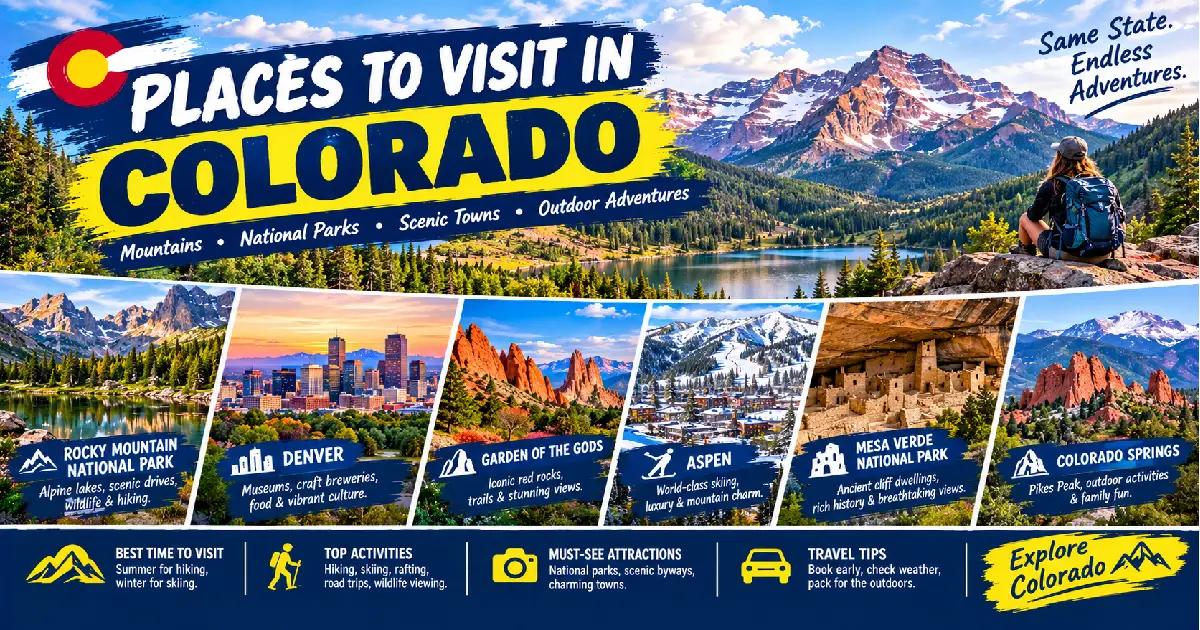
Colorado is one of the most geographically varied states in the American West — a place where the Rocky Mountains rise to 58 summits above 14,000 feet, where the high desert of the Western Slope transitions to canyon country as dramatic as anything in Utah, where small mining towns from the 1870s still sit at 9,000 feet surrounded by aspen groves that turn gold every October, and where the Front Range cities of Denver, Boulder, and Fort Collins offer urban culture at 5,000 feet with the mountains visible from every westward-facing window. What makes Colorado distinctive as a travel destination is the density of genuinely world-class experiences compressed into a state that spans roughly 380 miles east to west and 280 miles north to south — from Rocky Mountain National Park in the north to the Mesa Verde cliff dwellings in the southwest, from the hot springs towns of Glenwood Springs and Ouray to the Great Sand Dunes on the edge of the San Luis Valley.
The mountains are the central fact of Colorado travel. The state contains more high-altitude terrain than any other in the continental United States — more than 1,000 peaks above 10,000 feet and 58 above 14,000 (the “Fourteeners”), concentrated in the central and southern Rockies. The Continental Divide runs through the heart of the state, separating the Pacific-draining Western Slope from the Atlantic-draining Eastern Slope. This geography shapes everything about Colorado travel: the altitude affects visitors immediately (Denver is at 5,280 feet; most mountain destinations sit at 7,000–9,000 feet; ski resorts operate as high as 12,000 feet), the mountain passes close seasonally, and the weather can change from clear and 70°F to a mountain thunderstorm in 20 minutes at altitude. Understanding Colorado’s geography is the prerequisite for planning a Colorado trip effectively.
The state has also been shaped by three distinct historical eras: the Indigenous occupation and creation of the Mesa Verde cliff dwellings (700 CE–1300 CE); the 19th-century mining boom that produced Leadville, Telluride, Aspen, Central City, Cripple Creek, and dozens of other silver and gold camps, many of them now among the most charming small towns in the West; and the 20th-century ski industry that transformed those mining towns — and purpose-built resorts like Vail and Beaver Creek — into the ski destinations most Americans think of first when they hear “Colorado.” Traveling through all three layers simultaneously is one of the pleasures of a Colorado road trip.
| Place | Region | Best For | Best Season |
|---|---|---|---|
| Rocky Mountain National Park | Northern Front Range | Hiking, wildlife, alpine scenery | June–September |
| Denver | Front Range | City culture, food, day trips | Year-round |
| Boulder | Front Range | Outdoor lifestyle, Flatirons, food | Year-round |
| Aspen | Central Rockies | Skiing, hiking, arts, luxury | December–March / June–September |
| Telluride | Southwest | Skiing, festivals, box canyon drama | December–March / July–September |
| Vail | Central Rockies | World-class skiing, alpine village | December–April / June–September |
| Breckenridge | Summit County | Skiing, Victorian Main Street, hiking | December–April / June–September |
| Colorado Springs | Southern Front Range | Pikes Peak, Garden of the Gods, Air Force Academy | May–October |
| Mesa Verde National Park | Southwest | Ancestral Puebloan cliff dwellings | May–October |
| Durango | Southwest | Narrow-gauge railroad, rafting, gateway to Mesa Verde | May–October |
| Moab Area / Canyons of the Ancients | Western Slope | Canyon country, Colorado National Monument | March–May / September–November |
| Steamboat Springs | Northern Rockies | “Champagne powder” skiing, hot springs | December–March / June–September |
| Glenwood Springs | Western Slope | World’s largest hot springs pool, Glenwood Canyon | Year-round |
| Ouray | Southwest | Ice climbing, hot springs, “Little Switzerland” | Year-round |
| Great Sand Dunes National Park | San Luis Valley | Largest sand dunes in North America | May–October |
Region: Northern Front Range | MM/Location: Estes Park (north entrance) / Grand Lake (west entrance) | Best Season: June–September
Rocky Mountain National Park is the centerpiece of Colorado’s national park system and one of the finest mountain parks in the United States — 415 square miles of alpine tundra, glacial valleys, pine and aspen forest, and some of the most accessible high-altitude terrain in the country. The park’s 355 miles of trails range from flat valley-floor walks to summit approaches on Longs Peak (14,259 feet, the park’s only Fourteener), and the Trail Ridge Road — the highest paved continuous highway in the United States at 12,183 feet — crosses the Continental Divide through open alpine tundra where elk, bighorn sheep, and marmots are visible from the road.
What makes it unmissable: The combination of accessibility and grandeur. Trail Ridge Road is driveable in a standard car and places visitors in genuine alpine tundra — above the treeline, with 360-degree mountain views and tundra wildflowers in July — without any hiking required. The park’s elk population is one of the largest in Colorado; fall rut (mid-September to mid-October) brings bugling bulls and elk congregations in Horseshoe Park and Moraine Park that are among the finest wildlife spectacles in the American West.
Top experiences:
Practical: Entry $35/vehicle (valid 7 days). Timed-entry reservations required May–October for Bear Lake Road; reserve at recreation.gov weeks in advance. Altitude sickness is real at 10,000+ feet — hydrate before arrival, ascend gradually, allow one day to acclimatize in Denver or Estes Park before significant exertion.
Gateway town: Estes Park (east entrance) — charming mountain resort town with abundant accommodation. Grand Lake (west entrance) — quieter, more authentic, excellent base for western park access.
Region: Front Range | Altitude: 5,280 feet | Best Season: Year-round
Denver is both Colorado’s largest city and its most practical hub — the arrival point for the majority of Colorado visitors (Denver International Airport, the fifth-busiest in the United States) and a genuinely excellent destination in its own right. The city has transformed significantly since 2010, driven by the legalization of recreational cannabis (2012), a sustained tech and finance sector boom, and a food scene that now competes with Austin and Portland for per-capita culinary quality. What has not changed is the essential Denver experience: a Western city at altitude, with the Rocky Mountains visible from nearly every westward-facing street, a perpetually sunny climate (300 days of sunshine annually), and a population that treats outdoor recreation as non-negotiable.
Top experiences:
Day trips from Denver: Rocky Mountain National Park (1.5 hrs north), Breckenridge (1.5 hrs west on I-70), Colorado Springs (1 hr south), Boulder (45 min northwest), Rocky Mountain Arsenal Wildlife Refuge (20 min northeast, bison herd).
Region: Northern Front Range | Altitude: 5,430 feet | Best Season: Year-round
Boulder is one of the most livable and most-visited small cities in the American West — a university town (University of Colorado, 35,000 students) at the foot of the Flatirons, a series of dramatically tilted 300-million-year-old sandstone slabs that form one of the most recognizable mountain silhouettes in Colorado. The city has among the highest percentages of outdoor recreation participants of any American city its size; the trail system accessible from downtown is genuinely exceptional (300+ miles of trail in the Boulder Open Space and Mountain Parks system, with free access from the western edge of the city).
Top experiences:
Food and drink: Boulder’s restaurant scene punches well above its size — The Kitchen (1039 Pearl St, farm-to-table pioneer), Frasca Food and Wine (1738 Pearl St, Northern Italian, one of the finest restaurants in Colorado), Dushanbe Teahouse (1770 13th St, gift from Boulder’s sister city in Tajikistan, hand-carved interior), and Avery Brewing (4910 Nautilus Ct, Belgian-inspired craft beer) are the anchors.
Region: Roaring Fork Valley | Altitude: 7,908 feet | Best Season: December–March (ski), June–September (summer)
Aspen is the most famous ski resort town in the United States and arguably in the world — a place that is simultaneously a Victorian silver mining camp (founded 1879, boomed to 10,000 people by 1890, nearly abandoned by 1930), a postwar ski destination (Aspen Mountain opened in 1947), and the cultural and philanthropic capital of the American mountain West (the Aspen Institute, Aspen Ideas Festival, Aspen Music Festival). What distinguishes Aspen from other world-class ski destinations is the combination: a genuine Victorian downtown (not a purpose-built ski village), four ski mountains operated by Aspen Snowmass (Aspen Mountain, Aspen Highlands, Buttermilk, Snowmass), 336 annual inches of snowfall, and a cultural programming calendar that makes Aspen relevant year-round.
Ski season (December–April):
Summer season (June–September):
Note: Aspen is expensive. Hotel rooms average $500–1,200/night in ski season; lift tickets $180–260/day. Skiing on an Ikon or Epic pass significantly reduces costs.
Region: San Juan Mountains, Southwest Colorado | Altitude: 8,750 feet | Best Season: December–March (ski), July–September (summer)
Telluride is the most dramatically situated town in Colorado — a Victorian silver mining camp (founded 1876) sitting at the end of a steep-walled box canyon in the San Juan Mountains, connected to the Mountain Village ski resort above by a free gondola and surrounded on three sides by 13,000-foot canyon walls. The box canyon setting makes Telluride unlike any other ski town in the Rockies: the main street (Colorado Avenue) runs east-west through the canyon floor, with the canyon walls rising directly above the Victorian brick storefronts, and the 365-foot Bridal Veil Falls (Colorado’s longest free-falling waterfall) visible from the east end of town. There is no through traffic; Telluride Road 145 dead-ends at the town.
Ski season: 2,000 acres, 1,000 annual inches of snowfall in the upper mountain, and terrain that rewards expert skiers (Revelation Bowl, Gold Hill) while providing excellent intermediate runs. The free gondola connecting the town to Mountain Village at 9,500 feet is one of the finest pieces of ski resort infrastructure in the world.
Summer season:
Region: Eagle County, Central Rockies | Altitude: 8,150 feet | Best Season: November–April (ski), June–September (summer)
Vail Mountain is the largest single ski mountain in the United States by skiable acreage (5,317 acres) and the most visited ski resort in Colorado. Unlike Aspen and Telluride — genuine Victorian towns adapted to ski culture — Vail is a purpose-built alpine village opened in 1962, designed to evoke a Tyrolean mountain village (the cobblestone pedestrian areas, the architecture). The design has been sophisticated over six decades and the village is genuinely handsome; Vail is not merely a ski resort with a hotel cluster but a complete pedestrian village with hundreds of restaurants, independent shops, and year-round programming.
Skiing: The back bowls — Blue Sky Basin, China Bowl, Tea Cup Bowl, Siberia Bowl — are the defining Vail experience: 7 sq miles of above-treeline bowl skiing accessible from the top of the mountain, with terrain ranging from groomed intermediate runs to challenging ungroomed powder. Total skiable acreage (5,317) is larger than some entire European ski resorts.
Summer: The Eagle Bahn Gondola operates in summer for mountain biking (the Vail Mountain Bike Park has 80+ miles of trails) and hiking to the top of Vail Mountain (11,560 feet) for panoramic Gore Range views. Vail’s Betty Ford Alpine Gardens (at the base of the gondola) is the world’s highest botanic garden (8,200 feet) and free to visit.
Access: I-70 west from Denver, 97 miles (1.5–2 hrs in normal traffic; I-70 mountain traffic is heavy Friday evening and Sunday afternoon in ski season). Vail has no commercial airport — fly into Denver (EGE, Eagle County Airport, 35 miles west, serves seasonal direct flights).
Region: Summit County, Central Rockies | Altitude: 9,600 feet | Best Season: November–May (ski), June–September (summer)
Breckenridge is the most visited ski town in Colorado for independent travelers — a Victorian gold-mining camp (founded 1859, the oldest continually occupied European settlement in Colorado) with a genuine 19th-century main street (Main Street Breckenridge, 12 blocks of Victorian commercial buildings with independent restaurants, shops, and bars), a ski mountain of 2,908 acres with a vertical drop of 3,398 feet, and Summit County’s excellent trail system connecting Breckenridge to Keystone, Arapahoe Basin, and Copper Mountain on the Epic Pass.
What makes it the ideal Colorado ski town for first-timers: The combination of the historic downtown (walkable, authentic, not manufactured), the ski mountain’s range of terrain (excellent beginner and intermediate terrain at Peaks 7 and 8, challenging expert terrain at Peaks 6 and 10), and the Summit County free bus network (free bus connecting Breckenridge to Frisco, Keystone, and Dillon throughout ski season — no rental car needed if staying in town).
Summer: Breckenridge’s summer is equally excellent — the ski mountain opens for lift-accessed mountain biking and hiking in late June, and the Breckenridge Riverwalk and historic downtown provide a genuine Victorian mountain town experience. The Breckenridge Outdoor Education Center runs adaptive outdoor programs; the Breckenridge Music Festival (July–August) programs classical and folk music in the mountaintop Riverwalk Center.
Altitude note: Breckenridge at 9,600 feet is the highest town on this list. Altitude sickness risk is real for visitors arriving directly from sea level; spend one night in Denver (5,280 feet) before ascending to Breckenridge.
Region: Southern Front Range | Altitude: 6,035 feet | Best Season: May–October
Colorado Springs is Colorado’s second-largest city — a military and aerospace hub (Fort Carson, Peterson Space Force Base, NORAD, the United States Air Force Academy) with one of the finest concentrations of natural attractions in the American West within a 30-minute drive of downtown. The city itself is not a major destination; the attractions surrounding it are.
Top experiences:
Region: Southwest Colorado | Altitude: 6,500–8,572 feet | Best Season: May–October
Mesa Verde is the only National Park in the United States created to preserve the works of a people rather than a natural landscape — and the cliff dwellings of the Ancestral Puebloans (formerly called the Anasazi, a term now considered inappropriate) that it preserves are among the finest pre-Columbian architectural achievements in North America. The park’s 5,000+ archaeological sites include hundreds of cliff dwellings built into the alcoves of the mesa’s vertical sandstone walls between approximately 600 CE and 1300 CE, when the entire Mesa Verde population departed — for reasons still debated by archaeologists — in a migration south toward the Rio Grande.
Top experiences:
Practical: Park entry $35/vehicle (valid 7 days). The park road from the entrance to Cliff Palace is 21 miles; allow a full day. Cliff Palace and Balcony House tours sell out in summer — reserve at recreation.gov before arrival. No gas stations inside the park; fill up in Cortez or Durango.
Region: Southwest Colorado | Altitude: 6,512 feet | Best Season: May–October
Durango is the finest base-camp town in southwest Colorado — a Victorian railroad town on the Animas River that serves as the gateway to Mesa Verde (36 miles), the San Juan Mountains (immediately north), and the San Juan Skyway (the finest scenic drive in Colorado). The historic downtown — 12 blocks of 1880s commercial brick buildings along Main Avenue — has the genuine density and character of a real 19th-century railroad town, with independent restaurants, outfitters, breweries, and shops that reflect a year-round outdoor recreation economy rather than pure tourism.
Top experiences:
Region: Western Slope | Altitude: 4,593 feet (Grand Junction) | Best Season: March–May, September–November
Colorado National Monument is the closest the state comes to the canyon country of Utah — 32 square miles of red-rock canyons, sandstone monoliths, and juniper mesas above the Colorado River, administered by the National Park Service but unknown to most visitors outside the region. The Rim Rock Drive (23 miles, one-way) runs the full length of the monument’s rim, with overlooks into Ute Canyon, Monument Canyon (Coke Ovens formation, Independence Monument) and the Colorado River valley below. Monument Canyon Trail (6 miles round-trip) descends into the canyon floor beneath the Independence Monument — a 450-foot sandstone tower.
Grand Junction is the agricultural and commercial hub of the Western Slope — a genuine regional city with the Colorado Mesa University, wine country (the Grand Valley AVA produces Cabernet Franc, Syrah, and Merlot at 4,700 feet — one of the highest wine-producing regions in the United States), and the Museum of Western Colorado (free Tuesdays). The Palisade Peach Festival (August) draws Western Slope visitors for the finest high-altitude stone fruit in the country.
Region: Routt County, Northern Rockies | Altitude: 6,728 feet | Best Season: December–March (ski), June–September (summer)
Steamboat Springs is the most authentically Western of Colorado’s major ski resort towns — a genuine ranching and rodeo community (the Steamboat Springs Pro Rodeo Series runs June–August, Friday and Saturday nights) that was built on cattle before it was built on skiing. The town of 13,000 has a walkable Main Street with locally owned businesses, the Old Town Hot Springs (a geothermal pool complex in the heart of downtown, $20/adult), and access to a ski mountain — Steamboat — known internationally for Champagne Powder, a trademarked term for the exceptionally dry, light snow produced by the combination of cold temperatures and moisture from the Pacific and the Gulf of Mexico.
The Strawberry Park Natural Hot Springs (7 miles north, accessible by 4WD in winter) is among the finest natural hot springs in Colorado — pools at 104°F in a canyon setting, with a designated adult-only policy after dark.
Region: Garfield County, I-70 Corridor | Altitude: 5,760 feet | Best Season: Year-round
Glenwood Springs sits where the Roaring Fork River meets the Colorado River at the western end of Glenwood Canyon — one of the most dramatic highway corridors in the United States, a 12-mile section of I-70 blasted through a 1,000-foot-deep canyon of Precambrian granite (built 1982–1992 at a cost of $490 million, considered the most expensive highway construction project in American history at the time). The canyon is visible from the highway and extraordinary; the bike trail through the canyon provides a car-free perspective.
Glenwood Hot Springs Pool (415 E 6th St): The world’s largest geothermal hot spring pool — 405 feet long, heated to 90–93°F — has operated continuously since 1891. $31/adult; families stay adjacent at the Glenwood Hot Springs Lodge. glenwoodnhotsprings.com.
Iron Mountain Hot Springs (281 CO-82): A newer, more boutique hot springs experience on the Colorado River bank — 16 individual soaking pools and one large family pool. $28/adult. ironmountainhotsprings.com.
Glenwood Caverns Adventure Park (51000 Two Rivers Plaza Rd): Gondola ride up Iron Mountain to Colorado’s only mountaintop amusement park — cave tours ($23/adult), roller coasters, and a Giant Canyon Swing hanging 1,300 feet over Glenwood Canyon.
Region: San Juan Mountains, Southwest Colorado | Altitude: 7,792 feet | Best Season: Year-round (different seasons offer different experiences)
Ouray — nicknamed “Little Switzerland” for its position at the base of a vertical-walled box canyon in the San Juans — is the finest small town in Colorado in terms of the relationship between its natural setting and its built environment. Population 1,000; elevation 7,792 feet; surrounded on three sides by 13,000-foot peaks; accessed by the Million Dollar Highway (US-550), a section of road so named (in 1920s dollars) for the gold ore in the gravel used to build it.
Ouray Ice Park (Uncompahgre Gorge, immediately south of town): The world’s largest artificially maintained ice climbing park — a narrow gorge with 13 separate climbing columns running to 200 feet, irrigated and frozen through the winter season. Free to enter and observe; climbing lessons and gear rental from local guide services. Open January–February peak season.
Ouray Hot Springs (1200 Main St): Outdoor geothermal pool complex in the center of town, with mountain views on all sides. $18/adult.
Box Canyon Falls (Box Canyon Rd, south end of town): A 285-foot waterfall in a 20-foot-wide slot canyon, accessible via a boardwalk and suspension bridge for $5. One of the finest slot canyon experiences in Colorado.
4WD roads: Ouray is the hub for San Juan 4WD routes — Engineer Pass, Imogene Pass (connecting to Telluride), Black Bear Pass. Jeep rental available in town.
Region: San Luis Valley, South-Central Colorado | Altitude: 7,518 feet (dune base) | Best Season: May–October
Great Sand Dunes National Park contains the tallest sand dunes in North America — a 30-square-mile field of dunes rising 750 feet (Star Dune, the tallest dune in the park) from the floor of the San Luis Valley, with the 14,000-foot Sangre de Cristo Mountains as backdrop. The geological explanation — wind-blown sand from the San Luis Valley floor accumulates against the mountain front, prevented from further movement by the mountain barrier and recycled by seasonal streams — does not diminish the visual effect: the dunes look entirely wrong in the Colorado mountain setting, which is exactly why they are unforgettable.
Top experiences:
Practical: Entry $25/vehicle. No gas stations inside the park; fill up in Alamosa (30 miles south). The Zapata Ranch (The Nature Conservancy) north of the park protects a wild bison herd visible from the park entrance road.
November–April: Ski season. The mountain resorts are fully operational; road conditions in the mountains require checking (CDOT: cotrip.org). Mountain passes may close temporarily due to avalanche control.
May–June: Shoulder season — lower prices, smaller crowds, wildflowers at lower elevations. Some high mountain roads and trails remain snow-covered through June. Rafting rivers are at peak flow (May–June) from snowmelt.
July–August: Peak summer. Rocky Mountain National Park, Mesa Verde, Great Sand Dunes, and all mountain towns are at peak occupancy. Afternoon thunderstorms develop daily above treeline; start all summit hikes before noon.
September–October: The finest month for Colorado travel: aspen fall color (peak third week of September in most areas), clear skies, dramatically reduced crowds, and temperatures that remain warm through October. The Maroon Bells aspens and the San Juan Mountains are extraordinary in late September.
Colorado is car country. A rental car is essential for any travel outside Denver and Boulder (which are connected by a direct bus — the BOLT, $4 one-way). The major mountain resort towns (Vail, Breckenridge, Aspen, Steamboat) have ski-season shuttle service from Denver airport, but independent road access between destinations requires a car.
I-70 Mountain Corridor: The primary axis of Colorado mountain travel — Denver west to the ski resorts — is I-70 through Glenwood Canyon to Grand Junction. The corridor is heavily congested Friday evening (outbound) and Sunday afternoon (return) throughout ski season; allow 2–3 hours for the normally 90-minute Denver–Vail drive on peak Sundays.
Four-wheel drive: Required for mountain passes (Imogene, Engineer, Black Bear) accessed by jeep roads in the San Juans, and recommended for winter mountain driving generally. Major rental car companies at Denver airport offer AWD/4WD vehicles.
Posted By : Vinay
Latest Article
2nd Floor, 39, Above Kirti Club, DLF Industrial Area, Kirti Nagar, New Delhi, Delhi 110015



Travel Tourister is a leading Travel portal where we introduce travellers to trusted travel agents to make their journey hasselfree, memorable And happy. Travel Tourister is a platform where travellers get Tour packages ,Hotel packages deals through trusted travel companies And hoteliers who are working with us across the world. We always try to find new and more travel agents and hoteliers from every nook and corners across the world so that you could compare the deals with different travel agents and hoteliers and book your tour or hotel with the one you have chosen according to your taste and budget.
Copyright © Travel Tourister, India. All Rights Reserved

 Call
 Enquiry