Published on : 23 Oct 2026
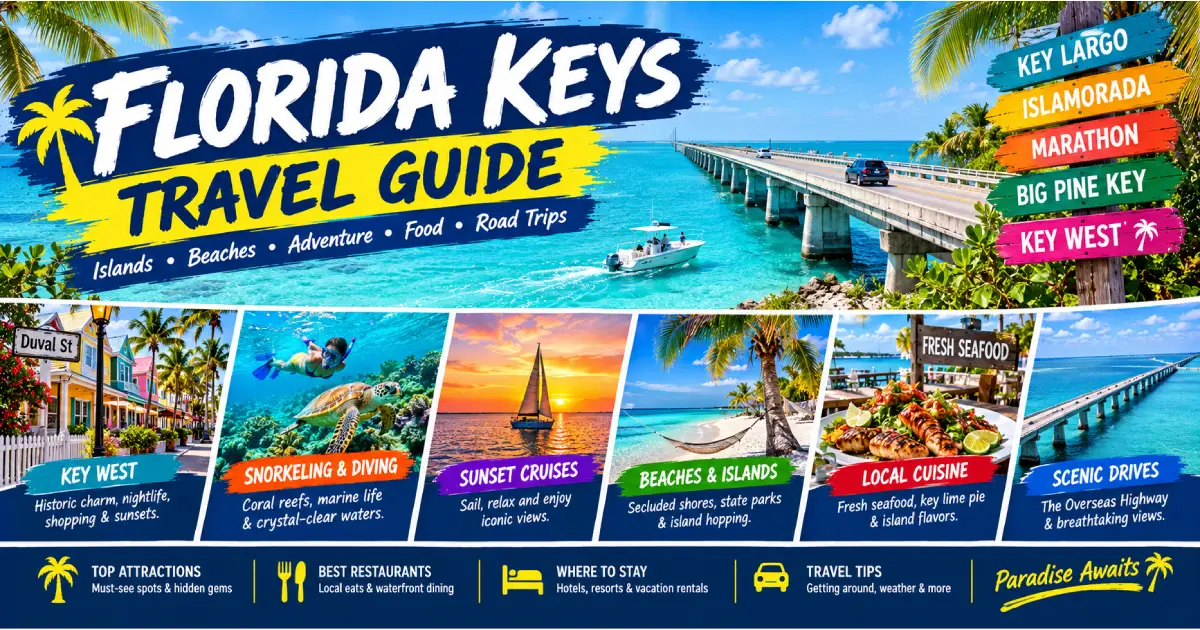
The Florida Keys are one of the great American road trips and one of the most singular landscapes in the continental United States — a 125-mile chain of coral islands trailing southwest from the tip of the Florida peninsula into the Gulf of Mexico and the Atlantic Ocean, connected by the Overseas Highway and separated from the rest of Florida by a combination of geography and temperament that is impossible to miss. The Keys begin at Key Largo, 60 miles south of Miami, and end at Key West, 90 miles from Cuba. Between them lie 42 bridges, the longest of which — the Seven Mile Bridge — is one of the most extraordinary driving experiences in North America: a perfectly straight, nearly featureless road running across open ocean water with no land visible in either direction.
What makes the Florida Keys distinctive in the context of American travel is the combination of natural and cultural specificity they pack into a thin strip of coral rock. The Florida Reef — the only living coral barrier reef in the continental United States, and the third largest in the world — runs along the Atlantic side of the Keys for their entire length, accessible by short boat ride from virtually any point. The backcountry of Florida Bay behind the Keys is the finest shallow-water fishing environment in the Western Hemisphere, drawing anglers from every continent for tarpon, permit, and bonefish on the grass flats. The mangrove ecosystem — the vast interconnected system of red mangrove prop-root tunnels and shallow tidal creeks that lines the bay side of the Keys — supports one of the most biodiverse coastal habitats in North America. And the terrestrial wildlife includes species found nowhere else on Earth: the Key deer of Big Pine Key, the American crocodile of the upper Keys backcountry, and the tiny Key Largo woodrat, among others.
The human culture of the Keys is equally specific. The chain was populated in the 19th century by Bahamian fishermen (the “Conchs,” a term now used for any native Keys resident), Cuban cigar makers, and the entrepreneurs who built fortunes from the wrecking industry — salvaging the cargo of the hundreds of ships that ran aground on the reef every year. Henry Flagler’s Florida East Coast Railway reached Key West in 1912 (the most technically ambitious railroad construction in American history to that point), was destroyed by the Labor Day Hurricane of 1935, and was converted to the Overseas Highway in 1938. The resulting culture — independent, saltwater-focused, and tolerant of eccentricity in a way that reflects both its geographic isolation and its history as a refuge for people who wanted to be somewhere else — is still identifiable throughout the Keys in 2026 and particularly concentrated in Key West.
| Factor | Details |
|---|---|
| Length | 125 miles (Key Largo to Key West) |
| Number of Islands | 1,700 islands; ~30 accessible by road |
| Number of Bridges | 42, including the 6.79-mile Seven Mile Bridge |
| Entry Point | Florida City (mainland) or Miami International Airport |
| Main Highway | US-1 / Overseas Highway (single two-lane road) |
| Mile Marker System | MM 126 (Key Largo) to MM 0 (Key West); used for all addresses |
| Time Zone | Eastern Time (UTC−5 / UTC−4 DST) |
| Best Season | November–April (dry season) |
| Sales Tax | 7.5% (Monroe County) |
| Emergency | 911 |
The Florida Keys use a mile marker (MM) system rather than street addresses for most locations along US-1. Mile markers begin at MM 126 at the mainland side of Key Largo and count down to MM 0 at the corner of Whitehead and Fleming Streets in Key West. Every business, park, and landmark in the Keys gives its location as a mile marker number plus “oceanside” (Atlantic side, south) or “bayside” (Florida Bay side, north). This system is the most important navigation concept in the Keys; understanding it makes the Overseas Highway completely logical.
Key MM locations:
Driving the Overseas Highway is the definitive Florida Keys experience and by far the most practical way to explore the full chain. US-1 is the only road connecting the Keys to the mainland; there is no alternative route.
From Miami: 60 miles to Key Largo / 160 miles to Key West. Take Florida Turnpike south (Extension) to Florida City, then US-1 south. Allow 1.5 hours to Key Largo, 3.5–4 hours to Key West (not counting stops). The Florida Turnpike ends at Florida City; US-1 begins there and doesn’t stop until Key West.
From Fort Lauderdale: 80 miles to Key Largo / 200 miles to Key West. Florida Turnpike south to Florida City, then US-1.
From Orlando: 270 miles to Key Largo / 380 miles to Key West. Florida Turnpike south all the way; approximately 4.5 hours to Key West.
From Tampa: 290 miles to Key Largo / 400 miles to Key West. I-75 south to Naples, then US-41 (Tamiami Trail) east to Florida City, then US-1; or FL Turnpike south from the interchange at Wildwood.
Traffic: US-1 through the Keys is two lanes for most of its length, with passing zones at intervals. The route is not a fast road — plan for an average speed of 45–50 mph between communities, slower through the commercial strips of Key Largo, Islamorada, and Marathon. The Sunday evening return from Key West to Miami can back up significantly.
Key driving stops:
Key West International Airport (EYW) is the principal Keys airport, with direct service from Miami, Fort Lauderdale, Tampa, Orlando, Atlanta, Charlotte, New York, Newark, Philadelphia, and Chicago. Flights from Miami take 45 minutes; from New York, 3 hours nonstop. See the Key West Travel Guide for full airline details.
Miami International Airport (MIA) — 60 miles from Key Largo, 160 miles from Key West — is the practical hub for travelers arriving from international destinations or US cities not served by EYW. Rent a car at MIA and drive the Overseas Highway; the drive from MIA to Key West takes approximately 3.5–4 hours.
The Key West Express high-speed catamaran operates from Fort Myers Beach to Key West — 100 miles across the Gulf of Mexico in approximately 3.5 hours. $100–135/person one-way; $175–225/person round-trip. Departs Fort Myers Beach at 8:30 AM, returns from Key West at 5:45 PM. Ideal for travelers from the Fort Myers/Naples/Cape Coral area. keywestexpress.net.
Note: There is no ferry service from Miami or Fort Lauderdale to Key West.
The Upper Keys are the most accessible section of the Keys from Miami and the section with the highest concentration of reef-based activities. Key Largo — the longest island in the Keys at 30 miles — is the self-proclaimed “Diving Capital of the World” and backs that claim with John Pennekamp Coral Reef State Park, the world’s first underwater state park, established in 1963.
Key Largo (MM 126–MM 90):
Islamorada (MM 90–MM 72): Known as the “Sport Fishing Capital of the World,” Islamorada is the center of the Keys backcountry fishing culture and has some of the finest full-service fishing lodges in the hemisphere.
Dining in the Upper Keys:
The Middle Keys center on Marathon — the second-largest community in the Keys (after Key West) and the most practical base for exploring both the Upper Keys and the Lower Keys on a multi-day trip. Marathon has a functioning downtown (grocery stores, hardware stores, schools — the infrastructure that supports a year-round community), an airport (MTH, for private and charter aviation), and the full range of accommodations from camping to luxury resorts.
Marathon (MM 72–MM 47):
Seven Mile Bridge (MM 47–MM 40): The centerpiece of the Overseas Highway experience — 6.79 miles of elevated roadway over open ocean water, with no land visible in either direction at the bridge’s midpoint and the Old Seven Mile Bridge running parallel on the right. The bridge was completed in 1982; the original 1909 Flagler Railroad bridge runs alongside and is now used as a fishing pier (world’s longest fishing pier at its peak, though sections are now closed for restoration). The view from the bridge’s midpoint at sunset is one of the finest in Florida.
Dining in the Middle Keys:
The Lower Keys are the least developed and most naturally preserved section of the accessible Keys — a collection of islands with more mangrove and hardwood hammock than commercial development, home to the National Key Deer Refuge and Looe Key National Marine Sanctuary (one of the finest dive sites in the Keys).
Bahia Honda State Park (MM 36.8): The finest state park in the Keys and the finest swimming beach in the entire Keys chain. Bahia Honda (Spanish for “deep bay”) occupies a narrow island straddling the Overseas Highway, with beaches on both the Atlantic and Florida Bay sides. The Sandspur Beach on the Atlantic side is wide, white, and remarkable for its clarity of water — the deep channel of Bahia Honda Channel produces strong tidal currents that keep the water clear and the sand clean. The ruins of Flagler’s original railroad bridge span the southern end of the park, providing one of the most photogenic structures in the Keys.
National Key Deer Refuge (MM 30–MM 16, Big Pine Key): The Key deer — the world’s smallest white-tailed deer, standing 24–32 inches at the shoulder and endemic to the lower Florida Keys — was nearly extinct in the 1950s (fewer than 50 animals). The National Key Deer Refuge, established in 1957, protects the habitat of approximately 1,000 Key deer across 84,351 acres. The Blue Hole (turn north on Key Deer Blvd from US-1, 1.5 miles) is a former rock quarry now filled with freshwater — unusual in the saltwater-surrounded Keys — where Key deer come to drink, alongside American alligators and large freshwater turtles. Early morning (7–9 AM) and late afternoon (4–6 PM) are peak viewing times; the deer are habituated to humans and can be observed at very close range. Free.
Looe Key National Marine Sanctuary (MM 27.5 bayside, Big Pine Key): The finest dive site in the Lower Keys — a section of the Florida Reef 5.4 miles offshore in 5–35 feet of water, featuring spectacular coral formations (enormous brain corals, elkhorn, staghorn, and pillar coral in exceptional health), a diverse fish population, and the consistently clear water of the deep-channel Lower Keys. The Looe Key Reef Resort and Dive Center (MM 27.5) runs daily two-tank dives to Looe Key ($85/person) and snorkel trips ($35/person).
Dining in the Lower Keys:
For full coverage of Key West — the definitive Keys destination — see the dedicated articles:
A car is essential for exploring the Keys — there is no public transportation between the Keys communities, and the distances between attractions require driving. Rent at Miami International Airport (the largest selection and often the lowest rates) or at Key West International Airport (EYW). Gas stations exist throughout the Keys but prices increase progressively toward Key West; fill up in Florida City or Homestead before entering the Keys if possible, and again in Marathon ($0.20–0.40 more per gallon than mainland prices, typically).
Speed limits: 45 mph through the island communities (enforced actively by Monroe County Sheriff’s Office); 55–65 mph on the open bridges and causeways. The posted limits are conservative and the local authorities are not lenient.
The Florida Keys Overseas Heritage Trail — a 106-mile paved multi-use trail running the length of the Keys — is largely complete, with some gaps between Marathon and the Lower Keys. The trail runs parallel to US-1 on the old railroad right-of-way where available and on the roadway shoulder elsewhere. Cycling the full trail requires logistics planning (the gaps require road cycling) but sections — particularly the Key Largo segment, the Marathon–Seven Mile Bridge section, and the Stock Island–Key West segment — are excellent. Bicycles available for rent in Key West ($15–25/day); limited rental availability in the Upper and Middle Keys.
Jules’ Undersea Lodge (Key Largo, MM 103.2): The world’s first underwater hotel, 30 feet below the surface of a lagoon. $800–1,200/person/night including meals and equipment. The most unique accommodation in Florida.
Cheeca Lodge and Spa (Islamorada, MM 82 oceanside): The iconic Upper Keys resort since 1946; private beach, saltwater lagoon, excellent fishing program. $350–650/night.
The Islander Resort (Islamorada, MM 82.1 oceanside): Boutique oceanfront resort, private beach, swimming lagoon, good value for the Upper Keys. $200–380/night.
Kona Kai Resort (Key Largo, MM 97.8 bayside): Adult-only boutique resort on Florida Bay, private beach, botanical gardens, extraordinary tranquility. $275–450/night.
Hawks Cay Resort (Duck Key, MM 61): The premier full-service resort in the Middle Keys — private island, multiple pools, water sports, dolphin experiences, full-service marina. $350–650/night.
The Tranquility Bay Resort (Marathon, MM 48.5 bayside): Beachfront resort with private lagoon beach, Florida Bay views, excellent for families. $280–500/night.
Seascape Motel (Marathon, MM 50.5 oceanside): Classic Keys mid-century motel on the ocean, affordable, independently owned. $120–200/night.
Little Palm Island Resort and Spa (Little Torch Key, MM 28.5 — accessible by launch only): The most luxurious resort in the Keys — a private island with 30 thatched-roof cottages on the ocean, no televisions or phones, exceptional restaurant and spa. $1,200–3,000+/night. One of the finest small resorts in the United States.
Parmer’s Resort (Little Torch Key, MM 28.7 bayside): Affordable family-friendly resort with private dock, kayaks included, quiet Lower Keys setting. $120–200/night.
Bahia Honda State Park Campground (MM 36.8): 80 campsites, many on the oceanfront. The finest campground in the Keys; book 11 months in advance through reserveamerica.com.
The Florida Reef provides the finest reef diving experience in the continental United States. Key dive sites from north to south:
Best months for diving: November through April for visibility (40–80 feet); July–August for warmest water (85–88°F).
The Florida Keys are considered by serious anglers to be the finest all-around fishing destination in the Western Hemisphere — arguably in the world. Three distinct fishing environments:
The Keys backcountry — the mangrove creeks, tidal channels, and shallow flats of Florida Bay — is among the finest sea kayaking environments in the United States. Guided tours available throughout the Keys from Key Largo to Key West; self-guided rentals at state park concessions (Pennekamp, Bahia Honda). The best guided experience: Florida Bay Outfitters (MM 104, Key Largo) and Lazy Dog Adventures (Stock Island, Key West) for backcountry mangrove tours.
| Budget Level | Daily Cost Per Person | What’s Included |
|---|---|---|
| Budget | $80–130/day | Camping or budget motel; groceries / deli meals; free activities (beaches, Key Deer, Robbie’s tarpon for $3, Bahia Honda beach); one reef snorkel trip |
| Mid-Range | $180–300/day | Mid-range resort or inn; restaurant meals ($30–50/person/meal); John Pennekamp glass-bottom boat or snorkel tour; one paid attraction |
| Luxury | $500–2,000+/day | Hawks Cay, Cheeca Lodge, or Little Palm Island; fishing charter; fine dining at Marker 88 or Pierre’s; water sports |
Money-saving strategies:
Day 1 — Upper Keys:
Day 2 — Middle Keys and Seven Mile Bridge:
Day 3 — Lower Keys and Key West:
Day 1: Key Largo — Pennekamp snorkeling, Jules’ Undersea lobby visit (if not staying), evening at Caribbean Club (the original filming location for the 1948 Bogart film Key Largo) Day 2: Islamorada — Robbie’s tarpon, Theater of the Sea, Hurricane Monument, dinner at Pierre’s Day 3: Marathon — Turtle Hospital, Crane Point, Seven Mile Bridge, Bahia Honda Day 4: Big Pine Key — Key Deer, Looe Key diving, No Name Pub Day 5: Key West — Full day; Hemingway Home, Mallory Square, Duval Street, Historic Seaport
As the 5-day itinerary plus: a fishing charter from Islamorada or Key West (the defining Keys experience for anglers), an overnight camping stay at Bahia Honda, a day trip to Dry Tortugas National Park from Key West, and a Looe Key dive from Big Pine Key.
Alligators and crocodiles: The American crocodile (not the more aggressive American alligator) inhabits the saltwater and brackish areas of the upper Keys, particularly around Florida Bay. Crocodiles in the Keys are generally shy and rarely aggressive toward humans; keep your distance if you see one. The Blue Hole on Big Pine Key has American alligators — maintain a 15-foot distance and never feed them.
Jellyfish and man-o’-war: Portuguese man-o’-war strandings occur throughout the Keys, particularly in spring when onshore winds are common. Do not touch man-o’-war tentacles even when dried on the sand.
Stingrays: Present in the sandy shallows throughout the Keys. The “stingray shuffle” (sliding feet along the bottom rather than stepping) alerts rays to move away before contact.
Mosquitoes: The Keys backcountry — particularly at dawn and dusk — can have intense mosquito concentrations from June through October. Bring and use DEET-based repellent if hiking or kayaking in the mangroves.
No swimming at boat ramps: Manatees congregate at boat ramps (the concrete structure radiates warmth). Do not swim at or near boat ramps; manatees can be seriously injured by swimmers kicking in their proximity.
Feeding Key deer is illegal (federal regulation, punishable by fines up to $50,000). Feeding habituates deer to humans and roads, contributing to the vehicle strikes that are the primary cause of Key deer mortality. Observe without feeding.
The Keys have a distinct cultural identity — Conch culture — that is worth understanding. “Conch” (pronounced “konk”) refers to a native-born Keys resident; the term is used with pride. Key West’s 1982 “secession” from the United States as the Conch Republic was a successful political protest, and the Conch Republic flag (a sun rising over water) appears on bumper stickers, storefronts, and clothing throughout the Keys. The cultural shorthand: the Keys are part of Florida but not particularly similar to it.
The Overseas Highway is the single evacuation route from the Keys. In the event of a hurricane watch or warning, evacuation is mandatory for low-lying and flood-prone areas (Evacuation Zone A covers most of the Keys). Contraflow operations (both lanes of US-1 northbound) begin on a set schedule once mandatory evacuation is ordered. Do not wait for the storm track to be certain — the 113-mile single-road evacuation under contraflow can take 8–12 hours, and the Keys’ position makes last-minute evacuation extremely dangerous.
Grocery stores exist in Key Largo (Winn-Dixie, MM 101.5), Islamorada (Publix, MM 81.6), Marathon (Publix, MM 50.2), and Key West (multiple). Gas stations exist throughout the chain but prices increase toward Key West; the price differential between mainland Florida and Key West can be $0.40–0.60/gallon. Fill up before crossing into the Keys at Florida City.
Posted By : Vinay
Latest Article
2nd Floor, 39, Above Kirti Club, DLF Industrial Area, Kirti Nagar, New Delhi, Delhi 110015



Travel Tourister is a leading Travel portal where we introduce travellers to trusted travel agents to make their journey hasselfree, memorable And happy. Travel Tourister is a platform where travellers get Tour packages ,Hotel packages deals through trusted travel companies And hoteliers who are working with us across the world. We always try to find new and more travel agents and hoteliers from every nook and corners across the world so that you could compare the deals with different travel agents and hoteliers and book your tour or hotel with the one you have chosen according to your taste and budget.
Copyright © Travel Tourister, India. All Rights Reserved

 Call
 Enquiry