Published on : 04 Nov 2026
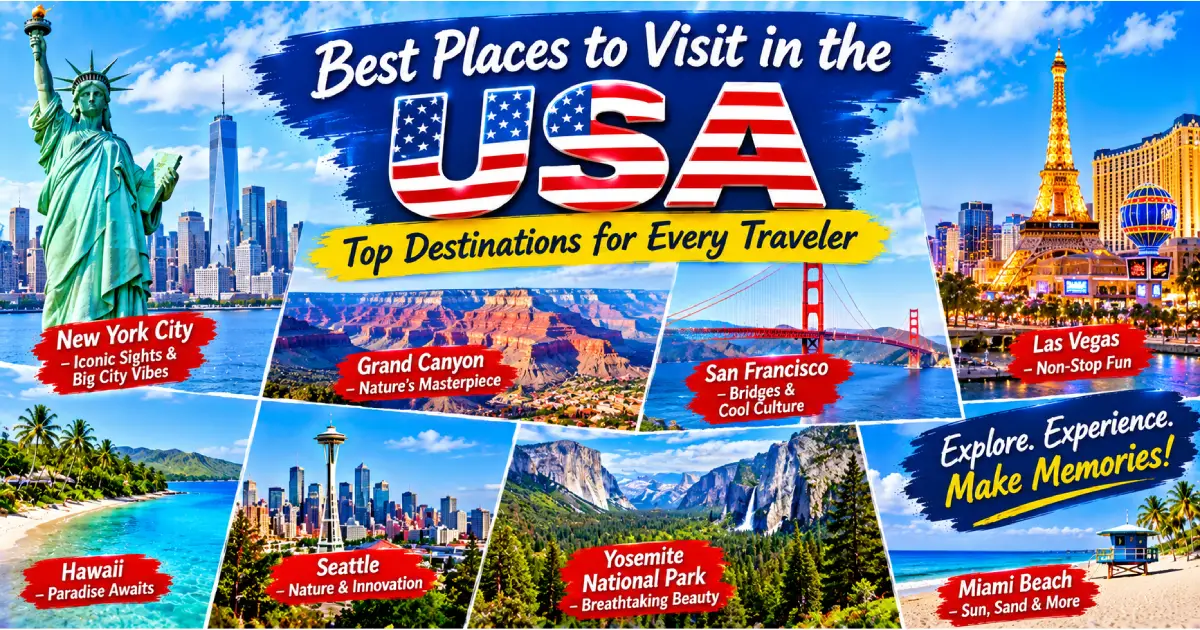
The United States is one of the most geographically and culturally diverse countries on Earth — a nation of 3.8 million square miles where a traveler can stand on the rim of a mile-deep canyon carved by six million years of river erosion, walk through a neighborhood where every building dates to before the American Revolution, watch humpback whales breach from a black-sand volcanic beach, eat the finest French-influenced Creole cooking in the Western Hemisphere, or ski 38-degree powder bowls above a Victorian silver-mining town. No single guide can do justice to the full range of American travel, but this one comes closer than most: 20 of the finest destinations in the country, chosen for the quality and distinctiveness of the experience they offer, with the specific places, prices, and practical details that make the difference between a good trip and an extraordinary one.
Whether you are an international visitor planning your first American journey, a domestic traveler working through a bucket list, or a frequent US traveler looking for a destination you haven’t yet explored, this guide is organized to help you choose. The cities are covered alongside the national parks, the coastal destinations alongside the mountain towns, the cultural capitals alongside the natural wonders — because the finest American travel itinerary almost always combines more than one of these categories.
New York is the most visited city in the United States and, by most measures, one of the two or three finest cities in the world for a traveler — a place of such density, variety, and inexhaustible energy that no two visits are the same, and where the combination of world-class museums, the finest restaurant scene on Earth (30,000+ restaurants, 70+ Michelin stars), the greatest concentration of live performing arts in the Western Hemisphere, and the particular thrill of Manhattan’s street life produces an experience available nowhere else.
Don’t miss: The Metropolitan Museum of Art ($30 suggested, the finest art museum in the Western Hemisphere, 5,000 years of human civilization across 17 acres of galleries), the 9/11 Memorial and Museum ($33/adult, the most powerful memorial museum in the United States), the Brooklyn Bridge (walk the 1.1-mile promenade free, the finest 30-minute walk in New York), the High Line (the 1.45-mile elevated park on a former freight rail line through the West Side, free, the finest urban park design in America since Central Park), Central Park (843 acres free, the Bethesda Terrace, the Ramble, the Reservoir running path), Katz’s Delicatessen (205 E Houston St, the most iconic deli in America, the pastrami on rye $28, open since 1888).
Best neighborhoods: The West Village (the finest streets in New York — Bedford Street, Commerce Street, Grove Street), Williamsburg Brooklyn (the finest food and bar neighborhood outside Manhattan), the Lower East Side (Russ & Daughters, the Tenement Museum $30), Harlem (the Apollo Theater, Sylvia’s soul food).
Budget: Hotels $250–380/night Manhattan; subway $2.90/ride, $34/7-day unlimited.
The Grand Canyon is the most spectacular natural landscape in the United States — a mile-deep, 277-mile-long canyon carved by the Colorado River through 1.8-billion-year-old Vishnu Basement Rocks, so vast and so visually extraordinary that first-time visitors frequently stand at the rim in silence, unable to process what they are seeing. It is the finest single natural wonder in America, the place that most reliably produces the sensation of genuine awe.
Don’t miss: Mather Point (the finest rim-side overlook at the South Rim, the view down to the Colorado River at the canyon floor 4,500 feet below, free with park admission), the Bright Angel Trail (the finest rim-to-river trail on the South Rim — 9.5 miles one way to the Colorado River, hike as far as the Indian Garden Oasis at 4.6 miles RT for a day hike, carry more water than you think you need), the Desert View Watchtower (the 1932 Mary Colter stone tower at the eastern end of Desert View Drive, the finest single viewpoint at the South Rim), sunrise at Hopi Point (the finest sunrise view on the South Rim, arrive 20 minutes before sunrise), the North Rim (open mid-May to mid-October, 1,000 feet higher than the South Rim, far fewer visitors, the Cape Royal Road to the finest viewpoints on the canyon, the finest Grand Canyon experience for a second visit).
Practical: $35/vehicle 7-day pass. South Rim open year-round. Phantom Ranch at the canyon bottom ($50/person dormitory, $190/cabin) books 15 months in advance via lottery at recreation.gov — the finest overnight experience in the national park system.
Hawaii is the most visually spectacular domestic travel destination in the United States — a remote volcanic archipelago 2,400 miles from California where four different sand colors (white, black, green, red), active volcanoes, 100-foot visibility snorkeling, 10,000 humpback whales, and the most dramatic coastal cliffs in America combine with Polynesian cultural depth and a genuine fusion food tradition to produce an experience genuinely unlike anywhere else in the country.
Don’t miss on Maui: Haleakala sunrise (the 10,023-foot volcano summit, reservation required at recreation.gov, $35 park fee, the finest sunrise in Hawaii), Road to Hana (64 miles of waterfalls, bamboo forests, and black-sand beaches), Molokini Crater snorkeling ($120–180/half-day tour, 100–150-foot visibility), humpback whale watching January–March (10,000+ whales in the Maui Channel, the finest whale watching from shore in North America). Don’t miss on Kauai: Na Pali Coast (the most spectacular coastal cliffs in the US, helicopter tour $250–400 the finest single helicopter experience in America, or hike the Kalalau Trail first 2 miles free), Waimea Canyon (“the Grand Canyon of the Pacific,” free drive-up view), Hanalei Bay (the finest crescent bay beach in Hawaii).
Budget: Flights $400–900 RT from West Coast; hotels $300–600/night resort. Best visited April–June or September–November.
New Orleans is the most culturally distinctive city in the United States — the only American city with a genuinely French colonial foundation, an unbroken tradition of African-American musical innovation (jazz was invented here, in the brothels and dance halls of Storyville around 1900), a cuisine that is simultaneously the most original and the most deeply rooted regional food tradition in America, and a relationship to pleasure, death, and celebration that has no parallel in the Protestant Anglo-American mainstream.
Don’t miss: Preservation Hall (726 St Peter St, the most important jazz venue in New Orleans — a bare-bones 19th-century hall where the finest traditional jazz musicians in the city perform nightly, $20 standing room/$35–50 reserved seat, the doors open at 8PM and the music starts at 8:30PM, arrive early), Café Du Monde (800 Decatur St, beignets and café au lait $6–8, open 24 hours, the most beloved café in New Orleans), the French Quarter (the finest preserved colonial urban streetscape in the United States — 86 blocks of Spanish and French colonial buildings with iron-lace balconies, the St. Louis Cathedral 1794 on Jackson Square the most beautiful church in the American South), Magazine Street (the finest shopping and dining corridor in New Orleans outside the Quarter), Commander’s Palace (1403 Washington Ave, Garden District — the most celebrated restaurant in New Orleans, the Saturday jazz brunch $65/person the finest Sunday-style meal in the American South, reserve 2–3 weeks in advance), the National WWII Museum ($31/adult, the finest WWII museum in the world, 7 pavilions, the Beyond All Boundaries 4D cinema experience $7 additional).
Best time: October–April (avoid July–August heat and humidity; Mardi Gras in February–March the finest street festival in America). Budget: Hotels $150–320/night.
San Francisco is the most beautifully situated city in America — a 7-by-7-mile peninsula of steep hills dropping into the finest natural harbor on the Pacific Coast, where the fog rolls through the Golden Gate at dusk and Victorian painted ladies survive on streets named after Spanish missionaries, and where the density of extraordinary restaurants, the Mission District murals, and the peculiar melancholy beauty of the city’s contradictions (enormous wealth beside visible poverty, technological optimism beside Victorian preservation) make every visit feel like a reckoning with the full complexity of modern America.
Don’t miss: Alcatraz ($47.30/adult including ferry, the most visited national park site in California, the audio tour narrated by former guards and inmates the finest self-guided museum experience in San Francisco, book 2–3 weeks in advance at alcatrazcruises.com), the Ferry Building Marketplace (the finest food market in California — Acme Bread, Cowgirl Creamery, the Saturday farmers market the finest in the Bay Area), Dolores Park (the finest park in San Francisco for people-watching), the Mission District (Clarion Alley murals, La Taqueria the finest burrito in San Francisco, Mission Dolores 1791 the oldest building in the city), Tartine Bakery (600 Guerrero St, the finest bakery in the United States, the country bread sells out by 5PM, the morning bun $6 the finest pastry in San Francisco), Muir Woods (30 minutes north via ferry and bus, the finest old-growth coastal redwood grove accessible from a major city, $15/person timed entry reservation required).
Budget: Hotels $220–350/night; cable car $8/ride; BART from SFO $10.
Yellowstone is the first national park in the world (1872) and the most geologically extraordinary landscape in the United States — a 2.2-million-acre supervolcano caldera in the northern Rocky Mountains where more than half of the world’s geothermal features are concentrated, where grizzly bears and wolf packs hunt elk in meadows visible from the road, and where the Old Faithful geyser erupts every 44–125 minutes to a height of 100–180 feet with a reliability that has made it the most visited natural attraction in the American West.
Don’t miss: Old Faithful and the Upper Geyser Basin (the finest concentration of geysers on Earth — 150 geysers within 1 square mile, the Grand Geyser erupts every 7–15 hours to 200 feet and is the tallest predictable geyser in the world, check the prediction board at the Old Faithful Visitor Center), Grand Prismatic Spring (the largest hot spring in the United States, 370 feet in diameter, the rainbow of bacterial mat colors — brown, orange, yellow, green around the deep blue center — is the most photographed geothermal feature in Yellowstone, the Fairy Falls Trail 1-mile spur to the overlook gives the finest view), Lamar Valley (the finest wildlife-viewing corridor in the lower 48 — the “Serengeti of North America,” wolf packs (reintroduced 1995), grizzly bears, bison herds of 1,000+, elk, pronghorn, and bald eagles visible from the road, dawn and dusk the finest times), Grand Canyon of the Yellowstone (the 1,200-foot yellow rhyolite canyon with the Lower Falls 308 feet — twice the height of Niagara — the finest waterfall in the Rocky Mountains, the Artist Point overlook the most photographed viewpoint in Yellowstone).
Practical: $35/vehicle 7-day pass. Open year-round (some roads close November–April). Lodges book 12 months in advance at yellowstonenationalparklodges.com.
Within 90 minutes of Manhattan lies one of the finest pastoral landscapes in the American Northeast — the Hudson River Valley, where the river cuts through the ancient Catskill Mountains past 19th-century estates, Revolutionary War battlefields, and farm-to-table restaurants that have made the region the finest culinary day-trip destination from New York City. The Dia:Beacon museum (3 Beekman St, Beacon — the finest single-building contemporary art museum in America, $20/adult, the Richard Serra sculptures the most physically demanding art in the building, the Agnes Martin galleries the most serene), Olana (the Frederick Church Hudson River School estate on a hilltop above the river, $15/adult tour, the finest view of the Hudson from any historic house in the valley), Millbrook Vineyards (the finest winery in the Hudson Valley, $10–15/tasting), Catskill Center hiking, Woodstock (the most famous small town in the valley after the 1969 festival, the Woodstock Artists Association gallery free, the best bookshop in the region at Mirabai Books).
Chicago is the finest American city that most international visitors underestimate — the third-largest city in the US, the city where the skyscraper was invented (the Home Insurance Building 1885), where deep-dish pizza and the Chicago-style hot dog have entered the American food canon, where the Art Institute of Chicago holds the finest Impressionist collection outside of Paris, and where the Chicago Riverwalk and the 606 Trail have remade the relationship between the city and its infrastructure in the same way the High Line did for New York.
Don’t miss: The Art Institute of Chicago ($26/adult, the finest art museum in the Midwest — Seurat’s A Sunday on La Grande Jatte, Grant Wood’s American Gothic, Edward Hopper’s Nighthawks, the Thorne Miniature Rooms the finest unexpected highlight in any American art museum), Millennium Park (the Cloud Gate (“the Bean”) the most photographed public sculpture in America, the Jay Pritzker Pavilion Frank Gehry bandshell free summer concerts, the Crown Fountain Jaume Plensa, all free), the Chicago Architecture Center river cruise ($47, the finest single architecture tour in any American city — the skyline is the finest collection of 20th-century commercial architecture in the world), Giordano’s (the finest deep-dish pizza in Chicago, the sausage and peppers $28/small deep-dish, 2355 N Clark St), Portillo’s (the finest Chicago-style hot dog — the poppy seed bun, yellow mustard, neon relish, pickled sport peppers, sport pickle, tomato, celery salt, never ketchup — $6.49).
Budget: Hotels $160–300/night; CTA transit $2.50/ride.
Utah concentrates the finest canyon country scenery in the world into five national parks within a 4-hour drive of each other — the finest single-state road trip in the United States.
Zion National Park (the finest canyon walk in America — the Narrows (hike up the Virgin River through 2,000-foot sandstone slot canyon walls, the finest wade-hike in the US, $5 walking stick rental, canyoneering permits required only for the full 16-mile top-down route), Angels Landing (the most thrilling day hike in the US — 1,488-foot climb to a 5,790-foot summit with chain assists on the final half-mile, permit required $3/person reservation.gov), $35/vehicle). Bryce Canyon (the most otherworldly landscape in the US — 60 million years of erosion have produced 200,000 hoodoos (orange and red limestone pinnacles) in the finest concentration on Earth, Sunrise Point the finest named overlook, the Navajo Loop / Queens Garden trail 2.9-mile loop the finest short hike in Bryce, $35/vehicle). Arches National Park (the finest collection of natural stone arches on Earth — 2,000+ arches, the Delicate Arch the most iconic (3-mile RT hike, $35/vehicle), Landscape Arch the longest natural stone span in North America at 290 feet, viewable from a 1.9-mile RT walk). Canyonlands National Park (the most remote and least visited of the five — the Mesa Arch sunrise the most dramatic 20-minute hike in the park (0.5 miles RT, free with park admission), the Island in the Sky district the finest overlook landscape). Capitol Reef National Park (the most underrated of the five — the Scenic Drive through the Waterpocket Fold the finest 20-mile canyon drive in Utah, pick and eat fruit from the historic Fruita Orchards free in season).
Nashville is the most visited non-coastal city in the American South — the birthplace and world capital of country music, where the neon honky-tonks of Lower Broadway, the songwriter-in-the-round culture of the Bluebird Café, the Ryman Auditorium’s sacred acoustics, and the city’s explosive restaurant scene have made it the finest music city in the United States and one of the finest food cities in the American South.
Don’t miss: Lower Broadway (the finest bar street in America — Tootsie’s Orchid Lounge (1960, the most beloved honky-tonk in Nashville, free, 7 days/week from 10AM), Robert’s Western World (the finest live music bar on the strip, the fried bologna sandwich $6 the most beloved cheap eat in Nashville, free)), Ryman Auditorium (116 Fifth Ave N, the “Mother Church of Country Music,” 2,362 red oak pews in a former tabernacle, tour $22/adult, concerts $35–150), Grand Ole Opry ($47–59/ticket, the most historic live radio broadcast in American history, running continuously since 1927), Bluebird Café (4104 Hillsboro Pike, 90-seat listening room, the most important songwriter-in-the-round venue in the world, $15–20 cover, tickets go on sale the 1st of the month at 9AM and sell out within hours), Prince’s Hot Chicken (123 Ewing Dr — the original hot chicken restaurant, the dish that Nashville invented in the 1930s, the Extra Hot level a genuine physical experience, the leg-and-thigh plate $12), Arnold’s Country Kitchen (605 8th Ave S — the finest meat-and-three in Nashville, the fried chicken the benchmark, $12–15 for the full plate, cash only, closes at 2PM).
Budget: Hotels $180–320/night; best visited October–April to avoid summer heat.
The Florida Keys are the most distinctive road trip in the Eastern United States — a 120-mile chain of coral islands connected by the Overseas Highway (US-1, 42 bridges over open water), stretching from the Florida mainland to Key West at the southernmost point in the continental US, where the Atlantic and Gulf of Mexico meet and the culture of the Caribbean begins to overlay the culture of the American South.
Don’t miss: John Pennekamp Coral Reef State Park (Key Largo — the first undersea park in the US, the finest snorkeling in the continental US, glass-bottom boat $32/adult), Theater of the Sea (Islamorada, the oldest marine park in the US, $43/adult, dolphin and sea lion shows), the Seven Mile Bridge (the most dramatic single bridge drive in the US, the old bridge parallel walkway for cycling and walking), Hemingway Home and Museum (Key West, $18/adult, 50+ six-toed cats), Mallory Square sunset (the finest free public nightly event in Florida), Kermit’s Key West Key Lime Shoppe ($5/slice, the finest Key lime pie in Florida).
Washington DC contains the finest concentration of free world-class museums in the world — the Smithsonian Institution‘s 19 museums on and near the National Mall, all free, hold the most important collections of American history, culture, and natural history assembled anywhere on Earth.
Don’t miss: National Museum of African American History and Culture (free timed-entry, the most important new museum in America — book 30 days in advance, the tickets release on the 1st of each month and sell out in minutes, the Contemplative Court the finest single architectural space in Washington), National Air and Space Museum (the Wright Flyer, the Spirit of St. Louis, the Apollo 11 command module Columbia — the most visited museum in the US), National Museum of Natural History (the Hope Diamond 45.52 carats, free), Vietnam Veterans Memorial (Maya Lin’s 1982 black granite wall with 58,318 names, the most emotionally powerful memorial in Washington), Lincoln Memorial (the site of MLK’s “I Have a Dream” speech, the finest civic monument in America, the view east down the Reflecting Pool to the Washington Monument the finest single vista in Washington), Ben’s Chili Bowl (1213 U St NW, the most beloved restaurant in Washington — a U Street institution since 1958, the half-smoke chili dog $9, the chili cheese fries $8, the most important restaurant in the history of Washington’s African American community).
Budget: Hotels $170–310/night; Metro $2–6/ride from airports.
Glacier is the finest mountain scenery in the continental United States — a 1-million-acre wilderness of jagged arêtes, turquoise glacial lakes, and 700+ lakes in the northern Rocky Mountains on the Canadian border, where the Going-to-the-Sun Road (the most spectacular paved mountain road in America) crosses the Continental Divide at 6,646-foot Logan Pass through scenery that the naturalist John Muir called “the best care-killing scenery on the continent.”
Don’t miss: Going-to-the-Sun Road (50 miles, open late June–mid-October, vehicle reservations required ($2/reservation at recreation.gov, available 90 days in advance and by lottery for peak season), the Logan Pass Visitor Center at the summit, the Hidden Lake Overlook Trail 2.7 miles RT from Logan Pass to a 6,998-foot overlook over a pristine glacial lake with mountain goats routinely visible at close range), Grinnell Glacier Trail (11.2 miles RT, 1,600-foot gain — the finest day hike in Glacier, the trail passes two turquoise lakes before reaching the glacier itself, one of the most dramatic hiking days available in the US), Many Glacier Hotel (1915 Swiss chalet-style on Swiftcurrent Lake, the finest lodge in Glacier, $250–450/night, reservations open 13 months in advance), Lake McDonald (the largest lake in the park, the rainbow-colored pebbles on the shoreline the most photographed non-mountain detail in Glacier).
Practical: $35/vehicle 7-day pass. Vehicle reservations required for Going-to-the-Sun Road mid-June to mid-September.
Charleston is the finest small city in the American South — a compact peninsula of 18th-century Georgian and Antebellum architecture between the Ashley and Cooper rivers, where the food scene (driven by the James Beard Award-winning chefs of the Lowcountry cuisine revival), the antebellum history (told honestly at the International African American Museum), and the particular beauty of the Rainbow Row pastel houses on East Bay Street combine to make it the most livable and most beautiful small city in the South.
Don’t miss: The Battery and White Point Garden (the finest city promenade in the South — the antebellum mansions of South Battery Street facing the harbor, the Civil War cannon placements, the view across to Fort Sumter where the first shots were fired), Rainbow Row (83–107 East Bay Street, the most photographed streetscape in Charleston — 13 pastel-painted Georgian row houses 1740s–1760s, free to photograph, best at dawn before the tour groups arrive), International African American Museum ($25/adult, opened 2023 on Gadsden’s Wharf where more enslaved Africans arrived in America than any other point of entry — the most important new museum in the American South), Husk (76 Queen St, Sean Brock’s landmark Lowcountry restaurant in an 1893 Victorian house, the menu changes daily based on what can be sourced within the South, the country ham biscuit the finest single bite in Charleston, $75–95/person, reserve 2–3 weeks in advance), Poogan’s Porch (72 Queen St, the finest shrimp and grits in Charleston in the most atmospheric Victorian porch dining room, $55–75/person).
Yosemite Valley is the finest concentration of vertical granite scenery in the United States — a 7-mile-long, 1-mile-wide glacially carved valley in the Sierra Nevada where El Capitan (3,000-foot vertical granite face, the most famous rock climb in the world), Half Dome (the 8,842-foot iconic granite dome), and Yosemite Falls (the tallest waterfall in North America at 2,425 feet) rise from a valley floor of meadows, the Merced River, and black oaks that turn gold in October.
Don’t miss: Valley View and Tunnel View (the two finest overlooks in Yosemite Valley, the view east through the valley to Half Dome from Tunnel View the most photographed viewpoint in the Sierra Nevada), Mirror Lake Trail (5-mile loop, the reflection of Half Dome in Mirror Lake in spring morning the finest mirror image in the park), Half Dome cables (the most thrilling day hike in California — 14–16 miles RT, 4,800-foot gain, cables only installed late May–mid-October, permit required $10 by lottery at recreation.gov, the summit view the finest day-hike payoff in the US), Mariposa Grove (the finest giant sequoia grove accessible from Yosemite Valley, the Grizzly Giant 2,700 years old the oldest tree in Yosemite), Yosemite Valley Lodge (the most accessible mid-range lodge in the valley, $250–380/night, books 12 months in advance).
Practical: $35/vehicle 7-day pass. Vehicle reservations required May–September ($2/reservation at recreation.gov).
Miami is the most cosmopolitan city in the American South — a subtropical metropolis where Latin American, Caribbean, and European cultures meet the Atlantic Ocean in an atmosphere of extraordinary visual energy, where the Art Basel Miami Beach fair (December) has made it the most important art market city in the Western Hemisphere outside New York, and where the food scene (Cuban, Haitian, Colombian, Venezuelan, Japanese) is the most diverse in the South.
Don’t miss: South Beach Art Deco Historic District (the finest Art Deco architecture in the world — 800+ buildings on Ocean Drive, Collins Avenue, and Washington Avenue from the 1920s–1940s, free walking tour from the Art Deco Welcome Center $30/guided), Wynwood Walls (the most important outdoor street art museum in the US, free, the converted warehouse district where every building surface has been muralized since 2009), Little Havana (Calle Ocho/SW 8th Street — Versailles Restaurant (the most famous Cuban restaurant in America, the Cuban sandwich $14, the café con leche $3, the domino tables outside), Ball & Chain nightclub where Billie Holiday performed), Pérez Art Museum Miami (PAMM, free first Thursday and Saturday of each month, the finest art museum in Florida), Joe’s Stone Crab (11 Washington Ave, South Beach — the most important seafood restaurant in Florida, open since 1913, stone crab claws $50–75/portion, no reservations for dinner, worth the wait).
Sedona is the finest red rock landscape in the American Southwest outside the Utah national parks — a small city (population ~10,000) in the Oak Creek Canyon of northern Arizona surrounded on all sides by 300-million-year-old Permian sandstone formations in colors ranging from deep ochre to vivid crimson, where the combination of extraordinary hiking, the finest spa resort town in the American West, and a New Age spiritual culture (the vortex sites) has made it the most visited small city in Arizona.
Don’t miss: Cathedral Rock Trail (1.2 miles RT, the most photographed rock formation in Arizona, the scramble to the saddle rewards with the finest panoramic view in Sedona), Bell Rock (the most accessible red rock formation in Sedona, 0.6-mile trail to the base, scramble further on your own comfort level), Devil’s Bridge Trail (4.2 miles RT — the finest natural stone arch in Sedona at 54 feet wide, one of the most popular hikes in the Southwest, the arch walk itself the most photographed moment in Sedona hiking, go before 8AM to avoid crowds), Oak Creek Canyon (the finest autumn color drive in Arizona — US-89A north from Sedona through the canyon, the Slide Rock State Park ($30/vehicle in summer, the natural sandstone water slide in Oak Creek the finest family attraction in the Sedona area)), Tlaquepaque Arts & Shopping Village (the finest arts gallery complex in Sedona, free entry, the architecture a recreation of a Mexican village, the finest gallery collection in northern Arizona).
Acadia is the finest coastal national park in the eastern United States — 49,000 acres of granite headlands, cobblestone beaches, and boreal forest on Mount Desert Island off the coast of Maine, where the Cadillac Mountain sunrise (the first place in the continental US to receive direct sunlight October 7–March 6 each year) and the Jordan Pond House popovers are as essential as the hiking.
Don’t miss: Cadillac Mountain Summit (the finest summit sunrise in the eastern US — $6/vehicle summit road reservation required at recreation.gov May–October, the view east over Frenchman Bay with islands stretching to the horizon at dawn is extraordinary), Ocean Path (1.9 miles along the Atlantic coast from Sand Beach to Otter Point, the finest coastal walk in the eastern US, free), Jordan Pond House (the most beloved lunch destination in Acadia — the popovers (hollow bread rolls served with Maine strawberry jam and butter $14/two, the most famous food in Acadia, the lawn tables overlooking Jordan Pond with the Bubble mountains behind the finest restaurant view in the park), the Jordan Pond Loop Trail 3.4 miles around the glacially carved pond, free), Thunder Hole (the sea cave that traps incoming surf and produces a thunderous boom and spray — best 2 hours before high tide), Bar Harbor (the gateway town, the finest lobster rolls in Maine at Thurston’s Lobster Pound (Bernard, the town across the harbor) and Beal’s Lobster Pier (Southwest Harbor, the most authentic lobster shack in the region, cold lobster roll $38, hot with butter $36)).
Budget: $35/vehicle 7-day pass. Hotels in Bar Harbor $200–380/night peak season (June–August). Best visited September–October for fall foliage and fewer crowds.
San Antonio is the finest history city in Texas and the most underrated major city in the American South — a city of 1.4 million where the Alamo (the most visited historic site in Texas), the River Walk (the finest urban river promenade in the US), four Spanish colonial missions (the San Antonio Missions National Historical Park, a UNESCO World Heritage Site), and a Tex-Mex food culture as deep and as delicious as any regional food tradition in America combine to make it the finest 3-day city trip in Texas at prices 40–50% below Austin and Dallas.
Don’t miss: The Alamo (300 Alamo Plaza, free, the 1836 siege site where 189 Texans held off 1,800 Mexican troops for 13 days, the most visited historic site in Texas, the Long Barrack Museum the finest detailed account of the siege), River Walk (the 15-mile network of riverside walkways 20 feet below street level through the downtown core, the finest urban waterway promenade in the American South, The Esquire Tavern (155 E Commerce St, 1933, the most historic bar on the River Walk, the finest margarita in San Antonio)), San Fernando Cathedral (1738, the oldest cathedral in Texas, free, the most beautiful church interior in San Antonio), Market Square/El Mercado (the largest Mexican market in the US outside of Mexico, free entry, the Mi Tierra Café y Panadería open 24 hours, the most atmospheric Tex-Mex café in the city), Biga on the Banks (203 S St Mary’s St — the finest non-Tex-Mex restaurant in San Antonio, the Gulf Coast seafood the benchmark, $65–85/person).
The Pacific Coast Highway (US-1 / California State Route 1) is the finest road trip in the United States — 655 miles of two-lane highway hugging the California coast from Dana Point in Orange County to Leggett in Mendocino County, passing through the finest collection of coastal scenery, wine country, and artisan food culture in America.
The essential stops: Big Sur (the 90-mile stretch of Highway 1 south of Monterey where the Santa Lucia Mountains drop 1,500 feet directly into the Pacific — the Bixby Creek Bridge (the most photographed bridge in California), the McWay Falls (80-foot waterfall falling onto a pristine cove beach, 0.5-mile walk from Julia Pfeiffer Burns State Park, $10/vehicle), the Henry Miller Memorial Library (free, the finest independent bookshop on the California coast)), Carmel-by-the-Sea (the most beautiful small town in California — the Point Lobos State Natural Reserve (the “crown jewel of California State Parks,” $10/vehicle, the finest tide pools in California and sea otters, sea lions, and harbor seals visible from the trails), Brophy’s Tavern the finest oyster bar in Carmel), Monterey (Monterey Bay Aquarium, $55/adult, the finest aquarium in the US), Santa Barbara (the finest Spanish Mission architecture in California — the Old Mission Santa Barbara (1786, the “Queen of the Missions,” $15/adult tour, the finest mission building in California), State Street the finest restaurant and wine bar corridor in Santa Barbara).
Drive direction: South to north for the finest cliff-side views — the ocean is on your left side driving north, maximizing the dramatic coastal overlook experience.
For international first-time visitors: New York (3–4 nights) + Washington DC (2–3 nights) + one national park (Grand Canyon or Yellowstone, 2–3 nights) + one West Coast city (San Francisco or Los Angeles, 2–3 nights) is the finest 12–14 day first American itinerary.
For families: Orlando (Disney/Universal, 3–4 nights) + Miami/Keys (3 nights) + one Gulf Coast beach (Clearwater or Siesta Key, 2 nights) is the finest family-focused 8–9 day trip in the eastern US.
For food and culture: New Orleans (3 nights) + Nashville (2 nights) + Charleston (2 nights) is the finest 7-day Southern food and music triangle in America.
For the outdoors: The Utah Mighty Five road trip (Zion + Bryce + Capitol Reef + Arches + Canyonlands, 7–10 days) is the finest single-state road trip in the United States.
For the ultimate road trip: Pacific Coast Highway from Los Angeles to San Francisco (5–7 days) with side trips to Big Sur and Carmel is the finest coastal drive in the world.
Posted By : Vinay
Latest Article
2nd Floor, 39, Above Kirti Club, DLF Industrial Area, Kirti Nagar, New Delhi, Delhi 110015



Travel Tourister is a leading Travel portal where we introduce travellers to trusted travel agents to make their journey hasselfree, memorable And happy. Travel Tourister is a platform where travellers get Tour packages ,Hotel packages deals through trusted travel companies And hoteliers who are working with us across the world. We always try to find new and more travel agents and hoteliers from every nook and corners across the world so that you could compare the deals with different travel agents and hoteliers and book your tour or hotel with the one you have chosen according to your taste and budget.
Copyright © Travel Tourister, India. All Rights Reserved

 Call
 Enquiry