Published on : 03 Nov 2026
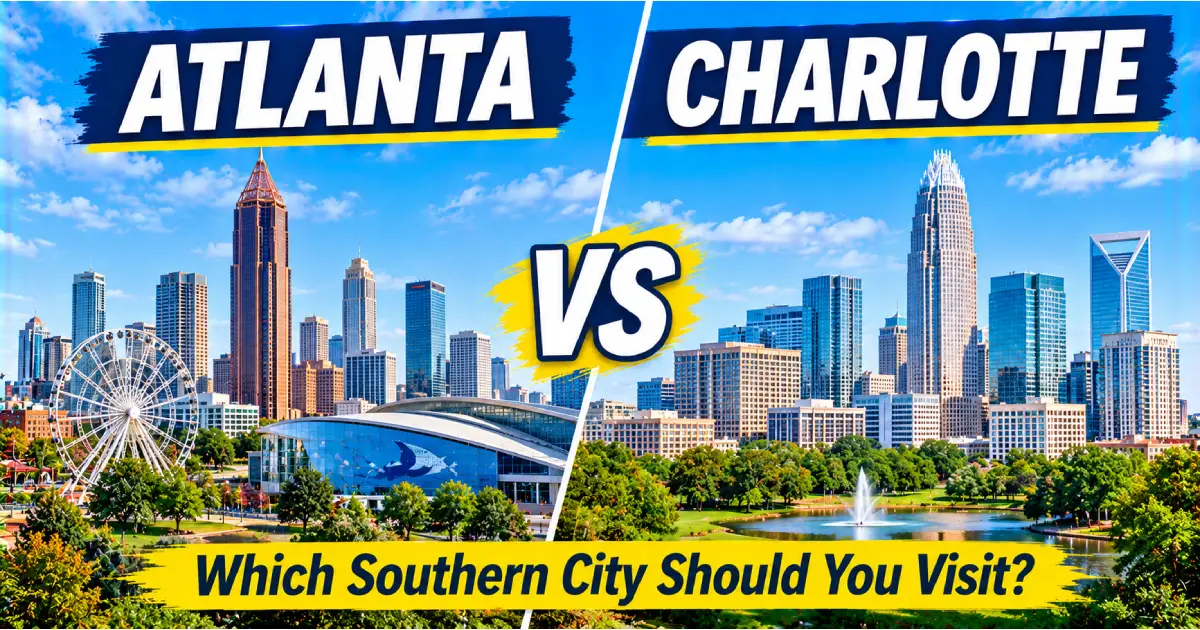
Atlanta and Charlotte are the two great cities of the American Southeast interior — rivals in finance, sports, and civic ambition, linked by 245 miles of I-85, and competing for the title of the South’s most dynamic urban destination. Atlanta is the larger, older, more culturally layered of the two: a city of 500,000 people (6.2 million in the metro, the ninth-largest in the United States), a global hub for film production and corporate headquarters, the birthplace of Martin Luther King Jr. and the civil rights movement, the city where Coca-Cola was invented and Delta Air Lines was born, and a food and music scene that has shaped American popular culture far beyond what its geographic position in the Deep South might suggest. Charlotte is smaller and younger in its cultural ambitions: 900,000 people (2.7 million metro), the second-largest banking center in the United States after New York, a city that has grown faster than almost any other American metro since 2000 and whose Uptown skyline has been almost entirely rebuilt in that time, with excellent restaurants, a genuine brewery scene, and outdoor access to the Blue Ridge Mountains and the Carolinas’ lake country within an hour.
The two cities are more different than their proximity and shared Southern identity might suggest. Atlanta is a Black cultural capital — roughly 52% of the city proper is African American, the city has produced more influential Black artists, entrepreneurs, politicians, and cultural figures per capita than any other American city in the past 50 years, and that cultural dominance shapes everything from the food to the music to the neighborhoods to the civic identity. Charlotte is whiter, wealthier (median household income $68,000 vs. Atlanta’s $59,000), more recently prosperous, and more defined by its banking and tech economy than by a deep cultural history. Atlanta has depth; Charlotte has momentum.
This guide compares both cities honestly across every dimension a traveler cares about — neighborhoods, food, history, music, cost, outdoor access, and day trips — and gives you a clear verdict at the end.
| Category | Atlanta, Georgia | Charlotte, North Carolina |
|---|---|---|
| Population | 500,000 (6.2M metro) | 900,000 (2.7M metro) |
| Founded | 1837 (railroad terminus) | 1768 (colonial settlement) |
| Elevation | 1,050 ft | 751 ft |
| Getting around | MARTA rail + car essential | Light rail (LYNX) + car essential |
| Average hotel | $140–250/night | $120–220/night |
| Average dinner | $40–70/person | $35–60/person |
| Top cultural asset | MLK National Historic Site, Beltline | NASCAR Hall of Fame, Mint Museum |
| Music identity | Hip-hop capital of the world | Country, rock, rising hip-hop |
| Film/TV | #3 film production city in world | Growing production hub |
| Sports teams | Braves, Falcons, Hawks, United | Panthers, Hornets, Charlotte FC |
| Day trips | Blue Ridge Mountains (1.5 hr), Savannah (4 hr) | Blue Ridge Parkway (1.5 hr), Asheville (2 hr) |
| Best season | March–May, Sept–Nov | March–May, Sept–Nov |
Atlanta’s neighborhoods are defined by the tree canopy — the city is known as “the city in a forest,” with more tree coverage per square mile than any other major American city, a legacy of the piedmont Georgia landscape that survived the 1864 burning and the subsequent century of growth. The neighborhoods are spread across a large, car-oriented metro, but the core is increasingly walkable thanks to the Atlanta Beltline.
The Atlanta Beltline is the most important urban infrastructure project in the American South of the past 20 years — a 22-mile loop of multi-use trails, parks, and transit corridors built along a former railway right-of-way that encircles the city’s intown neighborhoods. The Eastside Trail (2.25 miles from Ponce City Market to Inman Park) is the most active stretch — lined with restaurants, bars, street art murals, and the outdoor life of Atlanta’s most walkable corridor. The Westside Trail (connects the West End and Adair Park) passes through historically Black neighborhoods and the new outdoor amenity of Lee + White (a food and beverage development in former warehouses). The full loop, when complete, will connect 45 neighborhoods and be the finest urban park trail in the South.
Ponce City Market (675 Ponce de Leon Ave NE — a 2.1-million sq ft 1926 Sears, Roebuck & Co. distribution warehouse converted into the finest food hall and mixed-use development in Atlanta, Central Food Hall with 24 vendors on the ground floor, rooftop carnival rides and mini golf, the Beltline Eastside Trail access point, and the surrounding Old Fourth Ward neighborhood which is also the birthplace of Martin Luther King Jr.). Inman Park (Atlanta’s first planned suburb, 1889, Victorian homes on tree-lined streets, the Inman Park Festival in April the finest neighborhood street festival in Atlanta) and Little Five Points (the most counterculture neighborhood in Atlanta — vintage clothing, independent record shops, the Variety Playhouse for live music, the Euclid Avenue Yacht Club dive bar).
Virginia-Highland (the finest walkable restaurant and bar neighborhood in Atlanta — a grid of bungalows and Victorian cottages around the intersection of North Highland and Virginia Avenues, with more excellent independent restaurants per block than almost any other neighborhood in the South), Decatur (the independent city within the metro that has become Atlanta’s finest dining destination — Kimball House oyster bar and cocktails, Leon’s Full Service, the Decatur Beer Festival in September), and Midtown (the cultural core — the Atlanta Botanical Garden, the High Museum of Art, Piedmont Park, the Fox Theatre).
Sweet Auburn is the most historically significant neighborhood in Atlanta — the birthplace and boyhood home of Martin Luther King Jr., the Ebenezer Baptist Church where both he and his father preached, the original SCLC headquarters, the Auburn Avenue commercial district that was once called “the richest Negro street in the world” by Fortune magazine (1956), and the MLK National Historical Park (free, the most important civil rights heritage site in America). Mechanicsville, Pittsburgh, and the West End are the historically Black neighborhoods west of downtown where HBCU culture (Morehouse College, Spelman College, Clark Atlanta, Morris Brown — the “Atlanta University Center,” the largest consortium of historically Black colleges in the world) has shaped the city’s intellectual and cultural identity for 150 years.
Buckhead is Atlanta’s upscale commercial district — the finest concentration of high-end retail south of New York (Phipps Plaza, Lenox Square), the finest hotel row in the Southeast (The St. Regis, The Four Seasons, The Whitley), and the largest concentration of private wealth in Georgia. East Atlanta Village (EAV) is the neighborhood’s hipper, grittier counterpart — dive bars, independent music venues, the Earl for live music, the EARL restaurant for the finest bar food in Atlanta.
Charlotte’s neighborhoods are more recently developed and less historically layered than Atlanta’s, but the city has built genuine neighborhood character in its older districts and is developing new ones rapidly.
Uptown (Charlotte calls its downtown “Uptown” — a marketing decision from the 1970s that stuck) is the financial and sports district: the Bank of America Stadium (Carolina Panthers NFL), the Spectrum Center (Charlotte Hornets NBA), the NASCAR Hall of Fame (the finest racing museum in the world, $30/adult, 5 floors of exhibits and simulators), the Mint Museum Uptown (the finest craft and design collection in the Southeast), and the Blumenthal Performing Arts Center. Uptown has more hotel rooms per square mile than any neighborhood in the Carolinas and excellent walkability within its grid.
NoDa (North Davidson) is Charlotte’s arts district — the finest concentration of independently owned galleries, studios, music venues (Neighborhood Theatre, Visulite Theatre), and craft breweries (NoDa Brewing, one of the founding craft breweries of Charlotte’s scene) in a 10-block stretch of North Davidson Street. The neighborhood has the most authentic bohemian character in Charlotte and is worth a full afternoon and evening.
South End is Charlotte’s most rapidly developing neighborhood — the LYNX Blue Line light rail runs through it, connecting Uptown to the southeast, and the corridor along South Boulevard has become the finest restaurant and bar strip in Charlotte. The Queen City Q BBQ, the Wooden Robot Brewery, and the Free Range Brewing taproom are the anchors of the South End eating and drinking scene. The Charlotte Rail Trail (a 3.5-mile multi-use trail along the rail corridor) is the South End’s answer to the Atlanta Beltline.
Plaza Midwood (the most historically interesting residential neighborhood in Charlotte — bungalows and craftsman homes from the 1920s–1940s on tree-lined streets, the finest independent restaurant strip on Central Avenue, Soul Gastrolounge for the best cocktails in Charlotte, Thomas Street Tavern for the finest neighborhood bar). Dilworth (the first streetcar suburb, 1891, Victorian and craftsman homes, Freedom Park with 98 acres along Little Sugar Creek, the best neighborhood for an afternoon walk). Elizabeth (adjacent to Dilworth, the finest concentration of independent coffee shops and brunch restaurants in Charlotte).
The Elizabeth neighborhood around Central Avenue and the Concord Mills corridor in the northern suburbs represent the newer, car-dependent Charlotte — big box retail, chain restaurants, and the suburban growth that has made Charlotte one of the fastest-expanding metros in the country but has also created a sprawl that can feel anonymous to visitors from older, denser cities.
Atlanta’s food scene is one of the most exciting in the American South — driven by a young, diverse, globally connected population, an extraordinary local agricultural tradition (Georgia peaches, Vidalia onions, Georgia peanuts, Sea Island red peas, the Lowcountry larder an hour to the southeast), and a generation of chefs who are doing genuinely original work rather than replicating coastal trends.
The definitive Atlanta food experiences: Soul food at Busy Bee Café (810 Martin Luther King Jr. Drive, open since 1947, the most historically important soul food restaurant in Atlanta — MLK Jr., Andrew Young, and Maynard Jackson all ate here; fried chicken, oxtail, collard greens, cornbread, $12–18 plate, cash preferred) and Mary Mac’s Tea Room (Ponce de Leon Ave, open since 1945, “Atlanta’s dining room” — the chicken and dumplings are the finest in the city). Fried chicken at Hattie B’s Hot Chicken (West Midtown, the Nashville hot chicken import that has become one of Atlanta’s most beloved restaurants, $12–16, medium heat is the correct choice for most visitors) and Buttermilk Kitchen (Buckhead, the finest fried chicken sandwich in Atlanta at $16, the pimento cheese biscuit at $5 is the best single bite in the city). BBQ at Fox Bros. Bar-B-Q (Decatur, Texas-style smoked brisket in Georgia — the finest BBQ in Atlanta, $18–28/pound, the Brunswick stew is a local specialty). Breakfast at The Optimist (Westside, excellent brunch), OK Café (the most beloved diner in Atlanta, Buckhead, open since 1987, $9–14 breakfast), and Ria’s Bluebird (Grant Park, the finest pancakes in Atlanta, weekend lines, $10–14).
Fine dining: Staplehouse (Old Fourth Ward, the most important fine dining restaurant in Atlanta, the staff-owned model restaurant whose profits fund The Giving Kitchen nonprofit for food industry workers in crisis — $85 prix fixe, genuinely one of the finest restaurants in the American South, reservations essential months in advance), Bacchanalia (Westside, 30 years as Atlanta’s most acclaimed upscale restaurant, New American tasting menu, $145/person), Le Bon Nosh (Westside, French bistro from a Paris-trained Atlanta chef, the finest bistro in the Southeast, $28–52), Gunshow (Glenwood Park, chef Kevin Gillespie’s pop-up format restaurant where chefs bring dishes directly to tables dim sum style, $55–85/person, the most original restaurant concept in Atlanta).
International food: Atlanta’s international food scene reflects the city’s enormous immigrant population — the largest Vietnamese community in the Southeast (Buford Highway, Pho 24, Havana Sandwich Shop), the largest Korean community in the Southeast (Duluth and Doraville, Cho Sun Ok for the finest Korean barbecue), the finest Mexican food in the Deep South (Chamblee, El Rey del Taco on Buford Highway is a James Beard America’s Classics winner — $3 tacos, cash only, the finest taco in Atlanta). Buford Highway (the stretch of Buford Highway NE from Buckhead to Gwinnett County) is the finest international food corridor in the American South — 15 miles of Vietnamese, Chinese, Korean, Ethiopian, Mexican, Thai, and Central American restaurants that rivals the ethnic food geography of Houston or Los Angeles.
Charlotte’s food scene has developed significantly in the past decade, driven by the influx of banking and tech workers who arrived with cosmopolitan food expectations. The city is not yet at Atlanta’s level of depth and diversity, but its best restaurants are genuinely excellent, and the local food culture — defined by Appalachian mountain food traditions, Carolina barbecue (both Eastern vinegar-pepper style and Western tomato-based Lexington style), and the piedmont farm-to-table ethos — is distinctive and excellent.
The definitive Charlotte food experiences: Carolina BBQ at Midwood Smokehouse (the finest BBQ restaurant in Charlotte — whole hog Eastern-style and Lexington Western-style both available, $14–24, the fried okra is exceptional), Mac’s Speed Shop (South End, biker bar BBQ with excellent smoked ribs and pulled pork, outdoor patio, $15–22), and the drive to Lexington, NC (20 miles north — the capital of Piedmont Lexington-style BBQ, Lexington Barbecue #1 “The Monk” has been operating since 1962, the red slaw and the pork shoulder with dip sauce are the regional speciality, $10–16). Brunch at The Dunhill Hotel’s Asbury Restaurant (uptown, the finest brunch in Charlotte, $22–38), Common Market (South End, the finest sandwich shop and beer store in Charlotte, the turkey and brie on baguette $12). Seafood at The Optimist Charlotte (South End, the Atlanta import, excellent oysters and Gulf shrimp, $28–48). Cheerwine (the regional cherry soft drink invented in Salisbury NC in 1917 — ubiquitous in Charlotte, the finest regional soda in the American South, available at every restaurant and gas station, $1.50–3).
Fine dining: Kindred (Davidson NC, 20 minutes north — the finest restaurant in the Charlotte metro, James Beard–nominated, New American tasting menu in a former bank building in a small college town, $28–55 mains, reservations essential months in advance), Heritage Food & Drink (Waxhaw, 30 minutes south, farm-to-table in a converted 1930s general store, $26–48), The Fig Tree (Elizabeth, Charlotte’s most established fine dining, in a 1913 craftsman cottage, $38–68), Leah & Louise (Camp North End, chef Greg Collier’s James Beard–nominated Southern food with a soul and narrative, the finest genuinely Southern cooking in Charlotte, $28–48).
The verdict on food: Atlanta wins convincingly — the depth of its soul food tradition, the Buford Highway international food corridor, the excellence of Staplehouse and Gunshow, and the sheer size and diversity of a 6.2-million-person metro make Atlanta one of the finest food cities in the American South. Charlotte is excellent for its size and growing rapidly, but cannot match Atlanta’s depth.
Atlanta is the hip-hop capital of the world — the city that produced Outkast, Goodie Mob, Lil Jon, T.I., Ludacris, Young Jeezy, Gucci Mane, Future, 21 Savage, Migos, Lil Baby, Gunna, and Cardi B (who is from New York but whose career was built in Atlanta’s studio ecosystem). The Atlanta trap sound — defined by the 808 Mafia producers, the Zaytoven keyboard runs, the layered ad-lib vocal style — has dominated American popular music since approximately 2012 and shows no sign of receding. The Georgia Music Hall of Fame inductees range from Ray Charles (born Albany GA) to Otis Redding (Macon) to James Brown (Augusta) to Little Richard (Macon) to the Allman Brothers Band (Macon) to the entire contemporary Atlanta hip-hop ecosystem — making Georgia’s musical heritage arguably the deepest of any American state.
Live music venues: The Fox Theatre (660 Peachtree Street NE — a 1929 Moorish-Egyptian Revival movie palace with a 4,678-seat auditorium, a twinkling star-ceiling sky with clouds that actually move across it, and a Mighty Mo pipe organ — one of the most beautiful theater interiors in the United States, Broadway touring productions and major concerts, $40–200/show), the Tabernacle (152 Luckie Street, 2,600 capacity in a converted 1910 church, the finest mid-size concert venue in Atlanta), the Variety Playhouse (Little Five Points, 1,000 capacity, the finest neighborhood music room), the Masquerade (Heaven/Hell/Purgatory three-stage complex, the most storied alternative/rock venue), Chastain Park Amphitheatre (6,900-seat outdoor venue in a beautiful park in Buckhead, bring a picnic, June–September, $35–120).
Museums and history: The MLK National Historical Park (450 Auburn Ave NE — the most important civil rights heritage site in America: the birthplace home of Martin Luther King Jr., the Ebenezer Baptist Church where he preached and is buried with Coretta Scott King, the National Historic Site Visitor Center with exhibits on the civil rights movement, The King Center with the eternal flame — free, one of the most moving experiences in the American South), the National Center for Civil and Human Rights (downtown, $18.95/adult — the finest museum devoted to the global civil rights and human rights movements, the lunch counter sit-in experience where visitors place their hands on vibrating pads as sounds of protesters shouting at diners simulate the sit-ins, is among the most powerful museum exhibits in America), the Jimmy Carter Presidential Library and Museum ($12/adult, 35th president’s library in a beautiful park in Ponce de Leon), the High Museum of Art ($21.50/adult, Renzo Piano building in Midtown, the finest art museum in the Southeast — the folk art collection and the African American art collection are the standouts), the World of Coca-Cola ($22/adult, the definitive Coca-Cola brand experience, taste-testing vault with 100+ global Coca-Cola products, the formula vault, nostalgia galleries).
Charlotte’s cultural identity is shaped less by a deep artistic tradition and more by its status as a motorsports capital and a growing financial hub that is developing cultural institutions at pace.
NASCAR Hall of Fame (400 E. Martin Luther King Jr. Blvd, $30/adult — the definitive racing museum in the world, 5 floors, racing simulators, the Glory Road banked track display, artifacts from every NASCAR champion — the finest sports museum in the Southeast and the only museum of its type in North America, required for any motorsports fan). Charlotte Motor Speedway (Concord, 25 minutes NE — 167,000-seat oval track, the Coca-Cola 600 Memorial Day weekend the longest NASCAR race of the season, tours available $10/adult, the most accessible major motorsports venue in the country). Mint Museum (two locations — the Uptown Mint Museum Uptown for craft and design, the original Mint Museum Randolph in Myers Park for art and fashion — together the finest art museum complex in the Carolinas, $15/adult). Discovery Place Science ($17/adult, excellent natural history and science museum for families). Levine Museum of the New South (free, the finest museum specifically devoted to the history of the American South since the Civil War). Bechtler Museum of Modern Art (Uptown, $12/adult, the Josef Albers and Max Bill collection are the highlights).
Live music: Spectrum Center (NBA arena, major arena concerts), PNC Music Pavilion (23,000-seat outdoor amphitheater in the northeast suburbs, the largest music venue in the Carolinas), The Fillmore Charlotte (mid-size, 2,200 capacity, the finest mid-size venue in Charlotte), Neighborhood Theatre (NoDa, 800 capacity, excellent programming).
The verdict on music and culture: Atlanta wins decisively — the MLK historical sites are among the most important in the United States, the Fox Theatre is one of the most beautiful buildings in the South, and Atlanta’s role in creating contemporary popular music is unparalleled. Charlotte wins on motorsports culture — the NASCAR Hall of Fame is genuinely one of the finest sports museums in America.
Atlanta has a robust and growing craft brewery scene concentrated in the Westside and Ponce corridors. Sweetwater Brewing (195 Ottley Drive NE, the largest craft brewery in the Southeast, founded 1997, 420 Extra Pale Ale is the flagship, brewery tours $12/adult including tasting, the largest taproom in Atlanta), Creature Comforts Brewing (Athens GA, 1.5 hours east, the finest craft brewery in Georgia — the Tropicalia IPA is among the finest IPAs in the American South, distributed widely across Atlanta), Monday Night Brewing (Westside and West End locations, the finest taproom experience in Atlanta — the Garage West End location in a converted auto shop with excellent food, community vibe, excellent IPAs and stouts), Second Self Beer Co. (Westside, Thai wheat and red lager standouts), Wild Heaven Beer (Decatur original taproom and Avondale Estates), Three Taverns (Decatur, the finest Belgian and experimental styles in Atlanta, the A Night in Brussels witbier is the best wheat beer in Georgia).
Charlotte has one of the finest craft brewery scenes in the Carolinas — approximately 50 breweries in the metro, concentrated in NoDa and South End, with a collaborative culture that has produced some genuinely excellent beer.
NoDa Brewing (NoDa, the founding brewery of Charlotte’s craft scene — Hop, Drop ‘N Roll IPA has won multiple Great American Beer Festival medals, the large taproom with outdoor stage hosts live music on weekends, $6–8/pint), Wooden Robot Brewery (South End, the most design-focused taproom in Charlotte, excellent saisons and sours, $6–8/pint), Free Range Brewing (NoDa, the finest small-batch experimental brewery in Charlotte, the Fruit Witch series of sour ales is outstanding), Sycamore Brewing (South End, the most approachable taproom for non-beer-geeks, excellent year-round IPAs and the finest outdoor patio in Charlotte, food trucks on weekends), Legion Brewing (Plaza Midwood, the finest tap list in Charlotte for style diversity, excellent pizza kitchen), OMB (Olde Mecklenburg Brewery) (Midland neighborhood, German-style lagers and hefeweizens in a 40,000 sq ft traditional German Biergarten — the finest Biergarten experience in the Carolinas, $6/pint, dog-friendly outdoor space).
The verdict on craft beer: Charlotte wins on brewery density relative to city size (50 breweries in a metro of 2.7M vs. Atlanta’s comparable count in a 6.2M metro) and on the walkable brewery-hopping experience in NoDa and South End. Atlanta wins on the individual quality of Creature Comforts and Monday Night Brewing.
Atlanta is one of the most affordable major American cities to visit — the combination of a large hotel market (driven by convention business at the Georgia World Congress Center), a competitive short-term rental landscape, and Southern food pricing that has not yet caught up with coastal city costs makes Atlanta an excellent value destination.
Hotels downtown and Midtown average $140–250/night for mid-range; budget options in East Atlanta Village and Little Five Points run $85–130/night. Food is genuinely affordable — excellent tacos on Buford Highway at $3 each, soul food plates at Busy Bee for $14, mid-range restaurant dinners at $45–65/person with drinks. Transport is the challenge — Atlanta has the most car-dependent urban layout of any major American city, with MARTA rail covering only a cross-shaped corridor through Midtown and Downtown. Most neighborhoods (Virginia-Highland, Decatur, Inman Park, EAV) are not directly served by rail, and Uber/Lyft fills the gap at $12–25/ride. A car is genuinely useful in Atlanta in a way it is not in San Francisco or New York.
Budget estimate per person per day: $150–240 (mid-range); $280–400 (comfortable); $80–110 (budget, staying in EAV, eating Buford Highway taquerias and soul food).
Charlotte is slightly more affordable than Atlanta for hotels (the convention market is smaller) and comparable for food. Hotels in Uptown average $120–220/night mid-range; South End and NoDa run $100–180/night. Food is comparable to Atlanta in price and slightly below it in the neighborhood-restaurant range ($35–55/person for a good dinner). Transport: the LYNX Blue Line light rail ($2.20/ride) covers the Uptown to South End corridor well, but Charlotte remains car-dependent for most neighborhood exploration.
Budget estimate per person per day: $140–220 (mid-range); $250–380 (comfortable); $75–105 (budget).
The verdict on cost: Both cities are good value by national standards. Charlotte is modestly more affordable across hotels and food. Atlanta offers more value per dollar for cultural experiences — the MLK historical sites and National Center for Civil and Human Rights are among the most powerful museum experiences in America, and many are free or low-cost.
Atlanta’s immediate outdoor access is limited by its suburban sprawl — the city itself has excellent parks (Piedmont Park, Stone Mountain Park with its 825-foot granite dome 16 miles east, Kennesaw Mountain National Battlefield Park 20 miles NW), but true wilderness hiking requires driving 1.5–2 hours north to the Blue Ridge Mountains. Amicalola Falls State Park (1.5 hours north, $5/vehicle — the 729-foot Amicalola Falls is the tallest cascading waterfall east of the Mississippi; the Appalachian Trail begins 8 miles from the falls at Springer Mountain — the Approach Trail from the falls to Springer Mountain is one of the finest day hikes in Georgia). Cloudland Canyon State Park (1.75 hours NW, $5/vehicle — the finest day hike in Georgia: the Sitton’s Gulch Trail descends 1,000 feet into a sandstone canyon with two waterfalls, 4.9 miles RT). The Chattahoochee National Forest in the North Georgia mountains (1.5 hours north) contains the Cohutta Wilderness (the largest federally designated wilderness area in the eastern US at 36,977 acres).
Day trips: Savannah (4 hours south, I-16 — the finest historic city in Georgia, 22 squares of live oak and Spanish moss, the finest city for an overnight trip from Atlanta), Chattanooga, TN (1.75 hours NW — the finest small city in the mid-South, the Tennessee Aquarium $35, Lookout Mountain, Rock City, Ruby Falls, the Walnut Street Bridge), Athens, GA (1.5 hours east — the University of Georgia college town, the birthplace of R.E.M. and the B-52s, the finest live music small city in the South, Creature Comforts Brewing, the finest independent music scene in Georgia).
Charlotte’s outdoor access is superior to Atlanta’s — the Blue Ridge Mountains and the Appalachian Trail are closer (1–1.5 hours), the Piedmont lakes (Lake Norman, Lake Wylie — 15–30 minutes) are genuine recreational destinations, and the North Carolina coast (the finest Atlantic barrier island beaches in the Southeast) is 3–4 hours east.
Immediate outdoor access: Lake Norman (20 miles north, the largest man-made lake in NC, 520 miles of shoreline, excellent boating and paddleboarding, Lake Norman State Park hiking trails, Birkdale Village lakefront restaurants), Crowders Mountain State Park (30 minutes west, two prominent monadnocks rising 800 feet above the piedmont, the finest view of the Charlotte skyline from any natural elevation, excellent rock climbing, free). U.S. National Whitewater Center (USNWC — 7 miles west of Charlotte, the world’s largest artificial whitewater river, world-class kayaking and rafting, plus mountain biking, climbing wall, and zip lines, $20 full-day access pass — the finest outdoor recreation facility within any American city’s limits, the 2016 Olympic whitewater team trained here).
Day trips: Asheville, NC (2 hours west — the most creative small city in the American South, the finest mountain town east of the Rockies, Biltmore Estate $75/adult the largest private home in America, River Arts District, the finest craft brewery scene in the Southeast per capita, Grove Park Inn, the Blue Ridge Parkway). Blue Ridge Parkway (1.5 hours north or west — the finest scenic drive in the eastern United States, 469 miles from Shenandoah National Park to Cherokee NC, no commercial traffic, multiple overlooks, Linville Falls 4-mile loop, Grandfather Mountain $24/adult suspension bridge mile-high swinging bridge). Outer Banks, NC (4 hours east — Cape Hatteras National Seashore, Wright Brothers National Memorial Kitty Hawk, wild horses of Corolla, the finest barrier island beaches in the Mid-Atlantic).
The verdict on outdoor access: Charlotte wins — the U.S. National Whitewater Center is a unique facility with no equivalent near any other major American city, Asheville and the Blue Ridge Parkway are within 2 hours, and the lake access is superior to anything in Atlanta’s immediate surroundings.
Choose Atlanta if:
Choose Charlotte if:
The honest answer: Atlanta is the superior destination by most measures of cultural depth, food quality, historical significance, and urban complexity — it is one of the great American cities and deserves far more international recognition than it receives. Charlotte is an excellent city that punches above its demographic weight in food and outdoor access, and makes a better base than Atlanta for the Blue Ridge Mountains and Asheville. For a city trip, Atlanta. For outdoor adventure combined with a city base, Charlotte.
Posted By : Vinay
Latest Article
2nd Floor, 39, Above Kirti Club, DLF Industrial Area, Kirti Nagar, New Delhi, Delhi 110015



Travel Tourister is a leading Travel portal where we introduce travellers to trusted travel agents to make their journey hasselfree, memorable And happy. Travel Tourister is a platform where travellers get Tour packages ,Hotel packages deals through trusted travel companies And hoteliers who are working with us across the world. We always try to find new and more travel agents and hoteliers from every nook and corners across the world so that you could compare the deals with different travel agents and hoteliers and book your tour or hotel with the one you have chosen according to your taste and budget.
Copyright © Travel Tourister, India. All Rights Reserved

 Call
 Enquiry