Published on : 04 Nov 2026
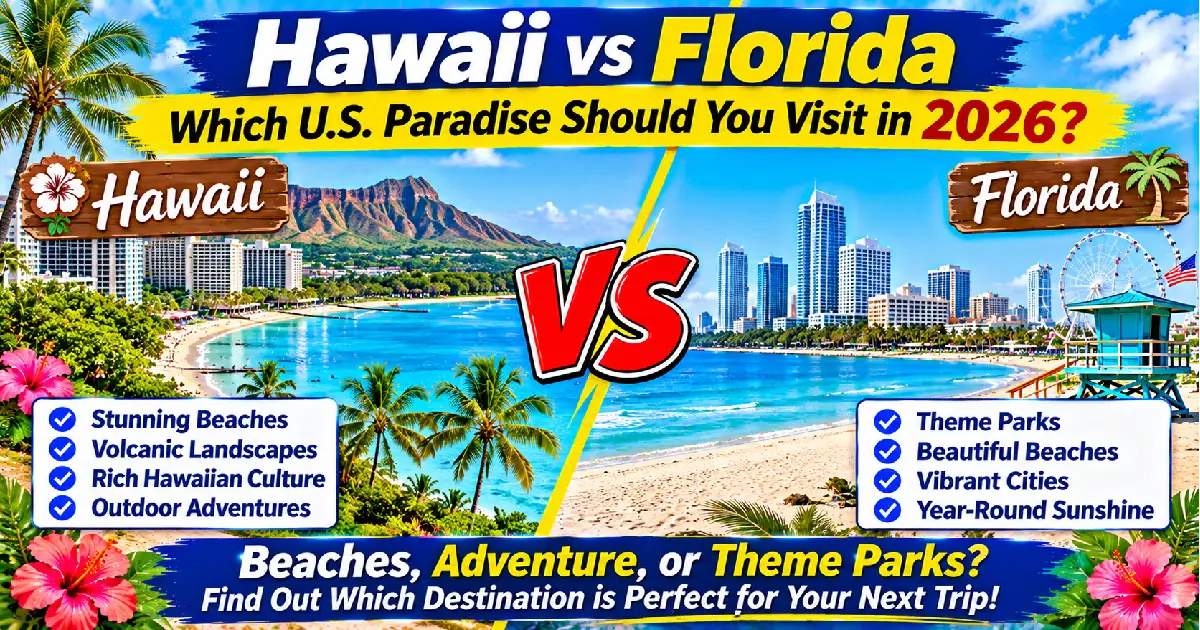
Hawaii and Florida are the two great tropical vacation destinations of the United States — the states that draw more leisure travelers than any others, that have built entire economies around the pursuit of sunshine, warm water, and the particular pleasure of the American beach holiday. They are profoundly different in almost every respect: Hawaii is a remote volcanic archipelago in the middle of the Pacific Ocean, 2,400 miles from California, where the landscape was born from fire and shaped by isolation into one of the most ecologically extraordinary and visually spectacular places on Earth. Florida is a flat limestone peninsula in the subtropical Southeast, connected to the continental United States, where the diversity of experience comes not from volcanic drama but from ecological richness — the Everglades, the coral reefs of the Keys, the spring-fed rivers, the manatee and alligator and roseate spoonbill — and from the concentrated resort infrastructure of Miami Beach, Orlando, and the Gulf Coast.
Both states are extraordinary travel destinations, and the choice between them is one of the most common and most genuinely interesting decisions in American vacation planning. This guide compares them honestly across every dimension a traveler cares about — beaches, cost, weather, food, outdoor adventure, wildlife, family suitability, and the specific islands and cities that define each destination — and gives you a clear, honest verdict at the end.
| Category | Hawaii | Florida |
|---|---|---|
| Total area | 10,932 sq mi (8 main islands) | 65,758 sq mi |
| Distance from mainland | 2,400 miles from California | Connected by road |
| Average flight cost (from mainland) | $400–900 RT from West Coast; $600–1,200 from East Coast | $100–350 RT from most US cities |
| Average hotel | $250–500/night (resort) | $120–350/night |
| Average dinner | $45–85/person | $35–65/person |
| Best beaches | Lanikai (Oahu), Hanalei Bay (Kauai), Wailea (Maui) | Siesta Key (Sarasota), Clearwater, Grayton Beach (Panhandle) |
| Best snorkeling | Molokini Crater (Maui), Hanauma Bay (Oahu) | John Pennekamp (Key Largo), Dry Tortugas |
| Weather | 75–85°F year-round, trade winds | 70–92°F; humid summers; hurricane season June–Nov |
| Wildlife | Green sea turtles, humpback whales, monk seals, nene geese | Alligators, manatees, dolphins, sea turtles, flamingos |
| Unique experience | Volcano hiking, surfing birthplace, luau, Polynesian culture | Everglades, Space Coast, Key West, Disney World |
| Best for families | Yes (gentle beaches, snorkeling, whale watching) | Yes (theme parks, Gulf Coast beaches, manatees) |
| Best season | April–June, September–November | October–April (dry season) |
Hawaii is not one destination but six distinct islands (plus the smaller Molokai and Lanai), each with its own character, landscape, and ideal visitor.
Oahu (the most visited island, home of Honolulu and Waikiki — 70% of all Hawaii visitors land here) is the gateway and the most urban island: Waikiki Beach (the most famous beach in the Pacific, 2 miles of golden sand fronting a wall of Art Deco and modern resort hotels, crowded but beautiful, the best surfing lessons in Hawaii at the base of Diamond Head, the Duke Kahanamoku statue honoring the man who spread surfing to the world from this very beach), Diamond Head (the 560-foot volcanic crater, the 1.6-mile round trip trail 560 ft to the summit crater rim is the finest short hike in Honolulu, $5/person timed-entry at recreation.gov, sunrise is extraordinary), Hanauma Bay Nature Preserve ($25/adult, the finest snorkeling within city limits in Hawaii — 2,000+ fish species in a flooded volcanic crater bay, reservation required, fills quickly), Pearl Harbor National Memorial (free, the most important WWII memorial in the Pacific — the USS Arizona Memorial above the sunken battleship, the USS Missouri where Japan signed the surrender, the Pacific Aviation Museum, reserve USS Arizona ferry tickets in advance at recreation.gov), the North Shore (the 7-mile miracle — the world’s most famous big-wave surf spots, Waimea Bay, Pipeline, the Banzai Pipeline break produces the finest waves in the world December–February, the Matsumoto Shave Ice in Haleiwa is the most beloved food stop on the North Shore). Oahu is the right island for first-time visitors, history, city amenities, and surf culture.
Maui (the most resort-developed island, the favorite of honeymooners and luxury travelers) offers the finest combination of beaches, whale watching, and dramatic landscape in Hawaii: Road to Hana (the most celebrated scenic drive in Hawaii — 64 miles of hairpin curves along the northeast coast through bamboo forests, waterfall pools, and black-sand beaches to Hana town and the Pools of Ohe’o / ‘Ohe’o Gulch (the “Seven Sacred Pools,” $35 national park entrance, the Pipiwai Trail 4 miles RT to the 400-foot Waimoku Falls through a bamboo forest that is the finest single hike on Maui), Haleakala National Park (the 10,023-foot dormant volcano summit — sunrise from the summit is the most celebrated sunrise in Hawaii, the crater is 7.5 miles across and 2,600 feet deep, temperatures at the summit can drop to 30°F even in summer so bring layers; the Hosmer Grove forest loop at 6,800 feet has endemic Hawaiian birds; the Sliding Sands Trail 11 miles RT into the crater floor is the finest full-day hike in Hawaii, $35/vehicle 7-day pass, summit sunrise reservations required at recreation.gov $1.50), Molokini Crater (the half-submerged volcanic islet offshore, accessible only by boat tour from Ma’alaea Harbor — the finest snorkeling and diving in Hawaii, visibility 100–150 feet in calm conditions, $120–180/person half-day tour), the Wailea Resort Coast (the finest luxury resort beaches in Hawaii — Wailea Beach, Polo Beach, Makena Beach (Big Beach) — calm, clear, magnificent). Maui is the right island for luxury travel, romance, whale watching (January–March, humpbacks — the finest whale watching from shore of any place in North America), and the combination of beach and volcanic landscape.
Kauai (the oldest and most dramatically beautiful island — the “Garden Isle,” 5.5 million years old versus Maui’s 1.5 million, so deeply eroded that the landscape has a lushness and a vertical drama that younger islands lack) is the finest landscape island in Hawaii: the Na Pali Coast (the most spectacular coastal cliffs in the United States — 15 miles of 4,000-foot green knife-edge ridges dropping directly into the Pacific, accessible by the Kalalau Trail (the most celebrated hike in Hawaii, 11 miles one way, a permit is required for camping beyond Hanakapi’ai Beach — $35/night at gocamp.hawaii.gov, camping permits sell out within minutes of their release; the first 2 miles to Hanakapi’ai Beach is the finest short hike in Hawaii with no permit required) or by Na Pali Coast boat tours ($150–200/person) or helicopter ($250–400/person — the finest single helicopter experience in the US), Waimea Canyon (“the Grand Canyon of the Pacific” — not as grand as the Arizona original but genuinely spectacular, 10 miles long, 3,000 feet deep, the Waimea Canyon Lookout free drive-up view, the Kukui Trail 5 miles RT 2,300 feet descent to the canyon floor), Hanalei Bay (the finest beach bay in Hawaii — a crescent of golden sand backed by 4,000-foot fluted ridges, the setting for the song “Puff the Magic Dragon,” the finest surf town in Hawaii, the Hanalei Pier at sunset is the most photographed scene on Kauai). Kauai is the right island for hikers, honeymooners who want dramatic natural landscape over resort development, and travelers doing a second or third Hawaii trip who are ready to move beyond Oahu and Maui.
The Big Island (Hawaii Island) (the youngest island, still geologically active — the most geologically dramatic island in the chain): Hawaii Volcanoes National Park ($35/vehicle 7-day pass — the most extraordinary national park in the United States for sheer geological spectacle: the Kilauea Caldera (the world’s most active volcano, the Halema’uma’u Crater glows red at night with the lava lake below, the Crater Rim Drive 10 miles around the caldera, the Thurston Lava Tube 0.3-mile walk through a 500-year-old lava tunnel, the Devastation Trail 1 mile through a 1959 eruption field) and the chance — not guaranteed but real — to see active lava flowing: check nps.gov/havo for current lava viewing conditions), Mauna Kea (the highest point in Hawaii at 13,796 feet, and by some measures the tallest mountain on Earth from base to summit at 33,000 feet; the Mauna Kea Visitor Information Station at 9,200 feet is the finest stargazing site in the Northern Hemisphere with 13 international telescope observatories near the summit; summit road requires 4WD, the Onizuka Center evening stargazing program is free), Kohala Coast (the most dramatic luxury resort corridor in Hawaii — the Four Seasons Hualalai and the Fairmont Orchid are among the finest resort hotels in the world), the Manta Ray Night Snorkel off the Kohala Coast ($90–130/person, guided boat tour at night where Pacific manta rays with 10–16-foot wingspans feed on plankton attracted by dive lights — one of the most extraordinary wildlife experiences in Hawaii). The Big Island is the right island for geology, astronomy, diverse landscapes (tropical, desert, alpine, and volcanic all on one island), and visitors who prioritize natural wonder over beach perfection.
Florida’s geographic variety is as wide as Hawaii’s but organized differently — not by island but by region.
Miami and South Florida (the most culturally complex Florida destination — the South Beach Art Deco Historic District on Ocean Drive, Collins Avenue, and Washington Avenue: the finest collection of Art Deco architecture in the world, 800+ buildings from the 1920s–1940s, the Art Deco Welcome Center walking tour $30, the Versace Mansion (now Casa Casuarina hotel, $500–2,000/night, exterior free to photograph), the Pérez Art Museum Miami (PAMM, free first Thursday and Saturday of each month), the Wynwood Walls (the most important outdoor street art museum in the United States, free entry to the outdoor walls, a converted warehouse district where every building surface has been muralized by international street artists since 2009, the most photographed cultural destination in Miami), Little Havana (SW 8th Street/Calle Ocho — the center of Cuban-American culture in the US: Versailles Restaurant (3555 SW 8th St, the most famous Cuban restaurant in America, open since 1971, the Cuban sandwich $14, café con leche $3, the domino tables outside where the elders play — one of the finest people-watching experiences in Miami), Ball & Chain (nightclub, the venue where Billie Holiday performed in the 1930s), the Bay of Pigs Memorial). Biscayne National Park (93% water, the northernmost living coral reef in the continental US, snorkeling and diving by boat from Dante Fascell Visitor Center, free park entry + boat tour $35–55).
The Florida Keys (the most unique geography in the continental United States — a 120-mile chain of coral islands connected by the Overseas Highway (US-1, 42 overseas bridges including the iconic Seven Mile Bridge, the finest road trip in Florida and one of the finest in America): Key Largo (John Pennekamp Coral Reef State Park — the first undersea park in the US, the finest snorkeling in the continental US, glass-bottom boat tours $32/adult, snorkel tours $30/adult, the Christ of the Deep 8.5-foot bronze statue 25 feet underwater is the most photographed underwater object in Florida), Islamorada (sport fishing capital of the world — the finest tarpon, bonefish, and permit fishing in the US, the Theater of the Sea marine park), Marathon (the Turtle Hospital ($25/adult tour, the finest sea turtle rehabilitation center in the world — 100+ turtles in treatment at any time)), Key West (the southernmost point in the continental US — the Ernest Hemingway Home and Museum ($18/adult, 1851 Spanish Colonial mansion where Hemingway lived 1931–1940 and wrote For Whom the Bell Tolls and To Have and Have Not, 50+ six-toed cats descended from his original cat still live on the property), the Harry S. Truman Little White House ($25/adult), Duval Street (the most celebrated bar street in Florida, the Sloppy Joe’s Bar where Hemingway drank, the Green Parrot the oldest bar in Key West open since 1890), the sunset celebration at Mallory Square (free, nightly, street performers, jugglers, and the collective ritual of watching the sun drop into the Gulf of Mexico — the finest free public event in Florida)).
The Everglades (the most ecologically extraordinary landscape in the continental United States — 1.5 million acres of subtropical wilderness at the tip of the Florida peninsula, the largest mangrove ecosystem in the western hemisphere, the only place on Earth where crocodiles and alligators coexist naturally. Anhinga Trail (0.8-mile paved boardwalk at Royal Palm — the finest wildlife-viewing trail in the Everglades, the anhinga birds dry their wings directly above the path and the alligators rest on the banks 6 feet below the boardwalk, in winter 20–40 alligators visible per hour), Shark Valley (15-mile loop road, bike rentals $15/half-day, the observation tower 65-foot overlook sees 30–40 alligators per mile on a winter morning — the finest alligator-viewing experience in Florida), Dry Tortugas National Park (70 miles west of Key West by ferry ($195/adult RT, Yankee Freedom III, 2.5-hour crossing each way) or floatplane ($390–450 RT) — Fort Jefferson, the massive 19th-century hexagonal coastal fortress, the third-largest coral reef system in the world surrounding it, the finest snorkeling in Florida, the most remote park in the lower 48 — free camping with permit, the overnight experience is extraordinary)).
The Gulf Coast (the finest beach coast in Florida for swimming and family travel — the Gulf of Mexico is warmer (80–85°F in summer), calmer, and clearer than the Atlantic, and the sand on the Gulf Coast is the finest in the continental US): Siesta Key (Sarasota — Siesta Beach has been voted the finest beach in the United States multiple times by the Travel Channel and TripAdvisor — the quartz sand is 99% pure white quartz, so fine it squeaks under your feet and stays cool even in direct sun, $0 entry, the finest free beach in Florida), Clearwater Beach (consistently ranked among the top 10 beaches in the US, family-friendly, excellent pier, the Clearwater Marine Aquarium $32/adult home of Winter the prosthetic-tailed dolphin of Dolphin Tale fame), Naples (the most affluent small city on the Gulf Coast — the Naples Pier at sunset, the Third Street South and Fifth Avenue South restaurant districts, the finest beach town in Southwest Florida), Fort Myers Beach (recovering from Hurricane Ian damage, gradually rebuilding), Sanibel Island (the finest shelling beach in the Western Hemisphere — the Sanibel Stoop (bending over to collect shells, a local art form), J.N. “Ding” Darling National Wildlife Refuge (5,030 acres, the finest birding refuge in Florida — roseate spoonbills, ospreys, alligators, and 245 bird species, Wildlife Drive $10/vehicle or free on Fridays)).
Orlando and Central Florida (the theme park capital of the world — Walt Disney World (the most visited theme park resort in the world, 4 parks, $109–189/day depending on date, Magic Kingdom the most visited single theme park on Earth), Universal Orlando (the finest Harry Potter experience in the world at The Wizarding World, Epic Universe opened 2025 adding 5 new worlds, $124–184/day), SeaWorld Orlando, the Kennedy Space Center ($75/adult, the finest space museum outside Washington DC, the Shuttle Atlantis is the single most extraordinary spacecraft artifact on display, $50 additional for astronaut encounter — 45 miles east of Orlando on the Space Coast)).
Hawaii’s beaches are among the most beautiful in the world — and the most varied. The volcanic geology produces beach sand in four distinct colors: white (calcium carbonate from coral and shells — Lanikai, Waikiki, Ka’anapali), black (volcanic basalt — Punalu’u Black Sand Beach on the Big Island, the only beach in the US where Hawaiian green sea turtles reliably haul out on black sand), green (olivine crystals from volcanic material — Papakōlea Green Sand Beach on the Big Island, one of only four green sand beaches in the world, accessible by 2.5-mile walk each way), and red (iron-rich volcanic material — Kaihalulu Red Sand Beach on Maui, accessible by an eroded trail, clothing-optional). The diversity of beach types is genuinely extraordinary.
The finest swimming beaches in Hawaii: Lanikai Beach (Oahu — the most beautiful beach in Hawaii for most visitors: a quarter-mile of powdery white sand with calm, turquoise, shoulder-deep water, the two Mokulua Islands offshore provide the finest kayaking day trip in Oahu ($55/half-day rental at Kailua Beach Adventures), no facilities, park on the street, arrive early), Hanalei Bay (Kauai — the finest bay beach in Hawaii, 2 miles of gold sand backed by fluted Na Pali ridges), Ka’anapali Beach (Maui — the finest resort beach in Hawaii, 3 miles of white sand fronting the finest resort hotel strip, the Black Rock promontory at the north end for excellent snorkeling, the cliff dive at Black Rock performed by resort staff at sunset daily), Waianapanapa Black Sand Beach (Maui — the finest black sand beach in Hawaii, 30-foot sea caves, blowholes, and the crashing Pacific in a dramatic volcanic setting, $10/vehicle timed-entry reservation required at gostateparks.hawaii.gov).
Florida has more miles of Atlantic and Gulf Coast beach than any other state in the continental US — 1,350 miles of coastline — ranging from the white quartz Gulf beaches (Siesta Key, Clearwater, Destin) to the coarser Atlantic beaches (Daytona, Miami, Fort Lauderdale) to the unique carbonate sand of the Keys.
The finest beaches: Siesta Key (Sarasota — voted best beach in the US multiple times, the quartz sand is extraordinarily fine and white, the water calm and clear, free entry), Grayton Beach State Park (Florida Panhandle — the finest beach in the Panhandle, sugar-white sand and emerald Gulf water, $5/vehicle, rated one of the top 10 beaches in the world by multiple outlets), Clearwater Beach (Pinellas County — family-friendly, facilities excellent, consistent awards for cleanliness), Bahia Honda State Park (Florida Keys — the finest beach in the Keys, turquoise water, old bridge walkway, $8/vehicle), South Beach Miami (Ocean Drive, famous Art Deco backdrop, energetic, excellent for people-watching rather than quiet swimming — the water is warm but the beach is dense on summer weekends).
The verdict on beaches: Hawaii wins on beauty and variety — the colored sands, the volcanic backdrops, the clarity of the water (visibility 50–100 feet off Maui vs. 10–30 feet off most Florida beaches), and the pristine condition of the most remote beaches make Hawaii’s beaches the finest in the United States. Florida wins on accessibility (no 5-hour flight), value, and the Gulf Coast’s calm, warm swimming water, which is genuinely superior to Hawaii’s more exposed ocean beaches for families with young children.
Hawaii’s wildlife is defined by endemism — 90% of native Hawaiian species exist nowhere else on Earth, the result of 70 million years of isolation in the middle of the Pacific Ocean. The wildlife experiences: Hawaiian green sea turtles (honu) — the largest green turtle population in the United States, resting on beaches and grazing on reef at virtually every snorkeling site, easiest to see at Laniakea Beach (Oahu, the most reliable sea turtle hauling site), Punalu’u Black Sand Beach (Big Island), and nearly every snorkeling location on Maui; it is legally required to stay 10 feet away. Humpback whales — 10,000+ North Pacific humpbacks winter in the warm shallow waters of the Maui Channel between Maui, Molokai, and Lanai from December–April; whale watching boat tours ($50–85/person from Ma’alaea Harbor) are the finest in the US, and humpbacks are routinely visible from shore on Maui’s west coast from December–March without any equipment. Hawaiian monk seals — one of the world’s most endangered marine mammals, only 1,600 alive, but reliably seen resting on beaches at Poipu Beach (Kauai) and occasionally on Oahu’s north shore. Nene (Hawaiian goose) — Hawaii’s state bird, the rarest goose in the world and one of the world’s rarest birds, most reliably seen on the Haleakala volcano slopes and at Hawaii Volcanoes National Park.
Florida’s wildlife is the finest in the eastern United States — a subtropical climate that supports a broader diversity of species than any other state in the east, and ecosystems (coral reef, mangrove, cypress swamp, pine flatwood) that concentrate wildlife in accessible ways.
Manatees — the finest manatee viewing in the world at Crystal River National Wildlife Refuge (90 minutes north of Tampa, the only place in the US where it is legal to swim with wild manatees, snorkel tours $40–65/person, the thermal springs attract 500+ manatees November–March). American alligators — 1.3 million in Florida, more than anywhere else in the world; the Shark Valley road in the Everglades, the Myakka River State Park (Sarasota, the most accessible large alligator population outside the Everglades, the airboat tour $25/adult is the finest alligator-viewing experience in Central Florida), and virtually every Florida freshwater body. Roseate spoonbills — the most visually spectacular wading bird in North America, reliably seen at Ding Darling NWR (Sanibel), the Everglades, and Myakka River State Park. Bottlenose dolphins — year-round in every coastal estuary and bay, boat tours from virtually every Florida marina. American crocodiles — found only in the extreme southern tip of Florida (Biscayne Bay and the southern Everglades); one of only two places on Earth where alligators and crocodiles coexist.
The verdict on wildlife: This is a genuine tie between extraordinary but utterly different wildlife ecosystems. Hawaii wins for the marine wildlife experience (snorkeling with sea turtles, whale watching from shore), which is available to any visitor with no special equipment. Florida wins for wildlife diversity and accessibility on land (manatees, alligators, roseate spoonbills) and for the Everglades, which is the most ecologically extraordinary landscape in the continental US.
Hawaii is one of the most expensive domestic US destinations — the remote island location means that virtually everything (food, fuel, building materials, consumer goods) must be shipped 2,400 miles from the mainland, and the costs are passed directly to visitors and residents alike. The average flight from the West Coast runs $400–900 RT per person ($600–1,200 from the East Coast, although deals exist if booked 3–6 months in advance); hotels at the major resorts (Wailea Maui, Ka’anapali, Kohala Coast Big Island, Poipu Kauai) run $350–700/night for a mid-range resort room; full-service resort rooms run $500–1,200/night. Food is 20–40% more expensive than mainland equivalents — a plate lunch (the local casual food — two scoops of white rice, a scoop of macaroni salad, and your choice of meat from a local plate lunch truck) runs $12–16 and is the best value meal in Hawaii. A mid-range dinner at a non-resort restaurant runs $55–85/person with drinks. The Road to Hana requires a rental car ($65–100/day plus Maui’s mandatory CDW insurance at $15–28/day); most Hawaiian activities (snorkel tours, helicopter tours, luaus) add $100–400 per day.
Budget estimate per person per day (excluding flights): $350–550 (mid-range resort); $200–320 (self-catering condo, plate lunches, own rental car); $500–900 (luxury resort).
Florida ranges from among the most affordable to among the most expensive domestic US destinations, depending entirely on where you go and when. Flights from most of the eastern US are $100–350 RT to Miami, Orlando, or Tampa; $250–500 RT from the West Coast. Hotels range from $80/night (budget Gulf Coast motel) to $500+/night (South Beach luxury). Orlando theme park days ($109–189/day per park) are the single largest cost driver for family trips. Key West and South Beach are comparable in cost to Hawaii for hotels and food; the Gulf Coast (Clearwater, Siesta Key, Naples) is significantly more affordable; the Panhandle (Destin, Santa Rosa Beach, Grayton Beach) is the best value beach region in Florida.
Budget estimate per person per day (excluding flights, no theme parks): $130–220 (Gulf Coast mid-range); $200–350 (South Beach or Keys); $350–600 (South Beach luxury or multi-park Orlando).
The verdict on cost: Florida wins decisively on overall cost — flights are cheaper from most US cities, hotels are more affordable outside of peak South Beach and Key West, and the best Gulf Coast beaches (Siesta Key, Clearwater, Grayton Beach) are free. Hawaii’s raw costs are 40–60% higher than comparable Florida experiences, though the remoteness and exclusivity are part of what Hawaii sells.
Hawaiian food culture is a genuine fusion — the result of the islands’ plantation-era immigration history, which brought workers from Japan, China, Korea, Portugal, Puerto Rico, and the Philippines in the 19th and early 20th centuries, each group leaving a permanent imprint on the local food landscape.
The definitive Hawaii food experiences: Poke (raw fish — typically ahi tuna, octopus, or salmon — dressed with shoyu, sesame oil, green onion, and a range of additions from avocado to tobiko, the finest fast food in Hawaii at $15–22/bowl, available everywhere from ABC Stores to dedicated poke shops to supermarket deli counters — the finest poke in Hawaii is at Foodland supermarkets (the poke counter is stocked fresh multiple times daily and priced per pound at $22–28/pound) and Tamura’s Fine Wine & Liquors in Kailua, Oahu). Plate lunch (see Cost section — the working-class local food, macaroni salad is non-negotiable, the kalua pork and the teriyaki chicken are the finest options, $12–16). Shave ice (not a snow cone — the ice is shaved to a powder-fine texture that absorbs the syrup rather than sitting on top, the finest in Hawaii at Matsumoto Shave Ice (Haleiwa, Oahu, $4–8) and Ululani’s Hawaiian Shave Ice (Lahaina, Maui) — order it with azuki beans and ice cream in the bottom and mochi balls on top). Spam musubi (Spam — which Hawaii consumes more per capita than any state in the US, a WWII-era legacy — pressed onto a block of rice and wrapped in nori seaweed, the finest portable snack in Hawaii at $2–4 at 7-Eleven and local gas stations). Luau food — the traditional feast of kalua pig (whole pig slow-roasted in an underground imu oven for 12 hours), poi (taro root paste, an acquired taste), lomi lomi salmon, haupia (coconut pudding), and haupia cake — the finest commercial luau experiences at the Old Lahaina Luau (Maui, $155/adult, the most acclaimed traditional luau, now operated at a new location after the 2023 Lahaina fire) and the Chief’s Luau (Oahu, $120–145/adult).
Florida’s food culture is as geographically diverse as the state itself — Cuban in Miami, Southern in the Panhandle, fresh Gulf seafood in the middle coast, and Bahamian-influenced in the Keys.
The definitive Florida food experiences: The Cuban sandwich (the Miami/Tampa original — slow-roasted pork, ham, Swiss cheese, pickles, mustard, and occasionally salami (Tampa-style) on Cuban bread, pressed flat in a plancha: the finest in Miami at Versailles Restaurant ($14) and in Tampa at The Columbia Restaurant (2117 E 7th Ave Ybor City, the oldest restaurant in Florida, open since 1905, the finest Cuban sandwich in the state, $16)). Stone crab claws (available only October 15–May 15, the claws are harvested and the crabs released to regenerate new claws — the most sustainably harvested seafood in the US, the finest at Joe’s Stone Crab (11 Washington Ave, Miami Beach, open since 1913, the most important seafood restaurant in Florida, $50–75/portion of large claws, served cold with mustard sauce, reservations not taken for dinner — arrive at opening or expect a 2-hour wait, worth it)). Key lime pie (the state pie of Florida, made with the small yellow Key lime from the Florida Keys — genuine Key lime pie is pale yellow, not green (the green versions are dyed), made with condensed milk, Key lime juice, and egg yolks in a graham cracker crust: the finest in Florida at the Kermit’s Key West Key Lime Shoppe ($5/slice, 200 Elizabeth Street), Blue Heaven (Key West, $9/slice, the finest sit-down Key lime pie experience), and the Original Brooks Tropicals (Homestead, the farm that grows most of Florida’s Key limes)). Florida stone crab, Gulf shrimp, grouper, and red snapper fresh at Bern’s Steak House (Tampa, the finest independent restaurant in Florida, the wine cellar with 500,000 bottles is the largest restaurant wine collection in the world, $65–120 for steak), Tarpon Springs sponge docks Greek food (the largest Greek-American community per capita in the US, Hellas Restaurant $18–32, saganaki and moussaka).
The verdict on food: Hawaii wins on uniqueness — the poke, the plate lunch, the shave ice, and the plantation-era fusion cuisine are genuinely original food cultures that exist nowhere else. Florida wins on variety and value — the Cuban food, Key lime pie, stone crab, Gulf seafood, and Greek food of Tarpon Springs together represent more total cuisine diversity at lower price points.
Choose Hawaii if:
Choose Florida if:
The honest answer: Hawaii is the more extraordinary travel destination — there is nowhere else in the United States where you can walk across a black sand beach watched by sea turtles, hike into an active volcanic crater, and snorkel in 100-foot visibility coral gardens on the same day. But Florida is the more practical and more accessible destination for most American travelers, with an extraordinary range of experiences at a fraction of the cost. The finest decision is to visit Florida as your regular beach vacation and save Hawaii for the trip you plan for a year.
Posted By : Vinay
Latest Article
2nd Floor, 39, Above Kirti Club, DLF Industrial Area, Kirti Nagar, New Delhi, Delhi 110015



Travel Tourister is a leading Travel portal where we introduce travellers to trusted travel agents to make their journey hasselfree, memorable And happy. Travel Tourister is a platform where travellers get Tour packages ,Hotel packages deals through trusted travel companies And hoteliers who are working with us across the world. We always try to find new and more travel agents and hoteliers from every nook and corners across the world so that you could compare the deals with different travel agents and hoteliers and book your tour or hotel with the one you have chosen according to your taste and budget.
Copyright © Travel Tourister, India. All Rights Reserved

 Call
 Enquiry