Published on : 03 Nov 2026
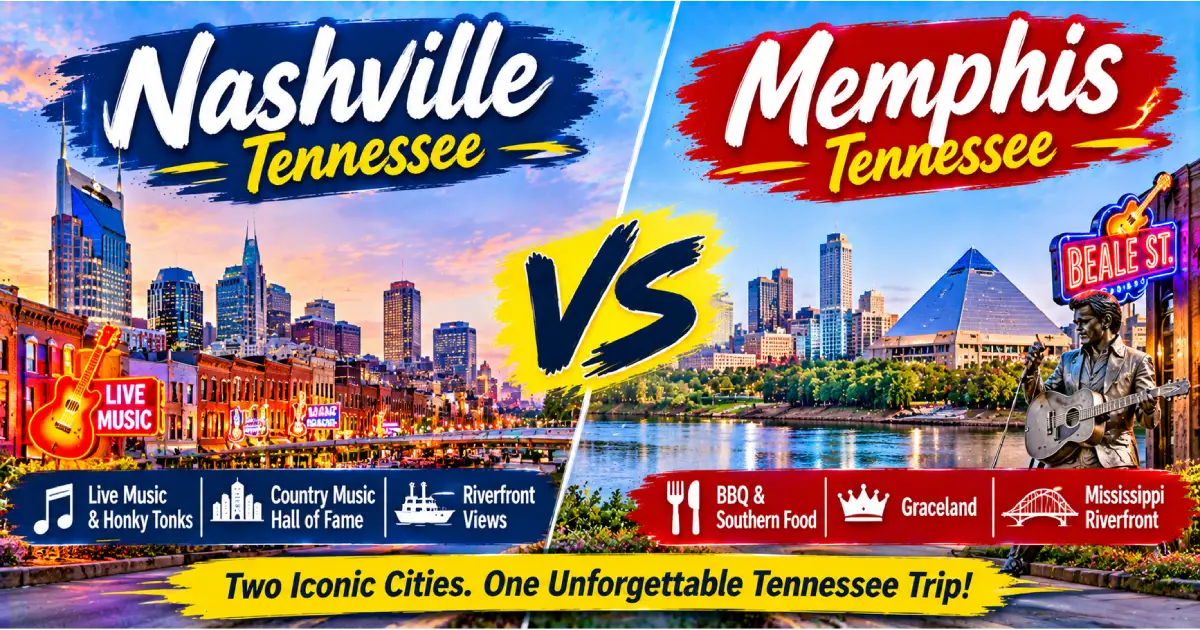
Nashville and Memphis are the two great music cities of Tennessee — and among the most musically important cities in the world. They sit 212 miles apart on I-40, separated by rolling middle Tennessee farmland and connected by a shared state identity and a long, complicated rivalry. Nashville is the capital of country music, the home of the Grand Ole Opry, the epicenter of the American music publishing industry, and a city that has transformed itself since 2010 into one of the most visited destinations in the United States — a bachelorette-party-and-Broadway-bar phenomenon that has reshaped a formerly mid-size Southern city into a genuine tourist juggernaut of 16 million annual visitors. Memphis is older, slower, heavier, more historically layered — the city where Elvis Presley recorded his first songs at Sun Studio, where B.B. King played Beale Street, where Martin Luther King Jr. was assassinated at the Lorraine Motel, where Al Green still preaches on Sunday mornings, and where the barbecue — slow-smoked pork ribs dry-rubbed with a spice blend and cooked over hickory for 5–6 hours — is the finest in America.
The difference between the two cities is not just about music genre. Nashville has become prosperous, gleaming, and relentlessly developed — a city where cranes have defined the skyline for 15 years and where a honky-tonk bar now costs $18 for a Bud Light because the demand from bachelorette parties and conventions has permanently reset the price floor. Memphis has not undergone that transformation. It remains a city with genuine poverty, genuine grit, genuine history, and a cultural depth that rewards slow, curious visitors who are willing to sit on a barstool on Beale Street and listen to a blues musician play for tips on a Tuesday afternoon. Both cities are extraordinary travel destinations. They are extraordinarily different experiences.
| Category | Nashville, Tennessee | Memphis, Tennessee |
|---|---|---|
| Population | 715,000 (2.0M metro) | 618,000 (1.3M metro) |
| Founded | 1779 | 1819 |
| Elevation | 597 ft | 285 ft (Mississippi River) |
| Music identity | Country, Americana, bluegrass | Blues, soul, rock & roll, gospel |
| Key music site | Grand Ole Opry, Ryman Auditorium | Sun Studio, Graceland, Beale Street |
| BBQ style | Hot chicken (not BBQ) | Dry-rub pork ribs, pulled pork |
| Average hotel | $180–320/night | $100–190/night |
| Average dinner | $45–80/person | $30–55/person |
| Getting around | Car essential; limited WeGo bus | Car essential; MATA bus limited |
| Annual visitors | 16 million | 11 million |
| Best for | Honky-tonks, bachelorette scene, hot chicken, Ryman | Blues, civil rights history, BBQ, Elvis, soul food |
| Best season | April–May, September–October | March–May, September–October |
Nashville’s geography organizes itself around Lower Broadway — the 4-block entertainment corridor that is both the city’s greatest tourist attraction and the thing most Nashvillians have complicated feelings about.
Lower Broadway (Broadway from 1st to 5th Avenue) is the honky-tonk district — a continuous strip of multi-story live music bars (each with 3–5 floors, a different cover band on each floor, no cover charge, open from 10 AM to 3 AM) that has been operating in some form since the 1940s but has expanded enormously since 2010. The landmarks: Tootsie’s Orchid Lounge (422 Broadway, open since 1960, the most historically important honky-tonk in Nashville — Kris Kristofferson, Waylon Jennings, and Willie Nelson all drank and played here before they were famous, still operating with live music from opening to close, the purple exterior unmistakable), Robert’s Western World (416 Broadway, the most authentic remaining honky-tonk — still primarily a working musician’s bar with real country and rockabilly rather than pop covers, the fried bologna sandwich $6 is the finest cheap meal on Broadway), Legends Corner (428 Broadway), and the newer mega-venues (Luke’s 32 Bridge owned by Luke Bryan, 7 floors; Ole Red owned by Blake Shelton). Lower Broadway is loud, crowded, expensive, and genuinely fun — but it is now primarily a tourist district rather than a working musician’s neighborhood.
The Gulch (south of downtown, formerly industrial warehouse district, now the most densely developed new neighborhood in Nashville — the Gulch Crossing and Icon towers, the finest concentration of upscale hotels and restaurants, the “What Lifts You” wings mural by Kelsey Montague that is the most photographed wall in Nashville). 12South (the most pleasant walkable retail and restaurant neighborhood in Nashville — Sevier Park, The Turnip Truck natural grocery, Frothy Monkey coffee, Finnegan’s Wake Irish pub, the best independent shopping). East Nashville (the neighborhood that authentic Nashville residents moved to when Broadway became too touristy — Five Points intersection, the finest independent restaurant and bar scene in the city, Mitchell Delicatessen for the best sandwich in Nashville, the East Nashville Farmer’s Market, the most diverse and interesting neighborhood for visitors who want to experience the city beyond the honky-tonks). Germantown (north of downtown, 19th-century German immigrant neighborhood with brick Victorian buildings — Germantown Café the finest upscale restaurant, Barista Parlor the most photogenic coffee shop in Nashville, the Nashville Farmer’s Market adjacent).
Music Row (16th and 17th Avenues south of downtown — the actual physical infrastructure of the country music industry: recording studios, publishing houses, management companies, and the RCA Studio B where Elvis, Dolly Parton, and the Everly Brothers recorded — tours available $15/adult, the most important active recording facility in Nashville). Midtown (the area around Vanderbilt University and Centennial Park — The Parthenon full-scale replica in Centennial Park, the only full-scale replica of the Athenian Parthenon in the world, 1897, free exterior, $6 interior with the 42-foot Athena statue).
Memphis’s geography is organized around the Mississippi River — the city sits on a bluff above the river at the fourth Chickasaw Bluff, and the river shapes everything from the city’s historical identity as a cotton trading port to its contemporary civic culture.
Beale Street (Beale Street from Main to 4th Street — the most historically important African American entertainment district in the United States, where W.C. Handy published the first written blues compositions in 1912, where B.B. King got his start, where the blues as a codified musical form was born from the Delta traditions of the Mississippi and Tennessee rivers). The present-day Beale Street is a tourist district — B.B. King’s Blues Club (143 Beale, the flagship venue of the late great B.B. King’s club chain, live blues nightly, $10–15 cover after 9 PM), Blues City Café (138 Beale, the finest tamales on Beale), Silky O’Sullivan’s (183 Beale, famous for the dueling pianos and the goats that live in the patio), Alfred’s on Beale (197 Beale, the most beloved bar). Beale Street is smaller and less overwhelming than Nashville’s Broadway, and the blues musicians playing for tips in the daytime are often genuinely excellent.
South Main Arts District (the most interesting neighborhood in Memphis for visitors who want to go beyond the tourist corridor — Central Station Memphis hotel in the 1914 restored train station, the Crosstown Concourse mixed-use art and food development in a 1927 Sears Roebuck distribution center, the Memphis Brooks Museum of Art, the Stax Museum at the original Stax Records location at McLemore and College). Overton Square (Midtown Memphis — the finest restaurant and bar neighborhood in the city, The Brass Door Irish pub, Bar Louie, the Malco Paradiso movie theater, the finest concentration of mid-range restaurants in Memphis). Cooper-Young (the most bohemian neighborhood in Memphis — Victorian and craftsman bungalows, independent coffeehouses, the YoLo frozen yogurt institution, the Cooper-Young Festival in September). Midtown around Overton Park (1,346 acres including the Memphis Zoo, the Memphis Brooks Museum of Art, the Memphis College of Art, and the magnificent Old Forest — 126 acres of old-growth urban forest that is the largest such forest in any American city east of the Mississippi).
Downtown Memphis beyond Beale Street: Mud Island River Park (the finest educational experience about the Mississippi River in America — a 5-block scale model of the entire 1,000-mile Lower Mississippi River you can walk along, free walking access, the full island $10/adult by monorail or pedestrian bridge), the Mississippi River Museum ($10/adult, excellent exhibits on river culture), the FedExForum (Grizzlies NBA, the finest mid-size arena in the South), and the Peabody Memphis Hotel (149 Union Avenue — the most famous hotel in Memphis, the 1925 Italian Renaissance landmark where the twice-daily Duck March has occurred since 1933: five mallard ducks live on the roof, descend by elevator at 11 AM, march across a red carpet to the travertine marble fountain in the Grand Lobby, and return at 5 PM — one of the finest and most genuinely charming hotel traditions in America, free to watch from the Grand Lobby).
Nashville’s music infrastructure is the most commercially sophisticated in the world. The Grand Ole Opry (2804 Opryland Drive, the longest-running live radio broadcast in American history, on air continuously since 1927, $47–59/adult for a live show with multiple performers — an extraordinary experience for anyone interested in American roots music, the show runs Tuesday/Thursday/Friday/Saturday nights, 6:30 PM and 9:30 PM, the modern Opry House seats 4,400) is the most important institution in country music. The Ryman Auditorium (116 5th Avenue N, the “Mother Church of Country Music” — a 1892 Union Gospel Tabernacle converted into the original home of the Grand Ole Opry 1943–1974, 2,362 seats, curved pews, the finest acoustic room in Nashville, now a premier concert venue for all genres and a daytime self-guided tour $25/adult with holographic performances) is the single finest music venue in Nashville and one of the finest in the United States.
Country Music Hall of Fame and Museum (222 5th Avenue S, $28.95/adult — the definitive museum of country music’s history, the Hatch Show Print letterpress shop in the museum is the most important working music poster printer in America, tours of the printing process available). RCA Studio B (Music Row, $15/adult) is the active recording studio where Elvis, Dolly, Roy Orbison, Waylon Jennings, and hundreds more recorded their most important work. Johnny Cash Museum (119 3rd Avenue S, $22/adult — a genuinely excellent museum devoted entirely to Cash’s life and catalog, the personal artifacts and the Man in Black mythology are well-served by the curation).
Live music beyond Broadway: The Bluebird Café (4104 Hillsboro Pike, the most important songwriter showcase room in America — 90 seats, performers sit in the round with no stage, covers are prohibited, the room launched Garth Brooks, Taylor Swift, and hundreds of others, $15–20 cover, reservations open on the first of each month and sell out within hours — the most essential Nashville music experience that is not on Broadway), The Basement (East Nashville, 250 capacity, the finest small indie music room), Ascend Amphitheater (outdoor waterfront, 6,800 capacity, summer concerts), Bridgestone Arena (17,500 capacity, major touring acts and Nashville Predators NHL).
Memphis’s music infrastructure is less polished than Nashville’s but carries more historical weight — the recordings made at Sun Studio and Stax Records between 1950 and 1975 changed popular music more profoundly than almost any other concentrated output in music history.
Sun Studio (706 Union Avenue — the “Birthplace of Rock & Roll,” the room where Elvis Presley recorded “That’s All Right” on July 5, 1954 (his first professional recording), where Johnny Cash, Jerry Lee Lewis, Carl Perkins, and Roy Orbison all recorded in the same era, where the Million Dollar Quartet (Elvis, Cash, Lewis, Perkins) famously gathered for an impromptu session on December 4, 1956 — the most consequential room in the history of popular music. Still a working recording studio (U2, Rattle and Hum was recorded here; Bono kept recording through the night); tours $15/adult depart every hour 10 AM–6 PM, the most important music pilgrimage site in America).
Stax Museum of American Soul Music (926 E. McLemore Avenue — the original location of Stax Records, demolished in 1989 and rebuilt as a museum on the original foundation in 2003, $13/adult — the most important museum of soul and R&B music in the world. Stax (1957–1975) produced Otis Redding, Sam & Dave, Isaac Hayes, Booker T. & the MGs, The Staple Singers, and Albert King — a catalog that defines American soul music. The Isaac Hayes gold-plated Cadillac El Dorado on display is the finest single artifact in any music museum in America). Memphis Rock ‘n’ Soul Museum (Beale Street at FedExForum, $13/adult, Smithsonian-affiliated, the finest overview of the full Memphis music ecosystem from gospel through blues through soul through rock).
Beale Street live music: The finest way to experience Memphis blues in 2026 is to walk Beale Street on a weekend night between 9 PM and midnight, stop into whichever venue has a live band you can hear from the street, order a Blues City Café Walking to-go cup ($9 large), and listen. B.B. King’s Blues Club has the most reliable programming; the smaller clubs (Rum Boogie Café, Blues City Café) often have better individual performers. Al Green’s Full Gospel Tabernacle (787 Hale Road, services at 11 AM Sunday — the Reverend Al Green still preaches and occasionally sings at his own church in South Memphis, free to attend as a respectful visitor, the most extraordinary free music experience in America and the most moving Sunday morning in the South).
The verdict on music: This is the central comparison for most visitors, and the honest answer is that it depends entirely on what you want. Nashville wins on country music infrastructure — the Opry, the Ryman, the Bluebird Café, and Studio B are unmatched for country and Americana. Memphis wins on historical weight — Sun Studio and the Stax Museum are the most important music heritage sites in America, and the blues culture of Beale Street is more authentic and less commercially produced than Nashville’s Broadway. If you love country music, Nashville is a pilgrimage. If you love blues, soul, and rock & roll history, Memphis is a pilgrimage.
Nashville’s signature contribution to American food culture is Nashville Hot Chicken — a fried chicken preparation unique to Nashville, invented at Prince’s Hot Chicken in the 1930s (family legend holds it was created as revenge by a girlfriend who put too much cayenne on her unfaithful boyfriend’s chicken and he loved it). A bone-in piece of fried chicken is coated in a paste of lard, cayenne pepper, brown sugar, garlic, and paprika after frying, served on white bread with dill pickle chips — one of the finest single dishes in American food culture and genuinely one of the most addictive things you can eat.
Prince’s Hot Chicken Shack (123 Ewing Drive, the original, founded 1945 — the most important hot chicken restaurant in America, the medium heat is genuinely incendiary for most visitors, the extra hot will cause physical distress in nearly everyone, $8–12/piece, cash preferred, the wait can reach 45 minutes on weekends). Bolton’s Spicy Chicken & Fish (624 Main Street East, the most authentic second-generation hot chicken experience, the fish version is underrated). Hattie B’s (multiple locations, the most accessible for visitors, more consistent quality, $12–16 plate). 400 Degrees (the spice levels go to “Stupid Hot,” the finest hot chicken sandwich in Nashville, $12–16).
Beyond hot chicken: The Loveless Café (8400 TN-100, 12 miles from downtown, open since 1951 — the most beloved country cooking restaurant in Tennessee, the biscuits are baked fresh every 20 minutes, the country ham is salt-cured and aged on premises, the peach preserves are housemade, $14–22, expect a 45-minute wait on weekends — worth every minute), Arnold’s Country Kitchen (605 8th Avenue S, the finest meat-and-three restaurant in Nashville — a cafeteria-line format where you choose a meat and three sides from a daily-changing menu, $12–16, open until sell-out, Tuesdays the fried chicken is the finest in the city), City House (Germantown, James Beard–winning chef Tandy Wilson, the finest Italian-influenced restaurant in Nashville, $28–52, the belly ham pizza with egg is the signature dish), The Catbird Seat (1711 Division Street, the most celebrated fine dining experience in Nashville — 32-seat chef’s counter, $155 tasting menu, one of the finest restaurants in the American South).
Memphis’s contribution to American food culture is Memphis BBQ — slow-smoked pork over hickory wood, served either as a dry rack (a full rack of spare ribs coated in a proprietary dry spice rub, no sauce, the smoke does the work) or wet (finished with a tomato-based sauce). Memphis BBQ is the most technically demanding American regional BBQ style — the ribs require 5–6 hours of smoke at 225–250°F, and the best pitmasters have been perfecting their rub formulas for 50+ years. Memphis is the only major American city where a “dry rib” is the default preference, not an aberration.
The essential Memphis BBQ experiences: Rendezvous (52 South 2nd Street, in an alley below the Peabody Hotel — open since 1948, the most famous BBQ restaurant in Memphis, the dry rub ribs are the standard against which all others are measured, charcoal-broiled rather than slow-smoked (a distinction Memphis purists debate ferociously), $24–32/rack, the Greek salad and the sausage and cheese plate are the side dishes, cash and card, reservations not taken, arrive early or expect a 45-minute wait). Central BBQ (multiple locations, the most consistent quality for slow-smoked pulled pork and ribs in Memphis, excellent nachos, $14–22 plate). Cozy Corner Restaurant (745 N. Parkway, the finest whole BBQ cornish hen in America at $12, a local institution since 1977, the pulled pork sandwich $8 is the best value in Memphis BBQ). Interstate Bar-B-Que (2265 S. Third Street, the finest neighborhood BBQ restaurant in Memphis, the spaghetti BBQ — pasta topped with pulled pork and BBQ sauce, a Memphis original — is the signature dish, $10–16).
Beyond BBQ: The Four Way (998 Mississippi Blvd, open since 1946, the most historically important soul food restaurant in Memphis — MLK Jr. ate his last meal here the night before his assassination (a point of civic pride and some scholarly debate), the fried catfish and the peach cobbler are the finest in Memphis, $12–18), Gus’s World Famous Fried Chicken (310 S. Front Street, national chain now but the Memphis original is still the finest, $12–16 for a two-piece plate, the crust has a crunch that rivals Nashville hot chicken), Payne’s Bar-B-Que (1393 Elvis Presley Blvd, the finest chopped pork BBQ sandwich in Memphis at $6, cash only, open until they sell out, arrive before 2 PM), The Second Line (2144 Monroe Avenue, New Orleans–influenced Southern food in Midtown, the finest brunch in Memphis at $18–28).
The verdict on food: This is the finest food rivalry in Tennessee. Nashville wins on hot chicken (a genuinely original American food invention and one of the most delicious things in the country) and on the breadth of its restaurant scene driven by the tourism boom. Memphis wins on BBQ (the finest pork BBQ in America, full stop) and on soul food tradition. If BBQ is your primary food interest, Memphis is non-negotiable. If you want a fuller restaurant scene, Nashville.
Nashville’s historical significance is primarily musical and educational — the city is home to several important HBCUs (Fisk University, founded 1866, the Jubilee Hall National Historic Landmark is the first permanent building in the US built to educate Black students with money raised by their own singing; Tennessee State University, Meharry Medical College, the oldest HBCU medical school in the South). The Nashville sit-ins of 1960 — when students from Fisk, Tennessee State, and American Baptist College sat at downtown lunch counters and were arrested in one of the most disciplined and effective nonviolent direct action campaigns of the civil rights era — are commemorated at the Nashville Civil Rights Room at the Nashville Public Library (615 Church Street, free — the finest civil rights museum in Nashville and an undervisited gem).
Memphis carries the heaviest civil rights history of any American city — heavier in some ways even than Birmingham or Selma, because Memphis is where the story of the civil rights movement ended in tragedy.
The National Civil Rights Museum at the Lorraine Motel (450 Mulberry Street, $20/adult — built around and within the Lorraine Motel, the motel where Dr. Martin Luther King Jr. was assassinated on April 4, 1968, standing on the balcony of Room 306. The museum tells the complete story of the American civil rights movement from the 1619 slavery era through the present day, ending with Room 306 preserved exactly as it was on April 4, 1968 — the wreath on the balcony railing, the view from Room 306 down to the street where Dr. King fell, and the view from the building across the street where James Earl Ray fired the shot. It is the most powerful museum experience in the American South and one of the most important museums in the United States. Allow 3–4 hours). Mason Temple (930 Mason Street, Church of God in Christ headquarters — the largest African American–owned building in the world when it was built in 1945, the venue where Dr. King delivered his final speech, “I’ve Been to the Mountaintop,” on April 3, 1968, the night before his assassination, free to visit during business hours). Memphis Sanitation Strike historical markers throughout downtown (the 1968 sanitation workers’ strike — “I AM A MAN” — that brought Dr. King to Memphis and led directly to his assassination is documented at multiple sites).
The verdict on history: Memphis wins decisively for the civil rights visitor. The National Civil Rights Museum at the Lorraine Motel is the single most important civil rights museum in America, and the weight of Memphis’s history — from Stax Records and Sun Studio to the sanitation strike and Dr. King’s assassination — gives the city a historical gravity that Nashville, for all its musical heritage, cannot match.
Nashville has become one of the most expensive mid-size cities to visit in the United States — the direct result of the tourism boom. Hotels downtown (Lower Broadway corridor) average $200–350/night in peak season (spring and fall); East Nashville and the Gulch run $150–250/night. The bachelorette party economy has permanently elevated prices across the entertainment district: $18 cocktails on Broadway, $20 cover charges at newly opened honky-tonks, $25 pedal tavern rides. Food is more expensive than comparable Southern cities — a meal at a good East Nashville restaurant runs $55–80/person with drinks. The Bluebird Café is $15–20 cover plus a two-drink minimum; the Grand Ole Opry $47–59/ticket. Budget estimate per person per day: $180–300 (mid-range); $350–500 (comfortable on Broadway); $100–140 (budget, staying in Antioch, eating Prince’s Hot Chicken and Arnold’s meat-and-three).
Memphis remains one of the most affordable major American cities to visit — hotel prices have not been reset by a tourism boom in the same way Nashville’s have, and the food culture (BBQ, soul food, tamales, catfish) is priced for a working-class local market rather than a tourist one. Hotels Midtown and South Main average $100–190/night; downtown Beale Street corridor runs $120–210/night. BBQ and soul food at $10–22 for a full meal. The National Civil Rights Museum $20; Sun Studio $15; Graceland (see below) $44.95–85/adult depending on package. Budget estimate per person per day: $130–210 (mid-range); $250–380 (comfortable); $70–100 (budget).
The verdict on cost: Memphis is significantly more affordable — roughly 25–35% less expensive than Nashville for comparable quality across hotels, food, and entertainment. For budget-conscious travelers, Memphis delivers more experience per dollar.
Graceland (3764 Elvis Presley Blvd, 9 miles south of downtown Memphis — the home of Elvis Presley from 1957 until his death on August 16, 1977, the second-most-visited private home in the United States after the White House, $44.95 for the basic Graceland Mansion tour, $85 for the Elvis Experience VIP package including the mansion, the automobile museum, the airplane exhibit, and the interactive exhibits). The mansion itself is smaller than most visitors expect — 17 rooms, the Jungle Room with its green shag carpeting and waterfall wall is the most famous interior, the TV Room with three televisions (Elvis liked to watch all three networks simultaneously) is the most revealing, and the Meditation Garden where Elvis, his parents, and his grandmother are buried is genuinely moving. The Elvis Presley’s Memphis complex across the street (built 2017) houses the automobile museum, two of Elvis’s private jets (the Lisa Marie and the Hound Dog II), and the most complete collection of Elvis artifacts and memorabilia in the world. Graceland is not a great museum by conventional standards — the interpretation is hagiographic and thin — but as a pilgrimage to the physical spaces where a genuinely transformative figure lived, it is irreplaceable. Go.
There is no equivalent experience in Nashville. The Johnny Cash Museum is excellent; the Country Music Hall of Fame is world-class; but neither carries the gravitational pull of Graceland for most international visitors.
Choose Nashville if:
Choose Memphis if:
The honest answer: Nashville is the better city for a pure vacation — more polished, more developed, better organized for visitors, more fun on a Saturday night in an uncomplicated way. Memphis is the better city for a traveler — more historical, more emotionally weighty, more genuinely Southern, and more likely to give you an experience you will think about for years. The finest Tennessee trip combines both: fly into Nashville, spend 2–3 days, drive I-40 to Memphis for 2–3 more days, and you have heard the full breadth of what Tennessee gave to American music and American history.
Posted By : Vinay
Latest Article
2nd Floor, 39, Above Kirti Club, DLF Industrial Area, Kirti Nagar, New Delhi, Delhi 110015



Travel Tourister is a leading Travel portal where we introduce travellers to trusted travel agents to make their journey hasselfree, memorable And happy. Travel Tourister is a platform where travellers get Tour packages ,Hotel packages deals through trusted travel companies And hoteliers who are working with us across the world. We always try to find new and more travel agents and hoteliers from every nook and corners across the world so that you could compare the deals with different travel agents and hoteliers and book your tour or hotel with the one you have chosen according to your taste and budget.
Copyright © Travel Tourister, India. All Rights Reserved

 Call
 Enquiry