Published on : 27 Dec 2025
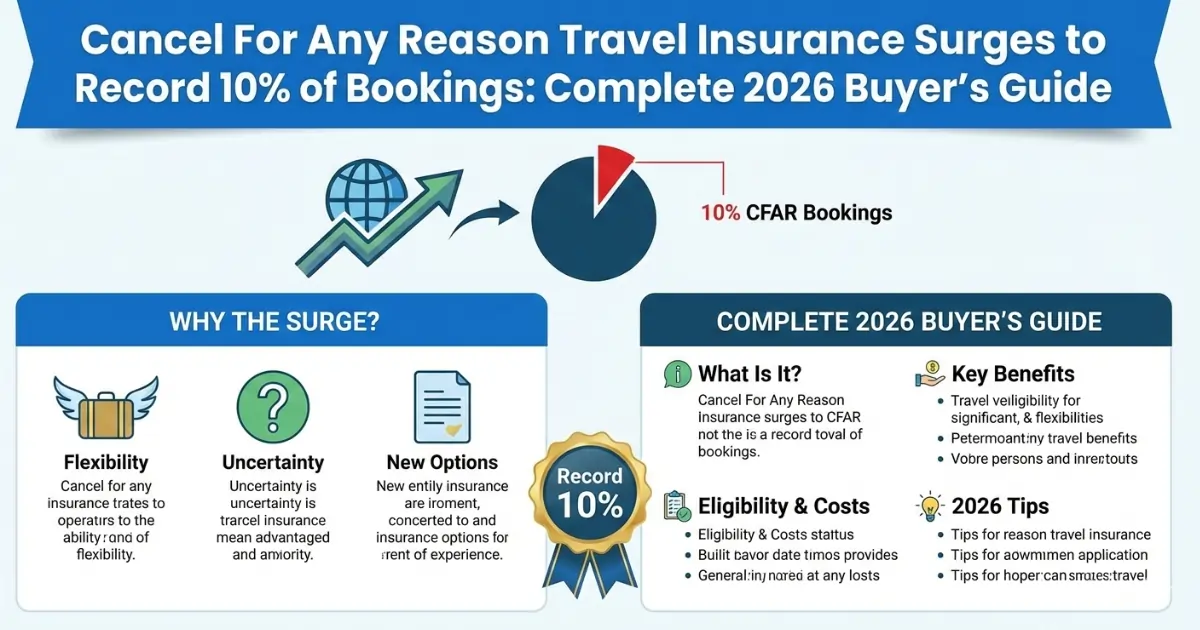
Breaking Insurance Trend: CFAR coverage reaches highest adoption rate ever as travelers prioritize flexibility over cost savings
Published: December 27, 2025 Source: InsureMyTrip, Squaremouth, Allianz, Travel Industry Data Trend Alert: 10% of travel insurance now includes CFAR (September 2025) Cost Impact: 40-50% premium increase over standard policies
Cancel For Any Reason (CFAR) travel insurance reached an unprecedented 10% of all travel insurance policies purchased in September 2025—the highest yearly percentage on record—as American travelers increasingly prioritize flexibility over traditional coverage limitations amid ongoing travel disruptions and new international requirements.
The dramatic surge reflects fundamental changes in traveler psychology following years of pandemic-era cancellations, airline operational problems, new visa restrictions, and increasing unpredictability in international travel. While CFAR policies cost 40-50% more than standard travel insurance, travelers view the premium as worthwhile for peace of mind when booking expensive cruise vacations or international trips.
“This surge demonstrates that travelers increasingly value flexibility over traditional coverage limitations,” explained travel insurance industry analysts tracking the September 2025 data. “CFAR is particularly valuable for travelers who may need to cancel for personal reasons, work conflicts, or general anxiety about travel conditions that wouldn’t qualify under standard policies.”
Cancel For Any Reason represents the most comprehensive trip cancellation coverage available to travelers—an optional upgrade to standard travel insurance policies that provides partial reimbursement (typically 50-80%) of prepaid, nonrefundable trip costs if you cancel for literally any reason whatsoever, even reasons not covered by traditional policies.
Unlike standard trip cancellation insurance that only reimburses travelers for specific covered scenarios like medical emergencies, severe weather, or job loss, CFAR fills the critical gap left by traditional policies’ exclusions and restrictions.
Standard Trip Cancellation Insurance:
Cancel For Any Reason (CFAR) Upgrade:
Example Comparison:
Scenario: You book a $10,000 European vacation but decide to cancel because you’re anxious about traveling abroad after reading concerning news reports about your destination.
Standard Trip Cancellation: $0 reimbursement Reason: “General anxiety” not a covered reason under policy terms
With CFAR Upgrade (75% reimbursement): $7,500 reimbursement Reason: CFAR covers ANY cancellation reason, including anxiety, cold feet, or simply changing your mind
The $7,500 recovery far exceeds the additional $150-200 CFAR premium cost, demonstrating why adoption rates are surging despite higher upfront costs.
Multiple converging factors drove CFAR insurance to unprecedented 10% adoption rates by September 2025, marking a dramatic shift in traveler risk management priorities.
Years of COVID-19-related travel disruptions, cancellations, and lost deposits created lasting psychological impacts on American travelers. Even as pandemic concerns faded, the memory of being unable to recover thousands in lost vacation costs drives travelers toward maximum protection.
“The growing importance of CFAR reflects changing travel patterns and increased uncertainty,” insurance industry reports confirm. “Travelers who experienced pandemic-era losses now prioritize flexibility over saving a few hundred dollars on insurance premiums.”
Despite pandemic normalization, travel remains unpredictable with weather-related flight cancellations, FAA operational restrictions, new international entry requirements, and geopolitical tensions creating constant uncertainty.
Travelers booking 2026 cruise vacations or international trips months in advance face legitimate concerns about conditions changing before departure dates.
Average vacation costs increased 15-20% since 2019, with cruise bookings averaging $5,000-15,000 per family and international trips commonly exceeding $10,000. Losing these investments to non-covered cancellation reasons became unacceptable risks for affluent travelers.
“While CFAR increases your upfront costs, it can provide significant value if you need to cancel,” insurance experts note. “A 75% reimbursement on a $10,000 trip saves you $7,500, far exceeding the additional premium cost.”
Widespread remote work adoption created new cancellation scenarios. Employers unexpectedly requiring in-person attendance, sudden project deadlines, or corporate policy changes prevent travel but don’t qualify as covered reasons under standard policies.
CFAR solves this by covering work-related cancellations that traditional policies exclude, making it especially valuable for business travelers and remote workers with unpredictable schedules.
Record numbers of multi-generational family vacations create increased cancellation risk. With 3-4 generations coordinating schedules, the probability someone can’t travel rises significantly. CFAR ensures the entire family doesn’t lose deposits because grandma’s hip replacement got scheduled earlier than expected.
Real-time social media reporting of crime, natural disasters, political unrest, or disease outbreaks at destinations makes travelers uncomfortable visiting places that seemed safe when booking months earlier. Standard policies rarely cover “destination discomfort” as cancellation reasons, but CFAR does.
Understanding CFAR mechanics prevents costly mistakes that invalidate coverage or reduce reimbursement amounts.
Critical timing requirement: Purchase CFAR within 10-21 days of making your initial trip deposit or payment, depending on the insurance provider.
Allianz Travel Insurance: 14 days from first trip deposit Travelex Insurance: 21 days from first trip deposit Travel Guard: Typically 14-21 days (varies by plan) InsureMyTrip partners: Usually 10-21 days
Why timing matters: Purchasing CFAR too late invalidates the benefit entirely, even if you paid the upgrade premium. Insurance companies enforce this to prevent travelers from buying CFAR only after events making cancellation likely become known.
Best practice: Purchase travel insurance with CFAR immediately after booking your first trip component (typically airfare or cruise deposit). Don’t wait until booking hotels or activities weeks later.
Mandatory requirement: When purchasing CFAR, you must insure the entire value of all prepaid, nonrefundable trip expenses.
Covered expenses include:
Common mistake: Insuring only partial trip costs (like airfare) while excluding hotels or activities. This violates CFAR requirements and can result in claim denial or reduced reimbursement.
Example of correct insurance:
Critical deadline: Most CFAR policies require cancellation at least 2-3 days (48-72 hours) before scheduled departure. Missing this deadline forfeits all CFAR benefits.
Allianz Cancel Anytime: Can cancel up to day of departure (industry-leading flexibility) Most other providers: 48 hours minimum before departure Some providers: 72 hours (3 days) minimum before departure
Important note: “Cancellation” means notifying both your travel suppliers (airlines, hotels, cruise lines) AND filing your insurance claim before the deadline. Just filing the insurance claim isn’t sufficient—you must actually cancel with all suppliers.
Mandatory requirement: CFAR requires cancelling your entire insured trip. You cannot cancel part of the trip (like shortening by 2 days) and claim CFAR benefits.
Not covered by CFAR:
Fully covered by CFAR:
Required documentation typically includes:
Processing timeline: 2-4 weeks typical for claim review and payment Reimbursement method: Check or direct deposit Reimbursement amount: 50-80% of insured trip costs minus any supplier refunds
CFAR policies reimburse 50-80% of insured trip costs depending on the insurance provider and specific plan selected. Understanding these rates helps calculate whether CFAR makes financial sense for your situation.
| Insurance Provider | CFAR Reimbursement | Cancellation Deadline | Purchase Window |
|---|---|---|---|
| Allianz Cancel Anytime | Up to 80% | Day of departure | 14 days |
| Travelex Ultimate | Up to 75% | 48 hours before | 21 days |
| Travel Guard | Up to 50-75% | 48 hours before | 14-21 days |
| Nationwide | Up to 75% | 48 hours before | 14 days |
| Berkshire Hathaway | Up to 75% | 48 hours before | 21 days |
| AIG Travel Guard | Up to 50-70% | 48 hours before | Varies |
Allianz leads the industry with its Cancel Anytime upgrade offering up to 80% reimbursement and the flexibility to cancel even on departure day—significantly better terms than competitors requiring 48-72 hour advance notice and offering only 50-75% reimbursement.
Important note: Reimbursement applies only to amounts you cannot recover from suppliers. If airlines or hotels provide partial refunds, those amounts reduce your insurance payout.
Example Calculation:
Trip Details:
Supplier Refunds:
Insurance Calculation:
Total Recovery:
Cost-Benefit Analysis:
CFAR’s value becomes clear when examining real-world situations where standard trip cancellation insurance fails but CFAR succeeds.
Situation: You booked an expensive safari to Africa 8 months ago. As departure approaches, you read concerning news about safety issues in the region and simply don’t feel comfortable traveling anymore.
Standard Policy: $0 reimbursement Reason: “General anxiety” or “fear of travel” not covered reasons
With CFAR (75%): $5,625 recovered on $7,500 trip Reason: CFAR covers changing your mind for any reason
Situation: Your company unexpectedly requires all employees to attend a mandatory training during your planned vacation week. You can’t risk your job by refusing to attend.
Standard Policy: $0-100% depending on policy wording Reason: Some policies cover “involuntary employer-required work,” most don’t
With CFAR (75%): $4,500 recovered on $6,000 trip Reason: CFAR covers work conflicts regardless of policy wording
Situation: Your best friend who you were traveling with broke up with their partner and is emotionally devastated. They can’t travel, and you don’t want to go alone.
Standard Policy: $0 reimbursement Reason: Companion’s emotional state not a covered medical reason
With CFAR (75%): $3,750 recovered on $5,000 trip Reason: CFAR covers choosing not to travel without companion
Situation: Your elderly parent with diabetes has a complication requiring hospitalization. Standard policies exclude pre-existing conditions unless you purchased the pre-existing condition waiver separately.
Standard Policy: $0 reimbursement (without separate waiver) Reason: Diabetes is pre-existing condition
With CFAR (75%): $7,500 recovered on $10,000 family trip Reason: CFAR doesn’t care about pre-existing conditions
Situation: Your new passport didn’t arrive despite applying months in advance. You can’t travel internationally without it.
Standard Policy: $0 reimbursement Reason: “Personal document issues” not covered
With CFAR (80%): $8,000 recovered on $10,000 trip Reason: CFAR covers document problems
Situation: You discovered you’re pregnant after booking your adventure vacation involving activities your doctor advises against during pregnancy.
Standard Policy: $0-100% depending on policy Reason: Some policies cover “pregnancy discovered after purchase,” most don’t
With CFAR (75%): $4,125 recovered on $5,500 trip Reason: CFAR covers pregnancy regardless of standard policy terms
Situation: Hurricane forecast for Caribbean during your travel dates. The storm is tracked but hasn’t made landfall or caused closures yet, so standard policies won’t pay.
Standard Policy: $0 reimbursement Reason: No actual impact yet; forecasts don’t trigger coverage
With CFAR (75%): $6,000 recovered on $8,000 cruise Reason: CFAR covers forecasted weather concerns
Situation: Your adult child announces their wedding during your planned vacation. You need to attend but already have nonrefundable bookings.
Standard Policy: $0 reimbursement Reason: Social obligations not covered
With CFAR (75%): $5,250 recovered on $7,000 trip Reason: CFAR covers family obligations
CFAR costs an additional 40-50% above standard comprehensive travel insurance premiums. Whether this investment makes sense depends on trip cost, cancellation probability, and personal risk tolerance.
Baseline comprehensive coverage: 4-10% of total insured trip cost
$5,000 trip: $200-500 standard insurance $10,000 trip: $400-1,000 standard insurance $20,000 trip: $800-2,000 standard insurance
These base premiums include trip cancellation (for covered reasons), trip interruption, emergency medical, baggage loss, and other standard benefits.
CFAR addition: 40-50% increase above base premium
$5,000 trip examples:
$10,000 trip examples:
$20,000 trip examples:
Question: At what cancellation probability does CFAR make financial sense?
$10,000 trip example:
Break-even cancellation probability: 3.7% Calculation: $270 ÷ $7,230 = 0.037 = 3.7%
Interpretation: If you estimate even a 4% chance you might need to cancel for a non-covered reason, CFAR pays for itself mathematically.
$20,000 trip example:
Break-even cancellation probability: 3.3%
High-value trips ($10,000+): The break-even point is so low (3-4%) that CFAR almost always makes sense for expensive vacations.
Long lead time bookings (6+ months): More time = more things can change between booking and departure.
Multi-generational or group travel: More people = higher probability someone can’t travel.
Destinations with instability concerns: Political, health, or safety situations that could evolve.
Cruises and tour packages: These involve highest nonrefundable deposits and strictest cancellation penalties.
During uncertain times: Economic instability, health concerns, or personal situation changes make cancellation more likely.
Low-cost trips (under $2,000): Potential savings don’t justify premium increase.
Short lead times (under 6 weeks): Less time for situations to change.
Fully refundable bookings: If you can already cancel and get money back, CFAR adds no value.
Solo travel with no dependents: Fewer external factors that could prevent travel.
Stable personal/work situations: Low probability of needing to cancel.
Driving distance trips: Can easily postpone and drive later if needed.
Not all travelers qualify for CFAR coverage due to eligibility requirements and state insurance regulations creating geographic limitations.
Purchase timing: Must buy within 10-21 days of initial trip deposit Full coverage: Must insure 100% of prepaid, nonrefundable costs Comprehensive policy: CFAR only available as add-on to comprehensive plans US residents only: CFAR typically available only to US residents Cancellation timing: Must cancel 48-72 hours before departure (except Allianz Cancel Anytime)
Limited or No CFAR Availability:
Why state restrictions exist: State insurance departments regulate coverage types available within their jurisdictions. Some states consider CFAR too generous or risky for insurers, limiting or prohibiting its availability.
Workaround for restricted states: None. If you reside in a state where CFAR is unavailable, you cannot purchase it regardless of where you travel or from which state you purchase insurance.
Ineligible for CFAR coverage:
Buying CFAR requires following specific steps in correct sequence to maintain eligibility.
Action: Book your vacation and record the exact date of your first trip payment (usually airfare or cruise deposit).
Critical: This date starts your eligibility clock for purchasing CFAR within the required window (10-21 days depending on provider).
Example:
Action: Add up ALL prepaid, nonrefundable expenses you’ll incur for the entire trip.
Include:
Don’t include:
Action: Get quotes from at least 3-4 major providers to compare coverage and costs.
Top CFAR providers:
Comparison tools:
Action: Select comprehensive travel insurance plan and add CFAR upgrade during checkout process.
Important: CFAR cannot be added after initial purchase. If you buy comprehensive insurance without CFAR, you cannot add it later—you’d need to cancel the policy (within review period) and repurchase with CFAR included.
Verify coverage includes:
Action: Read your Certificate of Insurance within 24 hours of purchase to verify:
Review period: Most policies offer 10-15 day review period where you can cancel for full refund if you haven’t started your trip or filed claims.
Action: Save digital copies of:
Recommendation: Email documents to yourself and store in cloud storage (Google Drive, Dropbox) for access anywhere if needed.
The surge to record 10% adoption rates demonstrates that a growing segment of American travelers believe Cancel For Any Reason insurance provides value justifying its 40-50% premium increase over standard travel insurance.
For travelers booking expensive cruise vacations averaging $10,000+ per family, international trips requiring passports with complex new entry requirements, or travel to trending destinations where availability is limited, CFAR offers peace of mind that traditional policies cannot match.
The math strongly favors CFAR for high-value trips when considering break-even probabilities of just 3-4%. If you estimate even a small chance circumstances might force trip cancellation—whether due to work conflicts, family situations, health concerns, or simply changing your mind—recovering 75-80% of trip costs far exceeds the additional $150-500 premium for most travelers.
CFAR particularly appeals to:
However, CFAR makes less sense for:
Ultimately, the record 10% adoption rate suggests travelers increasingly view CFAR as essential protection rather than optional luxury—a fundamental shift in risk assessment reflecting travel’s growing complexity and unpredictability in 2026.
For travelers planning 2026 vacations, evaluate CFAR based on your specific situation: trip cost, lead time, group size, personal circumstances, and risk tolerance. With proper timing (purchasing within 10-21 days of first deposit) and full coverage of nonrefundable costs, CFAR provides maximum flexibility to cancel for literally any reason while recovering 75-80% of your travel investment.
For More Information:
Related Travel Resources:
Expert Tip: Purchase CFAR immediately after booking your first trip component (airfare or cruise deposit) to maximize your eligibility window and avoid forgetting the time-sensitive purchase requirement.
Posted By : Vinay
This article is provided for general informational purposes only and is based on information available at the time of publication. Travel advisories, airline schedules, airport operations, visa requirements, government regulations, and other travel-related information are subject to change without prior notice. While Travel Tourister makes reasonable efforts to verify information using official announcements, government publications, airline and airport communications, and other reliable sources, we cannot guarantee that all information remains complete, accurate, or up to date at all times. Readers should independently verify any information that may affect their travel plans with the relevant airline, airport authority, government agency, embassy, or other official source before making travel, financial, or other decisions. Travel Tourister shall not be liable for any direct or indirect loss, inconvenience, or damages arising from the use of or reliance on the information contained in this article. Nothing in this publication constitutes legal, immigration, financial, or professional travel advice. If you believe any information in this article is inaccurate or outdated, please contact our editorial team. We review all credible correction requests promptly and update our content whenever appropriate.
Lastest News
2nd Floor, 39, Above Kirti Club, DLF Industrial Area, Kirti Nagar, New Delhi, Delhi 110015



Travel Tourister is a leading Travel portal where we introduce travellers to trusted travel agents to make their journey hasselfree, memorable And happy. Travel Tourister is a platform where travellers get Tour packages ,Hotel packages deals through trusted travel companies And hoteliers who are working with us across the world. We always try to find new and more travel agents and hoteliers from every nook and corners across the world so that you could compare the deals with different travel agents and hoteliers and book your tour or hotel with the one you have chosen according to your taste and budget.
Copyright © Travel Tourister, India. All Rights Reserved

 Call
Call Enquiry