Published on : 03 Jan 2026
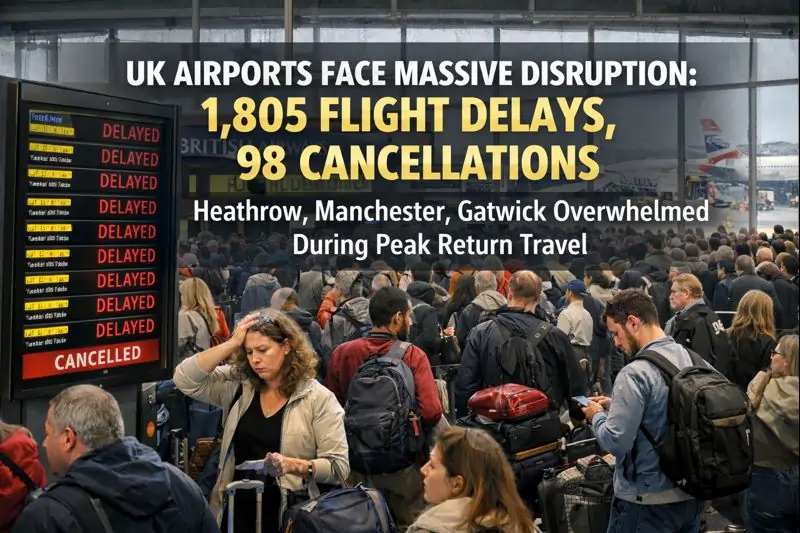
TRENDING: UK aviation system paralyzed January 3, 2026 with 1,805 flight delays + 98 cancellations across 11 airports—Heathrow (547 delays, 15 cancellations), Manchester (281/17), Gatwick (371/8), Luton (136/7), Birmingham (100/7) hardest hit as British Airways, easyJet, Ryanair, KLM, Lufthansa struggle amid winter weather, operational bottlenecks, stranding thousands during peak return period when families attempt reaching home after New Year holidays
Published: January 3, 2026 Source: Travel and Tour World, Airport Live Data, Civil Aviation Authority, Multiple Sources Key Finding: 1,903 total flight disruptions (1,805 delays + 98 cancellations) January 3, 2026 Hardest Hit: Heathrow (562 disruptions), Gatwick (379), Manchester (298), Luton (143) Airlines Affected: British Airways (203 delays, 10 cancellations), easyJet (155 delays, 15 cancellations) ANZ Impact: Major disruption for Australian/NZ travelers connecting through UK to/from Europe, Asia, Americas
Thousands of exhausted travelers faced long waits, disrupted connections, and broken travel plans on January 3, 2026 after UK airports reported an extraordinary volume of flight disruptions—with data compiled from live operations across Britain revealing a total of 1,805 flight delays and 98 cancellations at key hubs including Manchester, London Heathrow, London Gatwick, London Luton, Birmingham, Leeds Bradford, Aberdeen, Glasgow, Edinburgh, and Bristol, creating cascade effects through European air networks as major carriers British Airways, easyJet, Ryanair, KLM, and Lufthansa scrambled to rebook flights and support weary travelers during one of the peak travel periods annually when holiday-makers return home from New Year celebrations.
The disruptions struck as combination of persistent winter weather across UK and Continental Europe, operational bottlenecks at major hubs operating near capacity, and lingering effects from previous days’ weather delays compounded to create perfect storm of factors overwhelming aviation infrastructure designed for efficiency during normal operations but lacking redundancy to absorb shocks when multiple airports experience simultaneous challenges affecting crew rotations, aircraft positioning, and ground operations that collectively reduce capacity below demand levels.
“Many passengers waiting in Departure Lounges expressed frustration while airlines scrambled to rebook flights and support weary travellers,” confirms Travel and Tour World reporting from affected airports. “Major UK airports—some of the busiest in Europe—have been hit by a spike in operational disturbances that have compounded travel stress during one of the peak travel periods.”
For Australian and New Zealand travelers—who frequently transit through London Heathrow, Manchester, or Gatwick when flying between Oceania and Europe, or connecting to North American destinations via UK hubs—the disruptions create particular challenges as long-haul international flights from Sydney, Melbourne, Auckland arrive into chaos where onward connections disappear, rebooking queues stretch hours, and limited hotel availability forces airport overnight stays during peak period when accommodation near major hubs sells out weeks in advance at premium prices.
London Heathrow—the UK’s busiest international hub handling 80+ million passengers annually and serving as British Airways’ primary base—bore the brunt of January 3 disruptions with 547 flight delays and 15 cancellations, making it the most severely affected airport in UK and one of the worst-performing major European hubs on the day as cascading delays affected operations from early morning through evening, creating backlog that extended into following days as aircraft and crew rotations fell increasingly out of sync.
Heathrow-specific impacts:
Heathrow’s central role in UK and international connectivity amplified knock-on delays across Europe and beyond—as aircraft scheduled to depart Heathrow for Continental destinations sat delayed in London, those same aircraft couldn’t return from European cities on schedule, creating ripple effects through airline networks where single Heathrow delay affected six or more subsequent flights throughout the day as aircraft and crew became increasingly mispositioned.
“London Heathrow was the most delayed airport today, registering 202 delays and 9 cancellations,” confirms earlier reporting that underestimated final tallies as delays accumulated through afternoon and evening. “British Airways accounted for the majority of disruptions, with over 120 delayed flights and multiple cancellations, affecting both short-haul and long-haul operations.”
Passenger experiences at Heathrow:
Manchester Airport—ranked third among world’s most stressful airports in 2026 according to data-driven analysis by iSelect and reported by Condé Nast Traveller ME—recorded 281 delays and 17 cancellations (highest cancellation count among UK airports January 3), reflecting persistent congestion and operational bottlenecks that travelers have come to expect rather than avoid at the busy northern gateway handling 30+ million annual passengers.
Manchester challenges:
“Manchester recorded 181 delays and 11 cancellations, making it the most cancelled airport among those assessed,” notes earlier data that subsequently increased as day progressed. “easyJet alone accounted for 7 cancellations and 60 delays, while additional strain was visible across Jet2, Aer Lingus, and Emerald Airlines operations.”
Environment Canada issued yellow weather warning for snow and ice covering eight out of ten metropolitan boroughs in Greater Manchester, with forecast predicting sleet and snow moving southeastward with up to 5 cm possible in higher areas and risk of quickly forming icy patches—creating operational headaches that forced runway closures for snow clearing, created de-icing backlogs, and reduced arrival/departure rates below scheduled capacity.
Manchester’s reputation problem:
The airport’s high stress score reflects persistent congestion, operational bottlenecks, and string of disruptions that undermine its role as convenient alternative to London airports—particularly problematic for northern England residents and Scottish travelers who prefer Manchester’s regional accessibility over journey to London Heathrow or Gatwick for long-haul international flights.
London Gatwick—UK’s second-busiest airport and easyJet’s largest base—experienced 371 delays and 8 cancellations, with disruption concentrated among leisure and short-haul carriers particularly easyJet and BA Euroflyer, creating ripple effects to destinations including Madeira (Funchal), Rome Fiumicino, and Krakow popular with British holidaymakers.
Gatwick-specific factors:
“London Gatwick logged 137 delays and 8 cancellations, all cancellations linked to easyJet services,” confirms earlier reporting, though final figures reached 371 delays as schedule deteriorated through afternoon peak operations when European inbound and outbound flights concentrate in 2-3 hour windows creating vulnerability to cascading delays.
London Luton—fourth-largest London-area airport and primary base for Wizz Air and easyJet operations—saw 136 delays and 7 cancellations affecting primarily Eastern European and Mediterranean routes popular with leisure travelers and visiting friends/relatives traffic between UK and immigrant communities’ home countries.
Luton characteristics:
Birmingham—UK’s seventh-busiest airport serving Midlands region—experienced 100 delays and 7 cancellations, indicating lighter but persistent disruption affecting regional connectivity where travelers depend on Birmingham avoiding longer journeys to London airports or Manchester.
Birmingham impacts:
Leeds Bradford (LBA): 30 delays and 8 cancellations (highest cancellation rate proportionally) Aberdeen (ABZ): 24 delays and 7 cancellations (oil industry business travelers particularly affected) Glasgow (GLA): Substantial disruption affecting Scottish travelers Edinburgh (EDI): Notable delays impacting Scottish capital’s connectivity Bristol (BRS): Delays affecting Southwest England gateway Cardiff (CWL): Welsh travelers experiencing disruption
British Airways faced most severe absolute disruption with 203 delays and 10 cancellations across London airports (primarily Heathrow where airline operates 40%+ of flights), affecting both short-haul European schedules and long-haul intercontinental operations to North America, Asia, Middle East, Africa, and Oceania.
BA operational challenges:
“British Airways accounted for the majority of disruptions, with over 120 delayed flights and multiple cancellations, affecting both short-haul and long-haul operations,” confirms industry analysis. “Heathrow’s central role in UK and international connectivity amplified knock-on delays across Europe and beyond.”
easyJet emerged as largest disruption driver with 15 cancellations across Gatwick and Manchester and over 155 delays across multiple UK airports, reflecting operational pressure most visible at airline’s two largest bases where schedule density leaves minimal slack for recovery when delays begin accumulating.
easyJet challenges:
KLM Royal Dutch Airlines: Multiple cancellations and delays affecting Amsterdam-UK connections, particularly impacting passengers connecting through Schiphol for intercontinental flights.
Lufthansa: Frankfurt-London routes disrupted, affecting Star Alliance connections.
Ryanair: Europe’s largest budget carrier experiencing delays across UK network.
Virgin Atlantic: Long-haul disruptions at Heathrow affecting US routes particularly to New York, Los Angeles, Miami.
United Airlines, American Airlines, Delta: Transatlantic services to US affected (Edinburgh United reported 1 cancellation, Heathrow saw multiple US carrier delays).
Jet2: Leisure carrier heavily affected at Manchester with high delay volumes despite limited cancellations.
The UK Civil Aviation Authority—the official regulator responsible for overseeing safety and operational standards in aviation—provides extensive information on passenger entitlements when flights are delayed or cancelled, with rights differing significantly from North American regulations and offering stronger protections for travelers within UK/European jurisdiction.
Passenger rights under UK/EU regulations:
For cancellations:
For delays exceeding 3 hours:
Duty of care requirements:
UK/EU passenger rights distinguish between “controllable” and “uncontrollable” circumstances—with weather-related delays and cancellations typically classified as “extraordinary circumstances” outside airline control, exempting carriers from monetary compensation obligations while still requiring reasonable assistance with rebooking, meals, and accommodations.
What January 3 passengers ARE entitled to:
What passengers are NOT entitled to during weather delays:
Immediate steps:
Third-party claim services:
For Australian and New Zealand travelers, UK airports—particularly London Heathrow—serve as critical connection points for journeys between Oceania and destinations across Europe, Middle East, Africa, and Americas, making UK disruptions disproportionately impactful compared to travelers whose journeys don’t depend on British hubs.
Typical ANZ-UK routing patterns:
When Heathrow reports 547 delays and Manchester 281 delays simultaneously, ANZ travelers arriving from 22-hour overnight Sydney-London flights discover onward connections to Rome, Paris, or Frankfurt cancelled or delayed many hours—forcing decisions between waiting airport indefinitely for rebooking, paying out-of-pocket for expensive last-minute hotels in London, or abandoning European portions of trips entirely and returning to Australia on next available flight.
Compounding challenges for ANZ travelers:
“Trip interruption coverage essential for weather delays” becomes particularly important for Australian and New Zealand travelers whose long-haul international journeys carry greater financial risk and higher probability of disruption compared to domestic or short-haul regional travel.
What travel insurance covers:
Cancel For Any Reason (CFAR) policies:
Obsessively monitor flight status:
Proactive airline contact:
Consider delaying airport departure:
Multiple rebooking strategies simultaneously:
Be flexible:
Investigate alternative airports:
Document everything:
UK entry considerations:
Currency and payment:
Communication:
The 1,903 total flight disruptions across UK on January 3, 2026—comprising 1,805 delays and 98 cancellations concentrated at Heathrow (547 delays, 15 cancellations), Manchester (281/17), Gatwick (371/8), Luton (136/7), and Birmingham (100/7)—demonstrate how quickly combination of winter weather, operational bottlenecks, and lingering previous-day disruptions can overwhelm aviation infrastructure designed for efficiency during normal operations but lacking redundancy to absorb shocks when multiple airports experience simultaneous challenges.
For Australian and New Zealand travelers whose long-haul 22-24 hour flights from Sydney, Melbourne, Auckland to London Heathrow represent significant investments of time, money, and vacation days, arriving into UK chaos where onward European connections disappear creates particularly acute frustrations as jet-lagged passengers navigate unfamiliar rebooking systems, sold-out hotels, and UK-specific passenger rights differing from Australian consumer protections while fighting exhaustion after overnight flights and 8-10 hour time zone adjustments.
Key takeaways for travelers navigating UK airport disruptions:
✓ UK hub vulnerability (Heathrow 547 delays shows single-hub dependency risk) ✓ Monitor weather for UK connection cities even if origin/destination clear ✓ Travel insurance essential (trip interruption coverage airlines won’t provide) ✓ Build connection buffers (minimum 4+ hours connecting through UK hubs during winter) ✓ Understand UK passenger rights (stronger than US/Australia but weather exempt from compensation) ✓ Pack essentials in carry-on (medications, valuables, 24-hour clothing) ✓ Proactive rebooking (contact airline immediately when disruption likely) ✓ Flexible routing (alternative UK airports, European cities may resolve faster) ✓ Document expenses (receipts crucial for insurance/compensation claims) ✓ Premium credit cards (include trip delay coverage offsetting some costs)
“The ongoing pattern of severe operational challenges has led to repeated schedule adjustments at some of the UK’s busiest air hubs,” notes aviation analysis. “Both Heathrow and Manchester urged travellers to remain flexible with their plans, particularly during peak travel periods, and to verify flight information before heading to the airport.”
The January 3 disruptions follow weeks of intermittent UK aviation challenges through December 2025 and early January 2026, creating operational recovery difficulties where airlines struggle repositioning aircraft and crew to resume normal schedules even after weather improves—as planes and pilots end up in wrong cities, maintenance backlogs develop, crews exceed maximum duty hours requiring rest periods, extending disruption impacts days beyond triggering events.
For More Resources:
Related Travel Guides:
Final Reflection: January 3, 2026 UK aviation chaos—stranding thousands with 1,805 delays and 98 cancellations across Heathrow, Manchester, Gatwick, and regional airports—reminds Australian and New Zealand travelers that modern air travel’s efficiency depends on interconnected systems where disruption at single hub cascades through entire networks affecting passengers whose origins and destinations experience perfect conditions but suffer delays because connections route through UK airports experiencing weather, congestion, or operational bottlenecks. For long-haul travelers whose 22-hour Pacific crossings represent significant time and financial investments, UK hub dependency creates vulnerability that comprehensive travel insurance, flexible booking, generous connection buffers, and realistic winter travel expectations can mitigate but never eliminate. The lesson: UK hub connections during winter require acknowledging that disruption isn’t possibility but probability, with preparation transforming inevitable delays from travel disasters into manageable inconveniences requiring patience and adaptability.
Posted By : Vinay
This article is provided for general informational purposes only and is based on information available at the time of publication. Travel advisories, airline schedules, airport operations, visa requirements, government regulations, and other travel-related information are subject to change without prior notice. While Travel Tourister makes reasonable efforts to verify information using official announcements, government publications, airline and airport communications, and other reliable sources, we cannot guarantee that all information remains complete, accurate, or up to date at all times. Readers should independently verify any information that may affect their travel plans with the relevant airline, airport authority, government agency, embassy, or other official source before making travel, financial, or other decisions. Travel Tourister shall not be liable for any direct or indirect loss, inconvenience, or damages arising from the use of or reliance on the information contained in this article. Nothing in this publication constitutes legal, immigration, financial, or professional travel advice. If you believe any information in this article is inaccurate or outdated, please contact our editorial team. We review all credible correction requests promptly and update our content whenever appropriate.
Lastest News
2nd Floor, 39, Above Kirti Club, DLF Industrial Area, Kirti Nagar, New Delhi, Delhi 110015



Travel Tourister is a leading Travel portal where we introduce travellers to trusted travel agents to make their journey hasselfree, memorable And happy. Travel Tourister is a platform where travellers get Tour packages ,Hotel packages deals through trusted travel companies And hoteliers who are working with us across the world. We always try to find new and more travel agents and hoteliers from every nook and corners across the world so that you could compare the deals with different travel agents and hoteliers and book your tour or hotel with the one you have chosen according to your taste and budget.
Copyright © Travel Tourister, India. All Rights Reserved

 Call
Call Enquiry