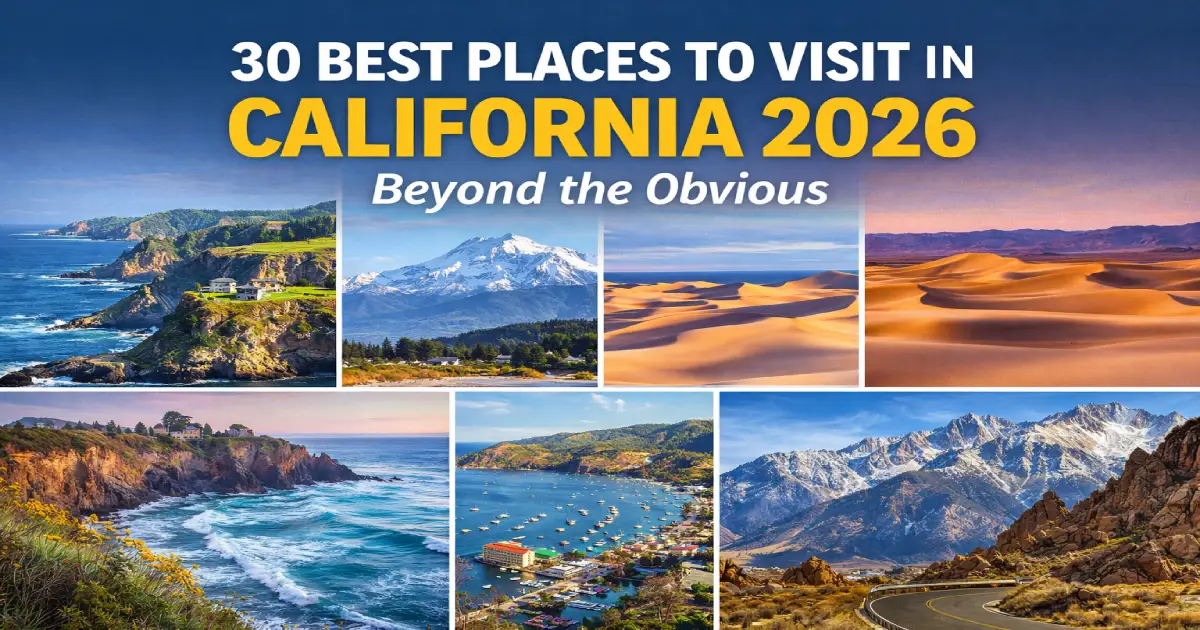
30 Best Places to Visit in California 2026: Beyond the Obvious
Published on : 28 Feb 2026
Best Places to Visit in California — From Iconic Cities to Hidden Coastal Gems
By Travel Tourister | Updated February 2026
California isn’t just Los Angeles and San Francisco—it’s 900 miles of Pacific coastline, alpine mountains, ancient redwood forests, scorching deserts, fertile wine valleys, and some of America’s most spectacular national parks, all packed into the country’s third-largest state.
I’ve explored California extensively over 25+ trips spanning budget backpacking adventures through the Sierra Nevada, mid-range coastal highway road trips, and luxury wine country weekends. The state’s geographic diversity continues to surprise me: a single week can include surfing in San Diego (70°F), skiing in Lake Tahoe (snow-covered peaks), hiking Yosemite’s granite cliffs, and sweating through Death Valley’s 120°F heat. This variety creates both opportunity and overwhelm—where do you even start?
This comprehensive 2026 guide breaks down California’s best destinations into digestible categories using insights from the California Travel & Tourism Commission, years of personal exploration, and recommendations from locals across the state. We’ll cover iconic must-sees everyone should experience, hidden gems most tourists miss, spectacular natural wonders, charming small towns, and strategic combinations for first-time visitors.
Whether you have 3 days or 3 weeks, whether you’re prioritizing beaches, mountains, cities, or wine, this guide helps you navigate California’s overwhelming abundance of world-class destinations.
California Destinations: Quick Reference by Region
Region
Must-See Destinations
Best For
Days Needed
Northern California
San Francisco, Napa Valley, Lake Tahoe, Redwood National Park
Urban culture, wine, mountains, ancient forests
7-10 days
Central Coast
Big Sur, Monterey, Carmel, Santa Barbara, San Luis Obispo
Coastal drives, charming towns, wine, beaches
4-7 days
Southern California
Los Angeles, San Diego, Orange County beaches, Palm Springs
Beaches, theme parks, urban entertainment, desert
5-10 days
Sierra Nevada
Yosemite, Sequoia & Kings Canyon, Mammoth Lakes, Lake Tahoe
National parks, hiking, skiing, mountain scenery
3-7 days
Deserts
Joshua Tree, Death Valley, Anza-Borrego, Palm Springs
Unique landscapes, stargazing, winter escapes
2-4 days
Central Valley
Sacramento, Fresno (gateway to parks)
State capital, agricultural heartland, budget bases
1-2 days
Top 10 Iconic California Destinations (Must-See)
1. San Francisco: The City by the Bay
Why Visit: America’s most European city delivers stunning bay views, cable cars climbing 45-degree hills, the iconic Golden Gate Bridge, diverse neighborhoods, and a legendary food scene—all packed into 49 square miles.
Don’t Miss:
Golden Gate Bridge walk or bike ride (rent bikes at Fisherman’s Wharf)
Alcatraz Island tour (book 2-3 months ahead, $45-65)
Cable car ride ($8 one-way, worth every penny)
Ferry Building Marketplace (gourmet food hall)
Walking neighborhoods: North Beach (Italian), Mission District (Mexican), Haight-Ashbury (hippie history)
Painted Ladies Victorian homes at Alamo Square
Chinatown (oldest in North America)
Coit Tower for 360° city views
Best Time: September-October (warmest, driest months—summer is cold and foggy)
Days Needed: 3-4 days minimum
Budget: Expensive ($280+ mid-range hotels, $45+ dinners)
2. Yosemite National Park: Nature’s Cathedral
Why Visit: Yosemite Valley showcases some of Earth’s most dramatic granite cliffs, towering waterfalls, giant sequoias, and alpine meadows. Half Dome and El Capitan are mountaineering icons recognized worldwide.
Don’t Miss:
Yosemite Valley floor drive (waterfalls, meadows, granite monoliths)
Glacier Point sunset (best valley overview, 30-minute drive from valley floor)
Mariposa Grove giant sequoias (shuttle required)
Yosemite Falls hike (strenuous but rewarding)
Tuolumne Meadows (summer only, high elevation alpine beauty)
Half Dome hike (permit lottery required, extremely strenuous)
Best Time: May-June (waterfalls peak from snowmelt) or September (crowds thin, weather stable)
Days Needed: 2-3 days minimum
Entry Fee: $35 per vehicle (7 days), reserve in advance (park fills daily May-September)
3. Los Angeles: Entertainment Capital
Why Visit: LA sprawls across 500 square miles of beaches, mountains, and urban neighborhoods, offering Hollywood glamour, world-class museums, diverse ethnic food, beach culture, and endless entertainment.
Don’t Miss:
Getty Center (free admission, $20 parking, world-class art and architecture)
Griffith Observatory (free admission, Hollywood sign views, LA skyline)
Santa Monica Pier and beach
Venice Beach Boardwalk (street performers, muscle beach, eclectic vibe)
Hollywood Walk of Fame and TCL Chinese Theatre
The Broad contemporary art museum (free, timed tickets)
LACMA (Los Angeles County Museum of Art)
Studio tours (Warner Bros, Paramount, Universal Studios)
Best Time: September-November (warm, dry, clearer air quality)
Days Needed: 4-5 days minimum (sprawling city requires time)
Budget: Moderate to expensive ($180-280 mid-range hotels)
4. Big Sur: Dramatic Coastal Beauty
Why Visit: The 90-mile stretch of Highway 1 between Carmel and San Simeon ranks among the world’s most scenic drives—towering cliffs plunging 1,000 feet to the Pacific, ancient redwoods, hidden beaches, and misty coastal mountains.
Don’t Miss:
McWay Falls (80-foot waterfall onto beach, iconic Big Sur image)
Bixby Bridge (most photographed bridge on California coast)
Henry Miller Memorial Library (quirky bookshop/cultural center)
Best Time: April-May or September-October (minimal fog, mild weather)
Days Needed: 1-2 days for driving, 3-4 days to fully explore with hikes
Note: Very limited cell service, no gas stations for 70+ miles, book accommodation far ahead
5. San Diego: America’s Finest City
Why Visit: Southern California’s second city offers 70 miles of beaches, near-perfect year-round weather (70°F average), world-famous zoo, naval history, craft beer scene, and laid-back SoCal vibe without LA’s intensity.
Don’t Miss:
San Diego Zoo (one of world’s best, $70 admission)
Balboa Park (17 museums, Spanish architecture, botanical gardens)
La Jolla Cove (sea lions, snorkeling, dramatic cliffs)
Torrey Pines State Reserve (coastal hiking, rare trees)
Sunset Cliffs for dramatic Pacific sunset views
Best Time: April-May or September-October (avoid summer crowds, perfect weather)
Days Needed: 3-4 days
Budget: Moderate ($180-260 mid-range hotels)
6. Napa Valley & Sonoma: Wine Country Excellence
Why Visit: California’s premier wine regions produce world-class wines in stunning vineyard landscapes. Over 1,000 wineries dot rolling hills, offering tastings, tours, farm-to-table dining, and luxurious resorts.
Don’t Miss:
Wine tasting at 3-4 wineries daily (budget $30-75 per person per winery)
Hot air balloon ride over vineyards (sunrise flights, $250-350)
Castello di Amorosa (authentic Italian castle winery)
Napa Valley Wine Train (vintage train journey with wine tasting)
French Laundry or other Michelin-starred dining (if budget allows)
Sonoma Plaza (charming town square, more laid-back than Napa)
Best Time: September-October (harvest/crush season, fall colors)
Days Needed: 2-3 days
Budget: Expensive (tastings add up, $200+ hotels common)
7. Lake Tahoe: Alpine Playground
Why Visit: America’s largest alpine lake straddles California-Nevada border, offering crystal-clear cobalt waters, skiing in winter, hiking/water sports in summer, and year-round mountain beauty at 6,225 feet elevation.
Don’t Miss:
Emerald Bay State Park (most photographed spot, stunning views)
Vikingsholm Castle (Scandinavian-style mansion, short hike required)
Lake Tahoe Scenic Drive (72 miles circling entire lake)
Winter skiing: Heavenly, Squaw Valley, Northstar (world-class resorts)
Summer beaches: Sand Harbor, Kings Beach, DL Bliss State Park
Kayaking or paddleboarding the crystal-clear water
Tahoe Rim Trail for hiking (165-mile loop, sections accessible)
Best Time: July-September (warm, lake activities) or December-March (skiing)
Days Needed: 2-4 days
Budget: Moderate to expensive (ski season pricier)
Whale watching tours (December-April prime season)
Best Time: April-May or September-October (minimal fog)
Days Needed: 2-3 days
Budget: Moderate to expensive ($180-320 mid-range hotels)
10. Joshua Tree National Park: Desert Wonderland
Why Visit: Two distinct deserts (Mojave and Colorado) meet here, creating otherworldly landscapes of twisted Joshua trees, massive boulder formations, and some of America’s darkest skies for stargazing.
Don’t Miss:
Keys View sunset (best park overview, San Andreas Fault visible)
Cholla Cactus Garden (thousands of “teddy bear” cacti glowing at sunset)
Skull Rock and nearby short hikes
Rock climbing (world-famous destination)
Stargazing (International Dark Sky Park designation)
Hidden Valley trail (1-mile loop through rock formations)
Best Time: October-April (summer 110°F+ dangerous for hiking)
Days Needed: 1-2 days
Entry Fee: $30 per vehicle (7 days)
Hidden Gems & Lesser-Known Destinations
11. Point Reyes National Seashore
Why Visit: One hour north of San Francisco, this windswept peninsula offers dramatic coastal cliffs, pristine beaches, elephant seal colonies, historic lighthouse, and extensive hiking—without the crowds of more famous destinations.
Highlights:
Point Reyes Lighthouse (308 steps down cliffside, whale watching December-April)
Elephant seal viewing at Chimney Rock or Drakes Beach (December-March breeding season)
Tomales Bay oyster farms (fresh oysters, picnic tables)
Alamere Falls (waterfall cascading onto beach, requires 8-mile round-trip hike)
Cypress Tree Tunnel (photogenic tree-lined road)
Best Time: April-October (winter brings heavy rain, wind)
Days Needed: Full day or overnight
12. Mendocino: Victorian Coastal Village
Why Visit: This tiny cliffside village (population 900) features preserved Victorian architecture, dramatic headlands, artistic community, and serves as gateway to rugged North Coast redwood forests.
Highlights:
Mendocino Headlands State Park (cliffside walks, tide pools, blowholes)
Art galleries and boutique shopping
Historic water towers and Victorian homes
Glass Beach in nearby Fort Bragg (sea glass from old dump, natural recycling)
Skunk Train ride through redwoods
Best Time: April-October
Days Needed: 1-2 days
13. Sequoia & Kings Canyon National Parks: Giant Trees
Why Visit: Home to the world’s largest trees (by volume), including General Sherman Tree—the largest living thing on Earth. Less crowded than Yosemite with equally spectacular Sierra Nevada scenery.
Highlights:
General Sherman Tree (275 feet tall, 36 feet diameter, 2,200 years old)
Giant Forest (concentrated grove of giant sequoias)
Moro Rock (granite dome, 400 steps to summit, panoramic views)
Kings Canyon Scenic Byway (deepest canyon in US, 8,000-foot descent)
Best Time: November-March only (summer 120°F+ dangerous)
Days Needed: 1-2 days
Entry Fee: $30 per vehicle (7 days)
15. Lassen Volcanic National Park: Hydrothermal Wonderland
Why Visit: California’s least-visited national park features active volcanic landscapes—boiling mudpots, steaming fumaroles, sulfur vents, and alpine lakes—plus excellent hiking without Yosemite-style crowds.
Highlights:
Lassen Peak summit hike (10,457 feet, strenuous but rewarding)
Manzanita Lake (crystal-clear reflection of peak)
Cinder Cone (volcanic cone with colorful painted dunes)
Best Time: July-September (snow closes roads through June)
Days Needed: 1-2 days
Entry Fee: $30 per vehicle (7 days)
16. Solvang: Danish Village
Why Visit: This quirky Danish-American town in Santa Barbara wine country features authentic Danish architecture, bakeries selling aebleskiver, windmills, and serves as base for nearby wine tasting.
Highlights:
Danish bakeries and restaurants
Copenhagen Drive shopping
Nearby Santa Ynez Valley wineries
Mission Santa Ines
Ostrich Land USA (nearby ostrich and emu farm)
Best Time: Year-round, but September-October ideal for wine country visits
Days Needed: Half day to full day
17. Salvation Mountain & Slab City: Desert Art
Why Visit: One of America’s strangest destinations—a massive hand-painted mountain created by one man over 30 years, located near an off-grid squatter community in Colorado Desert. Surreal, artistic, unforgettable.
Highlights:
Salvation Mountain (adobe, hay bales, and thousands of gallons of paint)
Slab City “East Jesus” art installation
Nearby Bombay Beach ghost town on Salton Sea
Free to visit, donations appreciated
Best Time: October-April (summer 110°F+)
Days Needed: 2-3 hours
Note: Remote location, limited services, bring water
18. Redwood National and State Parks: Ancient Giants
Why Visit: The world’s tallest trees tower over fern-covered forest floors creating cathedral-like groves. Coastal redwoods live 2,000+ years, reaching over 350 feet—tallest living organisms on Earth.
Highlights:
Avenue of the Giants (31-mile scenic drive through Humboldt Redwoods)
Lady Bird Johnson Grove (easy 1.4-mile loop)
Tall Trees Grove (permit required for access to tallest trees)
Fern Canyon (walls covered in ferns, Jurassic Park filming location)
Prairie Creek trails (Roosevelt elk herds visible)
Best Time: May-September (winter brings heavy rain)
Days Needed: 2-3 days
Entry: Free (national park portion), $8 day-use (state park areas)
19. Mammoth Lakes: Year-Round Mountain Town
Why Visit: Eastern Sierra town offers world-class skiing in winter, spectacular hiking in summer, hot springs, alpine lakes, and serves as gateway to stunning June Lake Loop and Mono Lake.
Highlights:
Mammoth Mountain skiing (winter)
Devils Postpile National Monument (columnar basalt formations)
Rainbow Falls (101-foot waterfall)
Hot Creek Geological Site (natural hot springs)
Convict Lake (dramatic mountain backdrop)
June Lake Loop (16-mile scenic drive)
Best Time: December-March (skiing) or July-September (hiking)
Days Needed: 2-4 days
20. Channel Islands National Park: California’s Galapagos
Why Visit: Five remote islands off Southern California coast harbor unique species found nowhere else, pristine kelp forests, sea caves, seabird colonies, and rugged natural beauty—accessible only by boat or plane.
Highlights:
Santa Cruz Island (largest, most accessible, sea cave kayaking)
Anacapa Island (closest, day trips, lighthouse, seabirds)
Island fox viewing (endemic species)
Kayaking through sea caves
Snorkeling in kelp forests
Whale watching during boat crossings
Best Time: April-October (calmer seas)
Days Needed: Full day (day trip) or overnight camping
Access: Boat from Ventura ($60-90 round-trip, 1-3 hours each way depending on island)
Route: San Francisco to San Diego (600+ miles)
Highlights Along the Way:
Half Moon Bay (beach town, surfing)
Santa Cruz (boardwalk, surf culture)
Monterey & Carmel (see #9 above)
Big Sur (see #4 above)
San Luis Obispo (charming college town)
Santa Barbara (see #8 above)
Malibu (celebrity homes, surf beaches)
Los Angeles (see #3 above)
Laguna Beach (artistic beach town)
San Diego (see #5 above)
Days Needed: 5-10 days (3-4 days minimum if rushing)
Best Time: April-May or September-October
Notes: Highway 1 through Big Sur sometimes closes due to landslides—check CalTrans before departure
22. Eastern Sierra Scenic Byway (US-395)
Route: Lone Pine to Lake Tahoe (200+ miles)
Highlights:
Alabama Hills (iconic Western movie filming location, Mt. Whitney backdrop)
Manzanar National Historic Site (WWII Japanese internment camp)
Mono Lake (ancient saline lake, tufa towers)
Bodie State Historic Park (authentic ghost town, gold rush era)
Mammoth Lakes (see #19 above)
June Lake Loop
Lake Tahoe (see #7 above)
Days Needed: 3-5 days
Best Time: June-October (winter snow closes mountain passes)
23. Death Valley to Joshua Tree Desert Loop
Route: Las Vegas → Death Valley → Joshua Tree → Palm Springs → back to Vegas or LA (500+ miles)
Highlights:
Death Valley (see #14 above)
Amargosa Opera House (quirky desert performance venue)
Mojave National Preserve
Joshua Tree (see #10 above)
Palm Springs (mid-century modern architecture, desert resort)
Days Needed: 4-6 days
Best Time: November-March only
Charming Small Towns Worth Visiting
24. Cambria: Coastal Charm
Peaceful coastal village between Big Sur and Morro Bay featuring Victorian architecture, art galleries, Moonstone Beach boardwalk, elephant seal rookery, and nearby Hearst Castle (opulent hilltop mansion, tours $30-100).
Best For: Romantic getaways, relaxed coastal walks
Days Needed: 1-2 days
25. Nevada City: Gold Rush History
Perfectly preserved Gold Rush town in Sierra Nevada foothills with Victorian architecture, underground mine tours, artistic community, craft breweries, and access to Tahoe National Forest hiking.
Best For: History buffs, antique shopping, mountain escape
Days Needed: 1-2 days
26. Ojai: Spiritual Retreat
Small valley town 90 minutes from LA known for “pink moment” sunsets, spiritual retreats, boutique shopping, hiking, and proximity to Los Padres National Forest. Favorite of wellness seekers and artists.
Best For: Relaxation, hiking, spa weekends
Days Needed: 1-2 days
27. Capitola: Beach Village Charm
Colorful beach cottages, Mediterranean-style village atmosphere, Venetian-inspired houses, excellent restaurants, and less touristy alternative to nearby Santa Cruz. Perfect for low-key beach time.
Best For: Quiet beach escapes, families
Days Needed: 1-2 days
28. Avalon (Catalina Island): Island Getaway
Accessible by ferry from Long Beach or San Pedro (1 hour), this Mediterranean-style town offers snorkeling, diving, glass-bottom boat tours, casino building (not gambling—ballroom), and golf cart transportation around traffic-free island.
Best For: Easy escape from LA, unique experience
Days Needed: 1-2 days (day trip possible)
Access: Ferry $75-90 round-trip
Additional Must-See California Destinations
29. Malibu & Santa Monica Mountains
Celebrity coastal community offering stunning beaches (Zuma, El Matador with dramatic rock formations), excellent surfing, mountain hiking (Malibu Creek State Park), wine tasting, and upscale dining with Pacific views.
Days Needed: 1-2 days
30. Anza-Borrego Desert State Park: Wildflower Superbloom
California’s largest state park explodes with wildflowers after wet winters (timing unpredictable, typically March-April). Even without blooms, offers dramatic badlands, palm oases, stargazing, and fewer crowds than other California deserts.
Days Needed: 1-2 days
Best Time: February-April (check bloom reports)
Sample California Itineraries
First-Time Visitor (7-10 Days)
Classic Loop:
San Francisco (3 days): City exploration, Alcatraz, neighborhoods
Yosemite (2 days): Valley, waterfalls, giant sequoias
Highway 1 to Big Sur (1 day): Coastal drive, stop at viewpoints
Los Angeles (2-3 days): Getty, beaches, Hollywood, museums
For first-time visitors, Yosemite National Park edges out other destinations as California’s single must-see location. The dramatic granite cliffs of Half Dome and El Capitan, towering waterfalls, giant sequoias, and accessible valley floor create iconic California scenery recognizable worldwide. However, San Francisco provides the most complete California experience combining urban culture, natural beauty, diverse neighborhoods, and nearby wine country—making it arguably the best single destination for understanding California’s variety. The “best” ultimately depends on whether you prioritize nature (Yosemite) or urban culture (San Francisco).
How many days do you need to see California?
Minimum 7-10 days for highlights: San Francisco (3 days), Yosemite (2 days), coastal drive through Big Sur (1 day), and Los Angeles (2-3 days). For comprehensive California experience including San Diego, wine country, and additional national parks: 14-21 days. California spans 900 miles north-south and contains vastly different regions—attempting to “see it all” in one trip leads to exhausting car time. Better strategy: Choose one region (Northern California, Central Coast, Southern California, or Sierra Nevada) and explore thoroughly, returning for other regions on future trips.
What should I not miss in California?
Five truly essential California experiences: (1) Yosemite Valley floor and waterfalls—California’s most iconic natural scenery; (2) Pacific Coast Highway through Big Sur—world-class coastal drive; (3) San Francisco neighborhoods and Golden Gate Bridge—quintessential California city; (4) Giant sequoias in Sequoia National Park or Yosemite’s Mariposa Grove—Earth’s largest living things; (5) Los Angeles beaches and culture—SoCal lifestyle personified. These five capture California’s diversity: mountains, coast, urban culture, ancient forests, and beach life. Everything else enhances but doesn’t define the California experience.
Is California expensive to visit?
Yes, California ranks among America’s most expensive states for tourism. San Francisco hotels average $280/night (mid-range), Los Angeles $220/night, coastal areas $180-300/night. Restaurant meals run $35-55 per person mid-range, gas costs $5.20/gallon (highest in US), and attractions charge premium prices. However, California offers free/low-cost experiences: all beaches free by law, excellent hiking trails, many museums have free days, and food trucks provide quality meals at budget prices. Budget travelers can explore California spending $100-150/day with strategic planning, but $200-350/day provides comfortable mid-range experience. Expect to spend 30-50% more than Texas or other affordable US destinations.
What is the prettiest part of California?
Big Sur’s 90-mile stretch of Highway 1 delivers California’s most dramatic coastal beauty—1,000-foot cliffs plunging to Pacific Ocean, ancient redwoods, hidden coves, and misty mountains. However, Yosemite Valley rivals Big Sur for sheer scenic impact with granite monoliths, thundering waterfalls, and meadows that inspired John Muir and Ansel Adams. Lake Tahoe’s cobalt-blue alpine waters surrounded by Sierra peaks offer different but equally stunning beauty. The “prettiest” depends on preference: Big Sur for coastal drama, Yosemite for mountain grandeur, Tahoe for alpine perfection. All three rank among America’s most beautiful landscapes.
Can you do California without a car?
San Francisco functions excellently without car (excellent public transit, walkable neighborhoods, bike-friendly). However, seeing California beyond SF requires vehicle—Los Angeles sprawls impossibly without car, national parks lack transit, Highway 1 coastal drives are the experience itself, and most destinations sit far apart with limited or no public transportation. Amtrak’s Coast Starlight train (LA-SF-Seattle) offers scenic alternative for coastal cities but takes much longer and serves limited stops. Bottom line: Budget $280-420/week for rental car to truly explore California. San Francisco-only trips work car-free, but broader California exploration requires driving.
When is the best time to visit California?
April-May and September-October deliver optimal conditions statewide: excellent weather, moderate crowds, reasonable prices (20-35% below summer), and minimal seasonal closures. September-October especially excellent—warm ocean temperatures, dry conditions, harvest season in wine country, and post-summer vacation crowd relief. Avoid July-August (extreme crowds, highest prices) unless traveling with school-age children. Winter (December-February) works for Southern California beaches and deserts but brings rain to north, snow closes mountain passes, and Yosemite/Tahoe require winter gear. Summer (June-August) offers warmest weather but crowded conditions and premium pricing make shoulder seasons superior for most travelers.
Is 3 days enough for California?
Three days suffices only for single-city visits: San Francisco (3 days covers major highlights), Los Angeles (3 days barely scratches surface), or San Diego (3 days comfortable pace). Attempting multi-destination California in 3 days means excessive driving and superficial experiences. Better approach: Choose one city or one small region (Yosemite + surrounding area, wine country + San Francisco, or San Diego + nearby coast) and explore properly. California rewards depth over breadth—spending 3 days truly experiencing one area delivers more satisfaction than rushing past 10 locations in same timeframe.
What is the most visited place in California?
Disneyland Resort (Anaheim) attracts more visitors than any single California destination—approximately 28 million annual visitors across both parks (Disneyland and California Adventure). For natural destinations, Yosemite leads with 4+ million annual visitors, followed by Golden Gate National Recreation Area (San Francisco) with 15+ million. Los Angeles International Airport handles most arrivals, but visitors disperse across LA’s 500 square miles making specific “most visited spot” difficult to quantify. Fisherman’s Wharf (San Francisco) and Venice Beach (Los Angeles) rank among most-visited free attractions.
How do I plan a trip to California?
Start by choosing primary region: Northern California (San Francisco, Yosemite, Napa, Tahoe), Central Coast (Big Sur, Monterey, Santa Barbara), Southern California (LA, San Diego, Palm Springs), or deserts (Joshua Tree, Death Valley). Book accommodations 2-4 months ahead for summer travel, 4-6 months for peak season (July-August). Reserve Yosemite camping/lodging 5 months advance (bookings open on 15th of month, 5 months prior). Rent car through AutoSlash or Costco Travel for best rates. Download offline maps (cell service spotty in rural areas). Budget $200-350/day mid-range per person including accommodation, food, transport, and activities. Allow more driving time than GPS suggests—California distances deceive, and coastal roads wind slowly.
Final Thoughts: Planning Your California Adventure
After exploring California for over a decade across 25+ trips spanning all regions, three fundamental principles emerge for planning exceptional California experiences:
1. California rewards regional focus over attempting comprehensive coverage. The state’s 163,696 square miles contain more diversity than most countries—deserts, mountains, beaches, farmland, forests, and cities each merit dedicated time. First-time visitors succeed by choosing 2-3 adjacent regions rather than crisscrossing the state. A Northern California trip (San Francisco, Yosemite, Napa, Tahoe) delivers cohesive experiences without exhausting drive time. Southern California (LA, San Diego, Joshua Tree) forms another logical grouping. Central Coast (Big Sur, Monterey, Santa Barbara) works perfectly as standalone region. Attempting to see everything creates vacation spent primarily in cars on highways.
2. Timing dramatically affects California experiences. Summer (July-August) brings oppressive crowds to Yosemite (parking lots full by 9 AM), premium pricing everywhere (+40-80% hotel costs), and ironically worse weather in San Francisco (cold, foggy). Shoulder seasons (April-May, September-October) deliver superior conditions: excellent weather, 20-35% lower costs, manageable crowds, and full accessibility to destinations. Winter works for Southern California and deserts but limits northern mountain access. Strategic timing transforms good California trips into exceptional ones while saving substantial money.
3. Hidden gems rival famous destinations in quality while offering authentic experiences. While Yosemite and Big Sur deserve their fame, lesser-known destinations like Sequoia National Park, Point Reyes, Mendocino, Lassen Volcanic, and Anza-Borrego deliver equally spectacular scenery without overwhelming crowds. Small towns (Cambria, Nevada City, Ojai, Capitola) showcase California character more authentically than LA or SF tourist zones. Balancing iconic must-sees with hidden gems creates richer understanding of California’s diversity.
California offers something for every traveler preference and budget level—from backpackers camping in Sierra Nevada to luxury seekers in Napa resorts, from surfers chasing perfect waves to families experiencing Disneyland magic. The state’s reliable weather (rarely truly “bad” timing exists outside winter mountain snow and desert summer heat), excellent road infrastructure, and unmatched natural diversity make it America’s most complete destination.
Start with clear priorities: Nature lover? Prioritize Yosemite, Big Sur, Redwoods, Sequoia. City explorer? Focus on San Francisco and LA. Beach enthusiast? San Diego to Santa Barbara coastline. Wine lover? Napa and Sonoma. Adventure seeker? Eastern Sierra and desert parks. Once you’ve identified your primary interest, build itinerary around that theme while sampling other California facets.
Whatever approach you choose, California rewards curious exploration, flexible planning, and openness to spontaneous detours. The best California experiences often happen when you pull over at unmarked viewpoint, talk with locals about hidden beaches, or follow scenic backroads instead of rushing toward famous destinations. California’s magic lies not just in iconic landmarks but in discovering your own perfect California moment—whether that’s sunrise over Half Dome, fog rolling through Golden Gate Bridge, perfect wave in San Diego, or quiet wine tasting in Sonoma.
For official California travel resources and current conditions, consult Visit California (Official Tourism), California National Parks (National Park Service), and Caltrans Road Conditions for highway closures and travel advisories.
—
About Travel TouristerTravel Tourister’s California specialists provide honest destination recommendations based on extensive personal travel experience across all California regions. We understand that California’s overwhelming variety requires strategic planning to match destinations with your interests, timeline, and budget.Need help planning your California itinerary? Contact our destination specialists who can recommend optimal routes, hidden gems, and strategic combinations based on your priorities. We help travelers avoid common mistakes and create memorable California experiences.
Posted By : Vinay
As a lead contributor for Travel Tourister, Vinay is dedicated to serving our Tier 1 audience (US, UK, Canada, Australia). His mission is to deliver precise, fact-checked news and actionable, data-driven articles that empower readers to make informed decisions, minimize travel risks, and maximize their adventure without compromising safety or budget.
Travel Tourister is a leading Travel portal where we introduce travellers to trusted travel agents to make their journey hasselfree, memorable And happy. Travel Tourister is a platform where travellers get Tour packages ,Hotel packages deals through trusted travel companies And hoteliers who are working with us across the world. We always try to find new and more travel agents and hoteliers from every nook and corners across the world so that you could compare the deals with different travel agents and hoteliers and book your tour or hotel with the one you have chosen according to your taste and budget.






 Call
Call Enquiry