Oahu vs Maui: Which Hawaiian Island to Visit? Complete 2026 Comparison
Published on : 27 Feb 2026
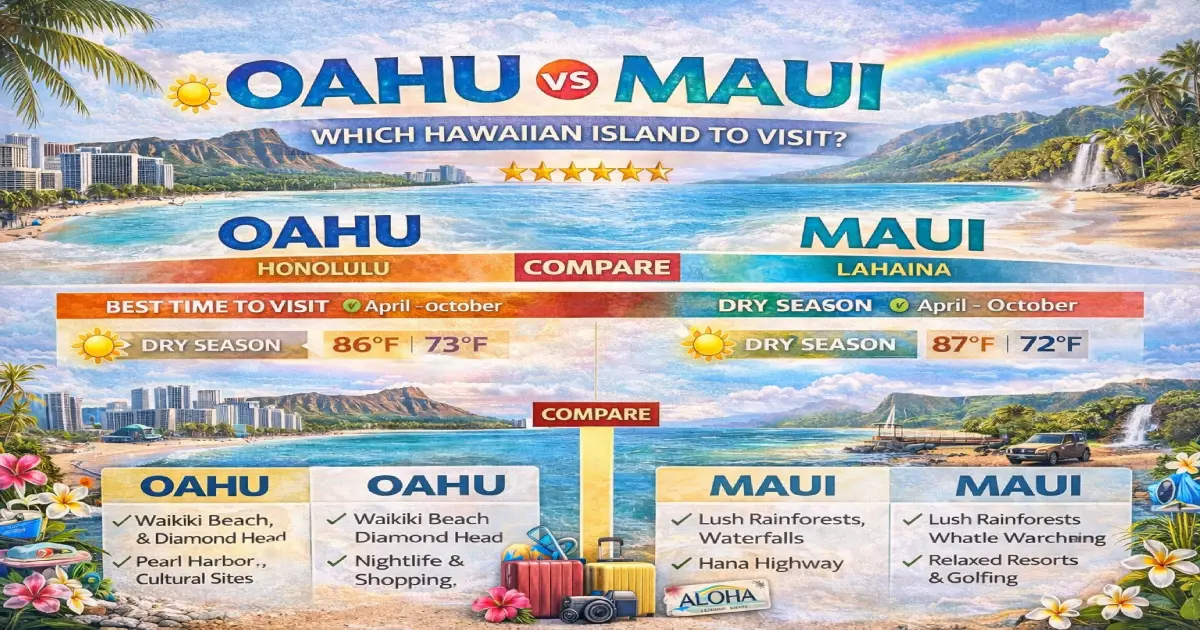
Oahu vs Maui: Which Hawaiian Island to Visit? 2026 Guide
“They’re both Hawaii with beaches and volcanoes,” my cousin said, planning her first Hawaiian vacation. “Just pick whichever has cheaper flights.”
That advice would have cost her $2,000 and ruined her trip.
After 11 trips to Hawaii spanning both islands—staying everywhere from Waikiki hostels to Wailea Four Seasons—I can tell you this: Oahu vs Maui isn’t about which is “better.” These islands serve fundamentally different travelers with completely different vacation styles.
Oahu is Hawaii’s energetic, accessible hub. Think urban Waikiki meets rural North Shore, Pearl Harbor history meets Polynesian culture, budget plate lunches meets fine dining, bustling streets meets secluded beaches. It’s Hawaii’s most diverse island offering something for everyone at every budget.
Maui is Hawaii’s premium beach resort paradise. Think luxury Wailea resorts, pristine snorkeling, epic Road to Hana, Haleakala sunrise, upscale dining, and that exclusive “away from it all” vibe. It’s where people go when they want polished Hawaiian perfection without urban distractions.
Both offer stunning beaches, volcanic landscapes, and aloha spirit. But stand in bustling Waikiki (Oahu’s tourist epicenter with 30,000+ hotel rooms) and compare it to serene Wailea (Maui’s luxury resort area with maybe 4,000 rooms)—you’ll immediately understand these islands have completely different personalities and price tags.
After tracking every expense across budget and luxury stays on both islands, interviewing local guides, and helping hundreds of travelers choose between them, I’ve learned this: most people pick the wrong island because they don’t understand what each actually delivers.
This comprehensive comparison covers everything: costs (Oahu is 20-40% cheaper), beaches, activities, culture, crowds, logistics, food, and that intangible vibe that makes each island unique. By the end, you’ll know exactly which island matches your vacation style, budget, and expectations—and you’ll save thousands by choosing correctly.
The Quick Answer (For the Time-Pressed)
Choose Oahu If You Want:
✓ Better value (20-40% cheaper than Maui across all categories)
✓ Urban + beach combination (Waikiki convenience + North Shore beauty)
✓ Excellent public transport (TheBus system = $3/ride, car optional)
✓ Historical significance (Pearl Harbor, USS Arizona, WWII sites)
✓ Vibrant nightlife (Waikiki bars, clubs, entertainment)
✓ Cultural diversity (Chinatown, authentic local neighborhoods)
✓ More activity variety (hiking, surfing, snorkeling, city exploring)
✓ Budget dining options (plate lunch trucks, food courts, local restaurants)
✓ Easy first-time logistics (concentrated tourism infrastructure)
✓ Shorter island (drive around in 3-4 hours)
✓ More flight options (major international hub)
✓ Active vacation style (variety keeps you engaged)
Choose Maui If You Want:
✓ Premium beach resort experience (Wailea/Kaanapali luxury properties)
✓ Less crowded feel (despite similar tourist numbers, feels more spacious)
✓ World-class snorkeling (Molokini Crater, Turtle Town beats Oahu options)
✓ Epic scenic drive (Road to Hana = bucket list experience)
✓ Haleakala sunrise/sunset (10,000-foot volcanic crater, otherworldly)
✓ More exclusive atmosphere (premium pricing creates upscale vibe)
✓ Better whale watching (December-April peak season, best in Hawaii)
✓ “Away from it all” vibe (no major city, resort-focused)
✓ Upcountry charm (Makawao, Kula farms, rural Hawaii character)
✓ Romantic honeymoon setting (built for couples, not families)
✓ Upscale dining focus (fewer budget options, more fine dining)
✓ Relaxed vacation pace (fewer attractions = forced relaxation)
The Core Difference
Oahu = Accessible Hawaiian variety
Urban meets beach, budget meets luxury, active meets relaxing, cultural depth, first-timer friendly, excellent value.
Maui = Premium Hawaiian beach resort
Polished luxury focus, beach/resort centered, less urban, higher prices, romantic atmosphere, natural beauty showcase.
Think of it this way:
Oahu is New York + Miami Beach (urban culture meets beach resort, something for everyone)
Maui is Napa Valley + Caribbean (upscale, serene, nature-focused, premium pricing)
Neither is objectively “better”—they serve different travelers and deliver different Hawaiian experiences.
Geography and Size: Compact vs Sprawling
Oahu: The Gathering Place (Concentrated)
Size: 597 square miles (third-largest Hawaiian island)
Population: 1 million (70% of Hawaii’s total population)
Shape: Two volcanic mountain ranges (Waianae, Koolau) creating distinct sides
Key regions:
Leeward Coast: Ko Olina resorts, less developed (West side)
Central Oahu: Pearl Harbor, military bases, pineapple fields
Drivability: Can drive around entire island in 3-4 hours. Waikiki to North Shore = 45 minutes. Compact enough for day trips from one base.
What this means: You can stay in Waikiki and easily explore North Shore, Windward beaches, Pearl Harbor, and hiking trails as day trips. Everything is accessible within 30-60 minutes.
Maui: The Valley Isle (Spread Out)
Size: 727 square miles (second-largest Hawaiian island)
Population: 165,000 (much less dense than Oahu)
Shape: Two volcanic masses (West Maui Mountains, Haleakala) connected by central valley
Key regions:
Wailea: Luxury resort area, pristine beaches, upscale (South Maui)
Kihei: Mid-range condos, long beaches, more affordable (South Maui)
Kaanapali/Lahaina: West side resorts, historic town, sunset views
Road to Hana: Epic scenic drive, waterfalls, East Maui (Full-day commitment)
Upcountry: Makawao, Kula farms, rural charm (Slopes of Haleakala)
Drivability: Cannot circle the island (Road past Hana becomes rough/unpaved). Kaanapali to Wailea = 45 min. Road to Hana = 2.5+ hours one way. Haleakala summit = 1.5 hours from coast.
What this means: Maui requires strategic base location. West side (Kaanapali) vs South side (Wailea) determines what’s easy to reach. Road to Hana and Haleakala require full-day commitments.
Size Comparison Impact
Factor
Oahu
Maui
Practical Impact
Exploration ease
Compact, central base works
Spread out, strategic base needed
Oahu easier for day trips
Drive times
30-60 min to most attractions
45-150 min depending on destination
Oahu less driving
Urban density
High (Honolulu/Waikiki)
Low (no major city)
Oahu urban, Maui resort-focused
Tourist concentration
Waikiki = crowded hub
Spread across regions
Maui feels less crowded
Geography Winner: Oahu for convenience, Maui for spread-out spaciousness
Maui’s strength: Fewer activities but each is spectacular. Road to Hana alone worth the trip. Forces relaxation (there’s only so much to do = beach time).
Activities Comparison
Category
Oahu
Maui
Winner
Variety
Extensive (history, culture, nature, urban)
Limited (nature-focused)
Oahu
Historical sites
Pearl Harbor (world-famous)
Limited (Lahaina historic town)
Oahu
Snorkeling quality
Good (Hanauma Bay)
Better (Molokini, consistency)
Maui
Hiking
Many options, easy access
Limited but spectacular (Haleakala)
Oahu (variety)
Signature experiences
Pearl Harbor, North Shore
Road to Hana, Haleakala, Molokini
Maui (more unique)
Nightlife
Vibrant (Waikiki bars, clubs)
Limited (resort bars)
Oahu
Shopping
Extensive (malls to markets)
Limited (resort shops, Lahaina)
Oahu
Free activities
Many (Pearl Harbor, beaches, hikes)
Good (beaches, some hikes)
Oahu
Activities Winner: Oahu (dramatically more variety keeps active travelers engaged for 7+ days)
But: Maui’s fewer activities are arguably more spectacular and unique (Road to Hana, Haleakala sunrise)
Resort fine dining (Grand Wailea, Four Seasons) — $80-150
Maui food characteristics:
Fewer budget options (plate lunch exists but limited)
Strong farm-to-table focus (Upcountry farms)
Resort dining dominance (premium pricing)
Excellent quality but higher baseline cost
Limited late-night options
Food Comparison
Factor
Oahu
Maui
Winner
Budget dining
Abundant, excellent
Limited
Oahu
Variety
Extensive (ethnic diversity)
Good (less diverse)
Oahu
Upscale dining
Excellent options
Excellent, more focused
Tie
Local authenticity
High (locals eat everywhere)
Good (smaller local scene)
Oahu
Farm-to-table
Growing
Strong (Upcountry proximity)
Maui
Value
Excellent ($10 fills you)
Moderate ($15 minimum)
Oahu
Food Winner: Oahu (better budget options, more variety, better value)
But: Maui excels at upscale farm-to-table dining if that’s your priority
Logistics and Getting Around
Oahu Transportation (Car Optional)
TheBus system:
$3 per ride, $7.50 day pass
Covers entire island (including North Shore)
Slow but functional (Waikiki to North Shore = 2+ hours)
Budget travelers can survive without rental car
Rental car:
$40-70/day (compact with taxes)
Recommended but not mandatory
Parking in Waikiki: $25-45/night (expensive)
Makes North Shore, Windward Coast easier
Uber/Lyft:
Readily available Waikiki and urban areas
$15-40 typical rides
Expensive to North Shore ($60-80 each way)
Waikiki walkability:
Can walk to dozens of restaurants, beaches, shops
Many tourists never leave Waikiki area
Strategy for Oahu: Stay in Waikiki without car for 3-4 days. Rent car for 2-3 days to explore North Shore, Windward Coast. Return car before departure. Saves $150-300 on parking.
Maui Transportation (Car Mandatory)
No public transport:
No viable bus system
Cannot avoid rental car unless staying at resort and never leaving
Rental car:
$50-95/day (compact with taxes)
Essential for Road to Hana, Haleakala, exploring
Gas: $90-140/week (more driving than Oahu)
Resort parking usually included (free)
Uber/Lyft:
Available in Wailea, Kaanapali, Lahaina
Limited elsewhere
Expensive between regions
Distances:
Wailea to Haleakala Summit: 1.5 hours
Wailea to Road to Hana start: 1 hour
Kaanapali to Wailea: 45 minutes
Road to Hana: 2.5-3 hours one way (600+ curves)
Maui driving challenges:
Road to Hana is exhausting (full day commitment)
Haleakala = early morning (3-4 AM departure for sunrise)
No circumnavigation (road past Hana rough/unpaved)
Transportation Comparison
Factor
Oahu
Maui
Winner
Car necessity
Optional (TheBus works)
Mandatory
Oahu (flexibility)
Weekly transport cost
$50 (TheBus) to $450 (car+parking)
$440-665 (car essential)
Oahu ($400 savings possible)
Ease of navigation
Compact, easy
Spread out, requires planning
Oahu
Parking costs
Expensive in Waikiki
Usually free at resorts
Maui
Walkability
Waikiki very walkable
Resorts walkable, nothing else
Oahu
Transportation Winner: Oahu (car optional, saving $400-665/week for budget travelers)
Crowds and Tourist Density
Oahu Crowds (Concentrated)
Tourist numbers: 5.5-6 million visitors annually
Crowding reality:
Waikiki: Extremely crowded (30,000+ hotel rooms concentrated)
Diamond Head: Packed sunrise/morning (hundreds per hour)
Hanauma Bay: Overcrowded (arrive before 8 AM)
Pearl Harbor: Crowded but manageable (free tickets reserve ahead)
North Shore: Moderate crowds (spread out along 7 miles)
Windward Coast: Less crowded (locals, limited parking)
Feels crowded because:
Tourists concentrate in Waikiki (small geographic area)
Top attractions see heavy traffic
Urban feel amplifies crowd sense
Escape strategies:
Lanikai, Kailua beaches (locals’ spots)
Hikes beyond Diamond Head (Koko Head, Lanikai Pillbox)
North Shore weekdays
Anything outside Waikiki radius
Maui Crowds (Spread Out)
Tourist numbers: 3 million visitors annually (fewer than Oahu)
Crowding reality:
Wailea beaches: Less crowded (resort spacing)
Kaanapali Beach: Moderate crowds (spread along 3 miles)
Road to Hana: Crowded (hundreds daily, but spread over 64 miles)
Logic: Maximize Oahu value, splurge on Maui ending
Option 2: Maui First, Oahu Second
6 nights Maui (Road to Hana, Haleakala, snorkeling)
7-8 nights Oahu (Pearl Harbor, North Shore, culture, beach variety)
Logic: Relaxation first, then exploration
Budget for Combined Trip (14 nights, 2 people):
Oahu (8 nights): $3,000-6,000
Maui (6 nights): $3,500-7,000
Inter-island flights: $300-400 round-trip
Rental cars both islands: $600-900
Activities/meals: $2,000-4,000
Total: $9,400-18,300
Best for:
Extended honeymoons
Once-in-lifetime Hawaii trips
Those who genuinely can’t decide
Travelers with 14+ days available
One-Week Split (Not Recommended)
Why avoid:
Lose half-day each direction to travel (packing, checkout, flight, checkin)
Two car rentals increase costs
Constant packing/unpacking
Don’t fully experience either island
Maui’s Road to Hana + Haleakala = 2 full days, leaving only 1-2 for beaches
Better strategy: Pick one island for 7 days. Come back to Hawaii for other island later.
Frequently Asked Questions
Which is better for first-time visitors, Oahu or Maui?
Oahu is better for first-timers. It offers easier logistics (TheBus, Waikiki base), more variety (urban + beach + history), better value (20-40% cheaper), and represents “classic Hawaii” most people imagine (Waikiki, Pearl Harbor, North Shore). Maui is better as a second Hawaii trip or for couples with higher budgets seeking resort relaxation.
Is Oahu or Maui cheaper?
Oahu is significantly cheaper—20-40% less across all categories. A mid-range 7-night trip costs $3,800-5,600 on Oahu vs $5,200-7,800 on Maui. Oahu offers budget options (hostels, TheBus, plate lunches) that don’t exist on Maui. Maui requires rental car ($350-665/week), while Oahu’s TheBus ($50/week) works for budget travelers.
Which has better beaches, Oahu or Maui?
Both have world-class beaches with different characters. Oahu offers more variety (calm Waikiki, surf mecca North Shore, pristine Lanikai) and easier access. Maui offers more consistent quality, better snorkeling overall, less crowded beaches, and upscale resort backing. Choose Oahu for variety and access, Maui for upscale beach lounging and snorkeling.
Can I visit both Oahu and Maui in one week?
Not recommended. You’d lose half-day each direction to travel, pay for two car rentals, constantly pack/unpack, and not fully experience either island. Better strategy: spend full 7 days on one island (Oahu for variety/value, Maui for resort relaxation). Return to Hawaii later for the other island, or extend trip to 14 days for proper exploration of both.
Is Maui more romantic than Oahu?
Maui markets itself as more romantic with luxury resorts, intimate atmosphere, and “away from it all” vibe. However, romance depends on budget. Under $10,000 total, Oahu offers better value for romantic experiences (sunset dinners, beach time, activities) without constant budget stress. Over $10,000, Maui delivers premium resort romance worth the premium pricing.
Which island has better food?
Oahu has better food variety and value. It offers abundant budget options (plate lunches $10-14), ethnic diversity (Chinatown, Japanese, Korean, Filipino), and excellent high-end dining. Maui has fewer budget options but excels at upscale farm-to-table dining with Upcountry produce. Choose Oahu for variety and value, Maui for upscale farm-to-table focus.
Do I need a rental car on Oahu and Maui?
Maui: Car mandatory—no viable public transport. Budget $350-665/week. Oahu: Car optional—TheBus covers island for $7.50/day. Budget travelers can survive without car, though rental ($40-70/day) makes North Shore and Windward Coast easier. Strategy: Stay in Waikiki carless, rent for 2-3 days to explore, return before departure.
Which island is less crowded?
Maui feels less crowded despite both being popular. Oahu gets 5.5-6 million visitors (concentrated in Waikiki), while Maui gets 3 million (spread across regions). Maui lacks urban density, has no tourist-packed hub like Waikiki, and premium pricing limits volume. Oahu offers crowd-escape options (Windward Coast, North Shore weekdays) but Waikiki is genuinely packed.
Is Oahu or Maui better for families?
Oahu is dramatically better for families. It’s 30-40% cheaper (huge for 4+ people), offers better logistics (TheBus eliminates car rental stress), provides more kid-friendly variety (Pearl Harbor, easier hikes, beaches, Waikiki walkability), and has more restaurant options for picky eaters. Maui works for families with unlimited budgets and older children who appreciate nature.
What are the must-do experiences on each island?
Oahu must-dos: Pearl Harbor, Waikiki Beach + Diamond Head, North Shore (surf beaches + food trucks), snorkeling at Hanauma Bay or Sharks Cove.
Maui must-dos: Road to Hana (full day scenic drive), Haleakala sunrise or sunset (10,000-foot crater), Molokini snorkeling, whale watching (December-April).
Final Verdict: Your Perfect Island Match
After comparing every aspect of Oahu vs Maui, here’s the bottom line:
Oahu is Hawaii’s Swiss Army knife. It delivers variety, value, culture, history, beaches, hiking, urban experiences, and North Shore magic—all at 20-40% less cost than Maui. It’s the practical choice for first-timers, families, budget travelers, active vacationers, and anyone wanting to experience multiple facets of Hawaii without breaking the bank.
Maui is Hawaii’s premium resort paradise. It offers luxury beach resorts, bucket-list experiences (Road to Hana, Haleakala), excellent snorkeling, romantic atmosphere, and that coveted “away from it all” vibe—at prices that reflect the premium positioning. It’s the splurge choice for couples, honeymooners with budgets over $10,000, beach loungers, and those prioritizing resort relaxation over variety.
The honest recommendation matrix:Budget under $6,000 (7 nights, 2 people): → Oahu (only realistic option)
Budget $6,000-10,000: → Oahu (better value, more variety)
Budget $10,000-15,000: → Either (Oahu for variety, Maui for resort focus)
Budget over $15,000: → Maui or both islandsFirst-time Hawaii visitors: → Oahu (easier logistics, represents “classic Hawaii”)
Families with children: → Oahu (30-40% cheaper, more variety, better logistics)
Honeymooners: → Maui (if budget allows), Oahu (if budget-conscious)
Active travelers: → Oahu (hiking, surfing, history, urban, variety)
Beach loungers: → Maui (upscale resorts, pristine beaches, forced relaxation)
Snorkel enthusiasts: → Maui (Molokini, consistency)
History/culture buffs: → Oahu (Pearl Harbor, museums, Polynesian culture)
Budget travelers: → Oahu (only viable island under $400/day)
Luxury seekers: → Either (both excel at high-end, different styles)
My personal take after 11 trips across both islands:
Most people should start with Oahu. It delivers everything you want from Hawaii—beaches, culture, history, variety, aloha spirit—without requiring a $10,000 budget or forcing you to choose between experiences. The 20-40% cost savings mean you can upgrade accommodations, extend your stay, or simply stress less about money.
Maui is where you go when you’ve done Oahu and want something different, or when your budget genuinely supports luxury resort vacations without financial strain. The Road to Hana and Haleakala are bucket-list worthy. Wailea resorts deliver polished perfection. Molokini snorkeling exceeds expectations. But you pay premium prices for these premium experiences.
The $12 plate lunch vs $68 resort meal lesson applies here: Both islands offer spectacular Hawaiian experiences. Oahu delivers them at real-world prices that make sense for most travelers. Maui packages them in luxury resort settings that justify premium pricing—if you have the budget.
Neither island disappoints. Both deliver aloha spirit, volcanic beauty, turquoise water, and memories that last lifetimes.
Choose based on budget, travel style, and what “paradise” means to you personally. Then prepare for the Hawaiian adventure of a lifetime—whichever island you select. consult Hawaii Tourism Authority, National Weather Service Honolulu, and Hawaii National Parks (National Park Service) for up-to-date information.
— About Travel Tourister’s Hawaii specialists provide honest, data-driven island comparisons based on extensive personal travel experience across Oahu and Maui. We understand that choosing the right island makes the difference between good vacations and perfectly matched Hawaiian experiences.Still deciding between Oahu vs Maui? Contact our specialists who can analyze your specific budget, travel style, and priorities to recommend the perfect island match. We help travelers avoid expensive mismatches and maximize value for their Hawaiian adventure.
Posted By : Vinay
As a lead contributor for Travel Tourister, Vinay is dedicated to serving our Tier 1 audience (US, UK, Canada, Australia). His mission is to deliver precise, fact-checked news and actionable, data-driven articles that empower readers to make informed decisions, minimize travel risks, and maximize their adventure without compromising safety or budget.
Travel Tourister is a leading Travel portal where we introduce travellers to trusted travel agents to make their journey hasselfree, memorable And happy. Travel Tourister is a platform where travellers get Tour packages ,Hotel packages deals through trusted travel companies And hoteliers who are working with us across the world. We always try to find new and more travel agents and hoteliers from every nook and corners across the world so that you could compare the deals with different travel agents and hoteliers and book your tour or hotel with the one you have chosen according to your taste and budget.




 Call
Call Enquiry