Best Time to Visit USA 2026: Complete Regional Weather Guide
Published on : 12 Feb 2026
Best Time to Visit USA — When America’s 9 Climate Zones Deliver Perfect Conditions
By Travel Tourister | Updated February 2026
The United States doesn’t have one “best time to visit”—it has nine different optimal windows depending on which region you’re exploring.
I discovered this reality the hard way during July 2019 when I attempted afternoon hiking in Arizona’s scorching 115°F (46°C) desert heat. Meanwhile, that same week, Seattle enjoyed perfect 75°F (24°C) weather with 16 hours of sunlight for outdoor activities. The USA’s massive geographic diversity—spanning from tropical Hawaii to arctic Alaska, from humid Florida swamps to arid Nevada deserts—means your travel timing can make or break your American adventure.
This comprehensive 2026 guide analyzes regional weather patterns using verified data from the National Oceanic and Atmospheric Administration (NOAA), historical tourism statistics spanning two decades, and firsthand insights from Travel Tourister’s network of destination specialists across all 50 states. We break down optimal visiting windows for nine distinct US climate regions, helping you avoid Florida’s hurricane season, catch peak fall foliage in New England, and experience national parks when trails are accessible and crowds manageable.
Whether planning a Northeast autumn tour, Southwest canyon exploration, Pacific Northwest summer getaway, or cross-country road trip, understanding America’s diverse climate zones prevents weather disappointments and maximizes your travel investment.
Understanding USA Climate Diversity: Why Regional Timing Matters
The continental United States spans 2,800 miles (4,500 km) coast-to-coast and 1,600 miles (2,575 km) north-to-south, crossing multiple climate zones that create dramatic seasonal variations. Consider this: on April 15th, California enjoys wildflower blooms, Oklahoma faces tornado season, Montana battles lingering snowstorms, and Florida offers perfect beach weather—same date, completely different conditions.
America’s 9 Distinct Climate Regions
Travel Tourister divides the USA into nine climate-based regions, each requiring different timing strategies:
1. Northeast (New York, New England, Mid-Atlantic): Four distinct seasons with humid continental climate, famous for spectacular fall foliage and snowy winters.
2. Southeast (Florida, Carolinas, Georgia, Louisiana): Humid subtropical climate with mild winters but oppressive summer humidity and hurricane vulnerability June-November.
3. Midwest (Great Lakes, Great Plains): Extreme temperature swings from -20°F winters to 95°F summers, tornado activity spring months.
4. Southwest (Arizona, New Mexico, Utah, Nevada): Desert and high-desert climate with scorching summers (110°F+) but pleasant spring and fall conditions.
5. West Coast (California, Oregon Coast): Mediterranean climate delivering America’s most consistent pleasant weather, especially California’s long dry season.
6. Pacific Northwest (Washington, Oregon): Marine west coast climate with rainy winters but spectacular dry summers July-September.
7. Rocky Mountains (Colorado, Wyoming, Montana): Alpine climate where summer is the only season for high-elevation access, plus world-class winter skiing.
8. Alaska: Subarctic to arctic climate with brief spectacular summers and long harsh winters.
9. Hawaii: Tropical maritime climate offering year-round warmth but with distinct wet/dry seasons and dramatic microclimates.
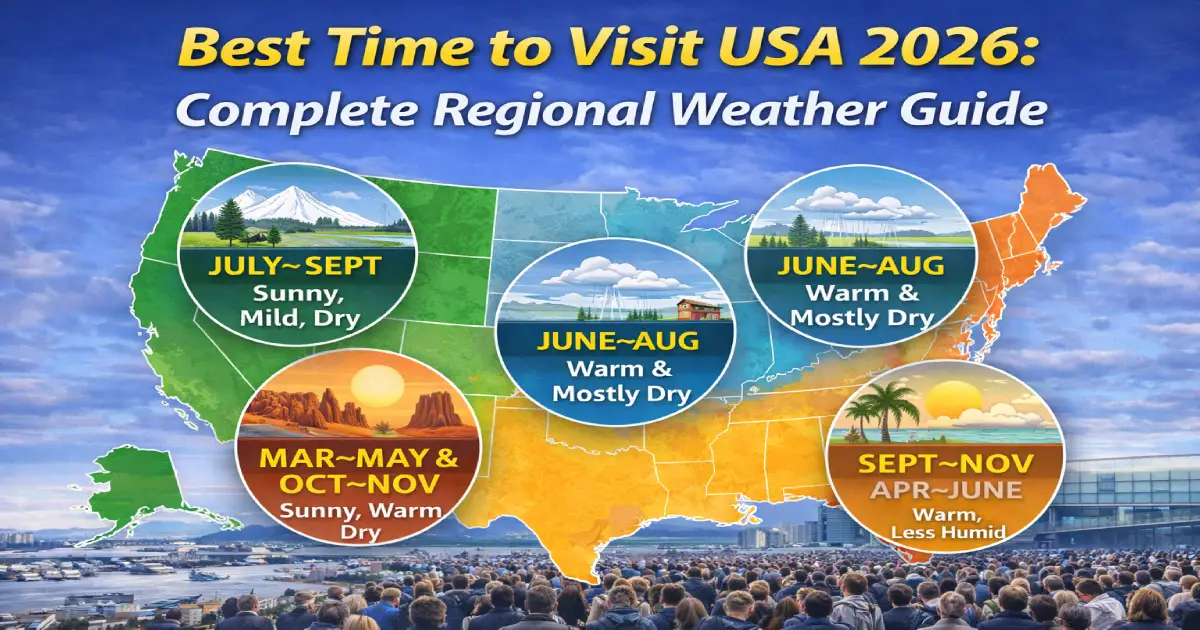
Quick Regional Reference: When to Visit Each US Region
Dry season with minimal rain, 65-85°F, wine harvest season
Pacific Northwest
July-September
Driest months after rainy season, 70-80°F, 16+ hour days
Rocky Mountains
June-September
High-elevation trails open, wildflowers peak, all roads accessible
Alaska
June-August
Midnight sun (20 hours daylight), 60-70°F warmest temps, wildlife viewing
Hawaii
April-May, September-November
Shoulder season pricing (25-40% savings), excellent 75-85°F weather
Northeast: Fall Foliage Glory September-October
Best Time: September 15 – October 31
The Northeast’s crown jewel season delivers spectacular autumn foliage, comfortable temperatures, and post-summer crowd relief. Having tracked fall foliage across Vermont, New Hampshire, and Maine for over a decade, Travel Tourister can confirm late September through October consistently offers the region’s most photogenic and pleasant conditions.
From late September through October, the region transforms into a kaleidoscope of red, orange, and gold as autumn leaves reach peak color. Temperatures range from 50-70°F (10-21°C)—perfect for exploring cities, hiking trails, and scenic drives without summer’s humidity or winter’s bitter cold.
September-October Highlights
Peak fall foliage in Vermont, New Hampshire, Maine (late September-mid October)
Apple orchards and pumpkin patches open for picking throughout region
Comfortable city walking in New York City, Boston, Philadelphia, Washington DC
Hotel rates 20-30% lower than July-August peak season
Crisp, clear days with minimal rainfall (3.5-3.8 inches monthly average)
Harvest festivals celebrating local agriculture across rural New England
Fall Foliage Timeline by State
Northern New England (Vermont, New Hampshire, Maine): Peak September 25 – October 10
Massachusetts, Connecticut: Peak October 5-20
New York (Adirondacks, Catskills, Finger Lakes): Peak September 28 – October 15
Mid-Atlantic (Pennsylvania, New Jersey): Peak October 10-25
Washington DC, Virginia: Peak October 20 – November 5
Alternative Season: Late Spring (May-June)
If fall doesn’t align with your schedule, late spring offers excellent Northeast conditions. May 15 – June 15 delivers 60-75°F (16-24°C) temperatures, blooming gardens throughout city parks, and outdoor café season beginning across major cities. Washington DC’s cherry blossoms peak late March to early April (highly variable year-to-year), while New York’s parks showcase tulips and magnolias in April. Hotel prices run 15-25% cheaper than summer peak, and tourist crowds remain manageable before family vacation season.
Southeast: Perfect Spring Weather March-May
Best Time: March 15 – May 15
The Southeast’s optimal window falls before summer’s oppressive heat and hurricane season’s unpredictability. Spring consistently delivers the region’s most comfortable conditions for both beach destinations and historic city exploration.
Spring temperatures hover between 65-80°F (18-27°C)—warm enough for beaches yet cool enough for comfortable city walking. Humidity remains moderate at 60-70% (compared to summer’s oppressive 80-90%), and ocean temperatures reach swimmable 75-80°F (24-27°C) by late April. Most importantly, hurricane risk remains virtually zero as the season doesn’t officially begin until June 1.
March-May Regional Highlights
Charleston and Savannah azalea/dogwood blooms peak late March through April
New Orleans Jazz Fest (April 24-May 4, 2026) with perfect weather for French Quarter exploration
Florida beaches clear of Spring Break crowds by mid-March while maintaining excellent weather
Historic plantation and fort tours comfortable without summer heat exhaustion risk
Sea turtle nesting season begins in May along Atlantic and Gulf coasts
Manatee viewing season extends through March in Florida springs
When to Avoid: Hurricane Season (June-November)
The Atlantic hurricane season officially runs June 1 – November 30, with peak activity August through October. According to NOAA historical data, August, September, and October account for 78% of major hurricanes affecting the Southeast. While actual strike probability remains relatively low for any specific location, summer travel insurance becomes essential, and September-October trips require flexible cancellation policies.
Southwest: Shoulder Season Excellence March-May & September-November
Best Time: April-May & September-October
The Southwest’s desert and high-desert climate creates extreme seasonal variation, making shoulder seasons dramatically superior to summer’s dangerous heat or winter’s elevation cold. Travel Tourister’s Southwest specialists—who conduct monthly national park assessments—consistently rank spring and fall as the region’s premium windows.
Spring and fall offer comfortable 60-80°F (16-27°C) temperatures at mid-elevations, perfect for hiking without heat stroke risk. Wildflowers bloom March-April in lower deserts and May-June at higher elevations. Clear skies dominate 75-85% of days, with minimal precipitation creating ideal photography conditions.
Why Summer Is Dangerous
Southwest summer temperatures regularly exceed safe outdoor activity thresholds. Phoenix averages 106°F (41°C) in July with regular spikes to 115°F+ (46°C+). Las Vegas hits 104°F (40°C) averages. Death Valley reaches 116°F (47°C) average with record temperatures of 134°F (57°C). Grand Canyon’s inner canyon climbs to 105-115°F (41-46°C), making hiking extremely dangerous.
Heat-related emergencies are the leading cause of national park deaths in the Southwest. If visiting in summer, plan outdoor activities exclusively before 9 AM or after 5 PM.
Southwest National Parks: Best Visiting Windows
Park
Best Months
Avoid
Key Details
Grand Canyon (South Rim)
Apr-May, Sep-Oct
Jun-Aug (extreme canyon heat)
South Rim open year-round, North Rim May 15-Oct 15 only
Zion National Park
Apr-May, Sep-Oct
Jul-Aug (100°F+ regularly)
The Narrows requires permits, best Apr-Jun before low water
Arches National Park
Mar-May, Sep-Nov
Jun-Aug (exceeds 100°F)
Sunrise/sunset provide best photography light and cooler temps
Bryce Canyon
May-Jun, Sep-Oct
Dec-Mar (snow closures)
8,000-9,000 ft elevation means cooler temps, snow through May possible
Antelope Canyon
Mar-Oct (light beams)
Nov-Feb (no beams, cold)
Book guided tours 2-3 months ahead, best light beams Apr-Sep
Sedona
Mar-May, Sep-Nov
Jun-Aug (95-105°F)
Vortex sites popular, energy tours available, red rock stunning spring/fall
West Coast: Extended Dry Season April-October
Best Time: September-October (Peak) | April-June (Spring Alternative)
California’s Mediterranean climate delivers America’s most consistently pleasant weather. The state’s famous dry season extends May through October, but Travel Tourister’s West Coast specialists identify fall (September-October) as optimal when summer fog clears, temperatures peak, and tourist crowds diminish.
September-October brings San Francisco’s warmest, driest months (70-75°F) after summer fog season ends. Napa and Sonoma wine country celebrates harvest season with crush parties and fall vineyard colors. Southern California’s ocean reaches its warmest (68-72°F), post-summer crowds disappear, and beach weather remains ideal. Highway 1 coastal driving enjoys clear skies with minimal fog, while Yosemite and Sequoia national parks remain accessible before winter road closures.
Regional California Variations
Southern California (Los Angeles, San Diego): Year-round viable with 65-80°F (18-27°C) temperatures, but May-October offers warmest ocean and most reliable sunshine. “June Gloom” brings morning coastal fog May-June that usually clears by noon. Water temperature peaks August-October at 62-68°F (17-20°C).
San Francisco & Bay Area: September-October are warmest, driest months. Summer paradox: June-August actually bring coolest, foggiest conditions (55-65°F). Mark Twain’s famous misquote captures reality: “The coldest winter I ever spent was a summer in San Francisco” (he never said it, but it’s accurate). Indian summer delivers 70-80°F temperatures and clear skies.
Wine Country (Napa, Sonoma, Paso Robles): August-October for harvest/crush season when wineries are most active. Spring alternative April-May showcases mustard blooms between vines. Temperatures 70-85°F (21-29°C) perfect for tastings.
Pacific Northwest: Premium Summer July-September
Best Time: July 15 – September 15
The Pacific Northwest’s reputation for rain is earned—Seattle averages 150 rainy days annually. But summer’s 10-12 week dry window reveals why locals endure gray months: spectacular mountain scenery, endless daylight, and comfortable temperatures never requiring air conditioning.
July and August average under 1 inch total rainfall—90% reduction from winter months. Temperatures remain comfortable 70-80°F (21-27°C), rarely exceeding 85°F (29°C). Daylight extends 16+ hours in July (sunrise 5:30 AM, sunset 9:00 PM). Mountain snow melts from trails, all roads open, and Mount Rainier plus Mount Hood become visible 70% of summer days versus just 30% rest of year.
Summer Season Highlights
Mount Rainier National Park wildflower meadows peak July-August
Columbia River Gorge waterfalls at full flow after spring snowmelt
San Juan Islands whale watching peak season (orcas pass through May-September)
Cascade Lakes warm enough for swimming (65-70°F water temperature)
Lavender farms bloom in Sequim, Washington during July
Seattle and Portland restaurant patios open for outdoor dining
Understanding the Rainy Season
October-May brings gray, drizzly weather with consistent low-intensity rain—not tropical downpours but gentle, persistent drizzle. Locals don’t use umbrellas; rain jacket culture dominates. Off-season advantages include 40-60% lower hotel rates, zero crowds, and cozy coffee shop atmosphere that defines Pacific Northwest culture.
Rocky Mountains: Summer Access June-September
Best Time: July-August (Peak) | June & September (Shoulder)
The Rocky Mountains’ alpine climate means one fundamental reality: summer is the only season when high-elevation trails, roads, and facilities fully open. While June and September offer value and thinner crowds, July-August provide maximum accessibility and wildflower displays.
Trail Ridge Road (Rocky Mountain NP) typically opens Memorial Day weekend. Going-to-the-Sun Road (Glacier NP) opens late June-early July. Beartooth Highway (Montana/Wyoming) opens late May. All close at first major October snowfall. Wildflowers peak in July at high elevations, creating carpets of color in alpine meadows. Wildlife viewing peaks as bears, elk, moose, and bison remain most active. Clear skies bring lowest precipitation of the year.
Major Rocky Mountain Parks
Yellowstone National Park: June-September roads open, July-August all facilities operating. Peak crowds July-August require arriving before 9 AM or after 5 PM. Wildlife viewing best June-early July for baby animals (bison calves, bear cubs).
Glacier National Park: July-September for Going-to-the-Sun Road access. Road opens late (usually July 1) due to heavy snowpack. Wildflowers peak mid-July to early August.
Rocky Mountain National Park: June-September with timed entry permits required (reserve months ahead). Trail Ridge Road opens Memorial Day weekend. Elk rut September-October brings dramatic bugling and wildlife behavior.
Winter Alternative: Ski Season (December-March)
If winter sports are your goal, January-February offer most snow and best conditions. Holiday weeks (Christmas-New Year’s, Presidents’ Day) bring extreme prices and crowds. Value periods: early December, mid-January, March spring skiing. Colorado resorts Vail, Aspen, Breckenridge lead. Wyoming’s Jackson Hole offers expert terrain. Montana’s Big Sky and Whitefish deliver fewer crowds.
Alaska: Midnight Sun June-August
Best Time: June 15 – August 31
Alaska’s brief summer window is America’s most constrained travel season. The state’s subarctic climate means tourism infrastructure essentially shuts down September through May. Summer is the only viable season for most visitors—and the midnight sun phenomenon alone justifies the timing.
Cruise season runs May-September only. Denali National Park road opens late May, closes mid-September. Most lodges operate June 1-August 31 exclusively. Tour operators run limited or closed schedules outside summer. Temperatures reach comfortable 60-70°F (16-21°C)—Alaska’s version of “summer.”
June-August Highlights
Midnight sun provides 18-22 hours of daylight depending on latitude
Bears fishing for salmon peak July-August in coastal areas
Tundra wildflowers bloom across landscape June-July
Glacier viewing optimal with longer days and clearer skies
Humpback whale watching in Southeast Alaska May-September
Salmon runs attract wildlife July-August throughout state
If aurora borealis is your primary goal, September and March offer shoulder darkness with reasonable temperatures. Peak darkness December-January brings extreme cold (-20 to -40°F), very limited daylight (4-5 hours), and most tourism closed. Fairbanks provides best aurora viewing location.
Hawaii: Shoulder Season Value April-May & September-November
Best Time: April-May & September-November
Hawaii’s tropical climate means comfortable 75-85°F (24-29°C) weather year-round, making timing primarily about value and crowds rather than weather conditions. Shoulder seasons deliver excellent conditions at 25-40% lower costs than peak winter and summer periods.
Year-round temperatures range 75-88°F (24-31°C). Ocean temperature maintains 75-80°F (24-27°C) consistently. Trade winds provide natural air conditioning. However, each island features distinct microclimates with windward (wet) versus leeward (dry) sides.
Shoulder season advantages include hotel rates 25-40% lower than December-March or June-August peaks, fewer mainland tourists crowding beaches and attractions, and still-excellent weather with only slight rain increase that minimally impacts activities. Whale watching season (December-April) overlaps with late shoulder period.
Peak Seasons to Avoid (Budget Travelers)
Winter peak (December 20 – March 31) brings mainlanders escaping cold weather and holiday travelers. Hotel rates spike 50-100% above shoulder seasons. Summer peak (June 15 – August 15) attracts family vacations during school break with rates 30-60% higher than shoulder periods.
Planning Tips for Multi-Region USA Trips
Combining Regions Successfully
If visiting multiple US regions in one trip, timing alignment becomes critical. Spring trips (April-May) work well combining Southeast (warm beaches) and Southwest (comfortable hiking). Fall trips (September-October) pair Northeast foliage with mid-Atlantic cities beautifully. Summer focuses on Alaska, Rockies, or Pacific Northwest when these regions shine.
The USA’s vast size means focusing on 2-3 regions maximum prevents spending entire vacations in airports or cars. Consider geographic proximity when planning multi-region itineraries.
Booking Timelines
National parks require 6-12 months advance booking for summer accommodations. Alaska cruises need 12 months ahead. Northeast fall foliage weekends book 3-6 months in advance. Ski resorts during holidays require 6-9 months planning. Major events like New Orleans Mardi Gras or Austin SXSW need even earlier reservations.
Weather Risks to Consider
Hurricane season affects Southeast June 1 – November 30, peaking August-October. Wildfire season impacts Western states July-October (check air quality before travel). Tornado season runs April-June across Midwest and Great Plains. Snow can close mountain passes through May in Rockies and Sierra Nevada.
Frequently Asked Questions
What is the best overall month to visit the USA?
May and September are ideal for visiting multiple regions simultaneously. May offers spring blooms, warming weather nationwide, and fewer crowds before summer vacation season. September delivers comfortable temperatures across most regions, early fall foliage in the North, and post-summer crowd dispersal. Both months provide the best weather-to-cost ratio.
When is the cheapest time to visit the USA?
November (excluding Thanksgiving week) and January-February offer lowest prices across most regions. Avoid major holidays, summer vacation period (June-August), and regional peak seasons for best deals. Shoulder seasons (April-May, September-October) provide better weather than winter while maintaining moderate pricing.
Can I visit the USA in winter?
Absolutely, depending on destination. Winter is perfect for Florida beaches (70-80°F), Southern California sunshine, and world-class Rocky Mountain skiing. However, avoid winter for northern cities, high-elevation national parks, or areas prone to snowstorms and sub-zero temperatures.
How far in advance should I book my USA trip?
Peak season destinations need 6-12 months advance booking (summer national parks, Alaska, ski resorts). Shoulder season trips work with 2-4 months planning. Domestic flight prices typically optimize 3-4 months before travel. Last-minute deals occasionally appear but don’t rely on this strategy for popular destinations or peak periods.
What about visiting during holidays?
Major holidays bring significantly higher prices and crowds. Thanksgiving (late November), Christmas-New Year’s (December 20-January 5), Memorial Day (late May), and July 4th weekends see hotel rates spike 40-100% above normal. However, holiday events can be memorable—consider Macy’s Thanksgiving Parade in NYC or July 4th fireworks on Washington’s National Mall if experiences outweigh cost concerns.
Do I need different clothing for different regions in the same season?
Yes, pack layers strategically. A single April trip could require shorts in Florida (80°F/27°C), jeans in Nashville (65°F/18°C), and winter coat in Yellowstone (40°F/4°C with possible snow). Check specific forecasts for each destination and pack accordingly rather than assuming uniform conditions.
What’s the best time for a cross-country road trip?
Late spring (May) or early fall (September-early October) offer most consistent weather across diverse regions. Summer works but expect intense heat in Southwest deserts and higher accommodation costs nationwide. Avoid winter for cross-country trips as snow closes mountain passes and northern routes become treacherous.
When is the best time to see fall foliage?
Peak fall foliage follows geographic patterns. Northern New England and upper Midwest peak late September to early October. Mid-Atlantic states (New York, Pennsylvania) peak mid-October. Southern Appalachians peak late October to early November. Monitor foliage forecast websites for precise timing as weather variations shift peak dates by 1-2 weeks annually.
Are national parks crowded in summer?
Yes, extremely. Yellowstone, Yosemite, Grand Canyon, Glacier, and Rocky Mountain parks see overwhelming crowds July-August. Arrive before 9 AM or after 5 PM to find parking and avoid worst congestion. Many parks now require timed entry permits even in peak season. Shoulder seasons (June, September) offer much better experiences with 40-60% fewer visitors.
Is Hawaii good to visit year-round?
Weather-wise, yes—temperatures remain 75-85°F (24-29°C) year-round. However, winter (December-March) and summer (June-August) bring premium pricing and maximum crowds. Shoulder seasons (April-May, September-November) offer identical weather at significantly lower costs with fewer tourists competing for beach space and restaurant reservations.
Final Thoughts: Matching Your Travel to Regional Seasons
After analyzing climate data, tourism patterns, and firsthand experience across all 50 states, one principle emerges: successful USA travel planning requires matching destinations to their optimal seasons rather than trying to see everything in one trip.
The United States rewards strategic timing. Northeast fall foliage demands September-October visits. Southwest national parks require spring or fall to avoid dangerous summer heat. Pacific Northwest summer (July-September) is non-negotiable for outdoor activities. Rocky Mountain high-elevation access only exists June-September. Alaska operates almost exclusively June-August.
Regional variation matters more than national averages. A $1,500 week in Las Vegas differs completely from $1,500 in Manhattan. March brings perfect Florida beach weather while delivering variable conditions in New England. July offers ideal Pacific Northwest hiking but dangerous Southwest desert heat.
For first-time USA visitors uncertain where to start, these proven seasonal combinations maximize experiences:
Southwest National Parks in April-May (Grand Canyon, Zion, Arches perfect hiking weather)
California Coast in September-October (San Francisco to San Diego with clear skies)
Northeast Cities and Fall Foliage in Late September-October (spectacular colors)
Pacific Northwest in August (Seattle, Portland, national parks during dry season)
Florida and Southeast in March-April (beaches and historic cities pre-hurricane season)
Shoulder seasons (April-May and September-October) typically deliver the best combination of pleasant weather, manageable crowds, and reasonable prices across most regions. Build 20-30% budget buffer for hidden expenses like sales tax, resort fees, tipping, and parking that international visitors often underestimate.
The USA offers extreme geographic diversity—from tropical beaches to arctic wilderness, from desert canyons to alpine peaks. Understanding each region’s optimal season transforms good trips into exceptional adventures. Whether exploring Manhattan’s energy, Yellowstone’s geysers, New Orleans’ music scene, or California’s coastline, proper seasonal timing prevents weather disappointments and maximizes your American experience.
—
About Travel TouristerTravel Tourister’s USA travel specialists provide honest, data-driven regional analysis based on extensive personal travel experience across all 50 states and decades of tracking seasonal patterns. We understand that proper seasonal timing transforms ordinary vacations into exceptional experiences while preventing weather-related disappointments.Need help planning your USA trip timing? Contact our regional specialists who can analyze your specific interests, preferred activities, and travel style to recommend optimal seasons and destinations. We help travelers avoid seasonal pitfalls and maximize their American adventure.
Posted By : Vinay
As a lead contributor for Travel Tourister, Vinay is dedicated to serving our Tier 1 audience (US, UK, Canada, Australia). His mission is to deliver precise, fact-checked news and actionable, data-driven articles that empower readers to make informed decisions, minimize travel risks, and maximize their adventure without compromising safety or budget.
Travel Tourister is a leading Travel portal where we introduce travellers to trusted travel agents to make their journey hasselfree, memorable And happy. Travel Tourister is a platform where travellers get Tour packages ,Hotel packages deals through trusted travel companies And hoteliers who are working with us across the world. We always try to find new and more travel agents and hoteliers from every nook and corners across the world so that you could compare the deals with different travel agents and hoteliers and book your tour or hotel with the one you have chosen according to your taste and budget.




 Call
Call Enquiry