Published on : 03 Mar 2026
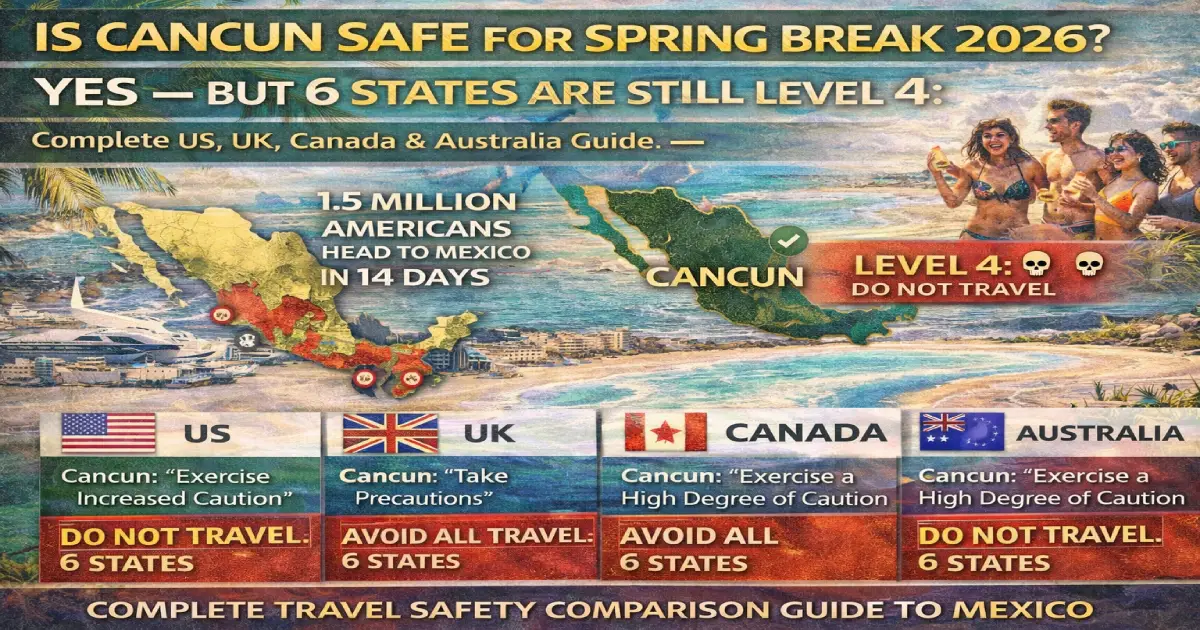
Published: March 3, 2026 Spring Break Starts: ~March 14–17, 2026 — 14 days away US Travelers to Mexico (Spring Break): 1.5 million forecast National Advisory: Level 2 — Exercise Increased Caution (unchanged) Cancún / Quintana Roo: ✅ Level 2 — FULLY CLEAR — normal operations Los Cabos / Baja California Sur: ✅ Level 2 — FULLY CLEAR — 70,000 students arriving this week Puerto Vallarta / Jalisco: ✅ RECOVERED — Level 3 (Reconsider Travel) — flights restored, nighttime curfew for US govt staff only Guadalajara / Jalisco: ✅ RECOVERED — Level 3 — 95% operations Tulum / Playa del Carmen: ✅ Level 2 — operating normally — exercise caution after dark Level 4 — DO NOT TRAVEL states: Guerrero, Sinaloa, Tamaulipas, Michoacán, Zacatecas, Colima US Embassy Spring Break Advisory: Issued TODAY, March 3, 2026 El Mencho Crisis: Over — shelter-in-place fully lifted February 24 Cruise Lines: Norwegian Bliss, Royal Princess, Holland America — PVR calls cancelled; Carnival Panorama March 3 PVR call — UNDER REVIEW; Royal Caribbean March 13 PVR call — UNDER REVIEW CDC Health Notice: Level 1 — Practice Usual Precautions
The answer is yes — but read the fine print. The US Embassy just issued its annual Spring Break advisory for Mexico this morning, March 3, confirming that Cancún, Tulum, Playa del Carmen, Cabo San Lucas, and Puerto Vallarta are all operational and receiving tourists. The chaos from the El Mencho killing on February 22 — which triggered shelter-in-place orders across 14 Mexican states and briefly halted flights at Puerto Vallarta and Guadalajara — is over. That crisis lasted 48 hours for Cancún and 72 hours for Puerto Vallarta. Today, 14 days before the first wave of Spring Breakers arrive, here is the verified, state-by-state picture of exactly where it is safe to go, where you should reconsider, and which six states remain at “Do Not Travel” level — regardless of El Mencho.
“Is Cancún safe after El Mencho?”
Yes. The US Embassy confirmed the situation returned to normal in Quintana Roo — including Cancún, Cozumel, Playa del Carmen, and Tulum — as early as February 23, a full day before the broader shelter-in-place was lifted everywhere else. Cancún International Airport has remained open and operating throughout, with the US Embassy having lifted the temporary shelter-in-place advisory that briefly included Quintana Roo.
“Is Mexico safe after El Mencho?”
It depends entirely on which state you are visiting. Cancún sits on the Caribbean side of Mexico, more than 1,100 miles from Puerto Vallarta — roughly comparable to the distance between Los Angeles and Chicago. The unrest was a Jalisco event. Six states that have nothing to do with El Mencho remain at Level 4 — Do Not Travel — and have been there since 2018. If you are going to Cancún, Cabo, or Playa del Carmen, you are not going to those states. Here is the full picture.
Quintana Roo (Cancún, Playa del Carmen, Tulum, Cozumel, Riviera Maya) The heart of Mexico’s Caribbean spring break scene. Notable tourist hubs like Cancun and Riviera Maya on the Yucatan Peninsula have generally seen fewer incidents, but the US government warns that violence can still spill over into these areas, particularly at night or in less populated spots. Bottom line: Go. Exercise standard caution after dark in downtown areas outside the Hotel Zone.
Baja California Sur (Los Cabos — Cabo San Lucas + San José del Cabo) The violence this weekend was a Jalisco and Pacific mainland event. Baja California Sur, where Cabo is located, saw none of it. As of Monday morning, February 23, Los Cabos International Airport is operating normally with no cancellations or disruptions. There are no shelter-in-place orders, no road blockades reported anywhere in Baja California Sur. Real-time traveler sentiment: based on over 1,000 recent, verified reports from travelers in the region, San José del Cabo is currently holding a safety score of 92, and Cabo San Lucas is sitting at a 91 — ranking Los Cabos among the safest destinations in the world for Americans right now. Bottom line: Go. 70,000 students arrive this week. Massive security deployment in place.
Mexico City (CDMX) Capital city. Level 2. Standard urban precautions apply — stick to Polanco, Roma, Condesa, and Centro Histórico tourist zones. Avoid less-touristed neighbourhoods at night. Bottom line: Safe for tourism with standard urban awareness.
Yucatán (Mérida, Chichén Itzá) Level 2. One of Mexico’s consistently safest states. Colonial city of Mérida, Chichén Itzá ruins. No cartel presence. Heavily touristed Mayan heritage zone. Bottom line: Go without hesitation.
Oaxaca (Oaxaca City, Puerto Escondido) Level 2. One of Mexico’s most visited cultural destinations. Oaxacan food scene, Monte Albán ruins, Pacific coast surf. No specific spring break mass-market profile but safe for independent travelers. Bottom line: Safe.
Baja California Norte (Tijuana, Ensenada, Mexicali) Level 2 state overall, but pay attention to surroundings after dark in downtown areas. Tijuana is a popular day-trip and nightlife destination from San Diego. The shelter-in-place was briefly applied to Tijuana during the El Mencho crisis and then lifted within 24 hours. Operations are fully normal now. Bottom line: Day trips and established tourist zones only. Avoid overnight stays in non-tourist areas.
Jalisco (Puerto Vallarta, Guadalajara, Riviera Nayarit) This is the epicentre of the February 22 El Mencho crisis. The good news: Puerto Vallarta International Airport was temporarily closed at the height of the disruption, but tourism officials say it currently remains open with “progressive recovery of connectivity.” Hotels, beaches, restaurants, the cruise port and the historic downtown area are all reporting safe conditions. Guadalajara reached 95% operations by February 24. Both Puerto Vallarta and Riviera Nayarit have restored order, with all major tourism destinations now operating as usual.
Remaining restriction: US government employees in Puerto Vallarta and Guadalajara are under a nighttime curfew. This does NOT apply to private US citizens.
Cruise situation: Norwegian Bliss, Royal Princess, and Holland America Zuiderdam have cancelled their Puerto Vallarta calls for this week. Carnival and Royal Caribbean are still reviewing March 3 and March 13 calls respectively.
Bottom line: Flights operating, resorts open, but this is the destination that was directly affected 9 days ago. If you have flexibility, monitor through March 7. If you are already booked with non-refundable reservations, PVR is functioning.
Sonora (Rocky Point/Puerto Peñasco) Level 3. Popular weekend beach destination for Arizonans. Road travel from the US border through Sonora requires caution due to cartel activity on certain routes. Air travel to Puerto Peñasco is safer than driving. Bottom line: Reconsider driving; flying is safer.
Chiapas, San Luis Potosí, Guanajuato All Level 3. Not typical spring break destinations. If you are travelling through these states on a road trip or connecting bus, exercise elevated caution.
These six states are at maximum warning and have been for years. None are spring break destinations, but Americans sometimes transit through them or travel to border cities. Do not do so.
| State | Key Concern | Popular Misconceptions |
|---|---|---|
| Guerrero | Acapulco — once a resort city, now cartel-controlled | Acapulco is NOT safe. Do not go. |
| Sinaloa | Culiacán — spiritual home of the Sinaloa Cartel (El Chapo’s former territory) | No tourist reason to visit |
| Tamaulipas | Matamoros, Reynosa — border cities. Kidnapping extremely high | Even crossing from Texas is high risk |
| Michoacán | Cartel turf wars, road ambushes common | Avoid all road travel, including Monarch butterfly reserves |
| Zacatecas | Extreme cartel violence — one of Mexico’s most dangerous states | No spring break relevance |
| Colima | Highest per-capita homicide rate in Mexico | No spring break relevance |
Critical note for Sinaloa: the US Embassy noted normalcy is returning to Quintana Roo, Sinaloa, and Tamaulipas after the El Mencho crisis — but these states still carry their Level 4 permanent designation. “Normalcy returning” in this context means the El Mencho-specific spike has passed — it does not mean Level 4 risks have changed. The permanent advisory remains in force.
Cancún is where the majority of the 1.5 million spring break travelers are headed. Here is the complete, verified situation today:
CUN Airport: ✅ Fully operational. Airport officials have confirmed that Cancún International Airport remains operational, with no reported closures. 9.7 million international visitors arrived in Cancún in 2024 — making it the most visited international destination for Americans after the Dominican Republic.
Hotel Zone (Zona Hotelera): ✅ Open. All major resort chains operating normally. Beaches open. Security presence increased as a precaution.
Downtown Cancún (El Centro): ⚠️ Exercise caution at night. US citizens should exercise caution in the downtown areas of Cancún, Playa del Carmen, and Tulum, especially after dark. The El Centro area is where the vast majority of crime incidents involving tourists occur. Stay in the Hotel Zone at night.
The geography context: Cancún’s Level 2 advisory is not new — Mexico has been at Level 2 overall for some time, even before the recent events in Jalisco. The state of Quintana Roo holds a Level 2 advisory tied to a risk of violence. That designation is not new. Spring Breakers coming to Cancún this year face the same advisory level as every year for the past several years.
“Guest Assist” App: Download the “Guest Assist” application for emergency services and assistance in Cancún, Playa del Carmen, Tulum, Cozumel, or other areas in the state of Quintana Roo. This is the US Embassy’s officially recommended emergency app for the region — download it before you land.
Cabo San Lucas is the second most popular spring break destination after Cancún. Los Cabos is bracing for the arrival of approximately 70,000 college students over the next five weeks as the 2026 Spring Break season officially kicks off.
What’s different about Cabo in 2026: Los Cabos has successfully transitioned into the undisputed luxury capital of Latin America. The region is now dominated by ultra-premium resorts, Michelin-caliber dining, world-class golf courses, and exclusive wellness retreats. Local authorities have deployed a massive security bubble this year including a significant increase in law enforcement personnel, K9 units, and enhanced surveillance across the major tourist zones.
Zero tolerance policy: The message from local authorities is crystal clear — there is a strict zero-tolerance policy for rowdy, disruptive behaviour this year. This means:
Drug warning for Cabo: Medical and recreational cannabis, along with all other narcotics, are strictly illegal in Mexico. K9 units are actively patrolling. The consequences are severe, and being a tourist will not protect you from arrest.
SJD Airport: ✅ Operating normally. No disruptions at any point during the El Mencho crisis.
Puerto Vallarta is the destination that lived through the worst of the El Mencho aftermath. Today it is recovered — but it needs one more week of monitoring before it gets a clean bill of health.
Current status:
What to watch: Cruise line decisions on March 13 Royal Caribbean call. If Royal Caribbean’s Navigator of the Seas restores its PVR port call, that is a clear signal from a major industry player that PVR is fully normalized.
The nighttime curfew: US government employees in PVR, Guadalajara, and Ciudad Guzmán are still under nighttime movement restrictions. This nighttime curfew for US government staff does NOT apply to private citizens. Private travelers can move freely at any hour — but exercise the same caution you would in any Mexican city after dark.
For travelers with PVR bookings starting March 10+: The situation is highly likely to be fully normalized by then. If your departure date is still weeks away, experts often suggest giving situations a few days to settle before making big cancellation decisions. Historically, tourism to Cancún has rebounded quickly after isolated events elsewhere in Mexico.
The US Embassy’s official Spring Break advisory, published today, sets out these specific warnings for all Mexico spring break destinations. Every point below is confirmed from the official embassy advisory:
Drug possession and use, including of medical marijuana, is illegal in Mexico and may result in a lengthy jail sentence. US citizens have died or suffered severe illness after using synthetic drugs or fake prescription pills. This is not a theoretical warning — multiple Americans have died from counterfeit pills sold in tourist areas in recent years.
Unregulated alcohol may be contaminated, and US citizens have reported losing consciousness or becoming injured after consuming tainted alcohol. How to protect yourself: ✅ Drink only at established resort bars and restaurants ✅ Watch your drink being poured — do not accept pre-poured drinks ✅ Stick to name-brand spirits you recognise ✅ If you feel unusual symptoms after drinking — seek medical attention immediately ✅ Report unregulated or contaminated alcohol to COFEPRIS at cofepris.gob.mx or by calling +52 01-800-033-5050.
Counterfeit medication is common and may be ineffective or dangerous. Buy medication from reputable places and consult a medical professional. Do not buy prescription medications from street vendors or unofficial pharmacies, regardless of price.
Avoid strong currents and do not swim after drinking or when warning flags indicate unsafe conditions. Mexico’s beach flag system: Green = safe, Yellow = caution, Red = dangerous, Black = beach closed. Drowning is one of the leading causes of US tourist deaths in Mexico — not crime.
Always use authorised, official taxis booked through your hotel or the official airport taxi desks. Use Uber where available. Do not hail taxis from the street or accept rides from strangers.
Monitor your credit or debit card accounts for unauthorized transactions. Limit the amount of cash you carry, be cautious when withdrawing funds from an ATM, and avoid isolated ATMs. Use ATMs inside bank branches or major hotels — not standalone machines on streets or in convenience stores.
US citizens have been victims of rape and sexual assault. Travel in groups at night. The “never leave a friend behind” rule is not social — it is a safety protocol.
The CDC maintains a Level 1 — Practice Usual Precautions travel health notice for Mexico. But Level 1 does not mean zero health risk for spring break destinations.
Dengue fever: As of early 2026, Mexico has seen low dengue activity, with 185 confirmed cases and 1,972 probable cases reported in the first two weeks alone — an 83% decrease compared to the same period in 2025, but experts warn of potential seasonal increases as the year progresses. Dengue is transmitted by mosquitoes — use DEET repellent, especially at dawn and dusk.
Zika virus: Zika virus activity in Mexico has declined sharply since the 2015–2016 epidemic, with only four confirmed cases in 2025. However, Zika poses particular risks to pregnant women due to potential birth defects — pregnant travellers should reconsider visiting Quintana Roo.
Chikungunya: Low transmission in 2025. Quintana Roo (Cancún) is one of the states where occasional cases are documented. Same mosquito prevention precautions apply.
Vaccines recommended: The CDC strongly recommends consulting a travel vaccine provider at least one month before departure to ensure routine and travel vaccinations are up to date. Travel clinics offer keen insights into today’s health risks. Recommended vaccines for Mexico include Hepatitis A, Typhoid, and ensuring routine vaccinations (MMR, Tdap, flu) are current.
Water: Do not drink tap water anywhere in Mexico. Bottled water only. Major all-inclusive resorts provide filtered water and ice — but exercise caution at smaller establishments.
Both destinations are in Quintana Roo (Level 2) and were fully cleared of the El Mencho shelter-in-place by February 23.
Tulum specific note: Tulum’s rapid expansion has clearly impacted the on-the-ground experience. Backed by 21 recent reports, the destination has dropped to a 76/100 on the traveller safety index and currently holds an elevated risk status. While the bohemian aesthetic remains a massive draw, the tourist experience here is currently less insulated and more volatile than the highly controlled environments of Cabo or Cancún. Travellers heading to Tulum this Spring Break need to exercise a higher degree of situational awareness.
Tulum also has a known issue with vehicle roadblocks and occasional tourist-targeting incidents in the downtown area after dark. The Tulum Hotel Zone (beach strip south of town) is safer than downtown. Book accommodations on the beach strip, not in the town.
Playa del Carmen: Generally safe in the tourist zone (5th Avenue / Quinta Avenida strip). Avoid the areas east of Calle 20 at night. Use the same downtown caution as Cancún.
1. Is your passport valid for at least 6 months after your return date? You cannot board an international plane without a passport. Carry your passport and make sure it hasn’t expired. Mexico technically requires only that your passport be valid for your travel dates, but airlines may deny boarding if your passport expires within 6 months.
2. Are you enrolled in STEP? Enroll in the State Department’s Smart Traveler Enrollment Program to receive safety updates and to help the US Embassy contact you in an emergency. It’s free, takes 5 minutes, and is the single most important safety step you can take. Register at step.state.gov.
3. Do you have travel insurance with medical evacuation coverage? Your US health insurance almost certainly does not cover you in Mexico. Medical evacuation from Cancún to the US can cost $50,000–$100,000 without insurance. Buy travel insurance that explicitly includes emergency medical evacuation. For Cancún specifically, download the “Guest Assist” app in the App Store or Google Play before you fly.
4. Does your credit card have trip cancellation and trip interruption coverage? The El Mencho crisis proved that Mexico travel can be disrupted by unexpected events. Chase Sapphire Reserve, Amex Platinum, and Capital One Venture X all include trip cancellation/interruption coverage. Know your card benefits before you go.
5. Do you have the US Embassy emergency number saved in your phone? 📞 US Embassy Mexico City 24/7 emergency line: +1-202-501-4444 (from abroad) or +1-888-407-4747 (from the US or Canada) 📞 US Consular Agency Cancún: Blvd. Kukulcán Km 13, Torre La Europea
UK Travelers: The FCDO advises travellers to exercise a high degree of caution throughout Mexico. Quintana Roo, Baja California Sur, and Yucatán are not under specific warnings beyond the national advisory. Guerrero, Sinaloa, Tamaulipas are advised against non-essential travel or all travel. Check: gov.uk/foreign-travel-advice/mexico
Canadian Travelers: Global Affairs Canada advises exercising a high degree of caution in Mexico overall, with “avoid non-essential travel” warnings for Colima, Guerrero, Michoacán, Sinaloa, and Tamaulipas, and specific areas of other states. Cancún and Quintana Roo, Cabo, and Puerto Vallarta are under the standard “high degree of caution” — not the elevated warnings. Check: travel.gc.ca/destinations/mexico
Australian Travelers: Smartraveller advises “exercise a high degree of caution in Mexico overall.” State-specific warnings for Sinaloa, Tamaulipas, Guerrero, Michoacán, and Zacatecas advise against travel. Cancún, Cabo, and Puerto Vallarta are covered by the general advisory, not the elevated warnings. Check: smartraveller.gov.au/destinations/americas/mexico
If you are going to Cancún, Playa del Carmen, Tulum, Cozumel, or anywhere in Quintana Roo: Go. The El Mencho crisis was resolved for this region on February 23. Historically, tourism to Cancún has rebounded quickly after isolated events elsewhere in Mexico, largely because the region is heavily dependent on international visitors and maintains strong security around tourist infrastructure. The advisory is Level 2 — the same level as France, Italy, and the UK. Follow the Embassy’s precautions (no drugs, watch your drink, official taxis, STEP registration) and you are making an informed, sensible travel decision.
If you are going to Los Cabos: Go. Cabo was never affected by El Mencho. The security deployment for Spring Break 2026 is the most comprehensive in the destination’s history. 70,000 students arrive this week and the operation is already running smoothly.
If you are going to Puerto Vallarta: Go — with one caveat. PVR is recovered and operating, but it was the epicentre of the February 22 crisis nine days ago. Watch the cruise line decisions on the March 13 Royal Caribbean call. If you are arriving March 14+, the destination should be fully normalized. Keep travel insurance active.
If you were planning any travel to Guerrero, Sinaloa, Tamaulipas, Michoacán, Zacatecas, or Colima: Do not travel. These Level 4 warnings predate El Mencho by years and have nothing to do with the February 22 crisis. They reflect persistent, structural cartel violence that has not improved.
Spring Break 2026 in Mexico: know your destination, follow the rules, and travel smart.
| Resource | Contact |
|---|---|
| US Embassy emergency (from abroad) | +1-202-501-4444 |
| US Embassy emergency (from US/Canada) | +1-888-407-4747 |
| Mexico emergency services | 911 |
| Cancún / Quintana Roo emergency app | “Guest Assist” (App Store / Google Play) |
| Contaminated alcohol report (COFEPRIS) | +52 01-800-033-5050 |
| US Embassy Mexico City | mx.usembassy.gov |
| STEP enrollment (free) | step.state.gov |
| State Dept Mexico advisory | travel.state.gov/mexico |
| CDC Mexico health notice | wwwnc.cdc.gov/travel/destinations/mexico |
| UK FCDO Mexico advice | gov.uk/foreign-travel-advice/mexico |
| Canada Global Affairs Mexico | travel.gc.ca/destinations/mexico |
| Australia Smartraveller Mexico | smartraveller.gov.au/destinations/americas/mexico |
Posted By : Vinay
This article is provided for general informational purposes only and is based on information available at the time of publication. Travel advisories, airline schedules, airport operations, visa requirements, government regulations, and other travel-related information are subject to change without prior notice. While Travel Tourister makes reasonable efforts to verify information using official announcements, government publications, airline and airport communications, and other reliable sources, we cannot guarantee that all information remains complete, accurate, or up to date at all times. Readers should independently verify any information that may affect their travel plans with the relevant airline, airport authority, government agency, embassy, or other official source before making travel, financial, or other decisions. Travel Tourister shall not be liable for any direct or indirect loss, inconvenience, or damages arising from the use of or reliance on the information contained in this article. Nothing in this publication constitutes legal, immigration, financial, or professional travel advice. If you believe any information in this article is inaccurate or outdated, please contact our editorial team. We review all credible correction requests promptly and update our content whenever appropriate.
Lastest News
2nd Floor, 39, Above Kirti Club, DLF Industrial Area, Kirti Nagar, New Delhi, Delhi 110015



Travel Tourister is a leading Travel portal where we introduce travellers to trusted travel agents to make their journey hasselfree, memorable And happy. Travel Tourister is a platform where travellers get Tour packages ,Hotel packages deals through trusted travel companies And hoteliers who are working with us across the world. We always try to find new and more travel agents and hoteliers from every nook and corners across the world so that you could compare the deals with different travel agents and hoteliers and book your tour or hotel with the one you have chosen according to your taste and budget.
Copyright © Travel Tourister, India. All Rights Reserved

 Call
Call Enquiry